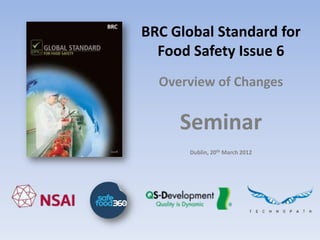
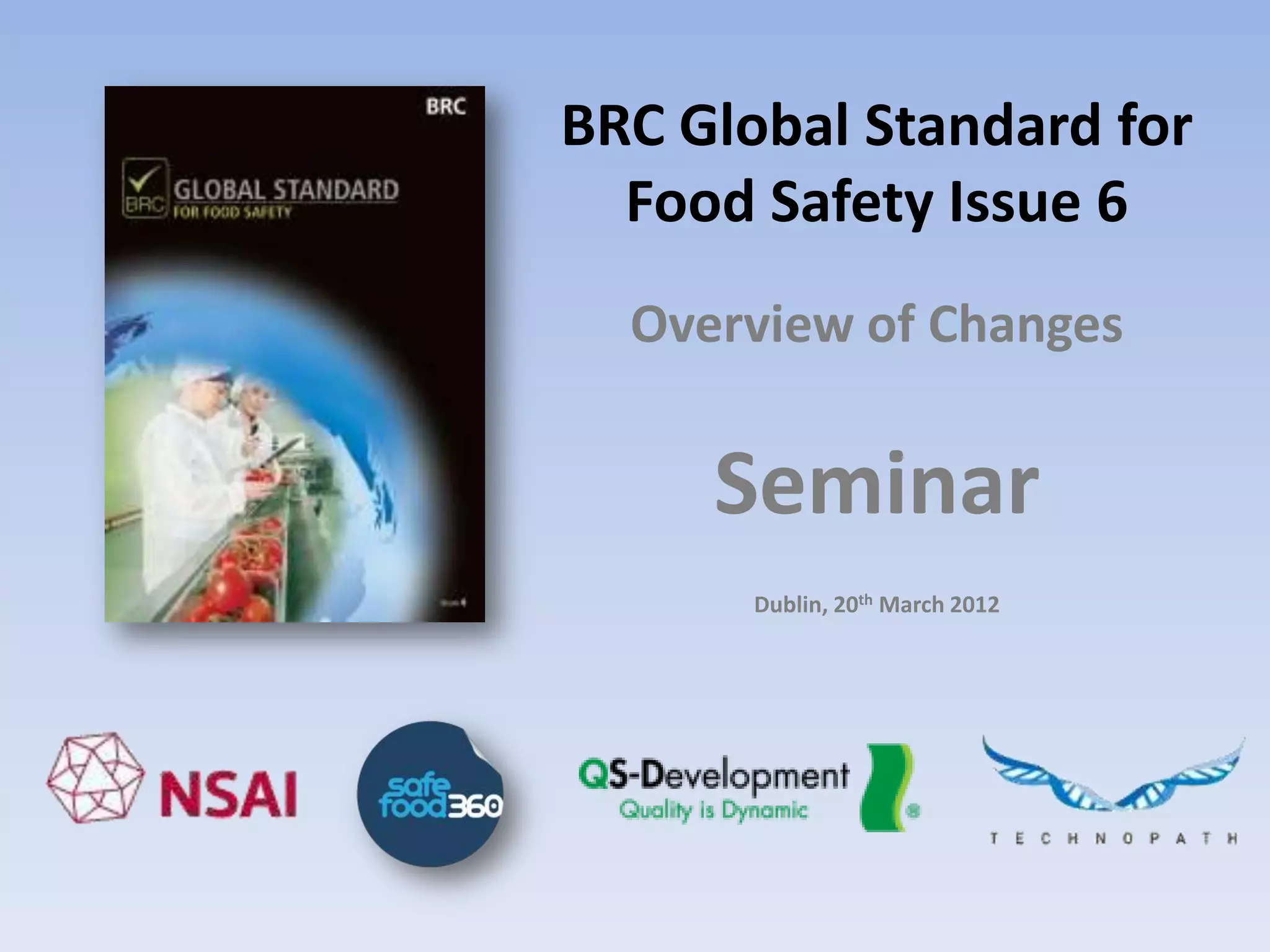
BRC Global Standard for
  Food Safety Issue 6
  Overview of Changes


     Seminar
       Dublin, 20th March 2012
BRC Global Standard for
Food Safety Issue 6
Overview of Changes
Summary
George Howlett


                 safefood360.com
Agenda


 •   Overview of the BRC Issue 6
 •   Reasons for change
 •   Changes in the requirements
 •   How to get started on changes
 •   New audit focus & what to expect
 •   Audit options
 •   Questions and answers session
 •   Networking


                                        safefood360.com
Change


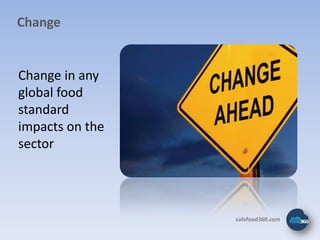
Change in any
global food
standard
impacts on the
sector


                 safefood360.com
Management of Impacts

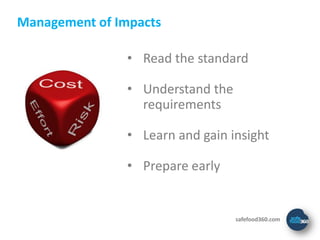
                • Read the standard

                • Understand the
                  requirements

                • Learn and gain insight

                • Prepare early


                                   safefood360.com
Who are the BRC?

• British Retail Consortium
• Trade association representing British
  retailers
• Maintain clear policies on food safety


                                     safefood360.com
What are the BRC Global Standards?
• Global safety and quality
  certification programme
• 17,000 certificated suppliers
  in 90 countries
• Facilitate standardisation
• Standards cover food,
  consumer products,
  packaging, storage &
  distribution
• Provide protection to the
  consumer

                                     safefood360.com
Global Standard for Food


                  • First published in 1998
                  • Revised every 3-4 years
                  • Initially developed to meet
                    legal requirements
                  • Developed into best practice


                                     safefood360.com
Why Change the Global Standard for Food?
Global Food Safety Initiative - GFSI


Consumer Goods Forum

GFSI Guidance Document

Sixth Edition


                                       safefood360.com
Why Change the Global Standard for Food?
Feedback
 • Produce a standard that truly reduces duplicate
   audits
 • Improve the balance between time spent in the
   office and time in the factory
 • Review the audit report to ensure it adds value - not
   cost
 • Improve the consistency between auditors
 • Provide a way to recognise sites in development


                                           safefood360.com
Core Principles of BRC Standard


 • Drive improvements in food safety
 • Enable manufactures meet the demands of their
   customers – reduce multiple audits
 • Facilitate improvements and efficiencies
 • Provide part of the due diligence defence for both
   customers and the certified site


                                          safefood360.com
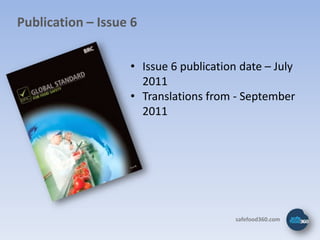
Publication – Issue 6


                   • Issue 6 publication date – July
                     2011
                   • Translations from - September
                     2011


                                        safefood360.com
New for Issue 6


 •   Re-focus of the audit process
 •   Introduction of more choice of audits
 •   Facilitate voluntary unannounced audits
 •   Enrolment scheme
 •   Extensive change and evolution of requirements
 •   Encourage adoption of food safety


                                          safefood360.com
Changing the audit


 • Moving to challenging not auditing
 • Time spent in the factory not the office
 • Additional time…
    ― for interviews with staff
    ― observing line start and change procedures
    ― reviewing procedures in the production area


                                        safefood360.com
Increasing the Audit Choice

 • Announced
 • Introduction of voluntary unannounced audits
 • Provide those who are long time certified with more
   of a challenge
 • Two unannounced programmes
 • One part (Fully unannounced)
 • Two parts (The announced portion focused on
   systems review and the unannounced on
   inspection)


                                         safefood360.com
Enrolment Scheme


 • Provide an entry point for sites developing food
   safety systems
 • Allow all sites to be on the same road
 • Designed particularly for developing nations
 • Clear differentiation between enrolled and certified
   sites


                                          safefood360.com
The Requirements

 • Key changes to the requirements – Evolution not
   Revolution
 • Statements of Intent reworded and auditable
 • Clauses have been modified, moved or collated
   together
 • Each clause has the same weight or value
 • ‘Procedure’ means it must be documented
 • ‘Minimum’ means the minimally accepted internal
   based on risk assessment
 • Risk assessments must be documented
 • Added detail on food safety issues to increase clarity
   and consistency

                                              safefood360.com
Main Changes to Requirements


 • Extended requirements in key areas
    ― supplier and raw materials controls
    ― foreign body control
    ― housekeeping and hygiene
    ― allergen management
    ― provenance / assurance claims


                                            safefood360.com
Other Protocol

 •   A+ is the highest grade
 •   Available only for unannounced audits
 •   Corrective actions addressed within 28 days
 •   Root cause analysis, timelines and review
 •   Product recalls must be notified to CB within 3 days
 •   CB’s will investigate reasons for recall
 •   Audit to be conduct on or before due date
 •   Traded goods no longer allowed in the scope
 •   Audit grades A+, A, B+, B, C+, C, No Grade


                                            safefood360.com
Senior Management Commitment and
Continual Improvement (Section 1)
Review of Objectives
   ― monitored and reported at least quarterly
   ― include food safety and quality objectives
   ― clear targets or measures of success

Management Review Records
  ― good information inputs
  ― output actions
  ― actions monitored and completed

                                         safefood360.com
Senior Management Commitment and
Continual Improvement (Section 1)
Deputies
  ― defined deputies when key managers absent
  ― document arrangements
  ― holiday periods
  ― key issue for unannounced audits


                                      safefood360.com
Quality Management Systems (Section 3)


 •   GMP audits required
 •   Based on RA – minimum monthly
 •   Supplier / material risk assessment
 •   Outsourced products to be audited
 •   Specifications to be reviewed – minimum 3 years
 •   Traceability to account for full mass balance


                                          safefood360.com
HACCP (Section 2)


 •   PRP’s now collected in one place
 •   Must be included as part of HACCP review
 •   New machinery introduction trigger HACCP review
 •   HACCP validation to be based on objective evidence


                                          safefood360.com
Site Standards (Section 4)
Plans

 • Factory Plan to define production zones
    ― Enclosed product area
    ― Low risk areas
    ― High care area
    ― High risk area
 • Process and personnel flows
 • Water storage and distribution


                                         safefood360.com
Site Standards (Section 4)
Cleaning and Hygiene

 • Defined and validated levels of cleaning performance
 • Hygiene and fabrication audits included within
   internal audits
 • Assessment of line change over cleaning
 • Specific requirements for cleaning in place (CIP)


                                         safefood360.com
Site Standards (Section 4)
Storage and Transport

 • Separation of storage from transport
 • Inclusion of local company owned storage facilities
 • Transport requirements aligned with Storage and
   Distribution Standard
 • Vehicle inspection
 • Stabilisation of load


                                          safefood360.com
Product Control (Section 5)
New Product Development

 • Applicable in all cases
 • HACCP study must be conducted
 • HACCP team must approve prior to production


                                       safefood360.com
Product Control (Section 5)
Management of Allergens

 • Requirements extended to address the issues
   identified through product recalls
    ― More specific guidance on measures to avoid
       cross contamination
    ― Line start up and product change-over checks
    ― Allergen awareness training for staff
    ― Increase consideration of allergen risks in new
       product development


                                          safefood360.com
Product Control (Section 5)
Provenance and Claims

 •   Provenance
 •   Assured status
 •   Identity preserved
 •   Procedures to prevent misleading claims
 •   Mass balance checks


                                           safefood360.com
Process Control (Section 6)

• Classification of site into production zones based on
  risk
   ― Enclosed product areas
   ― Low risk areas
   ― High care areas
   ― High risk areas


                                           safefood360.com
Personnel (Section 7)


 • Evidence of competency for CCP activities
 • Ear rings not permitted
 • Hand washing mandatory
 • Control of personal medicines
 • Medical screening mandatory
 • High risk / high care laundering services to be
   audited
 • RA of non laundered items e.g. aprons, gloves and
   chain mail

                                         safefood360.com
BRC Global Standard for
  Food Safety Issue 6


    Thank You

Presentation - G Howlett - BRC Issue 6 Seminar

  • 1.
    BRC Global Standardfor Food Safety Issue 6 Overview of Changes Seminar Dublin, 20th March 2012
  • 2.
    BRC Global Standardfor Food Safety Issue 6 Overview of Changes Summary George Howlett safefood360.com
  • 3.
    Agenda • Overview of the BRC Issue 6 • Reasons for change • Changes in the requirements • How to get started on changes • New audit focus & what to expect • Audit options • Questions and answers session • Networking safefood360.com
  • 4.
    Change Change in any globalfood standard impacts on the sector safefood360.com
  • 5.
    Management of Impacts • Read the standard • Understand the requirements • Learn and gain insight • Prepare early safefood360.com
  • 6.
    Who are theBRC? • British Retail Consortium • Trade association representing British retailers • Maintain clear policies on food safety safefood360.com
  • 7.
    What are theBRC Global Standards? • Global safety and quality certification programme • 17,000 certificated suppliers in 90 countries • Facilitate standardisation • Standards cover food, consumer products, packaging, storage & distribution • Provide protection to the consumer safefood360.com
  • 8.
    Global Standard forFood • First published in 1998 • Revised every 3-4 years • Initially developed to meet legal requirements • Developed into best practice safefood360.com
  • 9.
    Why Change theGlobal Standard for Food? Global Food Safety Initiative - GFSI Consumer Goods Forum GFSI Guidance Document Sixth Edition safefood360.com
  • 10.
    Why Change theGlobal Standard for Food? Feedback • Produce a standard that truly reduces duplicate audits • Improve the balance between time spent in the office and time in the factory • Review the audit report to ensure it adds value - not cost • Improve the consistency between auditors • Provide a way to recognise sites in development safefood360.com
  • 11.
    Core Principles ofBRC Standard • Drive improvements in food safety • Enable manufactures meet the demands of their customers – reduce multiple audits • Facilitate improvements and efficiencies • Provide part of the due diligence defence for both customers and the certified site safefood360.com
  • 12.
    Publication – Issue6 • Issue 6 publication date – July 2011 • Translations from - September 2011 safefood360.com
  • 13.
    New for Issue6 • Re-focus of the audit process • Introduction of more choice of audits • Facilitate voluntary unannounced audits • Enrolment scheme • Extensive change and evolution of requirements • Encourage adoption of food safety safefood360.com
  • 14.
    Changing the audit • Moving to challenging not auditing • Time spent in the factory not the office • Additional time… ― for interviews with staff ― observing line start and change procedures ― reviewing procedures in the production area safefood360.com
  • 15.
    Increasing the AuditChoice • Announced • Introduction of voluntary unannounced audits • Provide those who are long time certified with more of a challenge • Two unannounced programmes • One part (Fully unannounced) • Two parts (The announced portion focused on systems review and the unannounced on inspection) safefood360.com
  • 16.
    Enrolment Scheme •Provide an entry point for sites developing food safety systems • Allow all sites to be on the same road • Designed particularly for developing nations • Clear differentiation between enrolled and certified sites safefood360.com
  • 17.
    The Requirements •Key changes to the requirements – Evolution not Revolution • Statements of Intent reworded and auditable • Clauses have been modified, moved or collated together • Each clause has the same weight or value • ‘Procedure’ means it must be documented • ‘Minimum’ means the minimally accepted internal based on risk assessment • Risk assessments must be documented • Added detail on food safety issues to increase clarity and consistency safefood360.com
  • 18.
    Main Changes toRequirements • Extended requirements in key areas ― supplier and raw materials controls ― foreign body control ― housekeeping and hygiene ― allergen management ― provenance / assurance claims safefood360.com
  • 19.
    Other Protocol • A+ is the highest grade • Available only for unannounced audits • Corrective actions addressed within 28 days • Root cause analysis, timelines and review • Product recalls must be notified to CB within 3 days • CB’s will investigate reasons for recall • Audit to be conduct on or before due date • Traded goods no longer allowed in the scope • Audit grades A+, A, B+, B, C+, C, No Grade safefood360.com
  • 20.
    Senior Management Commitmentand Continual Improvement (Section 1) Review of Objectives ― monitored and reported at least quarterly ― include food safety and quality objectives ― clear targets or measures of success Management Review Records ― good information inputs ― output actions ― actions monitored and completed safefood360.com
  • 21.
    Senior Management Commitmentand Continual Improvement (Section 1) Deputies ― defined deputies when key managers absent ― document arrangements ― holiday periods ― key issue for unannounced audits safefood360.com
  • 22.
    Quality Management Systems(Section 3) • GMP audits required • Based on RA – minimum monthly • Supplier / material risk assessment • Outsourced products to be audited • Specifications to be reviewed – minimum 3 years • Traceability to account for full mass balance safefood360.com
  • 23.
    HACCP (Section 2) • PRP’s now collected in one place • Must be included as part of HACCP review • New machinery introduction trigger HACCP review • HACCP validation to be based on objective evidence safefood360.com
  • 24.
    Site Standards (Section4) Plans • Factory Plan to define production zones ― Enclosed product area ― Low risk areas ― High care area ― High risk area • Process and personnel flows • Water storage and distribution safefood360.com
  • 25.
    Site Standards (Section4) Cleaning and Hygiene • Defined and validated levels of cleaning performance • Hygiene and fabrication audits included within internal audits • Assessment of line change over cleaning • Specific requirements for cleaning in place (CIP) safefood360.com
  • 26.
    Site Standards (Section4) Storage and Transport • Separation of storage from transport • Inclusion of local company owned storage facilities • Transport requirements aligned with Storage and Distribution Standard • Vehicle inspection • Stabilisation of load safefood360.com
  • 27.
    Product Control (Section5) New Product Development • Applicable in all cases • HACCP study must be conducted • HACCP team must approve prior to production safefood360.com
  • 28.
    Product Control (Section5) Management of Allergens • Requirements extended to address the issues identified through product recalls ― More specific guidance on measures to avoid cross contamination ― Line start up and product change-over checks ― Allergen awareness training for staff ― Increase consideration of allergen risks in new product development safefood360.com
  • 29.
    Product Control (Section5) Provenance and Claims • Provenance • Assured status • Identity preserved • Procedures to prevent misleading claims • Mass balance checks safefood360.com
  • 30.
    Process Control (Section6) • Classification of site into production zones based on risk ― Enclosed product areas ― Low risk areas ― High care areas ― High risk areas safefood360.com
  • 31.
    Personnel (Section 7) • Evidence of competency for CCP activities • Ear rings not permitted • Hand washing mandatory • Control of personal medicines • Medical screening mandatory • High risk / high care laundering services to be audited • RA of non laundered items e.g. aprons, gloves and chain mail safefood360.com
  • 32.
    BRC Global Standardfor Food Safety Issue 6 Thank You