Country Report BRAZIL
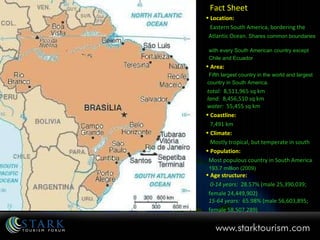
Fact Sheet Location:  Eastern South America, bordering the  Atlantic Ocean.  Shares common boundaries  with every South American country except  Chile and Ecuador   Area: Fifth largest country in the world and largest  country in South America.  total:   8,511,965 sq km   land:   8,456,510 sq km   water:   55,455 sq km Coastline:  7,491 km  Climate:  Mostly tropical, but temperate in south  Population: Most populous country in South America 193.7 million (2009) Age structure: 0-14 years:   28.57% (male 25,390,039;  female 24,449,902)   15-64 years:   65.98% (male 56,603,895;  female 58,507,289)
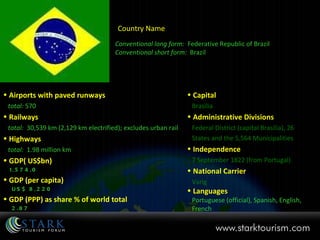
Airports with paved runways total:  570 Railways total:   30,539 km (2,129 km electrified); excludes urban rail Highways total:   1.98 million km GDP( US$bn) 1,574.0 GDP (per capita) US$ 8,220 GDP (PPP) as share % of world total 2.87 Conventional long form:   Federative Republic of Brazil Conventional short form:   Brazil Capital Brasilia  Administrative Divisions Federal District (capital Brasilia), 26  States and the 5,564 Municipalities Independence 7 September 1822 (from Portugal)  National Carrier  Varig Languages Portuguese (official), Spanish, English,  French Country Name
Travel and Tourism Competitiveness Index Ranked 5 th  in the Americas and 45 th  overall Ranked 2 nd  out of all countries for its natural resources and 14 th  for its cultural resources Ground transport remains underdeveloped with the quality of roads, ports and railroads ranked 110 th ,123 rd  and 86 th  respectively Safety and security (ranked 130 th ), overall policy environment (95 th ) and lack of price competitiveness (ranked 91 st ) are causes of concern  Source: The Travel & Tourism Competitiveness Report, 2009
Outbound Tourism - Determinants The future determinants of the frequency and volume of outbound travel are: The total population – or potential market size  Per Capita GDP  The degree of internet usage
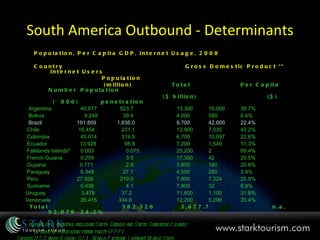
South America Outbound - Determinants Population, Per Capita GDP, Internet Usage, 2008  Country  Gross Domestic Product **   Internet Users   Population  (million)   Total  Per Capita  Number  Population  ($ billion)   ($)    (’000)  penetration  Argentina  40.677    523.7  13,300  16,000  39.7%  Bolivia    9.248    39.4  4,000  580  6.4%  Brazil    191.809    1,836.0  9,700  42,600  22.4%  Chile    16.454    231.1  13,900  7,035  43.2%  Colombia  45.014    319.5  6,700  10,097  22.8%  Ecuador    13.928    98.8  7,200  1,549  11.3%  Falklands Islands*  0.003    0.075  25,200  2  69.4%  French Guiana  0.209    3.5  17,300  42  20.5%  Guyana    0.771    2.9  3,800  160  20.8%  Paraguay  6.348    27.1  4,500  260  3.9%  Peru    27.926    219.0  7,800  7,324  25.5%  Suriname  0.438    4.1  7,800  32  6.8%  Uruguay    3.478    37.2  11,600  1,100  31.8%  Venezuela  26.415    334.6  12,200  5,298  20.4%    Total    382.326    3,677.7  n.a.  92,079  24.2%  *  claimed by Argentina, including South Georgia and South Sandwich Islands  ** in terms of purchasing power parity (PPP)  Sources: US Census Bureau, CIA World Factbook, Internet World Stats
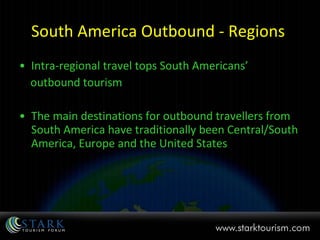
South America Outbound - Regions  Intra-regional travel tops South Americans’  outbound tourism The main destinations for outbound travellers from South America have traditionally been Central/South America, Europe and the United States
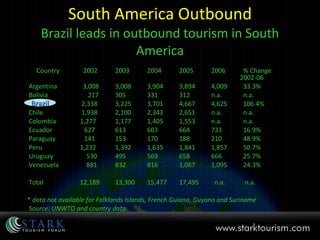
South America Outbound Brazil leads in outbound tourism in South America Country  2002  2003  2004  2005  2006  % Change    2002-06  Argentina  3,008  3,008  3,904  3,894  4,009  33.3%  Bolivia  217  305  331  312  n.a.  n.a.  Brazil  2,338  3,225  3,701  4,667  4,625  106.4% Chile  1,938  2,100  2,343  2,651  n.a.  n.a.  Colombia  1,277  1,177  1,405  1,553  n.a.  n.a.  Ecuador  627  613  603  664  733  16.9%  Paraguay  141  153  170  188  210  48.9%  Peru    1,232  1,392  1,635  1,841  1,857  50.7%  Uruguay    530  495  569  658  666  25.7%  Venezuela    881  832  816  1,067  1,095  24.3%  Total    12,189  13,300  15,477  17,495    n.a.   n.a.  *  data not available for Falklands Islands, French Guiana, Guyana and Suriname Source: UNWTO and country data Brazil
Population vs Economy Around 80% of Brazilians reside in urban centres. The south-east region is the richest and most densely populated and has the country's two largest cities, São Paulo and Rio de Janeiro, while the south is the wealthiest in terms of GDP per capita.
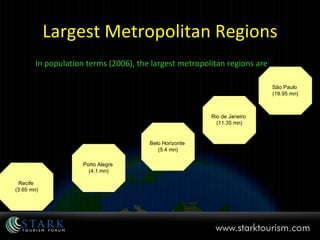
Largest Metropolitan Regions In population terms (2006), the largest metropolitan regions are  São Paulo  (19.95 mn) Recife  (3.65 mn) Rio de Janeiro  (11.35 mn) Porto Alegre  (4.1 mn) Belo Horizonte  (5.4 mn)
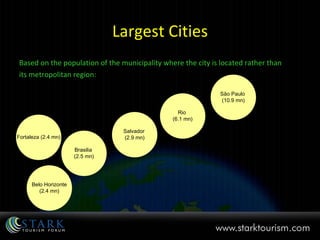
Largest Cities Based on the population of the municipality where the city is located rather than  its metropolitan region: Belo Horizonte (2.4 mn) Brasilia  (2.5 mn) Salvador  (2.9 mn) Rio  (6.1 mn) Fortaleza (2.4 mn) São Paulo  (10.9 mn)
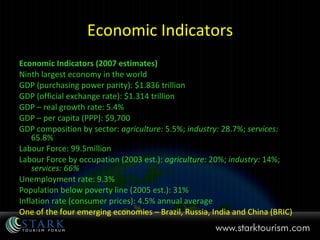
Economic Indicators Economic Indicators (2007 estimates) Ninth largest economy in the world GDP (purchasing power parity): $1.836 trillion GDP (official exchange rate): $1.314 trillion GDP – real growth rate: 5.4% GDP – per capita (PPP): $9,700 GDP composition by sector:  agriculture:  5.5%;  industry:  28.7%;  services:  65.8% Labour Force: 99.5million Labour Force by occupation (2003 est.):  agriculture:  20%;  industry:  14%;  services: 66% Unemployment rate: 9.3% Population below poverty line (2005 est.): 31% Inflation rate (consumer prices): 4.5% annual average One of the four emerging economies – Brazil, Russia, India and China (BRIC)
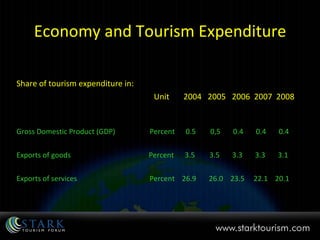
Economy and Tourism Expenditure Share of tourism expenditure in:  Unit  2004  2005  2006  2007  2008  Gross Domestic Product (GDP)  Percent  0.5  0,5  0.4  0.4  0.4 Exports of goods  Percent  3.5  3.5  3.3  3.3  3.1 Exports of services  Percent  26.9  26.0  23.5  22.1  20.1
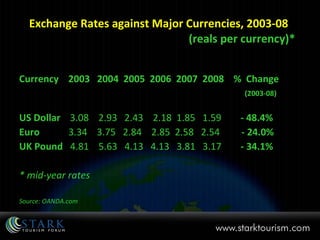
Exchange Rates against Major Currencies, 2003-08    (reals per currency)* Currency  2003  2004  2005  2006  2007  2008  %  Change (2003-08) US Dollar  3.08  2.93  2.43  2.18  1.85  1.59  - 48.4% Euro  3.34  3.75  2.84  2.85  2.58  2.54  - 24.0% UK Pound  4.81  5.63  4.13  4.13  3.81  3.17  - 34.1% * mid-year rates Source: OANDA.com
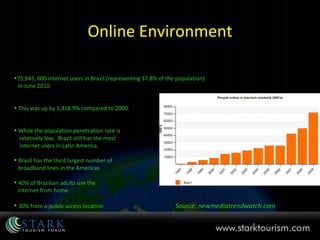
Online Environment 75,943, 600 internet users in Brazil (representing 37.8% of the population)  in June 2010. This was up by 1,418.9% compared to 2000.  While the population penetration rate is  relatively low,  Brazil still has the most internet   users in Latin America.  Brazil has the third largest number of  broadband lines in the Americas 40% of Brazilian adults use the  internet from home 30% from a public access location   Source: newmediatrendwatch.com
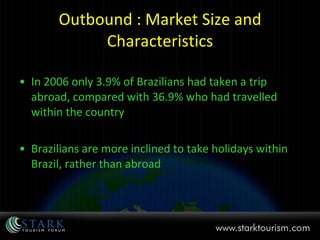
Outbound : Market Size and Characteristics In 2006 only 3.9% of Brazilians had taken a trip abroad, compared with 36.9% who had travelled within the country Brazilians are more inclined to take holidays within Brazil, rather than abroad
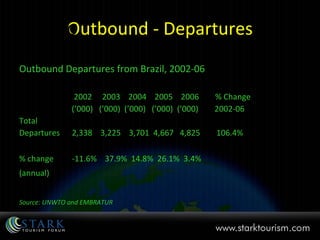
Outbound - Departures  Outbound Departures from Brazil, 2002-06    2002  2003  2004  2005  2006  % Change      (’000)  (’000)  (’000)  (’000)  (’000)  2002-06    Total Departures  2,338  3,225  3,701  4,667  4,825  106.4%    % change  -11.6%  37.9%  14.8%  26.1%  3.4%   (annual)    Source: UNWTO and EMBRATUR
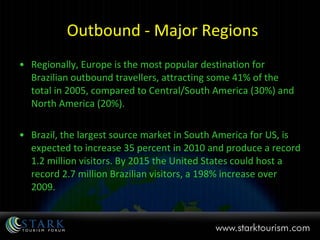
  Outbound - Major Regions Regionally, Europe is the most popular destination for Brazilian outbound travellers, attracting some 41% of the total in 2005, compared to Central/South America (30%) and North America (20%). Brazil, the largest source market in South America for US, is expected to increase 35 percent in 2010 and produce a record 1.2 million visitors. By 2015 the United States could host a record 2.7 million Brazilian visitors, a 198% increase over 2009.
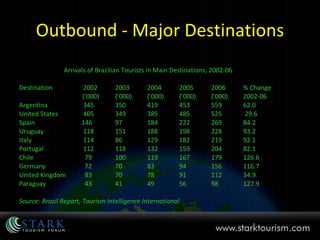
Outbound - Major Destinations Arrivals of Brazilian Tourists in Main Destinations, 2002-06  Destination  2002  2003  2004  2005  2006  % Change    (’000)  (’000)  (’000)  (’000)  (’000)  2002-06  Argentina  345  350  419  453  559  62.0  United States  405  349  385  485  525   29.6  Spain    146  97  184  222  269  84.2  Uruguay    118  151  188  198  228  93.2  Italy    114  86  129  182  219  92.1  Portugal    112  118  132  159  204  82.1  Chile    79  100  119  167  179  126.6  Germany    72  70  83  94  156  116.7  United Kingdom   83  70  78  91  112  34.9  Paraguay    43  41  49  56  98  127.9  Source: Brazil Report, Tourism Intelligence International
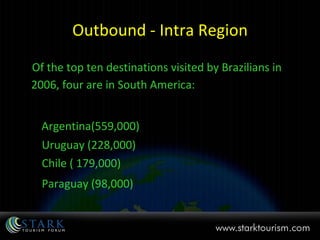
Outbound - Intra Region Of the top ten destinations visited by Brazilians in 2006, four are in South America:   Argentina(559,000)  Uruguay (228,000) Chile ( 179,000)  Paraguay (98,000)
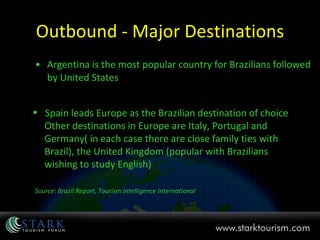
Outbound - Major Destinations Argentina is the most popular country for Brazilians followed by United States Spain leads Europe as the Brazilian destination of choice   Other destinations in Europe are Italy, Portugal and  Germany( in each case there are close family ties with  Brazil), the United Kingdom (popular with Brazilians  wishing to study English) Source: Brazil Report, Tourism Intelligence International
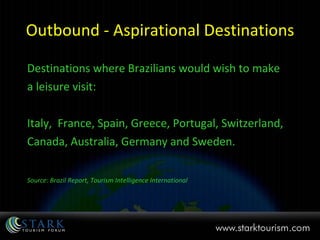
Outbound - Aspirational Destinations Destinations where Brazilians would wish to make  a leisure visit: Italy,  France, Spain, Greece, Portugal, Switzerland, Canada, Australia, Germany and Sweden. Source: Brazil Report, Tourism Intelligence International
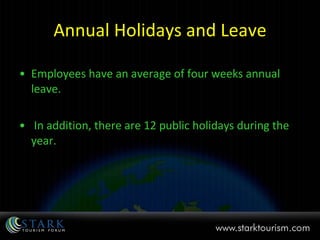
Annual Holidays and Leave Employees have an average of four weeks annual leave. In addition, there are 12 public holidays during the year.
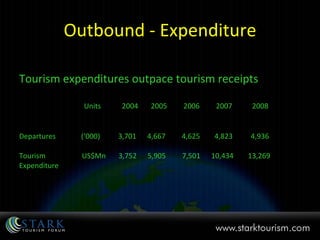
Outbound - Expenditure Tourism expenditures outpace tourism receipts Units  2004  2005  2006  2007  2008 Departures  (‘000)  3,701  4,667  4,625  4,823  4,936  Tourism  US$Mn  3,752  5,905  7,501  10,434  13,269 Expenditure
Outbound - Source Markets Main sources of Brazilian outbound travel São Paulo Rio de Janeiro
Outbound - Purpose of Visit Leisure is the main reason for Brazilians travelling overseas In 2005, almost two thirds (63%) of Brazilian outbound travel was for leisure purposes, compared with one third (33%) for business and 4% for VFR purposes. For visits to the United States, vacation/holiday trips accounted for 49% of the total in 2005; business, 36%; VFR, 24%; and conventions, 14%  (Source: OTTI) For visits to the UK, the average shares for 2006 were 40% for holidays; 18% for business; 23% for VFR; 14% for study; and 5% for other purposes.  (Source: IPS)   Portugal, Spain and Germany have higher than average proportions of VFR visits  (Source: ETC)
Outbound - Demographic Profile Majority of Brazilian travellers are middle-aged In 2002, just under half (48.4%) of all Brazilian outbound travellers were in the 28-45 age group, compared with 28.9% aged 46-65, 19.4% aged 18-27; and 3.3% aged 66 and over. In the case of travel to Britain, in 2006, over half (53%) of visitors from Brazil were aged between 25- 44 (of which 32% were in the 25-34 age group). The majority of Brazilian visitors to the US fall into the 35-54 year old age bracket. Source: Brazil Report, Tourism Intelligence International
Outbound - Seasonality Most Brazilian visits to Europe take place from June to August coinciding with the winter season in Brazil. In 2006, 30% of Brazilian visits to Britain were in the period July-September; 29% in January-March; and around 20% each in the remaining parts of the year, April-June and October-December  (Source: IPS) For visits to the United States, July, December and January are the most popular months  (Source: OTTI)
Outbound – Travel Motives Fashionable, vibrant cities such as New York, Miami, London, Paris etc. Ski resorts in Argentina and Chile. Cheaper shopping options in Paraguay and other neighbouring South American countries.  Visit relatives in European countries. Many Brazilians are first- and second generation descendants of European settlers, and as such, cultural and historical links between Brazil and Europe remain strong. To immerse themselves in Europe’s diverse culture and heritage. To attend prestigious sporting occasions (football, Formula 1 motor racing, etc). Business, trade, official trips Study, education (especially in Europe and North America)
Outbound - Travel Group Brazilian visitors are more likely to be travelling either alone (49%) or with other adults in a tour group (27%), and only 4% in a traditional family group of spouse/partner and children.  Most Brazilian visitors to the United States are married and more inclined (40%) to take their children with them. Source: Brazil Report, Tourism Intelligence International
Outbound - Air Travel In 2007, over 6 million passengers were carried on outbound international flights - a 64% increase over 1995 - of which 38% were to European destinations; 37% to South/Central America; 23% to North America; and the remaining 2% to Africa and Asia.  (Source: INFRAERO) Growth of air traffic in Brazil in the last few years, especially in its south-east region, has put severe pressure on airport infrastructure.  Non-stop flights from Brazil to international destinations are insufficient.
Outbound – International Gateways The main international gateways are : Aeroporto Internacional de Guarulhos in São Paulo connects to 28 countries  Aeroporto Internacional do Galeão in Rio de Janeiro connects to 18 countries Nearly all commercial airports are operated by INFRAERO, a government agency.
Outbound - Behaviour Pattern Brazilians are widely regarded as racially tolerant, friendly, fun-loving, and strongly attracted to city life.  If Portuguese translations are not available, Brazilians prefer to be given information in English, rather than Spanish. Accommodation in 3 and 4 star hotels in city centre locations. The wealthier travellers prefer 5 star luxury hotels. Serviced apartments and B&Bs are increasingly chosen by families.  Source: Brazil Report, Tourism Intelligence International
Outbound: Activities Preferred Shopping for fashion items is one of the prime activities. South American destinations are favoured by the more budget-conscious shopper. Visits to historical places, art galleries and museums, and sightseeing in cities, visits to cultural heritage sites, amusement/theme parks.  There is growing interest in Caribbean destinations.  Winter sports (particularly in Argentina, Chile, North America and Europe).  Nightlife and culture: Brazilians enjoy going out to cafes, bars and clubs whilst visiting a foreign country. They are also interested going to the theatre, opera, ballet, etc.
Outbound - Planning Internet is the key planning tool for international travel.  One to three months is usually required for deciding on an international trip and some may take more than three months. Independent travel is popular in Brazil
Outbound - Press Influence There is no national press, but the major newspapers in São Paulo and Rio de Janeiro reach wide audiences. They are: Globo   (Rio daily),  Jornal do Brasil   (Rio daily),  Folha de São   Paulo   (daily), Estado de São Paulo  (daily) and  Correio Braziliense .  Most newspapers publish a weekly travel supplement. The most important magazines for reaching potential travellers are the weekly  Veja, Exame   and  Caras   and the monthly travel magazines  Revista Viagem e Turismo   and  Próximo Viagem . The main travel trade publications are  Panrotas  and  Brasilturis .
Outbound - Media Influence Radio is still a popular form of entertainment and news reporting. The main stations are  Radio Nacional,  Globo Radio; Radio Eldorado Radio Bandeirantes  and  Radio Cultura The main TV channels are  TV Band  ,  Rede Globo,   Sistema Brasileiro de Televisao,   TV Record ,  NBR ,  Rede TV , TV Cultura  Cable TV is well established in the major urban areas.
Outbound - Forecast The Brazilian outbound travel market is anticipated to remain relatively buoyant in the short to medium term. Assuming that the Brazilian currency,  Real  remains strong and the Brazilian economy continues to expand at a moderate pace, the number of outbound trips will increase to around 6.5 million by 2011, and to grow by 4.5% on average, year to year, to over 8 million by 2020, a rise of about two thirds on 2006.  Both Argentina and the United States are likely to remain the top destinations for Brazilian outbound travel, boosted in the one case by the continuing weakness of the  peso , and in the other by the appreciation of the  real  against the US Dollar.  Trips to other destinations, such as Chile, Uruguay and Paraguay (which are now considered as relatively inexpensive) are also expected to grow, as will travel to Europe (assuming there is sufficient airlift capacity). Source: Brazil Report, Tourism Intelligence International
Marketing Tips Initially, it is best to target the two main potential market areas: Sao Paulo and Rio de Janeiro Brochures and information in Portuguese are much appreciated by the local trade The holiday periods of December /January /February and July should be avoided. Carnival and Easter are also bad times to visit Source: Brazil Report, Tourism Intelligence International
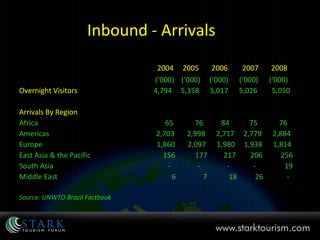
Inbound - Arrivals 2004  2005  2006  2007  2008 (‘000)  (‘000)  (‘000)  (‘000)  (‘000) Overnight Visitors   4,794  5,358  5,017  5,026  5,050 Arrivals By Region Africa  65  76  84  75  76 Americas  2,703  2,998  2,717  2,779  2,884 Europe  1,860  2,097  1,980  1,938  1,814 East Asia & the Pacific  156  177  217  206  256 South Asia  -  -  -  -  19 Middle East  6  7  18  26  -  Source: UNWTO Brazil Factbook
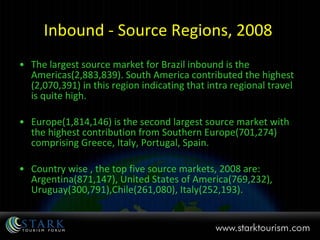
Inbound - Source Regions, 2008   The largest source market for Brazil inbound is the Americas(2,883,839). South America contributed the highest (2,070,391) in this region indicating that intra regional travel is quite high.  Europe(1,814,146) is the second largest source market with the highest contribution from Southern Europe(701,274) comprising Greece, Italy, Portugal, Spain.  Country wise , the top five source markets, 2008 are: Argentina(871,147), United States of America(769,232), Uruguay(300,791),Chile(261,080), Italy(252,193).
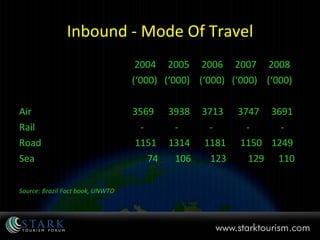
Inbound - Mode Of Travel 2004  2005  2006  2007  2008 (‘000)  (‘000)  (‘000)  (‘000)  (‘000)  Air  3569  3938  3713  3747  3691 Rail  -  -  -  -  - Road  1151  1314  1181  1150  1249 Sea  74  106  123  129  110  Source: Brazil Fact book, UNWTO
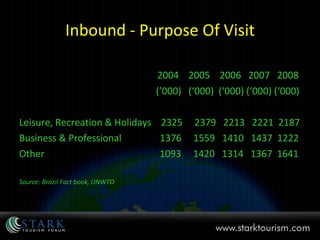
Inbound - Purpose Of Visit 2004  2005  2006  2007  2008 (’000)  (‘000)  (‘000) (‘000) (‘000) Leisure, Recreation & Holidays  2325  2379  2213  2221  2187 Business & Professional  1376  1559  1410  1437  1222 Other  1093  1420  1314  1367  1641  Source: Brazil Fact book, UNWTO
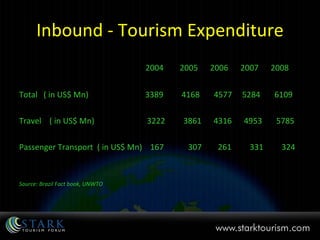
Inbound - Tourism Expenditure 2004  2005  2006  2007  2008 Total  ( in US$ Mn)  3389  4168  4577  5284  6109 Travel  ( in US$ Mn)  3222  3861  4316  4953  5785 Passenger Transport  ( in US$ Mn)  167  307  261  331  324 Source: Brazil Fact book, UNWTO
Major Travel and Tourism Events ABAV, Fair of the Americas : held in Rio de Janeiro in October that annually attracts more than 700 exhibitors from 40 countries and some 25,000 trade professionals. Considered the major event of the Latin American travel and tourism industry focused on the trade.  Salão do Turismo:  held in São Paulo in June, a gathering of  travel-related organisations promoted by the Brazilian Ministry of Tourism. The event is open to travel-industry professionals and the general public. EQUIPOTEL  : held in São Paulo in September, international fair of equipment, products and services for the hotel and hospitality industry.
Useful Links www.embratur.gov.br www.abav.com.br http://salaodoturismo.com.br
References UNWTO European Travel Commission Reports Tourism Industry Intelligence – Brazil Report EMBRATUR OTTI Visit Britain Country Profiles Internet World Stats CIA - The World Factbook 2001 Anholt-GMI Brands Index/British Tourist Authority
Disclaimer The report is based on the information from the published  sources and references mentioned and inferences drawn are from them. Stark Tourism Forum and its parent organization, The Stark Group and the Group Companies -  Stark Communications, Stark Expo, Stark World Publications are not responsible for errors/omissions that could have crept in knowingly or unwittingly.

Brazil tourism report

  • 1.
  • 2.
    Fact Sheet Location: Eastern South America, bordering the Atlantic Ocean. Shares common boundaries with every South American country except Chile and Ecuador Area: Fifth largest country in the world and largest country in South America. total:  8,511,965 sq km land:  8,456,510 sq km water:  55,455 sq km Coastline: 7,491 km Climate: Mostly tropical, but temperate in south Population: Most populous country in South America 193.7 million (2009) Age structure: 0-14 years:  28.57% (male 25,390,039; female 24,449,902) 15-64 years:  65.98% (male 56,603,895; female 58,507,289)
  • 3.
    Airports with pavedrunways total: 570 Railways total:  30,539 km (2,129 km electrified); excludes urban rail Highways total:  1.98 million km GDP( US$bn) 1,574.0 GDP (per capita) US$ 8,220 GDP (PPP) as share % of world total 2.87 Conventional long form:  Federative Republic of Brazil Conventional short form:  Brazil Capital Brasilia Administrative Divisions Federal District (capital Brasilia), 26 States and the 5,564 Municipalities Independence 7 September 1822 (from Portugal) National Carrier Varig Languages Portuguese (official), Spanish, English, French Country Name
  • 4.
    Travel and TourismCompetitiveness Index Ranked 5 th in the Americas and 45 th overall Ranked 2 nd out of all countries for its natural resources and 14 th for its cultural resources Ground transport remains underdeveloped with the quality of roads, ports and railroads ranked 110 th ,123 rd and 86 th respectively Safety and security (ranked 130 th ), overall policy environment (95 th ) and lack of price competitiveness (ranked 91 st ) are causes of concern Source: The Travel & Tourism Competitiveness Report, 2009
  • 5.
    Outbound Tourism -Determinants The future determinants of the frequency and volume of outbound travel are: The total population – or potential market size Per Capita GDP The degree of internet usage
  • 6.
    South America Outbound- Determinants Population, Per Capita GDP, Internet Usage, 2008 Country Gross Domestic Product ** Internet Users Population (million) Total Per Capita Number Population ($ billion) ($) (’000) penetration Argentina 40.677 523.7 13,300 16,000 39.7% Bolivia 9.248 39.4 4,000 580 6.4% Brazil 191.809 1,836.0 9,700 42,600 22.4% Chile 16.454 231.1 13,900 7,035 43.2% Colombia 45.014 319.5 6,700 10,097 22.8% Ecuador 13.928 98.8 7,200 1,549 11.3% Falklands Islands* 0.003 0.075 25,200 2 69.4% French Guiana 0.209 3.5 17,300 42 20.5% Guyana 0.771 2.9 3,800 160 20.8% Paraguay 6.348 27.1 4,500 260 3.9% Peru 27.926 219.0 7,800 7,324 25.5% Suriname 0.438 4.1 7,800 32 6.8% Uruguay 3.478 37.2 11,600 1,100 31.8% Venezuela 26.415 334.6 12,200 5,298 20.4% Total 382.326 3,677.7 n.a. 92,079 24.2% * claimed by Argentina, including South Georgia and South Sandwich Islands ** in terms of purchasing power parity (PPP) Sources: US Census Bureau, CIA World Factbook, Internet World Stats
  • 7.
    South America Outbound- Regions Intra-regional travel tops South Americans’ outbound tourism The main destinations for outbound travellers from South America have traditionally been Central/South America, Europe and the United States
  • 8.
    South America OutboundBrazil leads in outbound tourism in South America Country 2002 2003 2004 2005 2006 % Change 2002-06 Argentina 3,008 3,008 3,904 3,894 4,009 33.3% Bolivia 217 305 331 312 n.a. n.a. Brazil 2,338 3,225 3,701 4,667 4,625 106.4% Chile 1,938 2,100 2,343 2,651 n.a. n.a. Colombia 1,277 1,177 1,405 1,553 n.a. n.a. Ecuador 627 613 603 664 733 16.9% Paraguay 141 153 170 188 210 48.9% Peru 1,232 1,392 1,635 1,841 1,857 50.7% Uruguay 530 495 569 658 666 25.7% Venezuela 881 832 816 1,067 1,095 24.3% Total 12,189 13,300 15,477 17,495 n.a. n.a. * data not available for Falklands Islands, French Guiana, Guyana and Suriname Source: UNWTO and country data Brazil
  • 9.
    Population vs EconomyAround 80% of Brazilians reside in urban centres. The south-east region is the richest and most densely populated and has the country's two largest cities, São Paulo and Rio de Janeiro, while the south is the wealthiest in terms of GDP per capita.
  • 10.
    Largest Metropolitan RegionsIn population terms (2006), the largest metropolitan regions are São Paulo (19.95 mn) Recife (3.65 mn) Rio de Janeiro (11.35 mn) Porto Alegre (4.1 mn) Belo Horizonte (5.4 mn)
  • 11.
    Largest Cities Basedon the population of the municipality where the city is located rather than its metropolitan region: Belo Horizonte (2.4 mn) Brasilia (2.5 mn) Salvador (2.9 mn) Rio (6.1 mn) Fortaleza (2.4 mn) São Paulo (10.9 mn)
  • 12.
    Economic Indicators EconomicIndicators (2007 estimates) Ninth largest economy in the world GDP (purchasing power parity): $1.836 trillion GDP (official exchange rate): $1.314 trillion GDP – real growth rate: 5.4% GDP – per capita (PPP): $9,700 GDP composition by sector: agriculture: 5.5%; industry: 28.7%; services: 65.8% Labour Force: 99.5million Labour Force by occupation (2003 est.): agriculture: 20%; industry: 14%; services: 66% Unemployment rate: 9.3% Population below poverty line (2005 est.): 31% Inflation rate (consumer prices): 4.5% annual average One of the four emerging economies – Brazil, Russia, India and China (BRIC)
  • 13.
    Economy and TourismExpenditure Share of tourism expenditure in: Unit 2004 2005 2006 2007 2008 Gross Domestic Product (GDP) Percent 0.5 0,5 0.4 0.4 0.4 Exports of goods Percent 3.5 3.5 3.3 3.3 3.1 Exports of services Percent 26.9 26.0 23.5 22.1 20.1
  • 14.
    Exchange Rates againstMajor Currencies, 2003-08 (reals per currency)* Currency 2003 2004 2005 2006 2007 2008 % Change (2003-08) US Dollar 3.08 2.93 2.43 2.18 1.85 1.59 - 48.4% Euro 3.34 3.75 2.84 2.85 2.58 2.54 - 24.0% UK Pound 4.81 5.63 4.13 4.13 3.81 3.17 - 34.1% * mid-year rates Source: OANDA.com
  • 15.
    Online Environment 75,943,600 internet users in Brazil (representing 37.8% of the population) in June 2010. This was up by 1,418.9% compared to 2000. While the population penetration rate is relatively low, Brazil still has the most internet users in Latin America. Brazil has the third largest number of broadband lines in the Americas 40% of Brazilian adults use the internet from home 30% from a public access location Source: newmediatrendwatch.com
  • 16.
    Outbound : MarketSize and Characteristics In 2006 only 3.9% of Brazilians had taken a trip abroad, compared with 36.9% who had travelled within the country Brazilians are more inclined to take holidays within Brazil, rather than abroad
  • 17.
    Outbound - Departures Outbound Departures from Brazil, 2002-06 2002 2003 2004 2005 2006 % Change (’000) (’000) (’000) (’000) (’000) 2002-06 Total Departures 2,338 3,225 3,701 4,667 4,825 106.4% % change -11.6% 37.9% 14.8% 26.1% 3.4% (annual) Source: UNWTO and EMBRATUR
  • 18.
    Outbound- Major Regions Regionally, Europe is the most popular destination for Brazilian outbound travellers, attracting some 41% of the total in 2005, compared to Central/South America (30%) and North America (20%). Brazil, the largest source market in South America for US, is expected to increase 35 percent in 2010 and produce a record 1.2 million visitors. By 2015 the United States could host a record 2.7 million Brazilian visitors, a 198% increase over 2009.
  • 19.
    Outbound - MajorDestinations Arrivals of Brazilian Tourists in Main Destinations, 2002-06 Destination 2002 2003 2004 2005 2006 % Change (’000) (’000) (’000) (’000) (’000) 2002-06 Argentina 345 350 419 453 559 62.0 United States 405 349 385 485 525 29.6 Spain 146 97 184 222 269 84.2 Uruguay 118 151 188 198 228 93.2 Italy 114 86 129 182 219 92.1 Portugal 112 118 132 159 204 82.1 Chile 79 100 119 167 179 126.6 Germany 72 70 83 94 156 116.7 United Kingdom 83 70 78 91 112 34.9 Paraguay 43 41 49 56 98 127.9 Source: Brazil Report, Tourism Intelligence International
  • 20.
    Outbound - IntraRegion Of the top ten destinations visited by Brazilians in 2006, four are in South America: Argentina(559,000) Uruguay (228,000) Chile ( 179,000) Paraguay (98,000)
  • 21.
    Outbound - MajorDestinations Argentina is the most popular country for Brazilians followed by United States Spain leads Europe as the Brazilian destination of choice Other destinations in Europe are Italy, Portugal and Germany( in each case there are close family ties with Brazil), the United Kingdom (popular with Brazilians wishing to study English) Source: Brazil Report, Tourism Intelligence International
  • 22.
    Outbound - AspirationalDestinations Destinations where Brazilians would wish to make a leisure visit: Italy, France, Spain, Greece, Portugal, Switzerland, Canada, Australia, Germany and Sweden. Source: Brazil Report, Tourism Intelligence International
  • 23.
    Annual Holidays andLeave Employees have an average of four weeks annual leave. In addition, there are 12 public holidays during the year.
  • 24.
    Outbound - ExpenditureTourism expenditures outpace tourism receipts Units 2004 2005 2006 2007 2008 Departures (‘000) 3,701 4,667 4,625 4,823 4,936 Tourism US$Mn 3,752 5,905 7,501 10,434 13,269 Expenditure
  • 25.
    Outbound - SourceMarkets Main sources of Brazilian outbound travel São Paulo Rio de Janeiro
  • 26.
    Outbound - Purposeof Visit Leisure is the main reason for Brazilians travelling overseas In 2005, almost two thirds (63%) of Brazilian outbound travel was for leisure purposes, compared with one third (33%) for business and 4% for VFR purposes. For visits to the United States, vacation/holiday trips accounted for 49% of the total in 2005; business, 36%; VFR, 24%; and conventions, 14% (Source: OTTI) For visits to the UK, the average shares for 2006 were 40% for holidays; 18% for business; 23% for VFR; 14% for study; and 5% for other purposes. (Source: IPS) Portugal, Spain and Germany have higher than average proportions of VFR visits (Source: ETC)
  • 27.
    Outbound - DemographicProfile Majority of Brazilian travellers are middle-aged In 2002, just under half (48.4%) of all Brazilian outbound travellers were in the 28-45 age group, compared with 28.9% aged 46-65, 19.4% aged 18-27; and 3.3% aged 66 and over. In the case of travel to Britain, in 2006, over half (53%) of visitors from Brazil were aged between 25- 44 (of which 32% were in the 25-34 age group). The majority of Brazilian visitors to the US fall into the 35-54 year old age bracket. Source: Brazil Report, Tourism Intelligence International
  • 28.
    Outbound - SeasonalityMost Brazilian visits to Europe take place from June to August coinciding with the winter season in Brazil. In 2006, 30% of Brazilian visits to Britain were in the period July-September; 29% in January-March; and around 20% each in the remaining parts of the year, April-June and October-December (Source: IPS) For visits to the United States, July, December and January are the most popular months (Source: OTTI)
  • 29.
    Outbound – TravelMotives Fashionable, vibrant cities such as New York, Miami, London, Paris etc. Ski resorts in Argentina and Chile. Cheaper shopping options in Paraguay and other neighbouring South American countries. Visit relatives in European countries. Many Brazilians are first- and second generation descendants of European settlers, and as such, cultural and historical links between Brazil and Europe remain strong. To immerse themselves in Europe’s diverse culture and heritage. To attend prestigious sporting occasions (football, Formula 1 motor racing, etc). Business, trade, official trips Study, education (especially in Europe and North America)
  • 30.
    Outbound - TravelGroup Brazilian visitors are more likely to be travelling either alone (49%) or with other adults in a tour group (27%), and only 4% in a traditional family group of spouse/partner and children. Most Brazilian visitors to the United States are married and more inclined (40%) to take their children with them. Source: Brazil Report, Tourism Intelligence International
  • 31.
    Outbound - AirTravel In 2007, over 6 million passengers were carried on outbound international flights - a 64% increase over 1995 - of which 38% were to European destinations; 37% to South/Central America; 23% to North America; and the remaining 2% to Africa and Asia. (Source: INFRAERO) Growth of air traffic in Brazil in the last few years, especially in its south-east region, has put severe pressure on airport infrastructure. Non-stop flights from Brazil to international destinations are insufficient.
  • 32.
    Outbound – InternationalGateways The main international gateways are : Aeroporto Internacional de Guarulhos in São Paulo connects to 28 countries Aeroporto Internacional do Galeão in Rio de Janeiro connects to 18 countries Nearly all commercial airports are operated by INFRAERO, a government agency.
  • 33.
    Outbound - BehaviourPattern Brazilians are widely regarded as racially tolerant, friendly, fun-loving, and strongly attracted to city life. If Portuguese translations are not available, Brazilians prefer to be given information in English, rather than Spanish. Accommodation in 3 and 4 star hotels in city centre locations. The wealthier travellers prefer 5 star luxury hotels. Serviced apartments and B&Bs are increasingly chosen by families. Source: Brazil Report, Tourism Intelligence International
  • 34.
    Outbound: Activities PreferredShopping for fashion items is one of the prime activities. South American destinations are favoured by the more budget-conscious shopper. Visits to historical places, art galleries and museums, and sightseeing in cities, visits to cultural heritage sites, amusement/theme parks. There is growing interest in Caribbean destinations. Winter sports (particularly in Argentina, Chile, North America and Europe). Nightlife and culture: Brazilians enjoy going out to cafes, bars and clubs whilst visiting a foreign country. They are also interested going to the theatre, opera, ballet, etc.
  • 35.
    Outbound - PlanningInternet is the key planning tool for international travel. One to three months is usually required for deciding on an international trip and some may take more than three months. Independent travel is popular in Brazil
  • 36.
    Outbound - PressInfluence There is no national press, but the major newspapers in São Paulo and Rio de Janeiro reach wide audiences. They are: Globo (Rio daily), Jornal do Brasil (Rio daily), Folha de São Paulo (daily), Estado de São Paulo (daily) and Correio Braziliense . Most newspapers publish a weekly travel supplement. The most important magazines for reaching potential travellers are the weekly Veja, Exame and Caras and the monthly travel magazines Revista Viagem e Turismo and Próximo Viagem . The main travel trade publications are Panrotas and Brasilturis .
  • 37.
    Outbound - MediaInfluence Radio is still a popular form of entertainment and news reporting. The main stations are Radio Nacional, Globo Radio; Radio Eldorado Radio Bandeirantes and Radio Cultura The main TV channels are TV Band , Rede Globo, Sistema Brasileiro de Televisao, TV Record , NBR , Rede TV , TV Cultura Cable TV is well established in the major urban areas.
  • 38.
    Outbound - ForecastThe Brazilian outbound travel market is anticipated to remain relatively buoyant in the short to medium term. Assuming that the Brazilian currency, Real remains strong and the Brazilian economy continues to expand at a moderate pace, the number of outbound trips will increase to around 6.5 million by 2011, and to grow by 4.5% on average, year to year, to over 8 million by 2020, a rise of about two thirds on 2006. Both Argentina and the United States are likely to remain the top destinations for Brazilian outbound travel, boosted in the one case by the continuing weakness of the peso , and in the other by the appreciation of the real against the US Dollar. Trips to other destinations, such as Chile, Uruguay and Paraguay (which are now considered as relatively inexpensive) are also expected to grow, as will travel to Europe (assuming there is sufficient airlift capacity). Source: Brazil Report, Tourism Intelligence International
  • 39.
    Marketing Tips Initially,it is best to target the two main potential market areas: Sao Paulo and Rio de Janeiro Brochures and information in Portuguese are much appreciated by the local trade The holiday periods of December /January /February and July should be avoided. Carnival and Easter are also bad times to visit Source: Brazil Report, Tourism Intelligence International
  • 40.
    Inbound - Arrivals2004 2005 2006 2007 2008 (‘000) (‘000) (‘000) (‘000) (‘000) Overnight Visitors 4,794 5,358 5,017 5,026 5,050 Arrivals By Region Africa 65 76 84 75 76 Americas 2,703 2,998 2,717 2,779 2,884 Europe 1,860 2,097 1,980 1,938 1,814 East Asia & the Pacific 156 177 217 206 256 South Asia - - - - 19 Middle East 6 7 18 26 - Source: UNWTO Brazil Factbook
  • 41.
    Inbound - SourceRegions, 2008 The largest source market for Brazil inbound is the Americas(2,883,839). South America contributed the highest (2,070,391) in this region indicating that intra regional travel is quite high. Europe(1,814,146) is the second largest source market with the highest contribution from Southern Europe(701,274) comprising Greece, Italy, Portugal, Spain. Country wise , the top five source markets, 2008 are: Argentina(871,147), United States of America(769,232), Uruguay(300,791),Chile(261,080), Italy(252,193).
  • 42.
    Inbound - ModeOf Travel 2004 2005 2006 2007 2008 (‘000) (‘000) (‘000) (‘000) (‘000) Air 3569 3938 3713 3747 3691 Rail - - - - - Road 1151 1314 1181 1150 1249 Sea 74 106 123 129 110 Source: Brazil Fact book, UNWTO
  • 43.
    Inbound - PurposeOf Visit 2004 2005 2006 2007 2008 (’000) (‘000) (‘000) (‘000) (‘000) Leisure, Recreation & Holidays 2325 2379 2213 2221 2187 Business & Professional 1376 1559 1410 1437 1222 Other 1093 1420 1314 1367 1641 Source: Brazil Fact book, UNWTO
  • 44.
    Inbound - TourismExpenditure 2004 2005 2006 2007 2008 Total ( in US$ Mn) 3389 4168 4577 5284 6109 Travel ( in US$ Mn) 3222 3861 4316 4953 5785 Passenger Transport ( in US$ Mn) 167 307 261 331 324 Source: Brazil Fact book, UNWTO
  • 45.
    Major Travel andTourism Events ABAV, Fair of the Americas : held in Rio de Janeiro in October that annually attracts more than 700 exhibitors from 40 countries and some 25,000 trade professionals. Considered the major event of the Latin American travel and tourism industry focused on the trade. Salão do Turismo: held in São Paulo in June, a gathering of travel-related organisations promoted by the Brazilian Ministry of Tourism. The event is open to travel-industry professionals and the general public. EQUIPOTEL : held in São Paulo in September, international fair of equipment, products and services for the hotel and hospitality industry.
  • 46.
    Useful Links www.embratur.gov.brwww.abav.com.br http://salaodoturismo.com.br
  • 47.
    References UNWTO EuropeanTravel Commission Reports Tourism Industry Intelligence – Brazil Report EMBRATUR OTTI Visit Britain Country Profiles Internet World Stats CIA - The World Factbook 2001 Anholt-GMI Brands Index/British Tourist Authority
  • 48.
    Disclaimer The reportis based on the information from the published sources and references mentioned and inferences drawn are from them. Stark Tourism Forum and its parent organization, The Stark Group and the Group Companies - Stark Communications, Stark Expo, Stark World Publications are not responsible for errors/omissions that could have crept in knowingly or unwittingly.