ASI
A
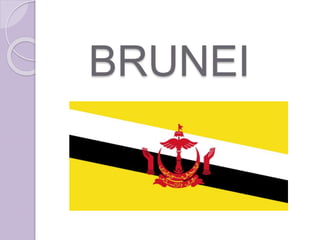
BRUNEI
Brunei(Bandar Seri Begawan)
Cities
 Bandar Seri Begawan — the capital,
sometimes known as "Bandar" or "BSB" for
short.
 Bangar — the tiny district capital of Temburong
district.
 Kuala Belait — town to catch transport to or
from Miri, Sarawak.
 Muara — main port of Brunei with passenger
ferries to Labuan and Sarawak.
 Seria — oil capital of Brunei, also known as
"Shelltown".
 Tutong - full of virgin forest and the beauty of
nature including TasekMarimbun
Abode of Peace
 Brunei “ Abode of Peace” is a small but -
thanks to natural gas and petroleum
resources - very rich country located
in Southeast Asia. It's surrounded by
Malaysia and has two parts physically
separated by Malaysia, almost being an
enclave. Strategically located on the South
China Sea, close to vital sea lanes linking
Indian and Pacific Oceans, it has an
exclusive economic fishing zone that extends
as far as Louisa Reef in the southern Spratly
Islands although it makes no public territorial
claim to the offshore reefs.
History
 The Sultanate of Brunei's heyday occurred
between the 15th and 17th centuries, when its
control extended over coastal areas of
northwest Borneo and the southern Philippines.
Brunei subsequently entered a period of decline
brought on by internal strife over royal
succession, colonial expansion of European
powers, and piracy. In 1888, Brunei became a
British protectorate. It was offered the opportunity
to join Malaysia as a state in 1963, but opted out
of the Federation due to a disagreement on the
amount of its oil income that would have to be
given to the central government in Kuala Lumpur.
Independence was achieved in 1984. The same
family has ruled Brunei for over six centuries.
Culture
 Brunei is officially an Islamic state,
with hundreds of large beautiful
mosques across the country. Sale of
alcohol is banned.Bringing in meat,
(other than seafood) which has not
been certified "halal", (slaughtered
according to Islamic law), is also
banned.
Other destinations
 Gadong - shopping centres where the biggest
mall in Brunei located. Local markets can be
found just next to the building. Full of local
shophouses from cheap T-shirt to cheap food,
even car's workshop!
 Serusop - newly shopping complex.New malls
and affordable Times Hotel.Serusop located
just 5 min from Brunei International Airport. The
new trend for youth hang out place.
 TasekMerimbun - famous lake located in
Tutong district.
 PantaiGadong, PantaiMuara and PantaiSerasa
- the must visit beaches in Borneo.
 Kiulap - Shophouses and Shopping Mall.
 Kampong Ayer - the very old, traditional kind of
the Venice of the East. It is not a shopping
complex but only cover with full of traditional
Cuisine
 Bruneians love to eat out and there are many
excellent restaurants in Brunei serving a wide
variety of cuisines, thanks to the large number of
foreign workers in the country.
 There is also the local nasikatok, a simple
combination of rice and curried beef or chicken,
which can be quite spicy. It is relatively
inexpensive when compared to other food that
you can buy, for example local food such as
chicken rice. However, it is not a healthy option,
with few vegetables and too much fat.
 Another choice is ambuyat, a culinary experience
unique to Borneo. It is a starchy and gooey paste
made from sago that can be dipped into a
savoury sauce.
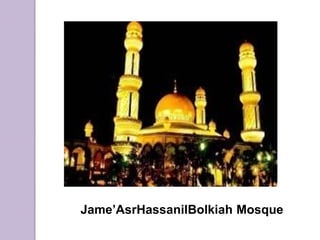
Jame’AsrHassanilBolkiah Mosque
Tourist Attraction
 Jame’AsrHassanilBolkiah Mosque
The Jame’AsrHassanilBolkiah Mosque is
by far the most splendid one of them all.
It is also one of the most important
religious sites in the country.
It is located in Kampong Kiarong, which
is quite close to the nation’s capital.
Though it is mainly a place of worship
among Muslims, it is open to visits by
those not of the faith during Thursdays.
You’ll definitely enjoy the architectural
masterpieces to be witnessed here.
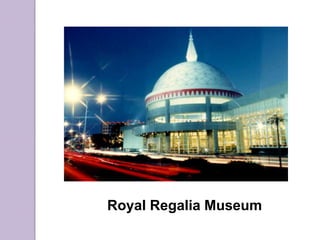
Royal Regalia Museum
Tourist Attraction
 Royal Regalia Museum
A tour of the many tourist attractions of
Brunei will give you various glimpses into the
royal buildings and cultural centers. Not only
do they speak of the architectural prowess of
the country, they also speak volumes
regarding the people’s history.
The Royal Regalia Museum is one of the
most culturally significant places to visit if you
want to understand the people’s culture and
history. The collections you will find here
portray the regal life of the royal dynasties
that ruled the land, which also reflects the
political aspects of the nation.
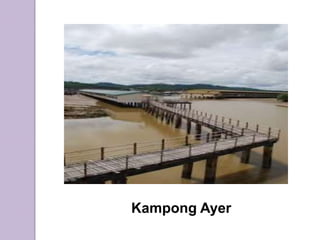
Kampong Ayer
Tourist Attraction
 Kampong Ayer
Kampong Ayer is locally dubbed as
the Venice of the East. It is one of the
tourist attractions in the country that
you shouldn’t miss. This place is
sometimes called the ‘water village’. It
is quite interesting that the moniker
‘Venice of the East’ wasn’t coined by
one of the locals but was given by a
foreign visitor.
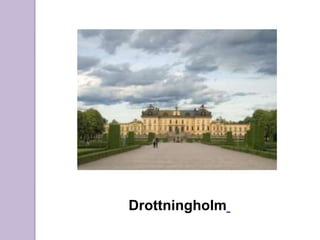
Drottningholm
Tourist Attraction
 Drottningholm
This tourist attraction is actually where
the country’s royal family resides. The
very first palace built in this site was
constructed in the 16th century.
However, it was destroyed in 1961
and a new palace was constructed the
following year. The place is quite
charming and reflects the country’s
glory.
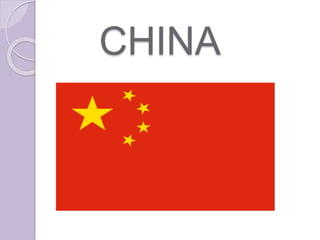
CHINA
China (Beijing)
• The second-largest country in the
world by land area after Russia.
• The world’s most populous country.
• The world’s largest exporter and
importer of goods, the world’s second-
largest economy.
Tourist Attraction
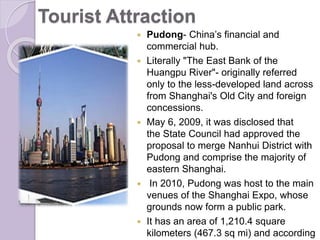
 Pudong- China’s financial and
commercial hub.
 Literally "The East Bank of the
Huangpu River"- originally referred
only to the less-developed land across
from Shanghai's Old City and foreign
concessions.
 May 6, 2009, it was disclosed that
the State Council had approved the
proposal to merge Nanhui District with
Pudong and comprise the majority of
eastern Shanghai.
 In 2010, Pudong was host to the main
venues of the Shanghai Expo, whose
grounds now form a public park.
 It has an area of 1,210.4 square
kilometers (467.3 sq mi) and according
Tourist Attraction
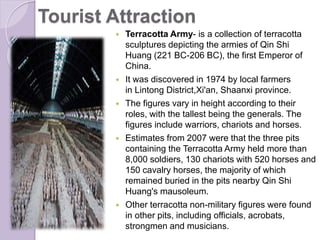
 Terracotta Army- is a collection of terracotta
sculptures depicting the armies of Qin Shi
Huang (221 BC-206 BC), the first Emperor of
China.
 It was discovered in 1974 by local farmers
in Lintong District,Xi'an, Shaanxi province.
 The figures vary in height according to their
roles, with the tallest being the generals. The
figures include warriors, chariots and horses.
 Estimates from 2007 were that the three pits
containing the Terracotta Army held more than
8,000 soldiers, 130 chariots with 520 horses and
150 cavalry horses, the majority of which
remained buried in the pits nearby Qin Shi
Huang's mausoleum.
 Other terracotta non-military figures were found
in other pits, including officials, acrobats,
strongmen and musicians.
Tourist Attraction
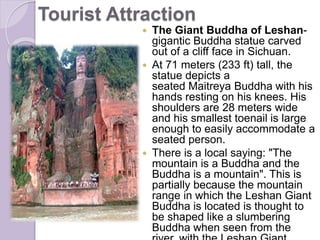
 The Giant Buddha of Leshan-
gigantic Buddha statue carved
out of a cliff face in Sichuan.
 At 71 meters (233 ft) tall, the
statue depicts a
seated Maitreya Buddha with his
hands resting on his knees. His
shoulders are 28 meters wide
and his smallest toenail is large
enough to easily accommodate a
seated person.
 There is a local saying: "The
mountain is a Buddha and the
Buddha is a mountain". This is
partially because the mountain
range in which the Leshan Giant
Buddha is located is thought to
be shaped like a slumbering
Buddha when seen from the
Tourist Attraction
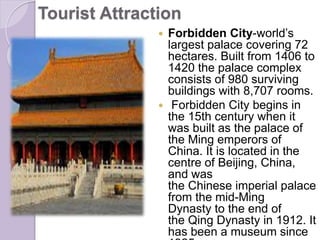
 Forbidden City-world’s
largest palace covering 72
hectares. Built from 1406 to
1420 the palace complex
consists of 980 surviving
buildings with 8,707 rooms.
 Forbidden City begins in
the 15th century when it
was built as the palace of
the Ming emperors of
China. It is located in the
centre of Beijing, China,
and was
the Chinese imperial palace
from the mid-Ming
Dynasty to the end of
the Qing Dynasty in 1912. It
has been a museum since
Tourist Attraction
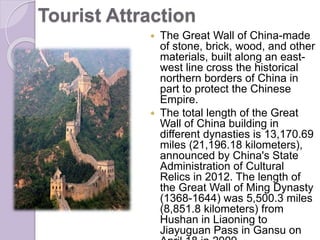
 The Great Wall of China-made
of stone, brick, wood, and other
materials, built along an east-
west line cross the historical
northern borders of China in
part to protect the Chinese
Empire.
 The total length of the Great
Wall of China building in
different dynasties is 13,170.69
miles (21,196.18 kilometers),
announced by China's State
Administration of Cultural
Relics in 2012. The length of
the Great Wall of Ming Dynasty
(1368-1644) was 5,500.3 miles
(8,851.8 kilometers) from
Hushan in Liaoning to
Jiayuguan Pass in Gansu on
MALAYSIA
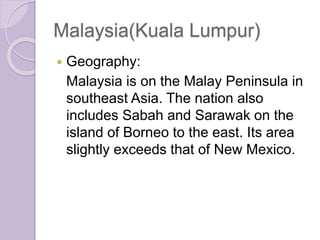
Malaysia(Kuala Lumpur)
 Geography:
Malaysia is on the Malay Peninsula in
southeast Asia. The nation also
includes Sabah and Sarawak on the
island of Borneo to the east. Its area
slightly exceeds that of New Mexico.
Tourist Attraction
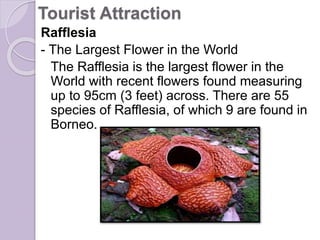
Rafflesia
- The Largest Flower in the World
The Rafflesia is the largest flower in the
World with recent flowers found measuring
up to 95cm (3 feet) across. There are 55
species of Rafflesia, of which 9 are found in
Borneo.
Tourist Attraction
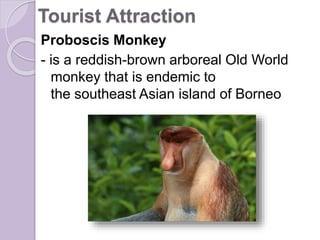
Proboscis Monkey
- is a reddish-brown arboreal Old World
monkey that is endemic to
the southeast Asian island of Borneo
Tourist Attraction
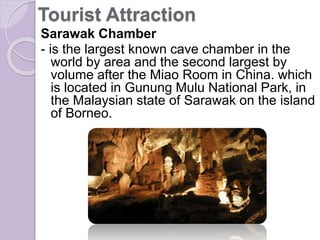
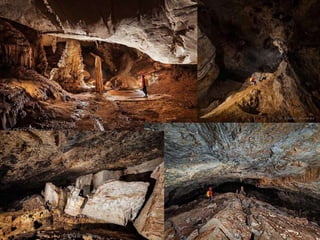
Sarawak Chamber
- is the largest known cave chamber in the
world by area and the second largest by
volume after the Miao Room in China. which
is located in Gunung Mulu National Park, in
the Malaysian state of Sarawak on the island
of Borneo.
Tourist Attraction
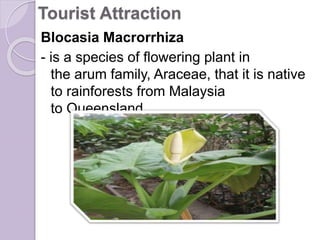
Blocasia Macrorrhiza
- is a species of flowering plant in
the arum family, Araceae, that it is native
to rainforests from Malaysia
to Queensland
Tourist Attraction
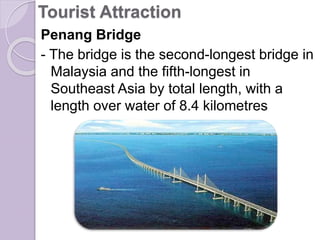
Penang Bridge
- The bridge is the second-longest bridge in
Malaysia and the fifth-longest in
Southeast Asia by total length, with a
length over water of 8.4 kilometres
Tourist Attraction
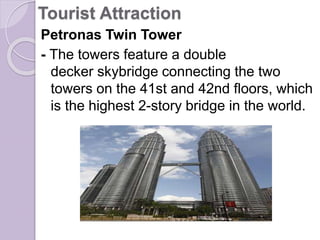
Petronas Twin Tower
- The towers feature a double
decker skybridge connecting the two
towers on the 41st and 42nd floors, which
is the highest 2-story bridge in the world.
Tourist Attraction
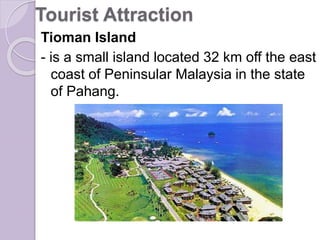
Tioman Island
- is a small island located 32 km off the east
coast of Peninsular Malaysia in the state
of Pahang.
Tourist Attraction
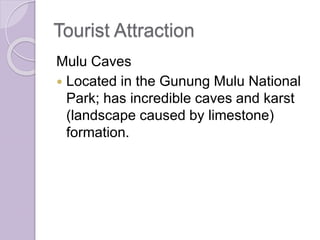
Mulu Caves
 Located in the Gunung Mulu National
Park; has incredible caves and karst
(landscape caused by limestone)
formation.
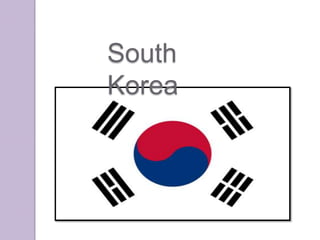
South
Korea
South Korea (Seoul)
• Population: 51,302,044 (2014)
• Has about 3000 islands but mostly small and
uninhabited.
• Its total area is 100,032 square kilometres
(38,622.57 sq mi)
• Officially called as Republic of Korea (Daehan
Minguk)
• The name Korea is derived from Goryeo, a
dynasty which ruled in the middle ages.
• Due to Hallyu, South Korea welcomed more
than 12 million visitors in 2013 with 6 million
tourists coming from China alone, making them
the 20th most visited country in the world.
• Asia’s fourth largest economy.
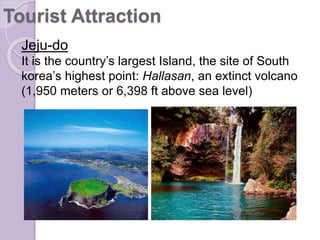
Jeju-do
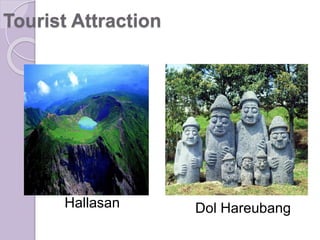
It is the country’s largest Island, the site of South
korea’s highest point: Hallasan, an extinct volcano
(1,950 meters or 6,398 ft above sea level)
Tourist Attraction
Hallasan Dol Hareubang
Tourist Attraction
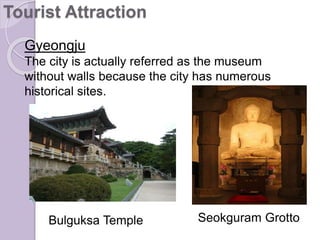
Gyeongju
The city is actually referred as the museum
without walls because the city has numerous
historical sites.
Bulguksa Temple Seokguram Grotto
Tourist Attraction
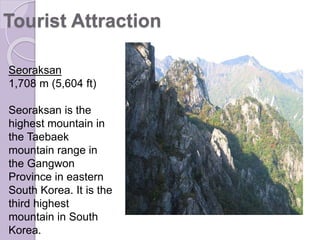
Seoraksan
1,708 m (5,604 ft)
Seoraksan is the
highest mountain in
the Taebaek
mountain range in
the Gangwon
Province in eastern
South Korea. It is the
third highest
mountain in South
Korea.
Tourist Attraction
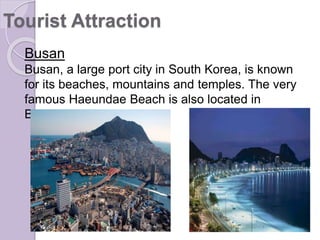
Busan
Busan, a large port city in South Korea, is known
for its beaches, mountains and temples. The very
famous Haeundae Beach is also located in
Busan.
Tourist Attraction
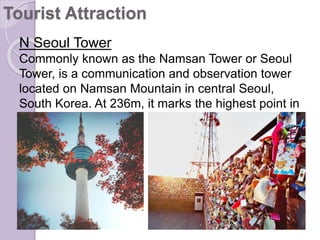
N Seoul Tower
Commonly known as the Namsan Tower or Seoul
Tower, is a communication and observation tower
located on Namsan Mountain in central Seoul,
South Korea. At 236m, it marks the highest point in
Seoul.
Tourist Attraction
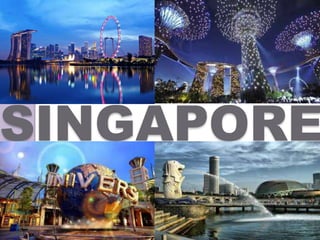
SINGAPORE
SINGAPORE
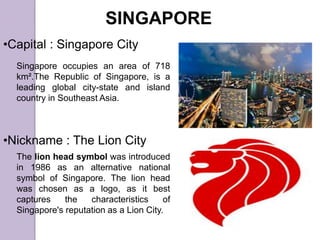
•Capital : Singapore City
•Nickname : The Lion City
Singapore occupies an area of 718
km².The Republic of Singapore, is a
leading global city-state and island
country in Southeast Asia.
The lion head symbol was introduced
in 1986 as an alternative national
symbol of Singapore. The lion head
was chosen as a logo, as it best
captures the characteristics of
Singapore's reputation as a Lion City.
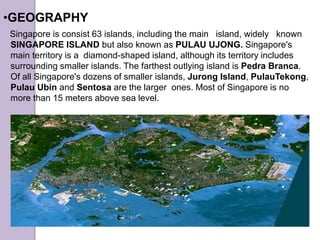
Singapore is consist 63 islands, including the main island, widely known
SINGAPORE ISLAND but also known as PULAU UJONG. Singapore's
main territory is a diamond-shaped island, although its territory includes
surrounding smaller islands. The farthest outlying island is Pedra Branca.
Of all Singapore's dozens of smaller islands, Jurong Island, PulauTekong,
Pulau Ubin and Sentosa are the larger ones. Most of Singapore is no
more than 15 meters above sea level.
•GEOGRAPHY
•ECONOMY
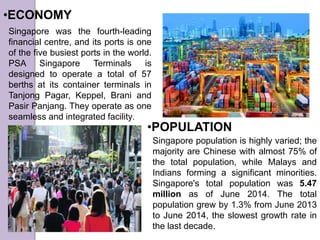
Singapore was the fourth-leading
financial centre, and its ports is one
of the five busiest ports in the world.
PSA Singapore Terminals is
designed to operate a total of 57
berths at its container terminals in
Tanjong Pagar, Keppel, Brani and
Pasir Panjang. They operate as one
seamless and integrated facility.
•POPULATION
Singapore population is highly varied; the
majority are Chinese with almost 75% of
the total population, while Malays and
Indians forming a significant minorities.
Singapore's total population was 5.47
million as of June 2014. The total
population grew by 1.3% from June 2013
to June 2014, the slowest growth rate in
the last decade.
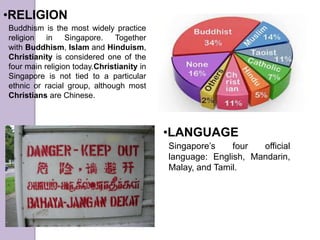
•RELIGION
Buddhism is the most widely practice
religion in Singapore. Together
with Buddhism, Islam and Hinduism,
Christianity is considered one of the
four main religion today.Christianity in
Singapore is not tied to a particular
ethnic or racial group, although most
Christians are Chinese.
•LANGUAGE
Singapore’s four official
language: English, Mandarin,
Malay, and Tamil.
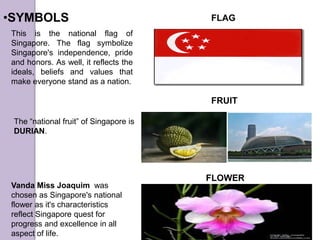
•SYMBOLS
This is the national flag of
Singapore. The flag symbolize
Singapore's independence, pride
and honors. As well, it reflects the
ideals, beliefs and values that
make everyone stand as a nation.
The “national fruit” of Singapore is
DURIAN.
FLAG
FRUIT
Vanda Miss Joaquim was
chosen as Singapore's national
flower as it's characteristics
reflect Singapore quest for
progress and excellence in all
aspect of life.
FLOWER
•ATTRACTIONS
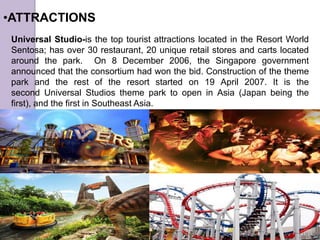
Universal Studio-is the top tourist attractions located in the Resort World
Sentosa; has over 30 restaurant, 20 unique retail stores and carts located
around the park. On 8 December 2006, the Singapore government
announced that the consortium had won the bid. Construction of the theme
park and the rest of the resort started on 19 April 2007. It is the
second Universal Studios theme park to open in Asia (Japan being the
first), and the first in Southeast Asia.
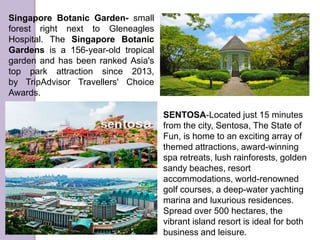
Singapore Botanic Garden- small
forest right next to Gleneagles
Hospital. The Singapore Botanic
Gardens is a 156-year-old tropical
garden and has been ranked Asia's
top park attraction since 2013,
by TripAdvisor Travellers' Choice
Awards.
SENTOSA-Located just 15 minutes
from the city, Sentosa, The State of
Fun, is home to an exciting array of
themed attractions, award-winning
spa retreats, lush rainforests, golden
sandy beaches, resort
accommodations, world-renowned
golf courses, a deep-water yachting
marina and luxurious residences.
Spread over 500 hectares, the
vibrant island resort is ideal for both
business and leisure.
THANK YOU
谢谢
TERIMA KASIH
நன்றி
Thailand
Thailand (Bangkok)
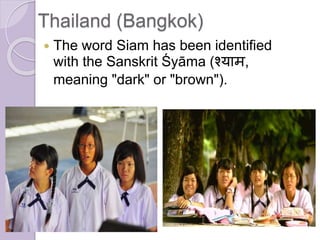
 The word Siam has been identified
with the Sanskrit Śyāma (श्याम,
meaning "dark" or "brown").
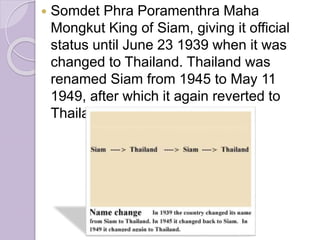
 Somdet Phra Poramenthra Maha
Mongkut King of Siam, giving it official
status until June 23 1939 when it was
changed to Thailand. Thailand was
renamed Siam from 1945 to May 11
1949, after which it again reverted to
Thailand.
Thailand (Bangkok)
 According to George Cœdès, the
word Thai means "free man" in
Siamese, "differentiating the Thai from
the natives encompassed in Thai
society as serfs.“
 A famous Thai scholar argued that
Thai simply means "people" or
"human being", since his investigation
shows that in some rural areas the
word "Thai" was used instead of the
usual Thai word "khon" for people.
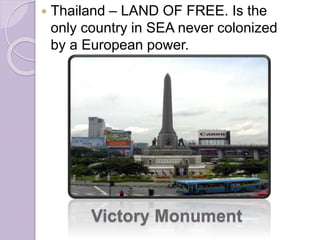
 Thailand – LAND OF FREE. Is the
only country in SEA never colonized
by a European power.
Victory Monument
Victory Monument
 The monument was erected in June
1941 to commemorate the Thai victory in
the Franco-Thai War, a brief conflict
waged against the French colonial
authorities in Indo-China, which resulted
in Thailand annexing some territories in
western Cambodia and northern and
southern Laos. These were among the
territories which the Kingdom of Siam
had been forced to cede to France in
1893 and 1904, and patriotic Thais
considered them rightfully to belong to
Thailand.
Trivia :
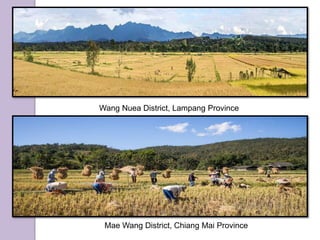
 Thailand is the largest rice exporter in the
world.
 Thailand has reclaimed its position as the
world’s number one rice exporter despite
of its political turmoil. It lost that title two
years ago after holding it for three
decades. New figures show Thailand has
regained the crown but at a cost.
 Thailand has a strong tradition of rice
production. It has the fifth-largest amount
of land under rice cultivation in the
world. Thailand has plans to further
increase the land available for rice
production, with a goal of adding
500,000 hectares to its already 9.2 million
hectares of rice-growing areas.
Wang Nuea District, Lampang Province
Mae Wang District, Chiang Mai Province
Religion
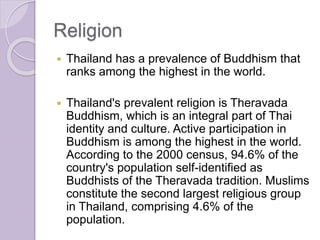
 Thailand has a prevalence of Buddhism that
ranks among the highest in the world.
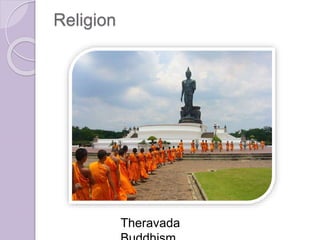
 Thailand's prevalent religion is Theravada
Buddhism, which is an integral part of Thai
identity and culture. Active participation in
Buddhism is among the highest in the world.
According to the 2000 census, 94.6% of the
country's population self-identified as
Buddhists of the Theravada tradition. Muslims
constitute the second largest religious group
in Thailand, comprising 4.6% of the
population.
Religion
Theravada
Bangkok
 Krung Thep meaning “city of Angels”
for short, one of Asia’s top tourist
destinatinations. In 2005, more than
11 million foreign tourist visited the
city.
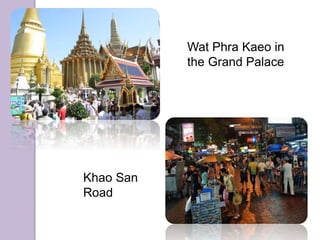
Wat Phra Kaeo in
the Grand Palace
Khao San
Road
 Krungthepmahanakhon Amonrattanakosin
Mahintharayutthaya Mahadilokphop
Noppharatratchathaniburirom
Udomratchaniwetmahasathan
Amonphimanawatansathit
Sakkathattiyawitsanukamprasit
The name, composed
of Pali and Sanskrit root words, translates
as:
 City of angels, great city of immortals,
magnificent city of the nine gems, seat of
the king, city of royal palaces, home of
gods incarnate, erected
by Vishvakarman atIndra's behest.
 The name is listed in Guinness World
Records as the world's longest place name.
Tourist Attractions
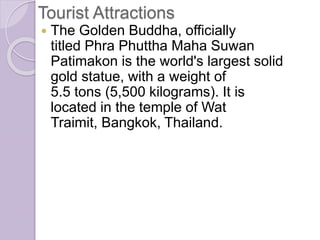
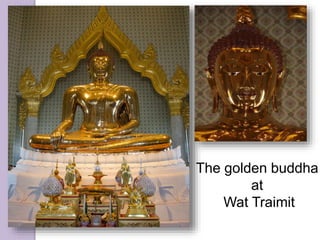
 The Golden Buddha, officially
titled Phra Phuttha Maha Suwan
Patimakon is the world's largest solid
gold statue, with a weight of
5.5 tons (5,500 kilograms). It is
located in the temple of Wat
Traimit, Bangkok, Thailand.
The golden buddha
at
Wat Traimit
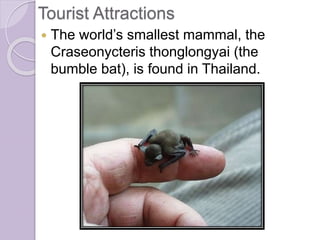
 The world’s smallest mammal, the
Craseonycteris thonglongyai (the
bumble bat), is found in Thailand.
Tourist Attractions
 More than 1,500 species of orchids grow
wild in Thai forests. Thailand is the world’s
number one orchid exporter.
- Thailand remains the world’s largest orchid
exporter with export volume and value
steadily increasing in the past decade.
The centre said Thai orchid exports in the
first half of this year were worth US$36.8
million, an increase of 1.7% compared to
that of the same period of last year.
It said the country now produces 44,000-
45,000 tons a year, or an annual growth of
1%-2%. Half of the production is used
locally and the rest is exported, the centre
said.
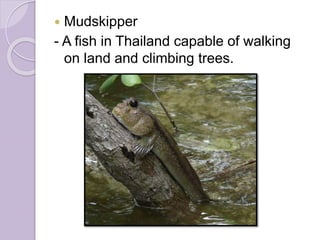
 Mudskipper
- A fish in Thailand capable of walking
on land and climbing trees.
Thank You!!


Asia - World Tourism

  • 1.
  • 2.
  • 3.
    Brunei(Bandar Seri Begawan) Cities Bandar Seri Begawan — the capital, sometimes known as "Bandar" or "BSB" for short.  Bangar — the tiny district capital of Temburong district.  Kuala Belait — town to catch transport to or from Miri, Sarawak.  Muara — main port of Brunei with passenger ferries to Labuan and Sarawak.  Seria — oil capital of Brunei, also known as "Shelltown".  Tutong - full of virgin forest and the beauty of nature including TasekMarimbun
  • 4.
    Abode of Peace Brunei “ Abode of Peace” is a small but - thanks to natural gas and petroleum resources - very rich country located in Southeast Asia. It's surrounded by Malaysia and has two parts physically separated by Malaysia, almost being an enclave. Strategically located on the South China Sea, close to vital sea lanes linking Indian and Pacific Oceans, it has an exclusive economic fishing zone that extends as far as Louisa Reef in the southern Spratly Islands although it makes no public territorial claim to the offshore reefs.
  • 5.
    History  The Sultanateof Brunei's heyday occurred between the 15th and 17th centuries, when its control extended over coastal areas of northwest Borneo and the southern Philippines. Brunei subsequently entered a period of decline brought on by internal strife over royal succession, colonial expansion of European powers, and piracy. In 1888, Brunei became a British protectorate. It was offered the opportunity to join Malaysia as a state in 1963, but opted out of the Federation due to a disagreement on the amount of its oil income that would have to be given to the central government in Kuala Lumpur. Independence was achieved in 1984. The same family has ruled Brunei for over six centuries.
  • 6.
    Culture  Brunei isofficially an Islamic state, with hundreds of large beautiful mosques across the country. Sale of alcohol is banned.Bringing in meat, (other than seafood) which has not been certified "halal", (slaughtered according to Islamic law), is also banned.
  • 7.
    Other destinations  Gadong- shopping centres where the biggest mall in Brunei located. Local markets can be found just next to the building. Full of local shophouses from cheap T-shirt to cheap food, even car's workshop!  Serusop - newly shopping complex.New malls and affordable Times Hotel.Serusop located just 5 min from Brunei International Airport. The new trend for youth hang out place.  TasekMerimbun - famous lake located in Tutong district.  PantaiGadong, PantaiMuara and PantaiSerasa - the must visit beaches in Borneo.  Kiulap - Shophouses and Shopping Mall.  Kampong Ayer - the very old, traditional kind of the Venice of the East. It is not a shopping complex but only cover with full of traditional
  • 8.
    Cuisine  Bruneians loveto eat out and there are many excellent restaurants in Brunei serving a wide variety of cuisines, thanks to the large number of foreign workers in the country.  There is also the local nasikatok, a simple combination of rice and curried beef or chicken, which can be quite spicy. It is relatively inexpensive when compared to other food that you can buy, for example local food such as chicken rice. However, it is not a healthy option, with few vegetables and too much fat.  Another choice is ambuyat, a culinary experience unique to Borneo. It is a starchy and gooey paste made from sago that can be dipped into a savoury sauce.
  • 9.
  • 10.
    Tourist Attraction  Jame’AsrHassanilBolkiahMosque The Jame’AsrHassanilBolkiah Mosque is by far the most splendid one of them all. It is also one of the most important religious sites in the country. It is located in Kampong Kiarong, which is quite close to the nation’s capital. Though it is mainly a place of worship among Muslims, it is open to visits by those not of the faith during Thursdays. You’ll definitely enjoy the architectural masterpieces to be witnessed here.
  • 11.
  • 12.
    Tourist Attraction  RoyalRegalia Museum A tour of the many tourist attractions of Brunei will give you various glimpses into the royal buildings and cultural centers. Not only do they speak of the architectural prowess of the country, they also speak volumes regarding the people’s history. The Royal Regalia Museum is one of the most culturally significant places to visit if you want to understand the people’s culture and history. The collections you will find here portray the regal life of the royal dynasties that ruled the land, which also reflects the political aspects of the nation.
  • 13.
  • 14.
    Tourist Attraction  KampongAyer Kampong Ayer is locally dubbed as the Venice of the East. It is one of the tourist attractions in the country that you shouldn’t miss. This place is sometimes called the ‘water village’. It is quite interesting that the moniker ‘Venice of the East’ wasn’t coined by one of the locals but was given by a foreign visitor.
  • 15.
  • 16.
    Tourist Attraction  Drottningholm Thistourist attraction is actually where the country’s royal family resides. The very first palace built in this site was constructed in the 16th century. However, it was destroyed in 1961 and a new palace was constructed the following year. The place is quite charming and reflects the country’s glory.
  • 17.
  • 18.
    China (Beijing) • Thesecond-largest country in the world by land area after Russia. • The world’s most populous country. • The world’s largest exporter and importer of goods, the world’s second- largest economy.
  • 19.
    Tourist Attraction  Pudong-China’s financial and commercial hub.  Literally "The East Bank of the Huangpu River"- originally referred only to the less-developed land across from Shanghai's Old City and foreign concessions.  May 6, 2009, it was disclosed that the State Council had approved the proposal to merge Nanhui District with Pudong and comprise the majority of eastern Shanghai.  In 2010, Pudong was host to the main venues of the Shanghai Expo, whose grounds now form a public park.  It has an area of 1,210.4 square kilometers (467.3 sq mi) and according
  • 20.
    Tourist Attraction  TerracottaArmy- is a collection of terracotta sculptures depicting the armies of Qin Shi Huang (221 BC-206 BC), the first Emperor of China.  It was discovered in 1974 by local farmers in Lintong District,Xi'an, Shaanxi province.  The figures vary in height according to their roles, with the tallest being the generals. The figures include warriors, chariots and horses.  Estimates from 2007 were that the three pits containing the Terracotta Army held more than 8,000 soldiers, 130 chariots with 520 horses and 150 cavalry horses, the majority of which remained buried in the pits nearby Qin Shi Huang's mausoleum.  Other terracotta non-military figures were found in other pits, including officials, acrobats, strongmen and musicians.
  • 21.
    Tourist Attraction  TheGiant Buddha of Leshan- gigantic Buddha statue carved out of a cliff face in Sichuan.  At 71 meters (233 ft) tall, the statue depicts a seated Maitreya Buddha with his hands resting on his knees. His shoulders are 28 meters wide and his smallest toenail is large enough to easily accommodate a seated person.  There is a local saying: "The mountain is a Buddha and the Buddha is a mountain". This is partially because the mountain range in which the Leshan Giant Buddha is located is thought to be shaped like a slumbering Buddha when seen from the
  • 22.
    Tourist Attraction  ForbiddenCity-world’s largest palace covering 72 hectares. Built from 1406 to 1420 the palace complex consists of 980 surviving buildings with 8,707 rooms.  Forbidden City begins in the 15th century when it was built as the palace of the Ming emperors of China. It is located in the centre of Beijing, China, and was the Chinese imperial palace from the mid-Ming Dynasty to the end of the Qing Dynasty in 1912. It has been a museum since
  • 23.
    Tourist Attraction  TheGreat Wall of China-made of stone, brick, wood, and other materials, built along an east- west line cross the historical northern borders of China in part to protect the Chinese Empire.  The total length of the Great Wall of China building in different dynasties is 13,170.69 miles (21,196.18 kilometers), announced by China's State Administration of Cultural Relics in 2012. The length of the Great Wall of Ming Dynasty (1368-1644) was 5,500.3 miles (8,851.8 kilometers) from Hushan in Liaoning to Jiayuguan Pass in Gansu on
  • 24.
  • 25.
    Malaysia(Kuala Lumpur)  Geography: Malaysiais on the Malay Peninsula in southeast Asia. The nation also includes Sabah and Sarawak on the island of Borneo to the east. Its area slightly exceeds that of New Mexico.
  • 26.
    Tourist Attraction Rafflesia - TheLargest Flower in the World The Rafflesia is the largest flower in the World with recent flowers found measuring up to 95cm (3 feet) across. There are 55 species of Rafflesia, of which 9 are found in Borneo.
  • 27.
    Tourist Attraction Proboscis Monkey -is a reddish-brown arboreal Old World monkey that is endemic to the southeast Asian island of Borneo
  • 28.
    Tourist Attraction Sarawak Chamber -is the largest known cave chamber in the world by area and the second largest by volume after the Miao Room in China. which is located in Gunung Mulu National Park, in the Malaysian state of Sarawak on the island of Borneo.
  • 29.
    Tourist Attraction Blocasia Macrorrhiza -is a species of flowering plant in the arum family, Araceae, that it is native to rainforests from Malaysia to Queensland
  • 30.
    Tourist Attraction Penang Bridge -The bridge is the second-longest bridge in Malaysia and the fifth-longest in Southeast Asia by total length, with a length over water of 8.4 kilometres
  • 31.
    Tourist Attraction Petronas TwinTower - The towers feature a double decker skybridge connecting the two towers on the 41st and 42nd floors, which is the highest 2-story bridge in the world.
  • 32.
    Tourist Attraction Tioman Island -is a small island located 32 km off the east coast of Peninsular Malaysia in the state of Pahang.
  • 34.
    Tourist Attraction Mulu Caves Located in the Gunung Mulu National Park; has incredible caves and karst (landscape caused by limestone) formation.
  • 35.
  • 36.
    South Korea (Seoul) •Population: 51,302,044 (2014) • Has about 3000 islands but mostly small and uninhabited. • Its total area is 100,032 square kilometres (38,622.57 sq mi) • Officially called as Republic of Korea (Daehan Minguk) • The name Korea is derived from Goryeo, a dynasty which ruled in the middle ages. • Due to Hallyu, South Korea welcomed more than 12 million visitors in 2013 with 6 million tourists coming from China alone, making them the 20th most visited country in the world. • Asia’s fourth largest economy.
  • 37.
    Jeju-do It is thecountry’s largest Island, the site of South korea’s highest point: Hallasan, an extinct volcano (1,950 meters or 6,398 ft above sea level) Tourist Attraction
  • 38.
  • 39.
    Gyeongju The city isactually referred as the museum without walls because the city has numerous historical sites. Bulguksa Temple Seokguram Grotto Tourist Attraction
  • 40.
    Seoraksan 1,708 m (5,604ft) Seoraksan is the highest mountain in the Taebaek mountain range in the Gangwon Province in eastern South Korea. It is the third highest mountain in South Korea. Tourist Attraction
  • 41.
    Busan Busan, a largeport city in South Korea, is known for its beaches, mountains and temples. The very famous Haeundae Beach is also located in Busan. Tourist Attraction
  • 42.
    N Seoul Tower Commonlyknown as the Namsan Tower or Seoul Tower, is a communication and observation tower located on Namsan Mountain in central Seoul, South Korea. At 236m, it marks the highest point in Seoul. Tourist Attraction
  • 43.
  • 44.
    SINGAPORE •Capital : SingaporeCity •Nickname : The Lion City Singapore occupies an area of 718 km².The Republic of Singapore, is a leading global city-state and island country in Southeast Asia. The lion head symbol was introduced in 1986 as an alternative national symbol of Singapore. The lion head was chosen as a logo, as it best captures the characteristics of Singapore's reputation as a Lion City.
  • 45.
    Singapore is consist63 islands, including the main island, widely known SINGAPORE ISLAND but also known as PULAU UJONG. Singapore's main territory is a diamond-shaped island, although its territory includes surrounding smaller islands. The farthest outlying island is Pedra Branca. Of all Singapore's dozens of smaller islands, Jurong Island, PulauTekong, Pulau Ubin and Sentosa are the larger ones. Most of Singapore is no more than 15 meters above sea level. •GEOGRAPHY
  • 46.
    •ECONOMY Singapore was thefourth-leading financial centre, and its ports is one of the five busiest ports in the world. PSA Singapore Terminals is designed to operate a total of 57 berths at its container terminals in Tanjong Pagar, Keppel, Brani and Pasir Panjang. They operate as one seamless and integrated facility. •POPULATION Singapore population is highly varied; the majority are Chinese with almost 75% of the total population, while Malays and Indians forming a significant minorities. Singapore's total population was 5.47 million as of June 2014. The total population grew by 1.3% from June 2013 to June 2014, the slowest growth rate in the last decade.
  • 47.
    •RELIGION Buddhism is themost widely practice religion in Singapore. Together with Buddhism, Islam and Hinduism, Christianity is considered one of the four main religion today.Christianity in Singapore is not tied to a particular ethnic or racial group, although most Christians are Chinese. •LANGUAGE Singapore’s four official language: English, Mandarin, Malay, and Tamil.
  • 48.
    •SYMBOLS This is thenational flag of Singapore. The flag symbolize Singapore's independence, pride and honors. As well, it reflects the ideals, beliefs and values that make everyone stand as a nation. The “national fruit” of Singapore is DURIAN. FLAG FRUIT Vanda Miss Joaquim was chosen as Singapore's national flower as it's characteristics reflect Singapore quest for progress and excellence in all aspect of life. FLOWER
  • 49.
    •ATTRACTIONS Universal Studio-is thetop tourist attractions located in the Resort World Sentosa; has over 30 restaurant, 20 unique retail stores and carts located around the park. On 8 December 2006, the Singapore government announced that the consortium had won the bid. Construction of the theme park and the rest of the resort started on 19 April 2007. It is the second Universal Studios theme park to open in Asia (Japan being the first), and the first in Southeast Asia.
  • 50.
    Singapore Botanic Garden-small forest right next to Gleneagles Hospital. The Singapore Botanic Gardens is a 156-year-old tropical garden and has been ranked Asia's top park attraction since 2013, by TripAdvisor Travellers' Choice Awards. SENTOSA-Located just 15 minutes from the city, Sentosa, The State of Fun, is home to an exciting array of themed attractions, award-winning spa retreats, lush rainforests, golden sandy beaches, resort accommodations, world-renowned golf courses, a deep-water yachting marina and luxurious residences. Spread over 500 hectares, the vibrant island resort is ideal for both business and leisure.
  • 51.
  • 52.
  • 53.
    Thailand (Bangkok)  Theword Siam has been identified with the Sanskrit Śyāma (श्याम, meaning "dark" or "brown").
  • 54.
     Somdet PhraPoramenthra Maha Mongkut King of Siam, giving it official status until June 23 1939 when it was changed to Thailand. Thailand was renamed Siam from 1945 to May 11 1949, after which it again reverted to Thailand.
  • 55.
    Thailand (Bangkok)  Accordingto George Cœdès, the word Thai means "free man" in Siamese, "differentiating the Thai from the natives encompassed in Thai society as serfs.“  A famous Thai scholar argued that Thai simply means "people" or "human being", since his investigation shows that in some rural areas the word "Thai" was used instead of the usual Thai word "khon" for people.
  • 56.
     Thailand –LAND OF FREE. Is the only country in SEA never colonized by a European power. Victory Monument
  • 57.
    Victory Monument  Themonument was erected in June 1941 to commemorate the Thai victory in the Franco-Thai War, a brief conflict waged against the French colonial authorities in Indo-China, which resulted in Thailand annexing some territories in western Cambodia and northern and southern Laos. These were among the territories which the Kingdom of Siam had been forced to cede to France in 1893 and 1904, and patriotic Thais considered them rightfully to belong to Thailand.
  • 58.
    Trivia :  Thailandis the largest rice exporter in the world.  Thailand has reclaimed its position as the world’s number one rice exporter despite of its political turmoil. It lost that title two years ago after holding it for three decades. New figures show Thailand has regained the crown but at a cost.  Thailand has a strong tradition of rice production. It has the fifth-largest amount of land under rice cultivation in the world. Thailand has plans to further increase the land available for rice production, with a goal of adding 500,000 hectares to its already 9.2 million hectares of rice-growing areas.
  • 59.
    Wang Nuea District,Lampang Province Mae Wang District, Chiang Mai Province
  • 60.
    Religion  Thailand hasa prevalence of Buddhism that ranks among the highest in the world.  Thailand's prevalent religion is Theravada Buddhism, which is an integral part of Thai identity and culture. Active participation in Buddhism is among the highest in the world. According to the 2000 census, 94.6% of the country's population self-identified as Buddhists of the Theravada tradition. Muslims constitute the second largest religious group in Thailand, comprising 4.6% of the population.
  • 61.
  • 62.
    Bangkok  Krung Thepmeaning “city of Angels” for short, one of Asia’s top tourist destinatinations. In 2005, more than 11 million foreign tourist visited the city.
  • 63.
    Wat Phra Kaeoin the Grand Palace Khao San Road
  • 64.
     Krungthepmahanakhon Amonrattanakosin MahintharayutthayaMahadilokphop Noppharatratchathaniburirom Udomratchaniwetmahasathan Amonphimanawatansathit Sakkathattiyawitsanukamprasit The name, composed of Pali and Sanskrit root words, translates as:  City of angels, great city of immortals, magnificent city of the nine gems, seat of the king, city of royal palaces, home of gods incarnate, erected by Vishvakarman atIndra's behest.  The name is listed in Guinness World Records as the world's longest place name.
  • 65.
    Tourist Attractions  TheGolden Buddha, officially titled Phra Phuttha Maha Suwan Patimakon is the world's largest solid gold statue, with a weight of 5.5 tons (5,500 kilograms). It is located in the temple of Wat Traimit, Bangkok, Thailand.
  • 66.
  • 67.
     The world’ssmallest mammal, the Craseonycteris thonglongyai (the bumble bat), is found in Thailand. Tourist Attractions
  • 68.
     More than1,500 species of orchids grow wild in Thai forests. Thailand is the world’s number one orchid exporter. - Thailand remains the world’s largest orchid exporter with export volume and value steadily increasing in the past decade. The centre said Thai orchid exports in the first half of this year were worth US$36.8 million, an increase of 1.7% compared to that of the same period of last year. It said the country now produces 44,000- 45,000 tons a year, or an annual growth of 1%-2%. Half of the production is used locally and the rest is exported, the centre said.
  • 69.
     Mudskipper - Afish in Thailand capable of walking on land and climbing trees.
  • 70.