BRAZIL

By,
Deeksha.G
ABOUT BRAZIL
 Brazil officially the Federative Republic of Brazil is







the largest country in both South America and
the Latin America region.
It is the world's fifth largest country, both
by geographical area and by population.
Bounded by the Atlantic Ocean on the east, Brazil has
a coastline of 7,491 km.
It borders all other South American countries
except Ecuador and Chile and occupies 47 percent of
the continent of South America.
The Brazilian economy is the world's seventh
largest by nominal GDP and the seventh largest by
purchasing power parity.
GDP OF BRAZIL
 Brazil has the sixth largest economy by







nominal GDP in the world, and seventh
largest purchasing power parity.
The GDP value of Brazil represents 3.93 percent of
the world economy IN 2012.
6th position in GDP with 2,476,651millions of
US$(2012)
5th position is expected by 2020 with 3,674,184
millions of US$.
GDP (PPP): $2.422 trillion IN 2013.
GDP (nominal): $2.190 trillion
IMPORTS AND EXPORTS OF
BRAZIL
 MAJOR EXPORTS

Iron ores and concentrates (15%), Petroleum oils, crude
(8%), Raw sugar, cane (6%), Soya beans (5%), Poultry
(3%).
 MAJOR IMPORTS
Cars (6%), Petroleum oils, refined (5%), Parts and
accessories of the motor vehicles (4%), Electronic
integrated circuits (3%), Medicaments, packaged (2%).
MAJOR TRADE PARTNERS (EXPORTS)
China (15%), United States (10%), Argentina (9%),
Netherlands (4%), Germany (4%).
 MAJOR TRADE PARTNERS (IMPORTS)
United States (18%), China (16%), Argentina (10%),
Germany (8%), Korea, Rep. (5%)
 MAIN INDUSTRIES

Textiles, shoes, chemicals, cement , lumber iron
ore, tin, steel, aircraft , motor vehicles and parts
other machinery and equipment.
ECONOMY
 Brazil is the largest national economy in Latin

America, the world's seventh largest economy at
market exchange rates and the seventh
largest in purchasing power parity(PPP),
according to the International Monetary Fund and
the World Bank. Brazil has a mixed economy with
abundant natural resources.
 Brazil has a labor force of over a 107 million
(ranking 6th worldwide) and unemployment of
6.2% (ranking 64th worldwide).
 The country has been expanding its presence in
international financial and commodities markets
and is one of a group of four emerging economies
called the BRIC countries
TOURISM
 Tourism in Brazil is a growing sector and key to the economy of several regions of the

country. The country had 5 million visitors, ranking in terms of international tourist
arrivals as the second destination in South America, and third in Latin America
after Mexico and Argentina. Revenues from international tourists
reached US$6 billion. Historical records of 5.4 million visitors and US$6.8 billion in
receipts were reached in 2011.
DEMOGRAPHICS
 The population of Brazil, as recorded by the 2008

PNAD, was approximately 190 million (22.31 inhabitants
per square kilometre or 57.8 /sq mi), with a ratio of men
to women of 0.95:1 and 83.75% of the population
defined as urban.
 The population is heavily concentrated in the
Southeastern (79.8 million inhabitants) and Northeastern
(53.5 million inhabitants) regions, while the two most
extensive regions, the Center-West and the North, which
together make up 64.12% of the Brazilian territory, have
a total of only 29.1 million inhabitants.
Race and ethnicity
Ethnicity
 White
 Pardo (Multiracial)
 Black
 Asian  
 Amerindian

Percentage
47.7%
43.1%
7.6%
1.1%
0.4%
RELIGION
Religion
 Roman Catholicism
 Protestantism
 No religion
 Spiritism
 Others

Percent
64.6%
22.2%
8.0%
2.0%
3.2%

LANGUAGE
 The official language of Brazil is Portuguese which almost all of the

population speaks and is virtually the only language used in
newspapers, radio, television, and for business and administrative
purposes. The most famous exception to this is a strong sign language
law that was passed by the National Congress of Brazil.
BRAZIL CURRENCY AGAINST
RUPEE AND DOLLAR
INR - Indian Rupee
 Country: India
 Region:Asia
 Sub-Unit:1 Rupee = 100 paise
 Symbol: .
BRL - Brazilian Real
 Country:Brazil
 Region:South America
 Sub-Unit:1 Real = 100 centavo
 Symbol:R$
AGAINST DOLLAR$
 1 Brazilian Real equals
 0.42 US Dollar
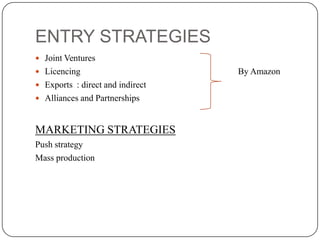
ENTRY STRATEGIES
 Joint Ventures
 Licencing

 Exports : direct and indirect
 Alliances and Partnerships

MARKETING STRATEGIES
Push strategy
Mass production

By Amazon
India -Brazil: Opportunities and Challenge
 In the last decade, India’s trade with Brazil has

jumped from $800 million to over $10 billion.
 Brazil’s widening middle class has increased the
country’s level of disposable income per capita.
Large oil and gas discoveries in the Santos
Basin, and sufficient, fast growing sugar cane
offer a natural resource for the biofuels industry.
Companies that can have product to support the
newly emerged middle class consumer or that
can serve the oil and gas and/or biofuel industry
should prosper in Brazil.india can import oil from
bazil.

Brazil

  • 1.
  • 2.
    ABOUT BRAZIL  Brazilofficially the Federative Republic of Brazil is     the largest country in both South America and the Latin America region. It is the world's fifth largest country, both by geographical area and by population. Bounded by the Atlantic Ocean on the east, Brazil has a coastline of 7,491 km. It borders all other South American countries except Ecuador and Chile and occupies 47 percent of the continent of South America. The Brazilian economy is the world's seventh largest by nominal GDP and the seventh largest by purchasing power parity.
  • 3.
    GDP OF BRAZIL Brazil has the sixth largest economy by      nominal GDP in the world, and seventh largest purchasing power parity. The GDP value of Brazil represents 3.93 percent of the world economy IN 2012. 6th position in GDP with 2,476,651millions of US$(2012) 5th position is expected by 2020 with 3,674,184 millions of US$. GDP (PPP): $2.422 trillion IN 2013. GDP (nominal): $2.190 trillion
  • 4.
    IMPORTS AND EXPORTSOF BRAZIL  MAJOR EXPORTS Iron ores and concentrates (15%), Petroleum oils, crude (8%), Raw sugar, cane (6%), Soya beans (5%), Poultry (3%).  MAJOR IMPORTS Cars (6%), Petroleum oils, refined (5%), Parts and accessories of the motor vehicles (4%), Electronic integrated circuits (3%), Medicaments, packaged (2%). MAJOR TRADE PARTNERS (EXPORTS) China (15%), United States (10%), Argentina (9%), Netherlands (4%), Germany (4%).  MAJOR TRADE PARTNERS (IMPORTS) United States (18%), China (16%), Argentina (10%), Germany (8%), Korea, Rep. (5%)
  • 5.
     MAIN INDUSTRIES Textiles,shoes, chemicals, cement , lumber iron ore, tin, steel, aircraft , motor vehicles and parts other machinery and equipment.
  • 6.
    ECONOMY  Brazil isthe largest national economy in Latin America, the world's seventh largest economy at market exchange rates and the seventh largest in purchasing power parity(PPP), according to the International Monetary Fund and the World Bank. Brazil has a mixed economy with abundant natural resources.  Brazil has a labor force of over a 107 million (ranking 6th worldwide) and unemployment of 6.2% (ranking 64th worldwide).  The country has been expanding its presence in international financial and commodities markets and is one of a group of four emerging economies called the BRIC countries
  • 7.
    TOURISM  Tourism inBrazil is a growing sector and key to the economy of several regions of the country. The country had 5 million visitors, ranking in terms of international tourist arrivals as the second destination in South America, and third in Latin America after Mexico and Argentina. Revenues from international tourists reached US$6 billion. Historical records of 5.4 million visitors and US$6.8 billion in receipts were reached in 2011.
  • 8.
    DEMOGRAPHICS  The populationof Brazil, as recorded by the 2008 PNAD, was approximately 190 million (22.31 inhabitants per square kilometre or 57.8 /sq mi), with a ratio of men to women of 0.95:1 and 83.75% of the population defined as urban.  The population is heavily concentrated in the Southeastern (79.8 million inhabitants) and Northeastern (53.5 million inhabitants) regions, while the two most extensive regions, the Center-West and the North, which together make up 64.12% of the Brazilian territory, have a total of only 29.1 million inhabitants.
  • 9.
    Race and ethnicity Ethnicity White  Pardo (Multiracial)  Black  Asian    Amerindian Percentage 47.7% 43.1% 7.6% 1.1% 0.4%
  • 10.
    RELIGION Religion  Roman Catholicism Protestantism  No religion  Spiritism  Others Percent 64.6% 22.2% 8.0% 2.0% 3.2% LANGUAGE  The official language of Brazil is Portuguese which almost all of the population speaks and is virtually the only language used in newspapers, radio, television, and for business and administrative purposes. The most famous exception to this is a strong sign language law that was passed by the National Congress of Brazil.
  • 11.
    BRAZIL CURRENCY AGAINST RUPEEAND DOLLAR INR - Indian Rupee  Country: India  Region:Asia  Sub-Unit:1 Rupee = 100 paise  Symbol: . BRL - Brazilian Real  Country:Brazil  Region:South America  Sub-Unit:1 Real = 100 centavo  Symbol:R$ AGAINST DOLLAR$  1 Brazilian Real equals  0.42 US Dollar
  • 12.
    ENTRY STRATEGIES  JointVentures  Licencing  Exports : direct and indirect  Alliances and Partnerships MARKETING STRATEGIES Push strategy Mass production By Amazon
  • 13.
    India -Brazil: Opportunitiesand Challenge  In the last decade, India’s trade with Brazil has jumped from $800 million to over $10 billion.  Brazil’s widening middle class has increased the country’s level of disposable income per capita. Large oil and gas discoveries in the Santos Basin, and sufficient, fast growing sugar cane offer a natural resource for the biofuels industry. Companies that can have product to support the newly emerged middle class consumer or that can serve the oil and gas and/or biofuel industry should prosper in Brazil.india can import oil from bazil.