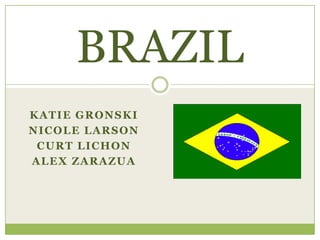
KATIE GRONSKINICOLE LARSONCURT LICHONALEX ZARAZUABRAZIL
Quick Brazil FactsRegion: South America Population: 194,747,347 Area Total: 8,511,965km2Capital: Brasilia Climate: Mostly tropical Languages: Portuguese (official)
CULTURAL ANALYSISRelevant HistoryGeographic SettingSocial InstitutionsReligion Living ConditionsLanguage
Relevant HistoryIn 1500 Pedro AlvaresCabrai claimed Brazil for the Portuguese.Brazil gained it’s independence from Portugal in 1822.Abolished slavery in 1888.Main export was coffee.
Geographical SettingLocated in the northeastern part of South America.Slightly smaller than the United States. 5th largest country in the world.Largest country in Latin America.“Land of Contrasts”
SocialInstitutions“Family” is not just thought of as nuclear family but as extended family.Godparents play an important role in a child’s life. Children typically live at home until they are married. Parental roles vary by region.
Social InstitutionsFamilies are becoming more urbanized.Women are leaving home and moving into the workforce.Religious marriages are decreasing.Ask the woman’s father for permission!!Infidelity is very common in Brazil.Family heritage is traced paternally.
Social InstitutionsLiteracy rate throughout Brazil is 88%.Children are required to attend school for a minimum of 8 years. Each Brazilian state has a governor and legislature. Brazil is based on Roman Code.
Social InstitutionsRule of Thumb for business in Brazil:Kiss, bow, or shake hands Patience is the most important virtue. Forceful attitudes are offensive.View themselves as Americans not South Americans.Punctuality is not important!
Religion and Aesthetics74% of Brazilians are Roman Catholic.Other religions…Protestant:  15.4%
Spiritualist:  1.3%
Voodoo:   .3%
Other:   1.8%
No religion:   7.4%Giving the “ok” to a Brazilian is offensive!!
Living ConditionsBiggest meal is eaten in the middle of the day.Types of food consumed is determined by class level. Main dish for all Brazilians to consume is rice, beans, and manioc.
Living ConditionsHousing in urban Brazil is very similar to the United States.Generally houses have two stories.Construct taller walls and have guard dogs to deter criminals. Brazilians are faced with water shortages so water tanks are placed on the roof to alleviate issues.
Living ConditionsType of clothing varies in rural and urban areas. Women like to appear flirtatious so they wear sexy clothes which include short skirts. Men wear slacks with a dress shirt. Shorts are only wore if they are going to the beach.Rural areas have a more “cowboy” appearance. Indigenous people wear face paint and traditional tunics.
Living Conditions Soccer is Brazil’s passion!!! Rio de Janerio is home to the largest soccer stadium in the world which seats 200,000 people. Brazilian women are known for watching soap operas. Lower class individuals go to samba school.
LanguageA majormisconception is that their official language is Spanish and Brazilians view this as very offensive!
Other languages:
German
Italian
Japanese
Korean
Spanish
Baltic Main language is Portuguese. There are more than 200 tribal groups that speak indigenous languages. Some upper class individuals speak English.

Brazil Marketing Plan

  • 1.
    KATIE GRONSKINICOLE LARSONCURTLICHONALEX ZARAZUABRAZIL
  • 2.
    Quick Brazil FactsRegion:South America Population: 194,747,347 Area Total: 8,511,965km2Capital: Brasilia Climate: Mostly tropical Languages: Portuguese (official)
  • 3.
    CULTURAL ANALYSISRelevant HistoryGeographicSettingSocial InstitutionsReligion Living ConditionsLanguage
  • 4.
    Relevant HistoryIn 1500Pedro AlvaresCabrai claimed Brazil for the Portuguese.Brazil gained it’s independence from Portugal in 1822.Abolished slavery in 1888.Main export was coffee.
  • 5.
    Geographical SettingLocated inthe northeastern part of South America.Slightly smaller than the United States. 5th largest country in the world.Largest country in Latin America.“Land of Contrasts”
  • 6.
    SocialInstitutions“Family” is notjust thought of as nuclear family but as extended family.Godparents play an important role in a child’s life. Children typically live at home until they are married. Parental roles vary by region.
  • 7.
    Social InstitutionsFamilies arebecoming more urbanized.Women are leaving home and moving into the workforce.Religious marriages are decreasing.Ask the woman’s father for permission!!Infidelity is very common in Brazil.Family heritage is traced paternally.
  • 8.
    Social InstitutionsLiteracy ratethroughout Brazil is 88%.Children are required to attend school for a minimum of 8 years. Each Brazilian state has a governor and legislature. Brazil is based on Roman Code.
  • 9.
    Social InstitutionsRule ofThumb for business in Brazil:Kiss, bow, or shake hands Patience is the most important virtue. Forceful attitudes are offensive.View themselves as Americans not South Americans.Punctuality is not important!
  • 10.
    Religion and Aesthetics74%of Brazilians are Roman Catholic.Other religions…Protestant: 15.4%
  • 11.
  • 12.
  • 13.
  • 14.
    No religion: 7.4%Giving the “ok” to a Brazilian is offensive!!
  • 15.
    Living ConditionsBiggest mealis eaten in the middle of the day.Types of food consumed is determined by class level. Main dish for all Brazilians to consume is rice, beans, and manioc.
  • 16.
    Living ConditionsHousing inurban Brazil is very similar to the United States.Generally houses have two stories.Construct taller walls and have guard dogs to deter criminals. Brazilians are faced with water shortages so water tanks are placed on the roof to alleviate issues.
  • 17.
    Living ConditionsType ofclothing varies in rural and urban areas. Women like to appear flirtatious so they wear sexy clothes which include short skirts. Men wear slacks with a dress shirt. Shorts are only wore if they are going to the beach.Rural areas have a more “cowboy” appearance. Indigenous people wear face paint and traditional tunics.
  • 18.
    Living Conditions Socceris Brazil’s passion!!! Rio de Janerio is home to the largest soccer stadium in the world which seats 200,000 people. Brazilian women are known for watching soap operas. Lower class individuals go to samba school.
  • 19.
    LanguageA majormisconception isthat their official language is Spanish and Brazilians view this as very offensive!
  • 20.
  • 21.
  • 22.
  • 23.
  • 24.
  • 25.
  • 26.
    Baltic Main languageis Portuguese. There are more than 200 tribal groups that speak indigenous languages. Some upper class individuals speak English.