Moderator: Anastasia O’Rourke Sustainable Purchasing Leadership
Council @SPLCouncil
Panelists from: Shelton Group, Sustainable Purchasing Leadership
Council
Sustainable Purchasing: Reimagining
Principles and Practices for Mainstream
Adoption
#SB14sd
Introducing the
Sustainable Purchasing Leadership Council

Christina Macken
Director of Programs
christina@purchasingcouncil.org
For more information:
!4
Founders Circle
U.S.
DEPARTMENT

of
AGRICULTURE
Strategic Partners
!6
What is leadership?
Managers do things right.

Leaders do the right thing.
Opportunity for strategic leadership
!9
Analysis by TRUTHstudio based on US Bureau of Economic Analysis 2011 Summary Use Annual I-O Table
Opportunity: Institutional purchasers shape markets. 

!10
$
Opportunity: Institutional purchasers shape markets. 

!11
Opportunity: Institutional purchasers shape markets. 

!12
• demand transparency into the upstream and
downstream impacts of goods and services.
• incorporate sustainability criteria into
purchasing decisions at a scale that can shift
markets.
• drive down the cost of sustainable products
and services so that everyone can afford them.
• ensure that end-users understand, like and
adopt new products and services.
Purchasing organizations are uniquely positioned to:
Challenge: Lack of coordination. 

!13
$
$
$ $
$
$
$
$
$
$$
$
Challenge: Lack of coordination. 

!14
Root Challenge
!15
The lack of standardization in
how sustainable purchasing is
defined, guided, measured,
and rewarded.
!16
A blue sky idea.
!17
Source: Wikimedia Commons (Creative Commons Attribution-Share Alike 2.0 Generic license. Attribution: Simon Johnston)
A big tent.
!18
Solution: Build a community of collaboration.
!19
Solution: Send coordinated market signals.
To support and recognize
purchasing leadership that
accelerates the transition 

to a prosperous and 

sustainable future.
Mission
A collaborative space where a
community of purpose convenes
to define, pursue, and promote
sustainability leadership in
institutional procurement.
Structure
!22
!23
SPLC Programs
Environmental Impacts
Increase these…
• biodiversity preservation
• climate adaptation
• resource optimization
• soil health stewardship
Decrease these…
• acidification
• desertification
• eutrophication
• freshwater pollution
• greenhouse gas emissions
• habitat depletion
• human health impacts
• land use change
• marine pollution
• ozone depletion
• radiation pollution
• resource depletion
• smog
• waste
• water consumption
Social Impacts
Increase these…
• anti-discrimination
• community engagement
• diversity/equal opportunity
• employee engagement
• equal remuneration
• fair trade
• freedom of association
• grievance & remedy processes
• human rights
• indigenous rights
• occupational health & safety
• right to collective bargaining
• sustainable compensation
• training and education
• worker rights
Decrease these…
• child labor
• forced/compulsory labor
• human trafficking
• sourcing from conflict
zones
Economic Impacts
Increase these…
• fair dealings
• innovation research /
investment
• open competition
• transparency of information
• use of diverse suppliers
• use of HUB zones
• use of local suppliers
Decrease these…
• conflicts of interest
• corruption (bribery, extortion…)
• dividing territories
• dumping
• exclusive dealing
• misleading market claims
• monopoly (seller collusion)
• monopsony(buyer collusion)
• patent misuse
• price fixing
• product tying
• refusal to deal
Group Exercise
Consider and answer the following questions
in small groups:
!
Which impacts described is your company
addressing and measuring impacts?
Group Reflection
!
!
What can SPLC do to better engage your
community and help brands position
yourselves as leaders along ESE impacts?
!
!
THANK YOU!
Q&A
+
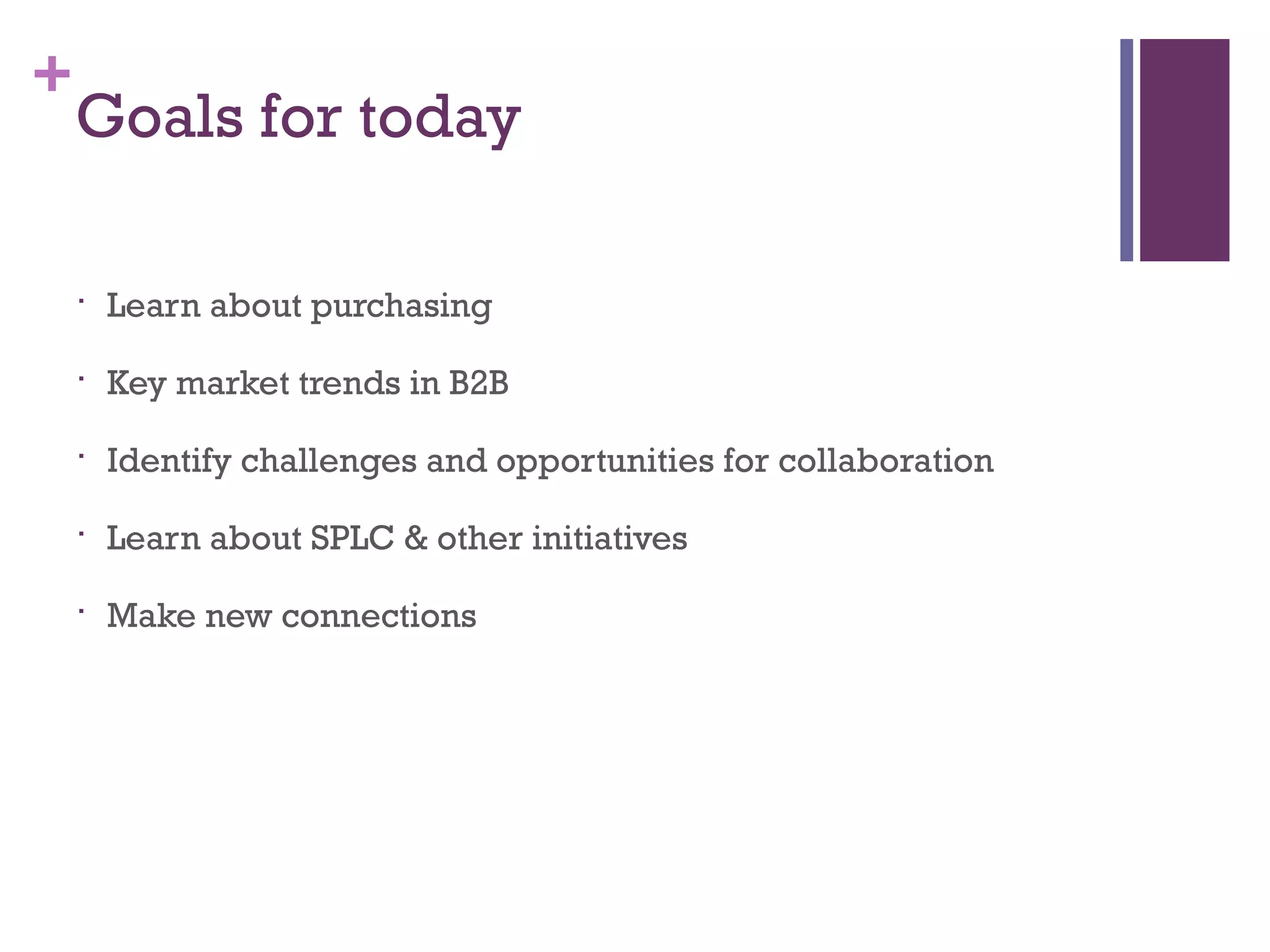
Goals for today
■ Learn about purchasing	

■ Key market trends in B2B	

■ Identify challenges and opportunities for collaboration	

■ Learn about SPLC & other initiatives 	

■ Make new connections
+
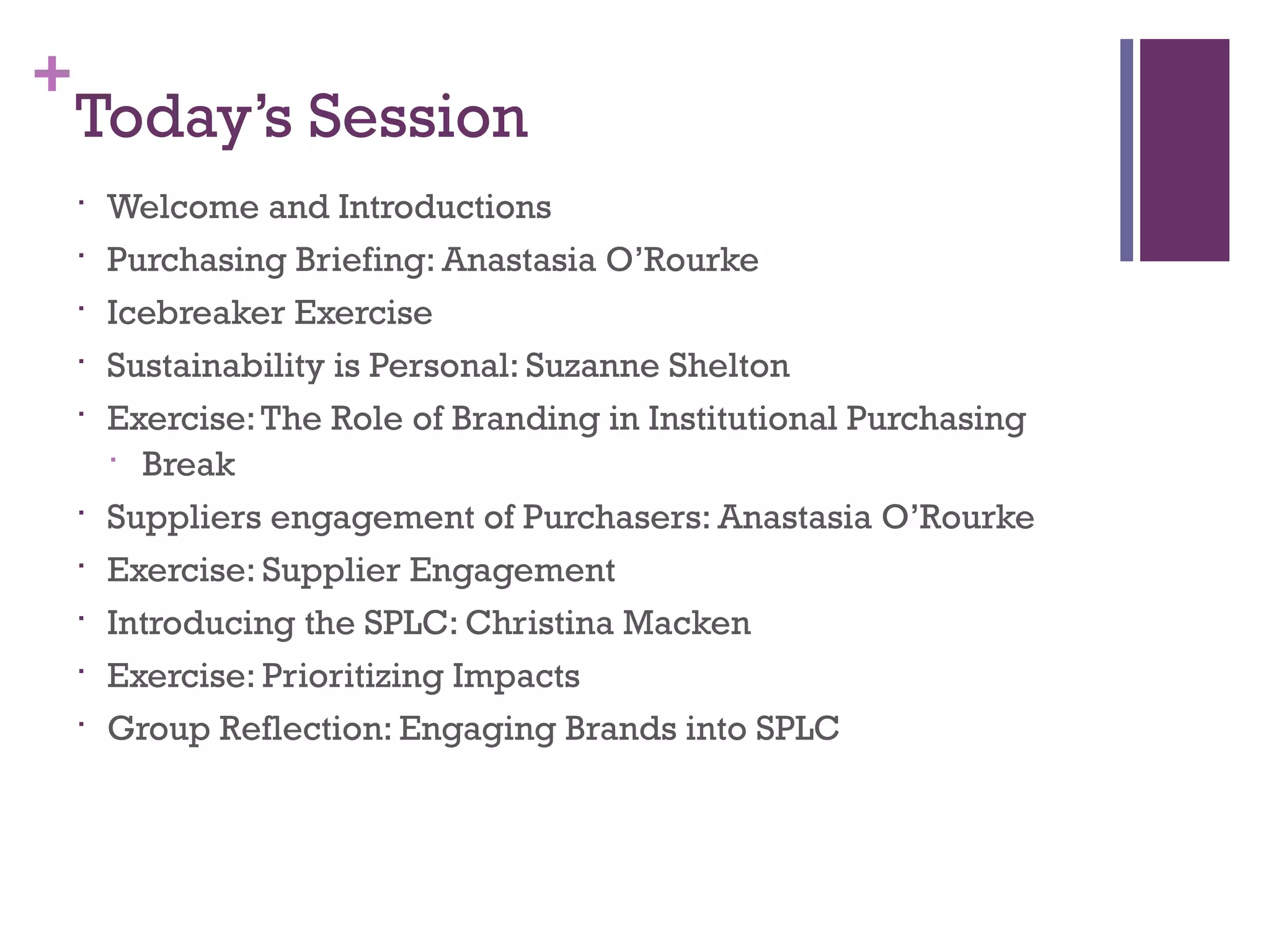
Today’s Session
■ Welcome and Introductions	

■ Purchasing Briefing: Anastasia O’Rourke	

■ Icebreaker Exercise 	

■ Sustainability is Personal: Suzanne Shelton	

■ Exercise: The Role of Branding in Institutional Purchasing 	

■ Break	

■ Suppliers engagement of Purchasers: Anastasia O’Rourke	

■ Exercise: Supplier Engagement	

■ Introducing the SPLC: Christina Macken	

■ Exercise: Prioritizing Impacts 	

■ Group Reflection: Engaging Brands into SPLC
+
The customer is always right:

A briefing on Purchasing and
Procurement
Dr. Anastasia O’Rourke
Chair Elect, Sustainable Purchasing Leadership Council
Sustainable Brands Workshop, June 2 2014
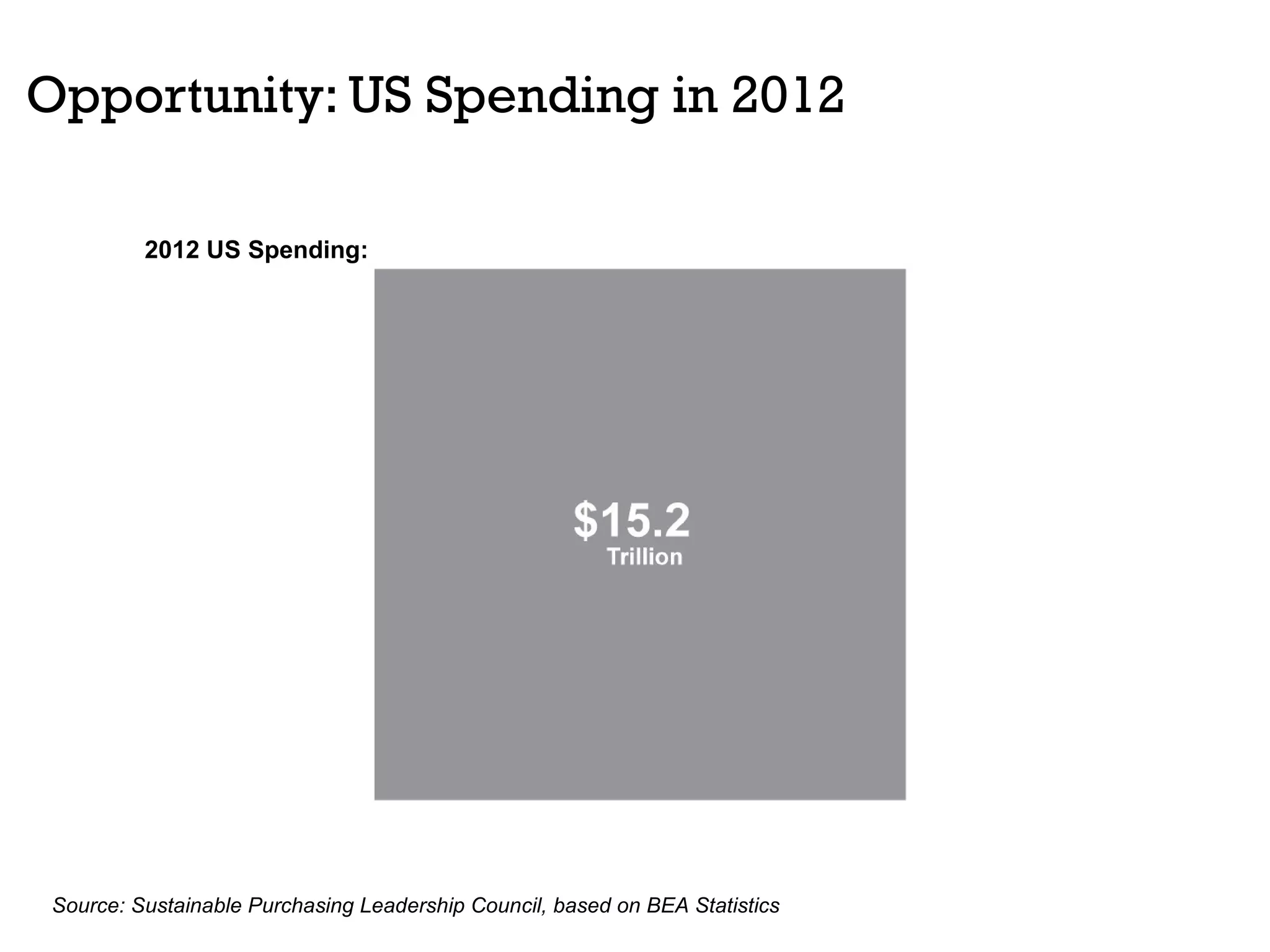
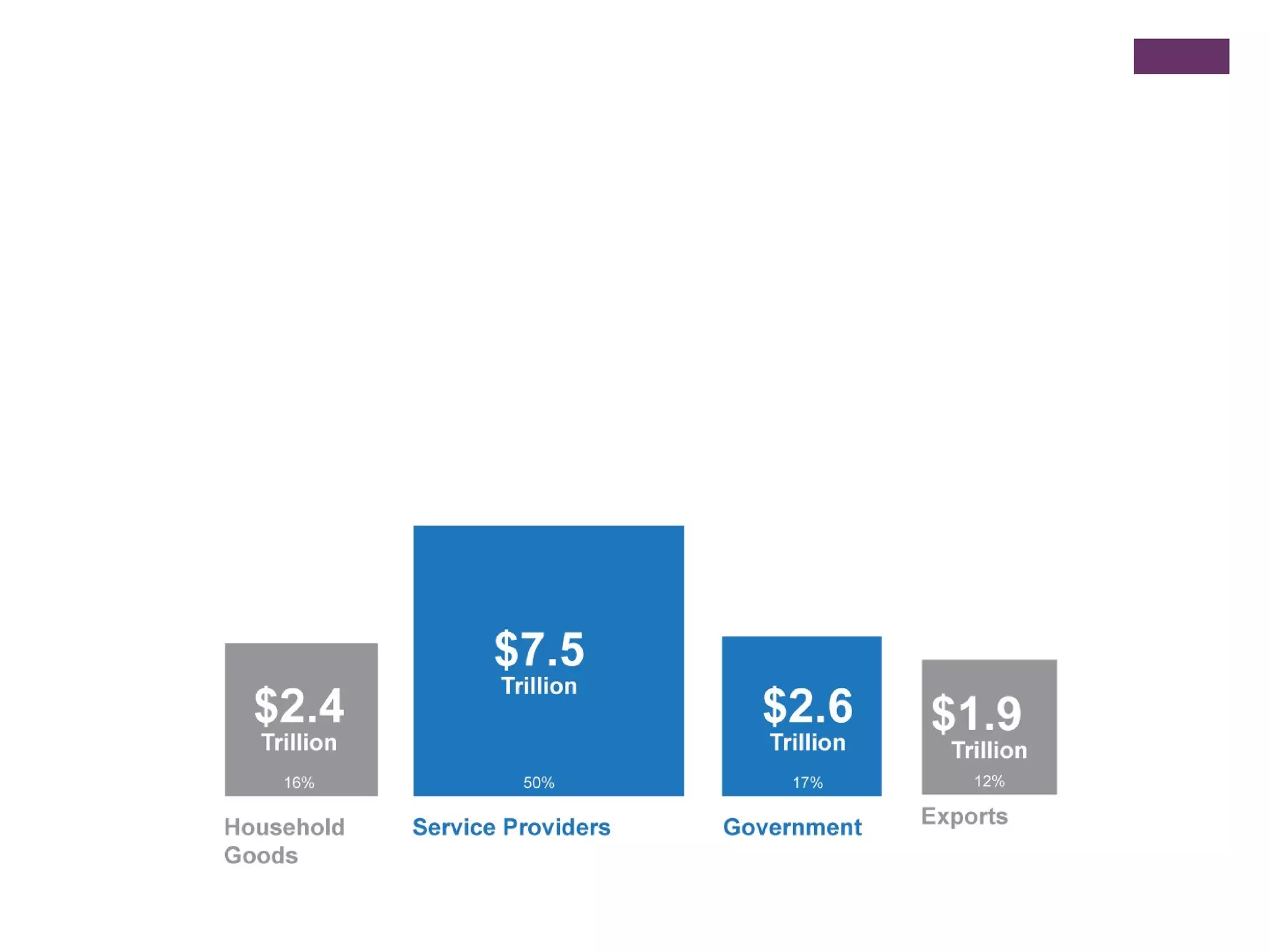
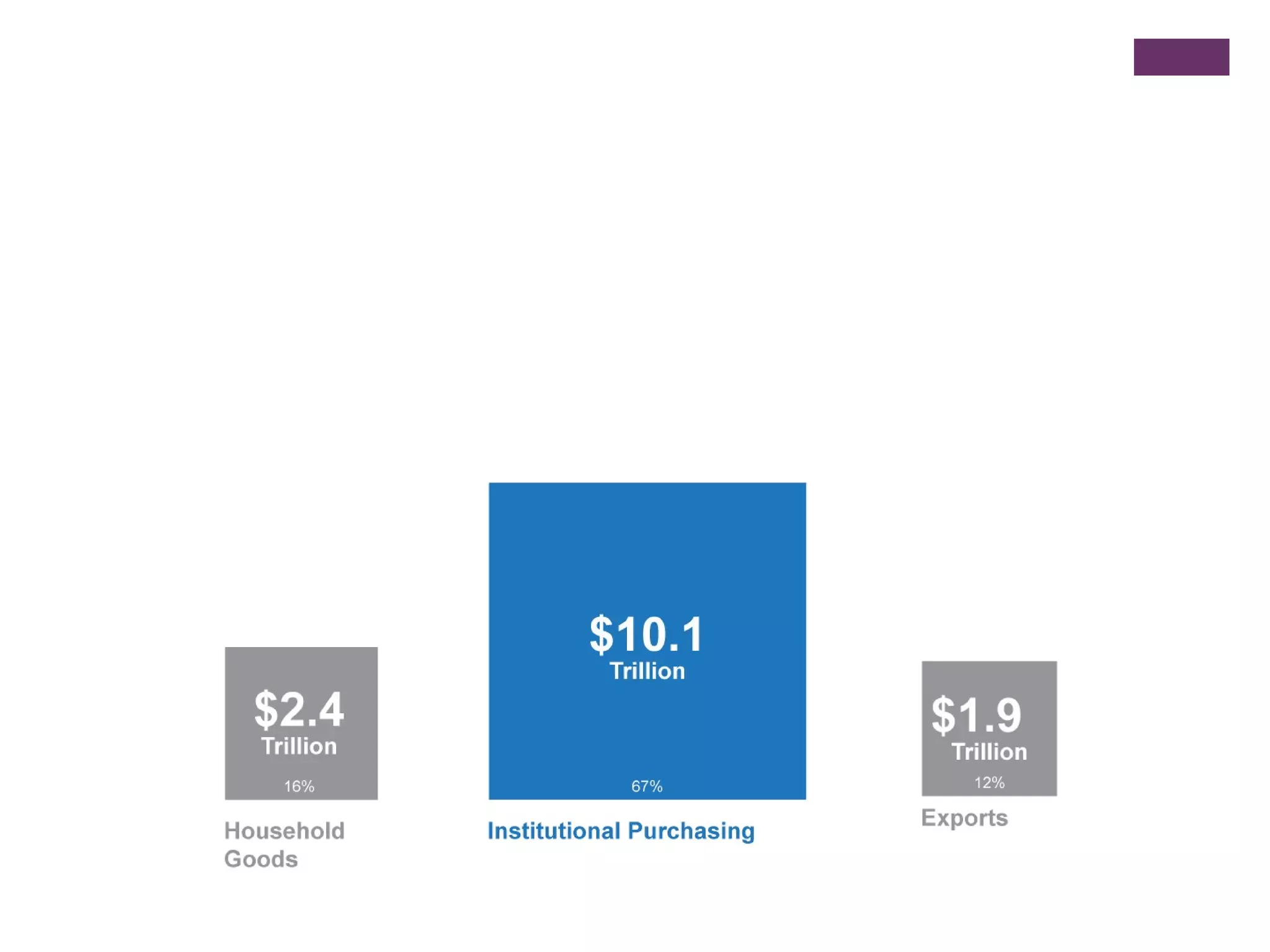
Opportunity: US Spending in 2012
2012 US Spending:
Source: Sustainable Purchasing Leadership Council, based on BEA Statistics
+
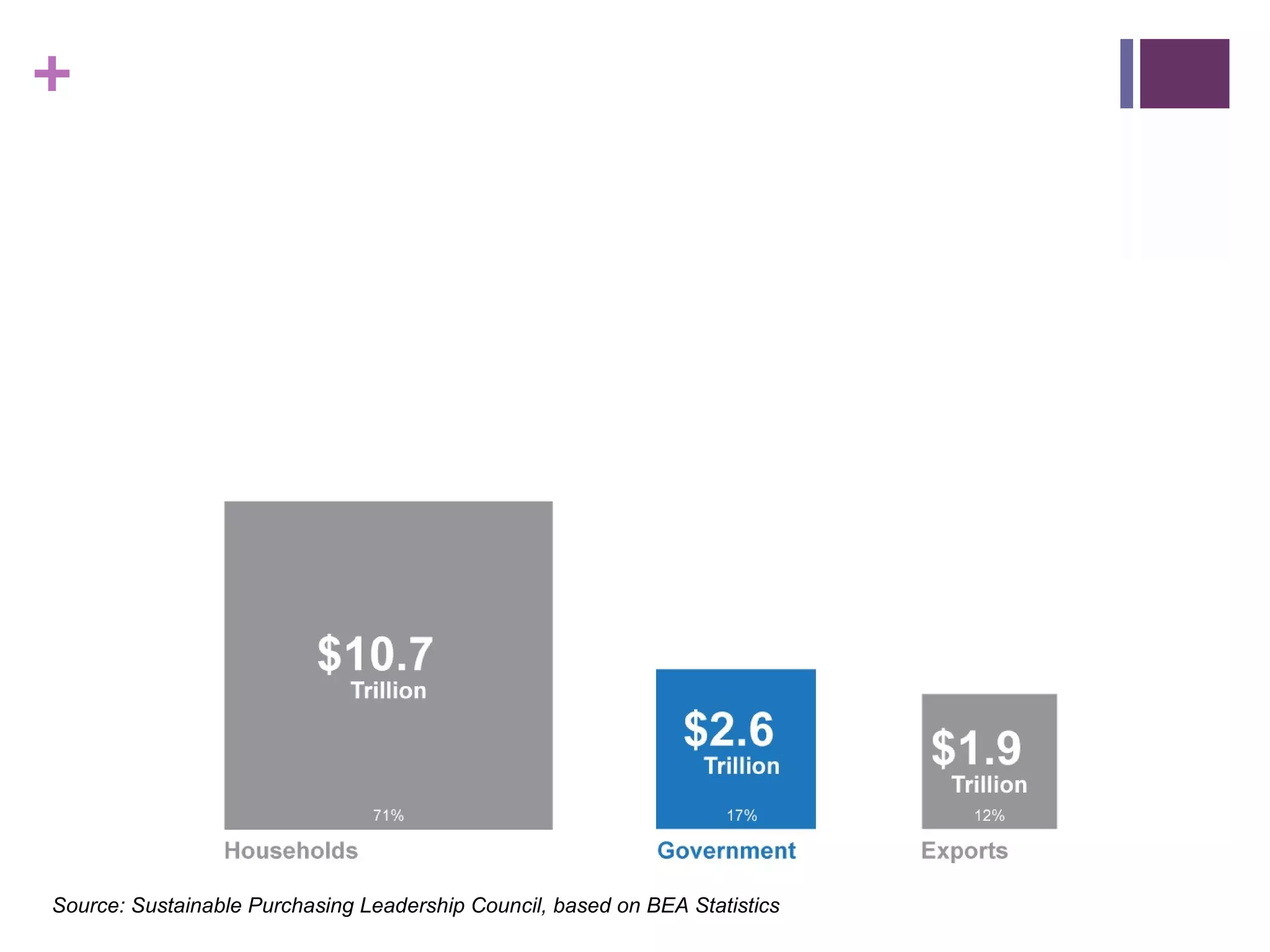
Source: Sustainable Purchasing Leadership Council, based on BEA Statistics
+
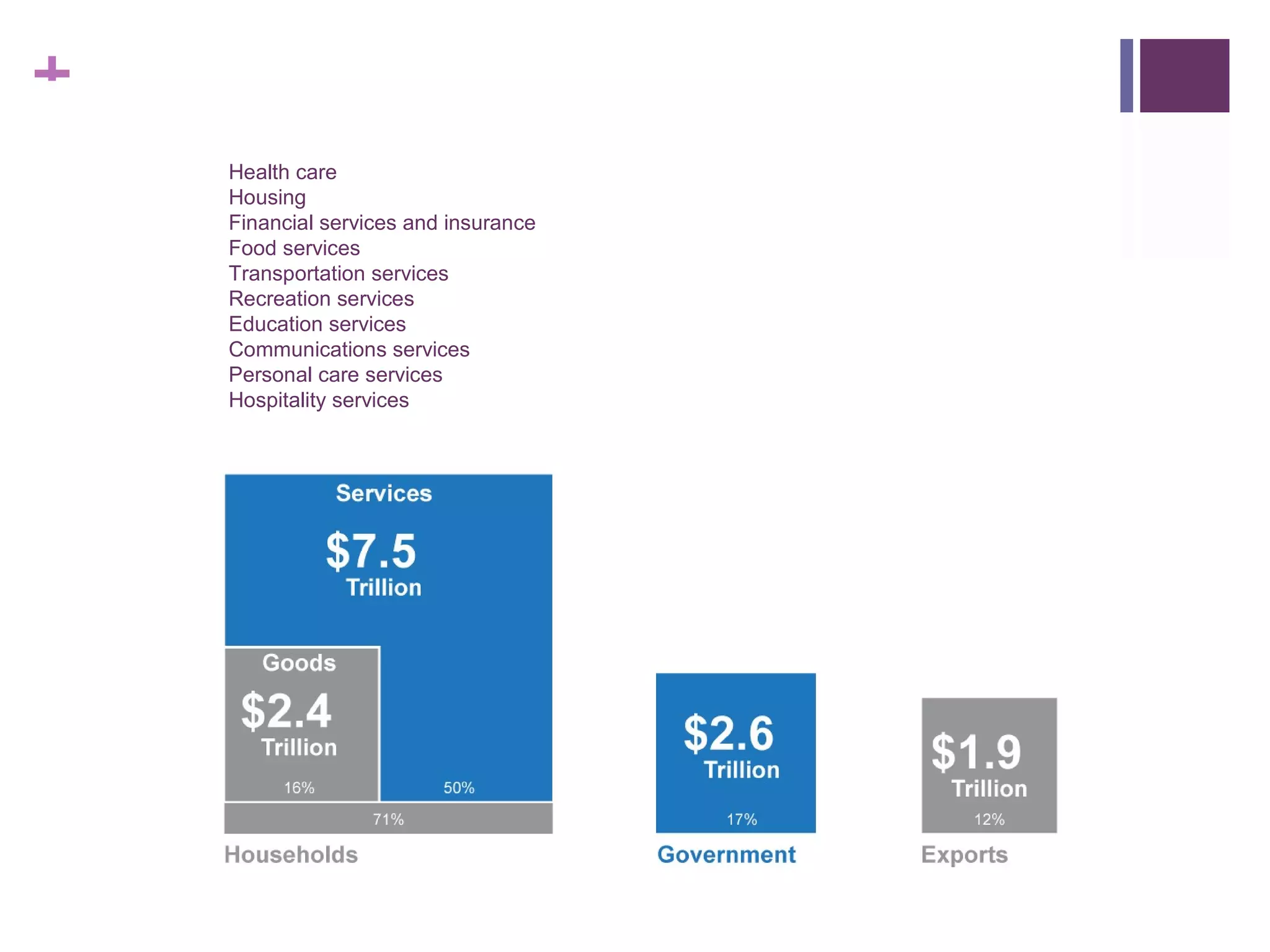
Health care
Housing
Financial services and insurance
Food services
Transportation services
Recreation services
Education services
Communications services
Personal care services
Hospitality services
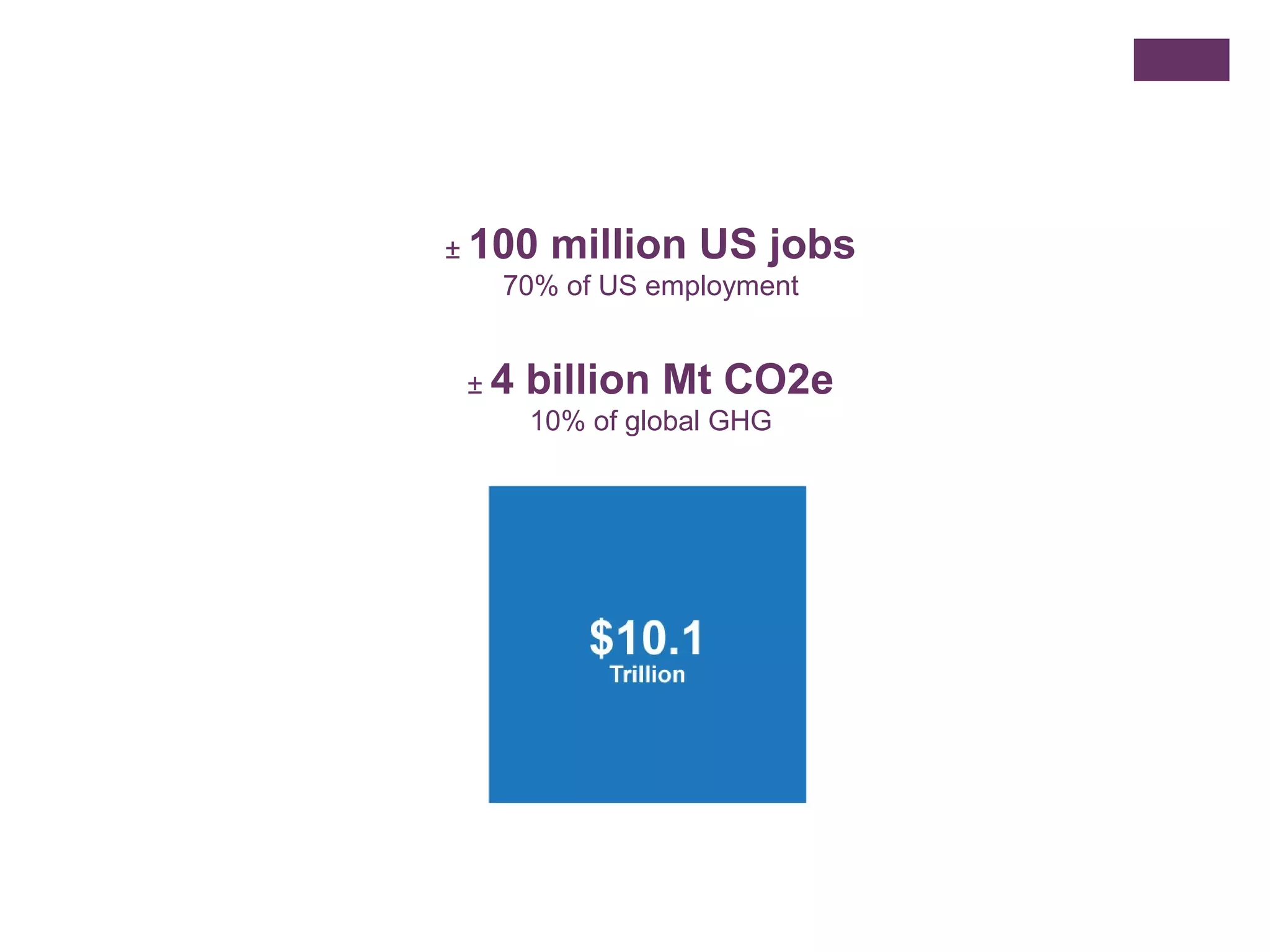
± 100 million US jobs

70% of US employment
± 4 billion Mt CO2e

10% of global GHG
+
Who exactly is the “buyer”?
■ The owner of the budget: Identifies the need	

■ The professional purchaser: Executes the purchase	

■ The influencers: Policy makers and others who have a say 	

■ Operations: Uses/disposes the product or service once delivered	

■ Direct Spend	

■ Indirect Spend
+
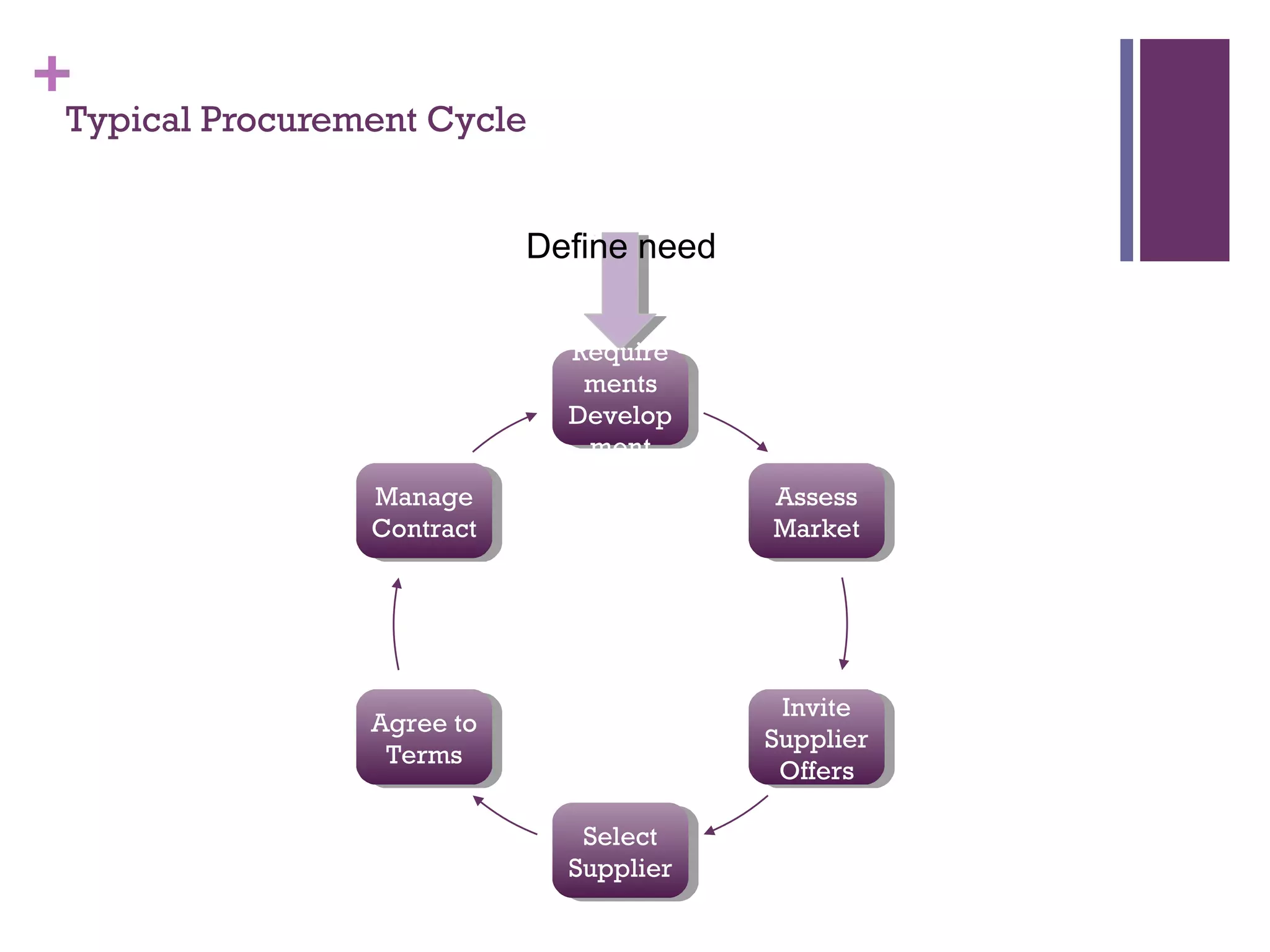
Typical Procurement Cycle
Requirem
ents
Developm
ent
Assess
Market
Invite
Supplier
Offers
Select
Supplier
Agree to
Terms
Manage
Contract
Define need
+
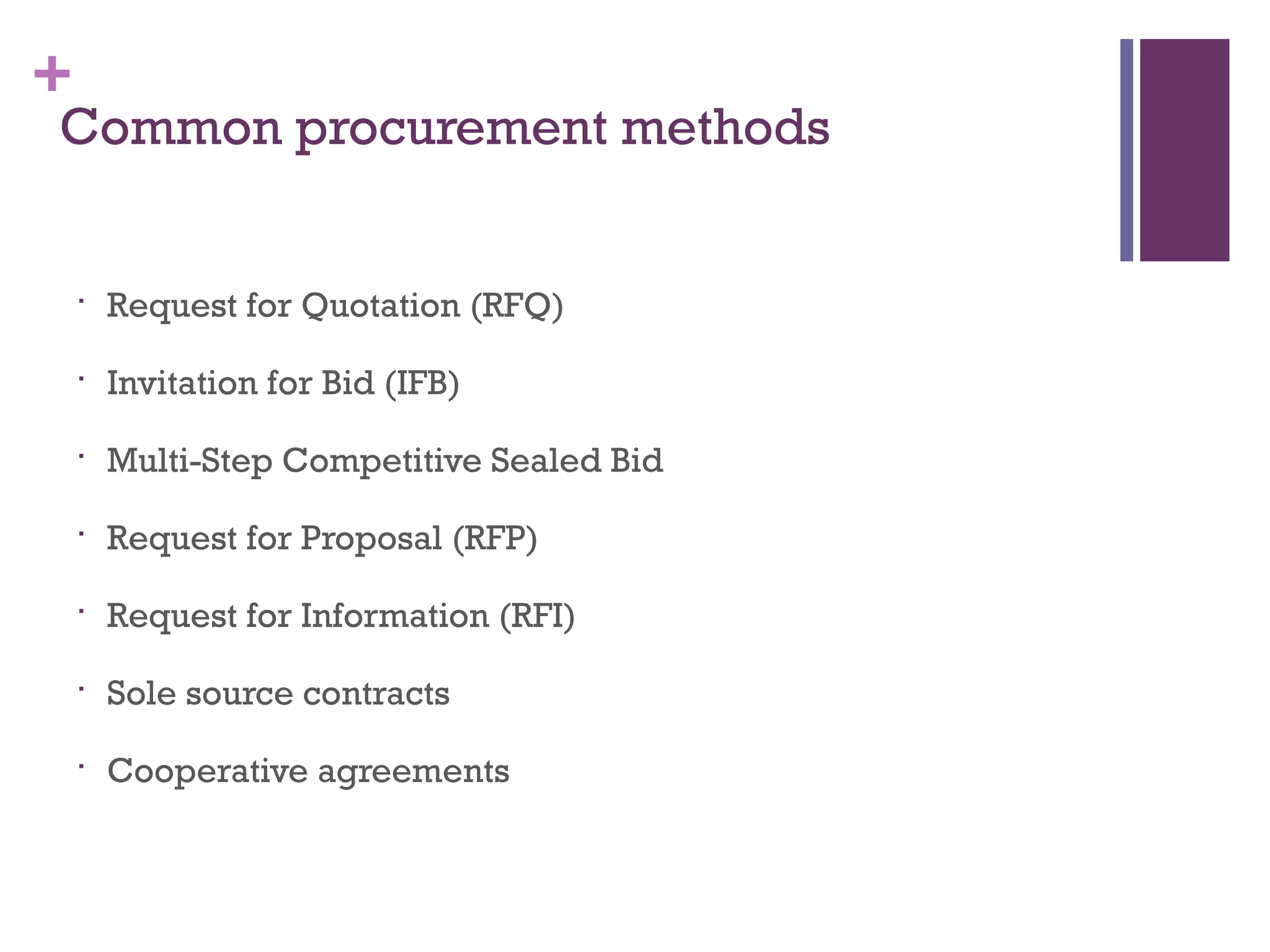
Common procurement methods
■ Request for Quotation (RFQ)	

■ Invitation for Bid (IFB)	

■ Multi-Step Competitive Sealed Bid	

■ Request for Proposal (RFP)	

■ Request for Information (RFI)	

■ Sole source contracts	

■ Cooperative agreements
+
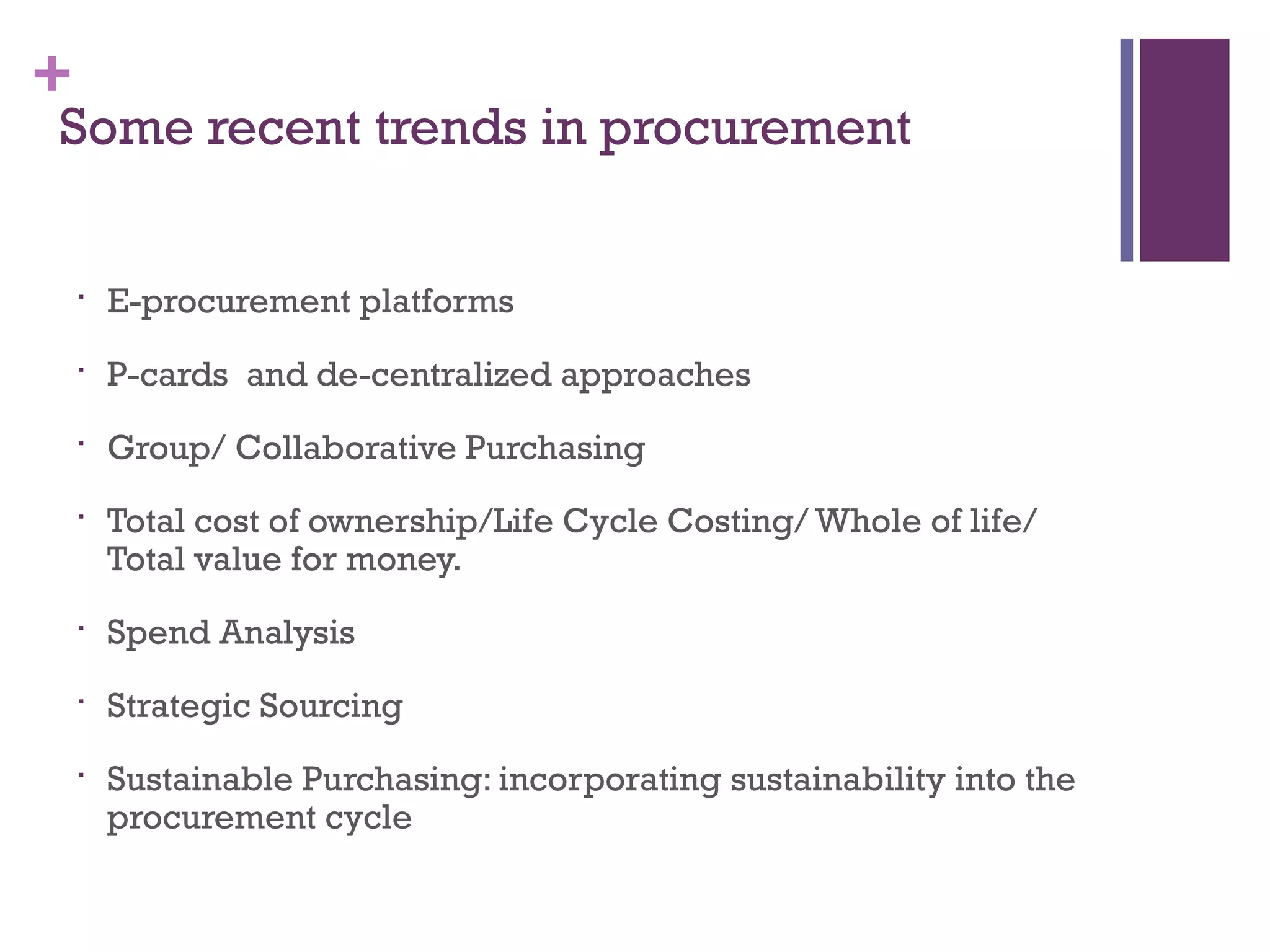
Some recent trends in procurement
■ E-procurement platforms	

■ P-cards and de-centralized approaches	

■ Group/ Collaborative Purchasing	

■ Total cost of ownership/Life Cycle Costing/ Whole of life/ Total value
for money.	

■ Spend Analysis	

■ Strategic Sourcing 	

■ Sustainable Purchasing: incorporating sustainability into the
procurement cycle
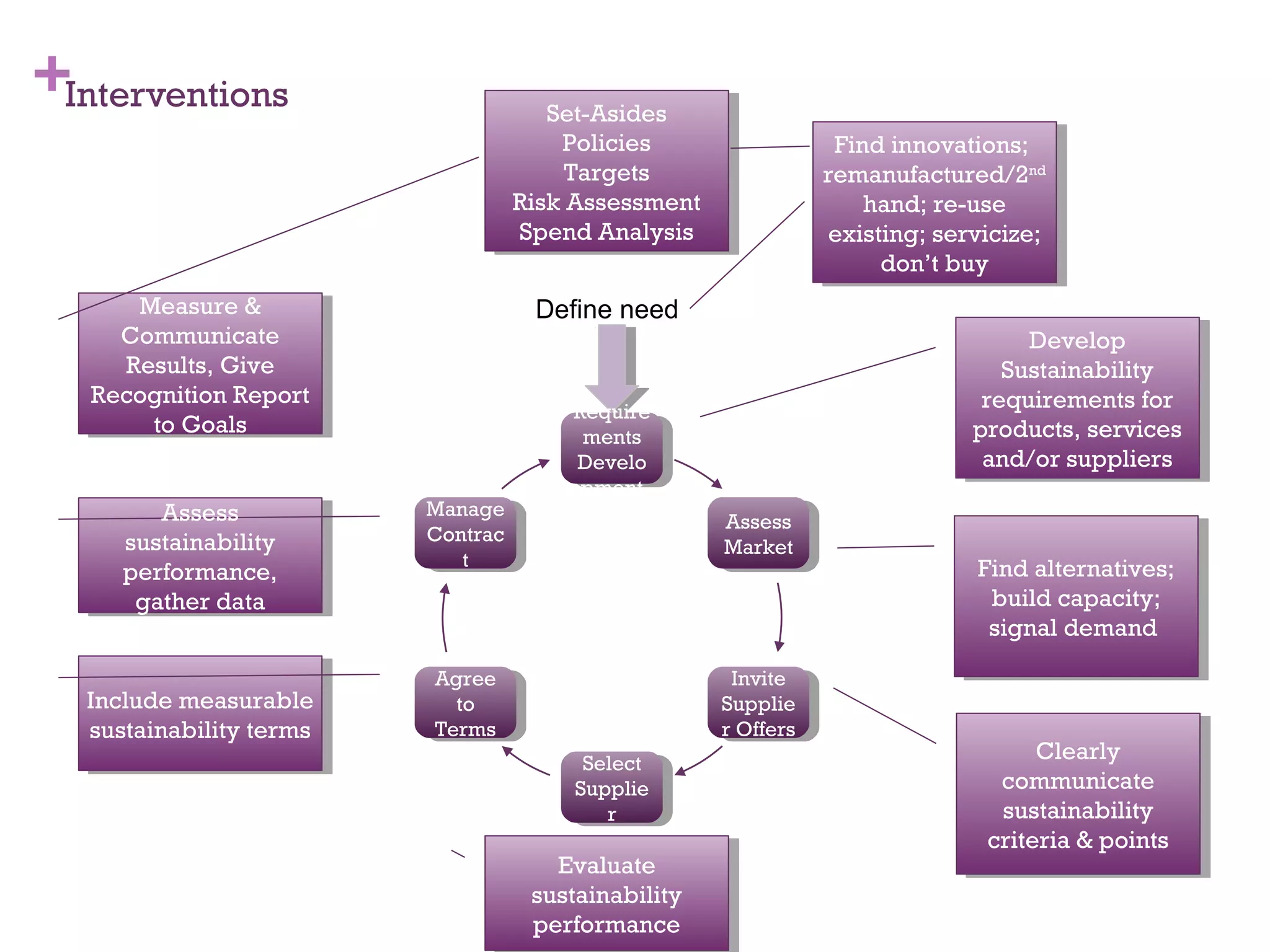
+Interventions
Require
ments
Develop
ment
Assess
Market
Invite
Supplier
Offers
Select
Supplier
Agree to
Terms
Manage
Contract
Define need
Find innovations;
remanufactured/2nd
hand; re-use existing;
servicize; don’t buy
Develop Sustainability
requirements for
products, services and/
or suppliers
Set-Asides	

Policies	

Targets	

Risk Assessment	

Spend Analysis
Find alternatives; build
capacity; signal
demand
Clearly communicate
sustainability criteria
& points
Evaluate sustainability
performance
Include measurable
sustainability terms
Assess sustainability
performance, gather
data
Measure &
Communicate Results,
Give Recognition
Report to Goals
+
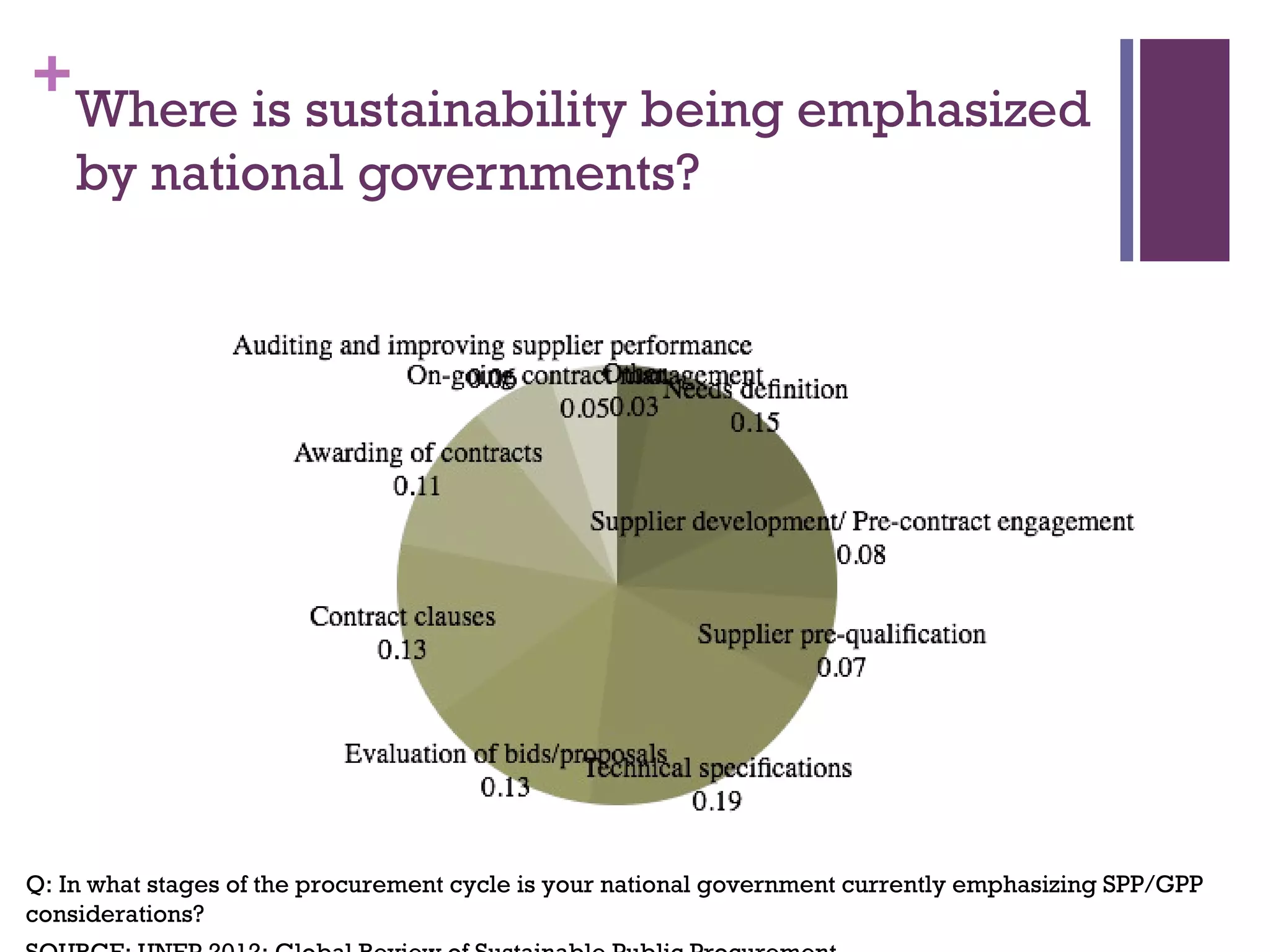
Where is sustainability being emphasized by
national governments?
On-going contract management	

0.05
Auditing and improving supplier performance	

0.06
Awarding of contracts	

0.11
Contract clauses	

0.13
Evaluation of bids/proposals	

0.13
Technical specifications	

0.19
Supplier pre-qualification	

0.07
Supplier development/ Pre-contract engagement	

0.08
Needs definition	

0.15
Other	

0.03
Q: In what stages of the procurement cycle is your national government currently emphasizing SPP/GPP considerations?	

SOURCE: UNEP 2012: Global Review of Sustainable Public Procurement
+
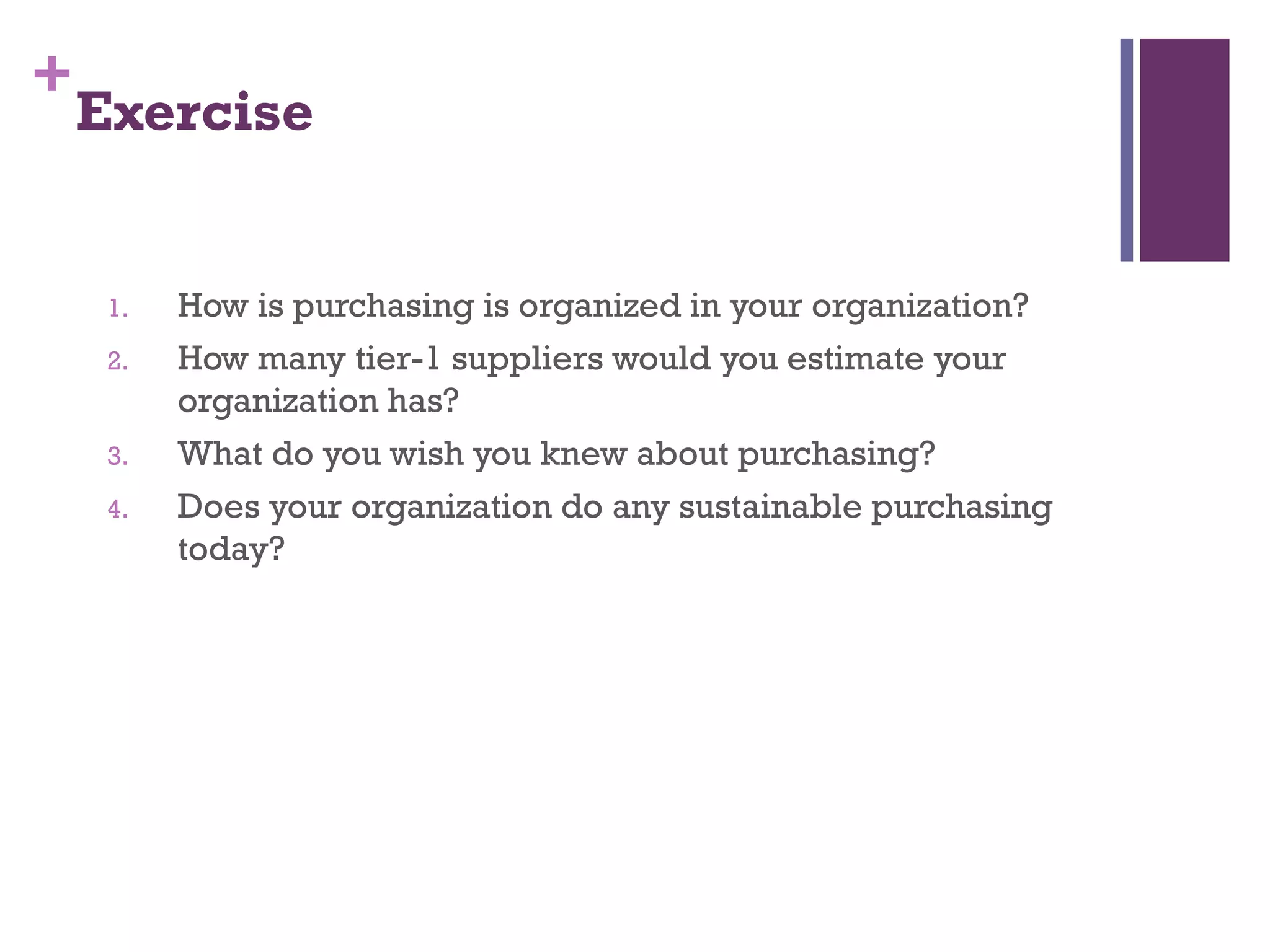
Exercise
1. How is purchasing is organized in your organization?	

2. How many tier-1 suppliers would you estimate your organization
has?	

3. What do you wish you knew about purchasing?	

4. Does your organization do any sustainable purchasing today?
+
Engagement Strategies:


 Suppliers engaging purchasers
+
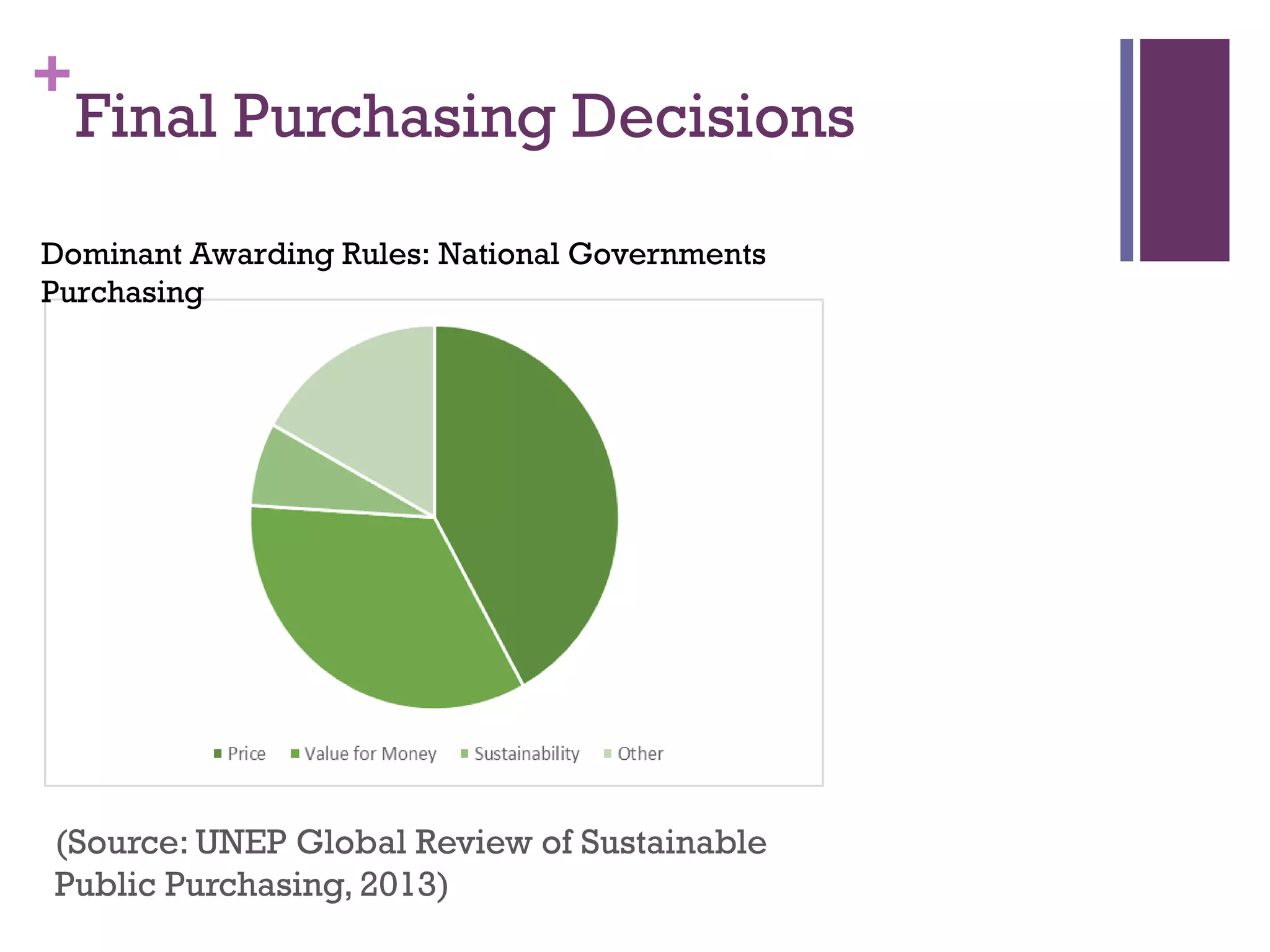
Final Purchasing Decisions
(Source: UNEP Global Review of Sustainable Public
Purchasing, 2013)
Dominant Awarding Rules: National Governments
Purchasing
+
What’s a (sustainable product) to do?
➢ Researched on over 1000 purchasing policies and guidance
documents:	

• Some set requirements	

• Some set leadership points	

• Many on the receiving end suspect that they’re not being
fully implemented 	

➢ So what to do:	

• If you’re ahead of the curve; but your messaging is getting
lost in the mix? 	

• How to differentiate as a purchaser when you and your
competitors all work with the same suppliers?
+
Looking into this further
➢ Recently spoke to 12 large organizations:	

• Purchasers: what they see works, what they’d like to see more of	

• Suppliers: what strategies they take to differentiate and win	

• Both: when and how to successfully engage
+
A range of strategies are being taken
➢ Offer innovative solutions that truly solves the customer need	

!
➢ Meet price requirements and then differentiate	

!
➢ Educate your buyers & your own sales team	

!
➢ Improve your marketing, tell your story, explain the benefits, validate
your claims	

!
➢ Co-Create, Adopt and Advocate Leadership Standards 	

!
➢ Partner and Network with credible organizations
+
Some nuance to this
➢ Product cycles: length & size of contract changes when/how often you
interact/how close is the relationship	

!
➢ Sector sensitivities:	

• Some are spending a lot of time answering questions, others virtually
nothing	

• Some can rely on ecolabels/others can’t	

!
➢ Products/Services: different types of contracts and interaction	

!
➢ Large enterprise contracts: trickier, cover many thousands of SKUs Harder
to differentiate here: need to use recognizable symbols
+
What’s not really working
➢ Adding to the confusion by making spurious &
undocumented claims	

!
➢ Being too focused on the technical detail in
communications, remember: there is a person on the
other end	

!
➢ Not answering customer questions on sustainability/
not answering them well	

!
➢ Charging a premium that makes it hard for the buyer
to argue for
REIMAGINE 

REDESIGN 

REGENERATE
#SB14sd

Sustainable Purchasing: Reimagining Principles and Practices for Mainstream Adoption

  • 2.
    Moderator: Anastasia O’RourkeSustainable Purchasing Leadership Council @SPLCouncil Panelists from: Shelton Group, Sustainable Purchasing Leadership Council Sustainable Purchasing: Reimagining Principles and Practices for Mainstream Adoption #SB14sd
  • 3.
    Introducing the Sustainable PurchasingLeadership Council
 Christina Macken Director of Programs christina@purchasingcouncil.org For more information:
  • 4.
  • 5.
  • 6.
  • 7.
  • 8.
    Managers do thingsright.
 Leaders do the right thing.
  • 9.
    Opportunity for strategicleadership !9 Analysis by TRUTHstudio based on US Bureau of Economic Analysis 2011 Summary Use Annual I-O Table
  • 10.
    Opportunity: Institutional purchasersshape markets. 
 !10 $
  • 11.
  • 12.
    Opportunity: Institutional purchasersshape markets. 
 !12 • demand transparency into the upstream and downstream impacts of goods and services. • incorporate sustainability criteria into purchasing decisions at a scale that can shift markets. • drive down the cost of sustainable products and services so that everyone can afford them. • ensure that end-users understand, like and adopt new products and services. Purchasing organizations are uniquely positioned to:
  • 13.
    Challenge: Lack ofcoordination. 
 !13 $ $ $ $ $ $ $ $ $ $$ $
  • 14.
    Challenge: Lack ofcoordination. 
 !14
  • 15.
    Root Challenge !15 The lackof standardization in how sustainable purchasing is defined, guided, measured, and rewarded.
  • 16.
  • 17.
    !17 Source: Wikimedia Commons(Creative Commons Attribution-Share Alike 2.0 Generic license. Attribution: Simon Johnston) A big tent.
  • 18.
    !18 Solution: Build acommunity of collaboration.
  • 19.
  • 20.
    To support andrecognize purchasing leadership that accelerates the transition 
 to a prosperous and 
 sustainable future. Mission
  • 21.
    A collaborative spacewhere a community of purpose convenes to define, pursue, and promote sustainability leadership in institutional procurement. Structure
  • 22.
  • 23.
  • 24.
  • 25.
    Environmental Impacts Increase these… •biodiversity preservation • climate adaptation • resource optimization • soil health stewardship Decrease these… • acidification • desertification • eutrophication • freshwater pollution • greenhouse gas emissions • habitat depletion • human health impacts • land use change • marine pollution • ozone depletion • radiation pollution • resource depletion • smog • waste • water consumption
  • 26.
    Social Impacts Increase these… •anti-discrimination • community engagement • diversity/equal opportunity • employee engagement • equal remuneration • fair trade • freedom of association • grievance & remedy processes • human rights • indigenous rights • occupational health & safety • right to collective bargaining • sustainable compensation • training and education • worker rights Decrease these… • child labor • forced/compulsory labor • human trafficking • sourcing from conflict zones
  • 27.
    Economic Impacts Increase these… •fair dealings • innovation research / investment • open competition • transparency of information • use of diverse suppliers • use of HUB zones • use of local suppliers Decrease these… • conflicts of interest • corruption (bribery, extortion…) • dividing territories • dumping • exclusive dealing • misleading market claims • monopoly (seller collusion) • monopsony(buyer collusion) • patent misuse • price fixing • product tying • refusal to deal
  • 28.
    Group Exercise Consider andanswer the following questions in small groups: ! Which impacts described is your company addressing and measuring impacts?
  • 29.
    Group Reflection ! ! What canSPLC do to better engage your community and help brands position yourselves as leaders along ESE impacts?
  • 30.
  • 31.
    + Goals for today ■Learn about purchasing ■ Key market trends in B2B ■ Identify challenges and opportunities for collaboration ■ Learn about SPLC & other initiatives ■ Make new connections
  • 32.
    + Today’s Session ■ Welcomeand Introductions ■ Purchasing Briefing: Anastasia O’Rourke ■ Icebreaker Exercise ■ Sustainability is Personal: Suzanne Shelton ■ Exercise: The Role of Branding in Institutional Purchasing ■ Break ■ Suppliers engagement of Purchasers: Anastasia O’Rourke ■ Exercise: Supplier Engagement ■ Introducing the SPLC: Christina Macken ■ Exercise: Prioritizing Impacts ■ Group Reflection: Engaging Brands into SPLC
  • 33.
    + The customer isalways right:
 A briefing on Purchasing and Procurement Dr. Anastasia O’Rourke Chair Elect, Sustainable Purchasing Leadership Council Sustainable Brands Workshop, June 2 2014
  • 34.
    Opportunity: US Spendingin 2012 2012 US Spending: Source: Sustainable Purchasing Leadership Council, based on BEA Statistics
  • 35.
    + Source: Sustainable PurchasingLeadership Council, based on BEA Statistics
  • 36.
    + Health care Housing Financial servicesand insurance Food services Transportation services Recreation services Education services Communications services Personal care services Hospitality services
  • 39.
    ± 100 millionUS jobs
 70% of US employment ± 4 billion Mt CO2e
 10% of global GHG
  • 40.
    + Who exactly isthe “buyer”? ■ The owner of the budget: Identifies the need ■ The professional purchaser: Executes the purchase ■ The influencers: Policy makers and others who have a say ■ Operations: Uses/disposes the product or service once delivered ■ Direct Spend ■ Indirect Spend
  • 41.
  • 42.
    + Common procurement methods ■Request for Quotation (RFQ) ■ Invitation for Bid (IFB) ■ Multi-Step Competitive Sealed Bid ■ Request for Proposal (RFP) ■ Request for Information (RFI) ■ Sole source contracts ■ Cooperative agreements
  • 43.
    + Some recent trendsin procurement ■ E-procurement platforms ■ P-cards and de-centralized approaches ■ Group/ Collaborative Purchasing ■ Total cost of ownership/Life Cycle Costing/ Whole of life/ Total value for money. ■ Spend Analysis ■ Strategic Sourcing ■ Sustainable Purchasing: incorporating sustainability into the procurement cycle
  • 44.
    +Interventions Require ments Develop ment Assess Market Invite Supplier Offers Select Supplier Agree to Terms Manage Contract Define need Findinnovations; remanufactured/2nd hand; re-use existing; servicize; don’t buy Develop Sustainability requirements for products, services and/ or suppliers Set-Asides Policies Targets Risk Assessment Spend Analysis Find alternatives; build capacity; signal demand Clearly communicate sustainability criteria & points Evaluate sustainability performance Include measurable sustainability terms Assess sustainability performance, gather data Measure & Communicate Results, Give Recognition Report to Goals
  • 45.
    + Where is sustainabilitybeing emphasized by national governments? On-going contract management 0.05 Auditing and improving supplier performance 0.06 Awarding of contracts 0.11 Contract clauses 0.13 Evaluation of bids/proposals 0.13 Technical specifications 0.19 Supplier pre-qualification 0.07 Supplier development/ Pre-contract engagement 0.08 Needs definition 0.15 Other 0.03 Q: In what stages of the procurement cycle is your national government currently emphasizing SPP/GPP considerations? SOURCE: UNEP 2012: Global Review of Sustainable Public Procurement
  • 46.
    + Exercise 1. How ispurchasing is organized in your organization? 2. How many tier-1 suppliers would you estimate your organization has? 3. What do you wish you knew about purchasing? 4. Does your organization do any sustainable purchasing today?
  • 47.
  • 48.
    + Final Purchasing Decisions (Source:UNEP Global Review of Sustainable Public Purchasing, 2013) Dominant Awarding Rules: National Governments Purchasing
  • 49.
    + What’s a (sustainableproduct) to do? ➢ Researched on over 1000 purchasing policies and guidance documents: • Some set requirements • Some set leadership points • Many on the receiving end suspect that they’re not being fully implemented ➢ So what to do: • If you’re ahead of the curve; but your messaging is getting lost in the mix? • How to differentiate as a purchaser when you and your competitors all work with the same suppliers?
  • 50.
    + Looking into thisfurther ➢ Recently spoke to 12 large organizations: • Purchasers: what they see works, what they’d like to see more of • Suppliers: what strategies they take to differentiate and win • Both: when and how to successfully engage
  • 51.
    + A range ofstrategies are being taken ➢ Offer innovative solutions that truly solves the customer need ! ➢ Meet price requirements and then differentiate ! ➢ Educate your buyers & your own sales team ! ➢ Improve your marketing, tell your story, explain the benefits, validate your claims ! ➢ Co-Create, Adopt and Advocate Leadership Standards ! ➢ Partner and Network with credible organizations
  • 52.
    + Some nuance tothis ➢ Product cycles: length & size of contract changes when/how often you interact/how close is the relationship ! ➢ Sector sensitivities: • Some are spending a lot of time answering questions, others virtually nothing • Some can rely on ecolabels/others can’t ! ➢ Products/Services: different types of contracts and interaction ! ➢ Large enterprise contracts: trickier, cover many thousands of SKUs Harder to differentiate here: need to use recognizable symbols
  • 53.
    + What’s not reallyworking ➢ Adding to the confusion by making spurious & undocumented claims ! ➢ Being too focused on the technical detail in communications, remember: there is a person on the other end ! ➢ Not answering customer questions on sustainability/ not answering them well ! ➢ Charging a premium that makes it hard for the buyer to argue for
  • 54.

Editor's Notes

  • #24 Think carefully about charging a premium and focus on any savings your product enables No translation is needed when you sell on cost efficiencies, reliability,and efficacy Improve your marketing, tell your story, explain the benefits Energy savings, FAQ sheets, tools used to explain it. Tell the story and show the results Validate your claims with credible third party organization/ certifications Enumerate the sustainability benefits being achieved: explain the co-benefits being achieved as part of the commercial offering (GE) Educate your buyers & your own internal stakeholders: Educate purchasers on implications of questions; eg when asking for compostibles: ask them: do you compost? Educate on better use of the products/services, to minimise env, impact Make sure sales associates are strong, well trained and understand how important they are to implementing the process, turn their customers into partners Educate on total cost of ownership and lifetime savings Create an advisory service team whose job it is to train customers eg on different certifications.standards. Sust. practices and why they should care or how to do green team’s successfully Partner With credible organizations & NGOs (Domtar) Participate in multi-stakeholder consortia (such as SPLC) Help Set, Adopt and Lobby for Leadership Standards Don’t just follow the market – stay ahead of it. Set standards, push for stringency Advocate for their adoption Innovate: Through supplier diversity programs, access innovation and a broad pool of ideas and talent TO bring forward a truly innovative solution that solves customer’s needs : harder to do but sometimes with much bigger sustainability gains. Service-ize your products think about use and the whole life cycle