
BRANDING &
BUSINESS STRATEGY
IN THE VALUE
DELIVERY PROCESS
By Bolaji Okusaga
Managing Director, The Quadrant Company
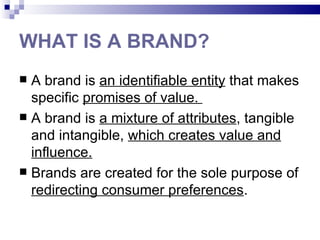
WHAT IS A BRAND?
 A brand is an identifiable entity that makes
  specific promises of value.
 A brand is a mixture of attributes, tangible
  and intangible, which creates value and
  influence.
 Brands are created for the sole purpose of
  redirecting consumer preferences.
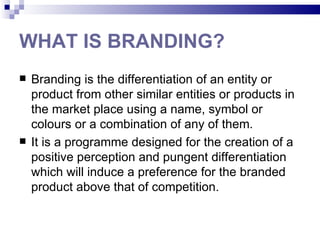
WHAT IS BRANDING?
   Branding is the differentiation of an entity or
    product from other similar entities or products in
    the market place using a name, symbol or
    colours or a combination of any of them.
   It is a programme designed for the creation of a
    positive perception and pungent differentiation
    which will induce a preference for the branded
    product above that of competition.
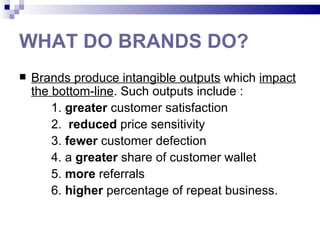
WHAT DO BRANDS DO?
   Brands produce intangible outputs which impact
    the bottom-line. Such outputs include :
        1. greater customer satisfaction
        2. reduced price sensitivity
        3. fewer customer defection
        4. a greater share of customer wallet
        5. more referrals
        6. higher percentage of repeat business.
ATTRIBUTES OF A BRAND
   A COMPELLING IDEA: this captures customers
    attention and commands loyalty.
   A RESOLUTE CORE PURPOSE: this remains
    the platform on which the brand concept is built.
   A CENTRAL ORGANISATIONAL PRINCIPLE:
    this helps align the brand strategy with the
    corporate / business strategy.
WHAT DO BRANDS THRIVE ON?
   Brands thrive on the ability to differentiate.
   Brands, most importantly, thrive on promises
    and the ability of customers to verify these
    promises.
   Brands communicate their promise to the
    market, soliciting customer patronage.
    Everything the customer experience in the
    process of evaluation, trial, purchase and
    adoption is a verification of the promise.
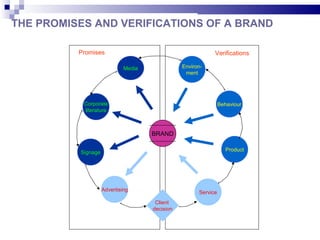
THE PROMISES AND VERIFICATIONS OF A BRAND

          Promises                                          Verifications

                             Media              Environ-
                                                 ment


           Corporate                                            Behaviour
           literature


                                     BRAND

                                                                   Product
          Signage


                    Advertising                       Service
                                      Client
                                     decision
HOW DO BRANDS EVOLVE? (1)
n   BRAND AS COMMODITY: this is characterized
    by an excess of demand over supply, products make
    little effort to differentiate, emphasis is on mass
    production, consumer’s perception is utilitarian.
n   BRAND AS REFERENCE: here competitive
    pressure stimulates a need for differentiation,
    differentiation is achieved through changes in products
    physical attributes, consumers memory expand
    beyond basic product category, product branding
    become a heuristic devise for decision making,
    consumers still value brands for their utilitarian value.
HOW DO BRANDS EVOLVE? (2)
   BRAND AS PERSONALITY: here differentiation
  through emphasis on rational / functional attributes
  become difficult, brands are given a personality in order
  to draw on emotional attributes, the use of brands
  therefore become a medium of self expression.
 BRAND AS ICON: here branding becomes a
  participative process between producers and
  consumers, consumers draw associations from the
  brand to boost their self identity, the more the
  associations a brand has, the greater its network in the
  consumer’s memory.
HOW DO BRANDS EVOLVE? (3)
   BRAND AS COMPANY: here brand equals the company and
  assumes a complex posture because there are many points of
  contact between the consumer and the brand, this is the beginning
  of post-modern marketing, here consumers become more active in
  the brand creation process, communication of the brands attribute is
  no longer unidirectional, rather it flows from producers and
  consumers alike, this interaction strengthens the relationship
  between the consumer and the producer.
 BRAND AS POLICY: here there is an alignment of the
  company’s ethical, social and political stance with the brand
  concept, this stage draws heavily on emotion.
WHY BRAND?
 In a global economy, with changing
  market dynamics and heightened
  competition, the role of the brand has
  become larger than being just a medium
  of recognition
 Brands now serve for business success.
 Company’s must produce healthy brands
  to stay competitive.
WHAT IS BUSINESS
STRATEGY?
   Business strategy is about giving order and
    consistency to complexities.
   It is about plotting and executing sustainable
    superior performance over competition.
   It answers the question, “what business should we be
    in, based on competence and available resources?”
   Business strategy is about building differentiation
    through the vehicle of people, technology and
    ambience.
   It is about delivering superior value above
    competition and gaining a higher market mileage.
ATTRIBUTES THAT MAKE FOR
SUPERIOR VALUE
   Functional Strategy: this focuses on such issue
    like functional fits such as manufacturing,
    engineering, marketing and finance.
   Institutional Strategy: this looks at the
    administrative fits such as organisational
    structure, information systems, incentive
    systems, strategic planning process, corporate
    culture and leadership style.
WHY DEPLOY STRATEGY?
   Companies are expending enormous energies to
    reproduce the cost and quality advantages
    already enjoyed by market leaders.
   Gaining competitive advantage therefore
    requires thinking through a complex process.
   The adoption of a process which differentiates
    offerings and deliver superior value can only
    come through the deployment of strategy.
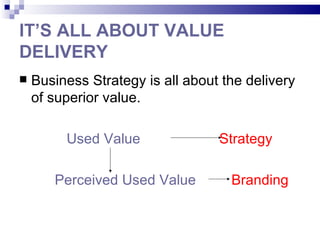
IT’S ALL ABOUT VALUE
DELIVERY
   Business Strategy is all about the delivery
    of superior value.

         Used Value               Strategy

       Perceived Used Value         Branding
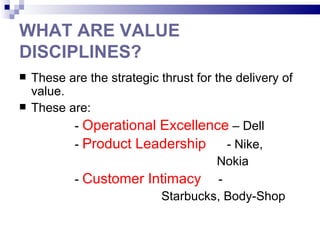
WHAT ARE VALUE
DISCIPLINES?
   These are the strategic thrust for the delivery of
    value.
   These are:
           - Operational Excellence – Dell
           - Product Leadership          - Nike,
                                        Nokia
           - Customer Intimacy -
                            Starbucks, Body-Shop
IT’S ALL ABOUT WINNING
   Companies that rose to global leadership over the years
    began with ambitions that were out of proportion to their
    resources and capabilities. But they created an
    obsession with winning.
   Strategic intent envisions a leadership position and
    establishes the criteria for charting the course. Honda
    set out to beat Ford, Canon set out to out pace Xerox in
    the market, Komatsu set out to encircle Caterpillar,
    Coca-cola set out to put Coke within arms reach of every
    consumer in the world. All are expressions of a strategic
    intent.
BUSINESS IS WAR, STRATEGY
IS THE ARSENAL?
    Building a competitive advantage in today's
     globalised market is like drawing a battle plan.
    - Ever wondered how the Japanese ascended in the
      auto-market while the European market leadership of

   the auto market waned?
- Ever wondered how India became a force in the
  Software market causing American companies to out-
  source competence from the Indian market?
- Ever wondered why China has become a major obstacle
  to America’s economic dominance of the world?
THE OTHER SIDE OF THE COIN
   Companies that fail to innovate soon start to lose
    ground to innovators: e.g. IBM loss was Dells
    gain, Coca-Cola’s loss in the American market
    was Pepsi’s gain. Wal-Mart became a market
    leader in the U.S retail market beating
    competitors like K-Mart.
   In Business the failure of one is the gain of
    another.
IF BUSINESS IS WAR AND
STRATEGY IS THE ARSENAL THEN
BRANDING IS THE BULLET
According to Shelly Lazarus , Chairman of
 Ogilvy & Mather:
 “Once the enterprise understands what the
 brand is all about, it gives direction to the whole
 enterprise. You know what products you are
 supposed to make and not make. You know how
 you are supposed to answer your telephone.
 You know how you’re going to package things. It
 gives a set of principles to an entire enterprise”.
BRANDING AND MARKETING:
WHERE DO THEY MEET?
   Brands and branding gives character to marketing.
   Competition dictates a need to create a perception in the
    mind of the target that there is no better product in the
    market than the one you are offering.
   Today, products are bought and not sold. Brands helps
    to pre-sell the product to the target.
   To stay competitive therefore, companies must deliver
    superior value by producing winning brands.
   If market leadership is a sign of business success, then
    branding is the key to sustainable growth and business
    consolidation.
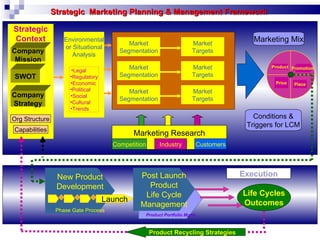
WHERE IS THE CONNECTION?

    Building a sustainable advantage in
    today’s globalised market, requires the
    linking of the brand and business strategy
    with the market planning and management
    framework of an organisation.
HOW CAN THIS HAPPEN?
Strategic Marketing Planning & Management Framework

Strategic
Context             Environmental                                                           Marketing Mix
                                           Market                       Market
                    or Situational
Company                Analysis
                                        Segmentation                    Targets
 Mission
                       •Legal              Market                       Market                   Product Promotion

SWOT                  •Regulatory       Segmentation                    Targets
                      •Economic                                                                   Price   Place
                      •Political           Market                       Market
Company               •Social
                      •Cultural
                                        Segmentation                    Targets
Strategy
                      •Trends

Org Structure                                                                               Conditions &
                                                                                          Triggers for LCM
Capabilities
                                             Marketing Research
                                      Competition         Industry           Customers


                 New Product                   Post Launch                               Execution
                 Development                     Product
                                                Life Cycle                               Life Cycles
                                    Launch                                               Outcomes
                                               Management
                 Phase Gate Process
                                                    Product Portfolio Mgmt


                                                     Product Recycling Strategies
FOOD FOR THOUGHT
   Of the twenty world leading brands in the
    Business-week brand rating, fifteen are
    American. Does this mean that Americans
    understand branding better than others?
   Business success is about risk-taking and
    innovation that produce the big idea from which
    big brands develop. Can a big idea ever
    translate to business success without its
    adoption of a brand concept?
THANK YOU.

Branding and business strategy

  • 1.
    BRANDING & BUSINESS STRATEGY INTHE VALUE DELIVERY PROCESS By Bolaji Okusaga Managing Director, The Quadrant Company
  • 2.
    WHAT IS ABRAND?  A brand is an identifiable entity that makes specific promises of value.  A brand is a mixture of attributes, tangible and intangible, which creates value and influence.  Brands are created for the sole purpose of redirecting consumer preferences.
  • 3.
    WHAT IS BRANDING?  Branding is the differentiation of an entity or product from other similar entities or products in the market place using a name, symbol or colours or a combination of any of them.  It is a programme designed for the creation of a positive perception and pungent differentiation which will induce a preference for the branded product above that of competition.
  • 4.
    WHAT DO BRANDSDO?  Brands produce intangible outputs which impact the bottom-line. Such outputs include : 1. greater customer satisfaction 2. reduced price sensitivity 3. fewer customer defection 4. a greater share of customer wallet 5. more referrals 6. higher percentage of repeat business.
  • 5.
    ATTRIBUTES OF ABRAND  A COMPELLING IDEA: this captures customers attention and commands loyalty.  A RESOLUTE CORE PURPOSE: this remains the platform on which the brand concept is built.  A CENTRAL ORGANISATIONAL PRINCIPLE: this helps align the brand strategy with the corporate / business strategy.
  • 6.
    WHAT DO BRANDSTHRIVE ON?  Brands thrive on the ability to differentiate.  Brands, most importantly, thrive on promises and the ability of customers to verify these promises.  Brands communicate their promise to the market, soliciting customer patronage.  Everything the customer experience in the process of evaluation, trial, purchase and adoption is a verification of the promise.
  • 7.
    THE PROMISES ANDVERIFICATIONS OF A BRAND Promises Verifications Media Environ- ment Corporate Behaviour literature BRAND Product Signage Advertising Service Client decision
  • 8.
    HOW DO BRANDSEVOLVE? (1) n BRAND AS COMMODITY: this is characterized by an excess of demand over supply, products make little effort to differentiate, emphasis is on mass production, consumer’s perception is utilitarian. n BRAND AS REFERENCE: here competitive pressure stimulates a need for differentiation, differentiation is achieved through changes in products physical attributes, consumers memory expand beyond basic product category, product branding become a heuristic devise for decision making, consumers still value brands for their utilitarian value.
  • 9.
    HOW DO BRANDSEVOLVE? (2)  BRAND AS PERSONALITY: here differentiation through emphasis on rational / functional attributes become difficult, brands are given a personality in order to draw on emotional attributes, the use of brands therefore become a medium of self expression.  BRAND AS ICON: here branding becomes a participative process between producers and consumers, consumers draw associations from the brand to boost their self identity, the more the associations a brand has, the greater its network in the consumer’s memory.
  • 10.
    HOW DO BRANDSEVOLVE? (3)  BRAND AS COMPANY: here brand equals the company and assumes a complex posture because there are many points of contact between the consumer and the brand, this is the beginning of post-modern marketing, here consumers become more active in the brand creation process, communication of the brands attribute is no longer unidirectional, rather it flows from producers and consumers alike, this interaction strengthens the relationship between the consumer and the producer.  BRAND AS POLICY: here there is an alignment of the company’s ethical, social and political stance with the brand concept, this stage draws heavily on emotion.
  • 11.
    WHY BRAND?  Ina global economy, with changing market dynamics and heightened competition, the role of the brand has become larger than being just a medium of recognition  Brands now serve for business success.  Company’s must produce healthy brands to stay competitive.
  • 12.
    WHAT IS BUSINESS STRATEGY?  Business strategy is about giving order and consistency to complexities.  It is about plotting and executing sustainable superior performance over competition.  It answers the question, “what business should we be in, based on competence and available resources?”  Business strategy is about building differentiation through the vehicle of people, technology and ambience.  It is about delivering superior value above competition and gaining a higher market mileage.
  • 13.
    ATTRIBUTES THAT MAKEFOR SUPERIOR VALUE  Functional Strategy: this focuses on such issue like functional fits such as manufacturing, engineering, marketing and finance.  Institutional Strategy: this looks at the administrative fits such as organisational structure, information systems, incentive systems, strategic planning process, corporate culture and leadership style.
  • 14.
    WHY DEPLOY STRATEGY?  Companies are expending enormous energies to reproduce the cost and quality advantages already enjoyed by market leaders.  Gaining competitive advantage therefore requires thinking through a complex process.  The adoption of a process which differentiates offerings and deliver superior value can only come through the deployment of strategy.
  • 15.
    IT’S ALL ABOUTVALUE DELIVERY  Business Strategy is all about the delivery of superior value. Used Value Strategy Perceived Used Value Branding
  • 16.
    WHAT ARE VALUE DISCIPLINES?  These are the strategic thrust for the delivery of value.  These are: - Operational Excellence – Dell - Product Leadership - Nike, Nokia - Customer Intimacy - Starbucks, Body-Shop
  • 17.
    IT’S ALL ABOUTWINNING  Companies that rose to global leadership over the years began with ambitions that were out of proportion to their resources and capabilities. But they created an obsession with winning.  Strategic intent envisions a leadership position and establishes the criteria for charting the course. Honda set out to beat Ford, Canon set out to out pace Xerox in the market, Komatsu set out to encircle Caterpillar, Coca-cola set out to put Coke within arms reach of every consumer in the world. All are expressions of a strategic intent.
  • 18.
    BUSINESS IS WAR,STRATEGY IS THE ARSENAL?  Building a competitive advantage in today's globalised market is like drawing a battle plan. - Ever wondered how the Japanese ascended in the auto-market while the European market leadership of the auto market waned? - Ever wondered how India became a force in the Software market causing American companies to out- source competence from the Indian market? - Ever wondered why China has become a major obstacle to America’s economic dominance of the world?
  • 19.
    THE OTHER SIDEOF THE COIN  Companies that fail to innovate soon start to lose ground to innovators: e.g. IBM loss was Dells gain, Coca-Cola’s loss in the American market was Pepsi’s gain. Wal-Mart became a market leader in the U.S retail market beating competitors like K-Mart.  In Business the failure of one is the gain of another.
  • 20.
    IF BUSINESS ISWAR AND STRATEGY IS THE ARSENAL THEN BRANDING IS THE BULLET According to Shelly Lazarus , Chairman of Ogilvy & Mather: “Once the enterprise understands what the brand is all about, it gives direction to the whole enterprise. You know what products you are supposed to make and not make. You know how you are supposed to answer your telephone. You know how you’re going to package things. It gives a set of principles to an entire enterprise”.
  • 21.
    BRANDING AND MARKETING: WHEREDO THEY MEET?  Brands and branding gives character to marketing.  Competition dictates a need to create a perception in the mind of the target that there is no better product in the market than the one you are offering.  Today, products are bought and not sold. Brands helps to pre-sell the product to the target.  To stay competitive therefore, companies must deliver superior value by producing winning brands.  If market leadership is a sign of business success, then branding is the key to sustainable growth and business consolidation.
  • 22.
    WHERE IS THECONNECTION?  Building a sustainable advantage in today’s globalised market, requires the linking of the brand and business strategy with the market planning and management framework of an organisation.
  • 23.
    HOW CAN THISHAPPEN?
  • 24.
    Strategic Marketing Planning& Management Framework Strategic Context Environmental Marketing Mix Market Market or Situational Company Analysis Segmentation Targets Mission •Legal Market Market Product Promotion SWOT •Regulatory Segmentation Targets •Economic Price Place •Political Market Market Company •Social •Cultural Segmentation Targets Strategy •Trends Org Structure Conditions & Triggers for LCM Capabilities Marketing Research Competition Industry Customers New Product Post Launch Execution Development Product Life Cycle Life Cycles Launch Outcomes Management Phase Gate Process Product Portfolio Mgmt Product Recycling Strategies
  • 25.
    FOOD FOR THOUGHT  Of the twenty world leading brands in the Business-week brand rating, fifteen are American. Does this mean that Americans understand branding better than others?  Business success is about risk-taking and innovation that produce the big idea from which big brands develop. Can a big idea ever translate to business success without its adoption of a brand concept?
  • 26.