FINAL CLASS
BRANDING & SEO
FINAL CLASS
LEARNING OBJECTIVES
‣ Create a brand house with all of its main elements: Idea, positioning,
attributes, pillars, and proof points
‣ Draft perceptual maps
‣ Develop a SEO strategy
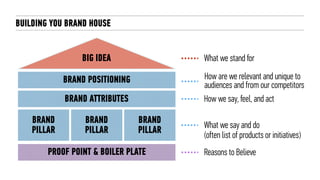
BUILDING YOU BRAND HOUSE
BIG IDEA
BRAND POSITIONING
BRAND ATTRIBUTES
BRAND
PILLAR
BRAND
PILLAR
BRAND
PILLAR
PROOF POINT & BOILER PLATE
What we stand for
How are we relevant and unique to
audiences and from our competitors
How we say, feel, and act
What we say and do
(often list of products or initiatives)
Reasons to Believe
FINAL LESSON
COMPETITOR ANALYSIS
PERCEPTUAL MAP
A PERCEPTUAL MAP is a visual representation of the
differences and similarities of brands, products, or
customers.
“Typically the position of a product, product line,
brand, or company is displayed relative to their
competition.” - Wikipedia
BRAND VOICE + POSITIONING
POSITIONING
The process by which marketers try to create an
identity in the minds of their target market
Repositioning – change your identity
Depositioning – change your competitor’s identity
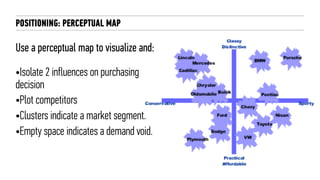
POSITIONING: PERCEPTUAL MAP
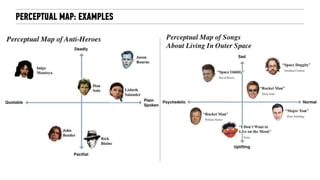
Use a perceptual map to visualize and:
•Isolate 2 influences on purchasing
decision
•Plot competitors
•Clusters indicate a market segment.
•Empty space indicates a demand void.
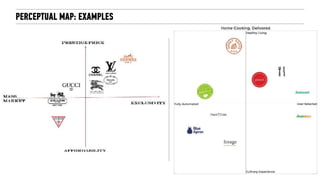
PERCEPTUAL MAP: EXAMPLES
ACTIVITY
DIGITAL MARKETING
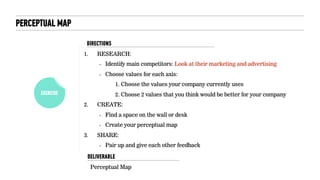
EXERCISE
PERCEPTUAL MAP
1. RESEARCH:
‣ Identify main competitors: Look at their marketing and advertising
‣ Choose values for each axis:
1. Choose the values your company currently uses
2. Choose 2 values that you think would be better for your company
2. CREATE:
‣ Find a space on the wall or desk
‣ Create your perceptual map
3. SHARE:
‣ Pair up and give each other feedback
Perceptual Map
DELIVERABLE
DIRECTIONS
PERCEPTUAL MAP
⌚ 20 MIN
1. RESEARCH:
• Choose a company and industry
• Identify main competitors: 

Look at their marketing and advertising
• Choose values for each axis: 

What are two influences on purchase decisions

Hint: What are the Value Propositions?
2. CREATE:
• Find a space on the wall or desk
• Create your perceptual map
3. SHARE:
• Pair up and give each other feedback
STRUCTURE
OBJECTIVES
Individually,
then pairsACTIVITY DEBRIEF
BRANDING
BRANDING
WHAT IS A BRAND?
AND HOW ARE THEY MARKETED?
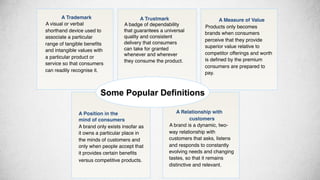
!A Trustmark!
!A badge of dependability
that guarantees a universal
quality and consistent
delivery that consumers
can take for granted
whenever and wherever
they consume the product. !
!A Measure of Value!
!Products only becomes
brands when consumers
perceive that they provide
superior value relative to
competitor offerings and worth
is defined by the premium
consumers are prepared to
pay.!
!!
!
A Relationship with
customers!
!A brand is a dynamic, two-
way relationship with
customers that asks, listens
and responds to constantly
evolving needs and changing
tastes, so that it remains
distinctive and relevant. !
A Position in the!
mind of consumers!
A brand only exists insofar as
it owns a particular place in
the minds of customers and
only when people accept that
it provides certain benefits
versus competitive products. !
!A Trademark!
!A visual or verbal
shorthand device used to
associate a particular
range of tangible benefits
and intangible values with
a particular product or
service so that consumers
can readily recognise it. !
Some Popular Definitions
WHY DO BRANDS EVEN MATTER?
1. People have too many choices and too little time
2. Most offerings have similar qualities and features
3. We tend to base our buying choices on trust
BRANDR
TO BURN
A SUCCESSFUL BRAND WAS:
EASILY IDENTIFIED.
DIFFICULT TO COPY.
AN INDICATOR OF THE QUALITY OF THE PRODUCT.
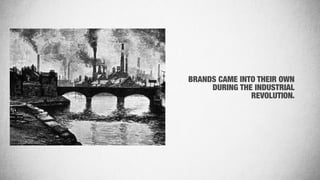
BRANDS CAME INTO THEIR OWN
DURING THE INDUSTRIAL
REVOLUTION.
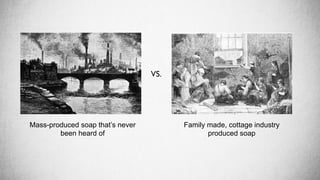
Mass-produced soap that’s never
been heard of
Family made, cottage industry
produced soap
VS.
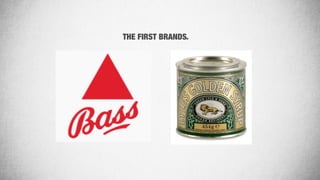
THE FIRST BRANDS.
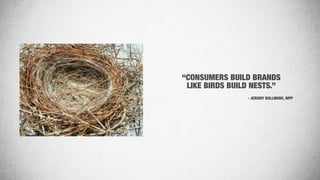
“CONSUMERS BUILD BRANDS
LIKE BIRDS BUILD NESTS.”
- JEREMY BULLMORE, WPP
1. WHERE IS THE MONEY?
2. WHAT IS THE REAL PROBLEM?
“A PROBLEM WELL-STATED
IS A PROBLEM HALF-SOLVED”
—Charles Kettering
“IF I HAD AN HOUR TO SAVE THE WORLD I
WOULD SPEND 59 MINUTES DEFINING
THE PROBLEM”
—ALBERT EINSTEIN
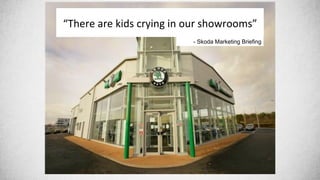
“There&are&kids&crying&in&our&showrooms”&
- Skoda Marketing Briefing
3. WHAT IS THE UNREASONABLE AMBITION?
Lead the next Industrial Revolution
Innovate so others can innovate
“TO MAKE CLEANLINESS COMMONPLACE; TO LESSEN WORK FOR
WOMEN; TO FOSTER HEALTH AND CONTRIBUTE TO PERSONAL
ATTRACTIVENESS, THAT LIFE MAY BE MORE ENJOYABLE AND
REWARDING FOR THE PEOPLE WHO USE OUR PRODUCTS.”
“TO LEAVE NO ATHLETE BEHIND.”
“THAT THE UNLEASHED CREATIVE SPIRIT WILL CHANGE THE WORLD.”
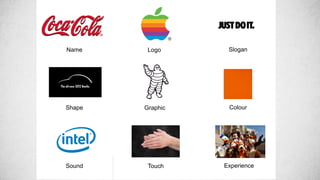
5. WHAT ARE THE BRAND’S KEY ELEMENTS?
Name Logo Slogan
Shape Graphic Colour
Sound Touch Experience
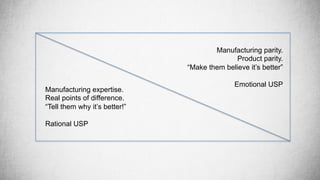
6. WHY SHOULD ANYONE BELIEVE IT?
Manufacturing expertise.
Real points of difference.
“Tell them why it’s better!”
Rational USP
Manufacturing parity.
Product parity.
“Make them believe it’s better”
Emotional USP
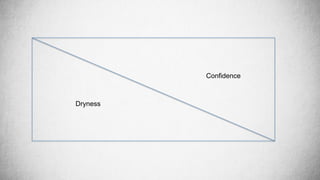
Dryness
Confidence
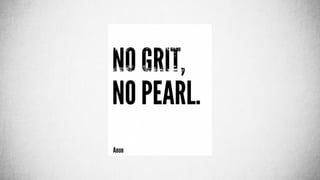
7. WHERE IS THE GRIT?
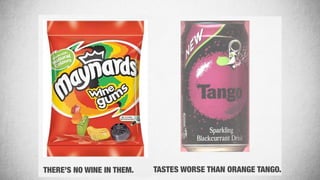
THERE’S NO WINE IN THEM.THERE’S NO WINE IN THEM. TASTES WORSE THAN ORANGE TANGO.
8. HOW CAN THE BRAND BE USEFUL?
9. WHAT IF I ONLY HAD $1?
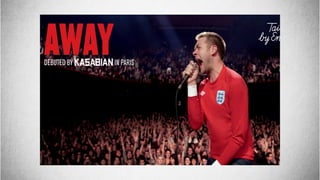
DEBUTED BY IN PARIS
10. REMEMBER, EVERYTHING IS MEDIA
11. MAKE PEOPLE FEEL
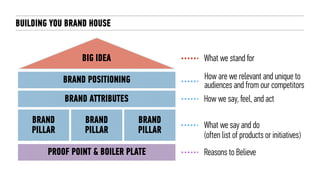
BUILDING YOU BRAND HOUSE
BIG IDEA
BRAND POSITIONING
BRAND ATTRIBUTES
BRAND
PILLAR
BRAND
PILLAR
BRAND
PILLAR
PROOF POINT & BOILER PLATE
What we stand for
How are we relevant and unique to
audiences and from our competitors
How we say, feel, and act
What we say and do
(often list of products or initiatives)
Reasons to Believe
EXERCISE
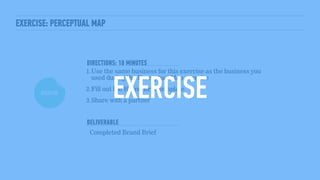
EXERCISE: PERCEPTUAL MAP
1.Use the same business for this exercise as the business you
used during the Perceptual Map exercise
2.Fill out the Brand Brief template
3.Share with a partner
Completed Brand Brief
DELIVERABLE
DIRECTIONS: 10 MINUTES
EXERCISE
EXERCISE
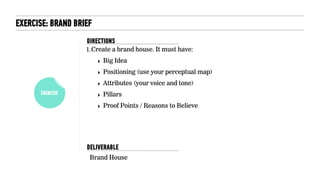
EXERCISE: BRAND BRIEF
1.Create a brand house. It must have:
‣ Big Idea
‣ Positioning (use your perceptual map)
‣ Attributes (your voice and tone)
‣ Pillars
‣ Proof Points / Reasons to Believe
Brand House
DELIVERABLE
DIRECTIONS
SEO
CREATING A
SEO STRATEGY
EXERCISE
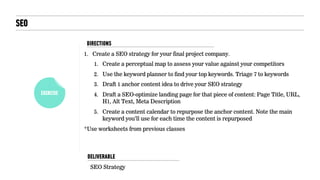
SEO
1. Create a SEO strategy for your final project company.
1. Create a perceptual map to assess your value against your competitors
2. Use the keyword planner to find your top keywords. Triage 7 to keywords
3. Draft 1 anchor content idea to drive your SEO strategy
4. Draft a SEO-optimize landing page for that piece of content: Page Title, URL,
H1, Alt Text, Meta Description
5. Create a content calendar to repurpose the anchor content. Note the main
keyword you’ll use for each time the content is repurposed
*Use worksheets from previous classes
SEO Strategy
DELIVERABLE
DIRECTIONS

Class 11: Branding and SEO

  • 1.
  • 2.
    FINAL CLASS LEARNING OBJECTIVES ‣Create a brand house with all of its main elements: Idea, positioning, attributes, pillars, and proof points ‣ Draft perceptual maps ‣ Develop a SEO strategy
  • 3.
    BUILDING YOU BRANDHOUSE BIG IDEA BRAND POSITIONING BRAND ATTRIBUTES BRAND PILLAR BRAND PILLAR BRAND PILLAR PROOF POINT & BOILER PLATE What we stand for How are we relevant and unique to audiences and from our competitors How we say, feel, and act What we say and do (often list of products or initiatives) Reasons to Believe
  • 4.
  • 5.
    PERCEPTUAL MAP A PERCEPTUALMAP is a visual representation of the differences and similarities of brands, products, or customers. “Typically the position of a product, product line, brand, or company is displayed relative to their competition.” - Wikipedia
  • 6.
    BRAND VOICE +POSITIONING POSITIONING The process by which marketers try to create an identity in the minds of their target market Repositioning – change your identity Depositioning – change your competitor’s identity
  • 7.
    POSITIONING: PERCEPTUAL MAP Usea perceptual map to visualize and: •Isolate 2 influences on purchasing decision •Plot competitors •Clusters indicate a market segment. •Empty space indicates a demand void.
  • 8.
  • 9.
  • 12.
  • 13.
    EXERCISE PERCEPTUAL MAP 1. RESEARCH: ‣Identify main competitors: Look at their marketing and advertising ‣ Choose values for each axis: 1. Choose the values your company currently uses 2. Choose 2 values that you think would be better for your company 2. CREATE: ‣ Find a space on the wall or desk ‣ Create your perceptual map 3. SHARE: ‣ Pair up and give each other feedback Perceptual Map DELIVERABLE DIRECTIONS
  • 14.
    PERCEPTUAL MAP ⌚ 20MIN 1. RESEARCH: • Choose a company and industry • Identify main competitors: 
 Look at their marketing and advertising • Choose values for each axis: 
 What are two influences on purchase decisions
 Hint: What are the Value Propositions? 2. CREATE: • Find a space on the wall or desk • Create your perceptual map 3. SHARE: • Pair up and give each other feedback STRUCTURE OBJECTIVES Individually, then pairsACTIVITY DEBRIEF
  • 15.
  • 16.
    WHAT IS ABRAND? AND HOW ARE THEY MARKETED?
  • 17.
    !A Trustmark! !A badgeof dependability that guarantees a universal quality and consistent delivery that consumers can take for granted whenever and wherever they consume the product. ! !A Measure of Value! !Products only becomes brands when consumers perceive that they provide superior value relative to competitor offerings and worth is defined by the premium consumers are prepared to pay.! !! ! A Relationship with customers! !A brand is a dynamic, two- way relationship with customers that asks, listens and responds to constantly evolving needs and changing tastes, so that it remains distinctive and relevant. ! A Position in the! mind of consumers! A brand only exists insofar as it owns a particular place in the minds of customers and only when people accept that it provides certain benefits versus competitive products. ! !A Trademark! !A visual or verbal shorthand device used to associate a particular range of tangible benefits and intangible values with a particular product or service so that consumers can readily recognise it. ! Some Popular Definitions
  • 18.
    WHY DO BRANDSEVEN MATTER? 1. People have too many choices and too little time 2. Most offerings have similar qualities and features 3. We tend to base our buying choices on trust
  • 19.
  • 20.
    A SUCCESSFUL BRANDWAS: EASILY IDENTIFIED. DIFFICULT TO COPY. AN INDICATOR OF THE QUALITY OF THE PRODUCT.
  • 21.
    BRANDS CAME INTOTHEIR OWN DURING THE INDUSTRIAL REVOLUTION.
  • 22.
    Mass-produced soap that’snever been heard of Family made, cottage industry produced soap VS.
  • 23.
  • 24.
    “CONSUMERS BUILD BRANDS LIKEBIRDS BUILD NESTS.” - JEREMY BULLMORE, WPP
  • 25.
    1. WHERE ISTHE MONEY?
  • 27.
    2. WHAT ISTHE REAL PROBLEM?
  • 28.
    “A PROBLEM WELL-STATED ISA PROBLEM HALF-SOLVED” —Charles Kettering
  • 29.
    “IF I HADAN HOUR TO SAVE THE WORLD I WOULD SPEND 59 MINUTES DEFINING THE PROBLEM” —ALBERT EINSTEIN
  • 30.
  • 31.
    3. WHAT ISTHE UNREASONABLE AMBITION?
  • 33.
    Lead the nextIndustrial Revolution Innovate so others can innovate
  • 34.
    “TO MAKE CLEANLINESSCOMMONPLACE; TO LESSEN WORK FOR WOMEN; TO FOSTER HEALTH AND CONTRIBUTE TO PERSONAL ATTRACTIVENESS, THAT LIFE MAY BE MORE ENJOYABLE AND REWARDING FOR THE PEOPLE WHO USE OUR PRODUCTS.” “TO LEAVE NO ATHLETE BEHIND.” “THAT THE UNLEASHED CREATIVE SPIRIT WILL CHANGE THE WORLD.”
  • 35.
    5. WHAT ARETHE BRAND’S KEY ELEMENTS?
  • 36.
    Name Logo Slogan ShapeGraphic Colour Sound Touch Experience
  • 38.
    6. WHY SHOULDANYONE BELIEVE IT?
  • 39.
    Manufacturing expertise. Real pointsof difference. “Tell them why it’s better!” Rational USP Manufacturing parity. Product parity. “Make them believe it’s better” Emotional USP
  • 40.
  • 41.
    7. WHERE ISTHE GRIT?
  • 43.
    THERE’S NO WINEIN THEM.THERE’S NO WINE IN THEM. TASTES WORSE THAN ORANGE TANGO.
  • 44.
    8. HOW CANTHE BRAND BE USEFUL?
  • 47.
    9. WHAT IFI ONLY HAD $1?
  • 48.
  • 49.
  • 52.
  • 54.
    BUILDING YOU BRANDHOUSE BIG IDEA BRAND POSITIONING BRAND ATTRIBUTES BRAND PILLAR BRAND PILLAR BRAND PILLAR PROOF POINT & BOILER PLATE What we stand for How are we relevant and unique to audiences and from our competitors How we say, feel, and act What we say and do (often list of products or initiatives) Reasons to Believe
  • 55.
    EXERCISE EXERCISE: PERCEPTUAL MAP 1.Usethe same business for this exercise as the business you used during the Perceptual Map exercise 2.Fill out the Brand Brief template 3.Share with a partner Completed Brand Brief DELIVERABLE DIRECTIONS: 10 MINUTES EXERCISE
  • 56.
    EXERCISE EXERCISE: BRAND BRIEF 1.Createa brand house. It must have: ‣ Big Idea ‣ Positioning (use your perceptual map) ‣ Attributes (your voice and tone) ‣ Pillars ‣ Proof Points / Reasons to Believe Brand House DELIVERABLE DIRECTIONS
  • 57.
  • 58.
    EXERCISE SEO 1. Create aSEO strategy for your final project company. 1. Create a perceptual map to assess your value against your competitors 2. Use the keyword planner to find your top keywords. Triage 7 to keywords 3. Draft 1 anchor content idea to drive your SEO strategy 4. Draft a SEO-optimize landing page for that piece of content: Page Title, URL, H1, Alt Text, Meta Description 5. Create a content calendar to repurpose the anchor content. Note the main keyword you’ll use for each time the content is repurposed *Use worksheets from previous classes SEO Strategy DELIVERABLE DIRECTIONS