Brain Secrets every
UXer needs to know
 @johnwhalen #brainsecrets
                             1
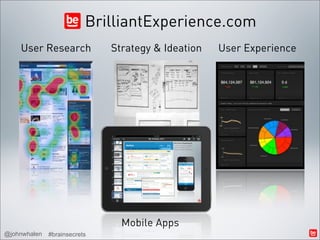
BrilliantExperience.com
    User Research             Strategy & Ideation   User Experience


                                Mobile Apps
@johnwhalen   #brainsecrets
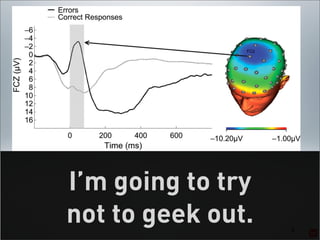
I’m going to try
not to geek out.   3
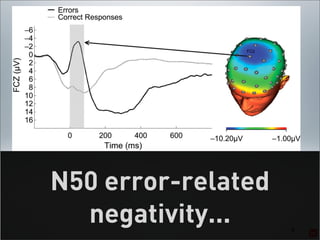
N50 error-related
  negativity...     4
...or d’oh!
              5
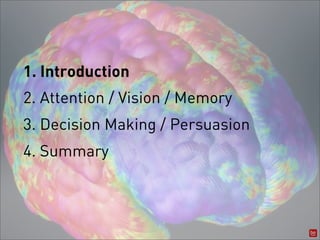
1. Introduction
2. Attention / Vision / Memory
3. Decision Making / Persuasion
4. Summary
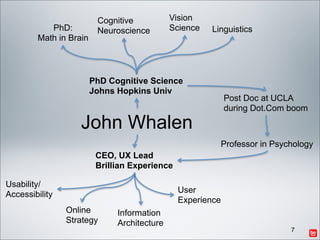
Cognitive           Vision
           PhD:          Neuroscience        Science   Linguistics
        Math in Brain


                        PhD Cognitive Science
                        Johns Hopkins Univ
                                                            Post Doc at UCLA
                                                            during Dot.Com boom

                   John Whalen
                                                         Professor in Psychology
                         CEO, UX Lead
                         Brillian Experience

Usability/
                                               User
Accessibility
                                               Experience
                Online        Information
                Strategy      Architecture
                                                                           7
8
We don’t experience
what is in the real world.   9
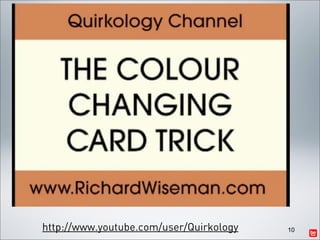
http://www.youtube.com/user/Quirkology   10
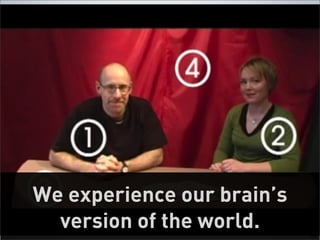
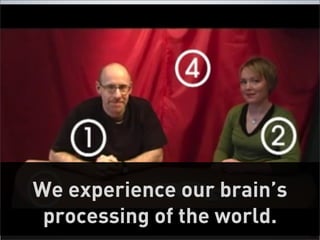
We experience our brain’s
  version of the world.     11
“Cogito ergo sum”
                    12
(I can’t trust my senses,
    but I know I exist
because of my thoughts.)    13
Oh, you mean like The Matrix
     ...okay now I got it!14
We use two major
thinking systems   15
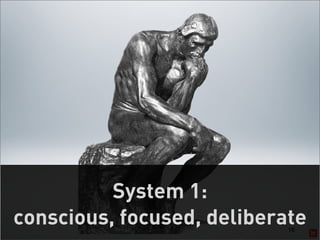
System 1:
conscious, focused, deliberate
                            16
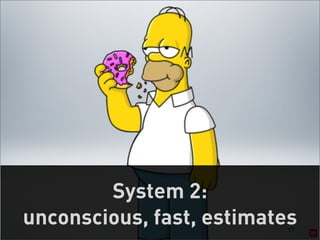
System 2:
unconscious, fast, estimates
                           17
We as UXers underestimate the
 power of System 2 and don’t
   take full advantage of it.
                          18
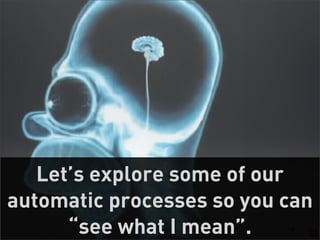
Let’s explore some of our
automatic processes so you can
      “see what I mean”.   19
1. Introduction
2. Attention / Vision / Memory
3. Decision Making / Persuasion
4. Summary
What captures your attention?
                           21
Your eyes move in saccades.
      http://bit.ly/tobiiglasses   22
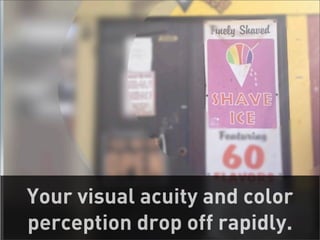
Your visual acuity and color
perception drop off rapidly.
                           23
Your visual acuity and color
perception drop off rapidly.
                           24
25
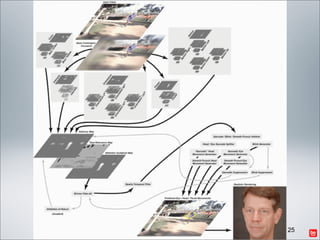
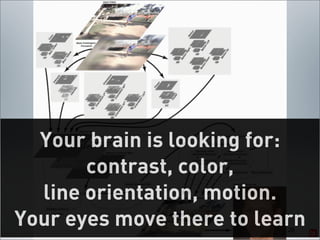
Your brain is looking for:
       contrast, color,
  line orientation, motion.
Your eyes move there to learn
                           26
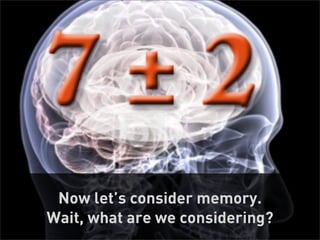
Now let’s consider memory.
Wait, what are we considering?
                                 27
Stare at the white dot. What happens to
      other spot during rotation?
     http://perception.research.yale.edu/MIB-Disappearance/MIB-Basic.mov   28
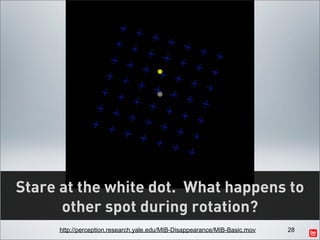
Stare at the white dot. What happens to
      other spot during rotation?
     http://perception.research.yale.edu/MIB-Disappearance/MIB-Basic.mov   28
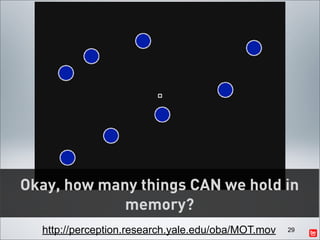
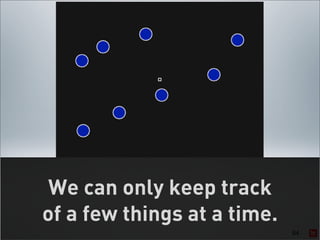
Okay, how many things CAN we hold in
             memory?
  http://perception.research.yale.edu/oba/MOT.mov   29
Okay, how many things CAN we hold in
             memory?
  http://perception.research.yale.edu/oba/MOT.mov   29
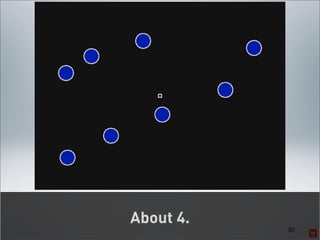
About 4.
           30
About 4.
           30
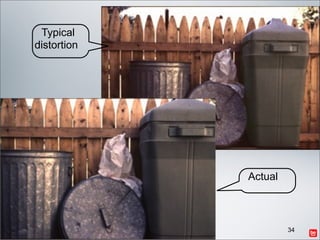
Now let’s look at picture memory.
    Draw a rectangle on a piece of paper.
I’ll give you 20 seconds to look at a picture.
        Sketch it exactly as it appears. 31
http://sites.sinauer.com/wolfe3e/chap7/boundexF.htm   32
Let’s see how you did.
                         33
Typical
distortion


             Actual


                      34
http://www.simonslab.com/videos.html   35
http://www.simonslab.com/videos.html
                                       36
http://www.simonslab.com/videos.html
                                       36
Phew, that’s a lot!
Let’s review, shall we?   37
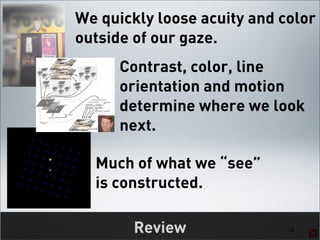
We quickly loose acuity and color
outside of our gaze.
      Contrast, color, line
      orientation and motion
      determine where we look
      next.

  Much of what we “see”
  is constructed.

        Review               38
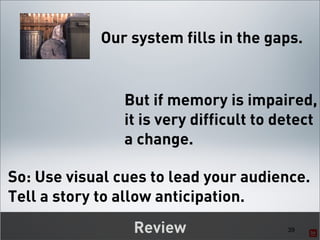
Our system fills in the gaps.


                But if memory is impaired,
                it is very difficult to detect
                a change.

So: Use visual cues to lead your audience.
Tell a story to allow anticipation.
                 Review                  39
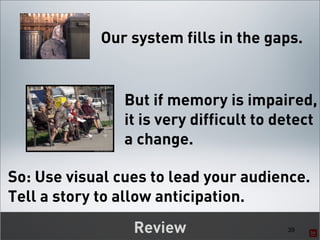
Our system fills in the gaps.


                But if memory is impaired,
                it is very difficult to detect
                a change.

So: Use visual cues to lead your audience.
Tell a story to allow anticipation.
                 Review                  39
How are we doing?
                    40
1. Introduction
2. Attention / Vision / Memory
3. Decision Making / Persuasion
4. Summary
System 2:
unconscious, fast, estimates
                           42
How could we use what
we know to be persuasive?
                        43
B


              A


                   C


Likeability, Free, Commitment
                           44
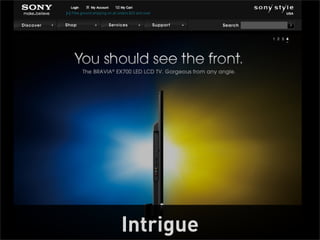
Intrigue   45
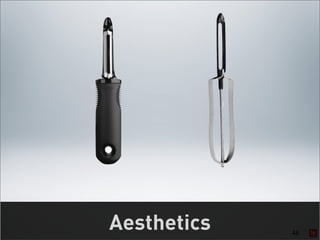
Aesthetics   46
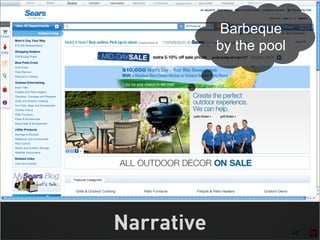
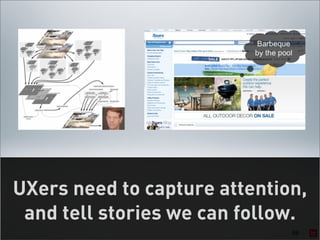
Barbeque
            by the pool


Narrative                 47
Where’s the
          barbeque?


Achievement         48
Authority   49
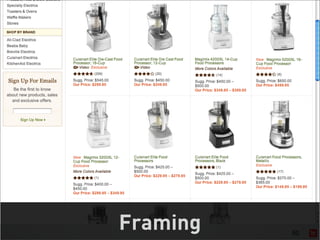
Framing   50
Anchoring   51
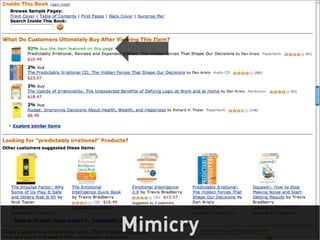
Mimicry   52
Scarcity, Loss Aversion   53
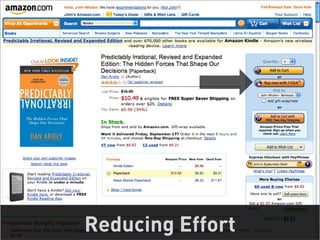
Reducing Effort   54
Creating Ownership   55
Phew, that’s a lot!
Let’s review, shall we?   56
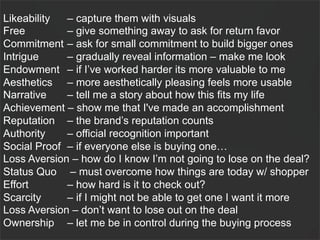
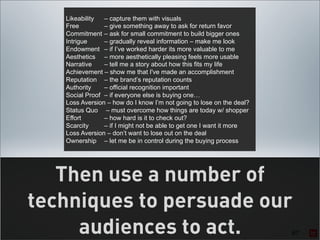
Likeability  – capture them with visuals
Free         – give something away to ask for return favor
Commitment – ask for small commitment to build bigger ones
Intrigue     – gradually reveal information – make me look
Endowment – if I’ve worked harder its more valuable to me
Aesthetics – more aesthetically pleasing feels more usable
Narrative    – tell me a story about how this fits my life
Achievement – show me that I've made an accomplishment
Reputation – the brand’s reputation counts
Authority    – official recognition important
Social Proof – if everyone else is buying one…
Loss Aversion – how do I know I’m not going to lose on the deal?
Status Quo – must overcome how things are today w/ shopper
Effort       – how hard is it to check out?
Scarcity     – if I might not be able to get one I want it more
Loss Aversion – don’t want to lose out on the deal
Ownership – let me be in control during the buying process
                                                            57
1. Introduction
2. Attention / Vision / Memory
3. Decision Making / Persuasion
4. Summary
We don’t experience
what is in the real world
                       59
We experience our brain’s
 processing of the world.   60
We use two major
thinking systems
                   61
System 1:
conscious, focused, deliberate
                            62
System 2:
unconscious, fast, estimates
                           63
We can only keep track
of a few things at a time.
                             64
We can only keep track
of a few things at a time.
                             64
We fill in a lot of details.
                               65
We fill in a lot of details.
                               65
We fill in a lot of details.
                               65
UXers need to capture attention,
 and tell stories we can follow.
                              66
Likeability  – capture them with visuals
   Free         – give something away to ask for return favor
   Commitment – ask for small commitment to build bigger ones
   Intrigue     – gradually reveal information – make me look
   Endowment – if I’ve worked harder its more valuable to me
   Aesthetics – more aesthetically pleasing feels more usable
   Narrative    – tell me a story about how this fits my life
   Achievement – show me that I've made an accomplishment
   Reputation – the brand’s reputation counts
   Authority    – official recognition important
   Social Proof – if everyone else is buying one…
   Loss Aversion – how do I know I’m not going to lose on the deal?
   Status Quo – must overcome how things are today w/ shopper
   Effort       – how hard is it to check out?
   Scarcity     – if I might not be able to get one I want it more
   Loss Aversion – don’t want to lose out on the deal
   Ownership – let me be in control during the buying process


   Then use a number of
techniques to persuade our
     audiences to act.                                                67
By making System 2 happy.
                            68
Thank you! #brainsecrets
                           69
Thank you! #brainsecrets
                           69
John Whalen
    @johnwhalen
User Research   Strategy   User Experience
                                             Mobile


         BrilliantExperience.com

Brain secrets every UXer needs to know