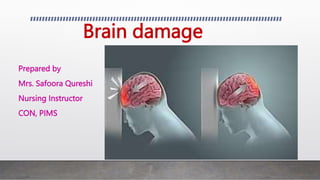
Brain damage
Prepared by
Mrs. Safoora Qureshi
Nursing Instructor
CON, PIMS
Brain Damage
• Neurotrauma, brain damage or brain injury (BI) is the destruction or
degeneration of brain cells.
• Brain injury may be traumatic or acquired
• Traumatic brain injury (TBI)
• is a non-degenerative, and non-congenital insult to the brain from
an external force, leading to permanent or temporary impairment of
cognitive, physical, and psychological functions, with associated
altered consciousness
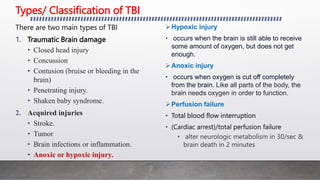
Types/ Classification of TBI
There are two main types of TBI
1. Traumatic Brain damage
• Closed head injury
• Concussion
• Contusion (bruise or bleeding in the
brain)
• Penetrating injury.
• Shaken baby syndrome.
2. Acquired injuries
• Stroke.
• Tumor
• Brain infections or inflammation.
• Anoxic or hypoxic injury.
Hypoxic injury
• occurs when the brain is still able to receive
some amount of oxygen, but does not get
enough.
Anoxic injury
• occurs when oxygen is cut off completely
from the brain. Like all parts of the body, the
brain needs oxygen in order to function.
Perfusion failure
• Total blood flow interruption
• (Cardiac arrest)/total perfusion failure
• alter neurologic metabolism in 30/sec &
brain death in 2 minutes
Causes
Traumatic
• Falls
• Motor vehicle accidents
• Blows to the head
• Violence
Acquired:
• Choking
• Drowning
• Drug overdose
• Exposure to poisons or pollutants, such as carbon monoxide or lead
• infection, such as encephalitis or meningitis
• Seizure
Symptoms
• Affected balance
• Dizziness
• Blurred vision
• Confusion
• Difficulty speaking clearly
• Headache, numbness, fatigue
• Memory problems
• paralysis
• vomiting
• Seizures
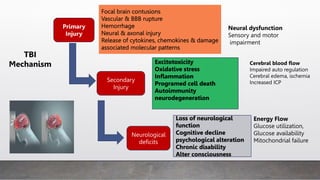
Pathophysiological Mechanisms of (TBI)
Primary injury causes local brain damage, leads to further neural
dysfunction
secondary damage
• begins with inflammatory activity followed by disruption of the
blood–brain barrier (BBB), peripheral blood cells infiltration, brain
edema, and the discharge of numerous immune mediators including
chemotactic factors and interleukins."
Focal brain contusions
Vascular & BBB rupture
Hemorrhage
Neural & axonal injury
Release of cytokines, chemokines & damage
associated molecular patterns
Excitotoxicity
Oxidative stress
Inflammation
Programed cell death
Autoimmunity
neurodegeneration
Loss of neurological
function
Cognitive decline
psychological alteration
Chronic disability
Alter consciousness
Primary
Injury
Secondary
Injury
Neurological
deficits
Neural dysfunction
Sensory and motor
impairment
Cerebral blood flow
Impaired auto regulation
Cerebral edema, ischemia
Increased ICP
Energy Flow
Glucose utilization,
Glucose availability
Mitochondrial failure
TBI
Mechanism
Special states of Alter Consciousness
Coma state:
A coma is a lengthy deep state of unconsciousness. People in a state of coma are alive but are
unable to move or be aware of or respond to their surroundings
Vegetative state
• A persistent vegetative state (PVS), also known as post-coma unresponsiveness (PCU), is a
chronic disorder in which an individual with severe brain damage appears to be awake but
shows no evidence of awareness of their surroundings.
• Nocked in syndrome
• Individuals with locked-in syndrome are conscious and awake, but have no ability to produce
movements (outside of eye movement) or to speak (aphonia). Cognitive function is usually
unaffected.
• Brain stem death
Is irreversible cessation of brain and brain stem function
Brain Damage [The Complete Picture]

Brain Damage [The Complete Picture]

  • 1.
    Brain damage Prepared by Mrs.Safoora Qureshi Nursing Instructor CON, PIMS
  • 2.
    Brain Damage • Neurotrauma,brain damage or brain injury (BI) is the destruction or degeneration of brain cells. • Brain injury may be traumatic or acquired • Traumatic brain injury (TBI) • is a non-degenerative, and non-congenital insult to the brain from an external force, leading to permanent or temporary impairment of cognitive, physical, and psychological functions, with associated altered consciousness
  • 3.
    Types/ Classification ofTBI There are two main types of TBI 1. Traumatic Brain damage • Closed head injury • Concussion • Contusion (bruise or bleeding in the brain) • Penetrating injury. • Shaken baby syndrome. 2. Acquired injuries • Stroke. • Tumor • Brain infections or inflammation. • Anoxic or hypoxic injury. Hypoxic injury • occurs when the brain is still able to receive some amount of oxygen, but does not get enough. Anoxic injury • occurs when oxygen is cut off completely from the brain. Like all parts of the body, the brain needs oxygen in order to function. Perfusion failure • Total blood flow interruption • (Cardiac arrest)/total perfusion failure • alter neurologic metabolism in 30/sec & brain death in 2 minutes
  • 4.
    Causes Traumatic • Falls • Motorvehicle accidents • Blows to the head • Violence Acquired: • Choking • Drowning • Drug overdose • Exposure to poisons or pollutants, such as carbon monoxide or lead • infection, such as encephalitis or meningitis • Seizure
  • 5.
    Symptoms • Affected balance •Dizziness • Blurred vision • Confusion • Difficulty speaking clearly • Headache, numbness, fatigue • Memory problems • paralysis • vomiting • Seizures
  • 6.
    Pathophysiological Mechanisms of(TBI) Primary injury causes local brain damage, leads to further neural dysfunction secondary damage • begins with inflammatory activity followed by disruption of the blood–brain barrier (BBB), peripheral blood cells infiltration, brain edema, and the discharge of numerous immune mediators including chemotactic factors and interleukins."
  • 7.
    Focal brain contusions Vascular& BBB rupture Hemorrhage Neural & axonal injury Release of cytokines, chemokines & damage associated molecular patterns Excitotoxicity Oxidative stress Inflammation Programed cell death Autoimmunity neurodegeneration Loss of neurological function Cognitive decline psychological alteration Chronic disability Alter consciousness Primary Injury Secondary Injury Neurological deficits Neural dysfunction Sensory and motor impairment Cerebral blood flow Impaired auto regulation Cerebral edema, ischemia Increased ICP Energy Flow Glucose utilization, Glucose availability Mitochondrial failure TBI Mechanism
  • 8.
    Special states ofAlter Consciousness Coma state: A coma is a lengthy deep state of unconsciousness. People in a state of coma are alive but are unable to move or be aware of or respond to their surroundings Vegetative state • A persistent vegetative state (PVS), also known as post-coma unresponsiveness (PCU), is a chronic disorder in which an individual with severe brain damage appears to be awake but shows no evidence of awareness of their surroundings. • Nocked in syndrome • Individuals with locked-in syndrome are conscious and awake, but have no ability to produce movements (outside of eye movement) or to speak (aphonia). Cognitive function is usually unaffected. • Brain stem death Is irreversible cessation of brain and brain stem function