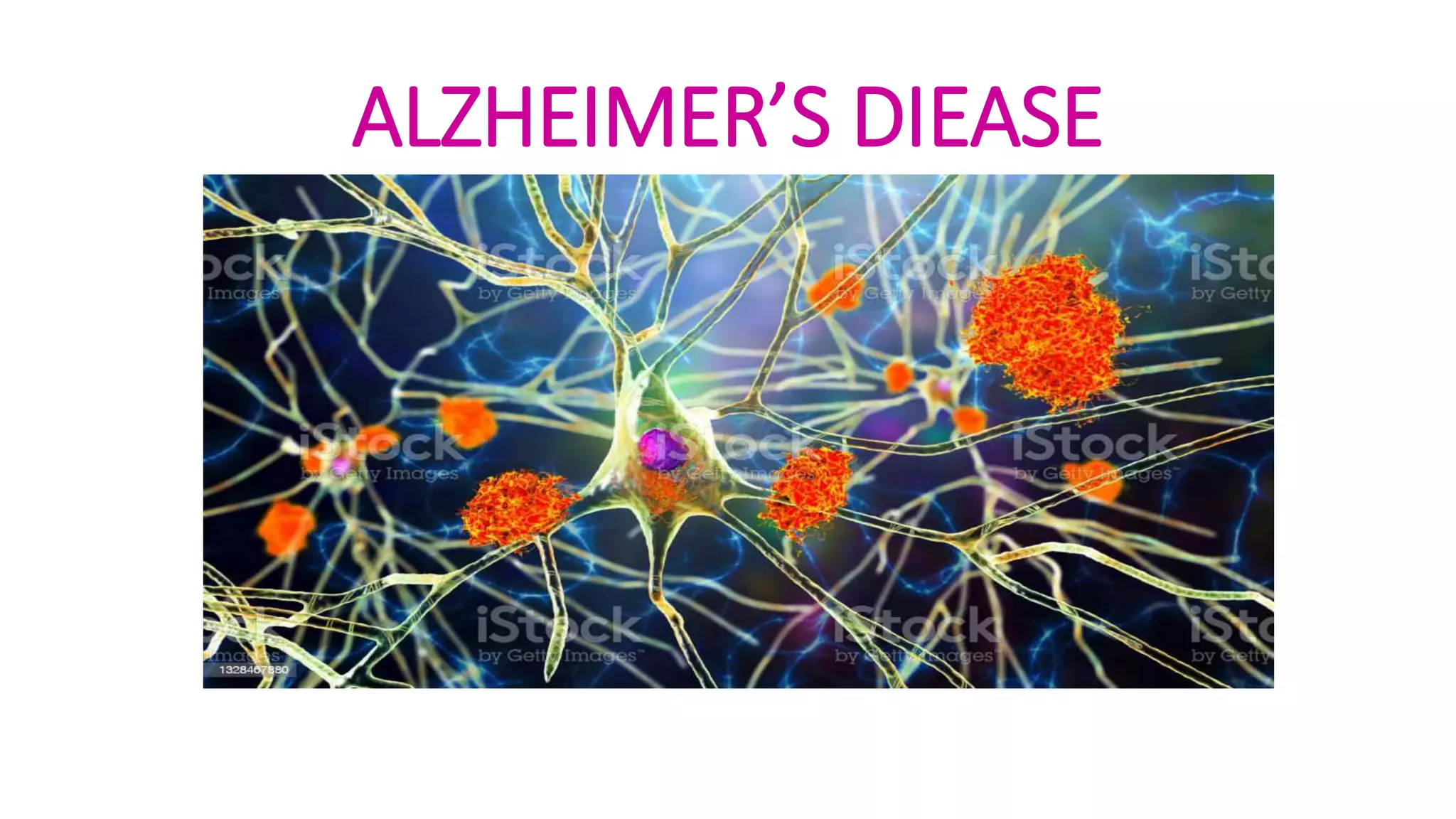
ALZHEIMER’S DIEASE
MMrs.Mr
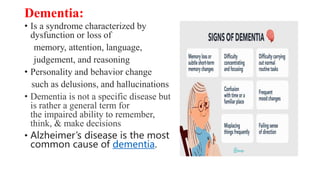
Dementia:
• Is a syndrome characterized by
dysfunction or loss of
memory, attention, language,
judgement, and reasoning
• Personality and behavior change
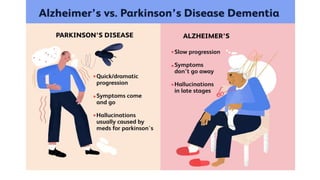
such as delusions, and hallucinations
• Dementia is not a specific disease but
is rather a general term for
the impaired ability to remember,
think, & make decisions
• Alzheimer’s disease is the most
common cause of dementia.
Alzheimer’s disease
• AD is a chronic progressive,
degenerative, disease of the brain
• AD is a progressive neurologic
disorder that causes the brain to
shrink (atrophy) and brain cells to die
• It is the most common form of
dementia
• Characterized by a gradual decline
in
• Memory.
• Reasoning and handling of
complex tasks.
• Language.
• Understanding visual form and
space relationship.
• Behavior and personality.
Prevalence:
• Early-onset Alzheimer’s
disease occurs before 65.
• Late-onset Alzheimer’s disease
occurs after age 65
• Dementia is more common in men
• AD affects more women than men
• Death with AD in women is about
twice as compare to men
Causes Diagnosis
Causes:
• unknown
• Aging/ is most common risk factor
• Genetic factors
• Environmental factors
Classification:
• Familial AD
• a strong family
connection/Genetic
• Sporadic AD
• No family connection
• Rapidly progress
• Diagnosis
• History
• Physical exam
• Psychological evaluation
• Mini-menta state Examination
• CT, MRI,PET scan
• Autopsy/ Brain tissue
examination confirms the
neurofibrillary tangles and
plaques
Blood CP, TFT,LFTs,CBC,creatinine,
BUN
Stages Of AD
Early (Mild):
• Forgetting
• Newly learned information,
recent events, places and names.
• Inability to find right words to express
thoughts.
• Loss of initiative and interest
• Decreased judgement
• Defective problem-solving.
• Geographic disorientation
Middle (Moderate):
• typically the longest stage and can last
many years.
• Impaired ability to recognized close
family members & friends
• Loss of remote/short-term memory.
• Wandering/getting lost
• suspicious about family, friends and
caregivers
• Agitation, behavior change,
insomnia
• Delusions, Illusions, hallucination
Late (Severe)
• Little memory ,inability to process
new information
• Cannot understand words
• Difficult eating, swallowing
• Repetitious words or sounds
• Immobility
• Urine/bowel incontinence
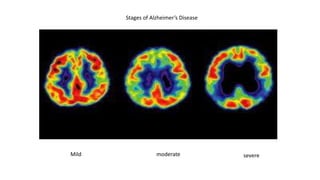
Stages of Alzheimer’s Disease
Mild moderate severe
Pathophysiology of AD
• Pathophysiology involves following process
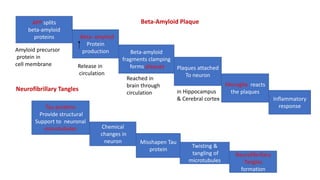
1. Beta-Amyloid Plaque:
• AD is characterized by buildup of protein called Beta-Amyloid which forms
sticky plaques in brain between neurons that disrupted cell functioning and
cause brain cells to die
• APP/amyloid precursor protein splits beta-amyloid proteins, releases in
circulation
• Plaque is first develop in hippochempus and cerebral cortex which deals
with language and reasoning
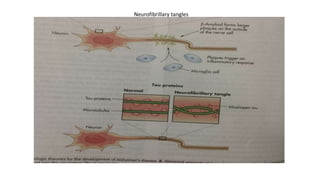
2. Neurofibrillary tangles:
• collection of twisted protein threads in side the nerve cells.
• Tau protein is the main component of these structures, that provide
support to microtubules
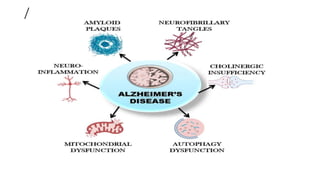
• Result in cholinergic insufficiency, mitochondria dysfunction, inflammation
and degeneration of neuron
Neurofibrillary tangles
APP splits
beta-amyloid
proteins
am
Beta- amyloid
Protein
production Beta-amyloid
fragments clamping
forms plaques Plaques attached
To neuron
Microglia reacts
the plaques
Inflammatory
response
Tau proteins
Provide structural
Support to neuronal
microtubules Chemical
changes in
neuron Misshapen Tau
protein
Twisting &
tangling of
microtubules
Amyloid precursor
protein in
cell membrane Release in
circulation
in Hippocampus
& Cerebral cortex
Neurofibrillary Tangles
Beta-Amyloid Plaque
Neurofibrillary
Tangles
formation
Reached in
brain through
circulation
/
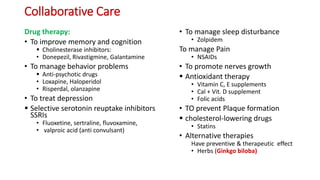
Collaborative Care
Drug therapy:
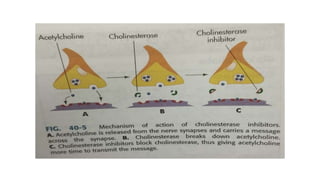
• To improve memory and cognition
 Cholinesterase inhibitors:
• Donepezil, Rivastigmine, Galantamine
• To manage behavior problems
 Anti-psychotic drugs
• Loxapine, Haloperidol
• Risperdal, olanzapine
• To treat depression
 Selective serotonin reuptake inhibitors
SSRIs
• Fluoxetine, sertraline, fluvoxamine,
• valproic acid (anti convulsant)
• To manage sleep disturbance
• Zolpidem
To manage Pain
• NSAIDs
• To promote nerves growth
 Antioxidant therapy
• Vitamin C, E supplements
• Cal + Vit. D supplement
• Folic acids
• TO prevent Plaque formation
 cholesterol-lowering drugs
• Statins
• Alternative therapies
Have preventive & therapeutic effect
• Herbs (Ginkgo biloba)
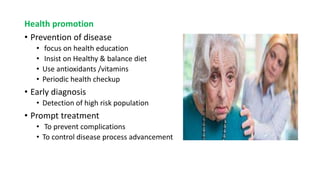
Health promotion
• Prevention of disease
• focus on health education
• Insist on Healthy & balance diet
• Use antioxidants /vitamins
• Periodic health checkup
• Early diagnosis
• Detection of high risk population
• Prompt treatment
• To prevent complications
• To control disease process advancement
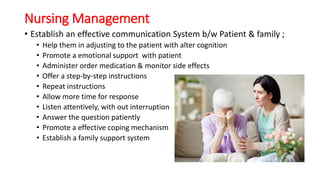
Nursing Management
• Establish an effective communication System b/w Patient & family ;
• Help them in adjusting to the patient with alter cognition
• Promote a emotional support with patient
• Administer order medication & monitor side effects
• Offer a step-by-step instructions
• Repeat instructions
• Allow more time for response
• Listen attentively, with out interruption
• Answer the question patiently
• Promote a effective coping mechanism
• Establish a family support system
• Provide Assistance
• In self-care, bathing, dressing,
grooming and toileting
• Be available for assistance in daily life
activities to
• Encourage independence
• Facilitate personal/ toilet hygiene
• Regulate toilet habits by
• insisting the patient to void /eliminate in
specified timing
• Provide a safe environment
• Use of assistive devices correctly
• Provide assistive devices to
• Steady gait
• Provide supportive ambulation
• Prevent Fall/injuries
• Plan protective measures before
exposure to a specified
environment
• Patient must wear shoes
• well fitted and tied
• Non-skids sole
• Prevents triggers such as
• Agitation ,restlessness, pain,
fatigue, restrains etc
• Insist use of vision correcting
device /glasses
• Use bed side railing

Alzheimer's Disease [A Complete Picture]

  • 1.
  • 2.
    Dementia: • Is asyndrome characterized by dysfunction or loss of memory, attention, language, judgement, and reasoning • Personality and behavior change such as delusions, and hallucinations • Dementia is not a specific disease but is rather a general term for the impaired ability to remember, think, & make decisions • Alzheimer’s disease is the most common cause of dementia.
  • 3.
    Alzheimer’s disease • ADis a chronic progressive, degenerative, disease of the brain • AD is a progressive neurologic disorder that causes the brain to shrink (atrophy) and brain cells to die • It is the most common form of dementia • Characterized by a gradual decline in • Memory. • Reasoning and handling of complex tasks. • Language. • Understanding visual form and space relationship. • Behavior and personality. Prevalence: • Early-onset Alzheimer’s disease occurs before 65. • Late-onset Alzheimer’s disease occurs after age 65 • Dementia is more common in men • AD affects more women than men • Death with AD in women is about twice as compare to men
  • 5.
    Causes Diagnosis Causes: • unknown •Aging/ is most common risk factor • Genetic factors • Environmental factors Classification: • Familial AD • a strong family connection/Genetic • Sporadic AD • No family connection • Rapidly progress • Diagnosis • History • Physical exam • Psychological evaluation • Mini-menta state Examination • CT, MRI,PET scan • Autopsy/ Brain tissue examination confirms the neurofibrillary tangles and plaques Blood CP, TFT,LFTs,CBC,creatinine, BUN
  • 6.
    Stages Of AD Early(Mild): • Forgetting • Newly learned information, recent events, places and names. • Inability to find right words to express thoughts. • Loss of initiative and interest • Decreased judgement • Defective problem-solving. • Geographic disorientation Middle (Moderate): • typically the longest stage and can last many years. • Impaired ability to recognized close family members & friends • Loss of remote/short-term memory. • Wandering/getting lost • suspicious about family, friends and caregivers • Agitation, behavior change, insomnia • Delusions, Illusions, hallucination Late (Severe) • Little memory ,inability to process new information • Cannot understand words • Difficult eating, swallowing • Repetitious words or sounds • Immobility • Urine/bowel incontinence
  • 7.
    Stages of Alzheimer’sDisease Mild moderate severe
  • 8.
    Pathophysiology of AD •Pathophysiology involves following process 1. Beta-Amyloid Plaque: • AD is characterized by buildup of protein called Beta-Amyloid which forms sticky plaques in brain between neurons that disrupted cell functioning and cause brain cells to die • APP/amyloid precursor protein splits beta-amyloid proteins, releases in circulation • Plaque is first develop in hippochempus and cerebral cortex which deals with language and reasoning 2. Neurofibrillary tangles: • collection of twisted protein threads in side the nerve cells. • Tau protein is the main component of these structures, that provide support to microtubules • Result in cholinergic insufficiency, mitochondria dysfunction, inflammation and degeneration of neuron
  • 9.
  • 10.
    APP splits beta-amyloid proteins am Beta- amyloid Protein productionBeta-amyloid fragments clamping forms plaques Plaques attached To neuron Microglia reacts the plaques Inflammatory response Tau proteins Provide structural Support to neuronal microtubules Chemical changes in neuron Misshapen Tau protein Twisting & tangling of microtubules Amyloid precursor protein in cell membrane Release in circulation in Hippocampus & Cerebral cortex Neurofibrillary Tangles Beta-Amyloid Plaque Neurofibrillary Tangles formation Reached in brain through circulation
  • 11.
  • 12.
    Collaborative Care Drug therapy: •To improve memory and cognition  Cholinesterase inhibitors: • Donepezil, Rivastigmine, Galantamine • To manage behavior problems  Anti-psychotic drugs • Loxapine, Haloperidol • Risperdal, olanzapine • To treat depression  Selective serotonin reuptake inhibitors SSRIs • Fluoxetine, sertraline, fluvoxamine, • valproic acid (anti convulsant) • To manage sleep disturbance • Zolpidem To manage Pain • NSAIDs • To promote nerves growth  Antioxidant therapy • Vitamin C, E supplements • Cal + Vit. D supplement • Folic acids • TO prevent Plaque formation  cholesterol-lowering drugs • Statins • Alternative therapies Have preventive & therapeutic effect • Herbs (Ginkgo biloba)
  • 14.
    Health promotion • Preventionof disease • focus on health education • Insist on Healthy & balance diet • Use antioxidants /vitamins • Periodic health checkup • Early diagnosis • Detection of high risk population • Prompt treatment • To prevent complications • To control disease process advancement
  • 15.
    Nursing Management • Establishan effective communication System b/w Patient & family ; • Help them in adjusting to the patient with alter cognition • Promote a emotional support with patient • Administer order medication & monitor side effects • Offer a step-by-step instructions • Repeat instructions • Allow more time for response • Listen attentively, with out interruption • Answer the question patiently • Promote a effective coping mechanism • Establish a family support system
  • 16.
    • Provide Assistance •In self-care, bathing, dressing, grooming and toileting • Be available for assistance in daily life activities to • Encourage independence • Facilitate personal/ toilet hygiene • Regulate toilet habits by • insisting the patient to void /eliminate in specified timing • Provide a safe environment • Use of assistive devices correctly • Provide assistive devices to • Steady gait • Provide supportive ambulation • Prevent Fall/injuries • Plan protective measures before exposure to a specified environment • Patient must wear shoes • well fitted and tied • Non-skids sole • Prevents triggers such as • Agitation ,restlessness, pain, fatigue, restrains etc • Insist use of vision correcting device /glasses • Use bed side railing