TBI defined as a blow to the head that disrupts the normal
function of the brain.
TBI, also known as Craniocerebral trauma.
TBI can result when the head suddenly & violently hits an
object or when the object pierces the skull.
60% of all TBI caused by road accident.
15-20% of TBI alcohol involvement.
One person dies in every 6 to 10 min.
1. Penetrating Brain Injury
2. Non-penetrating Brain Injury
Known as Open-head injuries.
Penetrating brain injury is when an object
enters the skull & harms the brain.
The Skull is Fractured.
The Meninges are torn.
- Fall
- Motor vehicle accident
- Sport injury
- Gunshot (high velocity)
- Violence (shaken baby)
- Possibly, death
- Fracture of skull
- Headache
- Bleeding, swelling of brain tissue
- Loss of consciousness
- Destruction of brain tissue (gunshot path)
- Respiratory & Cardiac failures resulting in death
(due to severe injury to Brain stem)
Known as Closed-head injuries
The meninges remain intact, the brain suffer
Indirect damage
- Concussion
- Diffuse Axonal injury
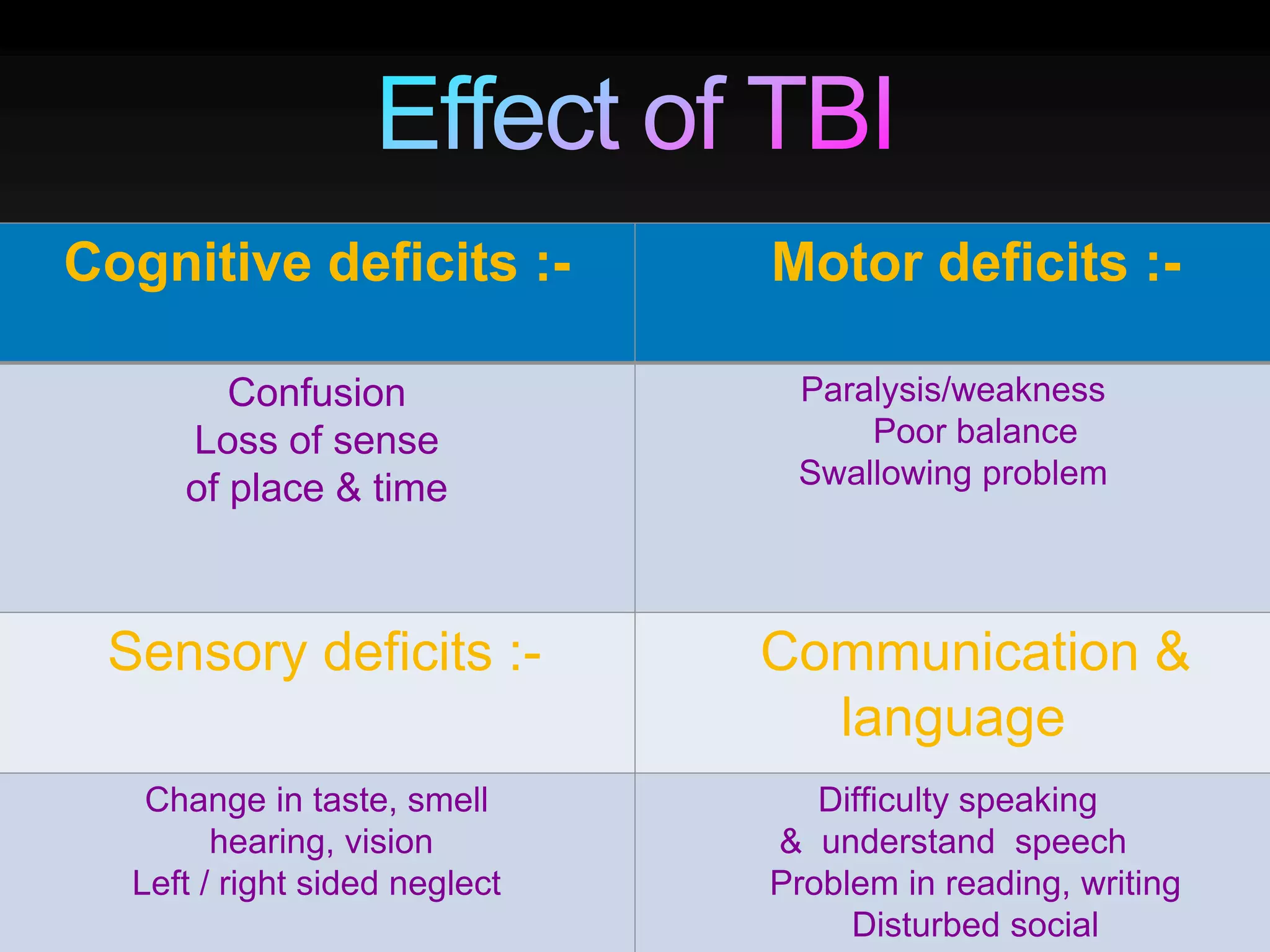
Cognitive deficits :- Motor deficits :-
Confusion
Loss of sense
of place & time
Paralysis/weakness
Poor balance
Swallowing problem
Sensory deficits :- Communication &
language
Change in taste, smell
hearing, vision
Left / right sided neglect
Difficulty speaking
& understand speech
Problem in reading, writing
Disturbed social
Hematome is accumulation of blood due to
haemorrhage
3 types of hematoma
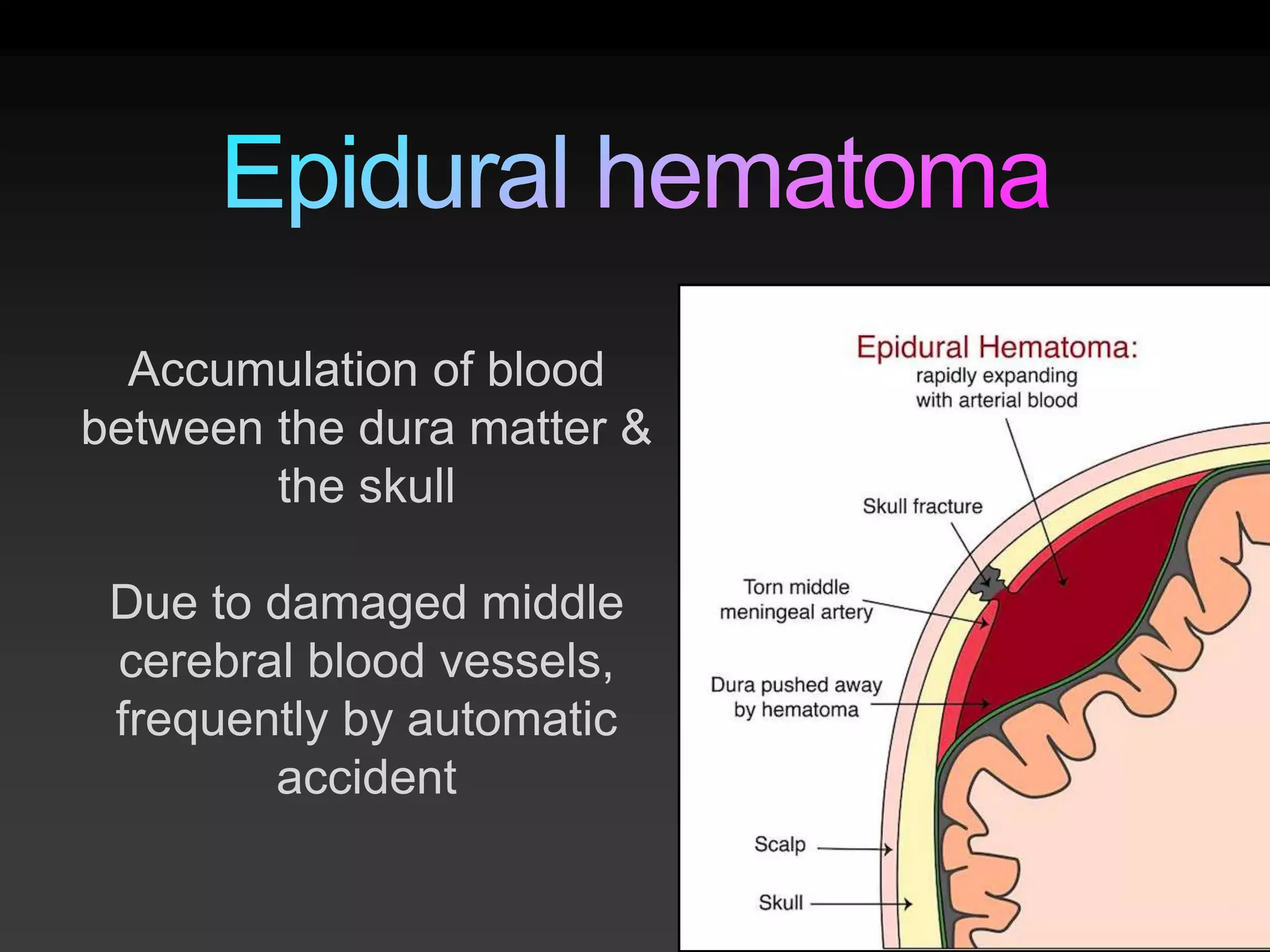
Accumulation of blood
between the dura matter &
the skull
Due to damaged middle
cerebral blood vessels,
frequently by automatic
accident
Lacerated (rupture) cortical
blood vessel hematoma
Accumulation of blood
between dura & arachnoid.
Accumulation of blood, water, cerebrospinal fluid
causes increased pressure
Increased pressure is the frequent cause of death in
TBI , pressure is the greatest
at the site of lesion
Brain tissue may be compressed, distorted, stretched
.
Initial assessment :-
Glasgow Coma Scale (GCS)
The Galveston Orientation and Amnesia Test
History of present condition
Past medical history
Result of investigations (X-Ray, CT-Scans)
Vision
Hearing
Swallowing
Posture & balance
Voluntary & involuntary movements
Memory
Attention
Thank you

Traumatic Brain Injury (TBI)

  • 2.
    TBI defined asa blow to the head that disrupts the normal function of the brain. TBI, also known as Craniocerebral trauma. TBI can result when the head suddenly & violently hits an object or when the object pierces the skull.
  • 3.
    60% of allTBI caused by road accident. 15-20% of TBI alcohol involvement. One person dies in every 6 to 10 min.
  • 4.
    1. Penetrating BrainInjury 2. Non-penetrating Brain Injury
  • 5.
    Known as Open-headinjuries. Penetrating brain injury is when an object enters the skull & harms the brain. The Skull is Fractured. The Meninges are torn.
  • 6.
    - Fall - Motorvehicle accident - Sport injury - Gunshot (high velocity) - Violence (shaken baby)
  • 7.
    - Possibly, death -Fracture of skull - Headache - Bleeding, swelling of brain tissue - Loss of consciousness - Destruction of brain tissue (gunshot path) - Respiratory & Cardiac failures resulting in death (due to severe injury to Brain stem)
  • 8.
    Known as Closed-headinjuries The meninges remain intact, the brain suffer Indirect damage
  • 9.
  • 10.
    Cognitive deficits :-Motor deficits :- Confusion Loss of sense of place & time Paralysis/weakness Poor balance Swallowing problem Sensory deficits :- Communication & language Change in taste, smell hearing, vision Left / right sided neglect Difficulty speaking & understand speech Problem in reading, writing Disturbed social
  • 11.
    Hematome is accumulationof blood due to haemorrhage 3 types of hematoma
  • 13.
    Accumulation of blood betweenthe dura matter & the skull Due to damaged middle cerebral blood vessels, frequently by automatic accident
  • 14.
    Lacerated (rupture) cortical bloodvessel hematoma Accumulation of blood between dura & arachnoid.
  • 15.
    Accumulation of blood,water, cerebrospinal fluid causes increased pressure Increased pressure is the frequent cause of death in TBI , pressure is the greatest at the site of lesion Brain tissue may be compressed, distorted, stretched .
  • 17.
    Initial assessment :- GlasgowComa Scale (GCS) The Galveston Orientation and Amnesia Test
  • 18.
    History of presentcondition Past medical history Result of investigations (X-Ray, CT-Scans) Vision Hearing Swallowing Posture & balance Voluntary & involuntary movements Memory Attention
  • 19.