Brain AVM and their
treatment
Dr. Avinash KM
MS, MRCS Ed(UK), Mch (KEM, Mumbai), FINR(Switzerland), FMINS(Germany),
• Interventional & Neurovascular surgeon and Stroke specialist,
• Endoscopic Neuro and Spine surgeon,
• Minimally invasive Neuro and Spine surgeon (FMINS).
mob: 9740866228, E mail: doc_avin@hotmail.com
Consultant Neurosurgeon and Neurointerventionist
Columbia Asia Hospital, Bangalore.
Brain Arterio-venous malformations:
BRAIN AVM
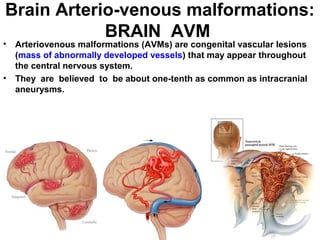
• Arteriovenous malformations (AVMs) are congenital vascular lesions
(mass of abnormally developed vessels) that may appear throughout
the central nervous system.
• They are believed to be about one-tenth as common as intracranial
aneurysms.
How do AVM present?
• Intracranial Hemorrhage: AVM bleed at 2-4% per year (2 to 17.8%). That means if there are
100 people with AVM in their brain, about 2 to 4 people will have bleeding in every year.
With a previous hemorrhage: for those people who have had bleeding from AVM, rebleeding in the
first year is 7%. ( 3.9%-- 17.9%).
Spetzler et al. (1992), showed that 82% of patients with small AVMs (less than 3 cm), 29% of
patients with medium-sized AVMs (3–6 cm), and 12% of patients with large AVM (greater
than 6 cm) present with hemorrhage.
Outcome after first hemorrhage:
1. Mortality (death due to bleeding) with hemorrhage: 5–30%
2. Morbidity with hemorrhage (limb weakness/ mental changes) : 20–30%.
• Epilepsy: second most common presentation. The annual incidence of new onset epilepsy in
patients with AVMs is 1–4%.
• Chronic headache:
• Focal neurologic deficits: in the form of limb weakness, mental changes, difficulty in
speaking.
• Developmental learning disorders: Patients with AVMs are more likely to have
developmental learning disorders than patients with other intracranial disorder, even
many years prior to the diagnosis of the AVM. This may be due to subtle injury to the
How are brain AVM classified?
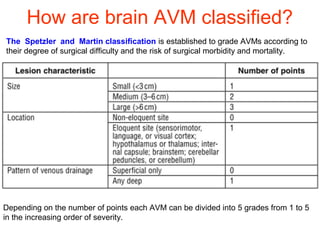
The Spetzler and Martin classification is established to grade AVMs according to
their degree of surgical difficulty and the risk of surgical morbidity and mortality.
Depending on the number of points each AVM can be divided into 5 grades from 1 to 5
in the increasing order of severity.
How are brain AVM managed?
• Conservative management
• Microneurosurgical(operational)
• Endovascular(interventional)
• Radiotherapy (Radiosurgery/gamma
knife)
Conservative management:
• Non-surgical and non-interventional management of some
patients with AVMs is appropriate.
• The malformation may be very extensive, located deep in the
brain, with blood supply primarily from deep perforating
vessels, which are not amenable to endovascular or
Neurosurgical treatment.
• Very advanced age would also be a consideration for
symptomatic therapy.
• Obviously poor medical condition, such as advanced heart
disease, respiratory insufficiency, or cancer with metastasis,
would be a contraindication to a definitive AVM treatment.
MICRONEUROSURGICAL: operational
• Microneurosurgical excision can be done with or without preoperative Embolization.
• Small and some medium sized AVMs can be excised without preoperative
embolization, depending on experience of the operator.
• preoperative embolization can offer several advantages. In addition to nidus
reduction, one may attempt to reduce the overall flow of the arteriovenous shunt by
occluding the largest feeders in order to reduce the risk of blood loss during the
surgery. Finally, one may attempt to embolize the feeding arteries that may be
deemed too difficult to access during surgery.
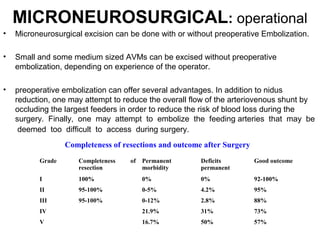
Completeness of resections and outcome after Surgery
Grade Completeness of
resection
Permanent
morbidity
Deficits
permanent
Good outcome
I 100% 0% 0% 92-100%
II 95-100% 0-5% 4.2% 95%
III 95-100% 0-12% 2.8% 88%
IV 21.9% 31% 73%
V 16.7% 50% 57%
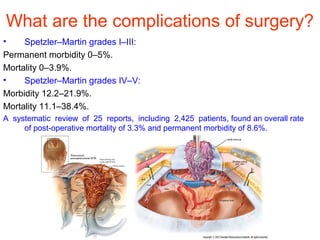
What are the complications of surgery?
• Spetzler–Martin grades I–III:
Permanent morbidity 0–5%.
Mortality 0–3.9%.
• Spetzler–Martin grades IV–V:
Morbidity 12.2–21.9%.
Mortality 11.1–38.4%.
A systematic review of 25 reports, including 2,425 patients, found an overall rate
of post-operative mortality of 3.3% and permanent morbidity of 8.6%.
ENDOVASCULAR TREATMENT
• What is AVM embolization?
Embolization treatment of AVM is also known as Embolotherapy
or Endovascular therapy. This procedure involves the injection
of glue or other non-reactive liquid adhesive material into the
AVM in order to block it off. For this purpose, a small catheter is
passed through a groin vessel all the way up into the blood
vessels supplying the AVM. Watch following video for better
understanding
http://www.youtube.com/watch?v=6MJWJZeGyk8
• Complete cure rate with embolization:
70% to 80% in small AVMS
20-40% large AVMS.
What are the Advantages of Embolization
Treatment?
• Embolization is very useful in making the AVM smaller in size
in order to be suitable for radiation treatment.
• Embolization is very useful to reduce the blood flow through
the AVM just before surgery. This makes it much easier for
the surgeon to remove the AVM.
• Can be early repeated and staged.
• Chances of a cure with embolization alone in large inoperable
AVM are about 20% to 40%.
• No open surgical procedure.
• Short hospital stay.
What are the Disadvantages of embolization?
• This form of treatment can only be done if the AVM is made up of vessels
that can be reached with the catheters.
• Multiple sessions may be required.
• There is a small chance of a stroke in about 1-3% occurring as the result
of the treatment.
•
Diagrams showing microcatheter
guided into the AVM and glue is being
injected to prevent blood from entering
it.
RADIOSURGERY:
Radiosurgery outcomes:
Radiosurgery takes about 2 to 3 years for AVM obliteration
• Rates of angiographic cure depend primarily on lesion size. Most of the
following results are at 2–5 year follow-up.
(a) Lesion diameter ≤ 3 cm: 75–95%
(b) Lesion diameter ≥ 3 cm: ≤ 70%
Effect on hemorrhage risk:
Risk of hemorrhage persists during the latency period
between radiosurgery and AVM obliteration(for 2 to 3 years).
One study found the annual risk of hemorrhage during the 2-
year latency period to be 4.8%.
Even with complete angiographic obliteration, the risk of
hemorrhage may not be zero and estimated risk of rebleeding
after complete nidus obliteration is 0.3% per year.
What are the complications of Radiosurgery/
Gamma Knife?
(a) Overall rate of neurological complications (transient
or permanent neurologic deficits): 8%
(b) Permanent neurologic deficits: 4.8%
(c) Complications:
– Radiation injury to brain parenchyma (6.4%)
– Cranial nerve injury (1%)
– New or worsened seizures (0.8%)
– Death (0.2%

Brain avm

  • 1.
    Brain AVM andtheir treatment Dr. Avinash KM MS, MRCS Ed(UK), Mch (KEM, Mumbai), FINR(Switzerland), FMINS(Germany), • Interventional & Neurovascular surgeon and Stroke specialist, • Endoscopic Neuro and Spine surgeon, • Minimally invasive Neuro and Spine surgeon (FMINS). mob: 9740866228, E mail: doc_avin@hotmail.com Consultant Neurosurgeon and Neurointerventionist Columbia Asia Hospital, Bangalore.
  • 2.
    Brain Arterio-venous malformations: BRAINAVM • Arteriovenous malformations (AVMs) are congenital vascular lesions (mass of abnormally developed vessels) that may appear throughout the central nervous system. • They are believed to be about one-tenth as common as intracranial aneurysms.
  • 3.
    How do AVMpresent? • Intracranial Hemorrhage: AVM bleed at 2-4% per year (2 to 17.8%). That means if there are 100 people with AVM in their brain, about 2 to 4 people will have bleeding in every year. With a previous hemorrhage: for those people who have had bleeding from AVM, rebleeding in the first year is 7%. ( 3.9%-- 17.9%). Spetzler et al. (1992), showed that 82% of patients with small AVMs (less than 3 cm), 29% of patients with medium-sized AVMs (3–6 cm), and 12% of patients with large AVM (greater than 6 cm) present with hemorrhage. Outcome after first hemorrhage: 1. Mortality (death due to bleeding) with hemorrhage: 5–30% 2. Morbidity with hemorrhage (limb weakness/ mental changes) : 20–30%. • Epilepsy: second most common presentation. The annual incidence of new onset epilepsy in patients with AVMs is 1–4%. • Chronic headache: • Focal neurologic deficits: in the form of limb weakness, mental changes, difficulty in speaking. • Developmental learning disorders: Patients with AVMs are more likely to have developmental learning disorders than patients with other intracranial disorder, even many years prior to the diagnosis of the AVM. This may be due to subtle injury to the
  • 4.
    How are brainAVM classified? The Spetzler and Martin classification is established to grade AVMs according to their degree of surgical difficulty and the risk of surgical morbidity and mortality. Depending on the number of points each AVM can be divided into 5 grades from 1 to 5 in the increasing order of severity.
  • 5.
    How are brainAVM managed? • Conservative management • Microneurosurgical(operational) • Endovascular(interventional) • Radiotherapy (Radiosurgery/gamma knife)
  • 6.
    Conservative management: • Non-surgicaland non-interventional management of some patients with AVMs is appropriate. • The malformation may be very extensive, located deep in the brain, with blood supply primarily from deep perforating vessels, which are not amenable to endovascular or Neurosurgical treatment. • Very advanced age would also be a consideration for symptomatic therapy. • Obviously poor medical condition, such as advanced heart disease, respiratory insufficiency, or cancer with metastasis, would be a contraindication to a definitive AVM treatment.
  • 7.
    MICRONEUROSURGICAL: operational • Microneurosurgicalexcision can be done with or without preoperative Embolization. • Small and some medium sized AVMs can be excised without preoperative embolization, depending on experience of the operator. • preoperative embolization can offer several advantages. In addition to nidus reduction, one may attempt to reduce the overall flow of the arteriovenous shunt by occluding the largest feeders in order to reduce the risk of blood loss during the surgery. Finally, one may attempt to embolize the feeding arteries that may be deemed too difficult to access during surgery. Completeness of resections and outcome after Surgery Grade Completeness of resection Permanent morbidity Deficits permanent Good outcome I 100% 0% 0% 92-100% II 95-100% 0-5% 4.2% 95% III 95-100% 0-12% 2.8% 88% IV 21.9% 31% 73% V 16.7% 50% 57%
  • 8.
    What are thecomplications of surgery? • Spetzler–Martin grades I–III: Permanent morbidity 0–5%. Mortality 0–3.9%. • Spetzler–Martin grades IV–V: Morbidity 12.2–21.9%. Mortality 11.1–38.4%. A systematic review of 25 reports, including 2,425 patients, found an overall rate of post-operative mortality of 3.3% and permanent morbidity of 8.6%.
  • 9.
    ENDOVASCULAR TREATMENT • Whatis AVM embolization? Embolization treatment of AVM is also known as Embolotherapy or Endovascular therapy. This procedure involves the injection of glue or other non-reactive liquid adhesive material into the AVM in order to block it off. For this purpose, a small catheter is passed through a groin vessel all the way up into the blood vessels supplying the AVM. Watch following video for better understanding http://www.youtube.com/watch?v=6MJWJZeGyk8 • Complete cure rate with embolization: 70% to 80% in small AVMS 20-40% large AVMS.
  • 10.
    What are theAdvantages of Embolization Treatment? • Embolization is very useful in making the AVM smaller in size in order to be suitable for radiation treatment. • Embolization is very useful to reduce the blood flow through the AVM just before surgery. This makes it much easier for the surgeon to remove the AVM. • Can be early repeated and staged. • Chances of a cure with embolization alone in large inoperable AVM are about 20% to 40%. • No open surgical procedure. • Short hospital stay.
  • 11.
    What are theDisadvantages of embolization? • This form of treatment can only be done if the AVM is made up of vessels that can be reached with the catheters. • Multiple sessions may be required. • There is a small chance of a stroke in about 1-3% occurring as the result of the treatment. • Diagrams showing microcatheter guided into the AVM and glue is being injected to prevent blood from entering it.
  • 12.
    RADIOSURGERY: Radiosurgery outcomes: Radiosurgery takesabout 2 to 3 years for AVM obliteration • Rates of angiographic cure depend primarily on lesion size. Most of the following results are at 2–5 year follow-up. (a) Lesion diameter ≤ 3 cm: 75–95% (b) Lesion diameter ≥ 3 cm: ≤ 70% Effect on hemorrhage risk: Risk of hemorrhage persists during the latency period between radiosurgery and AVM obliteration(for 2 to 3 years). One study found the annual risk of hemorrhage during the 2- year latency period to be 4.8%. Even with complete angiographic obliteration, the risk of hemorrhage may not be zero and estimated risk of rebleeding after complete nidus obliteration is 0.3% per year.
  • 13.
    What are thecomplications of Radiosurgery/ Gamma Knife? (a) Overall rate of neurological complications (transient or permanent neurologic deficits): 8% (b) Permanent neurologic deficits: 4.8% (c) Complications: – Radiation injury to brain parenchyma (6.4%) – Cranial nerve injury (1%) – New or worsened seizures (0.8%) – Death (0.2%