Balance of Payments
Contents
•
•
•
•
•

Balance of Payments (BOP).
Nature of BOP.
Format of BOP.
Components of BOP.
Balance of Payments ‘Surplus’ and
‘Deficit’.
• The BOP of a Country Always Balances.
• The BOP Account of a Country.
• Specific Uses of BOP for a Business
Manager.
Balance of Payments (BOP)
“A systematic record of all
economic transactions
between the residents of
the reporting country and
residents of foreign
countries.”
Nature of Balance of Payments
•
•
•

It is a statement having two sides.
It is a record of economic transaction.
It shows a relation between receipts &
payments.
• Visible & Invisible items both are included in
this statement.
• It is prepared for a certain period of time.
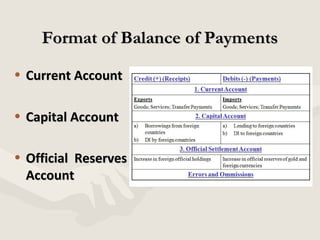
Format of Balance of Payments
• Current Account
• Capital Account
• Official Reserves
Account
Components of Balance of
Payment
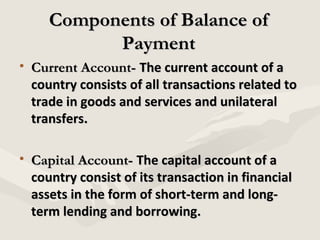
• Current Account- The current account of a
country consists of all transactions related to
trade in goods and services and unilateral
transfers.
• Capital Account- The capital account of a
country consist of its transaction in financial
assets in the form of short-term and longterm lending and borrowing.
Components of Balance of
Payment (Contd…)
Official Reserves Account
• In fact it is a part of capital account. But in
UK and USA balance of payments accounts
shows as a separate account.
• It measures the change in nation’s liquid and
non liquid liabilities to foreign official holders
and the change in nation’s official reserve
assets.
BOP Surplus and Deficit
• BOP Surplus- An imbalance in a nation's
balance of payments in which payments
made by the country are less than payments
received by the country. This is also termed
as favorable balance of payments.
• BOP Deficit- An imbalance in a nation's
balance of payments in which payments
made by the country exceed payments
received by the country. This is also termed
as unfavorable balance of payments.
Balance of Payments of a Country
Always Balances
• The debit side shows the use of total foreign
exchange acquired in a particular period.
• The credit side shows the sources from which
the foreign exchange is acquired during a
particular period.
• Against every credit entry, there is an offsetting
debit entry & vice-versa, so the receipts and
payments on these two sides must be equal.
Hence the two sides must necessary balance.
Balance of Payments of a Country
Always Balances (Contd…)
• Eg : If X imports from Y, Y should also import from X. Hence,
there would be a debit and credit entries in the balance of
payments of both the countries X & Y.
• The individual items in the balance of payments may not
balance. But the total credits of the country must be equal
to its total debits.
• If there is any deficit in any individual account, it would be
covered by a surplus in other accounts.
• If there is any difference between total debits and total
credits, it would be settled under ‘errors & omissions’.
• Hence, in the accounting sense, the balance of payments of
a country always balances.
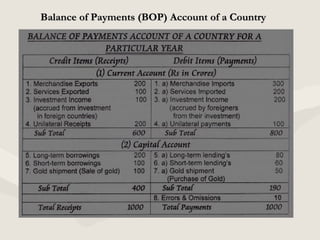
Balance of Payments (BOP) Account of a Country
Balance of Payments (BOP) Account of a Country (Contd…)
• The items 1 to 7 show the total receipts from all sources.
These receipts amount to Rs. 1000 Crores.
• The items 1(a) to 7(a) show the total payments on all
accounts. These payments amount to Rs. 990 Crores. When
item 8 included, the total payment is Rs. 1000 Crores. Hence,
the total credit is equal to the total debit.
• Thus the current a/c and capital a/c balance each other. Thus
surplus in current a/c is equal to the deficit in the capital a/c.
A deficit in current a/c is equal to the surplus in the capital
a/c.
• In the above given table, the balance of current a/c shows a
deficit of Rs. 200 Crores. But there is a corresponding surplus
of Rs. 200 Crores in the balance of capital a/c.
• Hence, the credit and debit side balance & the balance of
payments is in equilibrium.
Specific Uses of BOP for a
Business Manager
• A study of a country’s balance of payments can
help him in deciding whether he can
borrow/raise funds in a particular country or
invest his funds there.
• A proper analysis of balance of payments data
can reveal trends in factors that underlie the
value of the country’s currency in a foreign
market.
THANK YOU

Bop Managerial Economics

  • 1.
  • 2.
    Contents • • • • • Balance of Payments(BOP). Nature of BOP. Format of BOP. Components of BOP. Balance of Payments ‘Surplus’ and ‘Deficit’. • The BOP of a Country Always Balances. • The BOP Account of a Country. • Specific Uses of BOP for a Business Manager.
  • 3.
    Balance of Payments(BOP) “A systematic record of all economic transactions between the residents of the reporting country and residents of foreign countries.”
  • 4.
    Nature of Balanceof Payments • • • It is a statement having two sides. It is a record of economic transaction. It shows a relation between receipts & payments. • Visible & Invisible items both are included in this statement. • It is prepared for a certain period of time.
  • 5.
    Format of Balanceof Payments • Current Account • Capital Account • Official Reserves Account
  • 6.
    Components of Balanceof Payment • Current Account- The current account of a country consists of all transactions related to trade in goods and services and unilateral transfers. • Capital Account- The capital account of a country consist of its transaction in financial assets in the form of short-term and longterm lending and borrowing.
  • 7.
    Components of Balanceof Payment (Contd…) Official Reserves Account • In fact it is a part of capital account. But in UK and USA balance of payments accounts shows as a separate account. • It measures the change in nation’s liquid and non liquid liabilities to foreign official holders and the change in nation’s official reserve assets.
  • 8.
    BOP Surplus andDeficit • BOP Surplus- An imbalance in a nation's balance of payments in which payments made by the country are less than payments received by the country. This is also termed as favorable balance of payments. • BOP Deficit- An imbalance in a nation's balance of payments in which payments made by the country exceed payments received by the country. This is also termed as unfavorable balance of payments.
  • 9.
    Balance of Paymentsof a Country Always Balances • The debit side shows the use of total foreign exchange acquired in a particular period. • The credit side shows the sources from which the foreign exchange is acquired during a particular period. • Against every credit entry, there is an offsetting debit entry & vice-versa, so the receipts and payments on these two sides must be equal. Hence the two sides must necessary balance.
  • 10.
    Balance of Paymentsof a Country Always Balances (Contd…) • Eg : If X imports from Y, Y should also import from X. Hence, there would be a debit and credit entries in the balance of payments of both the countries X & Y. • The individual items in the balance of payments may not balance. But the total credits of the country must be equal to its total debits. • If there is any deficit in any individual account, it would be covered by a surplus in other accounts. • If there is any difference between total debits and total credits, it would be settled under ‘errors & omissions’. • Hence, in the accounting sense, the balance of payments of a country always balances.
  • 11.
    Balance of Payments(BOP) Account of a Country
  • 12.
    Balance of Payments(BOP) Account of a Country (Contd…) • The items 1 to 7 show the total receipts from all sources. These receipts amount to Rs. 1000 Crores. • The items 1(a) to 7(a) show the total payments on all accounts. These payments amount to Rs. 990 Crores. When item 8 included, the total payment is Rs. 1000 Crores. Hence, the total credit is equal to the total debit. • Thus the current a/c and capital a/c balance each other. Thus surplus in current a/c is equal to the deficit in the capital a/c. A deficit in current a/c is equal to the surplus in the capital a/c. • In the above given table, the balance of current a/c shows a deficit of Rs. 200 Crores. But there is a corresponding surplus of Rs. 200 Crores in the balance of capital a/c. • Hence, the credit and debit side balance & the balance of payments is in equilibrium.
  • 13.
    Specific Uses ofBOP for a Business Manager • A study of a country’s balance of payments can help him in deciding whether he can borrow/raise funds in a particular country or invest his funds there. • A proper analysis of balance of payments data can reveal trends in factors that underlie the value of the country’s currency in a foreign market.
  • 14.