
Presented by:
Amanpreet
Sourabh modgil
Meaning
 Bond is a debt security in which the authorized issuer
owes the holder a debt and is obliged to repay the
principal and interest at a later date, termed maturity.
It is issued by public authorites,credit intuition,
companies and supranational institutions in the
primary markets.
 A bond is a promissory note and financial debt.
Instrument issued by corporates and governments to
collect funds from public or investors by offering fixed
interest or there form of returns with specific maturity
term to the investors. In India the term bond is
associated generally with loan able instrument issued
by public undertaking.
FEATURES OF BOND
• Nominal, principal or face amount
• Issue price
• Maturity date
(1) short term
(2) medium term
(3) long term
• Coupon
• Coupon dates
• Indentures and covenants
• Optionality
(1) call ability
(2) put ability
(3) call dates and put dates
(4) convertible bonds
• Convertible bonds
• Exchangeable bonds
TYPES OF BONDS
• Fixed rate bonds
• Floating rate bond
• High yield bond
• Zero coupon bond
• Inflation linked bonds
• Assets-backed securities
• Subordinated bonds
• Perpetual bonds
• Bearer bond
• Registered bonds
• Book entry bonds
• Municipal bond
• Lottery bond
• War bond
• Other index bond
Bond
management
Bond
evaluation
concept
Sale and
purchase
Rating
agencies
Bond valuation
Time valuation
concept
Bond return
Yield to
maturity
Yield to cost
strategies
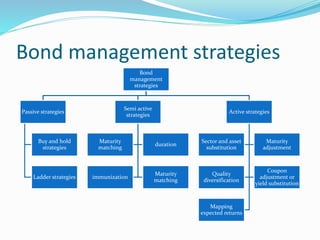
Bond management strategies
Bond
management
strategies
Passive strategies
Buy and hold
strategies
Ladder strategies
Semi active
strategies
Maturity
matching
duration
immunization
Maturity
matching
Active strategies
Sector and asset
substitution
Maturity
adjustment
Quality
diversification
Coupon
adjustment or
yield substitution
Mapping
expected returns
Passive strategy Buy and hold strategy : A buy and hold strategy
essentially means purchasing and holding a security to
maturity or redemption and then reinvesting cash
proceeds in similar securities.
 Advantages
Any capital change resulting from interest rate change is
neutralized or ignored.
Primarily used by income maximizing investors who are
interested in the largest coupon income over a desired
horizon.
 Bond ladder strategy: building a bond ladder means
buying bonds scheduled to come due at several different
dates in the future, rather than all in the same year.
 This process is known as laddering because each group on
bonds represents a rung on the investments maturity
ladder.
Advantages:
Beneficial in both situation when interest rate rise or fall.
Effective tool for someone who needs large mounts of money
available on certain future dates, for example, to pay for a
child education.
Disadvantages
if interest rates plunge, invester would be better off owning
only long term bonds
Ladders also not make sense for investors with smalll
amounts of money.
Semi active strategies
1. Immunization because of changes in the shape of the
term structure and changes in the level of interest rates,
investor faces interest rate risk. The elimination of
these risk is called bond immunization.
 Immunization is the investment of asset in such a
manner that the existing business is immunized to a
general change in the rate of interest provided that the
average duration of assets is equal to average duration of
liabilities.
 Two types of interest risk
a) Price risk : the price risk occurs due to decrease in price
or value of bond as a result of increasing in interest rate
in the market.
b) Coupon reinvestment risk: CRR arises because the
yield to maturity computation implicitly assumes that all
coupon flows will be reinvested at the promised yield to
maturity.
2. Duration: duration is a concept , which means the
weighted average measure of time period of bond’s life.
This is valuable in understanding how bond’s price
change in response to interest rate change.
Properties
I. High coupon rate result in shorter duration and less
volatility in price
II. The bond has no coupon rate, the duration is equal
to maturity period.
III. Higher , YTM leads to shorter duration , YTM and
duration have inverse relationship.
IV. The duration of a coupon bond increases at
decreasing rate with maturity.
Advantages: Necessary for a study of the effect of
changes in interest rates on bond prices and yields.
3 Dedication: dedication is concerned with financing a
stream of liabilities over time.
The purpose of dedication is to fund a sequence of
liability payments as they come due with no interest rate
risk.
It involve four steps:
I. Liability payment stream is determined
II. Bond universe is selected according to quality
criteria.
III. Investor objectives and constraints are identified
IV. Optimal portfolio is chosen
Active Strategies
 Sector and asset substitution among bonds say from
central government securities to higher yielding semi
government bonds or from government to corporate bonds.
 Maturity adjustments by shortening the maturities when
interest rates are expected to rise and lengthening the
maturities when interest rates are expected to fall.
 Quality diversification into various grade of risk, through
expected or actual ratings of bonds by rating agencies.
 Coupon adjustments or yield substitutions: bonds of
lower coupons are preferred when speculative capital gains
or losses are aimed at.
EVALUATION OF BONDS
1. Goodwill of the cooperation
2. Past earning of the profit
3. Purpose of collection money
Valuation of bonds The value of a bond is simply the present value of the security future
cash flows.
 Market price and expected yield are the major determinants of bond.
 Current year = coupon rate (current year is the coupon payment as a
% of current market price.
CY = CR/P
 CURRENT YIELD – Current yeild held investor to measure threir
annual cash flows on a bond every year. if the bond is purchased at
the face value the current yeild and coupon rate will the same. So
with the help of current yeild the investors can find out the rate of
cash flow from their investment evry year.
 HOLDING PERIOD RETURN - A Bond is held for no.
of years. So, it become necessary to calculate the rate
of return of that period.
 Yeild to maturity - (ytm) is the rate of return and
investors expects to earn if the bond is held till
maturity.
 It is the single discount factor that makes present value
of future cash flow from a bond equal to the current
price of the bond. YTM is the discounted cash flow of
the returns from the bond which represents interest
payment And premium or discount in the price.
 YMT is a measure of yield not a measure of returns
from a coupon bond.
ASSUMPTIONS
 The investors holds the bond till maturity
 The intering coupon received a re-invested and the
computed at the YTM rate or at the same interest rat as the
same ytm of the bond
 There is no default in payment of coupon or maturity of
value.
Valuation
of YTM
Simple
model
NPV
model

Bon

  • 1.
  • 2.
    Meaning  Bond isa debt security in which the authorized issuer owes the holder a debt and is obliged to repay the principal and interest at a later date, termed maturity. It is issued by public authorites,credit intuition, companies and supranational institutions in the primary markets.
  • 3.
     A bondis a promissory note and financial debt. Instrument issued by corporates and governments to collect funds from public or investors by offering fixed interest or there form of returns with specific maturity term to the investors. In India the term bond is associated generally with loan able instrument issued by public undertaking.
  • 4.
    FEATURES OF BOND •Nominal, principal or face amount • Issue price • Maturity date (1) short term (2) medium term (3) long term • Coupon • Coupon dates • Indentures and covenants
  • 5.
    • Optionality (1) callability (2) put ability (3) call dates and put dates (4) convertible bonds • Convertible bonds • Exchangeable bonds
  • 6.
    TYPES OF BONDS •Fixed rate bonds • Floating rate bond • High yield bond • Zero coupon bond • Inflation linked bonds • Assets-backed securities • Subordinated bonds • Perpetual bonds • Bearer bond • Registered bonds • Book entry bonds • Municipal bond
  • 7.
    • Lottery bond •War bond • Other index bond
  • 8.
    Bond management Bond evaluation concept Sale and purchase Rating agencies Bond valuation Timevaluation concept Bond return Yield to maturity Yield to cost strategies
  • 9.
    Bond management strategies Bond management strategies Passivestrategies Buy and hold strategies Ladder strategies Semi active strategies Maturity matching duration immunization Maturity matching Active strategies Sector and asset substitution Maturity adjustment Quality diversification Coupon adjustment or yield substitution Mapping expected returns
  • 10.
    Passive strategy Buyand hold strategy : A buy and hold strategy essentially means purchasing and holding a security to maturity or redemption and then reinvesting cash proceeds in similar securities.  Advantages Any capital change resulting from interest rate change is neutralized or ignored. Primarily used by income maximizing investors who are interested in the largest coupon income over a desired horizon.
  • 11.
     Bond ladderstrategy: building a bond ladder means buying bonds scheduled to come due at several different dates in the future, rather than all in the same year.  This process is known as laddering because each group on bonds represents a rung on the investments maturity ladder. Advantages: Beneficial in both situation when interest rate rise or fall. Effective tool for someone who needs large mounts of money available on certain future dates, for example, to pay for a child education. Disadvantages if interest rates plunge, invester would be better off owning only long term bonds Ladders also not make sense for investors with smalll amounts of money.
  • 12.
    Semi active strategies 1.Immunization because of changes in the shape of the term structure and changes in the level of interest rates, investor faces interest rate risk. The elimination of these risk is called bond immunization.  Immunization is the investment of asset in such a manner that the existing business is immunized to a general change in the rate of interest provided that the average duration of assets is equal to average duration of liabilities.  Two types of interest risk a) Price risk : the price risk occurs due to decrease in price or value of bond as a result of increasing in interest rate in the market. b) Coupon reinvestment risk: CRR arises because the yield to maturity computation implicitly assumes that all coupon flows will be reinvested at the promised yield to maturity.
  • 13.
    2. Duration: durationis a concept , which means the weighted average measure of time period of bond’s life. This is valuable in understanding how bond’s price change in response to interest rate change. Properties I. High coupon rate result in shorter duration and less volatility in price II. The bond has no coupon rate, the duration is equal to maturity period. III. Higher , YTM leads to shorter duration , YTM and duration have inverse relationship. IV. The duration of a coupon bond increases at decreasing rate with maturity. Advantages: Necessary for a study of the effect of changes in interest rates on bond prices and yields.
  • 14.
    3 Dedication: dedicationis concerned with financing a stream of liabilities over time. The purpose of dedication is to fund a sequence of liability payments as they come due with no interest rate risk. It involve four steps: I. Liability payment stream is determined II. Bond universe is selected according to quality criteria. III. Investor objectives and constraints are identified IV. Optimal portfolio is chosen
  • 15.
    Active Strategies  Sectorand asset substitution among bonds say from central government securities to higher yielding semi government bonds or from government to corporate bonds.  Maturity adjustments by shortening the maturities when interest rates are expected to rise and lengthening the maturities when interest rates are expected to fall.  Quality diversification into various grade of risk, through expected or actual ratings of bonds by rating agencies.  Coupon adjustments or yield substitutions: bonds of lower coupons are preferred when speculative capital gains or losses are aimed at.
  • 16.
    EVALUATION OF BONDS 1.Goodwill of the cooperation 2. Past earning of the profit 3. Purpose of collection money
  • 17.
    Valuation of bondsThe value of a bond is simply the present value of the security future cash flows.  Market price and expected yield are the major determinants of bond.  Current year = coupon rate (current year is the coupon payment as a % of current market price. CY = CR/P  CURRENT YIELD – Current yeild held investor to measure threir annual cash flows on a bond every year. if the bond is purchased at the face value the current yeild and coupon rate will the same. So with the help of current yeild the investors can find out the rate of cash flow from their investment evry year.
  • 18.
     HOLDING PERIODRETURN - A Bond is held for no. of years. So, it become necessary to calculate the rate of return of that period.  Yeild to maturity - (ytm) is the rate of return and investors expects to earn if the bond is held till maturity.
  • 19.
     It isthe single discount factor that makes present value of future cash flow from a bond equal to the current price of the bond. YTM is the discounted cash flow of the returns from the bond which represents interest payment And premium or discount in the price.  YMT is a measure of yield not a measure of returns from a coupon bond.
  • 20.
    ASSUMPTIONS  The investorsholds the bond till maturity  The intering coupon received a re-invested and the computed at the YTM rate or at the same interest rat as the same ytm of the bond  There is no default in payment of coupon or maturity of value. Valuation of YTM Simple model NPV model