CLASSIFICATION OF
VERTEBRATES
Vertebrates Meaning
• “Vertebrates are animals that possess a vertebral column and/or
notochord at any point in their lives.”
• One of the ways life is classified is through the presence or absence of the
vertebrate. Vertebrates and invertebrates evolved from a common ancestor
that was speculated to have lived around 600 million years ago.
• Evidence of true vertebrates began to appear 525 million years ago and ever
since then, vertebrates have branched off into a long lineage that includes
armoured fish and giant sauropods to woolly mammoths and modern man.
Characteristics of Vertebrates
• A vertebrate is an animal that has all of the following characteristic features at some point in its life:
• A stiff rod running through the length of the animal (it could either be the vertebral column and/or
notochord)
• Humans and all other vertebrates possess a notochord as an embryo and it eventually develops into the
vertebral column.
• A bundle of nerves run above the vertebral column (spinal cord) and the alimentary canal exists below it.
• The mouth is present at the anterior portion of the animals or right below it.
• The alimentary canal ends in the anus, which opens to the exterior. The tail extends after the anus.
Classification of Vertebrates
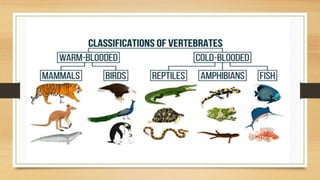
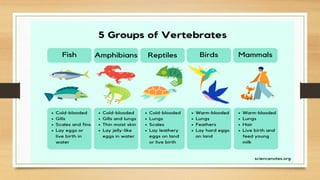
Vertebrates are classified into 7 classes based on their anatomical and
physiological features. They are:
• Mammals (Class Mammalia)
• This class of organisms have the ability to regulate their body temperature
irrespective of the surrounding ambient temperature. Therefore, mammals
are called endothermic animals and it includes humans and platypuses.
• Birds (Class Aves)
• From a biological perspective, birds are dinosaurs (more aptly called avian
dinosaurs). This class of organisms are characterised by feathers, toothless
beaks and a high metabolic rate. Furthermore, members of class Aves lay
hard-shelled eggs.
• Reptiles (Class Reptilia)
• Reptiles include tetrapods such as snakes, crocodiles, tuataras and turtles. The
characteristic feature of reptiles is that they are ectothermic in nature. Snakes
are still considered tetrapods though they have no visible limbs. This is due
to the fact that snakes evolved from ancestors that had limbs.
• Amphibians (Class Amphibia)
• Amphibians include ectothermic tetrapods such as frogs toads and
salamanders. The distinguishing feature that separates amphibians from
reptiles is their breeding behaviour. Most amphibians need a body of water
to breed as their eggs are shell-less. Furthermore, they undergo
metamorphosis where the young ones transform from fully-aquatic larval
form (with gills and fins) to terrestrial adult form.
• Bony fishes (Class Osteichthyes)
• This class of fishes is characterized by their skeleton which is composed
primarily of bone rather than cartilage (such as sharks). Class Osteichthyes is
also the largest class of vertebrates today.
• Cartilaginous fishes (Class Chondrichthyes)
• As the name suggests, this class is characterized by the cartilaginous skeleton.
Members include sharks, rays, skates and sawfish. Some sharks such as the
massive Greenland shark can live for several centuries. A specimen that was
tagged in 2016 was found to be at least 273 years old.
• Jawless fishes (Class Agnatha)
• These are very primitive fishes that have not changed much from fossil
records for millions of years. They have a jawless, circular mouth with rows
of small sharp which aid in holding and feeding on other fishes. Most
members of this class are parasites and scavengers.
END

CLASSIFICATION OF VERTEBRATES ANIMALS.pptx

  • 1.
  • 2.
    Vertebrates Meaning • “Vertebratesare animals that possess a vertebral column and/or notochord at any point in their lives.”
  • 3.
    • One ofthe ways life is classified is through the presence or absence of the vertebrate. Vertebrates and invertebrates evolved from a common ancestor that was speculated to have lived around 600 million years ago. • Evidence of true vertebrates began to appear 525 million years ago and ever since then, vertebrates have branched off into a long lineage that includes armoured fish and giant sauropods to woolly mammoths and modern man.
  • 5.
    Characteristics of Vertebrates •A vertebrate is an animal that has all of the following characteristic features at some point in its life: • A stiff rod running through the length of the animal (it could either be the vertebral column and/or notochord) • Humans and all other vertebrates possess a notochord as an embryo and it eventually develops into the vertebral column. • A bundle of nerves run above the vertebral column (spinal cord) and the alimentary canal exists below it. • The mouth is present at the anterior portion of the animals or right below it. • The alimentary canal ends in the anus, which opens to the exterior. The tail extends after the anus.
  • 7.
    Classification of Vertebrates Vertebratesare classified into 7 classes based on their anatomical and physiological features. They are: • Mammals (Class Mammalia) • This class of organisms have the ability to regulate their body temperature irrespective of the surrounding ambient temperature. Therefore, mammals are called endothermic animals and it includes humans and platypuses.
  • 8.
    • Birds (ClassAves) • From a biological perspective, birds are dinosaurs (more aptly called avian dinosaurs). This class of organisms are characterised by feathers, toothless beaks and a high metabolic rate. Furthermore, members of class Aves lay hard-shelled eggs.
  • 9.
    • Reptiles (ClassReptilia) • Reptiles include tetrapods such as snakes, crocodiles, tuataras and turtles. The characteristic feature of reptiles is that they are ectothermic in nature. Snakes are still considered tetrapods though they have no visible limbs. This is due to the fact that snakes evolved from ancestors that had limbs.
  • 10.
    • Amphibians (ClassAmphibia) • Amphibians include ectothermic tetrapods such as frogs toads and salamanders. The distinguishing feature that separates amphibians from reptiles is their breeding behaviour. Most amphibians need a body of water to breed as their eggs are shell-less. Furthermore, they undergo metamorphosis where the young ones transform from fully-aquatic larval form (with gills and fins) to terrestrial adult form.
  • 11.
    • Bony fishes(Class Osteichthyes) • This class of fishes is characterized by their skeleton which is composed primarily of bone rather than cartilage (such as sharks). Class Osteichthyes is also the largest class of vertebrates today.
  • 12.
    • Cartilaginous fishes(Class Chondrichthyes) • As the name suggests, this class is characterized by the cartilaginous skeleton. Members include sharks, rays, skates and sawfish. Some sharks such as the massive Greenland shark can live for several centuries. A specimen that was tagged in 2016 was found to be at least 273 years old.
  • 13.
    • Jawless fishes(Class Agnatha) • These are very primitive fishes that have not changed much from fossil records for millions of years. They have a jawless, circular mouth with rows of small sharp which aid in holding and feeding on other fishes. Most members of this class are parasites and scavengers.
  • 14.