Body Condition
Scoring in Beef
Cattle
Presented to: Mr. Peter Hanson
Presented by: Dayna Williams
               Cherise Shortts
              Iteisha Baker
Date: February 28, 2013
Body condition scoring is a management tool that can
be used to evaluate the nutritional status of beef cattle.
Body condition (fat cover) is an indication of energy
reserves of a beef animal.
It is important in beef production because it influences
subsequent reproductive and growth performance.
Why Condition Score ?

Condition scoring is a technique for
assessing the condition of livestock at
regular intervals. The purpose of
condition scoring is to achieve a balance
between economic feeding, good
production and good welfare.
These are the:
 Ribs
- Fore ribs
- 12th and 13th
 Backbone/Spinous Processes
 Transverse Processes
 Hooks/hip
 Tail head
 Pins
 Shoulder
 Stifle
 Brisket
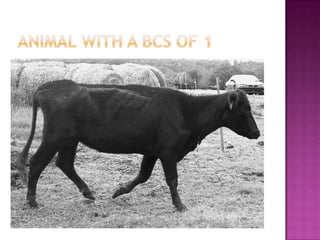
No palpated fat is detectable over the
spinous processes, ribs, or hooks. The tail
head and ribs appear very prominent
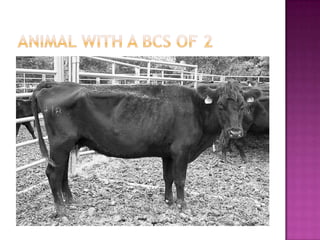
Animal is still somewhat emaciated but the
tail head and ribs are less prominent.
Individual spinous processes are still sharp to
the touch. Some tissue cover id present over
the ribs toward the top of the back
Individual ribs including fore ribs are easily
  identified but are not quite as sharp to the
  touch. Some fat can be felt along the spine
  and over the tail head. Some tissue cover is
  present over the ribs toward the top of the
  back.
Individual ribs may not be visually obvious.
Individual spinous processes can be felt when
palpated but feel rounded rather than sharp.
Some fat cover is present over the ribs,
transverse processes
Overall appearance is generally good. Fat
cover over ribs feels spongy. Palpable fat
cover is present on either side of the tail
head
A high degree of palpable fat exists over the
ribs and around the tail head. Firm pressure
is needed to feel the spinous processes
Considerable fat cover is present with a
fleshy overall appearance. Fat cover over the
ribs and around the tail head is very spongy.
Fat “pones” or “rounds” may be starting to
form along the tail head.
The animal is very fleshy and appears
overconditioned. Palpation of the spinous
processes is near impossible. Large fat
deposits are present over the ribs and around
the tail head. Fat pones around the tail head
are obvious.
The overall appearance is blocky with
extremely wasty and patchy fat cover. The
tail head and hooks are buried in fatty tissue
with fat pones protruding. Bone structure is
no longer visible and barely palpable. Large
fatty deposits may even impair animal
mobility.
Body condition scoring is important because
 It is used as a tool to help optimize
  production
 evaluate health
 assess nutritional status
 On average, most cows, especially beef
 cows, score in the range of 3 to 7 throughout
 the year. A cow is expected to be in optimal
 body condition (BCS 5-7) before calving. She
 may lose condition after calving and possibly
 into the breeding season. She may gain
 condition and weight as weaning approaches
 (there is adequate forage) and continue
 gaining fetal weight and any needed body
 condition in late gestation.
Body condition should be evaluated and
recorded four times a year.
 at weaning
 60-90 days before calving
 at calving.
 and at the beginning of the breeding
  system/season.
 Body   condition is one of the most important
  things to know about when raising cattle.
 In breeding animals (cows, heifers and bulls),
  body condition is closely related to the
  fertility and forage convertibility.
 In beefers (steers and heifers raised for beef
  production), it determines health, ability to
  gain, and when the animals are ready for
  slaughter.
 To make body condition less extreme, you
  must first understand what body scoring is.
 You must get the cattle in.
 You must try and eye up the general
  condition of the cow.
 You have to work on the animal's right
  side.
 You should start with the area over the last
  rib and the spine above that point.
 You should always note the body condition
  score of each cow that you do.
 Repeat with other cows that are to be
  scored.
Any Questions?

Body condition score 3

  • 1.
    Body Condition Scoring inBeef Cattle Presented to: Mr. Peter Hanson Presented by: Dayna Williams Cherise Shortts Iteisha Baker Date: February 28, 2013
  • 2.
    Body condition scoringis a management tool that can be used to evaluate the nutritional status of beef cattle. Body condition (fat cover) is an indication of energy reserves of a beef animal. It is important in beef production because it influences subsequent reproductive and growth performance.
  • 3.
    Why Condition Score? Condition scoring is a technique for assessing the condition of livestock at regular intervals. The purpose of condition scoring is to achieve a balance between economic feeding, good production and good welfare.
  • 4.
    These are the: Ribs - Fore ribs - 12th and 13th  Backbone/Spinous Processes  Transverse Processes  Hooks/hip  Tail head  Pins  Shoulder  Stifle  Brisket
  • 8.
    No palpated fatis detectable over the spinous processes, ribs, or hooks. The tail head and ribs appear very prominent
  • 10.
    Animal is stillsomewhat emaciated but the tail head and ribs are less prominent. Individual spinous processes are still sharp to the touch. Some tissue cover id present over the ribs toward the top of the back
  • 12.
    Individual ribs includingfore ribs are easily identified but are not quite as sharp to the touch. Some fat can be felt along the spine and over the tail head. Some tissue cover is present over the ribs toward the top of the back.
  • 14.
    Individual ribs maynot be visually obvious. Individual spinous processes can be felt when palpated but feel rounded rather than sharp. Some fat cover is present over the ribs, transverse processes
  • 16.
    Overall appearance isgenerally good. Fat cover over ribs feels spongy. Palpable fat cover is present on either side of the tail head
  • 18.
    A high degreeof palpable fat exists over the ribs and around the tail head. Firm pressure is needed to feel the spinous processes
  • 20.
    Considerable fat coveris present with a fleshy overall appearance. Fat cover over the ribs and around the tail head is very spongy. Fat “pones” or “rounds” may be starting to form along the tail head.
  • 22.
    The animal isvery fleshy and appears overconditioned. Palpation of the spinous processes is near impossible. Large fat deposits are present over the ribs and around the tail head. Fat pones around the tail head are obvious.
  • 24.
    The overall appearanceis blocky with extremely wasty and patchy fat cover. The tail head and hooks are buried in fatty tissue with fat pones protruding. Bone structure is no longer visible and barely palpable. Large fatty deposits may even impair animal mobility.
  • 25.
    Body condition scoringis important because  It is used as a tool to help optimize production  evaluate health  assess nutritional status
  • 26.
     On average,most cows, especially beef cows, score in the range of 3 to 7 throughout the year. A cow is expected to be in optimal body condition (BCS 5-7) before calving. She may lose condition after calving and possibly into the breeding season. She may gain condition and weight as weaning approaches (there is adequate forage) and continue gaining fetal weight and any needed body condition in late gestation.
  • 27.
    Body condition shouldbe evaluated and recorded four times a year.  at weaning  60-90 days before calving  at calving.  and at the beginning of the breeding system/season.
  • 28.
     Body condition is one of the most important things to know about when raising cattle.  In breeding animals (cows, heifers and bulls), body condition is closely related to the fertility and forage convertibility.  In beefers (steers and heifers raised for beef production), it determines health, ability to gain, and when the animals are ready for slaughter.
  • 29.
     To makebody condition less extreme, you must first understand what body scoring is.  You must get the cattle in.  You must try and eye up the general condition of the cow.  You have to work on the animal's right side.  You should start with the area over the last rib and the spine above that point.
  • 30.
     You shouldalways note the body condition score of each cow that you do.  Repeat with other cows that are to be scored.
  • 33.