Does an Extra Kidney-Ureter-Bladder (KUB)
Radiography Taken at ‘Upright Position’
During Routine Intravenous Urography
Provide Any Diagnostic Benefit?
Kamil Gurel, Safiye Gurel, Melike.E. Kalfaoglu, Cigdem Gökay
Abant Izzet Baysal University, Izzet Baysal School of Medicine,
Department of Radiology
Bolu/TURKEY
Introduction
• Intravenous urography (IVU) has long been
the main imaging evaluation of urinary tract
disease.
• However, the use of US, CT, and MRI has
surpassed the use of IVU in the last two
decades.
Introduction
• The declining use of IVU in clinical practice
presents a challenge for instruction in
urographic technique and interpretation.
• Nevertheless, IVU might still be important in
the diagnosis of some urinary tract disease
among other new modalities.
Purpose
• The aim of this prospective study is to
assess the value of taking a kidney-ureter-
bladder (KUB) radiography at upright
position during routine IVU in terms of
diagnostic benefit.
Methods and Materials
• September 2003-March 2006, 164 consecutive
patients were referred for IVU exam
In our department, a basal standart IVU exam
consists of totally 5 radiographies:
• Precontrast supine KUB
• Post-contrast supine KUB at 7th and 15th minutes
• Pelvic supine graphies for full bladder and post-voiding
• When needed, additional compression and/or oblique radiographies
• For all patients, an additional post-contrast
15th
min. upright KUB radiography was
obtained
• Two reviewers analyzed the 15th
min.
upright KUB comparing to 15th
min. supine
KUB radiographies together, resulting in a
consensus interpretation.
Methods and Materials
• This study is approved by our institutional
review board and informed consent was
obtained from patients.
Methods and Materials
• Statistical Evaluation
Evaluations were expressed in
percentages.
Results
• 164 patients
80 women, 84 men
Mean age 44,5 ±15,4 years
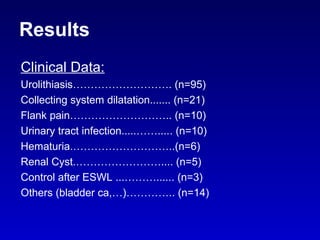
Clinical Data:
Urolithiasis………………………. (n=95)
Collecting system dilatation....... (n=21)
Flank pain……………………….. (n=10)
Urinary tract infection.....……..... (n=10)
Hematuria.………………………..(n=6)
Renal Cyst.…………………….... (n=5)
Control after ESWL ...………...... (n=3)
Others (bladder ca,…)………….. (n=14)
Results
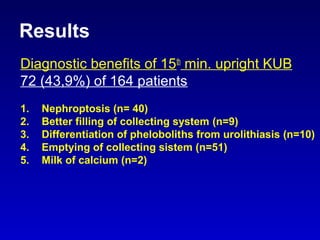
Diagnostic benefits of 15th
min. upright KUB
72 (43,9%) of 164 patients
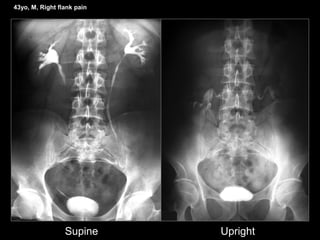
1. Nephroptosis (n= 40)
2. Better filling of collecting system (n=9)
3. Differentiation of pheloboliths from urolithiasis (n=10)
4. Emptying of collecting sistem (n=51)
5. Milk of calcium (n=2)
Results
1.Nephroptosis (Asymptomatic)
Downward displacement of kidney by more than two
vertebral bodies or 5 cm
40 patients (24.3%)
[bilateral (n=15), unilateral (n=25)]
Results
Supine Upright
57 yo, F, Right renal cyst and minimal pelvicaliectasia on US
43yo, M, Right flank pain
Supine Upright
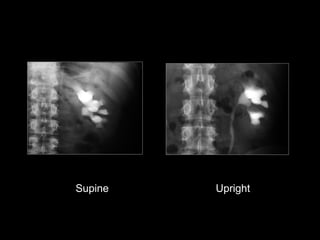
2. Better filling of collecting system
9 patients (5.4%)
[ureteral filling (n= 8),
upper pole infindibular filling (n=1) ]
Results
24 yo, F, nephrolitiasis
Supine UprightPre-contrast
Supine Upright
48yo, M,48 yo, M, urinary tract infection
Supine Upright
Results
3.Differentiation of pheloboliths from
urolithiasis
10 patients (16.4%) (lower urinary tract)
Supine Upright
44 yo, M, ureterolithiasis suspicion
L ureter
Supine Upright
Results
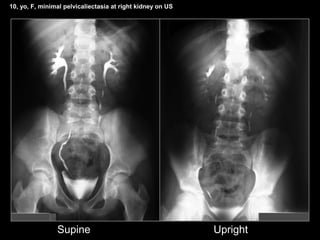
4. Emptying of collecting sistem
51 patients (31%)
10, yo, F, minimal pelvicaliectasia at right kidney on US
Supine Upright
Results
5. Milk of calcium
2 patients (1.2%)
Discussion
• Recently IVU has almost been accepted
as outdated.
• On the other hand alternative modalities
have their own limitations, and despite
their increasing use, the ideal “global”
urinary tract examination still remains
controversial
Assessment of Selected Imaging Modalities in the Evaluation of the Urinary Tract*
Variable
Intravenous
Urography
CT US
MR
Imaging
Cystoscopy-
Retrograde
Pyelography
Collecting system ++++ ++/+++ 0/+ ++ ++++
Parenchyma +++ ++++ ++ ++++ 0
Renal masses
(cysts, solid
tumors)
++ ++++ +++ ++++ 0
Function ++++ ++++ 0 ++++ 0
Calculi +++ ++++ ++ 0 ++
Ureter ++++ +++ 0 ++ ++++
Bladder ++/+++ +++ 0/+ +++ ++++
Abdomen-
retroperitoneum + ++++ +++ ++++ 0
Cost ++++ + ++++ + 0
Ionizing radiation ++ + ++++ ++++ +++
Note.—Assessment was performed with a scale from 0 to ++++, with 0 being the worst and ++++
the best. *Dyer RB, et al. Intravenous Urography: Tecnique and Interpretation. Radiographics 2006;
1(4):800-821.discussion 822-824.
Discussion
Nawfel RD, et al. Patient Radiation Dose at CT Urography and Conventional
Urography. Radiology 2004; 232:126-132.
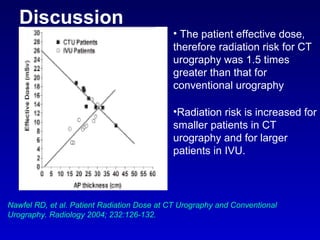
• The patient effective dose,
therefore radiation risk for CT
urography was 1.5 times
greater than that for
conventional urography
•Radiation risk is increased for
smaller patients in CT
urography and for larger
patients in IVU.
• CT urography performed with multi–
detector row CT may eventually replace
IVU. However, the increased radiation risk
from this examination compared with IVU
should be considered in the context of the
amount of information that is necessary for
the diagnostic task.
*Nawfel RD, et al. Patient Radiation Dose at CT Urography and Conventional
Urography. Radiology 2004; 232:126-132.
Discussion
‘Upright positioning’ seems to:
• Be possible-technically- only in IVU
• May be a part of routine IVU
• Can supply data about verification of urine
flow
• Can provide better filling
• Show positional change in gravity-related
layering, nephroptosis and phleboliths
Discussion
Weak points of this study are:
• There is no control grup (for comparison of
total number of films and patient radiation
dose)
• Absence of interobserver variability
assessment
Conclusion:
• IVU, a cornerstone in urinary system
imaging, has slowly been withdrawn from
routine clinical practice in the era of CT or
MR urography.
• However, the capability of using gravitational
forces by obtaining simply an upright
radiography still provides some diagnostic
benefits, in which CT or MR urography might
easily miss.

Bno ivp erect

  • 1.
    Does an ExtraKidney-Ureter-Bladder (KUB) Radiography Taken at ‘Upright Position’ During Routine Intravenous Urography Provide Any Diagnostic Benefit? Kamil Gurel, Safiye Gurel, Melike.E. Kalfaoglu, Cigdem Gökay Abant Izzet Baysal University, Izzet Baysal School of Medicine, Department of Radiology Bolu/TURKEY
  • 2.
    Introduction • Intravenous urography(IVU) has long been the main imaging evaluation of urinary tract disease. • However, the use of US, CT, and MRI has surpassed the use of IVU in the last two decades.
  • 3.
    Introduction • The declininguse of IVU in clinical practice presents a challenge for instruction in urographic technique and interpretation. • Nevertheless, IVU might still be important in the diagnosis of some urinary tract disease among other new modalities.
  • 4.
    Purpose • The aimof this prospective study is to assess the value of taking a kidney-ureter- bladder (KUB) radiography at upright position during routine IVU in terms of diagnostic benefit.
  • 5.
    Methods and Materials •September 2003-March 2006, 164 consecutive patients were referred for IVU exam In our department, a basal standart IVU exam consists of totally 5 radiographies: • Precontrast supine KUB • Post-contrast supine KUB at 7th and 15th minutes • Pelvic supine graphies for full bladder and post-voiding • When needed, additional compression and/or oblique radiographies
  • 6.
    • For allpatients, an additional post-contrast 15th min. upright KUB radiography was obtained • Two reviewers analyzed the 15th min. upright KUB comparing to 15th min. supine KUB radiographies together, resulting in a consensus interpretation. Methods and Materials
  • 7.
    Methods and Materials •This study is approved by our institutional review board and informed consent was obtained from patients.
  • 8.
    Methods and Materials •Statistical Evaluation Evaluations were expressed in percentages.
  • 9.
    Results • 164 patients 80women, 84 men Mean age 44,5 ±15,4 years
  • 10.
    Clinical Data: Urolithiasis………………………. (n=95) Collectingsystem dilatation....... (n=21) Flank pain……………………….. (n=10) Urinary tract infection.....……..... (n=10) Hematuria.………………………..(n=6) Renal Cyst.…………………….... (n=5) Control after ESWL ...………...... (n=3) Others (bladder ca,…)………….. (n=14) Results
  • 11.
    Diagnostic benefits of15th min. upright KUB 72 (43,9%) of 164 patients 1. Nephroptosis (n= 40) 2. Better filling of collecting system (n=9) 3. Differentiation of pheloboliths from urolithiasis (n=10) 4. Emptying of collecting sistem (n=51) 5. Milk of calcium (n=2) Results
  • 12.
    1.Nephroptosis (Asymptomatic) Downward displacementof kidney by more than two vertebral bodies or 5 cm 40 patients (24.3%) [bilateral (n=15), unilateral (n=25)] Results
  • 13.
    Supine Upright 57 yo,F, Right renal cyst and minimal pelvicaliectasia on US
  • 14.
    43yo, M, Rightflank pain Supine Upright
  • 15.
    2. Better fillingof collecting system 9 patients (5.4%) [ureteral filling (n= 8), upper pole infindibular filling (n=1) ] Results
  • 16.
    24 yo, F,nephrolitiasis Supine UprightPre-contrast
  • 17.
  • 18.
    48yo, M,48 yo,M, urinary tract infection Supine Upright
  • 19.
    Results 3.Differentiation of phelobolithsfrom urolithiasis 10 patients (16.4%) (lower urinary tract)
  • 20.
    Supine Upright 44 yo,M, ureterolithiasis suspicion
  • 21.
  • 22.
    Results 4. Emptying ofcollecting sistem 51 patients (31%)
  • 23.
    10, yo, F,minimal pelvicaliectasia at right kidney on US Supine Upright
  • 24.
    Results 5. Milk ofcalcium 2 patients (1.2%)
  • 25.
    Discussion • Recently IVUhas almost been accepted as outdated. • On the other hand alternative modalities have their own limitations, and despite their increasing use, the ideal “global” urinary tract examination still remains controversial
  • 26.
    Assessment of SelectedImaging Modalities in the Evaluation of the Urinary Tract* Variable Intravenous Urography CT US MR Imaging Cystoscopy- Retrograde Pyelography Collecting system ++++ ++/+++ 0/+ ++ ++++ Parenchyma +++ ++++ ++ ++++ 0 Renal masses (cysts, solid tumors) ++ ++++ +++ ++++ 0 Function ++++ ++++ 0 ++++ 0 Calculi +++ ++++ ++ 0 ++ Ureter ++++ +++ 0 ++ ++++ Bladder ++/+++ +++ 0/+ +++ ++++ Abdomen- retroperitoneum + ++++ +++ ++++ 0 Cost ++++ + ++++ + 0 Ionizing radiation ++ + ++++ ++++ +++ Note.—Assessment was performed with a scale from 0 to ++++, with 0 being the worst and ++++ the best. *Dyer RB, et al. Intravenous Urography: Tecnique and Interpretation. Radiographics 2006; 1(4):800-821.discussion 822-824.
  • 27.
    Discussion Nawfel RD, etal. Patient Radiation Dose at CT Urography and Conventional Urography. Radiology 2004; 232:126-132. • The patient effective dose, therefore radiation risk for CT urography was 1.5 times greater than that for conventional urography •Radiation risk is increased for smaller patients in CT urography and for larger patients in IVU.
  • 28.
    • CT urographyperformed with multi– detector row CT may eventually replace IVU. However, the increased radiation risk from this examination compared with IVU should be considered in the context of the amount of information that is necessary for the diagnostic task. *Nawfel RD, et al. Patient Radiation Dose at CT Urography and Conventional Urography. Radiology 2004; 232:126-132.
  • 29.
    Discussion ‘Upright positioning’ seemsto: • Be possible-technically- only in IVU • May be a part of routine IVU • Can supply data about verification of urine flow • Can provide better filling • Show positional change in gravity-related layering, nephroptosis and phleboliths
  • 30.
    Discussion Weak points ofthis study are: • There is no control grup (for comparison of total number of films and patient radiation dose) • Absence of interobserver variability assessment
  • 31.
    Conclusion: • IVU, acornerstone in urinary system imaging, has slowly been withdrawn from routine clinical practice in the era of CT or MR urography. • However, the capability of using gravitational forces by obtaining simply an upright radiography still provides some diagnostic benefits, in which CT or MR urography might easily miss.