Page 1 of 3
BMU features and its purpose
 Product, mechanical features & purpose, safety features, hoisting, GRU (glass replacement unit), track types, restraints system, cradle and
variants & purpose, protective coatings etc.
Roof mounted BMU
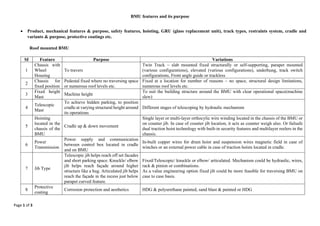
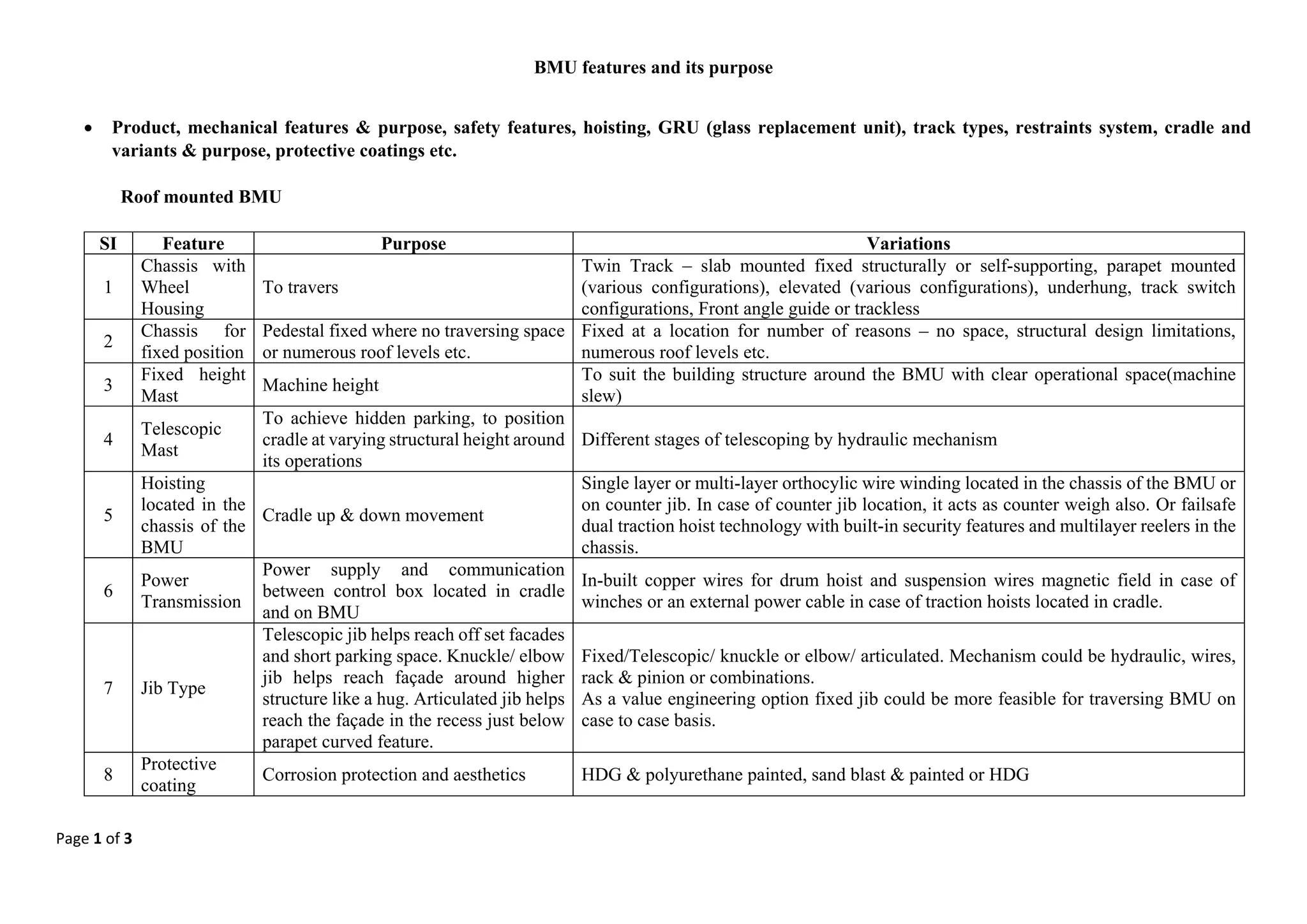
SI Feature Purpose Variations
1
Chassis with
Wheel
Housing
To travers
Twin Track – slab mounted fixed structurally or self-supporting, parapet mounted
(various configurations), elevated (various configurations), underhung, track switch
configurations, Front angle guide or trackless
2
Chassis for
fixed position
Pedestal fixed where no traversing space
or numerous roof levels etc.
Fixed at a location for number of reasons – no space, structural design limitations,
numerous roof levels etc.
3
Fixed height
Mast
Machine height
To suit the building structure around the BMU with clear operational space(machine
slew)
4
Telescopic
Mast
To achieve hidden parking, to position
cradle at varying structural height around
its operations
Different stages of telescoping by hydraulic mechanism
5
Hoisting
located in the
chassis of the
BMU
Cradle up & down movement
Single layer or multi-layer orthocylic wire winding located in the chassis of the BMU or
on counter jib. In case of counter jib location, it acts as counter weigh also. Or failsafe
dual traction hoist technology with built-in security features and multilayer reelers in the
chassis.
6
Power
Transmission
Power supply and communication
between control box located in cradle
and on BMU
In-built copper wires for drum hoist and suspension wires magnetic field in case of
winches or an external power cable in case of traction hoists located in cradle.
7 Jib Type
Telescopic jib helps reach off set facades
and short parking space. Knuckle/ elbow
jib helps reach façade around higher
structure like a hug. Articulated jib helps
reach the façade in the recess just below
parapet curved feature.
Fixed/Telescopic/ knuckle or elbow/ articulated. Mechanism could be hydraulic, wires,
rack & pinion or combinations.
As a value engineering option fixed jib could be more feasible for traversing BMU on
case to case basis.
8
Protective
coating
Corrosion protection and aesthetics HDG & polyurethane painted, sand blast & painted or HDG
Page 2 of 3
BMU features and its purpose
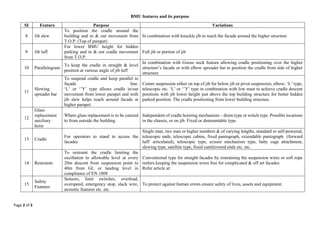
SI Feature Purpose Variations
8 Jib slew
To position the cradle around the
building and in & out movement from
T.O.P. (Top of parapet)
In combination with knuckle jib to reach the facade around the higher structure
9 Jib luff
For lower BMU height for hidden
parking and in & out cradle movement
from T.O.P.
Full jib or portion of jib
10 Parallelogram
To keep the cradle in straight & level
position at various angle of jib luff
In combination with Goose neck feature allowing cradle positioning over the higher
structure’s facade or with elbow spreader bar to position the cradle from side of higher
structure
11
Slewing
spreader bar
To suspend cradle and keep parallel to
façade line.
‘L’ or ‘’Y’ type allows cradle in/out
movement from lower parapet and with
jib slew helps reach around facade at
higher parapet.
Center suspension either on top of jib for below jib or pivot suspension, elbow, ‘L’ type,
telescopic etc. ‘L’ or ‘’Y’ type in combination with low mast to achieve cradle descent
positions with jib lower height just above the top building structure for better hidden
parked position. The cradle positioning from lower building structure.
12
Glass
replacement
auxiliary
hoist
Where glass replacement is to be catered
to from outside the building
Independent of cradle hoisting mechanism – drum type or winch type. Possible locations
in the chassis, or on jib. Fixed or demountable type.
13 Cradle
For operators to stand to access the
facades
Single man, two man or higher numbers & of varying lengths, standard or self-powered,
telescopic ends, telescopic cabins, fixed pantograph, extendable pantograph (forward
luff/ articulated), telescopic type, scissor mechanism type, baby cage attachment,
slewing type, satellite type, fixed cantilevered ends etc. etc.
14 Restraints
To restraint the cradle limiting the
oscillation to allowable level at every
20m descent from suspension point to
40m from GL or landing level in
compliance of EN 1808
Conventional type for straight facades by restraining the suspension wires or soft rope
reelers keeping the suspension wires free for complicated & off set facades.
Refer article at:
15
Safety
Features
Sensors, limit switches, overload,
overspeed, emergency stop, slack wire,
acoustic features etc. etc.
To protect against human errors ensure safety of lives, assets and equipment.
Page 3 of 3
Other Facade Access Solutions & Options
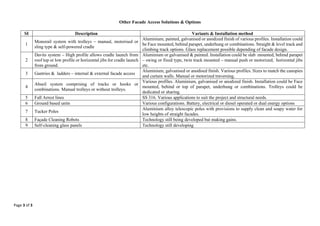
SI Description Variants & Installation method
1
Monorail system with trolleys – manual, motorised or
sling type & self-powered cradle
Aluminium, painted, galvanised or anodized finish of various profiles. Installation could
be Face mounted, behind parapet, underhung or combinations. Straight & level track and
climbing track options. Glass replacement possible depending of facade design.
2
Davits system – High profile allows cradle launch from
roof top or low profile or horizontal jibs for cradle launch
from ground.
Aluminium or galvanised & painted. Installation could be slab mounted, behind parapet
– swing or fixed type, twin track mounted – manual push or motorized, horizontal jibs
etc.
3 Gantries & ladders – internal & external facade access
Aluminium, galvanised or anodised finish. Various profiles. Sizes to match the canopies
and curtain walls. Manual or motorized traversing.
4
Abseil system comprising of tracks or hooks or
combinations. Manual trolleys or without trolleys.
Various profiles. Aluminium, galvanised or anodized finish. Installation could be Face
mounted, behind or top of parapet, underhung or combinations. Trolleys could be
dedicated or sharing.
5 Fall Arrest lines SS 316. Various applications to suit the project and structural needs.
6 Ground based units Various configurations. Battery, electrical or diesel operated or dual energy options
7 Tucker Poles
Aluminium alloy telescopic poles with provisions to supply clean and soapy water for
low heights of straight facades.
8 Façade Cleaning Robots Technology still being developed but making gains.
9 Self-cleaning glass panels Technology still developing

Bmu features & its purpose

  • 1.
    Page 1 of3 BMU features and its purpose  Product, mechanical features & purpose, safety features, hoisting, GRU (glass replacement unit), track types, restraints system, cradle and variants & purpose, protective coatings etc. Roof mounted BMU SI Feature Purpose Variations 1 Chassis with Wheel Housing To travers Twin Track – slab mounted fixed structurally or self-supporting, parapet mounted (various configurations), elevated (various configurations), underhung, track switch configurations, Front angle guide or trackless 2 Chassis for fixed position Pedestal fixed where no traversing space or numerous roof levels etc. Fixed at a location for number of reasons – no space, structural design limitations, numerous roof levels etc. 3 Fixed height Mast Machine height To suit the building structure around the BMU with clear operational space(machine slew) 4 Telescopic Mast To achieve hidden parking, to position cradle at varying structural height around its operations Different stages of telescoping by hydraulic mechanism 5 Hoisting located in the chassis of the BMU Cradle up & down movement Single layer or multi-layer orthocylic wire winding located in the chassis of the BMU or on counter jib. In case of counter jib location, it acts as counter weigh also. Or failsafe dual traction hoist technology with built-in security features and multilayer reelers in the chassis. 6 Power Transmission Power supply and communication between control box located in cradle and on BMU In-built copper wires for drum hoist and suspension wires magnetic field in case of winches or an external power cable in case of traction hoists located in cradle. 7 Jib Type Telescopic jib helps reach off set facades and short parking space. Knuckle/ elbow jib helps reach façade around higher structure like a hug. Articulated jib helps reach the façade in the recess just below parapet curved feature. Fixed/Telescopic/ knuckle or elbow/ articulated. Mechanism could be hydraulic, wires, rack & pinion or combinations. As a value engineering option fixed jib could be more feasible for traversing BMU on case to case basis. 8 Protective coating Corrosion protection and aesthetics HDG & polyurethane painted, sand blast & painted or HDG
  • 2.
    Page 2 of3 BMU features and its purpose SI Feature Purpose Variations 8 Jib slew To position the cradle around the building and in & out movement from T.O.P. (Top of parapet) In combination with knuckle jib to reach the facade around the higher structure 9 Jib luff For lower BMU height for hidden parking and in & out cradle movement from T.O.P. Full jib or portion of jib 10 Parallelogram To keep the cradle in straight & level position at various angle of jib luff In combination with Goose neck feature allowing cradle positioning over the higher structure’s facade or with elbow spreader bar to position the cradle from side of higher structure 11 Slewing spreader bar To suspend cradle and keep parallel to façade line. ‘L’ or ‘’Y’ type allows cradle in/out movement from lower parapet and with jib slew helps reach around facade at higher parapet. Center suspension either on top of jib for below jib or pivot suspension, elbow, ‘L’ type, telescopic etc. ‘L’ or ‘’Y’ type in combination with low mast to achieve cradle descent positions with jib lower height just above the top building structure for better hidden parked position. The cradle positioning from lower building structure. 12 Glass replacement auxiliary hoist Where glass replacement is to be catered to from outside the building Independent of cradle hoisting mechanism – drum type or winch type. Possible locations in the chassis, or on jib. Fixed or demountable type. 13 Cradle For operators to stand to access the facades Single man, two man or higher numbers & of varying lengths, standard or self-powered, telescopic ends, telescopic cabins, fixed pantograph, extendable pantograph (forward luff/ articulated), telescopic type, scissor mechanism type, baby cage attachment, slewing type, satellite type, fixed cantilevered ends etc. etc. 14 Restraints To restraint the cradle limiting the oscillation to allowable level at every 20m descent from suspension point to 40m from GL or landing level in compliance of EN 1808 Conventional type for straight facades by restraining the suspension wires or soft rope reelers keeping the suspension wires free for complicated & off set facades. Refer article at: 15 Safety Features Sensors, limit switches, overload, overspeed, emergency stop, slack wire, acoustic features etc. etc. To protect against human errors ensure safety of lives, assets and equipment.
  • 3.
    Page 3 of3 Other Facade Access Solutions & Options SI Description Variants & Installation method 1 Monorail system with trolleys – manual, motorised or sling type & self-powered cradle Aluminium, painted, galvanised or anodized finish of various profiles. Installation could be Face mounted, behind parapet, underhung or combinations. Straight & level track and climbing track options. Glass replacement possible depending of facade design. 2 Davits system – High profile allows cradle launch from roof top or low profile or horizontal jibs for cradle launch from ground. Aluminium or galvanised & painted. Installation could be slab mounted, behind parapet – swing or fixed type, twin track mounted – manual push or motorized, horizontal jibs etc. 3 Gantries & ladders – internal & external facade access Aluminium, galvanised or anodised finish. Various profiles. Sizes to match the canopies and curtain walls. Manual or motorized traversing. 4 Abseil system comprising of tracks or hooks or combinations. Manual trolleys or without trolleys. Various profiles. Aluminium, galvanised or anodized finish. Installation could be Face mounted, behind or top of parapet, underhung or combinations. Trolleys could be dedicated or sharing. 5 Fall Arrest lines SS 316. Various applications to suit the project and structural needs. 6 Ground based units Various configurations. Battery, electrical or diesel operated or dual energy options 7 Tucker Poles Aluminium alloy telescopic poles with provisions to supply clean and soapy water for low heights of straight facades. 8 Façade Cleaning Robots Technology still being developed but making gains. 9 Self-cleaning glass panels Technology still developing