The New EU
Framework Programme for
Research and Innovation
2014-2020
HORIZON 2020
Keith SEQUEIRA
Member of Cabinet
Commissioner Geoghegan-Quinn
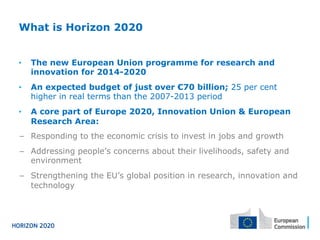
What is Horizon 2020
•  The new European Union programme for research and
innovation for 2014-2020
•  An expected budget of just over €70 billion; 25 per cent
higher in real terms than the 2007-2013 period
•  A core part of Europe 2020, Innovation Union & European
Research Area:
−  Responding to the economic crisis to invest in jobs and growth
−  Addressing people’s concerns about their livelihoods, safety and
environment
−  Strengthening the EU’s global position in research, innovation and
technology
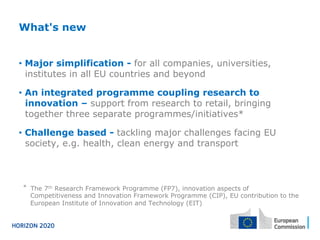
What's new
•  Major simplification - for all companies, universities,
institutes in all EU countries and beyond
•  An integrated programme coupling research to
innovation – support from research to retail, bringing
together three separate programmes/initiatives*
•  Challenge based - tackling major challenges facing EU
society, e.g. health, clean energy and transport
⃰  The 7th Research Framework Programme (FP7), innovation aspects of
Competitiveness and Innovation Framework Programme (CIP), EU contribution to the
European Institute of Innovation and Technology (EIT)
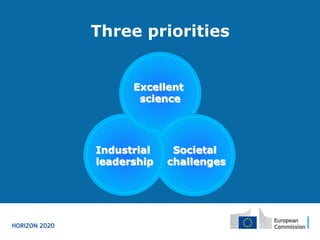
Three priorities
Excellent
science
Industrial
leadership
Societal
challenges
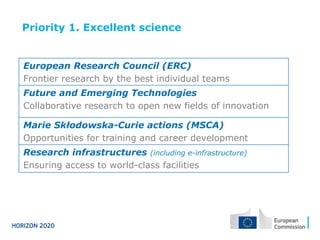
European Research Council (ERC)
Frontier research by the best individual teams
Future and Emerging Technologies
Collaborative research to open new fields of innovation
Marie Skłodowska-Curie actions (MSCA)
Opportunities for training and career development
Research infrastructures (including e-infrastructure)
Ensuring access to world-class facilities
Priority 1. Excellent science
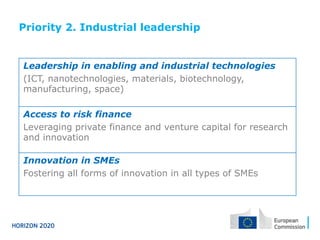
Leadership in enabling and industrial technologies
(ICT, nanotechnologies, materials, biotechnology,
manufacturing, space)
Access to risk finance
Leveraging private finance and venture capital for research
and innovation
Innovation in SMEs
Fostering all forms of innovation in all types of SMEs
Priority 2. Industrial leadership
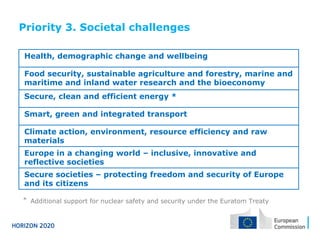
Priority 3. Societal challenges
⃰  Additional support for nuclear safety and security under the Euratom Treaty
Health, demographic change and wellbeing
Food security, sustainable agriculture and forestry, marine and
maritime and inland water research and the bioeconomy
Secure, clean and efficient energy *
Smart, green and integrated transport
Climate action, environment, resource efficiency and raw
materials
Europe in a changing world – inclusive, innovative and
reflective societies
Secure societies – protecting freedom and security of Europe
and its citizens
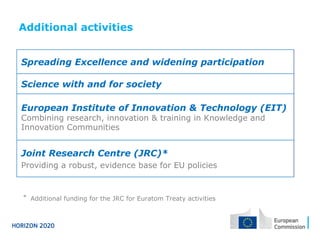
Spreading Excellence and widening participation
Science with and for society
European Institute of Innovation & Technology (EIT)
Combining research, innovation & training in Knowledge and
Innovation Communities
Joint Research Centre (JRC)*
Providing a robust, evidence base for EU policies
Additional activities
⃰  Additional funding for the JRC for Euratom Treaty activities
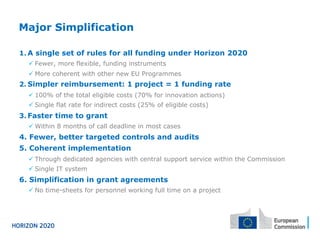
Major Simplification
1.  A single set of rules for all funding under Horizon 2020
ü Fewer, more flexible, funding instruments
ü More coherent with other new EU Programmes
2.  Simpler reimbursement: 1 project = 1 funding rate
ü 100% of the total eligible costs (70% for innovation actions)
ü Single flat rate for indirect costs (25% of eligible costs)
3.  Faster time to grant
ü Within 8 months of call deadline in most cases
4. Fewer, better targeted controls and audits
5. Coherent implementation
ü Through dedicated agencies with central support service within the Commission
ü Single IT system
6. Simplification in grant agreements
ü No time-sheets for personnel working full time on a project
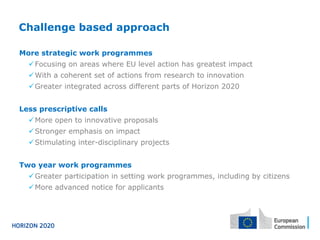
Challenge based approach
More strategic work programmes
ü Focusing on areas where EU level action has greatest impact
ü With a coherent set of actions from research to innovation
ü Greater integrated across different parts of Horizon 2020
Less prescriptive calls
ü More open to innovative proposals
ü Stronger emphasis on impact
ü Stimulating inter-disciplinary projects
Two year work programmes
ü Greater participation in setting work programmes, including by citizens
ü More advanced notice for applicants
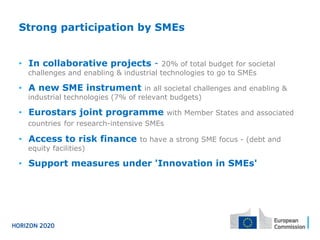
Strong participation by SMEs
•  In collaborative projects - 20% of total budget for societal
challenges and enabling & industrial technologies to go to SMEs
•  A new SME instrument in all societal challenges and enabling &
industrial technologies (7% of relevant budgets)
•  Eurostars joint programme with Member States and associated
countries for research-intensive SMEs
•  Access to risk finance to have a strong SME focus - (debt and
equity facilities)
•  Support measures under 'Innovation in SMEs'
Contributing to the European Research Area
(ERA)
•  2012 ERA framework proposal to create a single market for
knowledge research and innovation
•  Supported by Horizon 2020:
ü  Boosting ERA priorities – mobility of researchers, access to
infrastructures, knowledge transfer, policy learning for more effective
national systems
ü  Supporting Member States to collaborate – joint programming, ERA
NETs to support joint calls/ actions
ü  Optimising access to scientific knowledge – mandatory open access
to research publications
ü  Gender mainstreaming – gender balance in advisory structures, gender
relevant topics throughout the work programme
Strengthening socio-economic sciences and
humanities
•  Integrated within all societal challenges and enabling &
industrial technologies:
ü  Specific topics, e.g. understanding the determinants of health
ü  Multi-disciplinary topics
•  Specific focus in 'Europe in the world – inclusive, innovative
and reflective societies' challenge
•  Bottom up support in Excellence Science:
ü  European Research Council
ü  Marie Skłodowska-Curie actions
ü  Research Infrastructures
Widening participation
•  Clear division of labour:
ü  Cohesion policy (European Investment and Structural Funds):
support for regions to build research and innovation capacity through
smart specialisation strategies
ü  Horizon 2020: funding the best proposals on basis of competitive calls
with simplified access, support to policy reforms, and specific measures
to spread excellence and wider participation
•  Specific measures
ü  Twinning with leading research organisations
ü  Teaming to invest in new/improved Centres of Excellence
ü  ERA chairs to attract outstanding academics
ü  Access to international networks, through COST
ü  Support to development of smart specialisation strategies
International cooperation
•  Principle of general openness: the programme will remain
to be the most open funding programme in the world
•  Open to the association of: acceding countries, candidate
countries, potential candidates & selected international
partner countries meeting criteria
•  Targeted actions to be implemented taking a strategic
approach to international cooperation
Partnerships with industry and Member States
€22 billion Innovation Investment Package proposed by
Commission (July 2013)
Joint Technology Initiatives (with industry under Article 187):
• Innovative Medicines Initiative
• Clean Sky (Aeronautics)
• Fuel Cell and Hydrogen
• Biobased industries
• Electronic components and systems
Joint programmes (with Member States, under Article 185)
• European and Developing Countries Clinical Trials Partnership (EDCTP)
• European Metrology Research Programme
• Eurostars (for SMEs)
• Active and Assisted Living
Next steps
•  Legislative decision on EU budget
(2014-20)
•  Legislative decisions on Horizon 2020
•  Horizon 2020 launch events
•  Launch of first calls for proposals
•  Launch of Joint Technology Initiatives
and Joint Programmes with Member
States
Autumn 2013
Autumn 2013
Oct - Jan 2014
11 December 2013
Beginning 2014
Performance	
  of	
  Romania	
  in	
  FP7	
  	
  
•  Romanian	
  par0cipants	
  in	
  694	
  projects	
  (signed	
  grant	
  agreements)	
  
•  High	
  SME	
  par0cipa0on:	
  22	
  %	
  of	
  total	
  Romanian	
  par4cipa4ons	
  (EU	
  :	
  
18	
  %)	
  
•  Greatest	
  EU	
  contribu4on	
  to	
  Romanian	
  par4cipants	
  in:	
  	
  
−  ICT,
−  Nanosciences & Nanotech, Materials and new Production Technologies
−  Research Potential,
−  Transport,
−  Research for the benefit of SMEs
−  Environment
•  Romanian	
  success	
  rate	
  (14,6%)	
  is	
  lower	
  than	
  EU	
  average	
  (20,6%)	
  
Romania	
  performs	
  beJer	
  and	
  beJer	
  in	
  Framework	
  Programmes	
  
•  7th	
  Framework	
  Programme	
  (2007-­‐13)	
  contribu4on	
  to	
  Romania	
  
(€	
  115	
  m)	
  so	
  far:	
  
•  More	
  than	
  doubled	
  compared	
  to	
  the	
  6th	
  Framework	
  
Programme	
  (2002-­‐2006)	
  	
  
•  More	
  than	
  four	
  0mes	
  compared	
  to	
  the	
  5th	
  Framework	
  
Programme	
  (1998-­‐2002)	
  
•  Horizon	
  2020?	
  
•  A	
  clear	
  and	
  smart	
  specialisa4on	
  strategy	
  building	
  on	
  domains	
  where	
  
Romania	
  has	
  a	
  good	
  industrial	
  tradi4on	
  and	
  	
  S&T	
  strengths	
  (i.e.	
  
chemical	
  industry,	
  ICT,	
  automo4ve	
  sector)	
  
•  Increased	
  efforts	
  at	
  na4onal	
  level	
  to	
  strengthen	
  R&I	
  capacity	
  to	
  
ensure	
  successful	
  applica4ons	
  for	
  compe44ve	
  EU	
  funding	
  	
  
•  Closer	
  links	
  between	
  research,	
  innova4on	
  and	
  industry	
  by	
  
priori4sing	
  R&D	
  ac4vi4es	
  in	
  the	
  new	
  na4onal	
  strategy	
  that	
  aYract	
  
private	
  investment	


Horizon	
  2020	
  can	
  further	
  help	
  to	
  realise	
  Romania's	
  ambi0ons!	
  
HORIZON 2020
Thank you
for your attention!
Find out more:
www.ec.europa/research/horizon2020

Horizon 2020 Presentation

  • 1.
    The New EU FrameworkProgramme for Research and Innovation 2014-2020 HORIZON 2020 Keith SEQUEIRA Member of Cabinet Commissioner Geoghegan-Quinn
  • 2.
    What is Horizon2020 •  The new European Union programme for research and innovation for 2014-2020 •  An expected budget of just over €70 billion; 25 per cent higher in real terms than the 2007-2013 period •  A core part of Europe 2020, Innovation Union & European Research Area: −  Responding to the economic crisis to invest in jobs and growth −  Addressing people’s concerns about their livelihoods, safety and environment −  Strengthening the EU’s global position in research, innovation and technology
  • 3.
    What's new •  Majorsimplification - for all companies, universities, institutes in all EU countries and beyond •  An integrated programme coupling research to innovation – support from research to retail, bringing together three separate programmes/initiatives* •  Challenge based - tackling major challenges facing EU society, e.g. health, clean energy and transport ⃰  The 7th Research Framework Programme (FP7), innovation aspects of Competitiveness and Innovation Framework Programme (CIP), EU contribution to the European Institute of Innovation and Technology (EIT)
  • 4.
  • 5.
    European Research Council(ERC) Frontier research by the best individual teams Future and Emerging Technologies Collaborative research to open new fields of innovation Marie Skłodowska-Curie actions (MSCA) Opportunities for training and career development Research infrastructures (including e-infrastructure) Ensuring access to world-class facilities Priority 1. Excellent science
  • 6.
    Leadership in enablingand industrial technologies (ICT, nanotechnologies, materials, biotechnology, manufacturing, space) Access to risk finance Leveraging private finance and venture capital for research and innovation Innovation in SMEs Fostering all forms of innovation in all types of SMEs Priority 2. Industrial leadership
  • 7.
    Priority 3. Societalchallenges ⃰  Additional support for nuclear safety and security under the Euratom Treaty Health, demographic change and wellbeing Food security, sustainable agriculture and forestry, marine and maritime and inland water research and the bioeconomy Secure, clean and efficient energy * Smart, green and integrated transport Climate action, environment, resource efficiency and raw materials Europe in a changing world – inclusive, innovative and reflective societies Secure societies – protecting freedom and security of Europe and its citizens
  • 8.
    Spreading Excellence andwidening participation Science with and for society European Institute of Innovation & Technology (EIT) Combining research, innovation & training in Knowledge and Innovation Communities Joint Research Centre (JRC)* Providing a robust, evidence base for EU policies Additional activities ⃰  Additional funding for the JRC for Euratom Treaty activities
  • 9.
    Major Simplification 1.  Asingle set of rules for all funding under Horizon 2020 ü Fewer, more flexible, funding instruments ü More coherent with other new EU Programmes 2.  Simpler reimbursement: 1 project = 1 funding rate ü 100% of the total eligible costs (70% for innovation actions) ü Single flat rate for indirect costs (25% of eligible costs) 3.  Faster time to grant ü Within 8 months of call deadline in most cases 4. Fewer, better targeted controls and audits 5. Coherent implementation ü Through dedicated agencies with central support service within the Commission ü Single IT system 6. Simplification in grant agreements ü No time-sheets for personnel working full time on a project
  • 10.
    Challenge based approach Morestrategic work programmes ü Focusing on areas where EU level action has greatest impact ü With a coherent set of actions from research to innovation ü Greater integrated across different parts of Horizon 2020 Less prescriptive calls ü More open to innovative proposals ü Stronger emphasis on impact ü Stimulating inter-disciplinary projects Two year work programmes ü Greater participation in setting work programmes, including by citizens ü More advanced notice for applicants
  • 11.
    Strong participation bySMEs •  In collaborative projects - 20% of total budget for societal challenges and enabling & industrial technologies to go to SMEs •  A new SME instrument in all societal challenges and enabling & industrial technologies (7% of relevant budgets) •  Eurostars joint programme with Member States and associated countries for research-intensive SMEs •  Access to risk finance to have a strong SME focus - (debt and equity facilities) •  Support measures under 'Innovation in SMEs'
  • 12.
    Contributing to theEuropean Research Area (ERA) •  2012 ERA framework proposal to create a single market for knowledge research and innovation •  Supported by Horizon 2020: ü  Boosting ERA priorities – mobility of researchers, access to infrastructures, knowledge transfer, policy learning for more effective national systems ü  Supporting Member States to collaborate – joint programming, ERA NETs to support joint calls/ actions ü  Optimising access to scientific knowledge – mandatory open access to research publications ü  Gender mainstreaming – gender balance in advisory structures, gender relevant topics throughout the work programme
  • 13.
    Strengthening socio-economic sciencesand humanities •  Integrated within all societal challenges and enabling & industrial technologies: ü  Specific topics, e.g. understanding the determinants of health ü  Multi-disciplinary topics •  Specific focus in 'Europe in the world – inclusive, innovative and reflective societies' challenge •  Bottom up support in Excellence Science: ü  European Research Council ü  Marie Skłodowska-Curie actions ü  Research Infrastructures
  • 14.
    Widening participation •  Cleardivision of labour: ü  Cohesion policy (European Investment and Structural Funds): support for regions to build research and innovation capacity through smart specialisation strategies ü  Horizon 2020: funding the best proposals on basis of competitive calls with simplified access, support to policy reforms, and specific measures to spread excellence and wider participation •  Specific measures ü  Twinning with leading research organisations ü  Teaming to invest in new/improved Centres of Excellence ü  ERA chairs to attract outstanding academics ü  Access to international networks, through COST ü  Support to development of smart specialisation strategies
  • 15.
    International cooperation •  Principleof general openness: the programme will remain to be the most open funding programme in the world •  Open to the association of: acceding countries, candidate countries, potential candidates & selected international partner countries meeting criteria •  Targeted actions to be implemented taking a strategic approach to international cooperation
  • 16.
    Partnerships with industryand Member States €22 billion Innovation Investment Package proposed by Commission (July 2013) Joint Technology Initiatives (with industry under Article 187): • Innovative Medicines Initiative • Clean Sky (Aeronautics) • Fuel Cell and Hydrogen • Biobased industries • Electronic components and systems Joint programmes (with Member States, under Article 185) • European and Developing Countries Clinical Trials Partnership (EDCTP) • European Metrology Research Programme • Eurostars (for SMEs) • Active and Assisted Living
  • 17.
    Next steps •  Legislativedecision on EU budget (2014-20) •  Legislative decisions on Horizon 2020 •  Horizon 2020 launch events •  Launch of first calls for proposals •  Launch of Joint Technology Initiatives and Joint Programmes with Member States Autumn 2013 Autumn 2013 Oct - Jan 2014 11 December 2013 Beginning 2014
  • 18.
    Performance  of  Romania  in  FP7     •  Romanian  par0cipants  in  694  projects  (signed  grant  agreements)   •  High  SME  par0cipa0on:  22  %  of  total  Romanian  par4cipa4ons  (EU  :   18  %)   •  Greatest  EU  contribu4on  to  Romanian  par4cipants  in:     −  ICT, −  Nanosciences & Nanotech, Materials and new Production Technologies −  Research Potential, −  Transport, −  Research for the benefit of SMEs −  Environment •  Romanian  success  rate  (14,6%)  is  lower  than  EU  average  (20,6%)  
  • 19.
    Romania  performs  beJer  and  beJer  in  Framework  Programmes   •  7th  Framework  Programme  (2007-­‐13)  contribu4on  to  Romania   (€  115  m)  so  far:   •  More  than  doubled  compared  to  the  6th  Framework   Programme  (2002-­‐2006)     •  More  than  four  0mes  compared  to  the  5th  Framework   Programme  (1998-­‐2002)   •  Horizon  2020?  
  • 20.
    •  A  clear  and  smart  specialisa4on  strategy  building  on  domains  where   Romania  has  a  good  industrial  tradi4on  and    S&T  strengths  (i.e.   chemical  industry,  ICT,  automo4ve  sector)   •  Increased  efforts  at  na4onal  level  to  strengthen  R&I  capacity  to   ensure  successful  applica4ons  for  compe44ve  EU  funding     •  Closer  links  between  research,  innova4on  and  industry  by   priori4sing  R&D  ac4vi4es  in  the  new  na4onal  strategy  that  aYract   private  investment           Horizon  2020  can  further  help  to  realise  Romania's  ambi0ons!  
  • 21.
    HORIZON 2020 Thank you foryour attention! Find out more: www.ec.europa/research/horizon2020