+
Call for the Entrepreneurial Research Initiatives
Carnegie Mellon Portugal
Program
2006-2017
Education,
Research and
Innovation
Ecosystem
The information on these slides does not replace or override any requirements set
forth in the Regulations or the Announcement of the Call for Proposals.
+
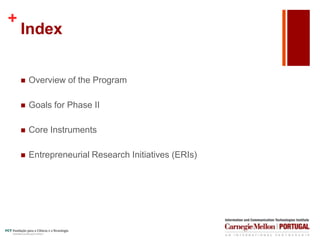
Index
 Overview of the Program
 Goals for Phase II
 Core Instruments
 Entrepreneurial Research Initiatives (ERIs)
+
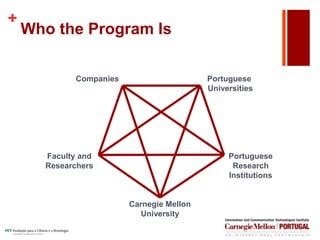
Who the Program Is
Portuguese
Universities
Portuguese
Research
Institutions
Carnegie Mellon
University
Faculty and
Researchers
Companies
+
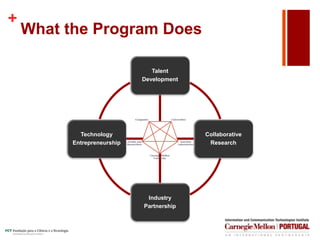
What the Program Does
Universities
Associate
Laboratories
Carnegie Mellon
University
Faculty and
Researchers
Companies
Talent
Development
Collaborative
Research
Industry
Partnership
Technology
Entrepreneurship
+
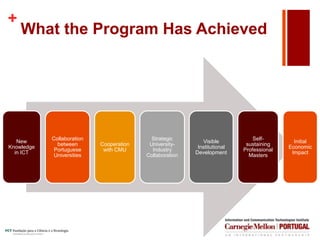
New
Knowledge
in ICT
Collaboration
between
Portuguese
Universities
Cooperation
with CMU
Strategic
University-
Industry
Collaboration
Visible
Institutional
Development
Self-
sustaining
Professional
Masters
Initial
Economic
Impact
What the Program Has Achieved
+
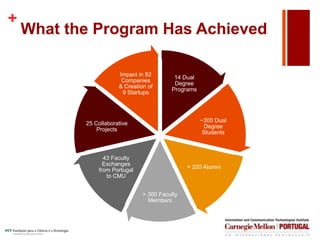
What the Program Has Achieved
14 Dual
Degree
Programs
~300 Dual
Degree
Students
> 200 Alumni
> 300 Faculty
Members
43 Faculty
Exchanges
from Portugal
to CMU
25 Collaborative
Projects
Impact in 82
Companies
& Creation of
9 Startups
+
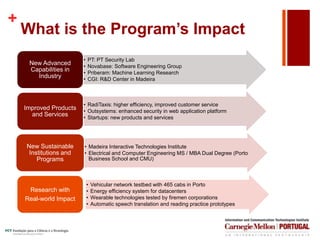
What is the Program’s Impact
• PT: PT Security Lab
• Novabase: Software Engineering Group
• Priberam: Machine Learning Research
• CGI: R&D Center in Madeira
New Advanced
Capabilities in
Industry
• RadiTaxis: higher efficiency, improved customer service
• Outsystems: enhanced security in web application platform
• Startups: new products and services
Improved Products
and Services
• Madeira Interactive Technologies Institute
• Electrical and Computer Engineering MS / MBA Dual Degree (Porto
Business School and CMU)
New Sustainable
Institutions and
Programs
• Vehicular network testbed with 465 cabs in Porto
• Energy efficiency system for datacenters
• Wearable technologies tested by firemen corporations
• Automatic speech translation and reading practice prototypes
Research with
Real-world Impact
+
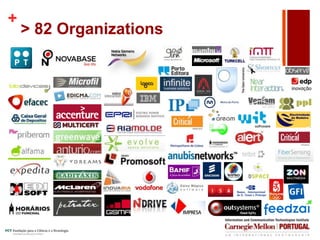
> 82 Organizations
+
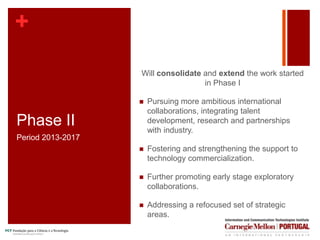
Phase II
Will consolidate and extend the work started
in Phase I
 Pursuing more ambitious international
collaborations, integrating talent
development, research and partnerships
with industry.
 Fostering and strengthening the support to
technology commercialization.
 Further promoting early stage exploratory
collaborations.
 Addressing a refocused set of strategic
areas.
Period 2013-2017
+
+
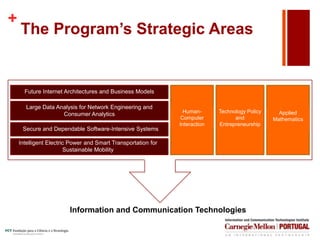
The Program’s Strategic Areas
Future Internet Architectures and Business Models
Large Data Analysis for Network Engineering and
Consumer Analytics
Secure and Dependable Software-Intensive Systems
Intelligent Electric Power and Smart Transportation for
Sustainable Mobility
Human-
Computer
Interaction
Technology Policy
and
Entrepreneurship
Applied
Mathematics
Information and Communication Technologies
+
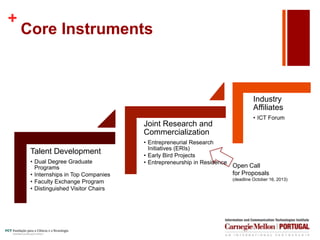
Core Instruments
Talent Development
• Dual Degree Graduate
Programs
• Internships in Top Companies
• Faculty Exchange Program
• Distinguished Visitor Chairs
Joint Research and
Commercialization
• Entrepreneurial Research
Initiatives (ERIs)
• Early Bird Projects
• Entrepreneurship in Residence
Industry
Affiliates
• ICT Forum
Open Call
for Proposals
(deadline October 16, 2013)
+
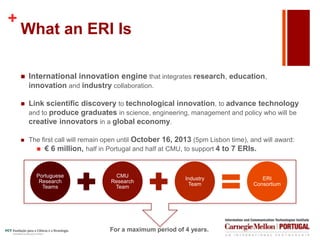
What an ERI Is
 International innovation engine that integrates research, education,
innovation and industry collaboration.
 Link scientific discovery to technological innovation, to advance technology
and to produce graduates in science, engineering, management and policy who will be
creative innovators in a global economy.
 The first call will remain open until October 16, 2013 (5pm Lisbon time), and will award:
 € 6 million, half in Portugal and half at CMU, to support 4 to 7 ERIs.
Portuguese
Research
Teams
CMU
Research
Team
Industry
Team
ERI
Consortium
For a maximum period of 4 years.
+
The Key Features of an ERI
 A vision for bridging research to innovation and developing innovative and
competitive talent;
 A strategic plan for research, education and innovation, with a path to
sustainability;
 A cross-disciplinary research program enabler of innovation;
 Cross-cultural global research, education and innovation experiences;
 An education program that uses CMU Portugal’s dual degree programs;
 An innovation program that includes partnerships with startups and/or
established companies.
+
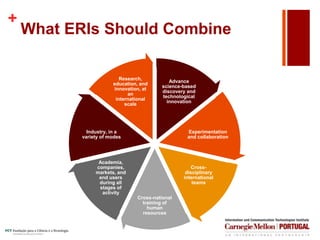
What ERIs Should Combine
Advance
science-based
discovery and
technological
innovation
Experimentation
and collaboration
Cross-
disciplinary
international
teams
Cross-national
training of
human
resources
Academia,
companies,
markets, and
end users
during all
stages of
activity
Industry, in a
variety of modes
Research,
education, and
innovation, at
an
international
scale
+
The Mission of an ERI
Stimulate and promote Portuguese innovation in Information
and Communication Technologies (ICT), by acting as
international innovation engines, embedded in global
knowledge and business networks, to train creative
innovators, generate new ideas and translate them into
products, processes and services.
+
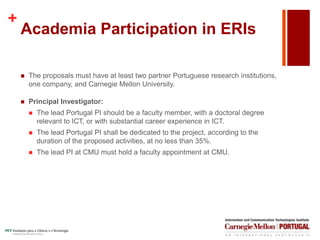
Academia Participation in ERIs
 The proposals must have at least two partner Portuguese research institutions,
one company, and Carnegie Mellon University.
 Principal Investigator:
 The lead Portugal PI should be a faculty member, with a doctoral degree
relevant to ICT, or with substantial career experience in ICT.
 The lead Portugal PI shall be dedicated to the project, according to the
duration of the proposed activities, at no less than 35%.
 The lead PI at CMU must hold a faculty appointment at CMU.
+
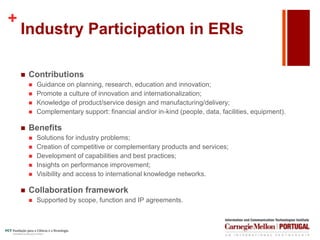
Industry Participation in ERIs
 Contributions
 Guidance on planning, research, education and innovation;
 Promote a culture of innovation and internationalization;
 Knowledge of product/service design and manufacturing/delivery;
 Complementary support: financial and/or in-kind (people, data, facilities, equipment).
 Benefits
 Solutions for industry problems;
 Creation of competitive or complementary products and services;
 Development of capabilities and best practices;
 Insights on performance improvement;
 Visibility and access to international knowledge networks.
 Collaboration framework
 Supported by scope, function and IP agreements.
+
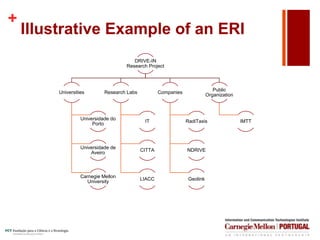
Illustrative Example of an ERI
DRIVE-IN
Research Project
Universities
Universidade do
Porto
Universidade de
Aveiro
Carnegie Mellon
University
Research Labs
IT
CITTA
LIACC
Companies
RadiTaxis
NDRIVE
Geolink
Public
Organization
IMTT
+
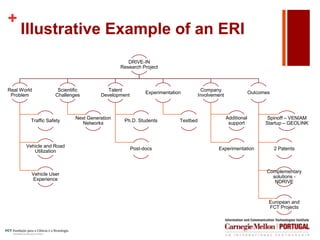
DRIVE-IN
Research Project
Real World
Problem
Traffic Safety
Vehicle and Road
Utilization
Vehicle User
Experience
Scientific
Challenges
Next Generation
Networks
Talent
Development
Ph.D. Students
Post-docs
Experimentation
Testbed
Company
Involvement
Additional
support
Experimentation
Outcomes
Spinoff – VENIAM
Startup – GEOLINK
2 Patents
Complementary
solutions -
NDRIVE
European and
FCT Projects
Illustrative Example of an ERI
+
ERIs at a Glance
 Focus on real world problems that cannot be addressed without a significant level
of fundamental knowledge in ICT, which feeds into devices, components and
systems needed to realize the targeted solutions.
 Identify and focus on opportunities to increase economic competitiveness and/or
to contribute to solving important societal problems.
 The team should combine research institutions, companies, markets, and
end users during all stages of activity.
 The first call will remain open until October 16, 2013 (5 pm Lisbon time), and will
award:
 € 6 million, half in Portugal and half at CMU, to support 4 to 7 ERIs;
 Start in 2014, with a maximum duration of 4 years.
+
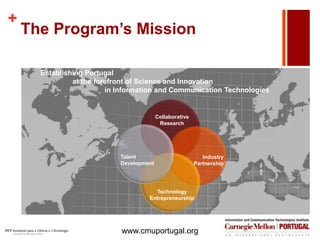
The Program’s Mission
Establishing Portugal
at the forefront of Science and Innovation
in Information and Communication Technologies
Talent
Development
Technology
Entrepreneurship
Collaborative
Research
Industry
Partnership
www.cmuportugal.org
+
Challenge
Leadership in the creation of international innovation
engines through strong Entrepreneurial Research
Initiatives.
www.cmuportugal.org :: eris@cmuportugal.org
The information on these slides does not replace or override any requirements set
forth in the Regulations or the Announcement of the Call for Proposals.

CMU Portugal Program outcomes and the Entrepreneurial Research Initiatives Call

  • 1.
    + Call for theEntrepreneurial Research Initiatives Carnegie Mellon Portugal Program 2006-2017 Education, Research and Innovation Ecosystem The information on these slides does not replace or override any requirements set forth in the Regulations or the Announcement of the Call for Proposals.
  • 2.
    + Index  Overview ofthe Program  Goals for Phase II  Core Instruments  Entrepreneurial Research Initiatives (ERIs)
  • 3.
    + Who the ProgramIs Portuguese Universities Portuguese Research Institutions Carnegie Mellon University Faculty and Researchers Companies
  • 4.
    + What the ProgramDoes Universities Associate Laboratories Carnegie Mellon University Faculty and Researchers Companies Talent Development Collaborative Research Industry Partnership Technology Entrepreneurship
  • 5.
  • 6.
    + What the ProgramHas Achieved 14 Dual Degree Programs ~300 Dual Degree Students > 200 Alumni > 300 Faculty Members 43 Faculty Exchanges from Portugal to CMU 25 Collaborative Projects Impact in 82 Companies & Creation of 9 Startups
  • 7.
    + What is theProgram’s Impact • PT: PT Security Lab • Novabase: Software Engineering Group • Priberam: Machine Learning Research • CGI: R&D Center in Madeira New Advanced Capabilities in Industry • RadiTaxis: higher efficiency, improved customer service • Outsystems: enhanced security in web application platform • Startups: new products and services Improved Products and Services • Madeira Interactive Technologies Institute • Electrical and Computer Engineering MS / MBA Dual Degree (Porto Business School and CMU) New Sustainable Institutions and Programs • Vehicular network testbed with 465 cabs in Porto • Energy efficiency system for datacenters • Wearable technologies tested by firemen corporations • Automatic speech translation and reading practice prototypes Research with Real-world Impact
  • 8.
  • 9.
    + Phase II Will consolidateand extend the work started in Phase I  Pursuing more ambitious international collaborations, integrating talent development, research and partnerships with industry.  Fostering and strengthening the support to technology commercialization.  Further promoting early stage exploratory collaborations.  Addressing a refocused set of strategic areas. Period 2013-2017 +
  • 10.
    + The Program’s StrategicAreas Future Internet Architectures and Business Models Large Data Analysis for Network Engineering and Consumer Analytics Secure and Dependable Software-Intensive Systems Intelligent Electric Power and Smart Transportation for Sustainable Mobility Human- Computer Interaction Technology Policy and Entrepreneurship Applied Mathematics Information and Communication Technologies
  • 11.
    + Core Instruments Talent Development •Dual Degree Graduate Programs • Internships in Top Companies • Faculty Exchange Program • Distinguished Visitor Chairs Joint Research and Commercialization • Entrepreneurial Research Initiatives (ERIs) • Early Bird Projects • Entrepreneurship in Residence Industry Affiliates • ICT Forum Open Call for Proposals (deadline October 16, 2013)
  • 12.
    + What an ERIIs  International innovation engine that integrates research, education, innovation and industry collaboration.  Link scientific discovery to technological innovation, to advance technology and to produce graduates in science, engineering, management and policy who will be creative innovators in a global economy.  The first call will remain open until October 16, 2013 (5pm Lisbon time), and will award:  € 6 million, half in Portugal and half at CMU, to support 4 to 7 ERIs. Portuguese Research Teams CMU Research Team Industry Team ERI Consortium For a maximum period of 4 years.
  • 13.
    + The Key Featuresof an ERI  A vision for bridging research to innovation and developing innovative and competitive talent;  A strategic plan for research, education and innovation, with a path to sustainability;  A cross-disciplinary research program enabler of innovation;  Cross-cultural global research, education and innovation experiences;  An education program that uses CMU Portugal’s dual degree programs;  An innovation program that includes partnerships with startups and/or established companies.
  • 14.
    + What ERIs ShouldCombine Advance science-based discovery and technological innovation Experimentation and collaboration Cross- disciplinary international teams Cross-national training of human resources Academia, companies, markets, and end users during all stages of activity Industry, in a variety of modes Research, education, and innovation, at an international scale
  • 15.
    + The Mission ofan ERI Stimulate and promote Portuguese innovation in Information and Communication Technologies (ICT), by acting as international innovation engines, embedded in global knowledge and business networks, to train creative innovators, generate new ideas and translate them into products, processes and services.
  • 16.
    + Academia Participation inERIs  The proposals must have at least two partner Portuguese research institutions, one company, and Carnegie Mellon University.  Principal Investigator:  The lead Portugal PI should be a faculty member, with a doctoral degree relevant to ICT, or with substantial career experience in ICT.  The lead Portugal PI shall be dedicated to the project, according to the duration of the proposed activities, at no less than 35%.  The lead PI at CMU must hold a faculty appointment at CMU.
  • 17.
    + Industry Participation inERIs  Contributions  Guidance on planning, research, education and innovation;  Promote a culture of innovation and internationalization;  Knowledge of product/service design and manufacturing/delivery;  Complementary support: financial and/or in-kind (people, data, facilities, equipment).  Benefits  Solutions for industry problems;  Creation of competitive or complementary products and services;  Development of capabilities and best practices;  Insights on performance improvement;  Visibility and access to international knowledge networks.  Collaboration framework  Supported by scope, function and IP agreements.
  • 18.
    + Illustrative Example ofan ERI DRIVE-IN Research Project Universities Universidade do Porto Universidade de Aveiro Carnegie Mellon University Research Labs IT CITTA LIACC Companies RadiTaxis NDRIVE Geolink Public Organization IMTT
  • 19.
    + DRIVE-IN Research Project Real World Problem TrafficSafety Vehicle and Road Utilization Vehicle User Experience Scientific Challenges Next Generation Networks Talent Development Ph.D. Students Post-docs Experimentation Testbed Company Involvement Additional support Experimentation Outcomes Spinoff – VENIAM Startup – GEOLINK 2 Patents Complementary solutions - NDRIVE European and FCT Projects Illustrative Example of an ERI
  • 20.
    + ERIs at aGlance  Focus on real world problems that cannot be addressed without a significant level of fundamental knowledge in ICT, which feeds into devices, components and systems needed to realize the targeted solutions.  Identify and focus on opportunities to increase economic competitiveness and/or to contribute to solving important societal problems.  The team should combine research institutions, companies, markets, and end users during all stages of activity.  The first call will remain open until October 16, 2013 (5 pm Lisbon time), and will award:  € 6 million, half in Portugal and half at CMU, to support 4 to 7 ERIs;  Start in 2014, with a maximum duration of 4 years.
  • 21.
    + The Program’s Mission EstablishingPortugal at the forefront of Science and Innovation in Information and Communication Technologies Talent Development Technology Entrepreneurship Collaborative Research Industry Partnership www.cmuportugal.org
  • 22.
    + Challenge Leadership in thecreation of international innovation engines through strong Entrepreneurial Research Initiatives. www.cmuportugal.org :: eris@cmuportugal.org The information on these slides does not replace or override any requirements set forth in the Regulations or the Announcement of the Call for Proposals.