Hungary-EU-Israel Workshop  Start-Ups and Innovation  Tel Aviv, 30th May 2011 The Innovation Union flagship initiative and framework conditions  :  How to provide incentives for start-ups early-stage innovation?    Emilie Tack, Innovation Policy Unit DG Research and Innovation
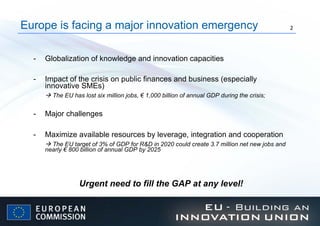
Globalization of knowledge and innovation capacities Impact of the crisis on public finances and business (especially innovative SMEs)    The EU has lost six million jobs, € 1,000 billion of annual GDP during the crisis; Major challenges  Maximize available resources by leverage, integration and cooperation      The EU target of 3% of GDP for R&D in 2020 could create 3.7 million net new jobs and nearly € 800 billion of annual GDP by 2025 Urgent need to fill the GAP at any level! Europe is facing a major innovation emergency
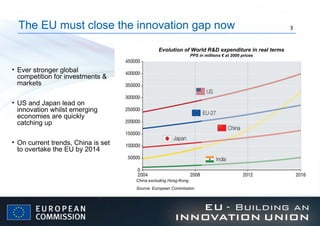
Evolution of World R&D expenditure in real terms PPS in millions € at 2000 prices Ever stronger global competition for investments & markets US and Japan lead on innovation whilst emerging economies are quickly catching up On current trends, China is set to overtake the EU by 2014  China excluding Hong-Kong Source: European Commission The EU must close the innovation gap now
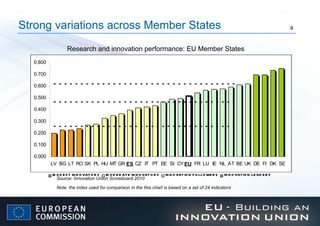
Research and innovation performance: EU Member States Source: Innovation Union Scoreboard 2010 Note: the index used for comparison in the this chart is based on a set of 24 indicators Strong variations across Member States   ES EU
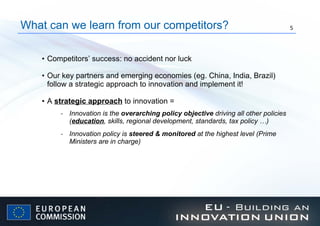
Competitors’ success: no accident nor luck Our key partners and emerging economies (eg. China, India, Brazil) follow a strategic approach to innovation and implement it!  A  strategic approach  to innovation =   Innovation is the  overarching policy objective  driving all other policies ( education , skills, regional development, standards, tax policy …) Innovation policy is  steered & monitored  at the highest level (Prime Ministers are in charge) What can we learn from our competitors?
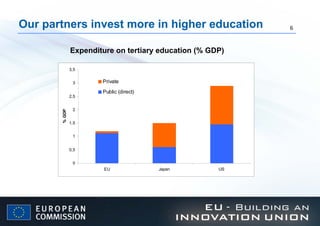
Our partners invest more in higher education Expenditure on tertiary education (% GDP)
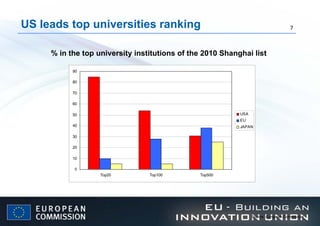
US leads top universities ranking % in the top university institutions of the 2010 Shanghai list Source: European Commission
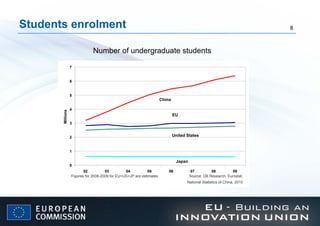
Students enrolment Number of undergraduate students 0 1 2 3 4 5 6 7 02 03 04 05 06 07 08 09 Millions China Source: DB Research, Eurostat,  Figures for 2008-2009 for EU+US+JP are estimates National Statistics of China, 2010 Japan United States EU
A flagship initiative of the Europe 2020 strategy Radically improving the  framework conditions  and reducing time-to-market Tackling underinvestment,  fragmentation  and duplication (“critical mass”) Using public funding to  leverage  private R&D (e.g. the EU Risk Sharing Finance Facility - RSFF) Promoting massive investment in skills, education, research and innovation especially through « recovery » packages ( “Smart” fiscal consolidation ) See:  http://ec.europa.eu/research/innovation-union/index_en.cfm   EU’s strategic approach:  Innovation Union
A  “standardisation package”  – comprising a Communication and a legislative proposal, to be adopted in May. 2 implementing legislative proposals to create a  unitary patent  protection (under enhanced cooperation between 25 MS) presented on 13 April. Proposals for putting in place an operational framework for the cross-border operation of  venture capital  funds by 2012.  A  review of the State aid  research and development and innovation framework in 2011 Proposals to exploit  public procurement  budgets for innovative products and services by the end of 2011  Improving Framework conditions
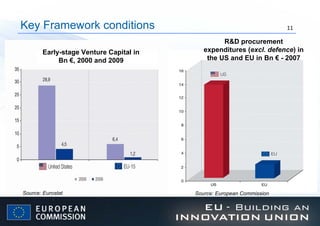
Key Framework conditions Source: Eurostat R&D procurement expenditures ( excl. defence ) in the US and EU in Bn € - 2007 Source: European Commission Early-stage Venture Capital in Bn €, 2000 and 2009
IU Commitment 11 By 2012, the Commission will ensure that  Venture Capital  funds established in any Member State can function and invest freely in the EU (If necessary by adopting a new legislative regime).
European Council conclusions follow-up Every effort should be pursued to lift remaining legal and administrative obstacles to the cross-border operation of  venture capital.  The Commission is invited to present proposals by the end of 2011 for putting in place an  EU-wide venture capital scheme
IU Commitment 10 By 2014: on the basis of Commission proposals, the EU should put in place  financial instruments  to attract a major increase in private finance and close the market gaps in investing in research and innovation.
European Council conclusions follow-up The Commission is invited to present proposals by the end of 2011 for scaling up the Risk Sharing Finance Facility  During 2011-2013, we will expand the scope and scale of RSFF implementing recommendations of the RSFF interim evaluation
Risk-Sharing Finance Facility (RSFF)    Policy Support : current state of play Moving towards a Portfolio First-Loss Piece for the whole RSFF (by end-2011), enabling a potential higher leverage effect on the EU financial contribution (cf. facing the level of demand until end-2013) and more support for target groups such as SMEs and research infrastructures Launch of a dedicated window to address research-intensive and innovative SMEs and mid-caps (early 2012)
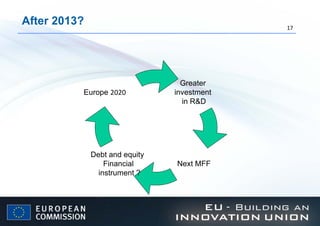
After 2013?   Greater  investment  in R&D Next MFF Debt and equity  Financial instrument ? Europe   2020   Europe 2020
RSFF post 2013? Innovation Credit Facility Good practice from the Netherlands Most applicants for loans are young start-ups Strong stress on the eligibility criteria on the developmental approach Risk sharing Cooperation-to-be with EIB
An integrated approach for the use of  financial instruments to support R&D&I Preparing the ground for the implementation of IUC 10  e.g. debt financial instrument in future CSF Debt instrument  will provide debt finance for risky investments in R&I activities and will cover loans, guarantees… Equity instrument  for early and growth stages investments : Support to early stage and seed investment  Support to the development of EU venture capital
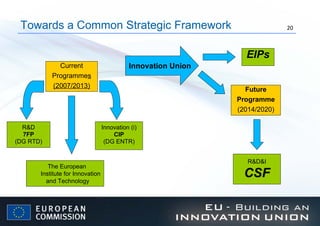
Current Programme s (2007/2013) R&D 7FP (DG RTD) Innovation (i) CIP (DG ENTR) Future Programme (2014/2020) R&D&I CSF EIPs Innovation Union  Towards a Common Strategic Framework   The European Institute for Innovation   and Technology
Next steps towards a CSF Follow up:  Analysis of contributions by Commission  Major event to conclude consultation  (10 June 2011) Inputs to preparation of Commission proposals Commission proposals: for post 2013 EU budget (June 2011) for the Common Strategic Framework (by end of 2011)  Legislative decisions  on the Common Strategic Framework by the Council and European Parliament (2012-13) =>  Common Strategic Framework  (from 2014)
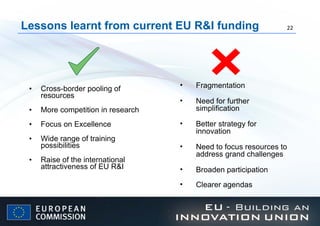
Lessons learnt from current EU R&I funding Cross-border pooling of resources More competition in research Focus on Excellence Wide range of training possibilities Raise of the international attractiveness of EU R&I Fragmentation Need for further simplification Better strategy for innovation Need to focus resources to address grand challenges Broaden participation Clearer agendas
Thank you for your attention

Ppt presentation emilie_tack

  • 1.
    Hungary-EU-Israel Workshop Start-Ups and Innovation Tel Aviv, 30th May 2011 The Innovation Union flagship initiative and framework conditions  :  How to provide incentives for start-ups early-stage innovation?  Emilie Tack, Innovation Policy Unit DG Research and Innovation
  • 2.
    Globalization of knowledgeand innovation capacities Impact of the crisis on public finances and business (especially innovative SMEs)  The EU has lost six million jobs, € 1,000 billion of annual GDP during the crisis; Major challenges Maximize available resources by leverage, integration and cooperation  The EU target of 3% of GDP for R&D in 2020 could create 3.7 million net new jobs and nearly € 800 billion of annual GDP by 2025 Urgent need to fill the GAP at any level! Europe is facing a major innovation emergency
  • 3.
    Evolution of WorldR&D expenditure in real terms PPS in millions € at 2000 prices Ever stronger global competition for investments & markets US and Japan lead on innovation whilst emerging economies are quickly catching up On current trends, China is set to overtake the EU by 2014 China excluding Hong-Kong Source: European Commission The EU must close the innovation gap now
  • 4.
    Research and innovationperformance: EU Member States Source: Innovation Union Scoreboard 2010 Note: the index used for comparison in the this chart is based on a set of 24 indicators Strong variations across Member States ES EU
  • 5.
    Competitors’ success: noaccident nor luck Our key partners and emerging economies (eg. China, India, Brazil) follow a strategic approach to innovation and implement it! A strategic approach to innovation = Innovation is the overarching policy objective driving all other policies ( education , skills, regional development, standards, tax policy …) Innovation policy is steered & monitored at the highest level (Prime Ministers are in charge) What can we learn from our competitors?
  • 6.
    Our partners investmore in higher education Expenditure on tertiary education (% GDP)
  • 7.
    US leads topuniversities ranking % in the top university institutions of the 2010 Shanghai list Source: European Commission
  • 8.
    Students enrolment Numberof undergraduate students 0 1 2 3 4 5 6 7 02 03 04 05 06 07 08 09 Millions China Source: DB Research, Eurostat, Figures for 2008-2009 for EU+US+JP are estimates National Statistics of China, 2010 Japan United States EU
  • 9.
    A flagship initiativeof the Europe 2020 strategy Radically improving the framework conditions and reducing time-to-market Tackling underinvestment, fragmentation and duplication (“critical mass”) Using public funding to leverage private R&D (e.g. the EU Risk Sharing Finance Facility - RSFF) Promoting massive investment in skills, education, research and innovation especially through « recovery » packages ( “Smart” fiscal consolidation ) See: http://ec.europa.eu/research/innovation-union/index_en.cfm EU’s strategic approach: Innovation Union
  • 10.
    A “standardisationpackage” – comprising a Communication and a legislative proposal, to be adopted in May. 2 implementing legislative proposals to create a unitary patent protection (under enhanced cooperation between 25 MS) presented on 13 April. Proposals for putting in place an operational framework for the cross-border operation of venture capital funds by 2012. A review of the State aid research and development and innovation framework in 2011 Proposals to exploit public procurement budgets for innovative products and services by the end of 2011 Improving Framework conditions
  • 11.
    Key Framework conditionsSource: Eurostat R&D procurement expenditures ( excl. defence ) in the US and EU in Bn € - 2007 Source: European Commission Early-stage Venture Capital in Bn €, 2000 and 2009
  • 12.
    IU Commitment 11By 2012, the Commission will ensure that Venture Capital funds established in any Member State can function and invest freely in the EU (If necessary by adopting a new legislative regime).
  • 13.
    European Council conclusionsfollow-up Every effort should be pursued to lift remaining legal and administrative obstacles to the cross-border operation of venture capital. The Commission is invited to present proposals by the end of 2011 for putting in place an EU-wide venture capital scheme
  • 14.
    IU Commitment 10By 2014: on the basis of Commission proposals, the EU should put in place financial instruments to attract a major increase in private finance and close the market gaps in investing in research and innovation.
  • 15.
    European Council conclusionsfollow-up The Commission is invited to present proposals by the end of 2011 for scaling up the Risk Sharing Finance Facility During 2011-2013, we will expand the scope and scale of RSFF implementing recommendations of the RSFF interim evaluation
  • 16.
    Risk-Sharing Finance Facility(RSFF) Policy Support : current state of play Moving towards a Portfolio First-Loss Piece for the whole RSFF (by end-2011), enabling a potential higher leverage effect on the EU financial contribution (cf. facing the level of demand until end-2013) and more support for target groups such as SMEs and research infrastructures Launch of a dedicated window to address research-intensive and innovative SMEs and mid-caps (early 2012)
  • 17.
    After 2013? Greater investment in R&D Next MFF Debt and equity Financial instrument ? Europe 2020 Europe 2020
  • 18.
    RSFF post 2013?Innovation Credit Facility Good practice from the Netherlands Most applicants for loans are young start-ups Strong stress on the eligibility criteria on the developmental approach Risk sharing Cooperation-to-be with EIB
  • 19.
    An integrated approachfor the use of financial instruments to support R&D&I Preparing the ground for the implementation of IUC 10 e.g. debt financial instrument in future CSF Debt instrument will provide debt finance for risky investments in R&I activities and will cover loans, guarantees… Equity instrument for early and growth stages investments : Support to early stage and seed investment Support to the development of EU venture capital
  • 20.
    Current Programme s(2007/2013) R&D 7FP (DG RTD) Innovation (i) CIP (DG ENTR) Future Programme (2014/2020) R&D&I CSF EIPs Innovation Union Towards a Common Strategic Framework The European Institute for Innovation and Technology
  • 21.
    Next steps towardsa CSF Follow up: Analysis of contributions by Commission Major event to conclude consultation (10 June 2011) Inputs to preparation of Commission proposals Commission proposals: for post 2013 EU budget (June 2011) for the Common Strategic Framework (by end of 2011) Legislative decisions on the Common Strategic Framework by the Council and European Parliament (2012-13) => Common Strategic Framework (from 2014)
  • 22.
    Lessons learnt fromcurrent EU R&I funding Cross-border pooling of resources More competition in research Focus on Excellence Wide range of training possibilities Raise of the international attractiveness of EU R&I Fragmentation Need for further simplification Better strategy for innovation Need to focus resources to address grand challenges Broaden participation Clearer agendas
  • 23.
    Thank you foryour attention