Framework Programme 7  Overview Arian Zwegers DG Information Society and Media Software & Service Architectures & Infrastructures FP7 seminar, Jožef Stefan Institute, Ljubljana, 15 January 2007
Questions Who has ever written a successful proposal? Who has ever been in a European research project? Who has ever been involved in a proposal? Who knows what European research is about? Who does not know anything about European research programmes?
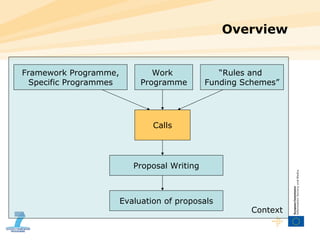
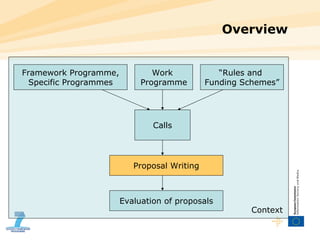
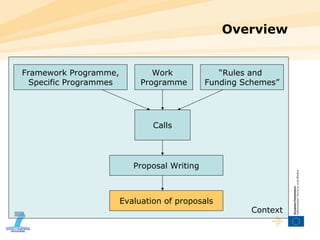
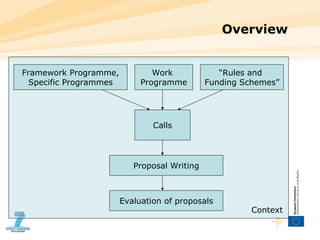
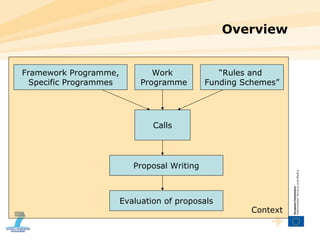
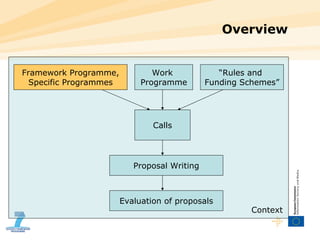
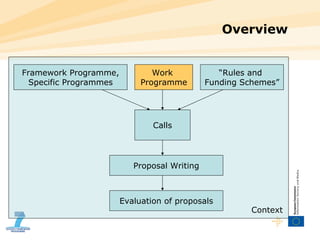
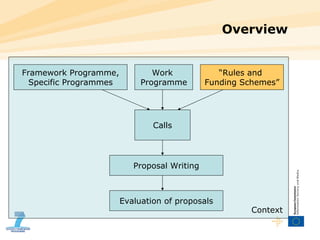
Overview Framework Programme, Specific Programmes Work  Programme Calls Proposal Writing Evaluation of proposals “ Rules and  Funding Schemes” Context
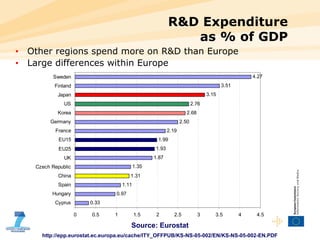
R&D Expenditure as % of GDP Source: Eurostat http://epp.eurostat.ec.europa.eu/cache/ITY_OFFPUB/KS-NS-05-002/EN/KS-NS-05-002-EN.PDF Other regions spend more on R&D than Europe Large differences within Europe
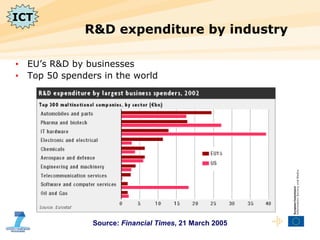
R&D expenditure by industry Source:  Financial Times , 21 March 2005 EU’s R&D by businesses Top 50 spenders in the world ICT
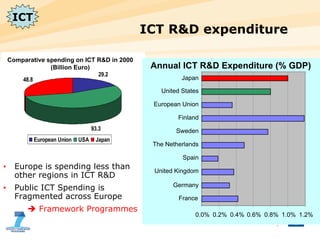
ICT R&D expenditure Europe is spending less than other regions in ICT R&D Public ICT Spending is Fragmented across Europe    Framework Programmes 0.0% 0.2% 0.4% 0.6% 0.8% 1.0% 1.2% France Germany United Kingdom Spain The Netherlands Sweden Finland European Union United States Japan Annual ICT R&D Expenditure (% GDP) Comparative spending on ICT R&D in 2000 (Billion Euro) ICT
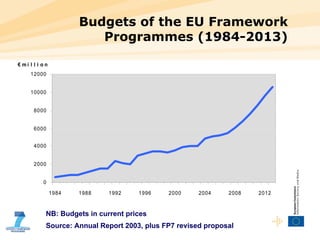
Budgets of the EU Framework Programmes (1984-2013) NB: Budgets in current prices Source: Annual Report 2003, plus FP7 revised proposal
What’s new? Main new elements compared to FP6: Duration increased from four/five to seven years Annual budget increased significantly Basic research (~ €1 billion per year) New structure: cooperation, ideas, people, capacities Flexible funding schemes Joint Technology Initiatives Simpler procedures Logistical and administrative tasks    external structures
Overview Framework Programme, Specific Programmes Work  Programme Calls Proposal Writing Evaluation of proposals “ Rules and  Funding Schemes” Context
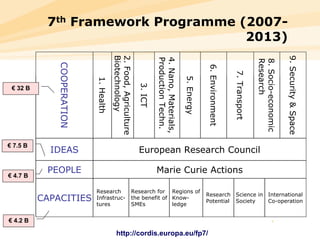
7 th  Framework Programme (2007-2013) International Co-operation Science in Society Research Potential Regions of Know-ledge Research for the benefit of SMEs Research Infrastruc-tures CAPACITIES Marie Curie Actions PEOPLE European Research Council IDEAS 9. Security & Space 8. Socio-economic Research 7. Transport 6. Environment 5. Energy 4. Nano, Materials, Production Techn. 3. ICT 2. Food, Agriculture Biotechnology 1. Health COOPERATION http://cordis.europa.eu/fp7/ €  32 B €  7.5 B €  4.7 B €  4.2 B
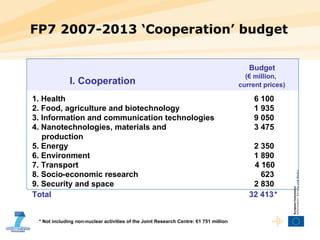
FP7 2007-2013 ‘Cooperation’ budget I. Cooperation Budget  (€ million,  current prices) 1. Health 6 100 2. Food, agriculture and biotechnology 1 935 3. Information and communication technologies 9 050 4. Nanotechnologies, materials and  production 3 475 5. Energy 2 350 6. Environment 1 890 7. Transport 4 160 8. Socio - economic research  623 9. Security and space 2 830 Total 32 413 * Not including non-nuclear activities of the Joint Research Centre: €1 751 million *
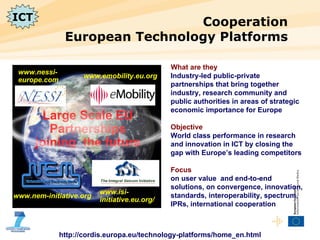
Cooperation European Technology Platforms http://cordis.europa.eu/technology-platforms/home_en.html What are they Industry-led public-private partnerships that bring together industry, research community and public authorities in areas of strategic economic importance for Europe Objective   World class performance in research and innovation in ICT by closing the gap with Europe’s leading competitors Focus  on user value  and end-to-end solutions, on convergence, innovation, standards, interoperability, spectrum, IPRs, international cooperation www.nem-initiative.org www.emobility.eu.org www.isi-initiative.eu.org/ www.nessi-europe.com Large Scale EU Partnerships  joining  the future ICT
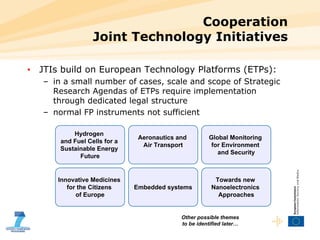
Cooperation Joint Technology Initiatives May  take the form of joint undertakings  –  Article 171 of the Treaty ‘ The Community may set up joint undertakings or any other structure necessary for the efficient execution of Community research, technological development and demonstration programmes’ JTIs aim to:  establish long-term public-private partnerships in research at European level in fields of high industrial and policy relevance  co-ordinate research efforts and respond to industry needs lead to flagship projects for European competitiveness
Cooperation Joint Technology Initiatives JTIs build on European Technology Platforms (ETPs): in a small number of cases, scale and scope of Strategic Research Agendas of ETPs require implementation through dedicated legal structure  normal FP instruments not sufficient Other possible themes to be identified later… Hydrogen  and Fuel Cells for a  Sustainable Energy  Future Aeronautics and  Air Transport Global Monitoring  for Environment  and Security Embedded systems Innovative Medicines  for the Citizens  of Europe Towards new  Nanoelectronics  Approaches
Ideas – Frontier Research Key driver to innovation and economic performance European Research Council (ERC) Autonomous scientific governance (Scientific Council) Support investigator-driven frontier research over all areas of research Support projects of individual teams Excellence as sole criterion European added-value through competition at European level Budget ~ €1bn p.a. (2007-2013 ~ €7.46)
People – Marie Curie Actions Initial training of researchers Marie Curie Networks Life-long training and career development Individual Fellowships Co-financing of regional/national/international programmes Industry-academia pathways and partnerships Industry-Academia Knowledge–sharing Scheme* International dimension Outgoing & Incoming International Fellowships International Cooperation Scheme Reintegration grants;  Support to researcher ‘diasporas’ Specific actions Mobility and career enhancement actions Excellence awards
Capacities – Research Capacity Research infrastructures Research for the benefit of SMEs Regions of Knowledge Research Potential Science in Society Coherent development of policies Activities of International Cooperation
1. Research Infrastructures Support to existing research infrastructures: Integrating activities Research e-infrastructures Support to new research infrastructures: Construction of new research infrastructures and major updates of existing ones Design studies
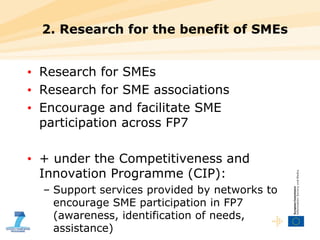
2. Research for the benefit of SMEs Research for SMEs Research for SME associations Encourage and facilitate SME participation across FP7 + under the Competitiveness and Innovation Programme (CIP): Support services provided by networks to encourage SME participation in FP7 (awareness, identification of needs, assistance)
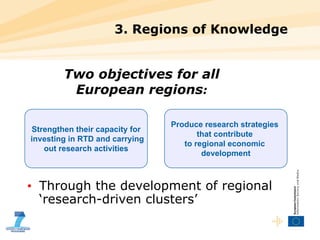
3. Regions of Knowledge Through the development of regional ‘research-driven clusters’ Two objectives for all European regions : Strengthen their capacity for investing in RTD and carrying out research activities Produce research strategies  that contribute  to regional economic  development
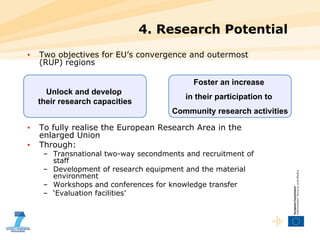
4. Research Potential Two objectives for EU’s convergence and outermost (RUP) regions  To fully realise the European Research Area in the enlarged Union Through: Transnational two-way secondments and recruitment of staff Development of research equipment and the material environment  Workshops and conferences for knowledge transfer ‘ Evaluation facilities’ Unlock and develop  their research capacities Foster an increase  in their participation to  Community research activities
5. Science in Society Strengthening the European science system (inc. scientific advice) Broader public engagement on science-related questions Promoting better science through ethics research and ethical review Science and technology and their place in society Gender research, gender dimension, and the role of women in research Science education – curiosity and the participation of young people Policy for the role and engagement of universities Communication between scientists, policy-makers, media and the public
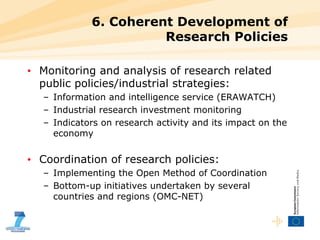
6. Coherent Development of Research Policies Monitoring and analysis of research related public policies/industrial strategies: Information and intelligence service (ERAWATCH) Industrial research investment monitoring Indicators on research activity and its impact on the economy Coordination of research policies: Implementing the Open Method of Coordination Bottom-up initiatives undertaken by several countries and regions (OMC-NET)
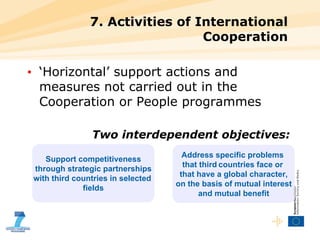
7. Activities of International Cooperation ‘ Horizontal’ support actions and measures not carried out in the  Cooperation or People programmes Two interdependent objectives: Support competitiveness through strategic partnerships  with third countries in selected  fields Address specific problems  that third   countries face or  that have a global character, on the basis of mutual interest and mutual benefit
Overview Framework Programme, Specific Programmes Work  Programme Calls Proposal Writing Evaluation of proposals “ Rules and  Funding Schemes” Context
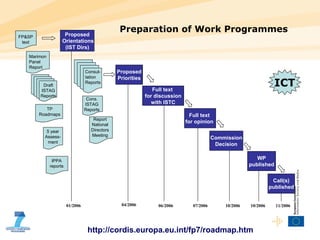
Preparation of Work Programmes 01/2006  04/2006  10/2006 Proposed Orientations (IST Dirs) Proposed Priorities Full text  for discussion with ISTC Commission Decision Full text  for opinion  Consul-tation Reports Marimon Panel Report  FP&SP text Report National Directors Meeting  Cons. ISTAG Reports  10/2006 11/2006 WP published Call(s) published 06/2006 07/2006 5 year Assess-ment  IPPA reports TP Roadmaps http://cordis.europa.eu.int/fp7/roadmap.htm ICT Draft ISTAG Reports
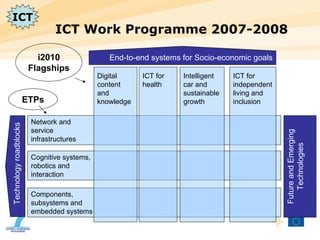
ICT Work Programme 2007-2008 Future and Emerging  Technologies Cognitive systems,  robotics and interaction  Network and  service  infrastructures Components,  subsystems and  embedded systems Digital content and knowledge ICT for health Intelligent car and sustainable growth ICT for independent living and inclusion End-to-end systems for Socio-economic goals Technology roadblocks ETPs i2010 Flagships ICT
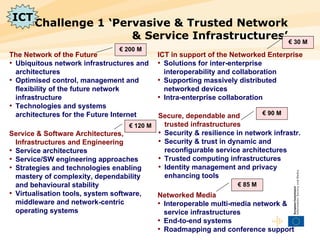
Challenge 1 ‘Pervasive & Trusted Network & Service Infrastructures’ The Network of the Future  Ubiquitous network infrastructures and architectures Optimised control, management and flexibility of the future network infrastructure Technologies and systems architectures for the Future Internet ICT in support of the Networked Enterprise Solutions for inter-enterprise interoperability and collaboration Supporting massively distributed networked devices Intra-enterprise collaboration Service & Software Architectures, Infrastructures and Engineering  Service architectures Service/SW engineering approaches Strategies and technologies enabling mastery of complexity, dependability and behavioural stability Virtualisation tools, system software, middleware and network-centric operating systems Networked Media  Interoperable multi-media network & service infrastructures  End-to-end systems Roadmapping and conference support €  200 M €  30 M €  85 M €  120 M Secure, dependable and  trusted infrastructures  Security & resilience in network infrastr. Security & trust in dynamic and reconfigurable service architectures  Trusted computing infrastructures Identity management and privacy enhancing tools  €  90 M ICT
Overview Framework Programme, Specific Programmes Work  Programme Calls Proposal Writing Evaluation of proposals “ Rules and  Funding Schemes” Context
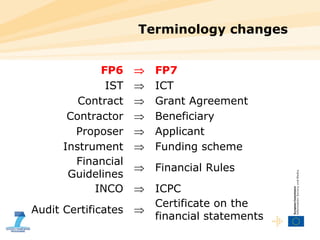
Terminology changes ICT  IST FP7  FP6 Beneficiary  Contractor Certificate on the financial statements  Audit Certificates  ICPC  INCO Financial Rules  Financial Guidelines Funding scheme  Instrument  Applicant  Proposer  Grant Agreement  Contract
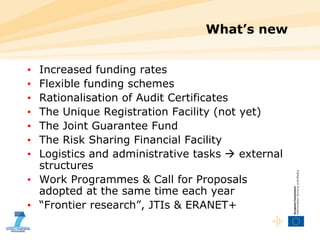
What’s new Increased funding rates Flexible funding schemes Rationalisation of Audit Certificates The Unique Registration Facility (not yet) The Joint Guarantee Fund The Risk Sharing Financial Facility Logistics and administrative tasks    external structures Work Programmes & Call for Proposals adopted at the same time each year “ Frontier research”, JTIs & ERANET+
Minimum conditions  for participation  General: 3 independent legal entities from  3 different Member States (MS) or Associated countries (Ac) Specificities Collaborative projects for specific cooperation actions (SICA) dedicated to international cooperation partner countries (ICPC) identified in WP: minimum  4 participants  of which 2 in different MS or Ac and 2 in different ICPC countries unless otherwise specified in work programme Participation of  international organisations  and participants from  third countries  if in addition to minima
Consortia  Consortium agreements  obligatory unless exempted by call for proposals, Commission to publish guidelines Coordinator  acts as efficient interface between consortium and Commission (verifies accession, monitors compliance, receives and distributes EC contribution, keeps financial records and ensures timely delivery of reports)  Specificities Tacit approval for changes in consortium membership, except if associated with other changes Written approval for change of coordinator
Community  financial contribution Eligibility for Funding : Legal entities from Member States and Associated  Countries or created under Community law (and the JRC) Specificities International European interest organisations Legal entities established in international cooperation partner countries (ICPC-INCO) and International organisations Legal entities established in 3 rd  countries other than ICPC-INCO, if provided for in Specific Programme or Work Programme or essential for carrying out action; or if provision for funding is provided for in a bilateral agreement between Community and that country
Forms of grant Reimbursement of eligible costs Specificities Flat rates: a percentage for indirect costs or scales of unit costs Lump sum amounts Combination of the above Scholarships or prizes Forms of grants to be used are specified in WP/calls for proposals ICPC participants may opt for lump sum financing
Reimbursement of eligible costs Co-financing, no profit Cost reporting models eliminated Participants charge direct and indirect eligible costs  Eligible costs Actual;  Incurred during the project;  Determined according to usual accounting and management principles/practices;  Used solely to achieve project objectives;  Consistent with principles of economy, efficiency and effectiveness;  Recorded in accounts (or the accounts of third parties); Exclusive of non-eligible costs Average personnel costs  may be used if consistent with above and do not differ significantly from actual
Indirect costs All participants:  Actual  indirect costs (participants may use a simplified method of calculation) or Flat-rate  of direct eligible costs excluding subcontracts and reimbursement of third parties’ costs – to be established by the Commission, currently 20% Non-profit public bodies, secondary and higher education establishments, research organisations and SMEs unable to identify real indirect costs:  Flat-rate of 60% of total direct eligible costs (until end 2009) Flat rate of minimum 40%, to be established by the Commission (as of 2010)
Maximum funding rates Research and technological development activities : –  50%  of eligible costs, but up to 75% of eligible costs for: Public bodies (non-profit) Secondary and higher education establishments Research organisations (non-profit) Small and Medium sized Enterprises (SMEs) Demonstration activities : –  50%  of eligible costs  Other activities : –  100%  including e.g. consortium management Coordination and support actions : –  100% Flat rate indirect costs: 7% Receipts are taken into account to determine the final Community financial contribution No more 7% limit of funding for management costs as in FP6
Guarantee mechanism Replaces financial collective responsibility Commission establishes and operates a participant  guarantee fund Contribution to guarantee fund of  max. 5% of the EC contribution by each participant, to be returned at the end of the project If interests generated not sufficient to cover sums due to EC, retention of max. 1% of EC contribution Exemption of retention for public bodies, higher and secondary education establishments, legal entities guaranteed by a Member State / Associated Country Ex-ante financial viability checks limited to coordinators and participants requesting > EUR 500.000  (unless exceptional circumstances) Guarantee fund replaces financial guarantees
Risk-sharing Finance Facility (RSFF)  The Community may award a grant to the European Investment Bank (EIB) to cover risk of loans [or guarantees] in support of research objectives set out under FP7 The EIB shall provide these loans [or guarantees] in a fair, transparent, impartial and equal way The Commission may object to the use of the RSFF for certain loans on terms defined in the grant agreement in accordance with the work programme
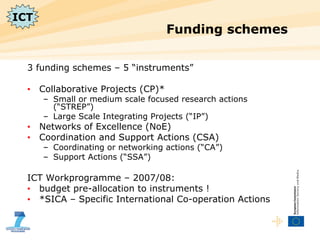
Funding schemes 3 funding schemes – 5 “instruments” Collaborative Projects (CP)* Small or medium scale focused research actions (“STREP”) Large Scale Integrating Projects (“IP”) Networks of Excellence (NoE) Coordination and Support Actions (CSA) Coordinating or networking actions (“CA”) Support Actions (“SSA”) ICT Workprogramme – 2007/08:  budget pre-allocation to instruments ! *SICA – Specific International Co-operation Actions ICT
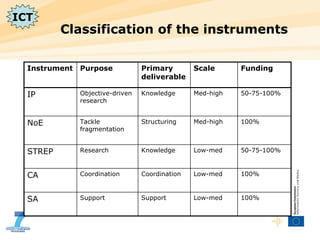
Classification of the instruments ICT 100% 100% 50-75-100% 100% 50-75-100% Funding Low-med Support Support SA Low-med Coordination Coordination CA Low-med Knowledge Research STREP Med-high Structuring Tackle fragmentation NoE Med-high Knowledge Objective-driven research IP Scale Primary deliverable Purpose Instrument
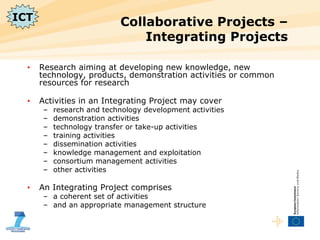
Collaborative Projects – Integrating Projects  Research aiming at developing new knowledge, new technology, products, demonstration activities or common resources for research  Activities in an Integrating Project may cover  research and technology development activities demonstration activities technology transfer or take-up activities training activities dissemination activities knowledge management and exploitation consortium management activities other activities An Integrating Project comprises a coherent set of activities and an appropriate management structure ICT
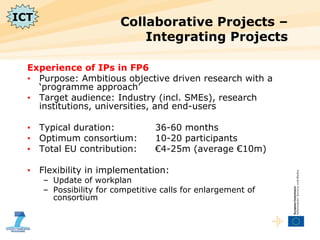
Collaborative Projects – Integrating Projects  Experience of IPs in FP6 Purpose: Ambitious objective driven research with a ‘programme approach’ Target audience: Industry (incl. SMEs), research institutions, universities, and end-users Typical duration: 36-60 months Optimum consortium:  10-20 participants Total EU contribution:  €4-25m (average €10m)  Flexibility in implementation:  Update of workplan Possibility for competitive calls for enlargement of consortium ICT
Collaborative Projects – Focused projects Targeting a specific objective in a clearly defined project approach Fixed overall work plan with stable deliverables that do not change over the life-time of the project Two types of activity or combination of the two: A research and technological development activity designed to generate new knowledge to improve competitiveness and/or address major societal needs /or  A demonstration activity designed to prove the viability of new technologies offering potential economic advantages but which can not be commercialised directly (e.g. testing of prototypes) as well as Project management activities (including innovation related activities like protection of knowledge dissemination and exploitation ICT
Collaborative Projects – Focused projects  Experience of STREPs in FP6  Purpose: Objective driven research more limited in scope than an IP Target audience: Industry incl. SMEs, research institutes, universities Typical duration: 18-36 months Optimum consortium: 6-15 participants Total EU contribution: €0.8 - 3 m (average €1.9m) Fixed workplan and fixed partnership for duration ICT
Networks of excellence NoEs are an instrument to overcome the fragmentation of the European research landscape in a given area and remove the barriers to integration Their purpose is to reach a durable restructuring and integration of efforts and institutions or parts of institutions The success of an NoE is not measured in terms of scientific results  … but by the extent to which the social fabric for researchers and research institutions in a field has changed due to the project,  … and the extent to which the existing capacities become more competitive as a result of this change Activities: Integrating activities Activities to support the network’s goals Activities to spread excellence Management activities
Networks of excellence Experience of NoEs in FP6  Purpose: Durable integration of participants’ research activities Target audience: research institutions, universities, mainly indirectly: industry – trough governing boards etc Typical duration:  48-60 months  (but indefinite integration!) Optimum consortium:  6-12 participants Total EU contribution:  €4-15m (average around €7m) Flexibility in implementation:  Update of workplan Possibility to add participants through competitive calls
Coordination or Networking actions Designed to promote and support the ad hoc networking and co-ordination of research and innovation activities at national, regional and European level over a fixed period for a specific purpose May combine the following types of activities Organisation of events (conferences, meetings); Performance of studies, analysis; Exchanges of personnel; Exchange and dissemination of good practice; Setting up of common information systems Setting up of expert groups; Definition, organisation, management of joint or common initiatives Management of the action
Coordination or Networking actions Experience of CAs in FP6 Purpose: Co-ordination of several research activities Target Audience: Research institutions, universities, industry incl. SMEs Typical duration: 18-36 months Optimum consortium:  13-26 participants Total EU contribution:  €0.5-1.8m (average  €1m) Fixed overall workplan and partnership for the duration
Support actions  Designed to underpin the implementation of the programme complement the other FP7 funding schemes,  help in preparations for future Community research and technological development policy activities and  stimulate, encourage and facilitate the participation of SMEs, civil society organisations, small research teams, newly developed and remote research centres, as well as setting up research clusters across Europe Cover one-off events or single purpose activities May combine the following two types of activities  Organisation of conferences, seminars, working groups and expert groups; Performance of studies, analysis; Fact findings and monitoring; Carrying out preparatory technical work, including feasibility studies Development of research or innovation strategies; Organising high level scientific awards and competitions;  Operational support, data access and dissemination, information and communication activities
Support actions  Experience of SSAs in FP6  Purpose: Support to programme implementation, preparation of future actions, dissemination of results Target audience: Research organisations, universities, industry incl. SMEs Typical duration: 9-30 months Optimum consortium: 1-15 participants Total EU contribution: €0.03-1m (average €0.5m)  Fixed overall workplan and partnership for the duration
Overview Framework Programme, Specific Programmes Work  Programme Calls Proposal Writing Evaluation of proposals “ Rules and  Funding Schemes” Context
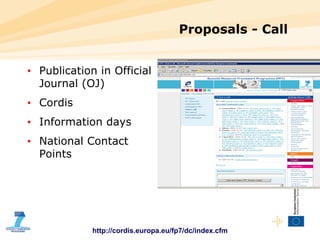
Proposals - Call Publication in Official Journal (OJ) Cordis  Information days National Contact Points http://cordis.europa.eu/fp7/dc/index.cfm
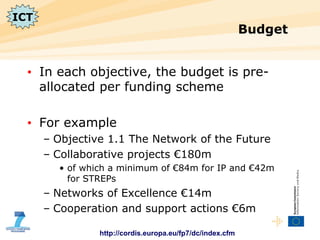
Budget In each objective, the budget is pre-allocated per funding scheme  For example Objective 1.1 The Network of the Future Collaborative projects €180m of which a minimum of €84m for IP and €42m for STREPs Networks of Excellence €14m Cooperation and support actions €6m http://cordis.europa.eu/fp7/dc/index.cfm ICT
Overview Framework Programme, Specific Programmes Work  Programme Calls Proposal Writing Evaluation of proposals “ Rules and  Funding Schemes” Context
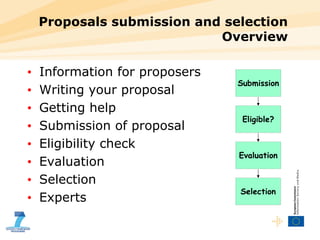
Proposals submission and selection Overview Information for proposers Writing your proposal Getting help Submission of proposal Eligibility check Evaluation Selection Experts Submission Selection Evaluation Eligible?
Information for applicants Workprogramme 2007-2008 Guide for Applicants Evaluation forms with notes EPSS manual Model grant agreement Rules on submission of proposals, and the related evaluation, selection and award procedures
When writing your proposal….1 Divide your effort over the evaluation criteria Many proposers concentrate on the scientific element, but loose marks on project implementation or impact description Think of the finishing touches which signal quality work clear language well-organised contents, following the Part B structure useful and understandable diagrams no typos, no inconsistencies, no obvious paste-ins, no numbers which don’t add up, no missing pages…
When writing your proposal….2 Make it easy for the evaluators to give you high marks. Don’t make it hard for them! Don’t write too little; cover what is requested  Don’t write too much Don’t leave them to figure out why it’s good, tell them why it’s good Leave nothing to the imagination
When writing your proposal….3 Available background documents Example ICT, Software Technologies Strategies and Policies for Global Leadership The Effect of Allowing Patents on Computer Implemented Inventions The Effect of Public Administrations Publishing Open Source Software Impact Assessment http://cordis.europa.eu/ist/st/studies.htm ICT
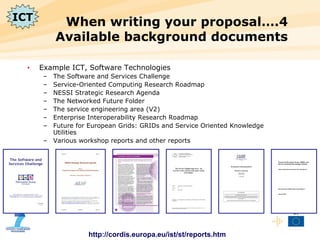
When writing your proposal….4 Available background documents Example ICT, Software Technologies The Software and Services Challenge Service-Oriented Computing Research Roadmap NESSI Strategic Research Agenda The Networked Future Folder The service engineering area (V2) Enterprise Interoperability Research Roadmap Future for European Grids: GRIDs and Service Oriented Knowledge Utilities Various workshop reports and other reports http://cordis.europa.eu/ist/st/reports.htm ICT
Getting help with your proposal  The ICT theme supports An Information Desk at many events Proposers’ days and briefings in Brussels and elsewhere ICT Proposers day in Cologne, 1 February 2007 Various specific information days in Brussels, e.g. Challenge 1 Info Day, 26 February 2007 (tentative) Partner search facilities A Helpdesk for proposers’ questions, reachable by email or phone (and a Helpdesk for electronic proposal submission) Cordis:  http://cordis.europa.eu/fp7/ And a network of National Contact Points in Europe and beyond:  http://cordis.europa.eu/fp7/ncp.htm ICT
Submission Fixed deadline calls* 17h00 Tuesdays One stage submission* Electronic submission only (*Special rules for FET Open scheme) ICT See Work Programme at http://cordis.europa.eu/fp7/dc/index.cfm
Electronic  Submission EPSS - Electronic Proposal Submission System Online preparation only! Improved validation checks before submission is accepted FP6 Failure rate = ± 1% Main reason for failure – waiting till the last minute Submit early, submit often!
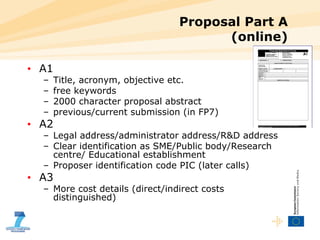
Proposal Part A (online) A1 Title, acronym, objective etc. free keywords 2000 character proposal abstract previous/current submission (in FP7) A2 Legal address/administrator address/R&D address Clear identification as SME/Public body/Research centre/ Educational establishment Proposer identification code PIC (later calls) A3 More cost details (direct/indirect costs distinguished)
Proposal Part B (pdf format only) Part B format directly linked to evaluation criteria Summary S&T quality (bullet points = sections) CP: Concept and objectives CP: Progress beyond the state-of-the-art CP: S/T methodology and associated work plan Implementation (idem) CP: Management structure and procedures CP: Individual participants CP: Consortium as a whole CP: Resources to be committed Impact (idem) CP: Expected impacts listed in the work programme CP: Dissemination and/or exploitation of project results, and management of intellectual property Ethics Section lengths recommended
Overview Framework Programme, Specific Programmes Work  Programme Calls Proposal Writing Evaluation of proposals “ Rules and  Funding Schemes” Context
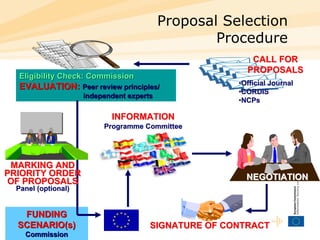
Proposal Selection  Procedure FUNDING SCENARIO(s) Commission Official Journal CORDIS NCPs CALL FOR PROPOSALS Eligibility Check: Commission EVALUATION:   Peer review principles/ independent experts MARKING AND PRIORITY ORDER OF PROPOSALS   Panel (optional) NEGOTIATION SIGNATURE OF CONTRACT INFORMATION Programme Committee
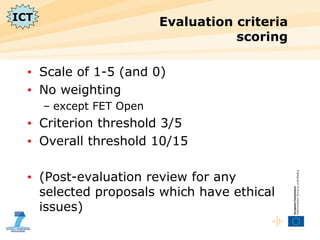
Evaluation criteria  scoring Scale of 1-5 (and 0) No weighting except FET Open Criterion threshold 3/5 Overall threshold 10/15 (Post-evaluation review for any selected proposals which have ethical issues) ICT
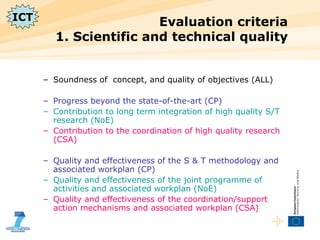
Evaluation criteria  1. Scientific and technical quality Soundness of  concept, and quality of objectives (ALL) Progress beyond the state-of-the-art (CP) Contribution to long term integration of high quality S/T research (NoE) Contribution to the coordination of high quality research (CSA) Quality and effectiveness of the S & T methodology and associated workplan (CP) Quality and effectiveness of the joint programme of activities and associated workplan (NoE) Quality and effectiveness of the coordination/support action mechanisms and associated workplan (CSA) ICT
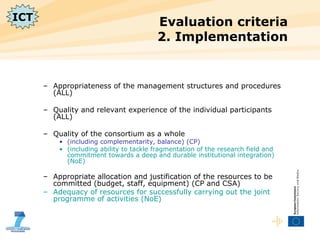
Evaluation criteria  2. Implementation Appropriateness of the management structures and procedures (ALL) Quality and relevant experience of the individual participants (ALL) Quality of the consortium as a whole (including complementarity, balance) (CP) (including ability to tackle fragmentation of the research field and commitment towards a deep and durable institutional integration) (NoE) Appropriate allocation and justification of the resources to be committed (budget, staff, equipment) (CP and CSA) Adequacy of resources for successfully carrying out the joint programme of activities (NoE) ICT
Evaluation criteria  3. Impact Contribution at the European or international level to the expected impacts listed in the workprogramme under the relevant activity (ALL) Appropriateness of measures for the dissemination and/or exploitation of project results, and management of intellectual property (CP) Appropriateness of measures for spreading excellence, exploiting results and disseminating knowledge through engagement with stakeholders and the public at large (NoE and CSA) ICT
Experts New calls for experts for FP7 to individuals to organisations Current FP6 experts will be invited to transfer to FP7* with a request to update their information (*if your email address is up-to-date!)
To conclude …
Other Programmes CIP Competitiveness and Innovation Framework Programme (CIP) Downstream parts of research and innovation Technology transfer Implementation and market take-up of existing new technologies Budget: roughly 0.5 billion Euro per year  Priorities  ICT Policy Support Programme  for 2007:  eGov, eInclusion, eHealth CIP: http://europa.eu.int/comm/enterprise/enterprise_policy/cip/index_en.htm
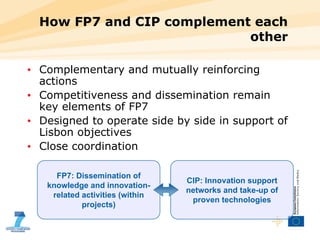
How FP7 and CIP complement each other Complementary and mutually reinforcing actions Competitiveness and dissemination remain key elements of FP7 Designed to operate side by side in support of Lisbon objectives Close coordination  FP7: Dissemination of knowledge and innovation-related activities (within projects) CIP: Innovation support networks and take-up of proven technologies
Other Programmes Structural Funds and Cohesion Fund  Objectives: to reduce disparities in development and promote economic and social cohesion in the European Union to improve the effectiveness of the Community’s structural assistance by concentrating the assistance,  to promote economic and social cohesion and solidarity between Member States Budget: roughly 28 and 2.5 billion Euro per year Eureka Structural Funds: http://europa.eu/scadplus/leg/en/lvb/l60014.htm Cohesion Fund: http://europa.eu/scadplus/leg/en/lvb/l60018.htm
Project Officers Before, during, and after the project Before a project Dissemination of Strategic Objective, Work Programme Advice/feedback to proposers During a project “ Counselling” projects Responsibility for tax payers’ money After a project Closure Impact assessment
Information EU research:  http://ec.europa.eu/research FP7: http://ec.europa.eu/research/fp7 Information on research programmes and projects:  http://cordis.europa.eu/ RTD  info  magazine:  http://ec.europa.eu/research/rtdinfo/ Information requests:  http://ec.europa.eu/research/enquiries/ Email: <first name>.<last name>@ec.europa.eu

20070115 FP7 Info

  • 1.
    Framework Programme 7 Overview Arian Zwegers DG Information Society and Media Software & Service Architectures & Infrastructures FP7 seminar, Jožef Stefan Institute, Ljubljana, 15 January 2007
  • 2.
    Questions Who hasever written a successful proposal? Who has ever been in a European research project? Who has ever been involved in a proposal? Who knows what European research is about? Who does not know anything about European research programmes?
  • 3.
    Overview Framework Programme,Specific Programmes Work Programme Calls Proposal Writing Evaluation of proposals “ Rules and Funding Schemes” Context
  • 4.
    Overview Framework Programme,Specific Programmes Work Programme Calls Proposal Writing Evaluation of proposals “ Rules and Funding Schemes” Context
  • 5.
    R&D Expenditure as% of GDP Source: Eurostat http://epp.eurostat.ec.europa.eu/cache/ITY_OFFPUB/KS-NS-05-002/EN/KS-NS-05-002-EN.PDF Other regions spend more on R&D than Europe Large differences within Europe
  • 6.
    R&D expenditure byindustry Source: Financial Times , 21 March 2005 EU’s R&D by businesses Top 50 spenders in the world ICT
  • 7.
    ICT R&D expenditureEurope is spending less than other regions in ICT R&D Public ICT Spending is Fragmented across Europe  Framework Programmes 0.0% 0.2% 0.4% 0.6% 0.8% 1.0% 1.2% France Germany United Kingdom Spain The Netherlands Sweden Finland European Union United States Japan Annual ICT R&D Expenditure (% GDP) Comparative spending on ICT R&D in 2000 (Billion Euro) ICT
  • 8.
    Budgets of theEU Framework Programmes (1984-2013) NB: Budgets in current prices Source: Annual Report 2003, plus FP7 revised proposal
  • 9.
    What’s new? Mainnew elements compared to FP6: Duration increased from four/five to seven years Annual budget increased significantly Basic research (~ €1 billion per year) New structure: cooperation, ideas, people, capacities Flexible funding schemes Joint Technology Initiatives Simpler procedures Logistical and administrative tasks  external structures
  • 10.
    Overview Framework Programme,Specific Programmes Work Programme Calls Proposal Writing Evaluation of proposals “ Rules and Funding Schemes” Context
  • 11.
    7 th Framework Programme (2007-2013) International Co-operation Science in Society Research Potential Regions of Know-ledge Research for the benefit of SMEs Research Infrastruc-tures CAPACITIES Marie Curie Actions PEOPLE European Research Council IDEAS 9. Security & Space 8. Socio-economic Research 7. Transport 6. Environment 5. Energy 4. Nano, Materials, Production Techn. 3. ICT 2. Food, Agriculture Biotechnology 1. Health COOPERATION http://cordis.europa.eu/fp7/ € 32 B € 7.5 B € 4.7 B € 4.2 B
  • 12.
    FP7 2007-2013 ‘Cooperation’budget I. Cooperation Budget (€ million, current prices) 1. Health 6 100 2. Food, agriculture and biotechnology 1 935 3. Information and communication technologies 9 050 4. Nanotechnologies, materials and production 3 475 5. Energy 2 350 6. Environment 1 890 7. Transport 4 160 8. Socio - economic research 623 9. Security and space 2 830 Total 32 413 * Not including non-nuclear activities of the Joint Research Centre: €1 751 million *
  • 13.
    Cooperation European TechnologyPlatforms http://cordis.europa.eu/technology-platforms/home_en.html What are they Industry-led public-private partnerships that bring together industry, research community and public authorities in areas of strategic economic importance for Europe Objective World class performance in research and innovation in ICT by closing the gap with Europe’s leading competitors Focus on user value and end-to-end solutions, on convergence, innovation, standards, interoperability, spectrum, IPRs, international cooperation www.nem-initiative.org www.emobility.eu.org www.isi-initiative.eu.org/ www.nessi-europe.com Large Scale EU Partnerships joining the future ICT
  • 14.
    Cooperation Joint TechnologyInitiatives May take the form of joint undertakings – Article 171 of the Treaty ‘ The Community may set up joint undertakings or any other structure necessary for the efficient execution of Community research, technological development and demonstration programmes’ JTIs aim to: establish long-term public-private partnerships in research at European level in fields of high industrial and policy relevance co-ordinate research efforts and respond to industry needs lead to flagship projects for European competitiveness
  • 15.
    Cooperation Joint TechnologyInitiatives JTIs build on European Technology Platforms (ETPs): in a small number of cases, scale and scope of Strategic Research Agendas of ETPs require implementation through dedicated legal structure normal FP instruments not sufficient Other possible themes to be identified later… Hydrogen and Fuel Cells for a Sustainable Energy Future Aeronautics and Air Transport Global Monitoring for Environment and Security Embedded systems Innovative Medicines for the Citizens of Europe Towards new Nanoelectronics Approaches
  • 16.
    Ideas – FrontierResearch Key driver to innovation and economic performance European Research Council (ERC) Autonomous scientific governance (Scientific Council) Support investigator-driven frontier research over all areas of research Support projects of individual teams Excellence as sole criterion European added-value through competition at European level Budget ~ €1bn p.a. (2007-2013 ~ €7.46)
  • 17.
    People – MarieCurie Actions Initial training of researchers Marie Curie Networks Life-long training and career development Individual Fellowships Co-financing of regional/national/international programmes Industry-academia pathways and partnerships Industry-Academia Knowledge–sharing Scheme* International dimension Outgoing & Incoming International Fellowships International Cooperation Scheme Reintegration grants; Support to researcher ‘diasporas’ Specific actions Mobility and career enhancement actions Excellence awards
  • 18.
    Capacities – ResearchCapacity Research infrastructures Research for the benefit of SMEs Regions of Knowledge Research Potential Science in Society Coherent development of policies Activities of International Cooperation
  • 19.
    1. Research InfrastructuresSupport to existing research infrastructures: Integrating activities Research e-infrastructures Support to new research infrastructures: Construction of new research infrastructures and major updates of existing ones Design studies
  • 20.
    2. Research forthe benefit of SMEs Research for SMEs Research for SME associations Encourage and facilitate SME participation across FP7 + under the Competitiveness and Innovation Programme (CIP): Support services provided by networks to encourage SME participation in FP7 (awareness, identification of needs, assistance)
  • 21.
    3. Regions ofKnowledge Through the development of regional ‘research-driven clusters’ Two objectives for all European regions : Strengthen their capacity for investing in RTD and carrying out research activities Produce research strategies that contribute to regional economic development
  • 22.
    4. Research PotentialTwo objectives for EU’s convergence and outermost (RUP) regions To fully realise the European Research Area in the enlarged Union Through: Transnational two-way secondments and recruitment of staff Development of research equipment and the material environment Workshops and conferences for knowledge transfer ‘ Evaluation facilities’ Unlock and develop their research capacities Foster an increase in their participation to Community research activities
  • 23.
    5. Science inSociety Strengthening the European science system (inc. scientific advice) Broader public engagement on science-related questions Promoting better science through ethics research and ethical review Science and technology and their place in society Gender research, gender dimension, and the role of women in research Science education – curiosity and the participation of young people Policy for the role and engagement of universities Communication between scientists, policy-makers, media and the public
  • 24.
    6. Coherent Developmentof Research Policies Monitoring and analysis of research related public policies/industrial strategies: Information and intelligence service (ERAWATCH) Industrial research investment monitoring Indicators on research activity and its impact on the economy Coordination of research policies: Implementing the Open Method of Coordination Bottom-up initiatives undertaken by several countries and regions (OMC-NET)
  • 25.
    7. Activities ofInternational Cooperation ‘ Horizontal’ support actions and measures not carried out in the Cooperation or People programmes Two interdependent objectives: Support competitiveness through strategic partnerships with third countries in selected fields Address specific problems that third countries face or that have a global character, on the basis of mutual interest and mutual benefit
  • 26.
    Overview Framework Programme,Specific Programmes Work Programme Calls Proposal Writing Evaluation of proposals “ Rules and Funding Schemes” Context
  • 27.
    Preparation of WorkProgrammes 01/2006 04/2006 10/2006 Proposed Orientations (IST Dirs) Proposed Priorities Full text for discussion with ISTC Commission Decision Full text for opinion Consul-tation Reports Marimon Panel Report FP&SP text Report National Directors Meeting Cons. ISTAG Reports 10/2006 11/2006 WP published Call(s) published 06/2006 07/2006 5 year Assess-ment IPPA reports TP Roadmaps http://cordis.europa.eu.int/fp7/roadmap.htm ICT Draft ISTAG Reports
  • 28.
    ICT Work Programme2007-2008 Future and Emerging Technologies Cognitive systems, robotics and interaction Network and service infrastructures Components, subsystems and embedded systems Digital content and knowledge ICT for health Intelligent car and sustainable growth ICT for independent living and inclusion End-to-end systems for Socio-economic goals Technology roadblocks ETPs i2010 Flagships ICT
  • 29.
    Challenge 1 ‘Pervasive& Trusted Network & Service Infrastructures’ The Network of the Future Ubiquitous network infrastructures and architectures Optimised control, management and flexibility of the future network infrastructure Technologies and systems architectures for the Future Internet ICT in support of the Networked Enterprise Solutions for inter-enterprise interoperability and collaboration Supporting massively distributed networked devices Intra-enterprise collaboration Service & Software Architectures, Infrastructures and Engineering Service architectures Service/SW engineering approaches Strategies and technologies enabling mastery of complexity, dependability and behavioural stability Virtualisation tools, system software, middleware and network-centric operating systems Networked Media Interoperable multi-media network & service infrastructures End-to-end systems Roadmapping and conference support € 200 M € 30 M € 85 M € 120 M Secure, dependable and trusted infrastructures Security & resilience in network infrastr. Security & trust in dynamic and reconfigurable service architectures Trusted computing infrastructures Identity management and privacy enhancing tools € 90 M ICT
  • 30.
    Overview Framework Programme,Specific Programmes Work Programme Calls Proposal Writing Evaluation of proposals “ Rules and Funding Schemes” Context
  • 31.
    Terminology changes ICT IST FP7  FP6 Beneficiary  Contractor Certificate on the financial statements  Audit Certificates ICPC  INCO Financial Rules  Financial Guidelines Funding scheme  Instrument Applicant  Proposer Grant Agreement  Contract
  • 32.
    What’s new Increasedfunding rates Flexible funding schemes Rationalisation of Audit Certificates The Unique Registration Facility (not yet) The Joint Guarantee Fund The Risk Sharing Financial Facility Logistics and administrative tasks  external structures Work Programmes & Call for Proposals adopted at the same time each year “ Frontier research”, JTIs & ERANET+
  • 33.
    Minimum conditions for participation General: 3 independent legal entities from 3 different Member States (MS) or Associated countries (Ac) Specificities Collaborative projects for specific cooperation actions (SICA) dedicated to international cooperation partner countries (ICPC) identified in WP: minimum 4 participants of which 2 in different MS or Ac and 2 in different ICPC countries unless otherwise specified in work programme Participation of international organisations and participants from third countries if in addition to minima
  • 34.
    Consortia Consortiumagreements obligatory unless exempted by call for proposals, Commission to publish guidelines Coordinator acts as efficient interface between consortium and Commission (verifies accession, monitors compliance, receives and distributes EC contribution, keeps financial records and ensures timely delivery of reports) Specificities Tacit approval for changes in consortium membership, except if associated with other changes Written approval for change of coordinator
  • 35.
    Community financialcontribution Eligibility for Funding : Legal entities from Member States and Associated Countries or created under Community law (and the JRC) Specificities International European interest organisations Legal entities established in international cooperation partner countries (ICPC-INCO) and International organisations Legal entities established in 3 rd countries other than ICPC-INCO, if provided for in Specific Programme or Work Programme or essential for carrying out action; or if provision for funding is provided for in a bilateral agreement between Community and that country
  • 36.
    Forms of grantReimbursement of eligible costs Specificities Flat rates: a percentage for indirect costs or scales of unit costs Lump sum amounts Combination of the above Scholarships or prizes Forms of grants to be used are specified in WP/calls for proposals ICPC participants may opt for lump sum financing
  • 37.
    Reimbursement of eligiblecosts Co-financing, no profit Cost reporting models eliminated Participants charge direct and indirect eligible costs Eligible costs Actual; Incurred during the project; Determined according to usual accounting and management principles/practices; Used solely to achieve project objectives; Consistent with principles of economy, efficiency and effectiveness; Recorded in accounts (or the accounts of third parties); Exclusive of non-eligible costs Average personnel costs may be used if consistent with above and do not differ significantly from actual
  • 38.
    Indirect costs Allparticipants: Actual indirect costs (participants may use a simplified method of calculation) or Flat-rate of direct eligible costs excluding subcontracts and reimbursement of third parties’ costs – to be established by the Commission, currently 20% Non-profit public bodies, secondary and higher education establishments, research organisations and SMEs unable to identify real indirect costs: Flat-rate of 60% of total direct eligible costs (until end 2009) Flat rate of minimum 40%, to be established by the Commission (as of 2010)
  • 39.
    Maximum funding ratesResearch and technological development activities : – 50% of eligible costs, but up to 75% of eligible costs for: Public bodies (non-profit) Secondary and higher education establishments Research organisations (non-profit) Small and Medium sized Enterprises (SMEs) Demonstration activities : – 50% of eligible costs Other activities : – 100% including e.g. consortium management Coordination and support actions : – 100% Flat rate indirect costs: 7% Receipts are taken into account to determine the final Community financial contribution No more 7% limit of funding for management costs as in FP6
  • 40.
    Guarantee mechanism Replacesfinancial collective responsibility Commission establishes and operates a participant guarantee fund Contribution to guarantee fund of max. 5% of the EC contribution by each participant, to be returned at the end of the project If interests generated not sufficient to cover sums due to EC, retention of max. 1% of EC contribution Exemption of retention for public bodies, higher and secondary education establishments, legal entities guaranteed by a Member State / Associated Country Ex-ante financial viability checks limited to coordinators and participants requesting > EUR 500.000 (unless exceptional circumstances) Guarantee fund replaces financial guarantees
  • 41.
    Risk-sharing Finance Facility(RSFF) The Community may award a grant to the European Investment Bank (EIB) to cover risk of loans [or guarantees] in support of research objectives set out under FP7 The EIB shall provide these loans [or guarantees] in a fair, transparent, impartial and equal way The Commission may object to the use of the RSFF for certain loans on terms defined in the grant agreement in accordance with the work programme
  • 42.
    Funding schemes 3funding schemes – 5 “instruments” Collaborative Projects (CP)* Small or medium scale focused research actions (“STREP”) Large Scale Integrating Projects (“IP”) Networks of Excellence (NoE) Coordination and Support Actions (CSA) Coordinating or networking actions (“CA”) Support Actions (“SSA”) ICT Workprogramme – 2007/08: budget pre-allocation to instruments ! *SICA – Specific International Co-operation Actions ICT
  • 43.
    Classification of theinstruments ICT 100% 100% 50-75-100% 100% 50-75-100% Funding Low-med Support Support SA Low-med Coordination Coordination CA Low-med Knowledge Research STREP Med-high Structuring Tackle fragmentation NoE Med-high Knowledge Objective-driven research IP Scale Primary deliverable Purpose Instrument
  • 44.
    Collaborative Projects –Integrating Projects Research aiming at developing new knowledge, new technology, products, demonstration activities or common resources for research Activities in an Integrating Project may cover research and technology development activities demonstration activities technology transfer or take-up activities training activities dissemination activities knowledge management and exploitation consortium management activities other activities An Integrating Project comprises a coherent set of activities and an appropriate management structure ICT
  • 45.
    Collaborative Projects –Integrating Projects Experience of IPs in FP6 Purpose: Ambitious objective driven research with a ‘programme approach’ Target audience: Industry (incl. SMEs), research institutions, universities, and end-users Typical duration: 36-60 months Optimum consortium: 10-20 participants Total EU contribution: €4-25m (average €10m) Flexibility in implementation: Update of workplan Possibility for competitive calls for enlargement of consortium ICT
  • 46.
    Collaborative Projects –Focused projects Targeting a specific objective in a clearly defined project approach Fixed overall work plan with stable deliverables that do not change over the life-time of the project Two types of activity or combination of the two: A research and technological development activity designed to generate new knowledge to improve competitiveness and/or address major societal needs /or A demonstration activity designed to prove the viability of new technologies offering potential economic advantages but which can not be commercialised directly (e.g. testing of prototypes) as well as Project management activities (including innovation related activities like protection of knowledge dissemination and exploitation ICT
  • 47.
    Collaborative Projects –Focused projects Experience of STREPs in FP6 Purpose: Objective driven research more limited in scope than an IP Target audience: Industry incl. SMEs, research institutes, universities Typical duration: 18-36 months Optimum consortium: 6-15 participants Total EU contribution: €0.8 - 3 m (average €1.9m) Fixed workplan and fixed partnership for duration ICT
  • 48.
    Networks of excellenceNoEs are an instrument to overcome the fragmentation of the European research landscape in a given area and remove the barriers to integration Their purpose is to reach a durable restructuring and integration of efforts and institutions or parts of institutions The success of an NoE is not measured in terms of scientific results … but by the extent to which the social fabric for researchers and research institutions in a field has changed due to the project, … and the extent to which the existing capacities become more competitive as a result of this change Activities: Integrating activities Activities to support the network’s goals Activities to spread excellence Management activities
  • 49.
    Networks of excellenceExperience of NoEs in FP6 Purpose: Durable integration of participants’ research activities Target audience: research institutions, universities, mainly indirectly: industry – trough governing boards etc Typical duration: 48-60 months (but indefinite integration!) Optimum consortium: 6-12 participants Total EU contribution: €4-15m (average around €7m) Flexibility in implementation: Update of workplan Possibility to add participants through competitive calls
  • 50.
    Coordination or Networkingactions Designed to promote and support the ad hoc networking and co-ordination of research and innovation activities at national, regional and European level over a fixed period for a specific purpose May combine the following types of activities Organisation of events (conferences, meetings); Performance of studies, analysis; Exchanges of personnel; Exchange and dissemination of good practice; Setting up of common information systems Setting up of expert groups; Definition, organisation, management of joint or common initiatives Management of the action
  • 51.
    Coordination or Networkingactions Experience of CAs in FP6 Purpose: Co-ordination of several research activities Target Audience: Research institutions, universities, industry incl. SMEs Typical duration: 18-36 months Optimum consortium: 13-26 participants Total EU contribution: €0.5-1.8m (average €1m) Fixed overall workplan and partnership for the duration
  • 52.
    Support actions Designed to underpin the implementation of the programme complement the other FP7 funding schemes, help in preparations for future Community research and technological development policy activities and stimulate, encourage and facilitate the participation of SMEs, civil society organisations, small research teams, newly developed and remote research centres, as well as setting up research clusters across Europe Cover one-off events or single purpose activities May combine the following two types of activities Organisation of conferences, seminars, working groups and expert groups; Performance of studies, analysis; Fact findings and monitoring; Carrying out preparatory technical work, including feasibility studies Development of research or innovation strategies; Organising high level scientific awards and competitions; Operational support, data access and dissemination, information and communication activities
  • 53.
    Support actions Experience of SSAs in FP6 Purpose: Support to programme implementation, preparation of future actions, dissemination of results Target audience: Research organisations, universities, industry incl. SMEs Typical duration: 9-30 months Optimum consortium: 1-15 participants Total EU contribution: €0.03-1m (average €0.5m) Fixed overall workplan and partnership for the duration
  • 54.
    Overview Framework Programme,Specific Programmes Work Programme Calls Proposal Writing Evaluation of proposals “ Rules and Funding Schemes” Context
  • 55.
    Proposals - CallPublication in Official Journal (OJ) Cordis Information days National Contact Points http://cordis.europa.eu/fp7/dc/index.cfm
  • 56.
    Budget In eachobjective, the budget is pre-allocated per funding scheme For example Objective 1.1 The Network of the Future Collaborative projects €180m of which a minimum of €84m for IP and €42m for STREPs Networks of Excellence €14m Cooperation and support actions €6m http://cordis.europa.eu/fp7/dc/index.cfm ICT
  • 57.
    Overview Framework Programme,Specific Programmes Work Programme Calls Proposal Writing Evaluation of proposals “ Rules and Funding Schemes” Context
  • 58.
    Proposals submission andselection Overview Information for proposers Writing your proposal Getting help Submission of proposal Eligibility check Evaluation Selection Experts Submission Selection Evaluation Eligible?
  • 59.
    Information for applicantsWorkprogramme 2007-2008 Guide for Applicants Evaluation forms with notes EPSS manual Model grant agreement Rules on submission of proposals, and the related evaluation, selection and award procedures
  • 60.
    When writing yourproposal….1 Divide your effort over the evaluation criteria Many proposers concentrate on the scientific element, but loose marks on project implementation or impact description Think of the finishing touches which signal quality work clear language well-organised contents, following the Part B structure useful and understandable diagrams no typos, no inconsistencies, no obvious paste-ins, no numbers which don’t add up, no missing pages…
  • 61.
    When writing yourproposal….2 Make it easy for the evaluators to give you high marks. Don’t make it hard for them! Don’t write too little; cover what is requested Don’t write too much Don’t leave them to figure out why it’s good, tell them why it’s good Leave nothing to the imagination
  • 62.
    When writing yourproposal….3 Available background documents Example ICT, Software Technologies Strategies and Policies for Global Leadership The Effect of Allowing Patents on Computer Implemented Inventions The Effect of Public Administrations Publishing Open Source Software Impact Assessment http://cordis.europa.eu/ist/st/studies.htm ICT
  • 63.
    When writing yourproposal….4 Available background documents Example ICT, Software Technologies The Software and Services Challenge Service-Oriented Computing Research Roadmap NESSI Strategic Research Agenda The Networked Future Folder The service engineering area (V2) Enterprise Interoperability Research Roadmap Future for European Grids: GRIDs and Service Oriented Knowledge Utilities Various workshop reports and other reports http://cordis.europa.eu/ist/st/reports.htm ICT
  • 64.
    Getting help withyour proposal The ICT theme supports An Information Desk at many events Proposers’ days and briefings in Brussels and elsewhere ICT Proposers day in Cologne, 1 February 2007 Various specific information days in Brussels, e.g. Challenge 1 Info Day, 26 February 2007 (tentative) Partner search facilities A Helpdesk for proposers’ questions, reachable by email or phone (and a Helpdesk for electronic proposal submission) Cordis: http://cordis.europa.eu/fp7/ And a network of National Contact Points in Europe and beyond: http://cordis.europa.eu/fp7/ncp.htm ICT
  • 65.
    Submission Fixed deadlinecalls* 17h00 Tuesdays One stage submission* Electronic submission only (*Special rules for FET Open scheme) ICT See Work Programme at http://cordis.europa.eu/fp7/dc/index.cfm
  • 66.
    Electronic SubmissionEPSS - Electronic Proposal Submission System Online preparation only! Improved validation checks before submission is accepted FP6 Failure rate = ± 1% Main reason for failure – waiting till the last minute Submit early, submit often!
  • 67.
    Proposal Part A(online) A1 Title, acronym, objective etc. free keywords 2000 character proposal abstract previous/current submission (in FP7) A2 Legal address/administrator address/R&D address Clear identification as SME/Public body/Research centre/ Educational establishment Proposer identification code PIC (later calls) A3 More cost details (direct/indirect costs distinguished)
  • 68.
    Proposal Part B(pdf format only) Part B format directly linked to evaluation criteria Summary S&T quality (bullet points = sections) CP: Concept and objectives CP: Progress beyond the state-of-the-art CP: S/T methodology and associated work plan Implementation (idem) CP: Management structure and procedures CP: Individual participants CP: Consortium as a whole CP: Resources to be committed Impact (idem) CP: Expected impacts listed in the work programme CP: Dissemination and/or exploitation of project results, and management of intellectual property Ethics Section lengths recommended
  • 69.
    Overview Framework Programme,Specific Programmes Work Programme Calls Proposal Writing Evaluation of proposals “ Rules and Funding Schemes” Context
  • 70.
    Proposal Selection Procedure FUNDING SCENARIO(s) Commission Official Journal CORDIS NCPs CALL FOR PROPOSALS Eligibility Check: Commission EVALUATION: Peer review principles/ independent experts MARKING AND PRIORITY ORDER OF PROPOSALS Panel (optional) NEGOTIATION SIGNATURE OF CONTRACT INFORMATION Programme Committee
  • 71.
    Evaluation criteria scoring Scale of 1-5 (and 0) No weighting except FET Open Criterion threshold 3/5 Overall threshold 10/15 (Post-evaluation review for any selected proposals which have ethical issues) ICT
  • 72.
    Evaluation criteria 1. Scientific and technical quality Soundness of concept, and quality of objectives (ALL) Progress beyond the state-of-the-art (CP) Contribution to long term integration of high quality S/T research (NoE) Contribution to the coordination of high quality research (CSA) Quality and effectiveness of the S & T methodology and associated workplan (CP) Quality and effectiveness of the joint programme of activities and associated workplan (NoE) Quality and effectiveness of the coordination/support action mechanisms and associated workplan (CSA) ICT
  • 73.
    Evaluation criteria 2. Implementation Appropriateness of the management structures and procedures (ALL) Quality and relevant experience of the individual participants (ALL) Quality of the consortium as a whole (including complementarity, balance) (CP) (including ability to tackle fragmentation of the research field and commitment towards a deep and durable institutional integration) (NoE) Appropriate allocation and justification of the resources to be committed (budget, staff, equipment) (CP and CSA) Adequacy of resources for successfully carrying out the joint programme of activities (NoE) ICT
  • 74.
    Evaluation criteria 3. Impact Contribution at the European or international level to the expected impacts listed in the workprogramme under the relevant activity (ALL) Appropriateness of measures for the dissemination and/or exploitation of project results, and management of intellectual property (CP) Appropriateness of measures for spreading excellence, exploiting results and disseminating knowledge through engagement with stakeholders and the public at large (NoE and CSA) ICT
  • 75.
    Experts New callsfor experts for FP7 to individuals to organisations Current FP6 experts will be invited to transfer to FP7* with a request to update their information (*if your email address is up-to-date!)
  • 76.
  • 77.
    Other Programmes CIPCompetitiveness and Innovation Framework Programme (CIP) Downstream parts of research and innovation Technology transfer Implementation and market take-up of existing new technologies Budget: roughly 0.5 billion Euro per year Priorities ICT Policy Support Programme for 2007: eGov, eInclusion, eHealth CIP: http://europa.eu.int/comm/enterprise/enterprise_policy/cip/index_en.htm
  • 78.
    How FP7 andCIP complement each other Complementary and mutually reinforcing actions Competitiveness and dissemination remain key elements of FP7 Designed to operate side by side in support of Lisbon objectives Close coordination FP7: Dissemination of knowledge and innovation-related activities (within projects) CIP: Innovation support networks and take-up of proven technologies
  • 79.
    Other Programmes StructuralFunds and Cohesion Fund Objectives: to reduce disparities in development and promote economic and social cohesion in the European Union to improve the effectiveness of the Community’s structural assistance by concentrating the assistance, to promote economic and social cohesion and solidarity between Member States Budget: roughly 28 and 2.5 billion Euro per year Eureka Structural Funds: http://europa.eu/scadplus/leg/en/lvb/l60014.htm Cohesion Fund: http://europa.eu/scadplus/leg/en/lvb/l60018.htm
  • 80.
    Project Officers Before,during, and after the project Before a project Dissemination of Strategic Objective, Work Programme Advice/feedback to proposers During a project “ Counselling” projects Responsibility for tax payers’ money After a project Closure Impact assessment
  • 81.
    Information EU research: http://ec.europa.eu/research FP7: http://ec.europa.eu/research/fp7 Information on research programmes and projects: http://cordis.europa.eu/ RTD info magazine: http://ec.europa.eu/research/rtdinfo/ Information requests: http://ec.europa.eu/research/enquiries/ Email: <first name>.<last name>@ec.europa.eu