Fostering entrepreneurship activities in the life sciences sector Failures and successes of workshops, trainings, grants and clusters in Central-Eastern Europe Zsombor Lacza, CEO Semmelweis Innovations
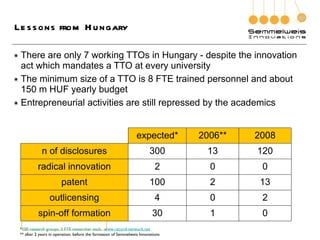
Lessons from Hungary There are only 7 working TTOs in Hungary - despite the innovation act which mandates a TTO at every university The minimum size of a TTO is 8 FTE trained personnel and about 150 m HUF yearly budget Entrepreneurial activities are still repressed by the academics * 100 research groups, 3 FTE researcher each,   www.record-network.net ** after 2 years in operation, before the formation of Semmelweis Innovations expected* 2006** 2008 n of disclosures 300 13 120 radical innovation 2 0 0 patent 100 2 13 outlicensing 4 0 2 spin-off formation 30 1 0
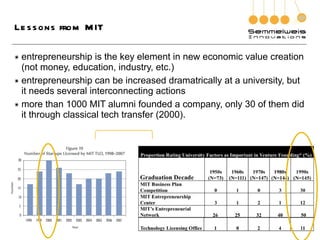
Lessons from MIT entrepreneurship is the key element in new economic value creation (not money, education, industry, etc.) entrepreneurship can be increased dramatrically at a university, but it needs several interconnecting actions more than 1000 MIT alumni founded a company, only 30 of them did it through classical tech transfer (2000).
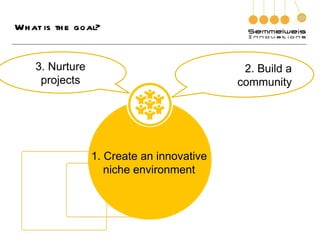
What is the goal? 1. Create an innovative niche environment 2. Build a community 3. Nurture projects
Incubators anyone? 50% Govt. grant - grant returned, no incubator 40% EU grant - granted, office space built 80% Govt. grant for virtual incubation - withdrawn 70% EU grant for building - withdrawn 70% EU grant for building - withdrawn ? Govt grant - pending
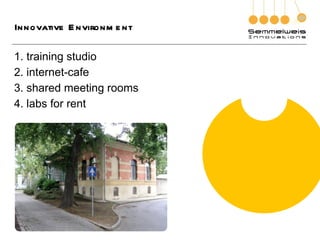
Innovative Environment training studio internet-cafe shared meeting rooms labs for rent
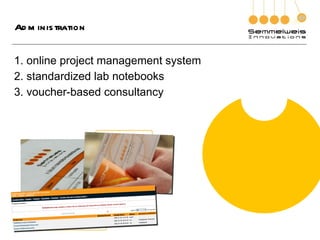
Administration online project management system standardized lab notebooks voucher-based consultancy
Building a community PhD level: IP, management courses Researcher level: faculty visits Project managers = future CEOs SIBE - practical learning researcher + manager + mentor 6 steps of business planning: model, IP, market, finance, design, presentation personalized business development
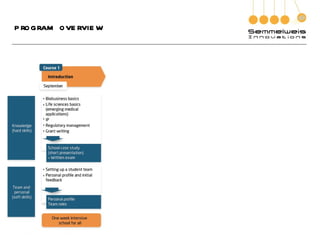
program overview
What do the students get? Minimized contact times - suitable for distance learning or for those who have a day job 3 weeks of your time in Budapest 2 hours on-line per week 6 + 6 half days in distance learning Hard skills: business models and planning, IP and marketing strategies, corporate design, team building with a Biotech focus Soft skills: self-assessment, team roles, negotiation skills, problem-solving, time-management www.semmelweisinnovations.com
What works best? The structure of intensive contact weeks plus working from home Mentoring: business consultants are best Coaching: to relieve stress and solve conflicts Stepwise introduction into real case studies Providing innovative tools to work with Biotech (=life sciences) focus Structured handouts and limited space Trainers trained to meet school requirements
What works least? Off-topic inventions Any changes in the Trimaran part  (course+rotation+voucher) Trainers with great knowledge but boring personality Trainers who cannot adapt to school rules Full handouts Tools without excessive practice and repetitions Unreal or canned cases (=case studies)
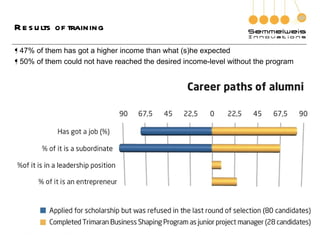
Results of training 47% of them has got a higher income than what (s)he expected 50% of them could not have reached the desired income-level without the program
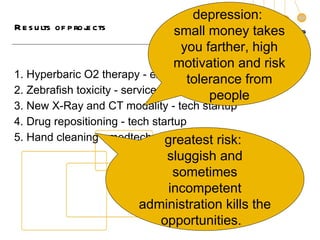
Results of projects Hyperbaric O2 therapy - expansion capital  Zebrafish toxicity - service company startup New X-Ray and CT modality - tech startup Drug repositioning - tech startup Hand cleaning - medtech startup depression:  small money takes you farther, high motivation and risk tolerance from people greatest risk:  sluggish and sometimes incompetent administration kills the opportunities.
www.semmelweisinnovations.com

Simmelweiss

  • 1.
    Fostering entrepreneurship activitiesin the life sciences sector Failures and successes of workshops, trainings, grants and clusters in Central-Eastern Europe Zsombor Lacza, CEO Semmelweis Innovations
  • 2.
    Lessons from HungaryThere are only 7 working TTOs in Hungary - despite the innovation act which mandates a TTO at every university The minimum size of a TTO is 8 FTE trained personnel and about 150 m HUF yearly budget Entrepreneurial activities are still repressed by the academics * 100 research groups, 3 FTE researcher each, www.record-network.net ** after 2 years in operation, before the formation of Semmelweis Innovations expected* 2006** 2008 n of disclosures 300 13 120 radical innovation 2 0 0 patent 100 2 13 outlicensing 4 0 2 spin-off formation 30 1 0
  • 3.
    Lessons from MITentrepreneurship is the key element in new economic value creation (not money, education, industry, etc.) entrepreneurship can be increased dramatrically at a university, but it needs several interconnecting actions more than 1000 MIT alumni founded a company, only 30 of them did it through classical tech transfer (2000).
  • 4.
    What is thegoal? 1. Create an innovative niche environment 2. Build a community 3. Nurture projects
  • 5.
    Incubators anyone? 50%Govt. grant - grant returned, no incubator 40% EU grant - granted, office space built 80% Govt. grant for virtual incubation - withdrawn 70% EU grant for building - withdrawn 70% EU grant for building - withdrawn ? Govt grant - pending
  • 6.
    Innovative Environment trainingstudio internet-cafe shared meeting rooms labs for rent
  • 7.
    Administration online projectmanagement system standardized lab notebooks voucher-based consultancy
  • 8.
    Building a communityPhD level: IP, management courses Researcher level: faculty visits Project managers = future CEOs SIBE - practical learning researcher + manager + mentor 6 steps of business planning: model, IP, market, finance, design, presentation personalized business development
  • 9.
  • 10.
    What do thestudents get? Minimized contact times - suitable for distance learning or for those who have a day job 3 weeks of your time in Budapest 2 hours on-line per week 6 + 6 half days in distance learning Hard skills: business models and planning, IP and marketing strategies, corporate design, team building with a Biotech focus Soft skills: self-assessment, team roles, negotiation skills, problem-solving, time-management www.semmelweisinnovations.com
  • 11.
    What works best?The structure of intensive contact weeks plus working from home Mentoring: business consultants are best Coaching: to relieve stress and solve conflicts Stepwise introduction into real case studies Providing innovative tools to work with Biotech (=life sciences) focus Structured handouts and limited space Trainers trained to meet school requirements
  • 12.
    What works least?Off-topic inventions Any changes in the Trimaran part (course+rotation+voucher) Trainers with great knowledge but boring personality Trainers who cannot adapt to school rules Full handouts Tools without excessive practice and repetitions Unreal or canned cases (=case studies)
  • 13.
    Results of training47% of them has got a higher income than what (s)he expected 50% of them could not have reached the desired income-level without the program
  • 14.
    Results of projectsHyperbaric O2 therapy - expansion capital Zebrafish toxicity - service company startup New X-Ray and CT modality - tech startup Drug repositioning - tech startup Hand cleaning - medtech startup depression: small money takes you farther, high motivation and risk tolerance from people greatest risk: sluggish and sometimes incompetent administration kills the opportunities.
  • 15.