Technology Innovation: a contribution to the Creative Economy conference Bill Wicksteed Athens, March 2010
Structure and acknowledgements A backward look at the development of theory  drawing heavily on a recent presentation made by Professor Ben Martin (SPRU) in Cambridge Reflections on the role of research and development borrowing from Dr Eoin O’Sullivan an IfM colleague Open innovation  current research by Dr Tim Minshall an IfM colleague Developing a new innovative place From my exposure to  one north  in Singapore
From individual entrepreneur  to corporate innovators (Martin) Schumpeter (1934, 1939, 1942, 1950) One of few economists in early 20 th  C to recognise importance of innovation Distinction between ‘invention’ and ‘innovation’ ‘ Schumpeter Mark I’ stressed central role of individual entrepreneur ‘ Schumpeter Mark II’ gave increasing importance to collective innovative activities of large firms and in-house R&D reflected changes in US industry in mid-20 th  C But still examples of Schumpeter Mark I (especially in IT)
Some helpful concepts Solow (1957) Economic growth not just  . . .  changes in labour & capital there is large ‘residual’ – attributable to technology change Innovation transforms  - invention into economic growth Categories of innovators   early adopters, early majority, late majority, laggards Science-push model  – Bush (1945) a linear model Basic research    Applied research    Tech development    Innovation provided rationale for government funding therefore favoured by scientists! Demand-pull model  – changed market demand ‘calls forth’ innovation also a linear model Market demand    Applied research    Technology development    Innovation   Innovation is influenced by the  form of the organisation  – internal divisions can hamper integration of R&D with knowledge of markets
Science push  and  demand pull (Martin) Langrish et al.,  Wealth from Knowledge  (1972 ) Study of 84 innovations Innovation “must involve synthesis of some kind of need with some kind of technical possibility”  Rejected simple linear models – “the sources of innovation are multiple” Gibbons & Johnston (1974) Study of information inputs to 30 innovations  Interactions between basic and applied research are complex Mowery & Rosenberg (1979) review Innovation an “iterative process, in which  both  demand and supply forces are responded to” i.e. both demand and supply side influences crucial to understanding the innovation process
From single factor to multifactor explanations of innovation (Martin) Early studies – focus on  successful   innovations Project SAPPHO (Rothwell et al., 1974)  43 matched pairs of successful & unsuccessful innovations Most important factor = ‘user needs understood’ Other significant factors include  attention to marketing ▪  support of senior ‘product champion’ size of project team ▪  coordination of R&D, production & marketing   good communication with external  scientific community Success not greatly affected by  R&D organisation, incentives, academic qualifications of staff, size of firm, no. of QSEs, project planning, growth rate of firm
The linear models rejected – but not abandoned! Both supply push and demand pull models are too simplistic There is a complexity multiple interactions between knowledge creation and its profitable exploitation And many of these interactions are iterative However policy makers, in search of simplicity, may think in terms of linear relationships!
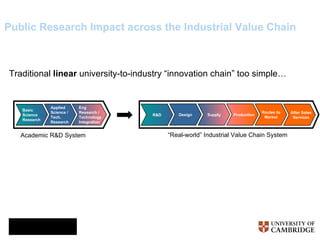
Basic  Science Research Applied  Science / Tech.  Research Eng Research / Technology Integration Academic R&D System “ Real-world” Industrial Value Chain System Industrial Innovation Research: Public Research Impact across the Industrial Value Chain Traditional  linear  university-to-industry “innovation chain” too simple… R&D Design Supply Production Routes to Market After Sales Services
Industrial Innovation Research: Public Research impact & interaction across the Industrial Value Chain Fundamental knowledge / Basic Science Research Applied science  /  Technology Research Tech. Development /  System integration / Industrial-readiness Academic R&D System “ Real-world” Industrial Value Chain System R&D Design Supply Production Routes to Market After Sales Services
Industrial Innovation Research: Public Research impact & interaction across the Industrial Value Chain Fundamental knowledge / Basic Science Research Applied science  /  Technology Research Tech. Development /  System integration / Industrial-readiness New knowledge from research base absorbed across entire value chain Academic R&D System “ Real-world” Industrial Value Chain System R&D Design Supply Production Routes to Market After Sales Services
Some further helpful concepts (1) Abernathy & Utterback (1975 & 1978) – dynamic model of product & process innovation Initial period dominated by radical product innovation Attracts new entrants    several competing designs Process innovations then become more important Emergence of a dominant design (e.g. QWERTY typewriter, Model T Ford, Hoover, Boeing 747, IBM PC) Nelson & Winter (1982),  An Evolutionary Theory of Economic Change Tech change and innovation central – generate ‘variation’ in form of new products, services etc. Firms compete with these products/services – market provides ‘selection’ mechanism i.e. analogy with biological evolution and ‘survival of the fittest’
Further concepts (2) National system of innovation “ that set of distinct institutions which jointly and individually contribute  to the development and diffusion of new technologies and which  provides the framework within which governments form and implement policies to influence the innovation process. As such it is a system of  inter-connected institutions to create, store and transfer the knowledge, skills and artefacts which define new technologies.” (Metcalfe, 1995) How effectively a NSI operates depends not just on the strength of the individual actors (companies, government labs, universities etc.) but more particularly on  the strength of the links  between them
Further concepts (3) National System of Innovation concept has been extended to other dimensions Regional system of innovation  – e.g. Saxenian, Cooke, Jaffe, Audretsch & Feldman, Morgan  Sectoral system of innovation  – e.g. Malerba, Breschi, Orsenigo, McKelvey  Regional system of innovation also influenced by cultural factors R Florida – cities/regions with more cultural diversity & ‘bohemian’ lifestyles more creative/innovative? Firms need to have effective links with all these different levels of systems if they are to benefit fully
Chapter 3 Intellectual Capital Cambridge University Research institutions Strategic alliances Informed networks Money and external business expertise Banks / Angels Venture capital Accountants Lawyers Marketing experts People Education Training Entrepreneurship Culture Trust Land, property and infrastructure Location Flexibility Cost Congestion Environment Chapters 8 & 16 Chapters 8 & 15 Chapters 8,13 & 14 In-Migration ©  SQW Ltd 2000;  [email_address] The Cambridge High Tech Cluster Planned Systems Individual choices Start-Ups  and Spin-Outs Chapters 4 & 12 Large firms In-/Out-Movers Ch. 5 Ch. 6 Firms and sectors Success Chapters 10 & 11 Chapter 7 Sustainability? Quality of life Job satisfaction Local politics Housing Travel to work Chapter 9 Intellectual property Knowledge transfer Science Parks, etc. Choice or Frustration
From closed to open innovation Locus of innovation shifting from within the firm to networks, alliances, collaborations etc. – i.e. innovation increasingly co-produced with partners (suppliers, users, universities etc.) Variously characterised (e.g. by Powell et al., Chesborough, von Hippel etc.) as  open innovation networked innovation distributed innovation interactive innovation Firms need good links with external knowledge sources + ability to exploit these promptly & effectively
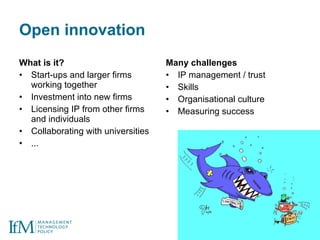
Open innovation What is it? Start-ups and larger firms working together Investment into new firms Licensing IP from other firms and individuals Collaborating with universities ... Many challenges IP management / trust Skills Organisational culture Measuring success
R&D MNC Insights
“ [chose Oxford]  due to its  history of innovation  in MRI  and wider medical R&D  … huge  local talent pool  – the  academic knowledge  is second to none... The Oxford area also contains many companies spun out from universities... the  supplier base is well established  and understands our requirements…” Dr Arthur Kaindl Managing Director, Siemens Magnet Technology R&D MNC Insights Location-decision factors Academic knowledge, R&D talent & spin outs [Source: UKTI]
“ We pride ourselves in being at the forefront of innovation and research... need to provide our talented scientists and technology experts with the  best possible environment …   We believe Cambridge offers… an  ecosystem  where our work can really flourish.” Terry Doyle, SVP, Philips Research R&D MNC Insights Location-decision factors Research base-Innovation “Ecosystem” [Source: UKTI] [Source: UKTI]
Cambridge winning prestige global R&D activities for UK The Research Base Matters
The competition is hotting up! Singapore is seeking to build a new “place” that will stimulate an innovative culture encourage collaboration across disciplines attract top global talent make the country a globally significant node in the international knowledge economy. It started with 200 ha of an army base and a prison  10 years on a new environment is up and running Delivered by an ambitious vision meticulous planning and design resource prioritisation and co-ordinated implementation
“ We need intellectually stimulating and vibrant physical environments where a critical mass of talents, entrepreneurs, scientists and researchers can congregate, exchange ideas and interact.” SPEECH BY DR TONY TAN,  FORMER DEPUTY PM AND MINISTER FOR DEFENCE,  AT THE LAUNCH OF one-north ON 4 DEC 2001 one-north one-north Objective
Biomedical Science Business Support Lifestyle Support Learning / Education Lifestyle Entertainment Infocomm Technology  & Digital Media Environmental Science & Engineering one-north Mixed of Industries
Xchanges  -  Centres of Excellence Vista Xchange Business, retail & lifestyle Life Xchange Biopolis - Biomedical sciences   Central Xchange Fusionopolis - Infocomm  +  Science & Engineering Wessex Estate Creative and Arts Media Xchange Mediapolis - Media Ecosystem Future Xchanges Future centres of excellence one-north Xchanges Vista Xchange Wessex Estate Life Xchange Central Xchange  Media Xchange Future Xchanges
Xchanges  -  Centres of Excellence one-north Dynamic Planning Allow sufficient space for single-industry growth to achieve critical mass Allow proximity to promote dynamic interaction Anticipate and induce direction of growth Importance of interlinkages for value creation Vista Xchange Wessex Estate Life Xchange Central Xchange  Media Xchange Future Xchanges
one-north | Life Xchange Biopolis Development Biopolis Phase 4 Hospitality Suites & Residences   Medical School one-north Research Hospital Biopolis Phase 3 Biopolis Phase 5
one-north | Wessex Estate Features Walk-Up Apartment Semi-Detached House Work Loft @ Wessex Comprises 26 blocks of black-and-white walk-up apartments and 58 semi-detached houses 4 blocks of walk-up apartments converted to Work Lofts for the creative industry Adaptive reuse of black-and-white houses for home-office and commercial usage, including artist’s studio, art gallery, design studio, cooking studio and performing arts school
Summing up The competition is strong and getting stronger Standing still is not an option The quality of “place” is crucially important Globally competitive people can chose where to live And their lifestyle preferences will play a part in theitr choices Linking with the diaspora is important But don’t forget to nurture local talent The ability to network creatively across disciplines and cultures is vital for competitiveness.

Bill Wicksteed

  • 1.
    Technology Innovation: acontribution to the Creative Economy conference Bill Wicksteed Athens, March 2010
  • 2.
    Structure and acknowledgementsA backward look at the development of theory drawing heavily on a recent presentation made by Professor Ben Martin (SPRU) in Cambridge Reflections on the role of research and development borrowing from Dr Eoin O’Sullivan an IfM colleague Open innovation current research by Dr Tim Minshall an IfM colleague Developing a new innovative place From my exposure to one north in Singapore
  • 3.
    From individual entrepreneur to corporate innovators (Martin) Schumpeter (1934, 1939, 1942, 1950) One of few economists in early 20 th C to recognise importance of innovation Distinction between ‘invention’ and ‘innovation’ ‘ Schumpeter Mark I’ stressed central role of individual entrepreneur ‘ Schumpeter Mark II’ gave increasing importance to collective innovative activities of large firms and in-house R&D reflected changes in US industry in mid-20 th C But still examples of Schumpeter Mark I (especially in IT)
  • 4.
    Some helpful conceptsSolow (1957) Economic growth not just . . . changes in labour & capital there is large ‘residual’ – attributable to technology change Innovation transforms - invention into economic growth Categories of innovators early adopters, early majority, late majority, laggards Science-push model – Bush (1945) a linear model Basic research  Applied research  Tech development  Innovation provided rationale for government funding therefore favoured by scientists! Demand-pull model – changed market demand ‘calls forth’ innovation also a linear model Market demand  Applied research  Technology development  Innovation Innovation is influenced by the form of the organisation – internal divisions can hamper integration of R&D with knowledge of markets
  • 5.
    Science push and demand pull (Martin) Langrish et al., Wealth from Knowledge (1972 ) Study of 84 innovations Innovation “must involve synthesis of some kind of need with some kind of technical possibility” Rejected simple linear models – “the sources of innovation are multiple” Gibbons & Johnston (1974) Study of information inputs to 30 innovations Interactions between basic and applied research are complex Mowery & Rosenberg (1979) review Innovation an “iterative process, in which both demand and supply forces are responded to” i.e. both demand and supply side influences crucial to understanding the innovation process
  • 6.
    From single factorto multifactor explanations of innovation (Martin) Early studies – focus on successful innovations Project SAPPHO (Rothwell et al., 1974) 43 matched pairs of successful & unsuccessful innovations Most important factor = ‘user needs understood’ Other significant factors include attention to marketing ▪ support of senior ‘product champion’ size of project team ▪ coordination of R&D, production & marketing good communication with external scientific community Success not greatly affected by R&D organisation, incentives, academic qualifications of staff, size of firm, no. of QSEs, project planning, growth rate of firm
  • 7.
    The linear modelsrejected – but not abandoned! Both supply push and demand pull models are too simplistic There is a complexity multiple interactions between knowledge creation and its profitable exploitation And many of these interactions are iterative However policy makers, in search of simplicity, may think in terms of linear relationships!
  • 8.
    Basic ScienceResearch Applied Science / Tech. Research Eng Research / Technology Integration Academic R&D System “ Real-world” Industrial Value Chain System Industrial Innovation Research: Public Research Impact across the Industrial Value Chain Traditional linear university-to-industry “innovation chain” too simple… R&D Design Supply Production Routes to Market After Sales Services
  • 9.
    Industrial Innovation Research:Public Research impact & interaction across the Industrial Value Chain Fundamental knowledge / Basic Science Research Applied science / Technology Research Tech. Development / System integration / Industrial-readiness Academic R&D System “ Real-world” Industrial Value Chain System R&D Design Supply Production Routes to Market After Sales Services
  • 10.
    Industrial Innovation Research:Public Research impact & interaction across the Industrial Value Chain Fundamental knowledge / Basic Science Research Applied science / Technology Research Tech. Development / System integration / Industrial-readiness New knowledge from research base absorbed across entire value chain Academic R&D System “ Real-world” Industrial Value Chain System R&D Design Supply Production Routes to Market After Sales Services
  • 11.
    Some further helpfulconcepts (1) Abernathy & Utterback (1975 & 1978) – dynamic model of product & process innovation Initial period dominated by radical product innovation Attracts new entrants  several competing designs Process innovations then become more important Emergence of a dominant design (e.g. QWERTY typewriter, Model T Ford, Hoover, Boeing 747, IBM PC) Nelson & Winter (1982), An Evolutionary Theory of Economic Change Tech change and innovation central – generate ‘variation’ in form of new products, services etc. Firms compete with these products/services – market provides ‘selection’ mechanism i.e. analogy with biological evolution and ‘survival of the fittest’
  • 12.
    Further concepts (2)National system of innovation “ that set of distinct institutions which jointly and individually contribute to the development and diffusion of new technologies and which provides the framework within which governments form and implement policies to influence the innovation process. As such it is a system of inter-connected institutions to create, store and transfer the knowledge, skills and artefacts which define new technologies.” (Metcalfe, 1995) How effectively a NSI operates depends not just on the strength of the individual actors (companies, government labs, universities etc.) but more particularly on the strength of the links between them
  • 13.
    Further concepts (3)National System of Innovation concept has been extended to other dimensions Regional system of innovation – e.g. Saxenian, Cooke, Jaffe, Audretsch & Feldman, Morgan Sectoral system of innovation – e.g. Malerba, Breschi, Orsenigo, McKelvey Regional system of innovation also influenced by cultural factors R Florida – cities/regions with more cultural diversity & ‘bohemian’ lifestyles more creative/innovative? Firms need to have effective links with all these different levels of systems if they are to benefit fully
  • 14.
    Chapter 3 IntellectualCapital Cambridge University Research institutions Strategic alliances Informed networks Money and external business expertise Banks / Angels Venture capital Accountants Lawyers Marketing experts People Education Training Entrepreneurship Culture Trust Land, property and infrastructure Location Flexibility Cost Congestion Environment Chapters 8 & 16 Chapters 8 & 15 Chapters 8,13 & 14 In-Migration © SQW Ltd 2000; [email_address] The Cambridge High Tech Cluster Planned Systems Individual choices Start-Ups and Spin-Outs Chapters 4 & 12 Large firms In-/Out-Movers Ch. 5 Ch. 6 Firms and sectors Success Chapters 10 & 11 Chapter 7 Sustainability? Quality of life Job satisfaction Local politics Housing Travel to work Chapter 9 Intellectual property Knowledge transfer Science Parks, etc. Choice or Frustration
  • 15.
    From closed toopen innovation Locus of innovation shifting from within the firm to networks, alliances, collaborations etc. – i.e. innovation increasingly co-produced with partners (suppliers, users, universities etc.) Variously characterised (e.g. by Powell et al., Chesborough, von Hippel etc.) as open innovation networked innovation distributed innovation interactive innovation Firms need good links with external knowledge sources + ability to exploit these promptly & effectively
  • 16.
    Open innovation Whatis it? Start-ups and larger firms working together Investment into new firms Licensing IP from other firms and individuals Collaborating with universities ... Many challenges IP management / trust Skills Organisational culture Measuring success
  • 17.
  • 18.
    “ [chose Oxford] due to its history of innovation in MRI and wider medical R&D … huge local talent pool – the academic knowledge is second to none... The Oxford area also contains many companies spun out from universities... the supplier base is well established and understands our requirements…” Dr Arthur Kaindl Managing Director, Siemens Magnet Technology R&D MNC Insights Location-decision factors Academic knowledge, R&D talent & spin outs [Source: UKTI]
  • 19.
    “ We prideourselves in being at the forefront of innovation and research... need to provide our talented scientists and technology experts with the best possible environment … We believe Cambridge offers… an ecosystem where our work can really flourish.” Terry Doyle, SVP, Philips Research R&D MNC Insights Location-decision factors Research base-Innovation “Ecosystem” [Source: UKTI] [Source: UKTI]
  • 20.
    Cambridge winning prestigeglobal R&D activities for UK The Research Base Matters
  • 21.
    The competition ishotting up! Singapore is seeking to build a new “place” that will stimulate an innovative culture encourage collaboration across disciplines attract top global talent make the country a globally significant node in the international knowledge economy. It started with 200 ha of an army base and a prison 10 years on a new environment is up and running Delivered by an ambitious vision meticulous planning and design resource prioritisation and co-ordinated implementation
  • 22.
    “ We needintellectually stimulating and vibrant physical environments where a critical mass of talents, entrepreneurs, scientists and researchers can congregate, exchange ideas and interact.” SPEECH BY DR TONY TAN, FORMER DEPUTY PM AND MINISTER FOR DEFENCE, AT THE LAUNCH OF one-north ON 4 DEC 2001 one-north one-north Objective
  • 23.
    Biomedical Science BusinessSupport Lifestyle Support Learning / Education Lifestyle Entertainment Infocomm Technology & Digital Media Environmental Science & Engineering one-north Mixed of Industries
  • 24.
    Xchanges - Centres of Excellence Vista Xchange Business, retail & lifestyle Life Xchange Biopolis - Biomedical sciences Central Xchange Fusionopolis - Infocomm + Science & Engineering Wessex Estate Creative and Arts Media Xchange Mediapolis - Media Ecosystem Future Xchanges Future centres of excellence one-north Xchanges Vista Xchange Wessex Estate Life Xchange Central Xchange Media Xchange Future Xchanges
  • 25.
    Xchanges - Centres of Excellence one-north Dynamic Planning Allow sufficient space for single-industry growth to achieve critical mass Allow proximity to promote dynamic interaction Anticipate and induce direction of growth Importance of interlinkages for value creation Vista Xchange Wessex Estate Life Xchange Central Xchange Media Xchange Future Xchanges
  • 26.
    one-north | LifeXchange Biopolis Development Biopolis Phase 4 Hospitality Suites & Residences Medical School one-north Research Hospital Biopolis Phase 3 Biopolis Phase 5
  • 27.
    one-north | WessexEstate Features Walk-Up Apartment Semi-Detached House Work Loft @ Wessex Comprises 26 blocks of black-and-white walk-up apartments and 58 semi-detached houses 4 blocks of walk-up apartments converted to Work Lofts for the creative industry Adaptive reuse of black-and-white houses for home-office and commercial usage, including artist’s studio, art gallery, design studio, cooking studio and performing arts school
  • 28.
    Summing up Thecompetition is strong and getting stronger Standing still is not an option The quality of “place” is crucially important Globally competitive people can chose where to live And their lifestyle preferences will play a part in theitr choices Linking with the diaspora is important But don’t forget to nurture local talent The ability to network creatively across disciplines and cultures is vital for competitiveness.

Editor's Notes