The Thar Desert also known as the Great Indian
Desert and Marusthali (Land of the dead) is a
large, arid region in the northwestern part of the
Indian subcontinent and forms a natural
boundary running along the border between
India and Pakistan. With an area of more than
200,000 km2 (77,000 sq mi), within the Indian state
of Rajasthan, covering the districts of Jaisalmer,
Barmer, Bikaner and Jodhpur, and some region
of the states of Punjab, Haryana and Gujarat. It is
the world's 9th largest subtropical desert.
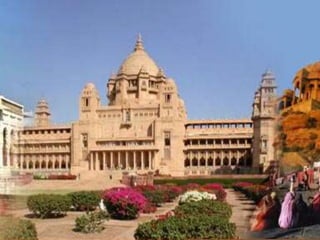
Jodhpur is the second largest city in the
Indian state of Rajasthan.
After its population crossed a million, it has been
declared as the
second 'Metropolitan City' of Rajasthan. It was formerly
the seat
of a princely state of the same name, the capital of the
kingdom
known as Marwar. Jodhpur is a
populartourist destination, featuring
many palaces, forts and temples, set in the stark
landscape of the Thar desert
LOCATI
ON
Udaipur is a very popular tourist destination. Apart from its
history, culture, and scenic locations, it is also known for
its Rajput-era palaces. The Lake Palace, for instance, covers
an entire island in the Pichola Lake. Many of the palaces
have been converted into luxury hotels. It is often called the
"Venice of the East", and is also nicknamed the "Lake City" or
"City of Lakes".[2][3] Lake Pichola, Fateh Sagar Lake, Udai
Sagar and Swaroop Sagar in this city are considered some of
the most beautiful lakes in the state.
LOCATI
ON
Jaipur is the capital and largest city of
the Indian state of Rajasthan in Northern India. It
was founded on 18 November 1727 by Maharaja
Sawai Jai Singh II, the ruler of Amber, after whom
the city is named. The city today has a population
of 3.1 million. Jaipur is known as the Pink City of
India.
LOCATI
ON
Jaisalmer, nicknamed "The
Golden city", is a town in the
Indian state of Rajasthan. It is
located 575 kilometres west of
the state capital Jaipur. It is a
World Heritage Site. It was once
known as Jaisalmer state.
Ranthambore National Park or Ranthambhore is
one of the largest national parks in northern India,
covering an area of 392 km². It is situated in the
Sawai Madhopur district of southeastern Rajasthan,
about 110 km northeast of Kota and 160 km
southeast of Jaipur, which is also the nearest airport.
The nearest town and railway station is at Sawai
Madhopur, about 11 km away. The park is also
close to the Kota train station. RIDCOR operates a
mega-highway between Kota and Ranthambhore.
The Sariska Tiger Reserve is an Indian national
park and Wildlife Sanctuary located in the
Alwar district of the state of Rajasthan. The
topography of Sariska supports scrub-thorn arid
forests, rocky landscapes, dry deciduous
forests, rocks, grasses and hilly cliffs. This area
was a hunting preserve of the Alwar state and
it was declared a wildlife reserve in 1955.
The Keoladeo National Park or
Keoladeo Ghana National Park
formerly known as the Bharatpur
Bird Sanctuary in Bharatpur,
Rajasthan, India is a famous
avifauna sanctuary that plays
host to thousands of birds
especially during the winter
season
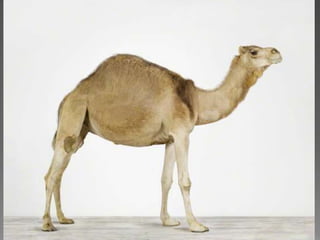
A camel is an even-toed ungulate within the genus
Camelus, bearing distinctive fatty deposits known as
"humps" on its back
The tiger is the largest
cat species, reaching a
total body length of up
to 3.38 m over curves
and weighing up to
388.7 kg in the wild.
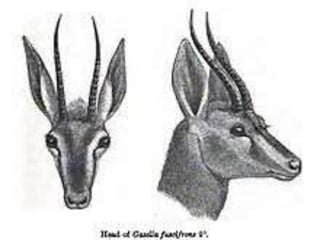
The chinkara lives in arid plains
and hills, deserts, dry scrub and
light forests
in India, Pakistan and Iran.
Occurrence and status in
Afghanistan are unclear. Most of
its range lies in India. In Iran, it
occurs patchily as far as Kavir
National Park near Tehran. It is
known to range up to elevations
1500 metres high in Pakistan.
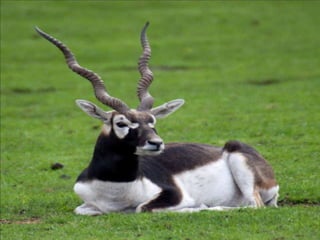
The blackbuck is an ungulate
species of antelope native to the
Indian subcontinent that has
been classified as near
threatened by IUCN since 2003,
as its range has decreased
sharply during the 20th century.
This beautiful little animal is about the size of a well-
grown house cat (about 20-30 inches long
including a 9-12 inch tail). The kit fox has very large
ears and a thick, sandy-yellow coat that enables it
to blend effortlessly into the desert environment. Its
bushy tail has a black tip, and its short, stout legs
are good for putting on a burst of speed. It can
make a quick dodge to safety, but the desert kit
fox is not a high-speed endurance runner like the
jack rabbit.
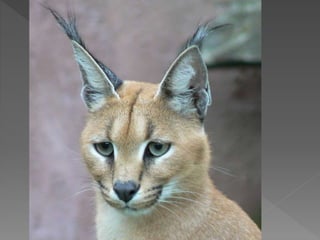
The caracal, also known as the desert lynx,
is a wild cat widely distributed across
Africa, Central Asia, and Southwest Asia
into India. In 2002, the IUCN listed the
caracal as Least Concern, as it is
widespread and relatively common
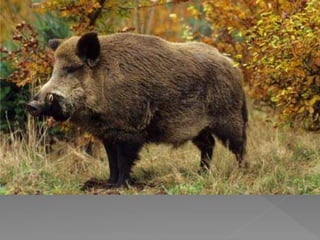
The wild boar, also known as the wild swine or
Eurasian wild pig is a suid native to much of
Eurasia, North Africa and the Greater Sunda
Islands.
The great Indian bustard or Indian
bustard is a bustard found in India
and the adjoining regions of
Pakistan
The gharial, also known as the gavial,
and the fish-eating crocodile, is a
crocodilian of the family Gavialidae,
native to the Indian Subcontinent.
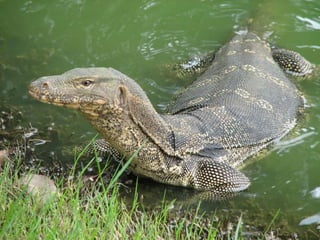
Monitor lizard is the common name of several
large lizard species, comprising the genus
Varanus. They are native to Africa, Asia and
Oceania, but are now found also in the Americas
as invasive species.
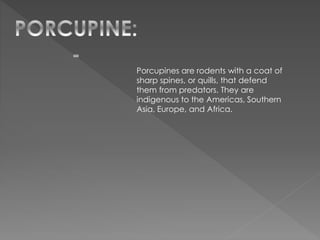
Porcupines are rodents with a coat of
sharp spines, or quills, that defend
them from predators. They are
indigenous to the Americas, Southern
Asia, Europe, and Africa.
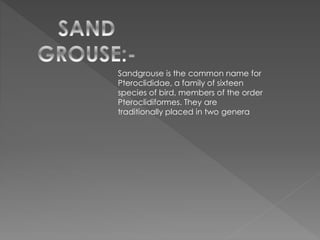
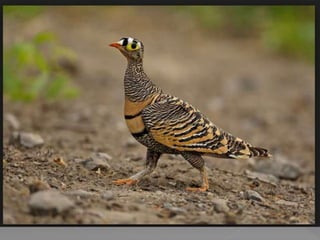
Sandgrouse is the common name for
Pteroclididae, a family of sixteen
species of bird, members of the order
Pteroclidiformes. They are
traditionally placed in two genera
Pelicans are a genus of large water
birds that makes up the family
Pelecanidae. They are characterised
by a long beak and a large throat
pouch used for catching prey and
draining water from the scooped up
contents before swallowing.
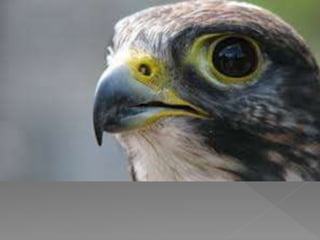
A falcon is any one of 37 species of raptor in the
genus Falco, widely distributed on all continents of
the world except Antarctica. Adult falcons have
thin tapered wings, which enable them to fly at
high speed and to change direction rapidly.
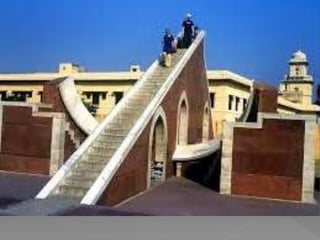
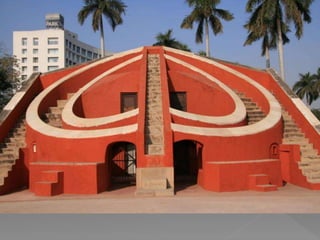
The Jantar Mantar is located in
the modern city of New Delhi. It
consists of 13 architectural
astronomy instruments
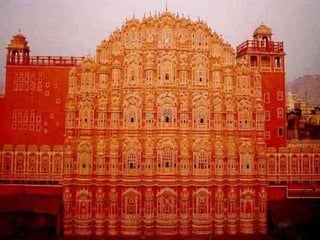
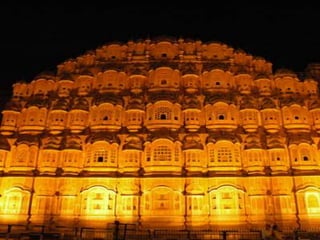
Hawa Mahal, is a palace in Jaipur, India,
so named because it was essentially a
high screen wall built so the women of the
royal household could observe street
festivities while unseen from the outside.
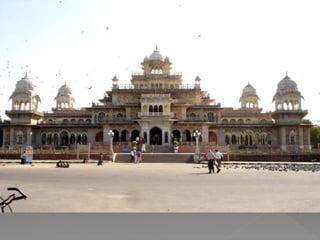
The historical garden is located in the heart of the city and
covers an area of 33 acres (130,000 m2), and was built by
Maharaja Sawai Ram Singh in 1868.
Within the garden which originally spread over 76 acres
(310,000 m2) in early 20th century is the Albert Hall
Museum (now known as Central Museum), named
after King Edward VII (Albert Edward), during whose visit to
the city as the Prince of Wales, its foundation stone was laid
on February 6, 1876.[1]
Apart from that it also has a bird park, the Zoo, Ravindra
Rang Manch Theatre, art gallery, exhibition ground,
gymnasium and several cafes and picnic spots are housed
in the garden.
The Lakshmi
Narayana Perumal Temple is
located in Pallikaranai, Chennai.
The temple is around 1 km the
Pallikaranai bus stop near the
pond.
Royal Albert Hall is a concert hall
on the northern edge of South
Kensington, London, best known
for holding The Proms concerts
annually each summer since
1941. It has a capacity
(depending on configuration of
the event) of up to 5,272 seats.
The Hall is a registered charity
held in trust for the nation and
receives no public or
government funding
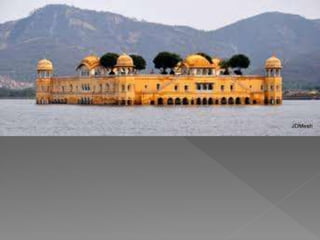
Lake Pichola, situated in Udaipur city in
the Indian state of Rajasthan, is an artificial
fresh water lake, created in the year 1362 AD,
named after the nearby Picholi village.[1][2] It is
one of the several contiguous lakes, and
developed over the last few centuries in and
around the famous Udaipur city. The lakes
around Udaipur were primarily created by
building dams to meet the drinking water and
irrigation needs of the city and its
neighborhood. Two islands, Jag
Niwas and Jag Mandir are located within
Pichola Lake, and have been developed with
several palaces to provide views of the lake
Maota Lake is located on the south side
of the city of Amer and it is close to
Amber fort. There is a garden in the
center of Maota Lake namely Kesar Kyari
Bagh with star shaped flower beds and
saffron flowers which were once planted
by Maharaja’s. Dilaram Bagh is also a
garden which is located in the center of
Maota Lake.
BRIJ FESTIVAL
The Brij Festival is held in the month of
March, a few days before the festival
of colors, Holi. This festival is held in the
commemoration of Lord Krishna. The
main attraction point of the Brij
Festival of Bharatpur, Rajasthan is the
Raslila Dance, illustrating the eternal
love story of Radha Krisha
DESERT FESTIVAL
The Desert Festival is held in
Jaisalmer, usually in the month
of January or February, every
year. The duration of the festival
is three days and it comes to an
end on Poornima, the full moon
da
ELEPHANT FESTIVAL
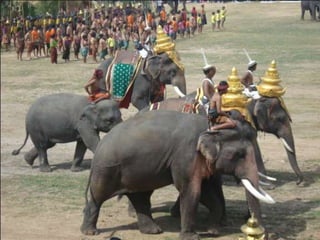
Elephant Festival is a festival celebrated
in Jaipur city in Rajasthan state in India. It is
held on the day of Holi festival, usually in the
month of March. The festival features Elephant
polo and Elephant Dance. The Elephant
Festival begins with a beautiful procession of
bedecked elephants, camels, horses and folk
dancers. The owners proudly embellish their
elephants with vibrant colors, jhools (saddle
cloth) and heavy jewellery. It is quite a treat to
see female elephants wearing anklets, which
tinkle as they walk. One can see people
sprinkling 'gulaal' (colored powder) perched
on top of the elephant.
Rajasthan features
Rajasthan features
Rajasthan features
Rajasthan features

Rajasthan features

  • 3.
    The Thar Desertalso known as the Great Indian Desert and Marusthali (Land of the dead) is a large, arid region in the northwestern part of the Indian subcontinent and forms a natural boundary running along the border between India and Pakistan. With an area of more than 200,000 km2 (77,000 sq mi), within the Indian state of Rajasthan, covering the districts of Jaisalmer, Barmer, Bikaner and Jodhpur, and some region of the states of Punjab, Haryana and Gujarat. It is the world's 9th largest subtropical desert.
  • 8.
    Jodhpur is thesecond largest city in the Indian state of Rajasthan. After its population crossed a million, it has been declared as the second 'Metropolitan City' of Rajasthan. It was formerly the seat of a princely state of the same name, the capital of the kingdom known as Marwar. Jodhpur is a populartourist destination, featuring many palaces, forts and temples, set in the stark landscape of the Thar desert
  • 9.
  • 18.
    Udaipur is avery popular tourist destination. Apart from its history, culture, and scenic locations, it is also known for its Rajput-era palaces. The Lake Palace, for instance, covers an entire island in the Pichola Lake. Many of the palaces have been converted into luxury hotels. It is often called the "Venice of the East", and is also nicknamed the "Lake City" or "City of Lakes".[2][3] Lake Pichola, Fateh Sagar Lake, Udai Sagar and Swaroop Sagar in this city are considered some of the most beautiful lakes in the state.
  • 19.
  • 28.
    Jaipur is thecapital and largest city of the Indian state of Rajasthan in Northern India. It was founded on 18 November 1727 by Maharaja Sawai Jai Singh II, the ruler of Amber, after whom the city is named. The city today has a population of 3.1 million. Jaipur is known as the Pink City of India.
  • 29.
  • 38.
    Jaisalmer, nicknamed "The Goldencity", is a town in the Indian state of Rajasthan. It is located 575 kilometres west of the state capital Jaipur. It is a World Heritage Site. It was once known as Jaisalmer state.
  • 49.
    Ranthambore National Parkor Ranthambhore is one of the largest national parks in northern India, covering an area of 392 km². It is situated in the Sawai Madhopur district of southeastern Rajasthan, about 110 km northeast of Kota and 160 km southeast of Jaipur, which is also the nearest airport. The nearest town and railway station is at Sawai Madhopur, about 11 km away. The park is also close to the Kota train station. RIDCOR operates a mega-highway between Kota and Ranthambhore.
  • 53.
    The Sariska TigerReserve is an Indian national park and Wildlife Sanctuary located in the Alwar district of the state of Rajasthan. The topography of Sariska supports scrub-thorn arid forests, rocky landscapes, dry deciduous forests, rocks, grasses and hilly cliffs. This area was a hunting preserve of the Alwar state and it was declared a wildlife reserve in 1955.
  • 57.
    The Keoladeo NationalPark or Keoladeo Ghana National Park formerly known as the Bharatpur Bird Sanctuary in Bharatpur, Rajasthan, India is a famous avifauna sanctuary that plays host to thousands of birds especially during the winter season
  • 62.
    A camel isan even-toed ungulate within the genus Camelus, bearing distinctive fatty deposits known as "humps" on its back
  • 65.
    The tiger isthe largest cat species, reaching a total body length of up to 3.38 m over curves and weighing up to 388.7 kg in the wild.
  • 68.
    The chinkara livesin arid plains and hills, deserts, dry scrub and light forests in India, Pakistan and Iran. Occurrence and status in Afghanistan are unclear. Most of its range lies in India. In Iran, it occurs patchily as far as Kavir National Park near Tehran. It is known to range up to elevations 1500 metres high in Pakistan.
  • 71.
    The blackbuck isan ungulate species of antelope native to the Indian subcontinent that has been classified as near threatened by IUCN since 2003, as its range has decreased sharply during the 20th century.
  • 74.
    This beautiful littleanimal is about the size of a well- grown house cat (about 20-30 inches long including a 9-12 inch tail). The kit fox has very large ears and a thick, sandy-yellow coat that enables it to blend effortlessly into the desert environment. Its bushy tail has a black tip, and its short, stout legs are good for putting on a burst of speed. It can make a quick dodge to safety, but the desert kit fox is not a high-speed endurance runner like the jack rabbit.
  • 77.
    The caracal, alsoknown as the desert lynx, is a wild cat widely distributed across Africa, Central Asia, and Southwest Asia into India. In 2002, the IUCN listed the caracal as Least Concern, as it is widespread and relatively common
  • 80.
    The wild boar,also known as the wild swine or Eurasian wild pig is a suid native to much of Eurasia, North Africa and the Greater Sunda Islands.
  • 83.
    The great Indianbustard or Indian bustard is a bustard found in India and the adjoining regions of Pakistan
  • 86.
    The gharial, alsoknown as the gavial, and the fish-eating crocodile, is a crocodilian of the family Gavialidae, native to the Indian Subcontinent.
  • 89.
    Monitor lizard isthe common name of several large lizard species, comprising the genus Varanus. They are native to Africa, Asia and Oceania, but are now found also in the Americas as invasive species.
  • 92.
    Porcupines are rodentswith a coat of sharp spines, or quills, that defend them from predators. They are indigenous to the Americas, Southern Asia, Europe, and Africa.
  • 95.
    Sandgrouse is thecommon name for Pteroclididae, a family of sixteen species of bird, members of the order Pteroclidiformes. They are traditionally placed in two genera
  • 98.
    Pelicans are agenus of large water birds that makes up the family Pelecanidae. They are characterised by a long beak and a large throat pouch used for catching prey and draining water from the scooped up contents before swallowing.
  • 101.
    A falcon isany one of 37 species of raptor in the genus Falco, widely distributed on all continents of the world except Antarctica. Adult falcons have thin tapered wings, which enable them to fly at high speed and to change direction rapidly.
  • 105.
    The Jantar Mantaris located in the modern city of New Delhi. It consists of 13 architectural astronomy instruments
  • 109.
    Hawa Mahal, isa palace in Jaipur, India, so named because it was essentially a high screen wall built so the women of the royal household could observe street festivities while unseen from the outside.
  • 113.
    The historical gardenis located in the heart of the city and covers an area of 33 acres (130,000 m2), and was built by Maharaja Sawai Ram Singh in 1868. Within the garden which originally spread over 76 acres (310,000 m2) in early 20th century is the Albert Hall Museum (now known as Central Museum), named after King Edward VII (Albert Edward), during whose visit to the city as the Prince of Wales, its foundation stone was laid on February 6, 1876.[1] Apart from that it also has a bird park, the Zoo, Ravindra Rang Manch Theatre, art gallery, exhibition ground, gymnasium and several cafes and picnic spots are housed in the garden.
  • 117.
    The Lakshmi Narayana PerumalTemple is located in Pallikaranai, Chennai. The temple is around 1 km the Pallikaranai bus stop near the pond.
  • 121.
    Royal Albert Hallis a concert hall on the northern edge of South Kensington, London, best known for holding The Proms concerts annually each summer since 1941. It has a capacity (depending on configuration of the event) of up to 5,272 seats. The Hall is a registered charity held in trust for the nation and receives no public or government funding
  • 126.
    Lake Pichola, situatedin Udaipur city in the Indian state of Rajasthan, is an artificial fresh water lake, created in the year 1362 AD, named after the nearby Picholi village.[1][2] It is one of the several contiguous lakes, and developed over the last few centuries in and around the famous Udaipur city. The lakes around Udaipur were primarily created by building dams to meet the drinking water and irrigation needs of the city and its neighborhood. Two islands, Jag Niwas and Jag Mandir are located within Pichola Lake, and have been developed with several palaces to provide views of the lake
  • 129.
    Maota Lake islocated on the south side of the city of Amer and it is close to Amber fort. There is a garden in the center of Maota Lake namely Kesar Kyari Bagh with star shaped flower beds and saffron flowers which were once planted by Maharaja’s. Dilaram Bagh is also a garden which is located in the center of Maota Lake.
  • 133.
    BRIJ FESTIVAL The BrijFestival is held in the month of March, a few days before the festival of colors, Holi. This festival is held in the commemoration of Lord Krishna. The main attraction point of the Brij Festival of Bharatpur, Rajasthan is the Raslila Dance, illustrating the eternal love story of Radha Krisha
  • 137.
    DESERT FESTIVAL The DesertFestival is held in Jaisalmer, usually in the month of January or February, every year. The duration of the festival is three days and it comes to an end on Poornima, the full moon da
  • 141.
    ELEPHANT FESTIVAL Elephant Festivalis a festival celebrated in Jaipur city in Rajasthan state in India. It is held on the day of Holi festival, usually in the month of March. The festival features Elephant polo and Elephant Dance. The Elephant Festival begins with a beautiful procession of bedecked elephants, camels, horses and folk dancers. The owners proudly embellish their elephants with vibrant colors, jhools (saddle cloth) and heavy jewellery. It is quite a treat to see female elephants wearing anklets, which tinkle as they walk. One can see people sprinkling 'gulaal' (colored powder) perched on top of the elephant.