Blue
Valentine
Timeline
Analysis
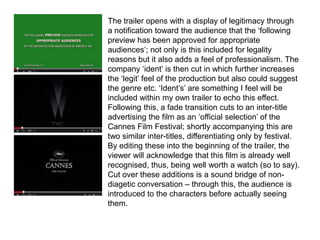
The trailer opens with a display of legitimacy through
a notification toward the audience that the ‘following
preview has been approved for appropriate
audiences’; not only is this included for legality
reasons but it also adds a feel of professionalism. The
company ‘ident’ is then cut in which further increases
the ‘legit’ feel of the production but also could suggest
the genre etc. ‘Ident’s’ are something I feel will be
included within my own trailer to echo this effect.
Following this, a fade transition cuts to an inter-title
advertising the film as an ‘official selection’ of the
Cannes Film Festival; shortly accompanying this are
two similar inter-titles, differentiating only by festival.
By editing these into the beginning of the trailer, the
viewer will acknowledge that this film is already well
recognised, thus, being well worth a watch (so to say).
Cut over these additions is a sound bridge of non-
diagetic conversation – through this, the audience is
introduced to the characters before actually seeing
them.
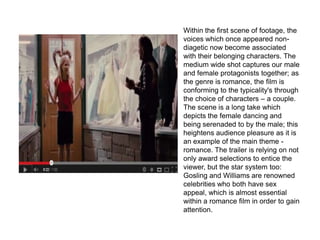
Within the first scene of footage, the
voices which once appeared non-
diagetic now become associated
with their belonging characters. The
medium wide shot captures our male
and female protagonists together; as
the genre is romance, the film is
conforming to the typicality's through
the choice of characters – a couple.
The scene is a long take which
depicts the female dancing and
being serenaded to by the male; this
heightens audience pleasure as it is
an example of the main theme -
romance. The trailer is relying on not
only award selections to entice the
viewer, but the star system too:
Gosling and Williams are renowned
celebrities who both have sex
appeal, which is almost essential
within a romance film in order to gain
attention.
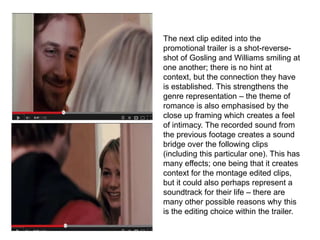
The next clip edited into the
promotional trailer is a shot-reverse-
shot of Gosling and Williams smiling at
one another; there is no hint at
context, but the connection they have
is established. This strengthens the
genre representation – the theme of
romance is also emphasised by the
close up framing which creates a feel
of intimacy. The recorded sound from
the previous footage creates a sound
bridge over the following clips
(including this particular one). This has
many effects; one being that it creates
context for the montage edited clips,
but it could also perhaps represent a
soundtrack for their life – there are
many other possible reasons why this
is the editing choice within the trailer.
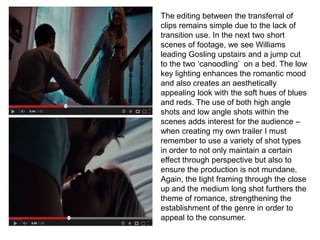
The editing between the transferral of
clips remains simple due to the lack of
transition use. In the next two short
scenes of footage, we see Williams
leading Gosling upstairs and a jump cut
to the two ‘canoodling’ on a bed. The low
key lighting enhances the romantic mood
and also creates an aesthetically
appealing look with the soft hues of blues
and reds. The use of both high angle
shots and low angle shots within the
scenes adds interest for the audience –
when creating my own trailer I must
remember to use a variety of shot types
in order to not only maintain a certain
effect through perspective but also to
ensure the production is not mundane.
Again, the tight framing through the close
up and the medium long shot furthers the
theme of romance, strengthening the
establishment of the genre in order to
appeal to the consumer.
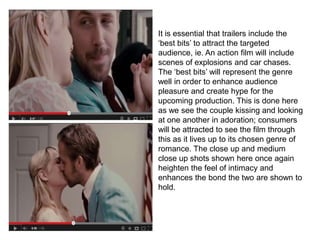
It is essential that trailers include the
‘best bits’ to attract the targeted
audience, ie. An action film will include
scenes of explosions and car chases.
The ‘best bits’ will represent the genre
well in order to enhance audience
pleasure and create hype for the
upcoming production. This is done here
as we see the couple kissing and looking
at one another in adoration; consumers
will be attracted to see the film through
this as it lives up to its chosen genre of
romance. The close up and medium
close up shots shown here once again
heighten the feel of intimacy and
enhances the bond the two are shown to
hold.
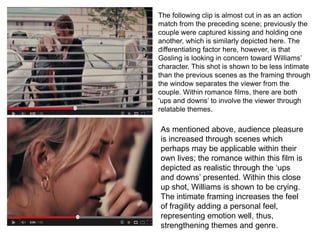
The following clip is almost cut in as an action
match from the preceding scene; previously the
couple were captured kissing and holding one
another, which is similarly depicted here. The
differentiating factor here, however, is that
Gosling is looking in concern toward Williams’
character. This shot is shown to be less intimate
than the previous scenes as the framing through
the window separates the viewer from the
couple. Within romance films, there are both
‘ups and downs’ to involve the viewer through
relatable themes.
As mentioned above, audience pleasure
is increased through scenes which
perhaps may be applicable within their
own lives; the romance within this film is
depicted as realistic through the ‘ups
and downs’ presented. Within this close
up shot, Williams is shown to be crying.
The intimate framing increases the feel
of fragility adding a personal feel,
representing emotion well, thus,
strengthening themes and genre.
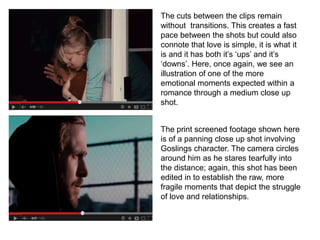
The cuts between the clips remain
without transitions. This creates a fast
pace between the shots but could also
connote that love is simple, it is what it
is and it has both it’s ‘ups’ and it’s
‘downs’. Here, once again, we see an
illustration of one of the more
emotional moments expected within a
romance through a medium close up
shot.
The print screened footage shown here
is of a panning close up shot involving
Goslings character. The camera circles
around him as he stares tearfully into
the distance; again, this shot has been
edited in to establish the raw, more
fragile moments that depict the struggle
of love and relationships.
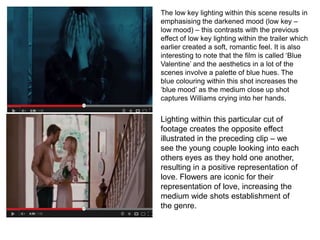
The low key lighting within this scene results in
emphasising the darkened mood (low key –
low mood) – this contrasts with the previous
effect of low key lighting within the trailer which
earlier created a soft, romantic feel. It is also
interesting to note that the film is called ‘Blue
Valentine’ and the aesthetics in a lot of the
scenes involve a palette of blue hues. The
blue colouring within this shot increases the
‘blue mood’ as the medium close up shot
captures Williams crying into her hands.
Lighting within this particular cut of
footage creates the opposite effect
illustrated in the preceding clip – we
see the young couple looking into each
others eyes as they hold one another,
resulting in a positive representation of
love. Flowers are iconic for their
representation of love, increasing the
medium wide shots establishment of
the genre.
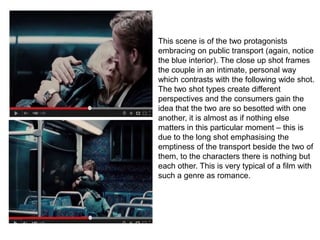
This scene is of the two protagonists
embracing on public transport (again, notice
the blue interior). The close up shot frames
the couple in an intimate, personal way
which contrasts with the following wide shot.
The two shot types create different
perspectives and the consumers gain the
idea that the two are so besotted with one
another, it is almost as if nothing else
matters in this particular moment – this is
due to the long shot emphasising the
emptiness of the transport beside the two of
them, to the characters there is nothing but
each other. This is very typical of a film with
such a genre as romance.
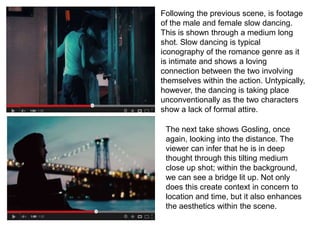
Following the previous scene, is footage
of the male and female slow dancing.
This is shown through a medium long
shot. Slow dancing is typical
iconography of the romance genre as it
is intimate and shows a loving
connection between the two involving
themselves within the action. Untypically,
however, the dancing is taking place
unconventionally as the two characters
show a lack of formal attire.
The next take shows Gosling, once
again, looking into the distance. The
viewer can infer that he is in deep
thought through this tilting medium
close up shot; within the background,
we can see a bridge lit up. Not only
does this create context in concern to
location and time, but it also enhances
the aesthetics within the scene.
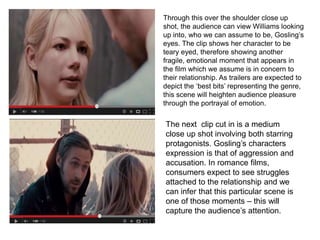
Through this over the shoulder close up
shot, the audience can view Williams looking
up into, who we can assume to be, Gosling’s
eyes. The clip shows her character to be
teary eyed, therefore showing another
fragile, emotional moment that appears in
the film which we assume is in concern to
their relationship. As trailers are expected to
depict the ‘best bits’ representing the genre,
this scene will heighten audience pleasure
through the portrayal of emotion.
The next clip cut in is a medium
close up shot involving both starring
protagonists. Gosling’s characters
expression is that of aggression and
accusation. In romance films,
consumers expect to see struggles
attached to the relationship and we
can infer that this particular scene is
one of those moments – this will
capture the audience’s attention.
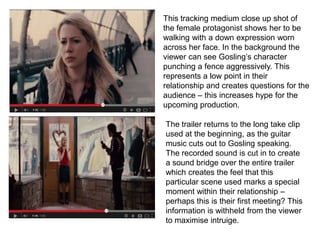
This tracking medium close up shot of
the female protagonist shows her to be
walking with a down expression worn
across her face. In the background the
viewer can see Gosling’s character
punching a fence aggressively. This
represents a low point in their
relationship and creates questions for the
audience – this increases hype for the
upcoming production.
The trailer returns to the long take clip
used at the beginning, as the guitar
music cuts out to Gosling speaking.
The recorded sound is cut in to create
a sound bridge over the entire trailer
which creates the feel that this
particular scene used marks a special
moment within their relationship –
perhaps this is their first meeting? This
information is withheld from the viewer
to maximise intruige.
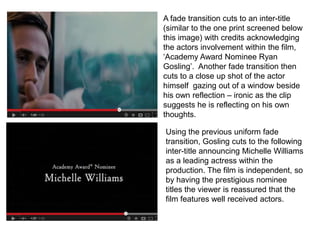
A fade transition cuts to an inter-title
(similar to the one print screened below
this image) with credits acknowledging
the actors involvement within the film,
‘Academy Award Nominee Ryan
Gosling’. Another fade transition then
cuts to a close up shot of the actor
himself gazing out of a window beside
his own reflection – ironic as the clip
suggests he is reflecting on his own
thoughts.
Using the previous uniform fade
transition, Gosling cuts to the following
inter-title announcing Michelle Williams
as a leading actress within the
production. The film is independent, so
by having the prestigious nominee
titles the viewer is reassured that the
film features well received actors.
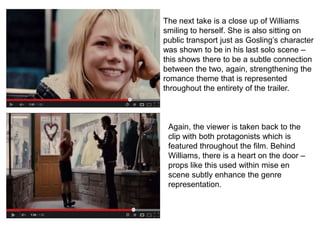
The next take is a close up of Williams
smiling to herself. She is also sitting on
public transport just as Gosling’s character
was shown to be in his last solo scene –
this shows there to be a subtle connection
between the two, again, strengthening the
romance theme that is represented
throughout the entirety of the trailer.
Again, the viewer is taken back to the
clip with both protagonists which is
featured throughout the film. Behind
Williams, there is a heart on the door –
props like this used within mise en
scene subtly enhance the genre
representation.
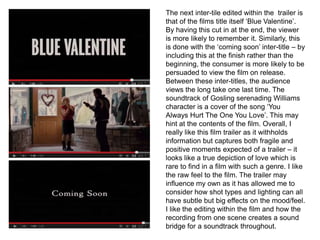
The next inter-tile edited within the trailer is
that of the films title itself ‘Blue Valentine’.
By having this cut in at the end, the viewer
is more likely to remember it. Similarly, this
is done with the ‘coming soon’ inter-title – by
including this at the finish rather than the
beginning, the consumer is more likely to be
persuaded to view the film on release.
Between these inter-titles, the audience
views the long take one last time. The
soundtrack of Gosling serenading Williams
character is a cover of the song ‘You
Always Hurt The One You Love’. This may
hint at the contents of the film. Overall, I
really like this film trailer as it withholds
information but captures both fragile and
positive moments expected of a trailer – it
looks like a true depiction of love which is
rare to find in a film with such a genre. I like
the raw feel to the film. The trailer may
influence my own as it has allowed me to
consider how shot types and lighting can all
have subtle but big effects on the mood/feel.
I like the editing within the film and how the
recording from one scene creates a sound
bridge for a soundtrack throughout.

Blue valentine timeline analysis

  • 1.
  • 2.
    The trailer openswith a display of legitimacy through a notification toward the audience that the ‘following preview has been approved for appropriate audiences’; not only is this included for legality reasons but it also adds a feel of professionalism. The company ‘ident’ is then cut in which further increases the ‘legit’ feel of the production but also could suggest the genre etc. ‘Ident’s’ are something I feel will be included within my own trailer to echo this effect. Following this, a fade transition cuts to an inter-title advertising the film as an ‘official selection’ of the Cannes Film Festival; shortly accompanying this are two similar inter-titles, differentiating only by festival. By editing these into the beginning of the trailer, the viewer will acknowledge that this film is already well recognised, thus, being well worth a watch (so to say). Cut over these additions is a sound bridge of non- diagetic conversation – through this, the audience is introduced to the characters before actually seeing them.
  • 3.
    Within the firstscene of footage, the voices which once appeared non- diagetic now become associated with their belonging characters. The medium wide shot captures our male and female protagonists together; as the genre is romance, the film is conforming to the typicality's through the choice of characters – a couple. The scene is a long take which depicts the female dancing and being serenaded to by the male; this heightens audience pleasure as it is an example of the main theme - romance. The trailer is relying on not only award selections to entice the viewer, but the star system too: Gosling and Williams are renowned celebrities who both have sex appeal, which is almost essential within a romance film in order to gain attention.
  • 4.
    The next clipedited into the promotional trailer is a shot-reverse- shot of Gosling and Williams smiling at one another; there is no hint at context, but the connection they have is established. This strengthens the genre representation – the theme of romance is also emphasised by the close up framing which creates a feel of intimacy. The recorded sound from the previous footage creates a sound bridge over the following clips (including this particular one). This has many effects; one being that it creates context for the montage edited clips, but it could also perhaps represent a soundtrack for their life – there are many other possible reasons why this is the editing choice within the trailer.
  • 5.
    The editing betweenthe transferral of clips remains simple due to the lack of transition use. In the next two short scenes of footage, we see Williams leading Gosling upstairs and a jump cut to the two ‘canoodling’ on a bed. The low key lighting enhances the romantic mood and also creates an aesthetically appealing look with the soft hues of blues and reds. The use of both high angle shots and low angle shots within the scenes adds interest for the audience – when creating my own trailer I must remember to use a variety of shot types in order to not only maintain a certain effect through perspective but also to ensure the production is not mundane. Again, the tight framing through the close up and the medium long shot furthers the theme of romance, strengthening the establishment of the genre in order to appeal to the consumer.
  • 6.
    It is essentialthat trailers include the ‘best bits’ to attract the targeted audience, ie. An action film will include scenes of explosions and car chases. The ‘best bits’ will represent the genre well in order to enhance audience pleasure and create hype for the upcoming production. This is done here as we see the couple kissing and looking at one another in adoration; consumers will be attracted to see the film through this as it lives up to its chosen genre of romance. The close up and medium close up shots shown here once again heighten the feel of intimacy and enhances the bond the two are shown to hold.
  • 7.
    The following clipis almost cut in as an action match from the preceding scene; previously the couple were captured kissing and holding one another, which is similarly depicted here. The differentiating factor here, however, is that Gosling is looking in concern toward Williams’ character. This shot is shown to be less intimate than the previous scenes as the framing through the window separates the viewer from the couple. Within romance films, there are both ‘ups and downs’ to involve the viewer through relatable themes. As mentioned above, audience pleasure is increased through scenes which perhaps may be applicable within their own lives; the romance within this film is depicted as realistic through the ‘ups and downs’ presented. Within this close up shot, Williams is shown to be crying. The intimate framing increases the feel of fragility adding a personal feel, representing emotion well, thus, strengthening themes and genre.
  • 8.
    The cuts betweenthe clips remain without transitions. This creates a fast pace between the shots but could also connote that love is simple, it is what it is and it has both it’s ‘ups’ and it’s ‘downs’. Here, once again, we see an illustration of one of the more emotional moments expected within a romance through a medium close up shot. The print screened footage shown here is of a panning close up shot involving Goslings character. The camera circles around him as he stares tearfully into the distance; again, this shot has been edited in to establish the raw, more fragile moments that depict the struggle of love and relationships.
  • 9.
    The low keylighting within this scene results in emphasising the darkened mood (low key – low mood) – this contrasts with the previous effect of low key lighting within the trailer which earlier created a soft, romantic feel. It is also interesting to note that the film is called ‘Blue Valentine’ and the aesthetics in a lot of the scenes involve a palette of blue hues. The blue colouring within this shot increases the ‘blue mood’ as the medium close up shot captures Williams crying into her hands. Lighting within this particular cut of footage creates the opposite effect illustrated in the preceding clip – we see the young couple looking into each others eyes as they hold one another, resulting in a positive representation of love. Flowers are iconic for their representation of love, increasing the medium wide shots establishment of the genre.
  • 10.
    This scene isof the two protagonists embracing on public transport (again, notice the blue interior). The close up shot frames the couple in an intimate, personal way which contrasts with the following wide shot. The two shot types create different perspectives and the consumers gain the idea that the two are so besotted with one another, it is almost as if nothing else matters in this particular moment – this is due to the long shot emphasising the emptiness of the transport beside the two of them, to the characters there is nothing but each other. This is very typical of a film with such a genre as romance.
  • 11.
    Following the previousscene, is footage of the male and female slow dancing. This is shown through a medium long shot. Slow dancing is typical iconography of the romance genre as it is intimate and shows a loving connection between the two involving themselves within the action. Untypically, however, the dancing is taking place unconventionally as the two characters show a lack of formal attire. The next take shows Gosling, once again, looking into the distance. The viewer can infer that he is in deep thought through this tilting medium close up shot; within the background, we can see a bridge lit up. Not only does this create context in concern to location and time, but it also enhances the aesthetics within the scene.
  • 12.
    Through this overthe shoulder close up shot, the audience can view Williams looking up into, who we can assume to be, Gosling’s eyes. The clip shows her character to be teary eyed, therefore showing another fragile, emotional moment that appears in the film which we assume is in concern to their relationship. As trailers are expected to depict the ‘best bits’ representing the genre, this scene will heighten audience pleasure through the portrayal of emotion. The next clip cut in is a medium close up shot involving both starring protagonists. Gosling’s characters expression is that of aggression and accusation. In romance films, consumers expect to see struggles attached to the relationship and we can infer that this particular scene is one of those moments – this will capture the audience’s attention.
  • 13.
    This tracking mediumclose up shot of the female protagonist shows her to be walking with a down expression worn across her face. In the background the viewer can see Gosling’s character punching a fence aggressively. This represents a low point in their relationship and creates questions for the audience – this increases hype for the upcoming production. The trailer returns to the long take clip used at the beginning, as the guitar music cuts out to Gosling speaking. The recorded sound is cut in to create a sound bridge over the entire trailer which creates the feel that this particular scene used marks a special moment within their relationship – perhaps this is their first meeting? This information is withheld from the viewer to maximise intruige.
  • 14.
    A fade transitioncuts to an inter-title (similar to the one print screened below this image) with credits acknowledging the actors involvement within the film, ‘Academy Award Nominee Ryan Gosling’. Another fade transition then cuts to a close up shot of the actor himself gazing out of a window beside his own reflection – ironic as the clip suggests he is reflecting on his own thoughts. Using the previous uniform fade transition, Gosling cuts to the following inter-title announcing Michelle Williams as a leading actress within the production. The film is independent, so by having the prestigious nominee titles the viewer is reassured that the film features well received actors.
  • 15.
    The next takeis a close up of Williams smiling to herself. She is also sitting on public transport just as Gosling’s character was shown to be in his last solo scene – this shows there to be a subtle connection between the two, again, strengthening the romance theme that is represented throughout the entirety of the trailer. Again, the viewer is taken back to the clip with both protagonists which is featured throughout the film. Behind Williams, there is a heart on the door – props like this used within mise en scene subtly enhance the genre representation.
  • 16.
    The next inter-tileedited within the trailer is that of the films title itself ‘Blue Valentine’. By having this cut in at the end, the viewer is more likely to remember it. Similarly, this is done with the ‘coming soon’ inter-title – by including this at the finish rather than the beginning, the consumer is more likely to be persuaded to view the film on release. Between these inter-titles, the audience views the long take one last time. The soundtrack of Gosling serenading Williams character is a cover of the song ‘You Always Hurt The One You Love’. This may hint at the contents of the film. Overall, I really like this film trailer as it withholds information but captures both fragile and positive moments expected of a trailer – it looks like a true depiction of love which is rare to find in a film with such a genre. I like the raw feel to the film. The trailer may influence my own as it has allowed me to consider how shot types and lighting can all have subtle but big effects on the mood/feel. I like the editing within the film and how the recording from one scene creates a sound bridge for a soundtrack throughout.