Bastille – Flaws
Music VideoAnalysis
Flaws by Bastille is a narrativedriven music video which follows the lead artist of the band through a day in his life as he deals with and
lives alongsideall of his ‘flaws’ represented by the group of skeleton faced girls. The video opens upon a crime scene which is
ultimately the sceneof his death as this video follows on fromthe Bad Bloods music video wherehe drowns himself in the same
location.
The first shotused is an extreme longshotthat establishes the opening sceneand shows theserious fans the continuation in the
timeline fromthe previous video. In this shot you can see one of the police men photographing thecrime scene with an old fashioned
camera. This links into Andrew Goodwin’s theory of looking which he identified as a key convention in music videos. The view then
changes to a POV shotof the camera that were justlooking at. This
can be interpreted as our view point as we follow him around
throughoutthe full video fromthis same angle and style.
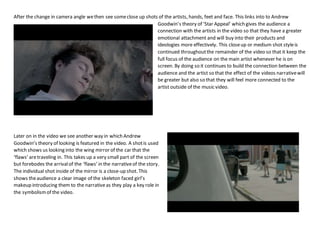
After the change in camera angle wethen see someclose up shots of the artists, hands, feet and face. This links into to Andrew
Goodwin’s theory of ‘Star Appeal’ which gives the audience a
connection with the artists in the video so that they have a greater
emotional attachment and will buy into their products and
ideologies more effectively. This closeup or medium shot styleis
continued throughoutthe remainder of the video so that it keep the
full focus of the audience on the main artist whenever he is on
screen. By doing so it continues to build the connection between the
audience and the artist so that the effect of the videos narrativewill
be greater but also so that they will feel more connected to the
artist outside of the music video.
Later on in the video we see another way in which Andrew
Goodwin’s theory of looking is featured in the video. A shotis used
which shows us looking into the wing mirror of the car that the
‘flaws’ aretraveling in. This takes up a very small part of the screen
but forebodes the arrivalof the ‘flaws’ in the narrativeof the story.
The individual shot inside of the mirror is a close-up shot. This
shows theaudience a clear image of the skeleton faced girl’s
makeup introducing them to the narrativeas they play a key role in
the symbolismof the video.
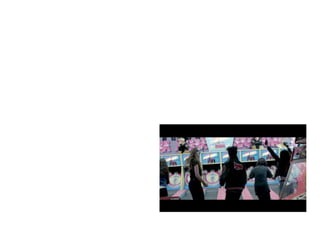
This next shot complies with Andrew Goodwin’s theory of looking and voyeurismof females. This is not as prevalent or extreme in this
music video as can be seen in many moremusic videos and in other music genres however it is featured in a less obvious way through
the Skeleton Girls. Two of the girls are wearing quite revealing shorts which follow Goodwin’s theory by attracting the male gazeto the
video. They are all also dancing quite suggestively which also follows the voyeuristic theories and also builds into the narrative. Due to
the similar positioning of the characters and the camera angle you can suggestthat the girls are dancing towards the main artist and
almost taunting him. The happiness of the girls and their energy juxtaposes the feelings of the main artist as he is very withdrawn and
depressed. However the costumes of the girls also contrasts their mood as they are wearing quite dark and pastel coloured clothes and
they have the black and white make-up. This could suggestthat they are acting so that they can taunt him further.
Later on in the music video it changes frombeing only narrativebased to being a live performancethatis built into the story. This causes
the music to change from being non-diegetic to being diegetic and also follows more closely to Goodwin’s theory of star appeal as this
section features much more close up shots of the artists head when he’s singing. The setting of this part of the video is also different as
this is set in a fairground and he is existing alongside the skeleton girls who can be interpreted as his flaws. It’s this point in the video
where the narrative changes from the ‘Flaws’ being separate to the artist or hostile towards him and start to almost enjoy being with
each other. This is a link to the lyrics of the song as he talks about always ‘wearing your flaws upon your sleeve’. This suggests that he is
not ashamed of his flaws and is happy with them which is symbolised by him enjoying being with them at the fair ground. The camera
angle is also different on a lot of the shots as we no longer are always close to the artist and we see a lot more interesting shots. This
suggests thatwe are now detached from him now that he has accepted the Flaws in his life. This is also shown though his general mood
and how he is less focused and hold less eye contact with the camera and other characters.
In the following scene where the artist and the Flaws are in the fairground we see an example of a link between the lyrics of the song
and the action in the video. On the word ‘Up’ in the final chorus it cuts to a shot of the artist and the main Flaw high up in a swing.
This amplifies the words of the song by making a clear link between the lyrics and the visuals, even if the audience do not consciously
notice this it will still add to the experience of the video. It is also an illustrative way of displaying the lyrics as they are plainly following
the lyrics while also doing it in a representative way that puts the lyrics of the song into the context of the fairground. This gives greater
meaning to the lyricsof thesongand creates a better connection between the lyricsandthe visualswhichmakesthevideo morerelevant.
The mise-en-sceneof this scene shows the now closeness of the artist and the ‘Flaws’ as they are physically closer than they have been
at any point previously in the video and they are also isolated. This isolation that we haven’t seen before suggests that they are happy
together and can live alongside each other happily. All of these scenes also show a contrastin mood fromthe start of the video. At the
start the video is quite dark and depressed and now it is bright and energetic. The mood of the characters have changed as you can
physically see them smiling and having fun. This in linked to Goodwin’s theory of Star Appeal as the audience want to see more of their
favourite artist and have an emotional connection to him so this complete change in mood and tone will reflect on the audience.
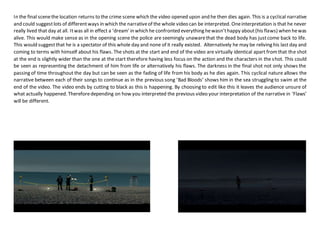
In the final scenethe location returns to the crime scene which the video opened upon and he then dies again. This is a cyclical narrative
and could suggestlots of differentways in which the narrativeof the whole video can be interpreted. Oneinterpretation is that he never
really lived that day at all. Itwas all in effect a ‘dream’ in which he confronted everything hewasn’thappy about(his flaws) when hewas
alive. This would make sense as in the opening scene the police are seemingly unawarethat the dead body has justcome back to life.
This would suggestthat he is a spectator of this whole day and none of it really existed. Alternatively he may be reliving his last day and
coming to terms with himself about his flaws. The shots at the start and end of the video are virtually identical apart fromthat the shot
at the end is slightly wider than the one at the start therefore having less focus on the action and the characters in the shot. This could
be seen as representing the detachment of him from life or alternatively his flaws. The darkness in the final shot not only shows the
passing of time throughout the day but can be seen as the fading of life from his body as he dies again. This cyclical nature allows the
narrative between each of their songs to continue as in the previous song ‘Bad Bloods’ shows him in the sea struggling to swim at the
end of the video. The video ends by cutting to black as this is happening. By choosing to edit like this it leaves the audience unsure of
what actually happened. Thereforedepending on how you interpreted the previous video your interpretation of the narrative in ‘Flaws’
will be different.
Bastille flaws analysis

Bastille flaws analysis

  • 1.
    Bastille – Flaws MusicVideoAnalysis Flaws by Bastille is a narrativedriven music video which follows the lead artist of the band through a day in his life as he deals with and lives alongsideall of his ‘flaws’ represented by the group of skeleton faced girls. The video opens upon a crime scene which is ultimately the sceneof his death as this video follows on fromthe Bad Bloods music video wherehe drowns himself in the same location. The first shotused is an extreme longshotthat establishes the opening sceneand shows theserious fans the continuation in the timeline fromthe previous video. In this shot you can see one of the police men photographing thecrime scene with an old fashioned camera. This links into Andrew Goodwin’s theory of looking which he identified as a key convention in music videos. The view then changes to a POV shotof the camera that were justlooking at. This can be interpreted as our view point as we follow him around throughoutthe full video fromthis same angle and style.
  • 2.
    After the changein camera angle wethen see someclose up shots of the artists, hands, feet and face. This links into to Andrew Goodwin’s theory of ‘Star Appeal’ which gives the audience a connection with the artists in the video so that they have a greater emotional attachment and will buy into their products and ideologies more effectively. This closeup or medium shot styleis continued throughoutthe remainder of the video so that it keep the full focus of the audience on the main artist whenever he is on screen. By doing so it continues to build the connection between the audience and the artist so that the effect of the videos narrativewill be greater but also so that they will feel more connected to the artist outside of the music video. Later on in the video we see another way in which Andrew Goodwin’s theory of looking is featured in the video. A shotis used which shows us looking into the wing mirror of the car that the ‘flaws’ aretraveling in. This takes up a very small part of the screen but forebodes the arrivalof the ‘flaws’ in the narrativeof the story. The individual shot inside of the mirror is a close-up shot. This shows theaudience a clear image of the skeleton faced girl’s makeup introducing them to the narrativeas they play a key role in the symbolismof the video.
  • 3.
    This next shotcomplies with Andrew Goodwin’s theory of looking and voyeurismof females. This is not as prevalent or extreme in this music video as can be seen in many moremusic videos and in other music genres however it is featured in a less obvious way through the Skeleton Girls. Two of the girls are wearing quite revealing shorts which follow Goodwin’s theory by attracting the male gazeto the video. They are all also dancing quite suggestively which also follows the voyeuristic theories and also builds into the narrative. Due to the similar positioning of the characters and the camera angle you can suggestthat the girls are dancing towards the main artist and almost taunting him. The happiness of the girls and their energy juxtaposes the feelings of the main artist as he is very withdrawn and depressed. However the costumes of the girls also contrasts their mood as they are wearing quite dark and pastel coloured clothes and they have the black and white make-up. This could suggestthat they are acting so that they can taunt him further.
  • 4.
    Later on inthe music video it changes frombeing only narrativebased to being a live performancethatis built into the story. This causes the music to change from being non-diegetic to being diegetic and also follows more closely to Goodwin’s theory of star appeal as this section features much more close up shots of the artists head when he’s singing. The setting of this part of the video is also different as this is set in a fairground and he is existing alongside the skeleton girls who can be interpreted as his flaws. It’s this point in the video where the narrative changes from the ‘Flaws’ being separate to the artist or hostile towards him and start to almost enjoy being with each other. This is a link to the lyrics of the song as he talks about always ‘wearing your flaws upon your sleeve’. This suggests that he is not ashamed of his flaws and is happy with them which is symbolised by him enjoying being with them at the fair ground. The camera angle is also different on a lot of the shots as we no longer are always close to the artist and we see a lot more interesting shots. This suggests thatwe are now detached from him now that he has accepted the Flaws in his life. This is also shown though his general mood and how he is less focused and hold less eye contact with the camera and other characters.
  • 5.
    In the followingscene where the artist and the Flaws are in the fairground we see an example of a link between the lyrics of the song and the action in the video. On the word ‘Up’ in the final chorus it cuts to a shot of the artist and the main Flaw high up in a swing. This amplifies the words of the song by making a clear link between the lyrics and the visuals, even if the audience do not consciously notice this it will still add to the experience of the video. It is also an illustrative way of displaying the lyrics as they are plainly following the lyrics while also doing it in a representative way that puts the lyrics of the song into the context of the fairground. This gives greater meaning to the lyricsof thesongand creates a better connection between the lyricsandthe visualswhichmakesthevideo morerelevant. The mise-en-sceneof this scene shows the now closeness of the artist and the ‘Flaws’ as they are physically closer than they have been at any point previously in the video and they are also isolated. This isolation that we haven’t seen before suggests that they are happy together and can live alongside each other happily. All of these scenes also show a contrastin mood fromthe start of the video. At the start the video is quite dark and depressed and now it is bright and energetic. The mood of the characters have changed as you can physically see them smiling and having fun. This in linked to Goodwin’s theory of Star Appeal as the audience want to see more of their favourite artist and have an emotional connection to him so this complete change in mood and tone will reflect on the audience.
  • 6.
    In the finalscenethe location returns to the crime scene which the video opened upon and he then dies again. This is a cyclical narrative and could suggestlots of differentways in which the narrativeof the whole video can be interpreted. Oneinterpretation is that he never really lived that day at all. Itwas all in effect a ‘dream’ in which he confronted everything hewasn’thappy about(his flaws) when hewas alive. This would make sense as in the opening scene the police are seemingly unawarethat the dead body has justcome back to life. This would suggestthat he is a spectator of this whole day and none of it really existed. Alternatively he may be reliving his last day and coming to terms with himself about his flaws. The shots at the start and end of the video are virtually identical apart fromthat the shot at the end is slightly wider than the one at the start therefore having less focus on the action and the characters in the shot. This could be seen as representing the detachment of him from life or alternatively his flaws. The darkness in the final shot not only shows the passing of time throughout the day but can be seen as the fading of life from his body as he dies again. This cyclical nature allows the narrative between each of their songs to continue as in the previous song ‘Bad Bloods’ shows him in the sea struggling to swim at the end of the video. The video ends by cutting to black as this is happening. By choosing to edit like this it leaves the audience unsure of what actually happened. Thereforedepending on how you interpreted the previous video your interpretation of the narrative in ‘Flaws’ will be different.