Bridesmaids
•   The trailer opens with the universal pictures logo
    onscreen for less than 2 seconds, with an up-beat
    soundtrack playing in the background. Already this
    suggests that it is a feel good movie.
•   There is then a short blackout and the picture quickly
    fades back to a man an establishing shot of a very
    nice house. It then immediately cuts to a man and
    woman in bed – showing that they are in the house.
    From the position of the people you presume that the
    man is more dominant as he is lying over her – he
    then tells her he wants to leave and all of his dialogue
    is more or less declaratives or imperatives: “you
    should probably get going soon”. This establishes her
    relationship with the man. Many of the lines are
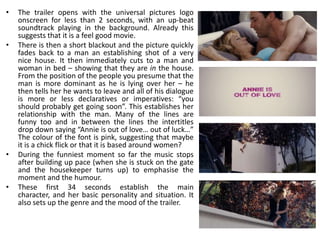
    funny too and in between the lines the intertitles
    drop down saying “Annie is out of love… out of luck…”
    The colour of the font is pink, suggesting that maybe
    it is a chick flick or that it is based around women?
•   During the funniest moment so far the music stops
    after building up pace (when she is stuck on the gate
    and the housekeeper turns up) to emphasise the
    moment and the humour.
•   These first 34 seconds establish the main
    character, and her basic personality and situation. It
    also sets up the genre and the mood of the trailer.
•   After the next intertitle “out of her depth” the music
    picks up pace and there is a second establishing shot
    of a city scape – giving the audience the location.
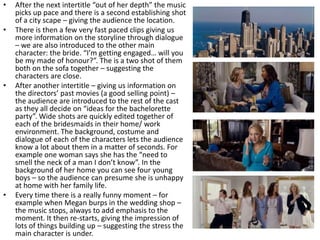
•   There is then a few very fast paced clips giving us
    more information on the storyline through dialogue
    – we are also introduced to the other main
    character: the bride. “I’m getting engaged… will you
    be my made of honour?”. The is a two shot of them
    both on the sofa together – suggesting the
    characters are close.
•   After another intertitle – giving us information on
    the directors’ past movies (a good selling point) –
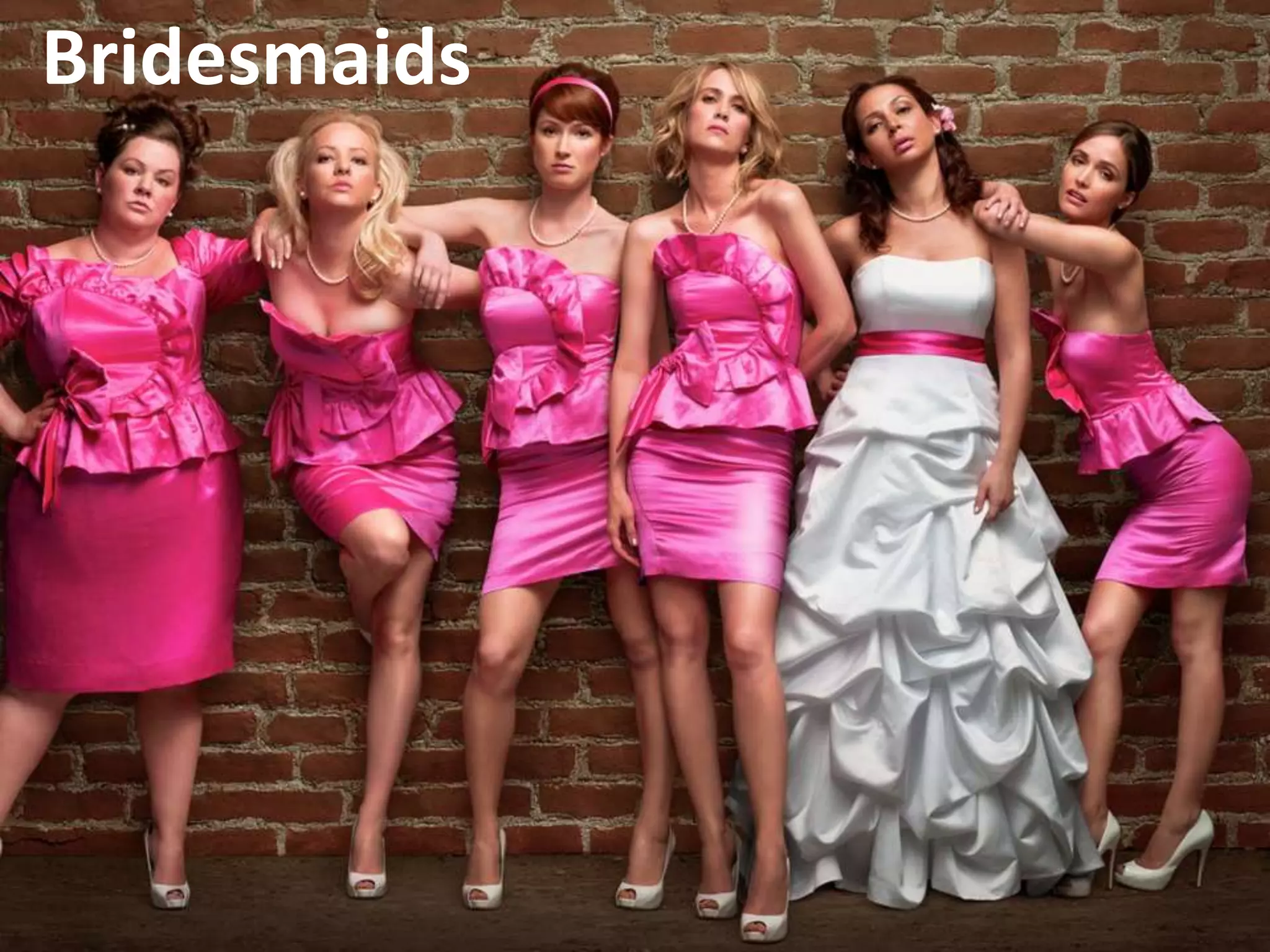
    the audience are introduced to the rest of the cast
    as they all decide on “ideas for the bachelorette
    party”. Wide shots are quickly edited together of
    each of the bridesmaids in their home/ work
    environment. The background, costume and
    dialogue of each of the characters lets the audience
    know a lot about them in a matter of seconds. For
    example one woman says she has the “need to
    smell the neck of a man I don’t know”. In the
    background of her home you can see four young
    boys – so the audience can presume she is unhappy
    at home with her family life.
•   Every time there is a really funny moment – for
    example when Megan burps in the wedding shop –
    the music stops, always to add emphasis to the
    moment. It then re-starts, giving the impression of
    lots of things building up – suggesting the stress the
    main character is under.
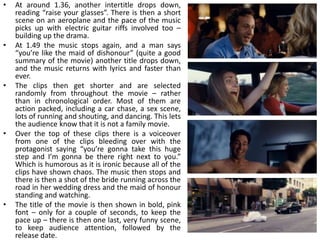
•   At around 1.36, another intertitle drops down,
    reading “raise your glasses”. There is then a short
    scene on an aeroplane and the pace of the music
    picks up with electric guitar riffs involved too –
    building up the drama.
•   At 1.49 the music stops again, and a man says
    “you’re like the maid of dishonour” (quite a good
    summary of the movie) another title drops down,
    and the music returns with lyrics and faster than
    ever.
•   The clips then get shorter and are selected
    randomly from throughout the movie – rather
    than in chronological order. Most of them are
    action packed, including a car chase, a sex scene,
    lots of running and shouting, and dancing. This lets
    the audience know that it is not a family movie.
•   Over the top of these clips there is a voiceover
    from one of the clips bleeding over with the
    protagonist saying “you’re gonna take this huge
    step and I’m gonna be there right next to you.”
    Which is humorous as it is ironic because all of the
    clips have shown chaos. The music then stops and
    there is then a shot of the bride running across the
    road in her wedding dress and the maid of honour
    standing and watching.
•   The title of the movie is then shown in bold, pink
    font – only for a couple of seconds, to keep the
    pace up – there is then one last, very funny scene,
    to keep audience attention, followed by the
    release date.
• In the trailer women are represented as quite wild, hysterical, drunk and
  sex hungry. This goes completely against any stereotypes of women in
  mainstream media. The trailer goes completely against Mulvey’s male
  gaze theory too – and in one clip the role is reversed as a woman
  describes how she is going to “climb that like a tree” when discussing a
  male character. This is probably because it is a women’s movie – or at
  least a majority of the target audience are. I think the trailer is mainly
  aimed at women due to the fact most of the characters are women, it is
  about weddings and the colour scheme is pin and white.
• The movie is a comedy and the trailer makes this clear from the
  beginning through the up tempo music and the emphasises and
  regularity of funny moments in the trailer.
• The narrative structure in the trailer conforms to that found in most. The
  first thirty seconds or so lays out the premise of the story and
  establishes setting and introduces the main character, The middle drives
  the story further and usually ends with a dramatic climax. Relationships
  are established further and characters are developed in their world, and
  the final minute or so consists of a visual montage of powerful and
  emotional moments/events of the film
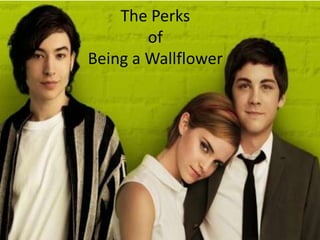
The Perks
        of
Being a Wallflower
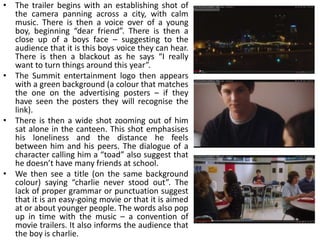
• The trailer begins with an establishing shot of
  the camera panning across a city, with calm
  music. There is then a voice over of a young
  boy, beginning “dear friend”. There is then a
  close up of a boys face – suggesting to the
  audience that it is this boys voice they can hear.
  There is then a blackout as he says “I really
  want to turn things around this year”.
• The Summit entertainment logo then appears
  with a green background (a colour that matches
  the one on the advertising posters – if they
  have seen the posters they will recognise the
  link).
• There is then a wide shot zooming out of him
  sat alone in the canteen. This shot emphasises
  his loneliness and the distance he feels
  between him and his peers. The dialogue of a
  character calling him a “toad” also suggest that
  he doesn’t have many friends at school.
• We then see a title (on the same background
  colour) saying “charlie never stood out”. The
  lack of proper grammar or punctuation suggest
  that it is an easy-going movie or that it is aimed
  at or about younger people. The words also pop
  up in time with the music – a convention of
  movie trailers. It also informs the audience that
  the boy is charlie.
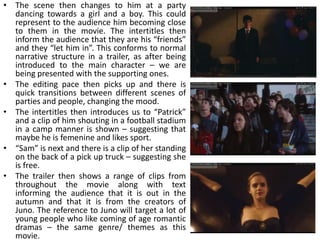
• The scene then changes to him at a party
  dancing towards a girl and a boy. This could
  represent to the audience him becoming close
  to them in the movie. The intertitles then
  inform the audience that they are his “friends”
  and they “let him in”. This conforms to normal
  narrative structure in a trailer, as after being
  introduced to the main character – we are
  being presented with the supporting ones.
• The editing pace then picks up and there is
  quick transitions between different scenes of
  parties and people, changing the mood.
• The intertitles then introduces us to “Patrick”
  and a clip of him shouting in a football stadium
  in a camp manner is shown – suggesting that
  maybe he is femenine and likes sport.
• “Sam” is next and there is a clip of her standing
  on the back of a pick up truck – suggesting she
  is free.
• The trailer then shows a range of clips from
  throughout the movie along with text
  informing the audience that it is out in the
  autumn and that it is from the creators of
  Juno. The reference to Juno will target a lot of
  young people who like coming of age romantic
  dramas – the same genre/ themes as this
  movie.
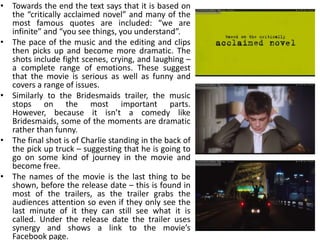
• Towards the end the text says that it is based on
  the “critically acclaimed novel” and many of the
  most famous quotes are included: “we are
  infinite” and “you see things, you understand”.
• The pace of the music and the editing and clips
  then picks up and become more dramatic. The
  shots include fight scenes, crying, and laughing –
  a complete range of emotions. These suggest
  that the movie is serious as well as funny and
  covers a range of issues.
• Similarly to the Bridesmaids trailer, the music
  stops on the most important parts.
  However, because it isn’t a comedy like
  Bridesmaids, some of the moments are dramatic
  rather than funny.
• The final shot is of Charlie standing in the back of
  the pick up truck – suggesting that he is going to
  go on some kind of journey in the movie and
  become free.
• The names of the movie is the last thing to be
  shown, before the release date – this is found in
  most of the trailers, as the trailer grabs the
  audiences attention so even if they only see the
  last minute of it they can still see what it is
  called. Under the release date the trailer uses
  synergy and shows a link to the movie’s
  Facebook page.
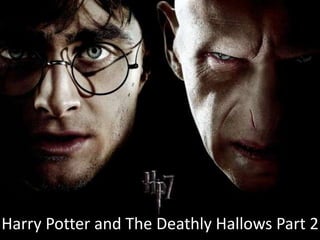
Harry Potter and The Deathly Hallows Part 2
• This trailer is slightly different to most others as it is the final instalment of a
  series of movies which have been a global success. Therefore the audience will
  already know the main characters.
• The trailer opens with the instantly recognisable “Hedwig’s theme” but a version
  that has been significantly slowed down. Any fans of the movie and even people
  who are not will relate the song to the previous Harry Potter movies. The slowing
  down of the song gives it an eery mood – suggesting that this movie will be the
  same as the others but much darker.
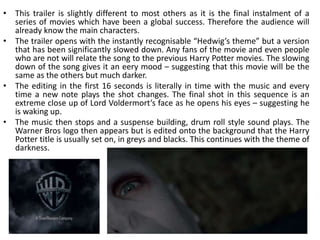
• The editing in the first 16 seconds is literally in time with the music and every
  time a new note plays the shot changes. The final shot in this sequence is an
  extreme close up of Lord Voldermort’s face as he opens his eyes – suggesting he
  is waking up.
• The music then stops and a suspense building, drum roll style sound plays. The
  Warner Bros logo then appears but is edited onto the background that the Harry
  Potter title is usually set on, in greys and blacks. This continues with the theme of
  darkness.
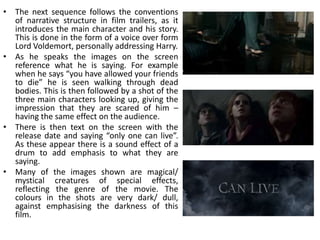
• The next sequence follows the conventions
  of narrative structure in film trailers, as it
  introduces the main character and his story.
  This is done in the form of a voice over form
  Lord Voldemort, personally addressing Harry.
• As he speaks the images on the screen
  reference what he is saying. For example
  when he says “you have allowed your friends
  to die” he is seen walking through dead
  bodies. This is then followed by a shot of the
  three main characters looking up, giving the
  impression that they are scared of him –
  having the same effect on the audience.
• There is then text on the screen with the
  release date and saying “only one can live”.
  As these appear there is a sound effect of a
  drum to add emphasis to what they are
  saying.
• Many of the images shown are magical/
  mystical creatures of special effects,
  reflecting the genre of the movie. The
  colours in the shots are very dark/ dull,
  against emphasising the darkness of this
  film.
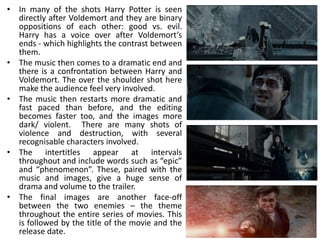
• In many of the shots Harry Potter is seen
  directly after Voldemort and they are binary
  oppositions of each other: good vs. evil.
  Harry has a voice over after Voldemort’s
  ends - which highlights the contrast between
  them.
• The music then comes to a dramatic end and
  there is a confrontation between Harry and
  Voldemort. The over the shoulder shot here
  make the audience feel very involved.
• The music then restarts more dramatic and
  fast paced than before, and the editing
  becomes faster too, and the images more
  dark/ violent. There are many shots of
  violence and destruction, with several
  recognisable characters involved.
• The intertitles appear at intervals
  throughout and include words such as “epic”
  and “phenomenon”. These, paired with the
  music and images, give a huge sense of
  drama and volume to the trailer.
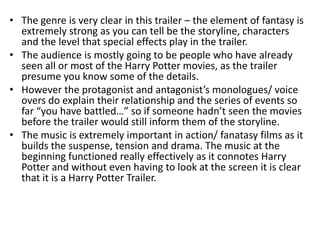
• The final images are another face-off
  between the two enemies – the theme
  throughout the entire series of movies. This
  is followed by the title of the movie and the
  release date.
• The genre is very clear in this trailer – the element of fantasy is
  extremely strong as you can tell be the storyline, characters
  and the level that special effects play in the trailer.
• The audience is mostly going to be people who have already
  seen all or most of the Harry Potter movies, as the trailer
  presume you know some of the details.
• However the protagonist and antagonist’s monologues/ voice
  overs do explain their relationship and the series of events so
  far “you have battled…” so if someone hadn’t seen the movies
  before the trailer would still inform them of the storyline.
• The music is extremely important in action/ fanatasy films as it
  builds the suspense, tension and drama. The music at the
  beginning functioned really effectively as it connotes Harry
  Potter and without even having to look at the screen it is clear
  that it is a Harry Potter Trailer.

Film Trailers

  • 1.
  • 2.
    The trailer opens with the universal pictures logo onscreen for less than 2 seconds, with an up-beat soundtrack playing in the background. Already this suggests that it is a feel good movie. • There is then a short blackout and the picture quickly fades back to a man an establishing shot of a very nice house. It then immediately cuts to a man and woman in bed – showing that they are in the house. From the position of the people you presume that the man is more dominant as he is lying over her – he then tells her he wants to leave and all of his dialogue is more or less declaratives or imperatives: “you should probably get going soon”. This establishes her relationship with the man. Many of the lines are funny too and in between the lines the intertitles drop down saying “Annie is out of love… out of luck…” The colour of the font is pink, suggesting that maybe it is a chick flick or that it is based around women? • During the funniest moment so far the music stops after building up pace (when she is stuck on the gate and the housekeeper turns up) to emphasise the moment and the humour. • These first 34 seconds establish the main character, and her basic personality and situation. It also sets up the genre and the mood of the trailer.
  • 3.
    After the next intertitle “out of her depth” the music picks up pace and there is a second establishing shot of a city scape – giving the audience the location. • There is then a few very fast paced clips giving us more information on the storyline through dialogue – we are also introduced to the other main character: the bride. “I’m getting engaged… will you be my made of honour?”. The is a two shot of them both on the sofa together – suggesting the characters are close. • After another intertitle – giving us information on the directors’ past movies (a good selling point) – the audience are introduced to the rest of the cast as they all decide on “ideas for the bachelorette party”. Wide shots are quickly edited together of each of the bridesmaids in their home/ work environment. The background, costume and dialogue of each of the characters lets the audience know a lot about them in a matter of seconds. For example one woman says she has the “need to smell the neck of a man I don’t know”. In the background of her home you can see four young boys – so the audience can presume she is unhappy at home with her family life. • Every time there is a really funny moment – for example when Megan burps in the wedding shop – the music stops, always to add emphasis to the moment. It then re-starts, giving the impression of lots of things building up – suggesting the stress the main character is under.
  • 4.
    At around 1.36, another intertitle drops down, reading “raise your glasses”. There is then a short scene on an aeroplane and the pace of the music picks up with electric guitar riffs involved too – building up the drama. • At 1.49 the music stops again, and a man says “you’re like the maid of dishonour” (quite a good summary of the movie) another title drops down, and the music returns with lyrics and faster than ever. • The clips then get shorter and are selected randomly from throughout the movie – rather than in chronological order. Most of them are action packed, including a car chase, a sex scene, lots of running and shouting, and dancing. This lets the audience know that it is not a family movie. • Over the top of these clips there is a voiceover from one of the clips bleeding over with the protagonist saying “you’re gonna take this huge step and I’m gonna be there right next to you.” Which is humorous as it is ironic because all of the clips have shown chaos. The music then stops and there is then a shot of the bride running across the road in her wedding dress and the maid of honour standing and watching. • The title of the movie is then shown in bold, pink font – only for a couple of seconds, to keep the pace up – there is then one last, very funny scene, to keep audience attention, followed by the release date.
  • 5.
    • In thetrailer women are represented as quite wild, hysterical, drunk and sex hungry. This goes completely against any stereotypes of women in mainstream media. The trailer goes completely against Mulvey’s male gaze theory too – and in one clip the role is reversed as a woman describes how she is going to “climb that like a tree” when discussing a male character. This is probably because it is a women’s movie – or at least a majority of the target audience are. I think the trailer is mainly aimed at women due to the fact most of the characters are women, it is about weddings and the colour scheme is pin and white. • The movie is a comedy and the trailer makes this clear from the beginning through the up tempo music and the emphasises and regularity of funny moments in the trailer. • The narrative structure in the trailer conforms to that found in most. The first thirty seconds or so lays out the premise of the story and establishes setting and introduces the main character, The middle drives the story further and usually ends with a dramatic climax. Relationships are established further and characters are developed in their world, and the final minute or so consists of a visual montage of powerful and emotional moments/events of the film
  • 6.
    The Perks of Being a Wallflower
  • 7.
    • The trailerbegins with an establishing shot of the camera panning across a city, with calm music. There is then a voice over of a young boy, beginning “dear friend”. There is then a close up of a boys face – suggesting to the audience that it is this boys voice they can hear. There is then a blackout as he says “I really want to turn things around this year”. • The Summit entertainment logo then appears with a green background (a colour that matches the one on the advertising posters – if they have seen the posters they will recognise the link). • There is then a wide shot zooming out of him sat alone in the canteen. This shot emphasises his loneliness and the distance he feels between him and his peers. The dialogue of a character calling him a “toad” also suggest that he doesn’t have many friends at school. • We then see a title (on the same background colour) saying “charlie never stood out”. The lack of proper grammar or punctuation suggest that it is an easy-going movie or that it is aimed at or about younger people. The words also pop up in time with the music – a convention of movie trailers. It also informs the audience that the boy is charlie.
  • 8.
    • The scenethen changes to him at a party dancing towards a girl and a boy. This could represent to the audience him becoming close to them in the movie. The intertitles then inform the audience that they are his “friends” and they “let him in”. This conforms to normal narrative structure in a trailer, as after being introduced to the main character – we are being presented with the supporting ones. • The editing pace then picks up and there is quick transitions between different scenes of parties and people, changing the mood. • The intertitles then introduces us to “Patrick” and a clip of him shouting in a football stadium in a camp manner is shown – suggesting that maybe he is femenine and likes sport. • “Sam” is next and there is a clip of her standing on the back of a pick up truck – suggesting she is free. • The trailer then shows a range of clips from throughout the movie along with text informing the audience that it is out in the autumn and that it is from the creators of Juno. The reference to Juno will target a lot of young people who like coming of age romantic dramas – the same genre/ themes as this movie.
  • 9.
    • Towards theend the text says that it is based on the “critically acclaimed novel” and many of the most famous quotes are included: “we are infinite” and “you see things, you understand”. • The pace of the music and the editing and clips then picks up and become more dramatic. The shots include fight scenes, crying, and laughing – a complete range of emotions. These suggest that the movie is serious as well as funny and covers a range of issues. • Similarly to the Bridesmaids trailer, the music stops on the most important parts. However, because it isn’t a comedy like Bridesmaids, some of the moments are dramatic rather than funny. • The final shot is of Charlie standing in the back of the pick up truck – suggesting that he is going to go on some kind of journey in the movie and become free. • The names of the movie is the last thing to be shown, before the release date – this is found in most of the trailers, as the trailer grabs the audiences attention so even if they only see the last minute of it they can still see what it is called. Under the release date the trailer uses synergy and shows a link to the movie’s Facebook page.
  • 10.
    Harry Potter andThe Deathly Hallows Part 2
  • 11.
    • This traileris slightly different to most others as it is the final instalment of a series of movies which have been a global success. Therefore the audience will already know the main characters. • The trailer opens with the instantly recognisable “Hedwig’s theme” but a version that has been significantly slowed down. Any fans of the movie and even people who are not will relate the song to the previous Harry Potter movies. The slowing down of the song gives it an eery mood – suggesting that this movie will be the same as the others but much darker. • The editing in the first 16 seconds is literally in time with the music and every time a new note plays the shot changes. The final shot in this sequence is an extreme close up of Lord Voldermort’s face as he opens his eyes – suggesting he is waking up. • The music then stops and a suspense building, drum roll style sound plays. The Warner Bros logo then appears but is edited onto the background that the Harry Potter title is usually set on, in greys and blacks. This continues with the theme of darkness.
  • 12.
    • The nextsequence follows the conventions of narrative structure in film trailers, as it introduces the main character and his story. This is done in the form of a voice over form Lord Voldemort, personally addressing Harry. • As he speaks the images on the screen reference what he is saying. For example when he says “you have allowed your friends to die” he is seen walking through dead bodies. This is then followed by a shot of the three main characters looking up, giving the impression that they are scared of him – having the same effect on the audience. • There is then text on the screen with the release date and saying “only one can live”. As these appear there is a sound effect of a drum to add emphasis to what they are saying. • Many of the images shown are magical/ mystical creatures of special effects, reflecting the genre of the movie. The colours in the shots are very dark/ dull, against emphasising the darkness of this film.
  • 13.
    • In manyof the shots Harry Potter is seen directly after Voldemort and they are binary oppositions of each other: good vs. evil. Harry has a voice over after Voldemort’s ends - which highlights the contrast between them. • The music then comes to a dramatic end and there is a confrontation between Harry and Voldemort. The over the shoulder shot here make the audience feel very involved. • The music then restarts more dramatic and fast paced than before, and the editing becomes faster too, and the images more dark/ violent. There are many shots of violence and destruction, with several recognisable characters involved. • The intertitles appear at intervals throughout and include words such as “epic” and “phenomenon”. These, paired with the music and images, give a huge sense of drama and volume to the trailer. • The final images are another face-off between the two enemies – the theme throughout the entire series of movies. This is followed by the title of the movie and the release date.
  • 14.
    • The genreis very clear in this trailer – the element of fantasy is extremely strong as you can tell be the storyline, characters and the level that special effects play in the trailer. • The audience is mostly going to be people who have already seen all or most of the Harry Potter movies, as the trailer presume you know some of the details. • However the protagonist and antagonist’s monologues/ voice overs do explain their relationship and the series of events so far “you have battled…” so if someone hadn’t seen the movies before the trailer would still inform them of the storyline. • The music is extremely important in action/ fanatasy films as it builds the suspense, tension and drama. The music at the beginning functioned really effectively as it connotes Harry Potter and without even having to look at the screen it is clear that it is a Harry Potter Trailer.