Dheeraj Singh Negi
INTRODUCTION 
 Blog: The term "weblog" was coined by Jorn 
Barger on 17 December 1997. Then Peter Merholz, 
jokingly broke the word weblog into the phrase we 
blog in the sidebar of his blog Peterme.com in 
1999, from where it becomes popular as "blog". 
Thus Blog is derived from Weblog. Blog or weblog 
is a web-based publication consisting primarily of 
periodic articles normally in reverse chronological 
order with reflections, comments, and often 
hyperlinks provided by the writer.
Definition: Blogs have different meaning to different 
people, ranging from “online journal” to “easily updated 
personal website”. A weblog is a journal (or newsletter) 
that is frequently updated and intended for general 
public consumption. Blogs generally represent the 
personality of the author or the Web site. 
According to Concept Websites Ltd 
(http://www.conceptwebsites.com/SEO/common-terms. 
htm), “a blog is basically a journal that is available 
on the web. The activity of updating a blog is "blogging" 
and someone who keeps a blog is a "blogger." Blogs are 
typically updated daily using software that allows people 
with little or no technical background to update and 
maintain the blog”.
In simple, it can be said that it is a web based website where 
articles posted will automatically be arranged in reverse 
chronological fashion or in a chronological fashion. The 
owner/member will post message which are sometimes rich 
with graph, audio, video and hyperlink periodically enabling 
others to view and comment. Topics often include the 
owner's/member’s daily life or views on a particular subject or 
topic of important to the group. The original post with its 
associated comments and discussion provide a very insight to 
the topic at hand. 
Many blogs are frequently updated and publicly accessible i.e 
they allow anybody to sign up at any time; some others are 
private where entry to the group is restricted. Some advanced 
users have server-side software, and often implement 
membership management and password protected areas. 
Others have created a mix of a blog and wiki, called a bliki.
HISTORY 
At the initial stage of internet development, Usenet, e-mail lists, Bulletin Board 
Systems (BBS), chronicles, commonplaces, diaries, and perzines were used as a 
form of Citizen Media. Bulletin Board is a service whereby messages and points of 
interest can be posted to be read and replied to unlike list server. The news group 
provides access to thousands of topic based discussion group services which are 
open to all. The news reader software allows one to post an article to any group for 
others to read. A comment to the message (original) can be added to the thread of 
the article. In recent times these are effectively replaced by the “blog”. 
During recent days, blog has evolved into a tool that offers some of the most insightful 
information on the Web. It provides self-publishing phenomenon represented by 
blogging and becoming much more common in LIS, as librarians, libraries and 
library associations have begun to blog as a way of communicating with their 
patrons and constituents. Many librarians world wide also publish their personal 
blogs that offer a wealth of information about librarianship, their parent institution 
and sometimes to their personal lives as well. 
The emergence of blogging provides a medium to give readers of the library new 
perspectives on the realities, as well as often offering different viewpoints from 
those of its official news sources. Many bloggers began to provide nearly-instant 
commentary on televised events, creating a secondary meaning of the word 
"blogging": to simultaneously transcribe and editorialize speeches and events 
shown on television (liveblogging).
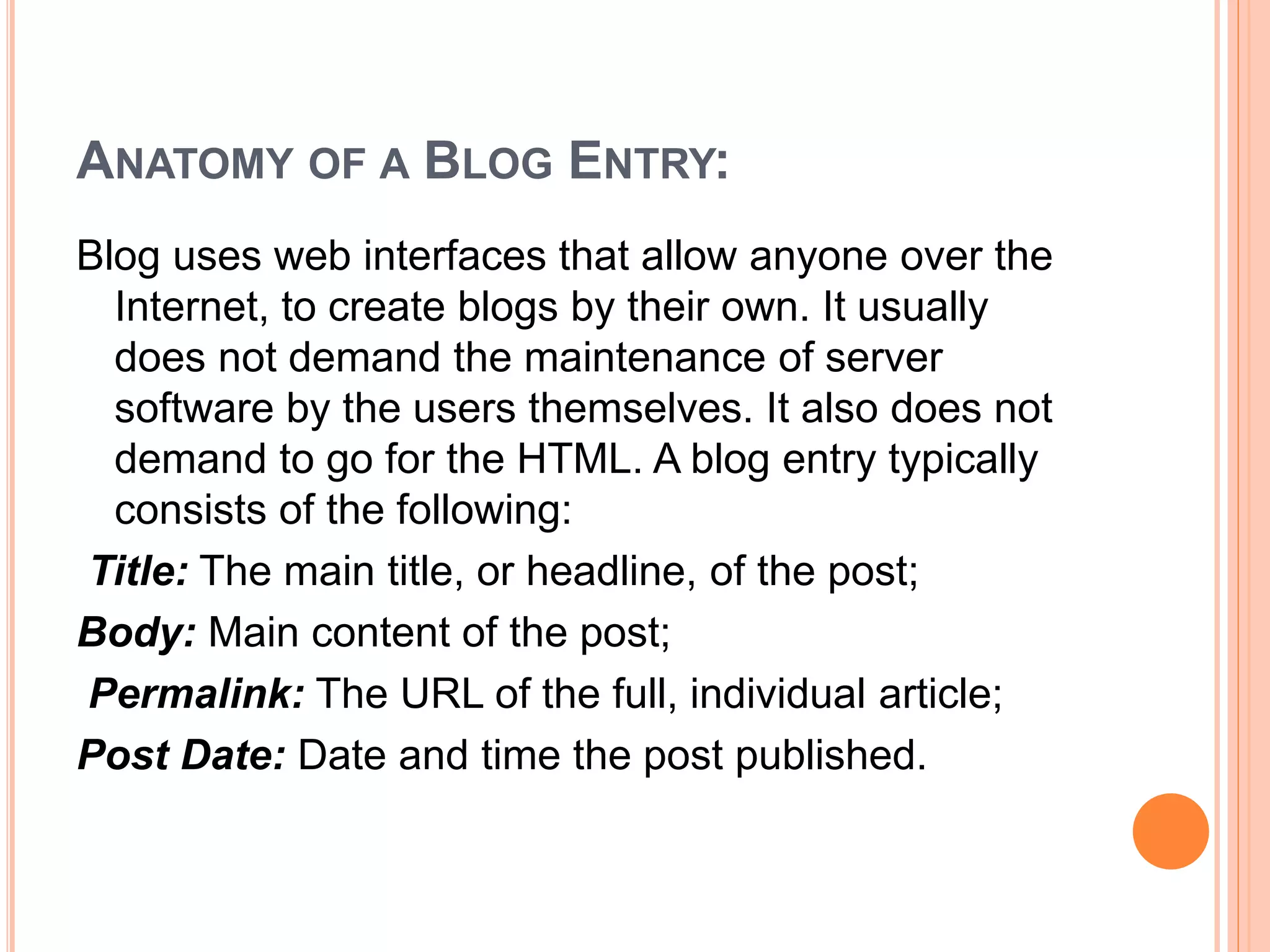
ANATOMY OF A BLOG ENTRY: 
Blog uses web interfaces that allow anyone over the 
Internet, to create blogs by their own. It usually 
does not demand the maintenance of server 
software by the users themselves. It also does not 
demand to go for the HTML. A blog entry typically 
consists of the following: 
Title: The main title, or headline, of the post; 
Body: Main content of the post; 
Permalink: The URL of the full, individual article; 
Post Date: Date and time the post published.
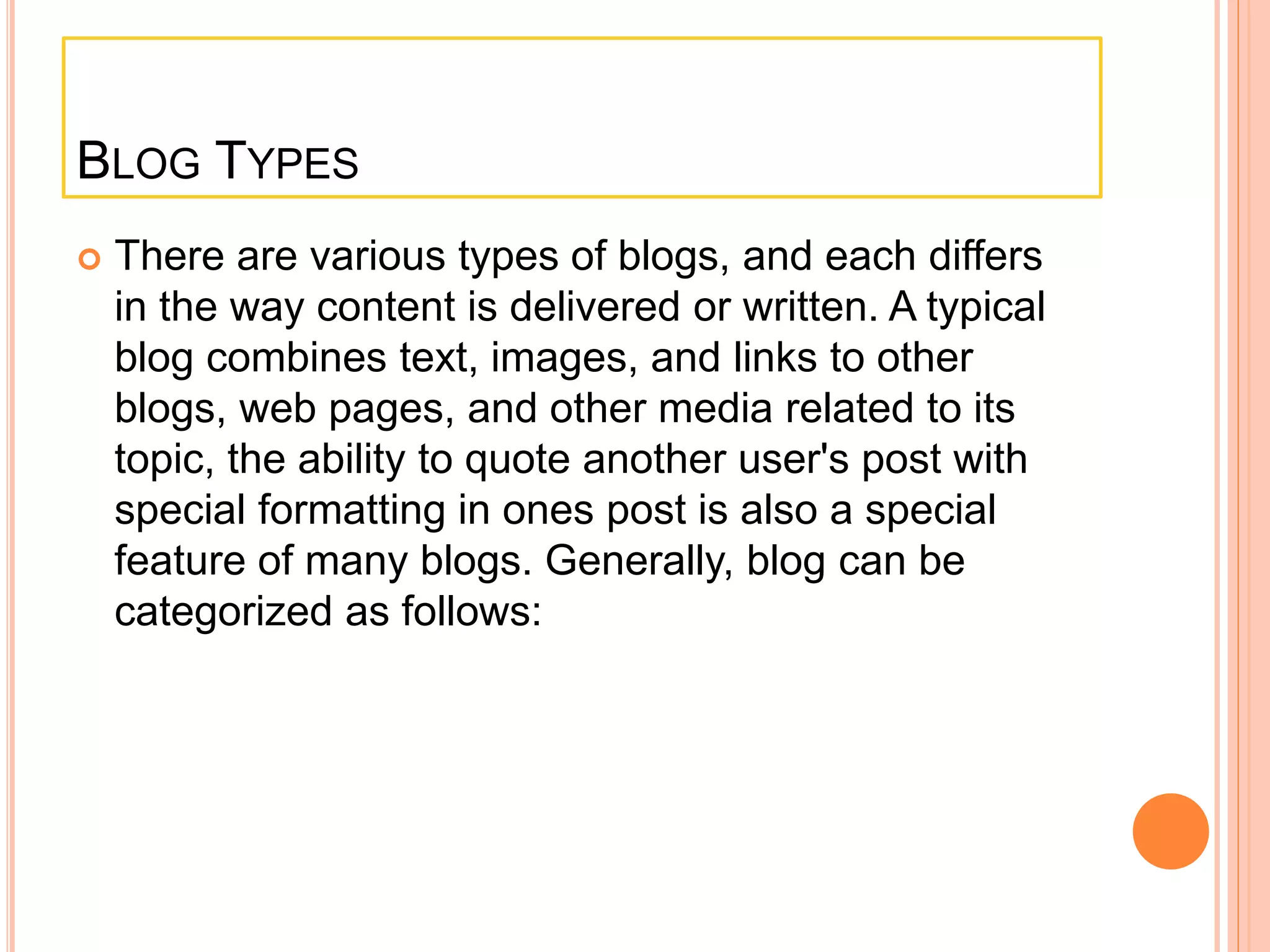
BLOG TYPES 
 There are various types of blogs, and each differs 
in the way content is delivered or written. A typical 
blog combines text, images, and links to other 
blogs, web pages, and other media related to its 
topic, the ability to quote another user's post with 
special formatting in ones post is also a special 
feature of many blogs. Generally, blog can be 
categorized as follows:
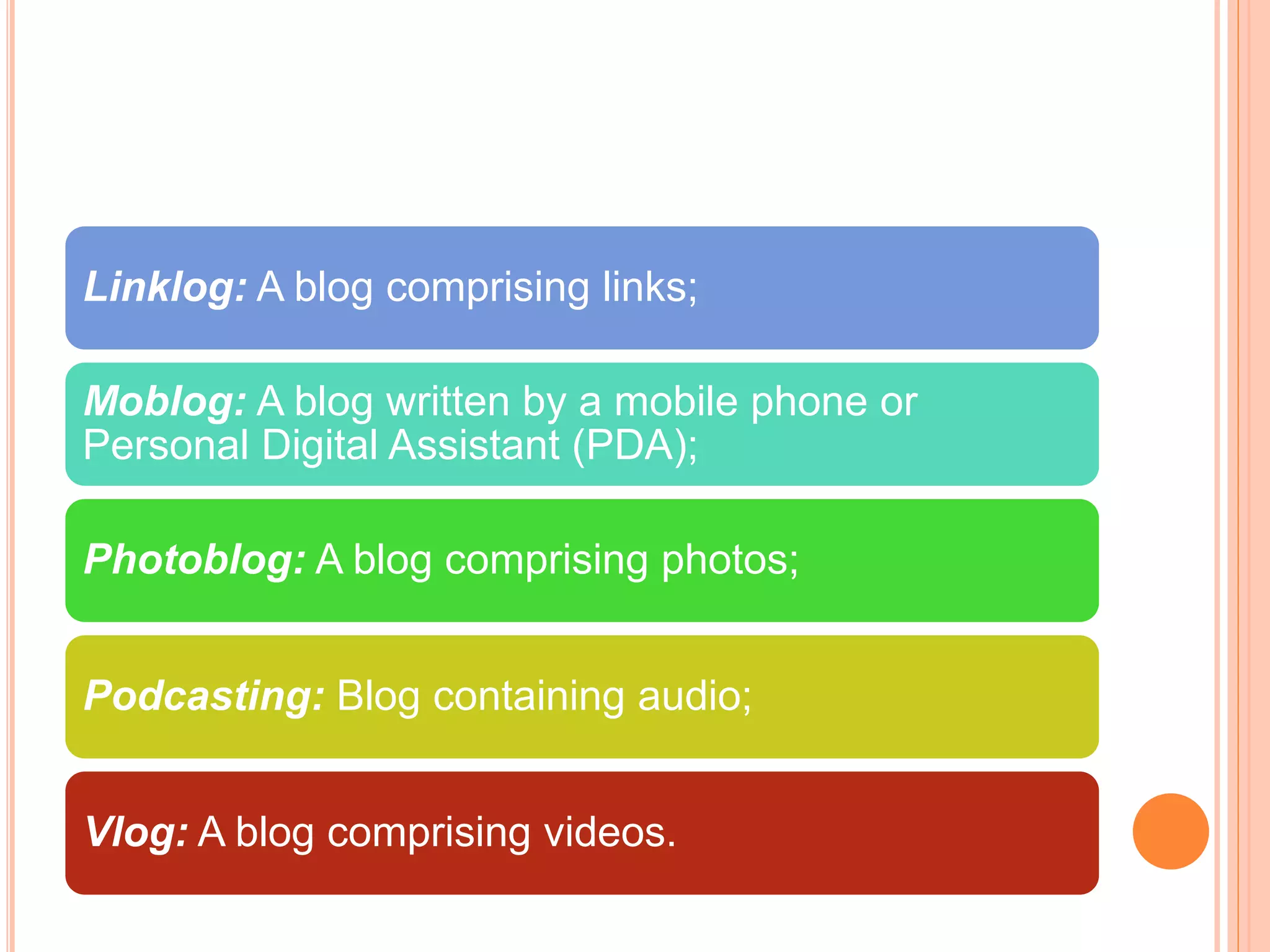
Linklog: A blog comprising links; 
Moblog: A blog written by a mobile phone or 
Personal Digital Assistant (PDA); 
Photoblog: A blog comprising photos; 
Podcasting: Blog containing audio; 
Vlog: A blog comprising videos.
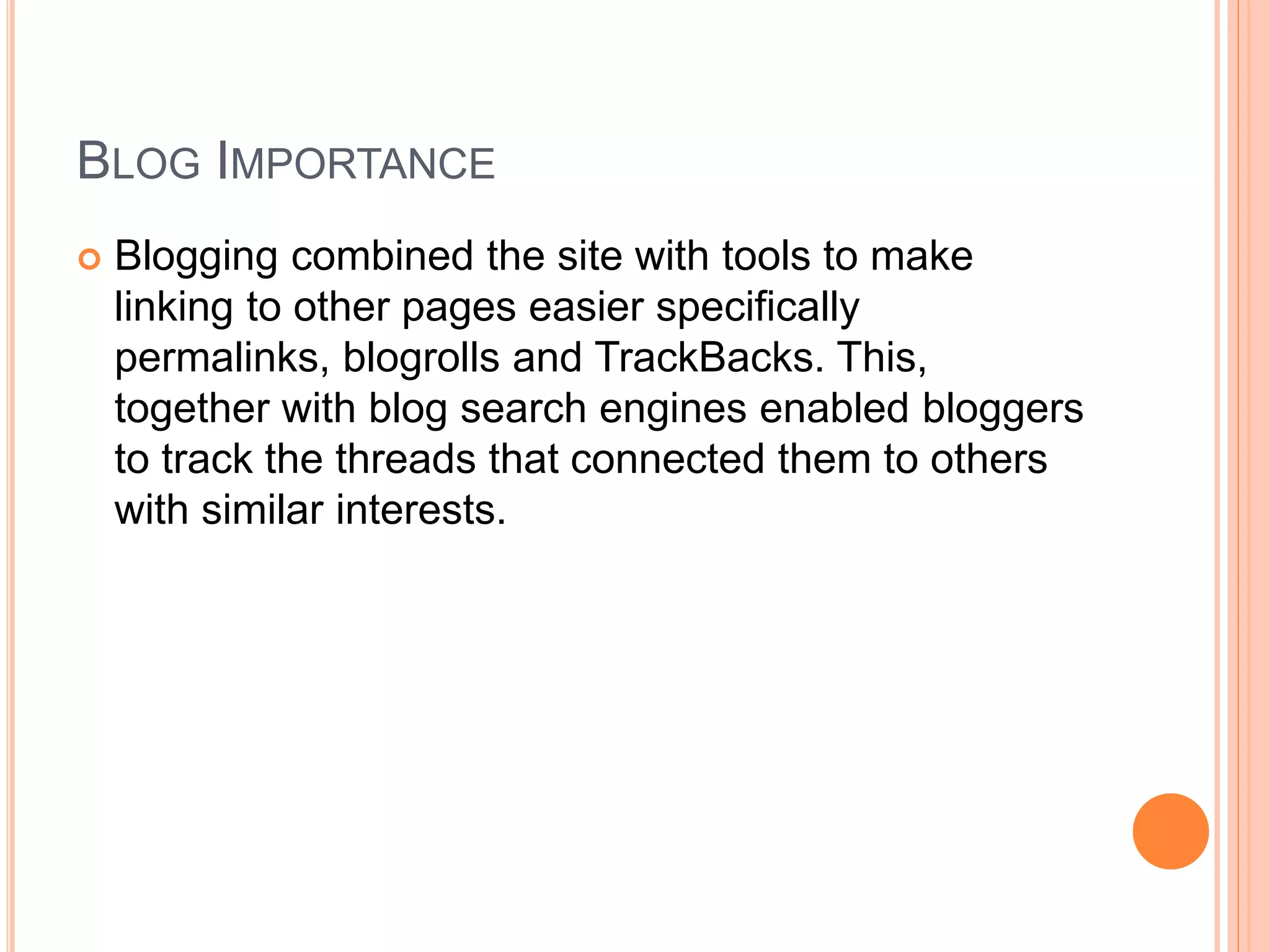
BLOG IMPORTANCE 
 Blogging combined the site with tools to make 
linking to other pages easier specifically 
permalinks, blogrolls and TrackBacks. This, 
together with blog search engines enabled bloggers 
to track the threads that connected them to others 
with similar interests.
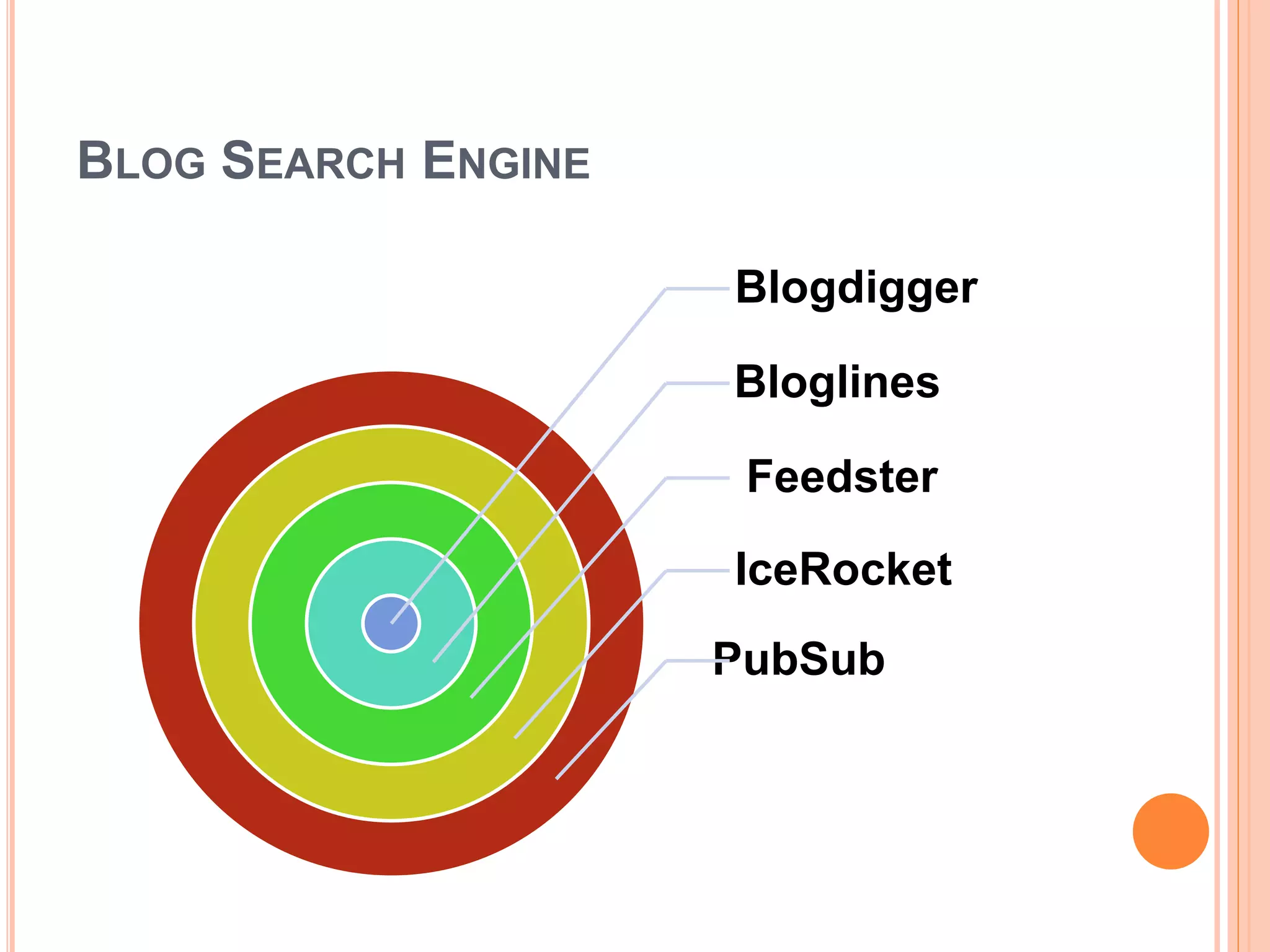
BLOG SEARCH ENGINE 
Blogdigger 
Bloglines 
Feedster 
IceRocket 
PubSub
BLOG HOSTING SERVICES 
 Blogs are generally hosted by dedicated blog 
hosting services or on regular web hosting services. 
Most of the free blog hosting services are ad-supported 
but generally have unlimited posting 
bandwidth and storage space. Generally, a small 
advertisement square banner is placed on the user 
blog, which does not affect the overall make up the 
said blog. Many blog hosting services also notified 
the blogger when someone adds some comments 
on his/her blog. Examples include the following
Blogger (https://www.blogger.com/start): Blogger was started 
by Evan Williams and Meg Hourihan (Pyra Labs of San 
Francisco) in August 1999 and was purchased by Google in 
February 2003. 
ii) coComment (http://www.cocomment.com/): coComment is 
a Swiss startup company funded by Swisscom Innovations 
and focused on providing high quality services to internet 
users worldwide. The company is based in Geneva, 
Switzerland. 
iii) LiveJournal (http://www.livejournal.com/): Brad Fitzpatrick 
started LiveJournal in March 1999. The LiveJournal can be 
used as a private journal, a blog, a discussion forum, a social 
network, and like other. 
iv) Open Diary (http://www.opendiary.com/): Launched in 
October 1998, soon growing to thousands of online diaries. 
Open Diary becomes the first blog community where readers 
could add comments to other writers' blog entries.
Pitas.com (http://www.pitas.com/): Andrew Smales 
created Pitas.com in July 1999 as an easier 
alternative to maintaining a "news page" on a 
website, followed by Diaryland in September 1999, 
focusing more on a personal diary community. 
Xanga (http://www.xanga.com/): Launched in 
1996, had only 100 diaries by 1997, but over 20 
million as of December 2005.
BEHAVIOR 
The Blogger's Code of Conduct is a proposal by Tim 
O'Reilly for bloggers to enforce civility on their blogs by being 
civil themselves and moderating comments on their blog. The 
code was proposed in 2007 due to threats made to 
blogger Kathy Sierra. The idea of the code was first reported 
by BBC News, who quoted O'Reilly saying, "I do think we 
need some code of conduct around what is acceptable 
behaviour, I would hope that it doesn't come through any kind 
of regulation it would come through self-regulation."[ 
O'Reilly and others came up with a list of seven proposed ideas:[ 
Take responsibility not just for your own words, but for the 
comments you allow on your blog. 
Label your tolerance level for abusive comments. 
Consider eliminating anonymous comments. 
Ignore the trolls.
 Take the conversation offline, and talk directly, or find an 
intermediary who can do so. 
 If you know someone who is behaving badly, tell them 
so. 
 Don't say anything online that you wouldn't say in 
person. 
 These ideas were predictably intensely discussed on the 
Web and in the media. While the internet has continued 
to grow, with online activity and discourse only picking 
up both in positive and negative ways in terms of blog 
interaction, the proposed Code has drawn more 
widespread attention to the necessity of monitoring 
blogging activity and social norms being as important 
online as offline.

Blog

  • 1.
  • 2.
    INTRODUCTION  Blog:The term "weblog" was coined by Jorn Barger on 17 December 1997. Then Peter Merholz, jokingly broke the word weblog into the phrase we blog in the sidebar of his blog Peterme.com in 1999, from where it becomes popular as "blog". Thus Blog is derived from Weblog. Blog or weblog is a web-based publication consisting primarily of periodic articles normally in reverse chronological order with reflections, comments, and often hyperlinks provided by the writer.
  • 3.
    Definition: Blogs havedifferent meaning to different people, ranging from “online journal” to “easily updated personal website”. A weblog is a journal (or newsletter) that is frequently updated and intended for general public consumption. Blogs generally represent the personality of the author or the Web site. According to Concept Websites Ltd (http://www.conceptwebsites.com/SEO/common-terms. htm), “a blog is basically a journal that is available on the web. The activity of updating a blog is "blogging" and someone who keeps a blog is a "blogger." Blogs are typically updated daily using software that allows people with little or no technical background to update and maintain the blog”.
  • 4.
    In simple, itcan be said that it is a web based website where articles posted will automatically be arranged in reverse chronological fashion or in a chronological fashion. The owner/member will post message which are sometimes rich with graph, audio, video and hyperlink periodically enabling others to view and comment. Topics often include the owner's/member’s daily life or views on a particular subject or topic of important to the group. The original post with its associated comments and discussion provide a very insight to the topic at hand. Many blogs are frequently updated and publicly accessible i.e they allow anybody to sign up at any time; some others are private where entry to the group is restricted. Some advanced users have server-side software, and often implement membership management and password protected areas. Others have created a mix of a blog and wiki, called a bliki.
  • 5.
    HISTORY At theinitial stage of internet development, Usenet, e-mail lists, Bulletin Board Systems (BBS), chronicles, commonplaces, diaries, and perzines were used as a form of Citizen Media. Bulletin Board is a service whereby messages and points of interest can be posted to be read and replied to unlike list server. The news group provides access to thousands of topic based discussion group services which are open to all. The news reader software allows one to post an article to any group for others to read. A comment to the message (original) can be added to the thread of the article. In recent times these are effectively replaced by the “blog”. During recent days, blog has evolved into a tool that offers some of the most insightful information on the Web. It provides self-publishing phenomenon represented by blogging and becoming much more common in LIS, as librarians, libraries and library associations have begun to blog as a way of communicating with their patrons and constituents. Many librarians world wide also publish their personal blogs that offer a wealth of information about librarianship, their parent institution and sometimes to their personal lives as well. The emergence of blogging provides a medium to give readers of the library new perspectives on the realities, as well as often offering different viewpoints from those of its official news sources. Many bloggers began to provide nearly-instant commentary on televised events, creating a secondary meaning of the word "blogging": to simultaneously transcribe and editorialize speeches and events shown on television (liveblogging).
  • 6.
    ANATOMY OF ABLOG ENTRY: Blog uses web interfaces that allow anyone over the Internet, to create blogs by their own. It usually does not demand the maintenance of server software by the users themselves. It also does not demand to go for the HTML. A blog entry typically consists of the following: Title: The main title, or headline, of the post; Body: Main content of the post; Permalink: The URL of the full, individual article; Post Date: Date and time the post published.
  • 7.
    BLOG TYPES There are various types of blogs, and each differs in the way content is delivered or written. A typical blog combines text, images, and links to other blogs, web pages, and other media related to its topic, the ability to quote another user's post with special formatting in ones post is also a special feature of many blogs. Generally, blog can be categorized as follows:
  • 8.
    Linklog: A blogcomprising links; Moblog: A blog written by a mobile phone or Personal Digital Assistant (PDA); Photoblog: A blog comprising photos; Podcasting: Blog containing audio; Vlog: A blog comprising videos.
  • 9.
    BLOG IMPORTANCE Blogging combined the site with tools to make linking to other pages easier specifically permalinks, blogrolls and TrackBacks. This, together with blog search engines enabled bloggers to track the threads that connected them to others with similar interests.
  • 11.
    BLOG SEARCH ENGINE Blogdigger Bloglines Feedster IceRocket PubSub
  • 12.
    BLOG HOSTING SERVICES  Blogs are generally hosted by dedicated blog hosting services or on regular web hosting services. Most of the free blog hosting services are ad-supported but generally have unlimited posting bandwidth and storage space. Generally, a small advertisement square banner is placed on the user blog, which does not affect the overall make up the said blog. Many blog hosting services also notified the blogger when someone adds some comments on his/her blog. Examples include the following
  • 13.
    Blogger (https://www.blogger.com/start): Bloggerwas started by Evan Williams and Meg Hourihan (Pyra Labs of San Francisco) in August 1999 and was purchased by Google in February 2003. ii) coComment (http://www.cocomment.com/): coComment is a Swiss startup company funded by Swisscom Innovations and focused on providing high quality services to internet users worldwide. The company is based in Geneva, Switzerland. iii) LiveJournal (http://www.livejournal.com/): Brad Fitzpatrick started LiveJournal in March 1999. The LiveJournal can be used as a private journal, a blog, a discussion forum, a social network, and like other. iv) Open Diary (http://www.opendiary.com/): Launched in October 1998, soon growing to thousands of online diaries. Open Diary becomes the first blog community where readers could add comments to other writers' blog entries.
  • 14.
    Pitas.com (http://www.pitas.com/): AndrewSmales created Pitas.com in July 1999 as an easier alternative to maintaining a "news page" on a website, followed by Diaryland in September 1999, focusing more on a personal diary community. Xanga (http://www.xanga.com/): Launched in 1996, had only 100 diaries by 1997, but over 20 million as of December 2005.
  • 15.
    BEHAVIOR The Blogger'sCode of Conduct is a proposal by Tim O'Reilly for bloggers to enforce civility on their blogs by being civil themselves and moderating comments on their blog. The code was proposed in 2007 due to threats made to blogger Kathy Sierra. The idea of the code was first reported by BBC News, who quoted O'Reilly saying, "I do think we need some code of conduct around what is acceptable behaviour, I would hope that it doesn't come through any kind of regulation it would come through self-regulation."[ O'Reilly and others came up with a list of seven proposed ideas:[ Take responsibility not just for your own words, but for the comments you allow on your blog. Label your tolerance level for abusive comments. Consider eliminating anonymous comments. Ignore the trolls.
  • 16.
     Take theconversation offline, and talk directly, or find an intermediary who can do so.  If you know someone who is behaving badly, tell them so.  Don't say anything online that you wouldn't say in person.  These ideas were predictably intensely discussed on the Web and in the media. While the internet has continued to grow, with online activity and discourse only picking up both in positive and negative ways in terms of blog interaction, the proposed Code has drawn more widespread attention to the necessity of monitoring blogging activity and social norms being as important online as offline.