The document discusses the integration of blockchain and artificial intelligence (AI), highlighting their combined benefits such as enhanced security, optimized energy consumption, and improved smart contracts. It also addresses challenges including privacy concerns, scalability, and a lack of regulations. Additionally, it emphasizes the importance of certification courses for professionals seeking to deepen their knowledge in this area.
What is
Artificial
Intelligence?
Artificial intelligenceis a human-
like intelligence simulation using
computers. Typically, computer
systems are programmed in a way
that will help the AI to imitate
human-like actions.
Unfortunately, no AI can fully
comprehend human activities or
actions as they’re very complicated
to simulate.
4.
What is
Blockchain?
Blockchain isa distributed ledger
system that eliminates the need for
any centralized authority and offers
security and privacy.
This technology is perfectly suited
to establish a fairer system that will
eliminate corruption and
fraudulent activities for good.
5.
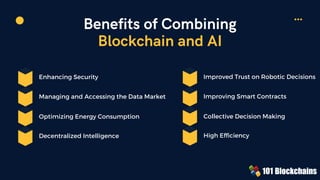
Benefits of Combining
Blockchainand AI
Enhancing Security
Optimizing Energy Consumption
Managing and Accessing the Data Market
Decentralized Intelligence
Improved Trust on Robotic Decisions
Collective Decision Making
Improving Smart Contracts
High Efficiency
6.
AI needs highvolumes of data being fed continuously;
blockchain can help to store these sensitive data
securely.
Using blockchain, experts can allow AI to use
encrypted data without exposing them.
AI can help to find out vulnerabilities in any
blockchain application using the machine learning
process.
Enhancing Security
7.
The public doesnot trust AI as it’s impossible to explain
why an AI makes a certain decision. Blockchain can
record all the decision-making processes and help AI to
gain trust from the public.
Blockchain can help AI be more transparent and help
analyze the data created by any AI.
Using blockchain, experts can be sure that all
information relating to AI are tamper-resistant and
authentic.
Improved Trust on Robotic Decisions
8.
Users can sellaccess to their personal data on the
blockchain and create a new marketplace for data
mining for AI.
Smaller startups and companies can use blockchain to
pool all of their information collection and challenge the
tech giants with a strong AI presence.
Blockchain ledger can act as the right training database
as AI needs to become an expert on a subject matter
faster.
Managing and Accessing the Data Market
9.
Data mining consumesa lot of energy, which negatively
affects our environment.
Machine learning can deal with this type of issue and
can offer modern solutions to reduce energy
consumption significantly.
Blockchain coupled with AI can use AI’s machine
learning capabilities to optimize their data
consumption, which will lower prices for any mining
hardware.
Optimizing Energy Consumption
10.
Blockchain uses smartcontracts, which are not smart enough
to detect any technical flaws themselves. Therefore, hackers
can easily use any loophole to exploit the contracts.
With AI, blockchain can help to audit smart contracts and get
rid of all technical issues.
AI can also review all conditions and adjust the smart
contracts based on the requirements.
Improving Smart Contracts
11.
The robotic swarmecosystem needs to make collective
decisions frequently. However, this ecosystem lacks the
environment to coordinate with each other.
Blockchain’s distributed and decentralized environment
can help to make decisions through majority voting.
Using blockchain, every single vote can be verified, and
the robotic swarm can take tamper-free decisions.
Collective Decision Making
12.
Instead of usinga single agent to perform several sub
tasks in blockchain AI, it can assign specific tasks to
specific agents.
All of these agents can have access to the common
training data or ledger system to improve their learning
capabilities from one another.
Also, Cybersecurity AI agents can use the ledger system
to coordinate security and solve any scheduling
problems.
Decentralized Intelligence
13.
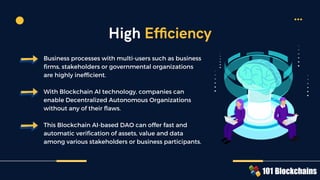
Business processes withmulti-users such as business
firms, stakeholders or governmental organizations
are highly inefficient.
With Blockchain AI technology, companies can
enable Decentralized Autonomous Organizations
without any of their flaws.
This Blockchain AI-based DAO can offer fast and
automatic verification of assets, value and data
among various stakeholders or business participants.
High Efficiency
14.
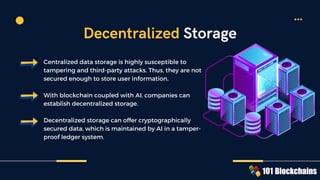
Centralized data storageis highly susceptible to
tampering and third-party attacks. Thus, they are not
secured enough to store user information.
With blockchain coupled with AI, companies can
establish decentralized storage.
Decentralized storage can offer cryptographically
secured data, which is maintained by AI in a tamper-
proof ledger system.
Decentralized Storage
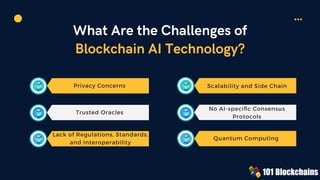
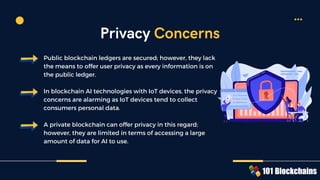
Public blockchain ledgersare secured; however, they lack
the means to offer user privacy as every information is on
the public ledger.
In blockchain AI technologies with IoT devices, the privacy
concerns are alarming as IoT devices tend to collect
consumers personal data.
A private blockchain can offer privacy in this regard;
however, they are limited in terms of accessing a large
amount of data for AI to use.
Privacy Concerns
17.
AI needs tohave scalability in order to function and
learn properly. However, blockchain can’t offer a
fully scalable system yet.
Specifically, public platforms tend to lose their
performance when a large amount of data needs to
get processed at the same time.
Blockchain needs more time to mature in order to
offer AI the full functionality it needs.
Scalability and Side Chains
18.
Smart contracts heavilydepend on oracles to pull data
from the outside world to trigger an event as these
contracts don’t have that function.
Oracles are centralized rather than decentralized, which
means they are susceptible to influences.
In blockchain AI technology, depending on such Oracles to
retrieve data can be problematic as it compromises data
integrity.
Trusted Oracles
19.
Blockchain uses consensusprotocols to maintain its
integrity and security. These protocols are heavily based on
blockchain technology itself.
If you couple blockchain with AI, blockchain needs to offer
AI-specific consensus protocols to enhance the quality of
machine learning.
Unfortunately, there aren’t any efficient AI-specific
consensus protocols that can offer the highest level of
security for AI.
No AI-specific Consensus Protocols
20.
To date, blockchainlacks the necessary structure for
proper standards or regulations.
Ethereum and other platforms do offer standards;
however, these standards are not universal; thus, it creates
conflicts between two different blockchain platforms.
Without specific standards in place, an AI can’t
communicate with another AI seamlessly using the
platform.
Lack of Regulations, Standards,
and Interoperability
21.
Blockchain’s reputation restsheavily on the fact that
it can offer cryptography, which is almost
unbreakable.
But due to the emergence of Quantum Computing,
blockchain can lose its value, as Quantum
computers can crack the public key encryption.
Blockchain AI systems need to offer quantum-safe
encryption processes to safeguard the data from
cyber-criminals.
Quantum Computing
Why You MustGo With 101 Blockchains
Certification Courses?
High-Quality Research Information
First-class Training Content
Interactive Exercises
Flexible Learning Using Modular
Approach
Access to Bonus Training Materials
Various Training Strategies for Faster
Learning
Tangible Proof of Course Completion
Weekly Hands-on Assignments
Professional Instructors
Premium Support