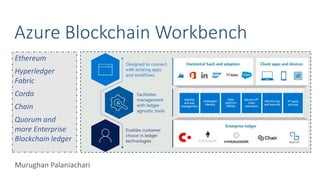
Azure Blockchain Workbench
Ethereum
Hyperledger
Fabric
Corda
Chain
Quorum and
more Enterprise
Blockchain ledger
Murughan Palaniachari
http://www.unicomlearning.com/2017/Devops_Microservices_and_Containers_Summit_Bangalore/
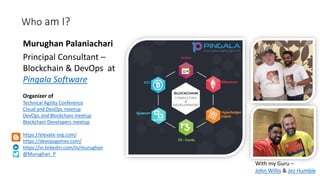
Who am I?
Murughan Palaniachari
Principal Consultant –
Blockchain & DevOps at
Pingala Software
With my Guru –
John Willis & Jez Humble
Organizer of
Technical Agility Conference
Cloud and DevOps meetup
DevOps and Blockchain meetup
Blockchain Developers meetup
https://elevate-org.com/
https://devopsgames.com/
https://in.linkedin.com/in/murughan
@Murughan_P
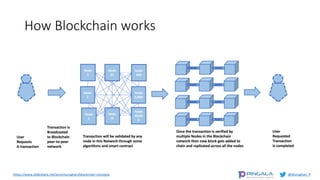
How Blockchain works
Node
2
Node
5,000
Node
N
Node
25
Transaction is
Broadcasted
to Blockchain
peer-to-peer
network
User
Requests
A transaction
Transaction will be validated by any
node in this Network through some
algorithms and smart contract
Once the transaction is verified by
multiple Nodes in the Blockchain
network then new block gets added to
chain and replicated across all the nodes
User
Requested
Transaction
Is completed
Node
500
Node
5
Node
1
Node
20,00
0
@Murughan_Phttps://www.slideshare.net/arunmurughan/blockchain-concepts
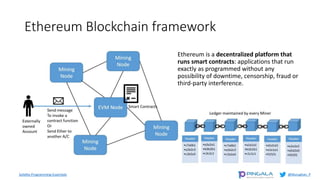
Ethereum Blockchain framework
Ethereum is a decentralized platform that
runs smart contracts: applications that run
exactly as programmed without any
possibility of downtime, censorship, fraud or
third-party interference.
Solidity-Programming-Essentials @Murughan_P
Characteristics of Blockchain
Distributed
Ledger
Decentralized
Immutable
Encrypted
Smart
Contract
Traceable
@Murughan_P
Smart Contract
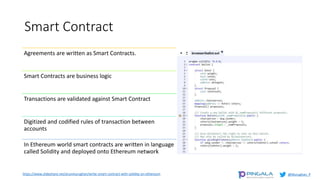
Agreements are written as Smart Contracts.
Smart Contracts are business logic
Transactions are validated against Smart Contract
Digitized and codified rules of transaction between
accounts
In Ethereum world smart contracts are written in language
called Solidity and deployed onto Ethereum network
@Murughan_Phttps://www.slideshare.net/arunmurughan/write-smart-contract-with-solidity-on-ethereum
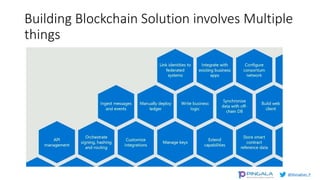
Building Blockchain Solution involves Multiple
things
@Murughan_P
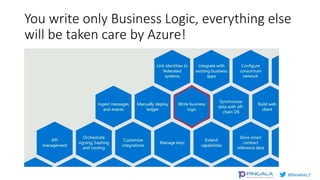
You write only Business Logic, everything else
will be taken care by Azure!
@Murughan_P
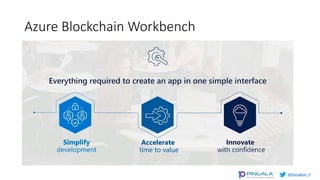
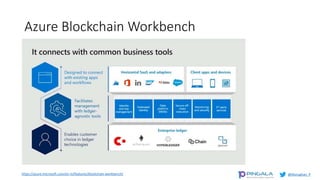
Azure Blockchain Workbench
@Murughan_P
Azure Blockchain Workbench
https://azure.microsoft.com/en-in/features/blockchain-workbench/ @Murughan_P
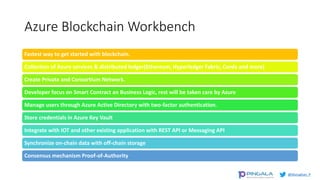
Azure Blockchain Workbench
Fastest way to get started with blockchain.
Collection of Azure services & distributed ledger(Ethereum, Hyperledger Fabric, Corda and more)
Create Private and Consortium Network.
Developer focus on Smart Contract an Business Logic, rest will be taken care by Azure
Manage users through Azure Active Directory with two-factor authentication.
Store credentials in Azure Key Vault
Integrate with IOT and other existing application with REST API or Messaging API
Synchronize on-chain data with off-chain storage
Consensus mechanism Proof-of-Authority
@Murughan_P
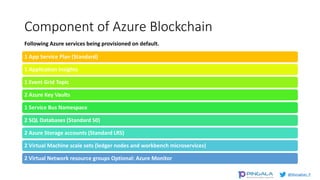
Component of Azure Blockchain
1 App Service Plan (Standard)
1 Application Insights
1 Event Grid Topic
2 Azure Key Vaults
1 Service Bus Namespace
2 SQL Databases (Standard S0)
2 Azure Storage accounts (Standard LRS)
2 Virtual Machine scale sets (ledger nodes and workbench microservices)
2 Virtual Network resource groups Optional: Azure Monitor
Following Azure services being provisioned on default.
@Murughan_P
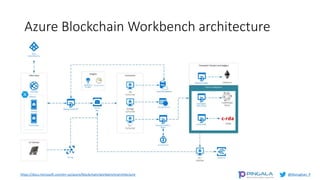
Azure Blockchain Workbench architecture
https://docs.microsoft.com/en-us/azure/blockchain/workbench/architecture @Murughan_P
Azure Blockchain Workbench architecture
• Identity and authentication
• Enterprise identity and user management through Azure Active Directory
• Client Application
• Automatically generates client applications for web and mobile.
• Upload and deploy your own smart contracts.
• The application interface is dynamically generated based on smart contract
metadata.
• Assign a user access to the smart contract in the context of a specific role.
• Gateway service API
• Blockchain Workbench includes a REST-based gateway service API.
• When data is requested by the API, queries are sent to the off-chain SQL database.
@Murughan_P
Azure Blockchain Workbench architecture
• Message broker
• Incoming messages
• Send messages directly to Service Bus
• Downstream consumers
• One consumer is triggered by blockchain events to populate the off-chain SQL store.
• The other consumer is to capture metadata for events generated by the API related to
the upload and storage of documents.
• Message consumers
• Below message consumers take messages from Service Bus.
• Distributed ledger consumer
• Database consumer
• Storage consumer
@Murughan_P
Azure Blockchain Workbench architecture
• Transaction builder and signer
• DLT processes writing inbound messages to blockchain
• Private keys are stored in Azure Key Vault.
• Blockchain Workbench retrieves the appropriate private key from Key Vault and signs
the transaction outside of Key Vault.
• Once signed, the transaction is sent to transaction routers and ledgers.
• Transaction routers and ledgers
• Transaction routers and ledgers take signed transactions and route them to the
appropriate blockchain
• DLT watcher
• A distributed ledger technology (DLT) watcher monitors events occurring on block
chains attached to Blockchain Workbench.
@Murughan_P
Azure Blockchain Workbench architecture
• Azure SQL database
• The Azure SQL database attached to Blockchain Workbench stores contract
definitions, configuration metadata, and a SQL-accessible replica of data stored in
the blockchain.
• This data can easily be queried, visualized, or analyzed by directly accessing the
database.
• This off-chain storage provides the ability for enterprise organizations to query data
in SQL rather than in a blockchain ledger.
• Azure Storage
• Azure Storage is used to store contracts and metadata associated with contracts.
• Monitoring
• Workbench provides application logging using Application Insights and Azure
Monitor. Application Insights is used to store all logged information from Blockchain
Workbench and includes errors, warnings, and successful operations.
@Murughan_P
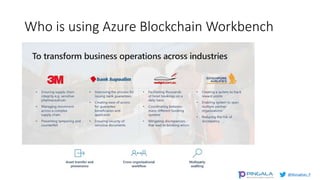
Who is using Azure Blockchain Workbench
@Murughan_P
DEMO
Step by step guide to Build and Deploy Asset Transfer Dapp with Ethereum
https://elevate-org.com/2018/11/15/step-by-step-guide-to-create-and-
deploy-asset-transfer-dapp-through-azure-blockchain-workbench/
@Murughan_P
Reference/Further reading
• https://docs.microsoft.com/en-us/azure/blockchain/workbench/
• Azure Blockchain Github
• https://elevate-org.com/
@Murughan_P

Azure Blockchain Workbench

  • 1.
    Azure Blockchain Workbench Ethereum Hyperledger Fabric Corda Chain Quorumand more Enterprise Blockchain ledger Murughan Palaniachari
  • 2.
    http://www.unicomlearning.com/2017/Devops_Microservices_and_Containers_Summit_Bangalore/ Who am I? MurughanPalaniachari Principal Consultant – Blockchain & DevOps at Pingala Software With my Guru – John Willis & Jez Humble Organizer of Technical Agility Conference Cloud and DevOps meetup DevOps and Blockchain meetup Blockchain Developers meetup https://elevate-org.com/ https://devopsgames.com/ https://in.linkedin.com/in/murughan @Murughan_P
  • 3.
    How Blockchain works Node 2 Node 5,000 Node N Node 25 Transactionis Broadcasted to Blockchain peer-to-peer network User Requests A transaction Transaction will be validated by any node in this Network through some algorithms and smart contract Once the transaction is verified by multiple Nodes in the Blockchain network then new block gets added to chain and replicated across all the nodes User Requested Transaction Is completed Node 500 Node 5 Node 1 Node 20,00 0 @Murughan_Phttps://www.slideshare.net/arunmurughan/blockchain-concepts
  • 4.
    Ethereum Blockchain framework Ethereumis a decentralized platform that runs smart contracts: applications that run exactly as programmed without any possibility of downtime, censorship, fraud or third-party interference. Solidity-Programming-Essentials @Murughan_P
  • 5.
  • 6.
    Smart Contract Agreements arewritten as Smart Contracts. Smart Contracts are business logic Transactions are validated against Smart Contract Digitized and codified rules of transaction between accounts In Ethereum world smart contracts are written in language called Solidity and deployed onto Ethereum network @Murughan_Phttps://www.slideshare.net/arunmurughan/write-smart-contract-with-solidity-on-ethereum
  • 7.
    Building Blockchain Solutioninvolves Multiple things @Murughan_P
  • 8.
    You write onlyBusiness Logic, everything else will be taken care by Azure! @Murughan_P
  • 9.
  • 10.
  • 11.
    Azure Blockchain Workbench Fastestway to get started with blockchain. Collection of Azure services & distributed ledger(Ethereum, Hyperledger Fabric, Corda and more) Create Private and Consortium Network. Developer focus on Smart Contract an Business Logic, rest will be taken care by Azure Manage users through Azure Active Directory with two-factor authentication. Store credentials in Azure Key Vault Integrate with IOT and other existing application with REST API or Messaging API Synchronize on-chain data with off-chain storage Consensus mechanism Proof-of-Authority @Murughan_P
  • 12.
    Component of AzureBlockchain 1 App Service Plan (Standard) 1 Application Insights 1 Event Grid Topic 2 Azure Key Vaults 1 Service Bus Namespace 2 SQL Databases (Standard S0) 2 Azure Storage accounts (Standard LRS) 2 Virtual Machine scale sets (ledger nodes and workbench microservices) 2 Virtual Network resource groups Optional: Azure Monitor Following Azure services being provisioned on default. @Murughan_P
  • 13.
    Azure Blockchain Workbencharchitecture https://docs.microsoft.com/en-us/azure/blockchain/workbench/architecture @Murughan_P
  • 14.
    Azure Blockchain Workbencharchitecture • Identity and authentication • Enterprise identity and user management through Azure Active Directory • Client Application • Automatically generates client applications for web and mobile. • Upload and deploy your own smart contracts. • The application interface is dynamically generated based on smart contract metadata. • Assign a user access to the smart contract in the context of a specific role. • Gateway service API • Blockchain Workbench includes a REST-based gateway service API. • When data is requested by the API, queries are sent to the off-chain SQL database. @Murughan_P
  • 15.
    Azure Blockchain Workbencharchitecture • Message broker • Incoming messages • Send messages directly to Service Bus • Downstream consumers • One consumer is triggered by blockchain events to populate the off-chain SQL store. • The other consumer is to capture metadata for events generated by the API related to the upload and storage of documents. • Message consumers • Below message consumers take messages from Service Bus. • Distributed ledger consumer • Database consumer • Storage consumer @Murughan_P
  • 16.
    Azure Blockchain Workbencharchitecture • Transaction builder and signer • DLT processes writing inbound messages to blockchain • Private keys are stored in Azure Key Vault. • Blockchain Workbench retrieves the appropriate private key from Key Vault and signs the transaction outside of Key Vault. • Once signed, the transaction is sent to transaction routers and ledgers. • Transaction routers and ledgers • Transaction routers and ledgers take signed transactions and route them to the appropriate blockchain • DLT watcher • A distributed ledger technology (DLT) watcher monitors events occurring on block chains attached to Blockchain Workbench. @Murughan_P
  • 17.
    Azure Blockchain Workbencharchitecture • Azure SQL database • The Azure SQL database attached to Blockchain Workbench stores contract definitions, configuration metadata, and a SQL-accessible replica of data stored in the blockchain. • This data can easily be queried, visualized, or analyzed by directly accessing the database. • This off-chain storage provides the ability for enterprise organizations to query data in SQL rather than in a blockchain ledger. • Azure Storage • Azure Storage is used to store contracts and metadata associated with contracts. • Monitoring • Workbench provides application logging using Application Insights and Azure Monitor. Application Insights is used to store all logged information from Blockchain Workbench and includes errors, warnings, and successful operations. @Murughan_P
  • 18.
    Who is usingAzure Blockchain Workbench @Murughan_P
  • 19.
    DEMO Step by stepguide to Build and Deploy Asset Transfer Dapp with Ethereum https://elevate-org.com/2018/11/15/step-by-step-guide-to-create-and- deploy-asset-transfer-dapp-through-azure-blockchain-workbench/ @Murughan_P
  • 20.
    Reference/Further reading • https://docs.microsoft.com/en-us/azure/blockchain/workbench/ •Azure Blockchain Github • https://elevate-org.com/ @Murughan_P