BLOCKCHAIN, HYPERLEDGER,WEB 3.0
UNDERSTANDING AND CONCEPTS
Pradeep Keith Fernandez – CISSP, CISA, CIPT
Disclaimer:All the content that is presented in these slides are content from various articles, youtube videos and magazines on the internet. I have just summarized my thoughts basis
this understanding and is meant for educational purposes for those that wish to learn more on these topics.These thoughts, opinions and understanding are solely my own and do not
represent in any way anybody or any organization that I am associated with.
Blockchain and Key elements
• A blockchain is a distributed ledger that is open to anyone that facilitates the process of
recording transactions and tracking assets in a business network
• It is a system in which a record of transactions are maintained across several computers that
are linked in a peer-to-peer network
• A blockchain collects information together in groups, known as blocks, that hold sets of
information.
• Blocks have certain storage capacities and, when filled, are closed and linked to the previously
filled block using the hash of the previous block, forming a chain of data known as blockchain
• If one user tampers with a block’s record of transactions, all other nodes would cross-
reference each other and easily pinpoint the node with the incorrect information.
• Blockchain is ideal for delivering faster, reliable and accurate information because it provides
immediate, shared and completely transparent information stored on a distributed
immutable ledger that can be accessed only by network members
Nodes & Blocks
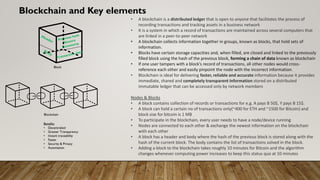
• A block contains collection of records or transactions for e.g. A pays B 50$, Y pays B 15$.
• A block can hold a certain no of transactions only(~400 for ETH and ~1500 for Bitcoin) and
block size for bitcoin is 1 MB
• To participate in the blockchain, every user needs to have a node/device running
• Nodes are connected to each other & exchange the newest information on the blockchain
with each other
• A block has a header and body where the hash of the previous block is stored along with the
hash of the current block. The body contains the list of transactions solved in the block.
• Adding a block to the blockchain takes roughly 10 minutes for Bitcoin and the algorithm
changes whenever computing power increases to keep this status quo at 10 minutes
Block
Blockchain
Benefits
• Decentralied
• Greater Transparency
• Instant traceability
• Faster
• Security & Privacy
• Automation
Blockchain - Mining
Mining (Proof of Work consensus)
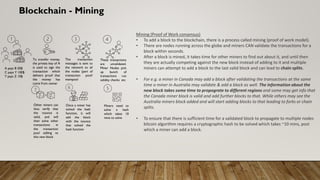
• To add a block to the blockchain, there is a process called mining (proof of work model).
• There are nodes running across the globe and miners CAN validate the transactions for a
block within seconds.
• After a block is mined, it takes time for other miners to find out about it, and until then
they are actually competing against the new block instead of adding to it and multiple
miners can attempt to add a block to the last valid block and can lead to chain splits.
• For e.g. a miner in Canada may add a block after validating the transactions at the same
time a miner in Australia may validate & add a block as well. The information about the
new block takes some time to propograte to different regions and some may get info that
the Canada miner block is valid and add further blocks to that. While others may see the
Australia miners block added and will start adding blocks to that leading to forks or chain
splits.
• To ensure that there is sufficient time for a validated block to propagate to multiple nodes
bitcoin algorithm requires a cryptographic hash to be solved which takes ~10 mins, post
which a miner can add a block.
A pays B 50$
C pays Y 100$
Y pays Z 10$
The transaction
messages is sent to
the network to all
the nodes (part of
transaction pool/
mempool
These transactions
are unvalidated.
Miner Nodes pick
up bunch of
transactions run
validity checks etc
To transfer money,
the private key of A
is used to sign the
transaction which
delivers proof that
the money has
come from owner
Miners need to
solve a hash
which takes 10
mins to solve
Once a miner has
solved the hash
function, it will
add the block
with the nounce
that solved the
hash function
Other miners can
thus verify that
the nounce is
valid, and will
then solve other
transactions in
the transaction
pool adding to
this new block
Blockchain – Hashing algorithm
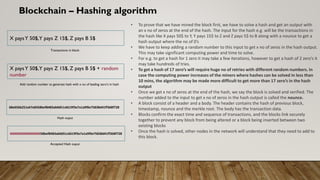
• To prove that we have mined the block first, we have to solve a hash and get an output with
an x no of zeros at the end of the hash. The input for the hash e.g. will be the transactions in
the hash like X pays 50$ to Y, Y pays 15$ to Z and Z pays 5$ to B along with a nounce to get a
hash output where the no of 0’s
• We have to keep adding a random number to this input to get x no of zeros in the hash output.
This may take significant computing power and time to solve.
• For e.g. to get a hash for 1 zero it may take a few iterations, however to get a hash of 2 zero’s it
may take hundreds of tries.
• To get a hash of 17 zero’s will require huge no of retries with different random numbers. In
case the computing power increases of the miners where hashes can be solved in less than
10 mins, the algorithm may be made more difficult to get more than 17 zero’s in the hash
output
• Once we get x no of zeros at the end of the hash, we say the block is solved and verified. The
number added to the input to get x no of zeros in the hash output is called the nounce.
• A block consist of a header and a body. The header contains the hash of previous block,
timestamp, nounce and the merkle root. The body has the transaction data.
• Blocks confirm the exact time and sequence of transactions, and the blocks link securely
together to prevent any block from being altered or a block being inserted between two
existing blocks
• Once the hash is solved, other nodes in the network will understand that they need to add to
this block.
X paysY 50$,Y pays Z 15$, Z pays B 5$
Transactions in block
Add random number to generate hash with x no of leading zero’s in hash
X paysY 50$,Y pays Z 15$, Z pays B 5$ + random
number
68e656b251e67e8358bef8483ab0d51c6619f3e7a1a9f0e75838d41ff368f728
Hash ouput
0000000000000000058bef8483ab0d51c6619f3e7a1a9f0e75838d41ff368f728
Accepted Hash ouput
Blockchain permissioned vs permissionless
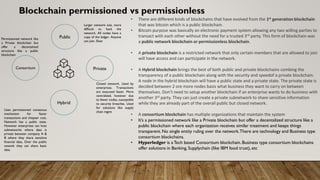
• There are different kinds of blockchains that have evolved from the 1st generation blockchain
that was bitcoin which is a public blockchain.
• Bitcoin purpose was basically an electronic payment system allowing any two willing parties to
transact with each other without the need for a trusted 3rd party. This form of blockchain was
a public network blockchain or permissionless blockchain.
• A private blockchain is a restricted network that only certain members that are allowed to join
will have access and can participate in the network.
• A Hybrid blockchain brings the best of both public and private blockchains combing the
transparency of a public blockchain along with the security and speedof a private blockchain.
A node in the hybrid blockchain will have a public state and a private state. The private state is
decided between 2 ore more nodes basis what business they want to carry on between
themselves. Don’t need to setup another blockchain if an enterprise wants to do business with
another 3rd party. They can just create a private subnetwork to share sensitive information
while they are already part of the overall public but closed network.
• A consortium blockchain has multiple organizations that maintain the system
• It’s a permissioned network like a Private blockchain but offer a decentalized structure like a
public blockchain where each organization receives similar treatment and keeps things
transparent. No single entity ruling over the network.There are technology and Business type
consortium blockchains.
• Hyperledger is a Tech based Consortium blockchain. Business type consortium blockchains
offer solutions in Banking, Supplychain (like IBM food trust), etc
Public
Private
Hybrid
Consortium
Larger network size, more
difficult to hack the
network. All nodes have a
copy of the ledger. Anyone
can join. Slow
Closed network. Used by
enterprises. Transactions
are executed faster. More
centralized, however due
to fewer nodes, susceptible
to security breaches. Used
for solutions like supply
chain mgmt
Uses permissioned consensus
mechanism for faster
transactions and chepaer cost.
Network has a public state.
However enterprises can host
subnetworks where data is
private between company A &
B where they share sensitive
financial data, Over the public
newotk they can share basic
data.
Permissioned network like
a Private blockchain but
offer a decentalized
structure like a public
blockchain
HyperLedger - Fabric
• In 2016, the Linux Foundation launched Hyperledger to democratize and standardize
Blockchain for the business world. Hyperledger is an open-source collaborative effort created
to advance cross-industry blockchain technologies
• Allows organizations to build custom Blockchain apps to cater to their specific business needs.
• HyperLedgers has multiple frameworks like Fabric, Burrow, Sawtooth, Grid, etc
Fabric
• Hyperledger Fabric is a permissioned Blockchain infrastructure with a modular architecture
wherein there’s a delineation of roles between the nodes in the infrastructure, the execution
of smart contracts, along with configurable consensus and membership services.
• In a Fabric network, there is a membership service that handles identity for users transacting
via a digital certificate. The certificate is used to sign transactions and submit them onto the
blockchain as well as basis their identity access permissions are provided to perform certain
transactions.
• The CA is a pluggable module and you can use the Fabric CA or an external CA
• Client Apps are written in any language like node.JS, Python and Java and interact with the
blockchain network via SDK’s/Hyperledger Fabric client.
• There are different peer nodes called endorsers and committers. An organization can run
multiple peers and there could be multiple organizations as part of the network
Client App
SDK
HFC
External CA Fabric CA
Membership
Services
Endorser Peer
Committer Peer
Blockchain
ChainCode
Events
World State
peer
HyperLedger Fabric Network
Ordering Service
Endorsment Policy
BESU BURROW
FABRIC
INDY
SAWTOOTH
Different types of Hyperledger's
HyperLedger – Fabric Consensus Flow
Fabric Consensus flow
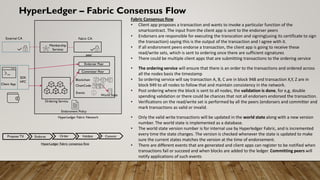
• Client app proposes a transaction and wants to invoke a particular function of the
smartcontract. The input from the client app is sent to the endorser peers
• Endorsers are responsible for executing the transcation and signing(using its certificate to sign
the transaction) saying this is the output of the transaction and I agree with it.
• If all endorsment peers endorse a transaction, the client app is going to receive these
read/write sets, which is sent to ordering once there are sufficient signatures
• There could be multiple client apps that are submitting transactions to the ordering service
• The ordering service will ensure that there is an order to the transactions and ordered across
all the nodes basis the timestamp
• So ordering service will say transaction A, B, C are in block 948 and transaction X,Y, Z are in
block 949 to all nodes to follow that and maintain consistency in the network.
• Post ordering where the block is sent to all nodes, the validation is done, for e,g, double
spending validation or there could be chances that not all endorsers endorsed the transaction.
• Verifications on the read/write set is performed by all the peers (endorsers and committer and
mark transactions as valid or invalid.
• Only the valid write transactions will be updated in the world state along with a new version
number. The world state is implemented as a database.
• The world state version number is for internal use by Hyperledger Fabric, and is incremented
every time the state changes. The version is checked whenever the state is updated to make
sure the current states matches the version at the time of endorsement.
• There are different events that are generated and client apps can register to be notified when
transactions fail or succeed and when blocks are added to the ledger. Committing peers will
notify applications of such events
Propose TX Endorse Order Validate Commit
HyperLedger Fabric consensus flow
Client App
SDK
HFC
External CA Fabric CA
Membership
Services
Endorser Peer
Committer Peer
Blockchain
ChainCode
Events
World State
peer
HyperLedger Fabric Network
Ordering Service
Endorsment Policy
SmartContracts
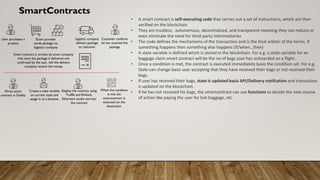
• A smart contract is self-executing code that carries out a set of instructions, which are then
verified on the blockchain
• They are trustless, autonomous, decentralized, and transparent meaning they can reduce or
even eliminate the need for third-party intermediaries
• The code defines the mechanisms of the transaction and is the final arbiter of the terms. If
something happens then something else happens (if/when…then)
• A state variable is defined which is stored in the blockchain. For e.g. a state variable for an
baggage claim smart contract will be the no of bags user has onboarded on a flight.
• Once a condition is met, the contract is executed immediately basis the condition set. For e,g.
State can change basis user accepting that they have received their bags or not received their
bags.
• If user has received their bags, state is updated basis API/Delivery notifcation and transaction
is updated on the blockchain.
• If he has not received his bags, the smartcontract can use functions to decide the next course
of action like paying the user for lost baggage, etc
User purchases a
product
Write smart
contract in Solidty
Ecom provider
sends package via
logistics company
Smart contract is written by ecom company
that once the package is delivered and
confirmed by the user, will the delivery
company receive the money
Create a state variable
on current state and
assign it to a function
Deploy the contract using
Truffle and Embark,
Ethereum studio and test
the contract
When the condition
is met the
smartcontract is
executed on the
blockchain
logistics company
delivers package
to customer
Customer confirms
he has received the
package
SideChains & Layer 2 scaling solution (off-chain)
• Layer 2 scaling solutions are built on top of Main chain using existing elements like smart contracts
• Main chains are really slow and if we try to speed them up they arent as secure or as safe. Also
transaction/gas fees are very high on the main chain with validators/miners solving only high worth
transactions keeping many transactions pending.
• There is a tradeoff between security, decentralization and speed of transactions
• Scalability shouldn’t come at the expense of Security and Decentralization so its best to use layer 2
scaling and not compromise on security in the main chain
Sidechain
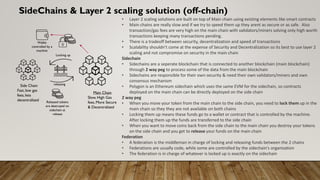
• Sidechains are a seperate blockchain that is connected to another blockchain (main blockchain)
through 2 way peg to process some of the data from the main blockchain
• Sidechains are responsible for their own security & need their own validators/miners and own
consensus mechanism
• Polygon is an Ethereum sidechain which uses the same EVM for the sidechain, so contracts
deployed on the main chain can be directly deployed on the side chain
2 way peg
• When you move your token from the main chain to the side chain, you need to lock them up in the
main chain so they they are not available on both chains
• Locking them up means these funds go to a wallet or contract that is controlled by the machine.
After locking them up the funds are transferred to the side chain
• When you want to move coins back from the side chain to the main chain you destroy your tokens
on the side chain and you get to release your funds on the main chain
Federation
• A federation is the middleman in charge of locking and releasing funds between the 2 chains
• Federations are usually code, while some are controlled by the sidechain's organization
• The federation is in charge of whatever is locked up is exactly on the sidechain
Main Chain
Slow, High Gas
fees, More Secure
& Decentralized
Side Chain
Fast, low gas
fees, less
decentralized
Locking up
releasing
Wallet
controlled by a
machine
Released tokens
are destroyed on
sidechain at
release
Writing Smart Contracts
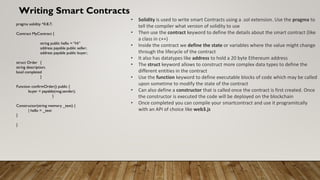
• Solidity is used to write smart Contracts using a .sol extension. Use the pragma to
tell the compiler what version of solidity to use
• Then use the contract keyword to define the details about the smart contract (like
a class in c++)
• Inside the contract we define the state or variables where the value might change
through the lifecycle of the contract
• It also has datatypes like address to hold a 20 byte Ethereum address
• The struct keyword allows to construct more complex data types to define the
different entities in the contract
• Use the function keyword to define executable blocks of code which may be called
upon sometime to modify the state of the contract
• Can also define a constructor that is called once the contract is first created. Once
the constructor is executed the code will be deployed on the blockchain
• Once completed you can compile your smartcontract and use it programitcally
with an API of choice like web3.js
pragma solidity ^0.8.7;
Contract MyContract {
string public hello = “Hi”
address payable public seller;
address payable public buyer;
struct Order {
string description;
bool completed
}
Function confirmOrder() public {
buyer = payable(msg.sender);
}
Constructor(string memory _text) {
| hello = _text
}
}
Validator Nodes
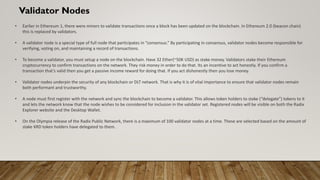
• Earlier in Ethereum 1, there were miners to validate transactions once a block has been updated on the blockchain. In Ethereum 2.0 (beacon chain)
this is replaced by validators.
• A validator node is a special type of full node that participates in “consensus.” By participating in consensus, validator nodes become responsible for
verifying, voting on, and maintaining a record of transactions.
• To become a validator, you must setup a node on the blockchain. Have 32 Ether(~50K USD) as stake money. Validators stake their Ethereum
cryptocurrency to confirm transactions on the network. They risk money in order to do that. Its an incentive to act honestly. If you confirm a
transaction that’s valid then you get a passive income reward for doing that. If you act dishonestly then you lose money.
• Validator nodes underpin the security of any blockchain or DLT network. That is why it is of vital importance to ensure that validator nodes remain
both performant and trustworthy.
• A node must first register with the network and sync the blockchain to become a validator. This allows token holders to stake (“delegate”) tokens to it
and lets the network know that the node wishes to be considered for inclusion in the validator set. Registered nodes will be visible on both the Radix
Explorer website and the Desktop Wallet.
• On the Olympia release of the Radix Public Network, there is a maximum of 100 validator nodes at a time. These are selected based on the amount of
stake XRD token holders have delegated to them.
Validator Nodes
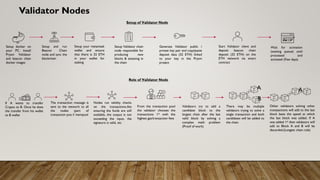
Setup Validator chain
node responsible for
producing new
blocks & attesting in
the chain
Setup your metamask
wallet and ensure
that there is 32 ETH
in your wallet for
staking
Generate Validator public /
private key pair and copy/paste
deposit data (32 ETH) linked
to your key in the Prysm
project
Wait for activation
(waiting queue) until
processed and
activated (Few days)
Setup docker on
your PC. Install
Prysm Validator
and beacon chain
docker images
Setup of Validator Node
Role of Validator Node
If A wants to transfer
Crypto to B. Once he does
the transfer from his wallet
to B wallet
The transaction message is
sent to the network to all
the nodes (part of
transaction poo l/ mempool
Nodes run validity checks
on the transactions.like
ensuring the funds are still
available, the output is not
exceeding the input, the
signature is valid, etc
Start Validator client and
deposit beacon chain
deposit (32 ETH) on the
ETH network via smart
contract
Setup and run
Beacon Chain
node and sync the
blockchain
Validators try to add a
candidate block to the
largest chain after the last
valid block by solving a
complex math problem
(Proof of work)
From the transaction pool
the validator chooses the
transactions 1st with the
highest gas/transaction fees
Other validators solving other
tranasactions will add to the last
block basis the speed at which
the last block was added. If A
was added 1st then validators will
add to Block A and B will be
discarded.(Longest chain rule)
There may be multiple
validators trying to solve a
single transaction and both
candidates will be added to
the chain
A
B
A
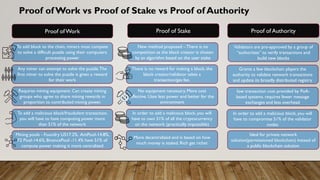
Proof of Work vs Proof of Stake vs Proof of Authority
Proof of Work Proof of Stake
To add block to the chain, miners must compete
to solve a difficult puzzle using their computers
processing power
New method proposed –There is no
competition as the block creator is chosen
by an algorithm based on the user stake
Any miner can attempt to solve the puzzle.The
first miner to solve the puzzle is given a reward
for their work
There is no reward for making a block, the
block creator/validator takes a
transaction/gas fee.
Requires mining equipment. Can create mining
groups who agree to share mining rewards in
proportion to contributed mining power.
No equipment necessary. More cost
effective. Uses less power and better for the
environment
To add a malicious block/fraudulent transaction,
you will have to have computing power more
than 51% of the network
In order to add a malicious block, you will
have to own 51% of all the cryptocurrency
on the network (practically impossible)
Mining pools - Foundry US17.2%, AntPool-14.8%,
F2 Pool-14.6%, BinancePool -11.4% have 51% of
compute power making it more centralized
More decentralized and is based on how
much money is staked. Rich get richer.
Ideal for private network
solution(permissioned blockchain) instead of
a public blockchain solution
Proof of Authority
Validators are pre-approved by a group of
“authorities” to verify transactions and
build new blocks
Grants a few blockchain players the
authority to validate network transactions
and update its broadly distributed registry
low transaction cost provided by PoA-
based systems. requires fewer message
exchanges and less overhead
In order to add a malicious block, you will
have to compromise 51% of the validator
nodes
What is DeFi
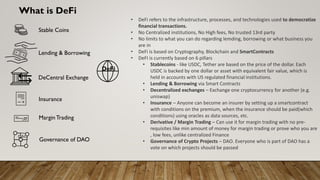
• DeFi refers to the infrastructure, processes, and technologies used to democratize
financial transactions.
• No Centralized institutions, No High fees, No trusted 13rd party
• No limits to what you can do regarding lemding, borrowing or what business you
are in
• DeFi is based on Cryptography, Blockchain and SmartContracts
• DeFI is currently based on 6 pillars
• Stablecoins - like USDC, Tether are based on the price of the dollar. Each
USDC is backed by one dollar or asset with equivalent fair value, which is
held in accounts with US regulated financial institutions.
• Lending & Borrowing via Smart Contracts
• Decentralized exchanges – Exchange one cryptocurrency for another (e.g.
uniswap)
• Insurance – Anyone can become an insurer by setting up a smartcontract
with conditions on the premium, when the insurance should be paid(which
conditions) using oracles as data sources, etc.
• Derivative / Margin Trading – Can use it for margin trading with no pre-
requisites like min amount of money for margin trading or prove who you are
, low fees, unlike centralized Finance
• Governance of Crypto Projects – DAO. Everyone who is part of DAO has a
vote on which projects should be passed
DeFi
DAO
Stable Coins
Lending & Borrowing
DeCentral Exchange
Insurance
MarginTrading
Governance of DAO
WHAT ISWEB 3.0
• Today, major corporations collect and store our data and sell it to advertisers.And this has
made these corporations powerful and the internet centralized.
• Websites should not treat their users as products. Instead, they should provide ownership of
data back to their users.
• The data should be secured cryptographically, and the website and service should equally
prioritize every user’s privacy.
• Web 3.0 is the 3rd generation of internet which will bring an open, transparent and
decentralized era (using blockchain) of the internet where everyone is participating(user will be
a node to a decentralized network) and rewarded for their participation.
• The metaverse is a single, universal and immersive virtual world that is facilitated by the use
of virtual reality (VR) and augmented reality (AR) headsets (but uses some underlying
technology used byWeb 3 like the blockchain and NFT’s)
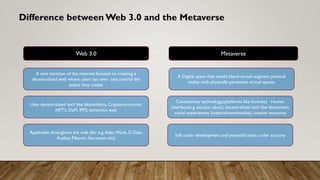
Difference between Web 3.0 and the Metaverse
Web 3.0 Metaverse
A new iteration of the internet focused on creating a
decentralized web where users can own and control the
assets they create
A Digital space that would blend virtual augment physical
reality with physically persistent virtual spaces.
Uses decentralized tech like blockchains, Cryptocurrencies,
NFT’s, DeFI, IPFS, semantics web
Connectivity technology,(platforms like fortnite) Human
Interface(e.g occulus, xbox), decentralized tech like blockchain,
social experiences (avatars/merchandise), creator economy
Applicable throughout the web (for e.g.Atlas.Work, D.Tube,
Audius, Filecoin, Secretum, etc)
Still under development and potential areas under scrutiny
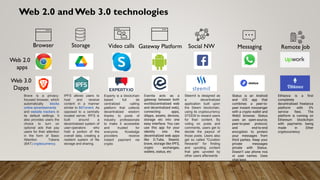
Web 2.0 and Web 3.0 technologies
Browser
Web 2.0
apps
Web 3.0
Dapps
Storage Video calls Gateway Platform Social NW Messaging Remote Job
Brave is a privacy-
focused browser, which
automatically blocks
online advertisements
and website trackers in
its default settings. It
also provides users the
choice to turn on
optional ads that pay
users for their attention
in the form of Basic
Attention Tokens
(BAT) cryptocurrency.
IPFS allows users to
host and receive
content in a manner
similar to BitTorrent. As
opposed to a centrally
located server, IPFS is
built around a
decentralized system of
user-operators who
hold a portion of the
overall data, creating a
resilient system of file
storage and sharing.
Experty is a blockchain
based full de
centralized calling
platform that collects
decentralized wisdom
thanks to pools of
industry professionals
to make it accessible
and trusted for
everyone. Kowledge
providers receive
instant payment via
crypto
Esentia acts as a
gateway between both
worlds(centralized web
and decentralized web),
connecting apps,
dApps, assets, devices,
storage etc into one
easy interface. You can
use this app for your
identity into the
decentralized web apps
like D.Tube, Steenit,
brave, storage like IPFS,
crypto exchanges,
wallets, status, etc
Steemit is designed as
a decentralized
application built upon
the Steem blockchain,
using its cryptocurrency
STEEM to reward users
for their content. By
voting on posts and
comments, users get to
decide the payout of
those posts. Users also
get so called "Curation
Rewards" for finding
and upvoting content
that gets upvoted by
other users afterwards
Status is an Android
and iOS app that
combines a peer-to-
peer instant messenger
with a crypto wallet and
Web3 browser. Status
uses an open-source,
peer-to-peer protocol,
and end-to-end
encryption to protect
your messages from
third parties. Keep your
private messages
private with Status.
Doesn’t use phone nos
or user names. Uses
chat keys
Ethlance is a first
completely
decentralised freelance
platform with 0%
service fees. The
platform is running on
Ethereum blockchain
with payments being
made in Ether
cryptocurrency
Web 3.0 Architecture
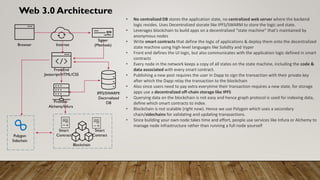
• No centralized DB stores the application state, no centralized web server where the backend
logic resides. Uses Decentralized storate like IPFS/SWARM to store the logic and state.
• Leverages blockchain to build apps on a decentralized “state machine” that’s maintained by
anonymous nodes
• Write smart contracts that define the logic of applications & deploy them onto the decentralized
state machine using high-level languages like Solidity and Vyper
• Front end defines the UI logic, but also communicates with the application logic defined in smart
contracts
• Every node in the network keeps a copy of all states on the state machine, including the code &
data associated with every smart contract.
• Publishing a new post requires the user in Dapp to sign the transaction with their private key
after which the Dapp relay the transaction to the blockchain
• Also since users need to pay extra everytime their transaction requires a new state, for storage
apps use a decentralized off-chain storage like IPFS
• Querying data on the blockchain is not easy and hence graph protocol is used for indexing data,
define which smart contracts to index.
• Blockchain is not scalable (right now). Hence we use Polygon which uses a secondary
chain/sidechains for validating and updating tranasactions.
• Since building your own node takes time and effort, people use services like Infura or Alchemy to
manage node infrastructure rather than running a full node yourself
Browser Internet
FrontEnd
Javascript/HTML/CSS
Provider
Alchemy/Infura
Blockchain
Smart
Contract
Smart
Contract
IPFS/SWARM/
Dectrnalized
DB
Polygon
Sidechain
Signer
(Metmask)
IPFS – InterPlanetary File System
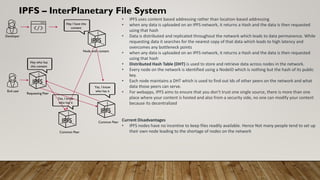
• IPFS uses content based addressing rather than location-based addressing
• when any data is uploaded on an IPFS network, it returns a Hash and the data is then requested
using that hash
• Data is distributed and replicated throughout the network which leads to data permanence. While
requesting data it searches for the nearest copy of that data which leads to high latency and
overcomes any bottleneck points
• when any data is uploaded on an IPFS network, it returns a Hash and the data is then requested
using that hash
• Distributed Hash Table (DHT) is used to store and retrieve data across nodes in the network.
• Every node on the network is identified using a NodeID which is nothing but the hash of its public
key.
• Each node maintains a DHT which is used to find out Ids of other peers on the network and what
data those peers can serve.
• For webapps, IPFS aims to ensure that you don’t trust one single source, there is more than one
place where your content is hosted and also from a security side, no one can modify your content
because its decentralized
Current Disadvantages
• IPFS nodes have no incentive to keep files readily available. Hence Not many people tend to set up
their own node leading to the shortage of nodes on the network
IPFS
IPFS
IPFS
Node with content
Common Peer
Requesting Peer
Hey I have this
content
Hey who has
this content
Yes, I know
who has it
Developer
End user
IPFS
Common Peer
Yes, I know
who has it
NFT’s – Non FungibleTokens
• In the physical world, we know that the original painting of the MonaLisa is in the Louvre
Museum. In the digital world, you can’t tell if the art you’re looking at is original.
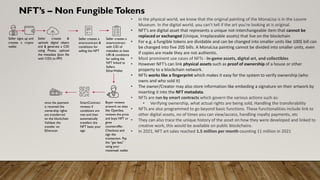
• NFT’s are digital asset that represents a unique not-interchangeable item that cannot be
replaced or exchanged (Unique, Irreplaceable assets) that live on the blockchain
• For e.g. a fungible tokens are dividable and can be changed into smaller units like 100$ bill can
be changed into five 20$ bills. A MonaLisa painting cannot be divided into smaller units, even
if copies are made they are not authentic.
• Most prominent use cases of NFTs - In-game assets, digital art, and collectibles
• However NFT’s can link physical assets such as proof of ownership of a house or other
property to a blockchain network.
• NFTs works like a fingerprint which makes it easy for the system to verify ownership (who
owns and who sold it)
• The owner/Creator may also store information like embeding a signature on their artwork by
inserting it into the NFT metadata.
• NFTs are run by smart contracts which govern the various actions such as:
• Verifying ownership, what actual rights are being sold, Handling the transferability
• NFTs are also programmed to go beyond basic functions. These functionalities include link to
other digital assets, no of times you can view/access, handling royalty payments, etc
• They can also trace the unique history of the asset on how they were developed and linked to
creative work, this would be available on public blockchains.
• In 2021, NFT art sales reached 1.5 million per month counting 11 million in 2021
Seller signs up and
creates a crypto
wallet
Seller creates &
uploads digital object
and & generate a CID
using Pinata, uplioad
the metadata (Json file
with CID) to IPFS
Seller creates a
smartcontract &
conditions for
selling the NFT
Seller creates a
smartcontract
with CID of
metadata as base
URI & conditions
for selling the
NFT linked to
Sellers
EtherWallet
Buyer reviews
artwork on sites
like OpenSea,
reviews the price
and buys NFT or
gives
counteroffer.
Checkout and
sign the
transaction. Pay
the “gas fees”
using your
metamask wallet
once the payment
is received the
ownership rights
are transferred
on the blockchain
Validate the
transfer on
Etherscan
SmartContract
reviews if
conditions are
met and then
automatically
transfers the
NFT basis your
sign
Ronin Network Hack
Sky Mavis - Game
Developer
Axie Infinity
NFT Game
NFT
Axie Token
NFT Pay to
play to earn
game
Ronin Network –
Ethereum
Sidechain
Validators
Ronin Bridge – Bridge to
move funds from
Ethereum blockchain to
Ronin Network
Ethereum
Blockchain – Slow
& High Gas fees
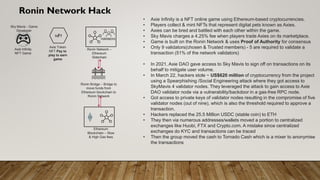
• Axie Infinity is a NFT online game using Ethereum-based cryptocurrencies.
• Players collect & mint NFTs that represent digital pets known as Axies.
• Axies can be bred and battled with each other within the game.
• Sky Mavis charges a 4.25% fee when players trade Axies on its marketplace.
• Game is built on the Ronin Network & uses Proof of Authority for consensus
• Only 9 validators(chosen & Trusted members) - 5 are required to validate a
transaction (51% of the network validators)
• In 2021, Axie DAO gave access to Sky Mavis to sign off on transactions on its
behalf to mitigate user volume.
• In March 22, hackers stole ~ US$620 million of cryptocurrency from the project
using a Spearphishing /Social Engineering attack where they got access to
SkyMavis 4 validator nodes. They leveraged the attack to gain access to Axie
DAO validator node via a vulnerability/backdoor in a gas-free RPC node.
• Got access to private keys of validator nodes resulting in the compromise of five
validator nodes (out of nine), which is also the threshold required to approve a
transaction.
• Hackers replaced the 25.5 Million USDC (stable coin) to ETH
• They then via numerous addresses/wallets moved a portion to centralized
exchanges like Huobi, FTX and Crypto.com. A mistake since centralized
exchanges do KYC and transactions can be traced
• Then the group moved the cash to Tornado Cash which is a mixer to anonymise
the transactions
Ronin Network Hack
Tornado Cash
Mixer (Anonymises
transactions)
Hacker
Centralized
Exchange
Centralized
Exchange
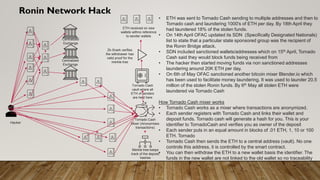
• ETH was sent to Tornado Cash sending to multiple addresses and then to
Tornado cash and laundering 1000's of ETH per day. By 18th April they
had laundered 18% of the stolen funds.
• On 14th April OFAC updated its SDN (Specifically Designated Nationals)
list to state that a particular state sponsored group was the recipient of
the Ronin Bridge attack.
• SDN included sanctioned wallets/addresses which on 15th April, Tornado
Cash said they would block funds being received from
• The hacker then started moving funds via non sanctioned addresses
laundering around 20K ETH per day.
• On 6th of May OFAC sanctioned another bitcoin mixer Blender.io which
has been used to facilitate money laundering. It was used to launder 20.5
million of the stolen Ronin funds. By 6th May all stolen ETH were
laundered via Tornado Cash
How Tornado Cash mixer works
• Tornado Cash works as a mixer where transactions are anonymized.
• Each sender registers with Tornado Cash and links their wallet and
deposit funds. Tornado cash will generate a hash for you. This is your
identifier to TornadoCash and verifies you as owner of the deposit
• Each sender puts in an equal amount in blocks of .01 ETH, 1, 10 or 100
ETH. Tornado
• Tornado Cash then sends the ETH to a central address (vault). No one
controls this address, it is controlled by the smart contract.
• You can then withdraw the ETH to a new wallet basis the identifier. The
funds in the new wallet are not linked to the old wallet so no traceability
Tornado Cash
vault where all
ETH of senders
are held here
ETH received on new
wallets withno reference
to sender wallets
Merkle tree keeps
track of the deposit
hashes
Zk-Snark verifies
the withdrawer has
valid proof for the
merkle tree
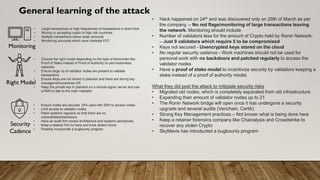
General learning of the attack
• Hack happened on 24th and was discovered only on 29th of March as per
the company. – No red flags/monitoring of large transactions leaving
the network. Monitoring should include
• Number of validators less for the amount of Crypto held by Ronin Network.
– Just 9 validators which require 5 to be compromised
• Keys not secured - Unencrypted keys stored on the cloud
• No regular security cadence - Work machines should not be used for
personal work with no backdoors and patched regularly to access the
validator nodes
• Have a proof of stake model to incentivize security by validators keeping a
stake instead of a proof of authority model.
What they did post the attack to mitigiate security risks
• Migrated old nodes, which is completely separated from old infrastructure
• Expanding their amount of validator nodes up to 21
• The Ronin Network bridge will open once it has undergone a security
upgrade and several audits (Verichain, Certik)
• Strong Key Management practices – Not known what is being done here
• Keep a retainer forensics company like Chainalysis and Crowdstrike to
recover any stolen Crypto
• SkyMavis has introducted a bugbounty program
• Large transactions or high frequencies of transactions in short time
• Moving or accepting crypto to high risk countries
• Multiple transactions below radar amounts
• Monitoring accounts which have inadeqte KYC
Monitoring
• Choose the right model depending on the type of blockchain like
Proof of Stake instead of Proof of Authority on permissionless
networks
• Ensure large no of validator nodes are present to validate
transactions
• Ensure Keys are not stored in plaintext and there are strong key
management practices OR
• Keep the private key in plaintext on a remote signer server and use
a KMS to talk to the main Validator
Right Model
Security
Cadence
• Ensure nodes are secured. 2FA used with SSH to access nodes
• Limit access to validator nodes
• Patch systems regularly so that there are no
vulnerabilities/backdoors
• Have an audit firm review architecture and systems periodically
• Keep a retainer firm to trace and track stolem funds
• Possibly incorporate a bugbounty program
THANKYOU

Blockchain, Hyperledger, DeFi, Web 3.0 - understanding and concepts

  • 1.
    BLOCKCHAIN, HYPERLEDGER,WEB 3.0 UNDERSTANDINGAND CONCEPTS Pradeep Keith Fernandez – CISSP, CISA, CIPT Disclaimer:All the content that is presented in these slides are content from various articles, youtube videos and magazines on the internet. I have just summarized my thoughts basis this understanding and is meant for educational purposes for those that wish to learn more on these topics.These thoughts, opinions and understanding are solely my own and do not represent in any way anybody or any organization that I am associated with.
  • 2.
    Blockchain and Keyelements • A blockchain is a distributed ledger that is open to anyone that facilitates the process of recording transactions and tracking assets in a business network • It is a system in which a record of transactions are maintained across several computers that are linked in a peer-to-peer network • A blockchain collects information together in groups, known as blocks, that hold sets of information. • Blocks have certain storage capacities and, when filled, are closed and linked to the previously filled block using the hash of the previous block, forming a chain of data known as blockchain • If one user tampers with a block’s record of transactions, all other nodes would cross- reference each other and easily pinpoint the node with the incorrect information. • Blockchain is ideal for delivering faster, reliable and accurate information because it provides immediate, shared and completely transparent information stored on a distributed immutable ledger that can be accessed only by network members Nodes & Blocks • A block contains collection of records or transactions for e.g. A pays B 50$, Y pays B 15$. • A block can hold a certain no of transactions only(~400 for ETH and ~1500 for Bitcoin) and block size for bitcoin is 1 MB • To participate in the blockchain, every user needs to have a node/device running • Nodes are connected to each other & exchange the newest information on the blockchain with each other • A block has a header and body where the hash of the previous block is stored along with the hash of the current block. The body contains the list of transactions solved in the block. • Adding a block to the blockchain takes roughly 10 minutes for Bitcoin and the algorithm changes whenever computing power increases to keep this status quo at 10 minutes Block Blockchain Benefits • Decentralied • Greater Transparency • Instant traceability • Faster • Security & Privacy • Automation
  • 3.
    Blockchain - Mining Mining(Proof of Work consensus) • To add a block to the blockchain, there is a process called mining (proof of work model). • There are nodes running across the globe and miners CAN validate the transactions for a block within seconds. • After a block is mined, it takes time for other miners to find out about it, and until then they are actually competing against the new block instead of adding to it and multiple miners can attempt to add a block to the last valid block and can lead to chain splits. • For e.g. a miner in Canada may add a block after validating the transactions at the same time a miner in Australia may validate & add a block as well. The information about the new block takes some time to propograte to different regions and some may get info that the Canada miner block is valid and add further blocks to that. While others may see the Australia miners block added and will start adding blocks to that leading to forks or chain splits. • To ensure that there is sufficient time for a validated block to propagate to multiple nodes bitcoin algorithm requires a cryptographic hash to be solved which takes ~10 mins, post which a miner can add a block. A pays B 50$ C pays Y 100$ Y pays Z 10$ The transaction messages is sent to the network to all the nodes (part of transaction pool/ mempool These transactions are unvalidated. Miner Nodes pick up bunch of transactions run validity checks etc To transfer money, the private key of A is used to sign the transaction which delivers proof that the money has come from owner Miners need to solve a hash which takes 10 mins to solve Once a miner has solved the hash function, it will add the block with the nounce that solved the hash function Other miners can thus verify that the nounce is valid, and will then solve other transactions in the transaction pool adding to this new block
  • 4.
    Blockchain – Hashingalgorithm • To prove that we have mined the block first, we have to solve a hash and get an output with an x no of zeros at the end of the hash. The input for the hash e.g. will be the transactions in the hash like X pays 50$ to Y, Y pays 15$ to Z and Z pays 5$ to B along with a nounce to get a hash output where the no of 0’s • We have to keep adding a random number to this input to get x no of zeros in the hash output. This may take significant computing power and time to solve. • For e.g. to get a hash for 1 zero it may take a few iterations, however to get a hash of 2 zero’s it may take hundreds of tries. • To get a hash of 17 zero’s will require huge no of retries with different random numbers. In case the computing power increases of the miners where hashes can be solved in less than 10 mins, the algorithm may be made more difficult to get more than 17 zero’s in the hash output • Once we get x no of zeros at the end of the hash, we say the block is solved and verified. The number added to the input to get x no of zeros in the hash output is called the nounce. • A block consist of a header and a body. The header contains the hash of previous block, timestamp, nounce and the merkle root. The body has the transaction data. • Blocks confirm the exact time and sequence of transactions, and the blocks link securely together to prevent any block from being altered or a block being inserted between two existing blocks • Once the hash is solved, other nodes in the network will understand that they need to add to this block. X paysY 50$,Y pays Z 15$, Z pays B 5$ Transactions in block Add random number to generate hash with x no of leading zero’s in hash X paysY 50$,Y pays Z 15$, Z pays B 5$ + random number 68e656b251e67e8358bef8483ab0d51c6619f3e7a1a9f0e75838d41ff368f728 Hash ouput 0000000000000000058bef8483ab0d51c6619f3e7a1a9f0e75838d41ff368f728 Accepted Hash ouput
  • 5.
    Blockchain permissioned vspermissionless • There are different kinds of blockchains that have evolved from the 1st generation blockchain that was bitcoin which is a public blockchain. • Bitcoin purpose was basically an electronic payment system allowing any two willing parties to transact with each other without the need for a trusted 3rd party. This form of blockchain was a public network blockchain or permissionless blockchain. • A private blockchain is a restricted network that only certain members that are allowed to join will have access and can participate in the network. • A Hybrid blockchain brings the best of both public and private blockchains combing the transparency of a public blockchain along with the security and speedof a private blockchain. A node in the hybrid blockchain will have a public state and a private state. The private state is decided between 2 ore more nodes basis what business they want to carry on between themselves. Don’t need to setup another blockchain if an enterprise wants to do business with another 3rd party. They can just create a private subnetwork to share sensitive information while they are already part of the overall public but closed network. • A consortium blockchain has multiple organizations that maintain the system • It’s a permissioned network like a Private blockchain but offer a decentalized structure like a public blockchain where each organization receives similar treatment and keeps things transparent. No single entity ruling over the network.There are technology and Business type consortium blockchains. • Hyperledger is a Tech based Consortium blockchain. Business type consortium blockchains offer solutions in Banking, Supplychain (like IBM food trust), etc Public Private Hybrid Consortium Larger network size, more difficult to hack the network. All nodes have a copy of the ledger. Anyone can join. Slow Closed network. Used by enterprises. Transactions are executed faster. More centralized, however due to fewer nodes, susceptible to security breaches. Used for solutions like supply chain mgmt Uses permissioned consensus mechanism for faster transactions and chepaer cost. Network has a public state. However enterprises can host subnetworks where data is private between company A & B where they share sensitive financial data, Over the public newotk they can share basic data. Permissioned network like a Private blockchain but offer a decentalized structure like a public blockchain
  • 6.
    HyperLedger - Fabric •In 2016, the Linux Foundation launched Hyperledger to democratize and standardize Blockchain for the business world. Hyperledger is an open-source collaborative effort created to advance cross-industry blockchain technologies • Allows organizations to build custom Blockchain apps to cater to their specific business needs. • HyperLedgers has multiple frameworks like Fabric, Burrow, Sawtooth, Grid, etc Fabric • Hyperledger Fabric is a permissioned Blockchain infrastructure with a modular architecture wherein there’s a delineation of roles between the nodes in the infrastructure, the execution of smart contracts, along with configurable consensus and membership services. • In a Fabric network, there is a membership service that handles identity for users transacting via a digital certificate. The certificate is used to sign transactions and submit them onto the blockchain as well as basis their identity access permissions are provided to perform certain transactions. • The CA is a pluggable module and you can use the Fabric CA or an external CA • Client Apps are written in any language like node.JS, Python and Java and interact with the blockchain network via SDK’s/Hyperledger Fabric client. • There are different peer nodes called endorsers and committers. An organization can run multiple peers and there could be multiple organizations as part of the network Client App SDK HFC External CA Fabric CA Membership Services Endorser Peer Committer Peer Blockchain ChainCode Events World State peer HyperLedger Fabric Network Ordering Service Endorsment Policy BESU BURROW FABRIC INDY SAWTOOTH Different types of Hyperledger's
  • 7.
    HyperLedger – FabricConsensus Flow Fabric Consensus flow • Client app proposes a transaction and wants to invoke a particular function of the smartcontract. The input from the client app is sent to the endorser peers • Endorsers are responsible for executing the transcation and signing(using its certificate to sign the transaction) saying this is the output of the transaction and I agree with it. • If all endorsment peers endorse a transaction, the client app is going to receive these read/write sets, which is sent to ordering once there are sufficient signatures • There could be multiple client apps that are submitting transactions to the ordering service • The ordering service will ensure that there is an order to the transactions and ordered across all the nodes basis the timestamp • So ordering service will say transaction A, B, C are in block 948 and transaction X,Y, Z are in block 949 to all nodes to follow that and maintain consistency in the network. • Post ordering where the block is sent to all nodes, the validation is done, for e,g, double spending validation or there could be chances that not all endorsers endorsed the transaction. • Verifications on the read/write set is performed by all the peers (endorsers and committer and mark transactions as valid or invalid. • Only the valid write transactions will be updated in the world state along with a new version number. The world state is implemented as a database. • The world state version number is for internal use by Hyperledger Fabric, and is incremented every time the state changes. The version is checked whenever the state is updated to make sure the current states matches the version at the time of endorsement. • There are different events that are generated and client apps can register to be notified when transactions fail or succeed and when blocks are added to the ledger. Committing peers will notify applications of such events Propose TX Endorse Order Validate Commit HyperLedger Fabric consensus flow Client App SDK HFC External CA Fabric CA Membership Services Endorser Peer Committer Peer Blockchain ChainCode Events World State peer HyperLedger Fabric Network Ordering Service Endorsment Policy
  • 8.
    SmartContracts • A smartcontract is self-executing code that carries out a set of instructions, which are then verified on the blockchain • They are trustless, autonomous, decentralized, and transparent meaning they can reduce or even eliminate the need for third-party intermediaries • The code defines the mechanisms of the transaction and is the final arbiter of the terms. If something happens then something else happens (if/when…then) • A state variable is defined which is stored in the blockchain. For e.g. a state variable for an baggage claim smart contract will be the no of bags user has onboarded on a flight. • Once a condition is met, the contract is executed immediately basis the condition set. For e,g. State can change basis user accepting that they have received their bags or not received their bags. • If user has received their bags, state is updated basis API/Delivery notifcation and transaction is updated on the blockchain. • If he has not received his bags, the smartcontract can use functions to decide the next course of action like paying the user for lost baggage, etc User purchases a product Write smart contract in Solidty Ecom provider sends package via logistics company Smart contract is written by ecom company that once the package is delivered and confirmed by the user, will the delivery company receive the money Create a state variable on current state and assign it to a function Deploy the contract using Truffle and Embark, Ethereum studio and test the contract When the condition is met the smartcontract is executed on the blockchain logistics company delivers package to customer Customer confirms he has received the package
  • 9.
    SideChains & Layer2 scaling solution (off-chain) • Layer 2 scaling solutions are built on top of Main chain using existing elements like smart contracts • Main chains are really slow and if we try to speed them up they arent as secure or as safe. Also transaction/gas fees are very high on the main chain with validators/miners solving only high worth transactions keeping many transactions pending. • There is a tradeoff between security, decentralization and speed of transactions • Scalability shouldn’t come at the expense of Security and Decentralization so its best to use layer 2 scaling and not compromise on security in the main chain Sidechain • Sidechains are a seperate blockchain that is connected to another blockchain (main blockchain) through 2 way peg to process some of the data from the main blockchain • Sidechains are responsible for their own security & need their own validators/miners and own consensus mechanism • Polygon is an Ethereum sidechain which uses the same EVM for the sidechain, so contracts deployed on the main chain can be directly deployed on the side chain 2 way peg • When you move your token from the main chain to the side chain, you need to lock them up in the main chain so they they are not available on both chains • Locking them up means these funds go to a wallet or contract that is controlled by the machine. After locking them up the funds are transferred to the side chain • When you want to move coins back from the side chain to the main chain you destroy your tokens on the side chain and you get to release your funds on the main chain Federation • A federation is the middleman in charge of locking and releasing funds between the 2 chains • Federations are usually code, while some are controlled by the sidechain's organization • The federation is in charge of whatever is locked up is exactly on the sidechain Main Chain Slow, High Gas fees, More Secure & Decentralized Side Chain Fast, low gas fees, less decentralized Locking up releasing Wallet controlled by a machine Released tokens are destroyed on sidechain at release
  • 10.
    Writing Smart Contracts •Solidity is used to write smart Contracts using a .sol extension. Use the pragma to tell the compiler what version of solidity to use • Then use the contract keyword to define the details about the smart contract (like a class in c++) • Inside the contract we define the state or variables where the value might change through the lifecycle of the contract • It also has datatypes like address to hold a 20 byte Ethereum address • The struct keyword allows to construct more complex data types to define the different entities in the contract • Use the function keyword to define executable blocks of code which may be called upon sometime to modify the state of the contract • Can also define a constructor that is called once the contract is first created. Once the constructor is executed the code will be deployed on the blockchain • Once completed you can compile your smartcontract and use it programitcally with an API of choice like web3.js pragma solidity ^0.8.7; Contract MyContract { string public hello = “Hi” address payable public seller; address payable public buyer; struct Order { string description; bool completed } Function confirmOrder() public { buyer = payable(msg.sender); } Constructor(string memory _text) { | hello = _text } }
  • 11.
    Validator Nodes • Earlierin Ethereum 1, there were miners to validate transactions once a block has been updated on the blockchain. In Ethereum 2.0 (beacon chain) this is replaced by validators. • A validator node is a special type of full node that participates in “consensus.” By participating in consensus, validator nodes become responsible for verifying, voting on, and maintaining a record of transactions. • To become a validator, you must setup a node on the blockchain. Have 32 Ether(~50K USD) as stake money. Validators stake their Ethereum cryptocurrency to confirm transactions on the network. They risk money in order to do that. Its an incentive to act honestly. If you confirm a transaction that’s valid then you get a passive income reward for doing that. If you act dishonestly then you lose money. • Validator nodes underpin the security of any blockchain or DLT network. That is why it is of vital importance to ensure that validator nodes remain both performant and trustworthy. • A node must first register with the network and sync the blockchain to become a validator. This allows token holders to stake (“delegate”) tokens to it and lets the network know that the node wishes to be considered for inclusion in the validator set. Registered nodes will be visible on both the Radix Explorer website and the Desktop Wallet. • On the Olympia release of the Radix Public Network, there is a maximum of 100 validator nodes at a time. These are selected based on the amount of stake XRD token holders have delegated to them.
  • 12.
    Validator Nodes Setup Validatorchain node responsible for producing new blocks & attesting in the chain Setup your metamask wallet and ensure that there is 32 ETH in your wallet for staking Generate Validator public / private key pair and copy/paste deposit data (32 ETH) linked to your key in the Prysm project Wait for activation (waiting queue) until processed and activated (Few days) Setup docker on your PC. Install Prysm Validator and beacon chain docker images Setup of Validator Node Role of Validator Node If A wants to transfer Crypto to B. Once he does the transfer from his wallet to B wallet The transaction message is sent to the network to all the nodes (part of transaction poo l/ mempool Nodes run validity checks on the transactions.like ensuring the funds are still available, the output is not exceeding the input, the signature is valid, etc Start Validator client and deposit beacon chain deposit (32 ETH) on the ETH network via smart contract Setup and run Beacon Chain node and sync the blockchain Validators try to add a candidate block to the largest chain after the last valid block by solving a complex math problem (Proof of work) From the transaction pool the validator chooses the transactions 1st with the highest gas/transaction fees Other validators solving other tranasactions will add to the last block basis the speed at which the last block was added. If A was added 1st then validators will add to Block A and B will be discarded.(Longest chain rule) There may be multiple validators trying to solve a single transaction and both candidates will be added to the chain A B A
  • 13.
    Proof of Workvs Proof of Stake vs Proof of Authority Proof of Work Proof of Stake To add block to the chain, miners must compete to solve a difficult puzzle using their computers processing power New method proposed –There is no competition as the block creator is chosen by an algorithm based on the user stake Any miner can attempt to solve the puzzle.The first miner to solve the puzzle is given a reward for their work There is no reward for making a block, the block creator/validator takes a transaction/gas fee. Requires mining equipment. Can create mining groups who agree to share mining rewards in proportion to contributed mining power. No equipment necessary. More cost effective. Uses less power and better for the environment To add a malicious block/fraudulent transaction, you will have to have computing power more than 51% of the network In order to add a malicious block, you will have to own 51% of all the cryptocurrency on the network (practically impossible) Mining pools - Foundry US17.2%, AntPool-14.8%, F2 Pool-14.6%, BinancePool -11.4% have 51% of compute power making it more centralized More decentralized and is based on how much money is staked. Rich get richer. Ideal for private network solution(permissioned blockchain) instead of a public blockchain solution Proof of Authority Validators are pre-approved by a group of “authorities” to verify transactions and build new blocks Grants a few blockchain players the authority to validate network transactions and update its broadly distributed registry low transaction cost provided by PoA- based systems. requires fewer message exchanges and less overhead In order to add a malicious block, you will have to compromise 51% of the validator nodes
  • 14.
    What is DeFi •DeFi refers to the infrastructure, processes, and technologies used to democratize financial transactions. • No Centralized institutions, No High fees, No trusted 13rd party • No limits to what you can do regarding lemding, borrowing or what business you are in • DeFi is based on Cryptography, Blockchain and SmartContracts • DeFI is currently based on 6 pillars • Stablecoins - like USDC, Tether are based on the price of the dollar. Each USDC is backed by one dollar or asset with equivalent fair value, which is held in accounts with US regulated financial institutions. • Lending & Borrowing via Smart Contracts • Decentralized exchanges – Exchange one cryptocurrency for another (e.g. uniswap) • Insurance – Anyone can become an insurer by setting up a smartcontract with conditions on the premium, when the insurance should be paid(which conditions) using oracles as data sources, etc. • Derivative / Margin Trading – Can use it for margin trading with no pre- requisites like min amount of money for margin trading or prove who you are , low fees, unlike centralized Finance • Governance of Crypto Projects – DAO. Everyone who is part of DAO has a vote on which projects should be passed DeFi DAO Stable Coins Lending & Borrowing DeCentral Exchange Insurance MarginTrading Governance of DAO
  • 15.
    WHAT ISWEB 3.0 •Today, major corporations collect and store our data and sell it to advertisers.And this has made these corporations powerful and the internet centralized. • Websites should not treat their users as products. Instead, they should provide ownership of data back to their users. • The data should be secured cryptographically, and the website and service should equally prioritize every user’s privacy. • Web 3.0 is the 3rd generation of internet which will bring an open, transparent and decentralized era (using blockchain) of the internet where everyone is participating(user will be a node to a decentralized network) and rewarded for their participation. • The metaverse is a single, universal and immersive virtual world that is facilitated by the use of virtual reality (VR) and augmented reality (AR) headsets (but uses some underlying technology used byWeb 3 like the blockchain and NFT’s)
  • 16.
    Difference between Web3.0 and the Metaverse Web 3.0 Metaverse A new iteration of the internet focused on creating a decentralized web where users can own and control the assets they create A Digital space that would blend virtual augment physical reality with physically persistent virtual spaces. Uses decentralized tech like blockchains, Cryptocurrencies, NFT’s, DeFI, IPFS, semantics web Connectivity technology,(platforms like fortnite) Human Interface(e.g occulus, xbox), decentralized tech like blockchain, social experiences (avatars/merchandise), creator economy Applicable throughout the web (for e.g.Atlas.Work, D.Tube, Audius, Filecoin, Secretum, etc) Still under development and potential areas under scrutiny
  • 17.
    Web 2.0 andWeb 3.0 technologies Browser Web 2.0 apps Web 3.0 Dapps Storage Video calls Gateway Platform Social NW Messaging Remote Job Brave is a privacy- focused browser, which automatically blocks online advertisements and website trackers in its default settings. It also provides users the choice to turn on optional ads that pay users for their attention in the form of Basic Attention Tokens (BAT) cryptocurrency. IPFS allows users to host and receive content in a manner similar to BitTorrent. As opposed to a centrally located server, IPFS is built around a decentralized system of user-operators who hold a portion of the overall data, creating a resilient system of file storage and sharing. Experty is a blockchain based full de centralized calling platform that collects decentralized wisdom thanks to pools of industry professionals to make it accessible and trusted for everyone. Kowledge providers receive instant payment via crypto Esentia acts as a gateway between both worlds(centralized web and decentralized web), connecting apps, dApps, assets, devices, storage etc into one easy interface. You can use this app for your identity into the decentralized web apps like D.Tube, Steenit, brave, storage like IPFS, crypto exchanges, wallets, status, etc Steemit is designed as a decentralized application built upon the Steem blockchain, using its cryptocurrency STEEM to reward users for their content. By voting on posts and comments, users get to decide the payout of those posts. Users also get so called "Curation Rewards" for finding and upvoting content that gets upvoted by other users afterwards Status is an Android and iOS app that combines a peer-to- peer instant messenger with a crypto wallet and Web3 browser. Status uses an open-source, peer-to-peer protocol, and end-to-end encryption to protect your messages from third parties. Keep your private messages private with Status. Doesn’t use phone nos or user names. Uses chat keys Ethlance is a first completely decentralised freelance platform with 0% service fees. The platform is running on Ethereum blockchain with payments being made in Ether cryptocurrency
  • 18.
    Web 3.0 Architecture •No centralized DB stores the application state, no centralized web server where the backend logic resides. Uses Decentralized storate like IPFS/SWARM to store the logic and state. • Leverages blockchain to build apps on a decentralized “state machine” that’s maintained by anonymous nodes • Write smart contracts that define the logic of applications & deploy them onto the decentralized state machine using high-level languages like Solidity and Vyper • Front end defines the UI logic, but also communicates with the application logic defined in smart contracts • Every node in the network keeps a copy of all states on the state machine, including the code & data associated with every smart contract. • Publishing a new post requires the user in Dapp to sign the transaction with their private key after which the Dapp relay the transaction to the blockchain • Also since users need to pay extra everytime their transaction requires a new state, for storage apps use a decentralized off-chain storage like IPFS • Querying data on the blockchain is not easy and hence graph protocol is used for indexing data, define which smart contracts to index. • Blockchain is not scalable (right now). Hence we use Polygon which uses a secondary chain/sidechains for validating and updating tranasactions. • Since building your own node takes time and effort, people use services like Infura or Alchemy to manage node infrastructure rather than running a full node yourself Browser Internet FrontEnd Javascript/HTML/CSS Provider Alchemy/Infura Blockchain Smart Contract Smart Contract IPFS/SWARM/ Dectrnalized DB Polygon Sidechain Signer (Metmask)
  • 19.
    IPFS – InterPlanetaryFile System • IPFS uses content based addressing rather than location-based addressing • when any data is uploaded on an IPFS network, it returns a Hash and the data is then requested using that hash • Data is distributed and replicated throughout the network which leads to data permanence. While requesting data it searches for the nearest copy of that data which leads to high latency and overcomes any bottleneck points • when any data is uploaded on an IPFS network, it returns a Hash and the data is then requested using that hash • Distributed Hash Table (DHT) is used to store and retrieve data across nodes in the network. • Every node on the network is identified using a NodeID which is nothing but the hash of its public key. • Each node maintains a DHT which is used to find out Ids of other peers on the network and what data those peers can serve. • For webapps, IPFS aims to ensure that you don’t trust one single source, there is more than one place where your content is hosted and also from a security side, no one can modify your content because its decentralized Current Disadvantages • IPFS nodes have no incentive to keep files readily available. Hence Not many people tend to set up their own node leading to the shortage of nodes on the network IPFS IPFS IPFS Node with content Common Peer Requesting Peer Hey I have this content Hey who has this content Yes, I know who has it Developer End user IPFS Common Peer Yes, I know who has it
  • 20.
    NFT’s – NonFungibleTokens • In the physical world, we know that the original painting of the MonaLisa is in the Louvre Museum. In the digital world, you can’t tell if the art you’re looking at is original. • NFT’s are digital asset that represents a unique not-interchangeable item that cannot be replaced or exchanged (Unique, Irreplaceable assets) that live on the blockchain • For e.g. a fungible tokens are dividable and can be changed into smaller units like 100$ bill can be changed into five 20$ bills. A MonaLisa painting cannot be divided into smaller units, even if copies are made they are not authentic. • Most prominent use cases of NFTs - In-game assets, digital art, and collectibles • However NFT’s can link physical assets such as proof of ownership of a house or other property to a blockchain network. • NFTs works like a fingerprint which makes it easy for the system to verify ownership (who owns and who sold it) • The owner/Creator may also store information like embeding a signature on their artwork by inserting it into the NFT metadata. • NFTs are run by smart contracts which govern the various actions such as: • Verifying ownership, what actual rights are being sold, Handling the transferability • NFTs are also programmed to go beyond basic functions. These functionalities include link to other digital assets, no of times you can view/access, handling royalty payments, etc • They can also trace the unique history of the asset on how they were developed and linked to creative work, this would be available on public blockchains. • In 2021, NFT art sales reached 1.5 million per month counting 11 million in 2021 Seller signs up and creates a crypto wallet Seller creates & uploads digital object and & generate a CID using Pinata, uplioad the metadata (Json file with CID) to IPFS Seller creates a smartcontract & conditions for selling the NFT Seller creates a smartcontract with CID of metadata as base URI & conditions for selling the NFT linked to Sellers EtherWallet Buyer reviews artwork on sites like OpenSea, reviews the price and buys NFT or gives counteroffer. Checkout and sign the transaction. Pay the “gas fees” using your metamask wallet once the payment is received the ownership rights are transferred on the blockchain Validate the transfer on Etherscan SmartContract reviews if conditions are met and then automatically transfers the NFT basis your sign
  • 21.
    Ronin Network Hack SkyMavis - Game Developer Axie Infinity NFT Game NFT Axie Token NFT Pay to play to earn game Ronin Network – Ethereum Sidechain Validators Ronin Bridge – Bridge to move funds from Ethereum blockchain to Ronin Network Ethereum Blockchain – Slow & High Gas fees • Axie Infinity is a NFT online game using Ethereum-based cryptocurrencies. • Players collect & mint NFTs that represent digital pets known as Axies. • Axies can be bred and battled with each other within the game. • Sky Mavis charges a 4.25% fee when players trade Axies on its marketplace. • Game is built on the Ronin Network & uses Proof of Authority for consensus • Only 9 validators(chosen & Trusted members) - 5 are required to validate a transaction (51% of the network validators) • In 2021, Axie DAO gave access to Sky Mavis to sign off on transactions on its behalf to mitigate user volume. • In March 22, hackers stole ~ US$620 million of cryptocurrency from the project using a Spearphishing /Social Engineering attack where they got access to SkyMavis 4 validator nodes. They leveraged the attack to gain access to Axie DAO validator node via a vulnerability/backdoor in a gas-free RPC node. • Got access to private keys of validator nodes resulting in the compromise of five validator nodes (out of nine), which is also the threshold required to approve a transaction. • Hackers replaced the 25.5 Million USDC (stable coin) to ETH • They then via numerous addresses/wallets moved a portion to centralized exchanges like Huobi, FTX and Crypto.com. A mistake since centralized exchanges do KYC and transactions can be traced • Then the group moved the cash to Tornado Cash which is a mixer to anonymise the transactions
  • 22.
    Ronin Network Hack TornadoCash Mixer (Anonymises transactions) Hacker Centralized Exchange Centralized Exchange • ETH was sent to Tornado Cash sending to multiple addresses and then to Tornado cash and laundering 1000's of ETH per day. By 18th April they had laundered 18% of the stolen funds. • On 14th April OFAC updated its SDN (Specifically Designated Nationals) list to state that a particular state sponsored group was the recipient of the Ronin Bridge attack. • SDN included sanctioned wallets/addresses which on 15th April, Tornado Cash said they would block funds being received from • The hacker then started moving funds via non sanctioned addresses laundering around 20K ETH per day. • On 6th of May OFAC sanctioned another bitcoin mixer Blender.io which has been used to facilitate money laundering. It was used to launder 20.5 million of the stolen Ronin funds. By 6th May all stolen ETH were laundered via Tornado Cash How Tornado Cash mixer works • Tornado Cash works as a mixer where transactions are anonymized. • Each sender registers with Tornado Cash and links their wallet and deposit funds. Tornado cash will generate a hash for you. This is your identifier to TornadoCash and verifies you as owner of the deposit • Each sender puts in an equal amount in blocks of .01 ETH, 1, 10 or 100 ETH. Tornado • Tornado Cash then sends the ETH to a central address (vault). No one controls this address, it is controlled by the smart contract. • You can then withdraw the ETH to a new wallet basis the identifier. The funds in the new wallet are not linked to the old wallet so no traceability Tornado Cash vault where all ETH of senders are held here ETH received on new wallets withno reference to sender wallets Merkle tree keeps track of the deposit hashes Zk-Snark verifies the withdrawer has valid proof for the merkle tree
  • 23.
    General learning ofthe attack • Hack happened on 24th and was discovered only on 29th of March as per the company. – No red flags/monitoring of large transactions leaving the network. Monitoring should include • Number of validators less for the amount of Crypto held by Ronin Network. – Just 9 validators which require 5 to be compromised • Keys not secured - Unencrypted keys stored on the cloud • No regular security cadence - Work machines should not be used for personal work with no backdoors and patched regularly to access the validator nodes • Have a proof of stake model to incentivize security by validators keeping a stake instead of a proof of authority model. What they did post the attack to mitigiate security risks • Migrated old nodes, which is completely separated from old infrastructure • Expanding their amount of validator nodes up to 21 • The Ronin Network bridge will open once it has undergone a security upgrade and several audits (Verichain, Certik) • Strong Key Management practices – Not known what is being done here • Keep a retainer forensics company like Chainalysis and Crowdstrike to recover any stolen Crypto • SkyMavis has introducted a bugbounty program • Large transactions or high frequencies of transactions in short time • Moving or accepting crypto to high risk countries • Multiple transactions below radar amounts • Monitoring accounts which have inadeqte KYC Monitoring • Choose the right model depending on the type of blockchain like Proof of Stake instead of Proof of Authority on permissionless networks • Ensure large no of validator nodes are present to validate transactions • Ensure Keys are not stored in plaintext and there are strong key management practices OR • Keep the private key in plaintext on a remote signer server and use a KMS to talk to the main Validator Right Model Security Cadence • Ensure nodes are secured. 2FA used with SSH to access nodes • Limit access to validator nodes • Patch systems regularly so that there are no vulnerabilities/backdoors • Have an audit firm review architecture and systems periodically • Keep a retainer firm to trace and track stolem funds • Possibly incorporate a bugbounty program
  • 24.