E – learning facilitators: analyses of their different roles within different e – learning methodologies and approaches n. I/05/B/F/PP-154178 Fifth Phase:   TESTING OF PROJECT RESULTS BY ACHIEVING AN EXPERIMENTATION ON THE JOB  Partners: Università di Napoli Federico II, Dipartimento di Filosofia “A. Aliotta”, Italy Timsoft, Romania National Organisation Women in Higher Technical Education and Position - VHTO, Netherlands
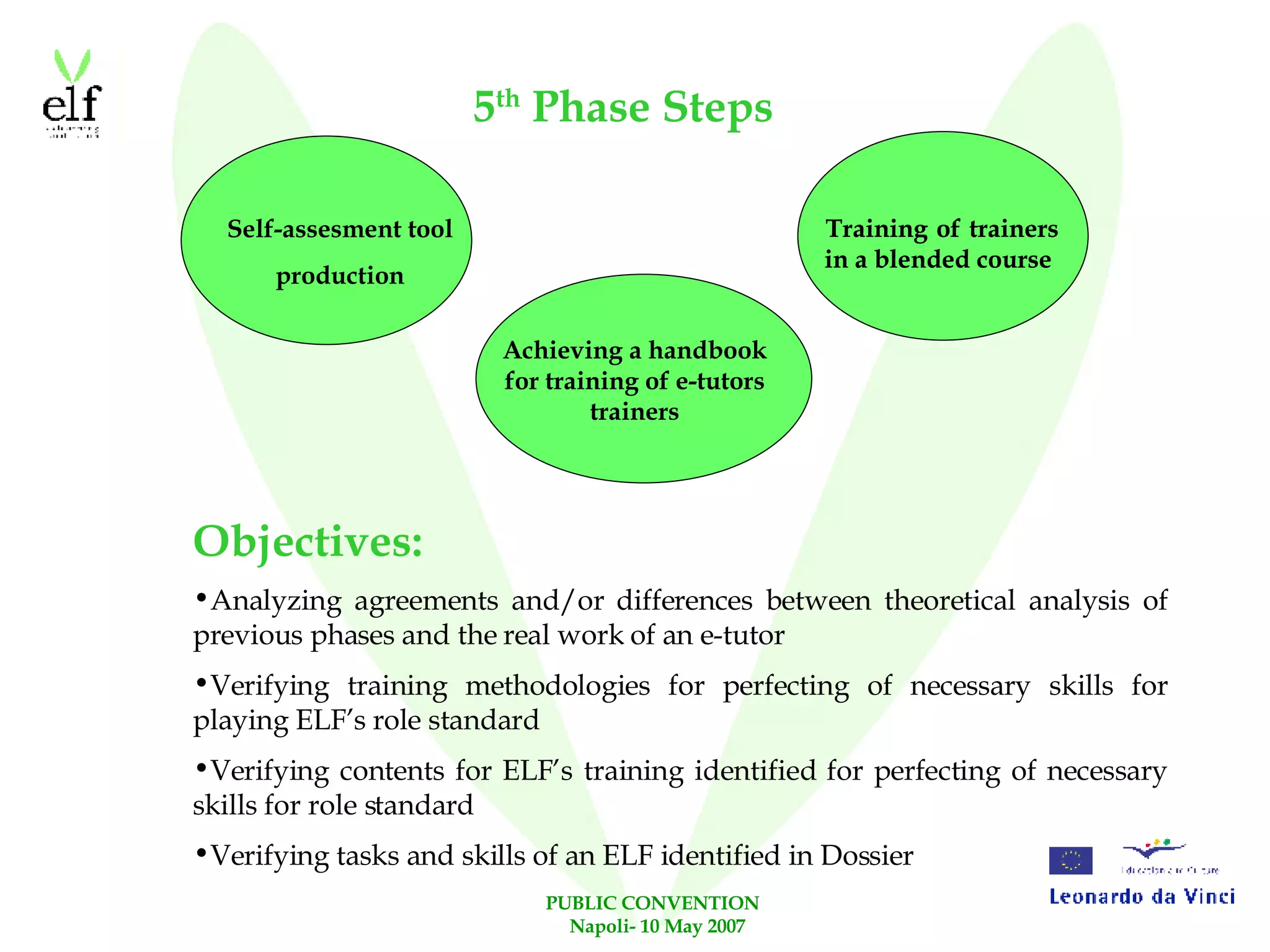
Self-assesment tool production Training of trainers in a blended course Achieving a handbook for training of e-tutors trainers 5 th  Phase Steps Training of trainers in a blended course Objectives: Analyzing agreements and/or differences between theoretical analysis of previous phases and the real work of an e-tutor Verifying training methodologies for perfecting of necessary skills for playing ELF’s role standard Verifying contents for ELF’s training identified for perfecting of necessary skills for role standard Verifying tasks and skills of an ELF identified in Dossier
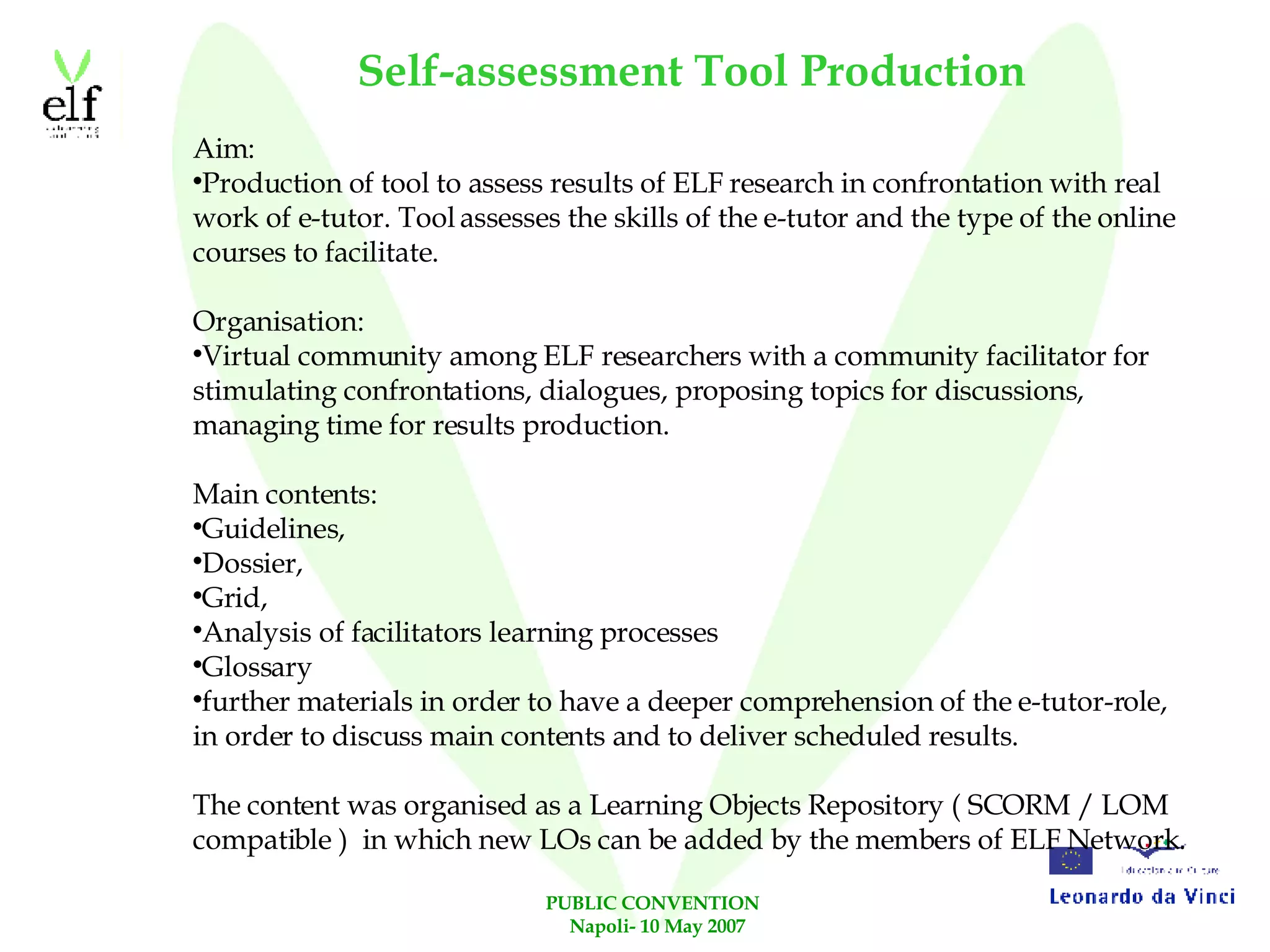
Self-assessment Tool Production Aim: Production of tool to assess results of ELF research in confrontation with real work of e-tutor. Tool assesses the skills of the e-tutor and the type of the online courses to facilitate. Organisation: Virtual community among ELF researchers with a community facilitator for stimulating confrontations, dialogues, proposing topics for discussions, managing time for results production. Main contents: Guidelines, Dossier, Grid, Analysis of facilitators learning processes Glossary further materials in order to have a deeper comprehension of the e-tutor-role, in order to discuss main contents and to deliver scheduled results. The content was organised as a Learning Objects Repository ( SCORM / LOM compatible )  in which new LOs can be added by the members of ELF Network.
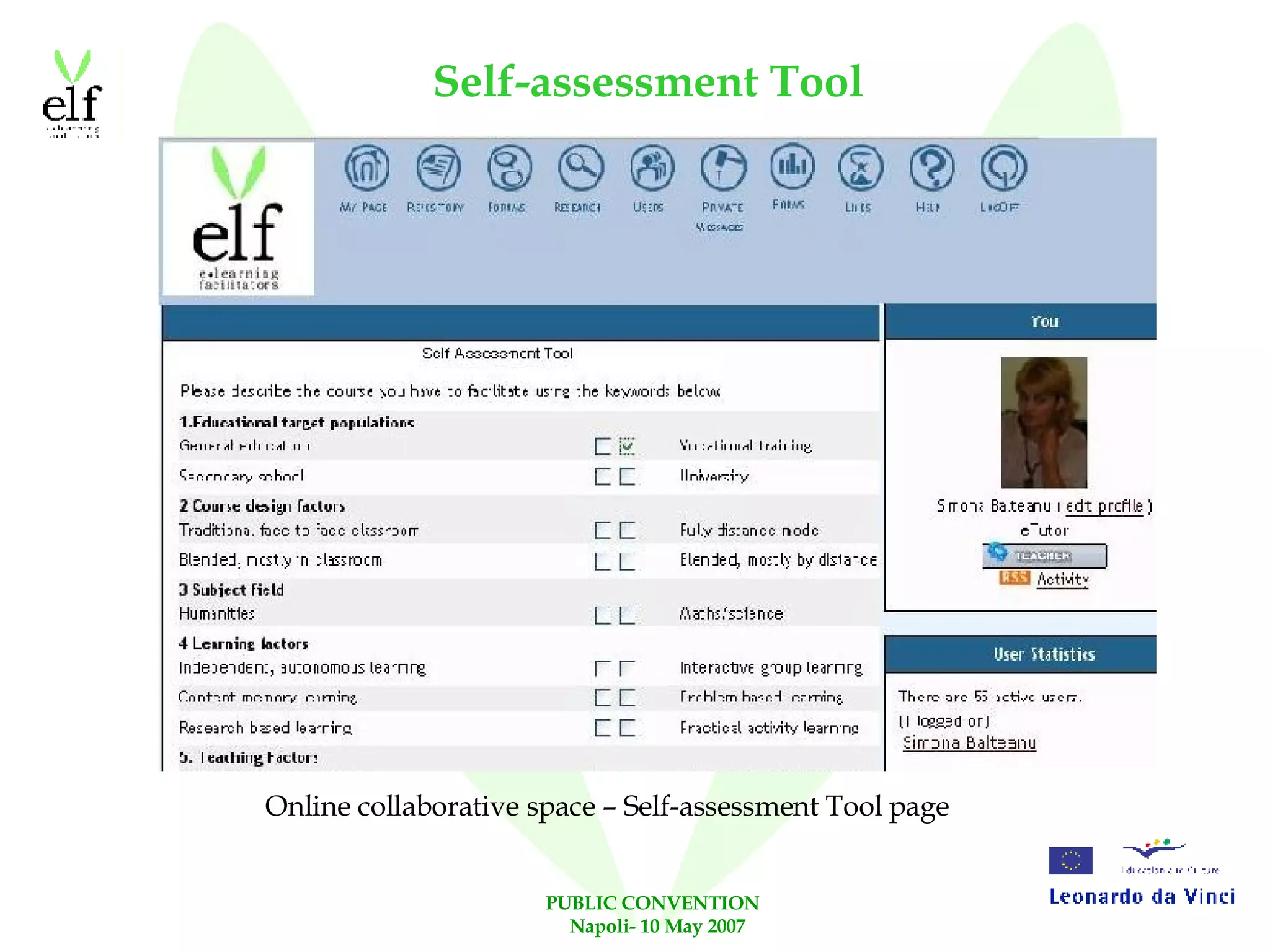
Self-assessment Tool Online collaborative space – Self-assessment Tool page
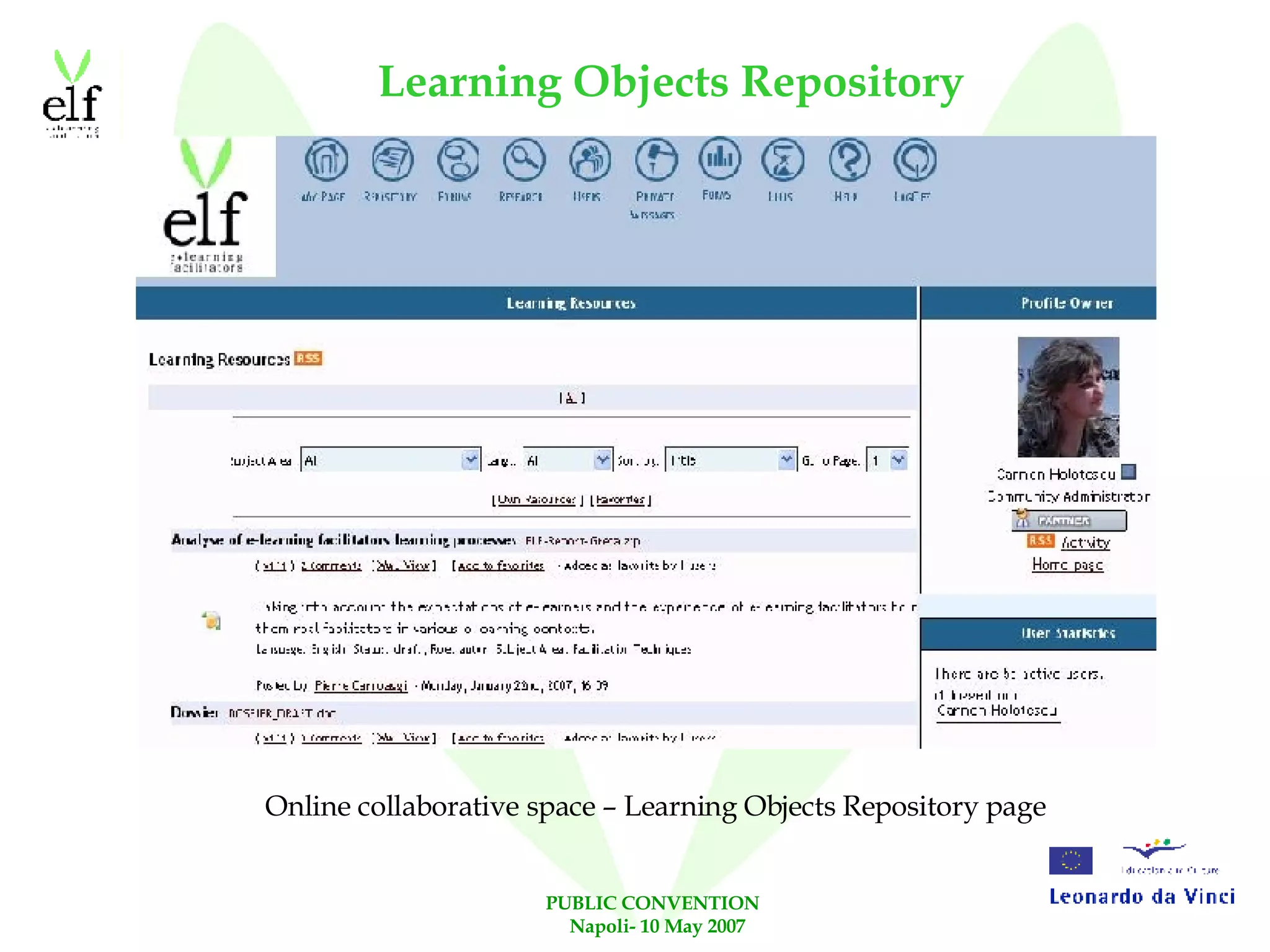
Learning Objects Repository Online collaborative space – Learning Objects Repository page
Training of Trainers in a blended course Aim: Verifying training methodologies for perfecting of necessary skills for playing ELF’s role standard Verifying contents for ELF’s training identified for perfecting of necessary skills for role standard Verifying tasks and skills of an ELF identified in Dossier Verifying the tool produced in the previous step Organisation: Virtual community in which participate the e-Tutors ( 3 from each country ); the discussions are facilitated by a community facilitator and the ELF partners. The e-Tutors from  each country can have also f2f meetings with the partner from that country Duration: 4 weeks. Activities: Materials study Test Self-assessment Tool Online discussions and feedback related to materials and tool
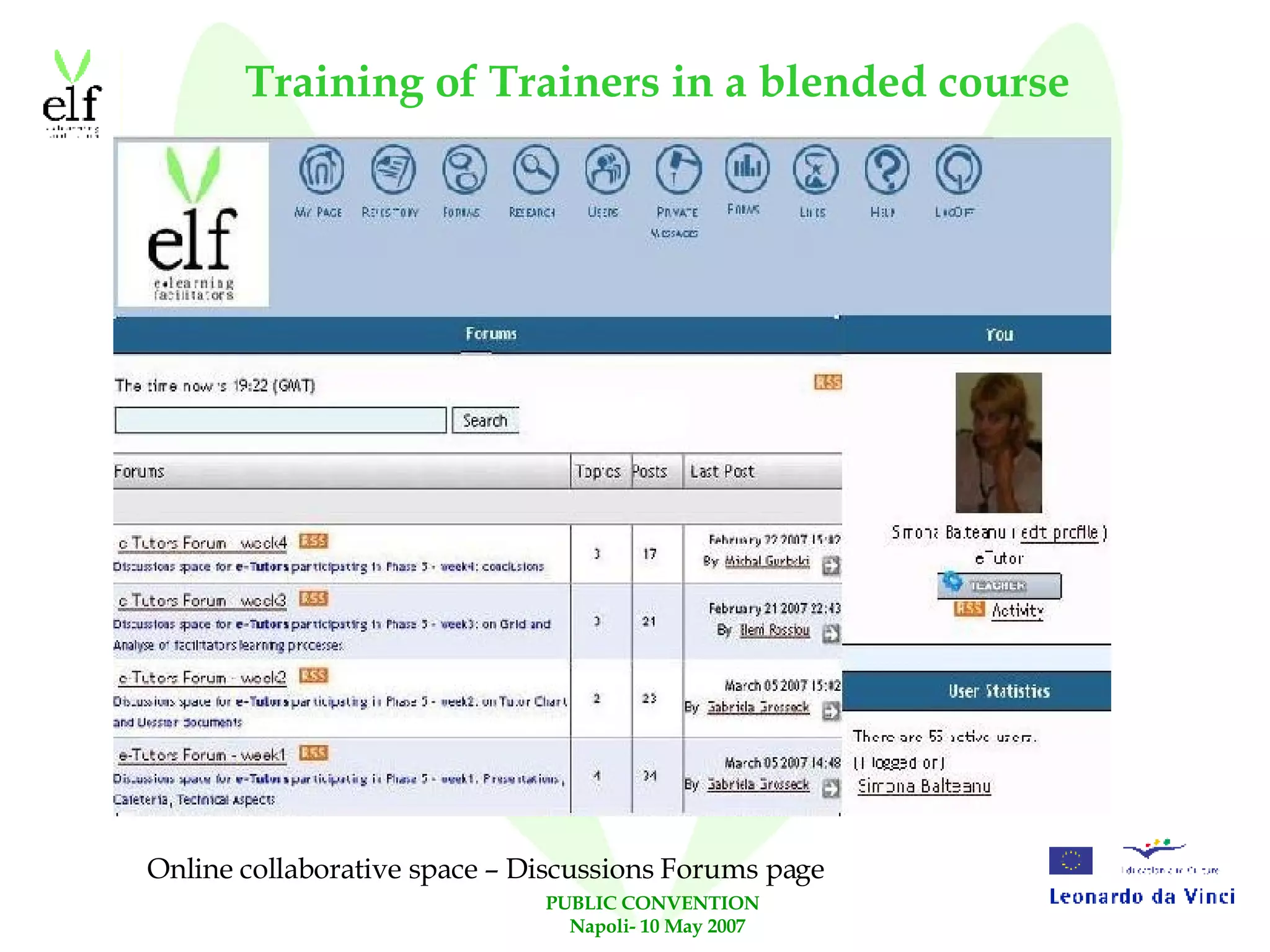
Training of Trainers in a blended course Online collaborative space – Discussions Forums page
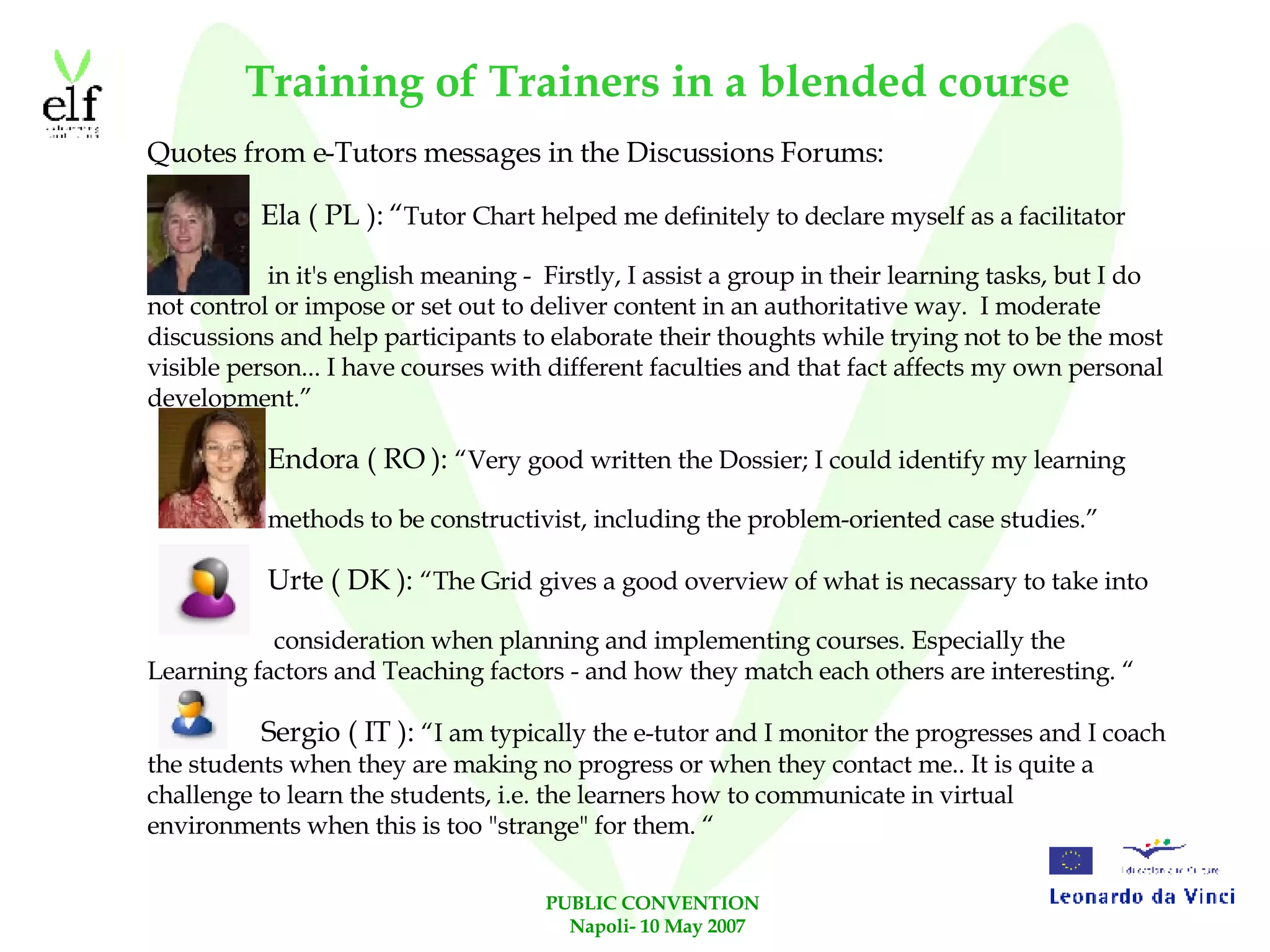
Training of Trainers in a blended course Quotes from e-Tutors messages in the Discussions Forums: Ela ( PL ): “ Tutor Chart helped me definitely to declare myself as a facilitator  in it's english meaning -  Firstly, I assist a group in their learning tasks, but I do not control or impose or set out to deliver content in an authoritative way.  I moderate discussions and help participants to elaborate their thoughts while trying not to be the most visible person... I have courses with different faculties and that fact affects my own personal development.” Endora ( RO ):  “Very good written the Dossier; I could identify my learning  methods to be constructivist, including the problem-oriented case studies.” Urte ( DK ):  “The Grid gives a good overview of what is necassary to take into consideration when planning and implementing courses. Especially the Learning factors and Teaching factors - and how they match each others are interesting. “ Sergio ( IT ):  “I am typically the e-tutor and I monitor the progresses and I coach the students when they are making no progress or when they contact me.. It is quite a challenge to learn the students, i.e. the learners how to communicate in virtual environments when this is too "strange" for them. “
Training of Trainers in a blended course Quotes from e-Tutors messages in the Discussions Forums: Sen ( NL ): “ I could find here useful information about e-learning and the ways of tutoring. ” Eleni  (GR ):  “I would like to add some points as it concerns the "temptation"  of bulding our "learning community" and further more to manage to keep it  ALIVE! resources of the points below are my experience in using blended learning in tradional face-to-face instruction in Higher education..” Valeryia  ( BG):  “Reading that Analysis makes me think over face-to-face  classwork at school. A good analysis of  the difficulties that e-learning facilitators come up against could be the ground to rethink all the difficulties that facilitators encounter in the classroom. It is worthy of consideration.” Celine ( FR ):  “Concerning my e-tutor activity, I work essentially in the  framework of a training scheme destined to improve the employees and employers skills and competences for reception and integration of new employee(s) within their company.”
Achieving a handbook for training of e-tutors trainers Aim: Production of a handbook for training of e-tutors trainers, improve the project materials using the feedback obtained in the previous step. Activities: - Comparison between: a) conclusions of the participants in the blended course  b) project products c) analysis of the reports of the participants  - Writing of the handbook - Valorization - Management of the quality - Publish the handbook on ELF website.

Blended course for e-tutors

  • 1.
    E – learningfacilitators: analyses of their different roles within different e – learning methodologies and approaches n. I/05/B/F/PP-154178 Fifth Phase: TESTING OF PROJECT RESULTS BY ACHIEVING AN EXPERIMENTATION ON THE JOB Partners: Università di Napoli Federico II, Dipartimento di Filosofia “A. Aliotta”, Italy Timsoft, Romania National Organisation Women in Higher Technical Education and Position - VHTO, Netherlands
  • 2.
    Self-assesment tool productionTraining of trainers in a blended course Achieving a handbook for training of e-tutors trainers 5 th Phase Steps Training of trainers in a blended course Objectives: Analyzing agreements and/or differences between theoretical analysis of previous phases and the real work of an e-tutor Verifying training methodologies for perfecting of necessary skills for playing ELF’s role standard Verifying contents for ELF’s training identified for perfecting of necessary skills for role standard Verifying tasks and skills of an ELF identified in Dossier
  • 3.
    Self-assessment Tool ProductionAim: Production of tool to assess results of ELF research in confrontation with real work of e-tutor. Tool assesses the skills of the e-tutor and the type of the online courses to facilitate. Organisation: Virtual community among ELF researchers with a community facilitator for stimulating confrontations, dialogues, proposing topics for discussions, managing time for results production. Main contents: Guidelines, Dossier, Grid, Analysis of facilitators learning processes Glossary further materials in order to have a deeper comprehension of the e-tutor-role, in order to discuss main contents and to deliver scheduled results. The content was organised as a Learning Objects Repository ( SCORM / LOM compatible ) in which new LOs can be added by the members of ELF Network.
  • 4.
    Self-assessment Tool Onlinecollaborative space – Self-assessment Tool page
  • 5.
    Learning Objects RepositoryOnline collaborative space – Learning Objects Repository page
  • 6.
    Training of Trainersin a blended course Aim: Verifying training methodologies for perfecting of necessary skills for playing ELF’s role standard Verifying contents for ELF’s training identified for perfecting of necessary skills for role standard Verifying tasks and skills of an ELF identified in Dossier Verifying the tool produced in the previous step Organisation: Virtual community in which participate the e-Tutors ( 3 from each country ); the discussions are facilitated by a community facilitator and the ELF partners. The e-Tutors from each country can have also f2f meetings with the partner from that country Duration: 4 weeks. Activities: Materials study Test Self-assessment Tool Online discussions and feedback related to materials and tool
  • 7.
    Training of Trainersin a blended course Online collaborative space – Discussions Forums page
  • 8.
    Training of Trainersin a blended course Quotes from e-Tutors messages in the Discussions Forums: Ela ( PL ): “ Tutor Chart helped me definitely to declare myself as a facilitator in it's english meaning - Firstly, I assist a group in their learning tasks, but I do not control or impose or set out to deliver content in an authoritative way. I moderate discussions and help participants to elaborate their thoughts while trying not to be the most visible person... I have courses with different faculties and that fact affects my own personal development.” Endora ( RO ): “Very good written the Dossier; I could identify my learning methods to be constructivist, including the problem-oriented case studies.” Urte ( DK ): “The Grid gives a good overview of what is necassary to take into consideration when planning and implementing courses. Especially the Learning factors and Teaching factors - and how they match each others are interesting. “ Sergio ( IT ): “I am typically the e-tutor and I monitor the progresses and I coach the students when they are making no progress or when they contact me.. It is quite a challenge to learn the students, i.e. the learners how to communicate in virtual environments when this is too "strange" for them. “
  • 9.
    Training of Trainersin a blended course Quotes from e-Tutors messages in the Discussions Forums: Sen ( NL ): “ I could find here useful information about e-learning and the ways of tutoring. ” Eleni (GR ): “I would like to add some points as it concerns the "temptation" of bulding our "learning community" and further more to manage to keep it ALIVE! resources of the points below are my experience in using blended learning in tradional face-to-face instruction in Higher education..” Valeryia ( BG): “Reading that Analysis makes me think over face-to-face classwork at school. A good analysis of the difficulties that e-learning facilitators come up against could be the ground to rethink all the difficulties that facilitators encounter in the classroom. It is worthy of consideration.” Celine ( FR ): “Concerning my e-tutor activity, I work essentially in the framework of a training scheme destined to improve the employees and employers skills and competences for reception and integration of new employee(s) within their company.”
  • 10.
    Achieving a handbookfor training of e-tutors trainers Aim: Production of a handbook for training of e-tutors trainers, improve the project materials using the feedback obtained in the previous step. Activities: - Comparison between: a) conclusions of the participants in the blended course b) project products c) analysis of the reports of the participants - Writing of the handbook - Valorization - Management of the quality - Publish the handbook on ELF website.