Presentation
On
Blade Server
CONTENT
 Introduction
 Concept
 Blade Server Technology
 Hardware & Software
 Blade Enclosure
 Blade Server Architecture
 Advantages
 Disadvantages
 Conclusion
 Reference
 Blade servers are efficient solutions for data
centres requiring flexible, high density
deployment and management of high
performance servers. Blade servers can
pack more server performance into less
space while reducing cost and complexity,
simplifying deployment and management,
and improving overall data centre
performance.
CONCEPT
 Blade server : Less space
, more work
 Two key pointers
 What’s in store?
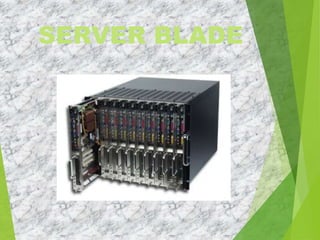
SERVER BLADE
BLADE SERVER
TECHNOLOGY
Blade server technology greatly
increases server density, Lowers power
and cooling costs, eases server
expansion and simplifies data centre
management.
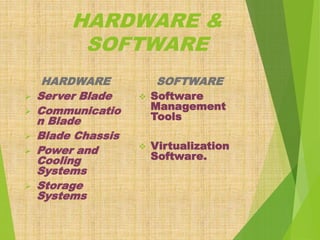
HARDWARE &
SOFTWARE
HARDWARE
 Server Blade
 Communicatio
n Blade
 Blade Chassis
 Power and
Cooling
Systems
 Storage
Systems
SOFTWARE
 Software
Management
Tools
 Virtualization
Software.
BLADE ENCLOSURE
 Power
 Cooling
 Networking
 Storage
 Connectivity
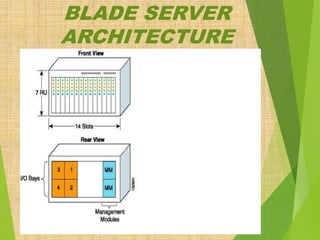
BLADE SERVER
ARCHITECTURE
ADVANTAGES
 Reduced space
Requirements.
 Reduced Power
Consumption.
 Lower
Management
Cost.
 Simplified
Cabling.
 Future
Proofing.
 Easier Physical
Deployment.
DISADVANTAGES
 Configuration Expenses.
 Unit Utilization.
 Technology Advancements.
 Temperature Requirements.
CONCLUSION
Blade servers are an important new technology that promise
unheard-of levels of data center device density. Given the right
management tools, it should be possible for the data center
manager to move into a more strategic role. Rather than
firefighting day-to-day tactical problems, the human input can
become more creative than at present. Well-engineered,
vendor-independent blade server management tools will allow
the operator to focus on issues related to service fulfillment and
assurance.
Reference
 www.wikipedia.org
 www.studymafia.org
QUERIES
Thank you

BLADE SERVER