Black Language Matters
Repositioning African American
English in Language Education
Shajaira Lopez, EdD
Aurora University
Illinois TESOL Bilingual Education
English Learner Advocacy Council in Higher Education
February 24, 2018
Black Language
Matters!
2
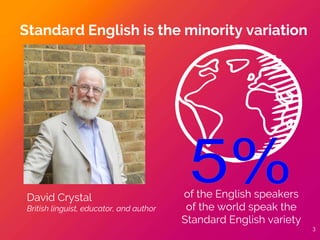
of the English speakers
of the world speak the
Standard English variety
David Crystal
British linguist, educator, and author
Standard English is the minority variation
3
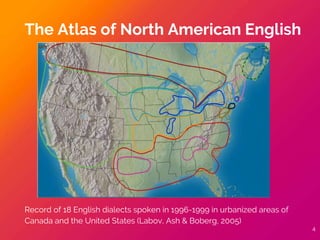
Record of 18 English dialects spoken in 1996-1999 in urbanized areas of
Canada and the United States (Labov, Ash & Boberg, 2005)
The Atlas of North American English
4
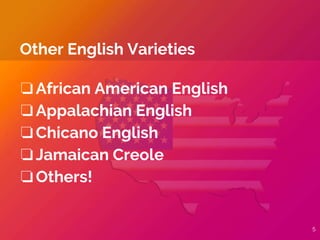
❏African American English
❏Appalachian English
❏Chicano English
❏Jamaican Creole
❏Others!
Other English Varieties
5
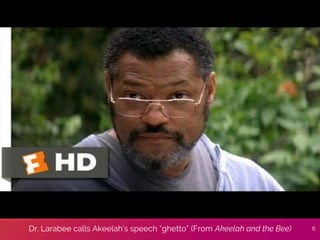
Dr. Larabee calls Akeelah’s speech “ghetto” (From Akeelah and the Bee) 6
How do we
change this?
7
8
Black Language
Matters!
9
What
is
AAE?
African American English is as
systematic, rule-governed, and
patterned as all other languages and
language varieties (Hudley & Mallinson,
2011).
10
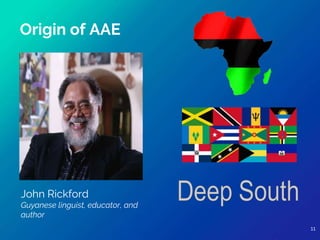
John Rickford
Guyanese linguist, educator, and
author
Origin of AAE
11
12
❏ Similarities in AAE and West African English
❏ Pronunciation of initial [th] as [d]: “dat,” “da”
❏ Pronunciation of final [th] as [f]: “baf,” “mouf”
❏ Completed actions: “He done ate”
❏ Habitual actions: “He be eatin’”
❏ Double negatives: “I don’t want none”
AAE may have originated from
West African languages
12
13
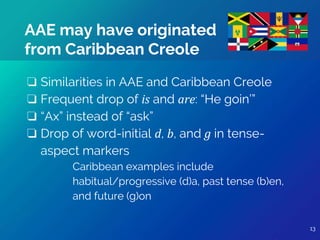
❏ Similarities in AAE and Caribbean Creole
❏ Frequent drop of is and are: “He goin’”
❏ “Ax” instead of “ask”
❏ Drop of word-initial d, b, and g in tense-
aspect markers
Caribbean examples include
habitual/progressive (d)a, past tense (b)en,
and future (g)on
AAE may have originated
from Caribbean Creole
13
14
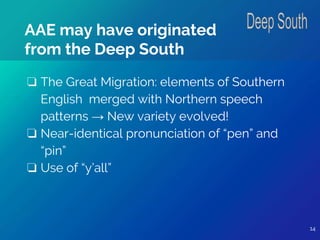
❏ The Great Migration: elements of Southern
English merged with Northern speech
patterns → New variety evolved!
❏ Near-identical pronunciation of “pen” and
“pin”
❏ Use of “y’all”
AAE may have originated
from the Deep South
14
Some of the terms
that have been
used to refer to
the linguistic
patterns of African
Americans?
Black Language
Black English
Ebonics
African American
Vernacular English
(AAVE)
African American
Language (AAL)
African American
English (AAE)
15
Status of
AAE
in the U.S.
16
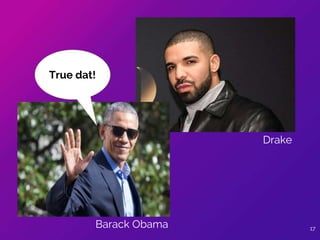
True dat!
17Barack Obama
Drake
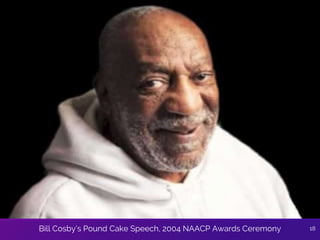
Bill Cosby’s Pound Cake Speech, 2004 NAACP Awards Ceremony 18
19
Status of
AAE
in education
Teachers tend to spend less time
engaging in conversations with AAE-
speaking students and pay less
attention to them (Boutte & Johnson,
2013).
1972: Students’ Right to Their Own Language
Resolution (NCTE, 1974)
We affirm the students' right to their own patterns
and varieties of language—the dialects of their
nurture or whatever dialects in which they find their
own identity and style. . . We affirm strongly that
teachers must have the experiences and training
that will enable them to respect diversity and
uphold the right of students to their own language.
(NCTE, 1974, p. 1)
Noteworthy attempt to address
AAE in education
20
1988: National Language Policy (NCTE, 2015)
1. To provide resources to enable native and
nonnative speakers to achieve oral and literate
competence in English
2. To support programs that assert the legitimacy of
native languages and dialects and ensure that
proficiency in one’s mother tongue will not be lost
3. To foster the teaching of languages other than
English so that native speakers of English can
rediscover the language of their heritage or learn a
second language.
Noteworthy attempt to address
AAE in education (cont.)
21
❏ 1996: Oakland Resolution on Ebonics (Fogel
& Ehri, 2000)
❏ 1997: TESOL position statement on African
American Vernacular English (TESOL, 1997)
TESOL affirmed that the variety of English known as African
American Vernacular English, Black English, Ebonics, and
sometimes by other names has been shown through research
to be a rule-governed linguistic system, with its own lexical,
phonological, syntactic, and discourse patterns and, thus,
deserves pedagogical recognition. . . TESOL thus advocates
that teacher education include instruction in linguistics and in
developing partnerships between home and school.
Noteworthy attempts to address
AAE in education (cont.)
22
23
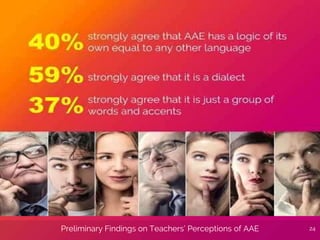
What are P-12 teachers’
perceptions on students’
use of AAE in the
classrooms?
Preliminary Findings on Teachers’ Perceptions of AAE 24
Toni Morrison, described language
as, “the thing that black people love
so much—the saying of words,
holding them on the tongue,
experimenting with them, playing
with them. It’s a love, a passion. Its
function is like a preacher’s: to make
you stand up out of your seat, make
you lose yourself and hear yourself.”
(Thomas, 1994, p. 123)
25
Black Language
Matters!
26
27
References
Boutte, G. S., & Johnson, G. L. (2013). Do educators see and honor biliteracy and bidialectalism in african american language speakers?
apprehensions and reflections of two Grandparents/Professional educators. Early Childhood Education Journal, 41(2), 133-141.
doi:http://dx.doi.org/10.1007/s10643-012-0538-5
[Cambridge University Press ELT]. (2012, October 23). Academic English - Prof. David Crystal on standard vs. non-standard English.
[Video File]. Retrieved from https://www.youtube.com/watch?v=hGg-2MQVReQ&list=LLCtuZmtZp-ZNcliC-uBRbVQ&index=5
Charity Hudley, A. H., & Mallinson, C. (2011) Understanding English language variation in U.S. schools. New York: Teachers College Pres.
Fogel, H., & Ehri, L. C. (2000). Teaching elementary students who speak Black English Vernacular to write in Standard English: Effects of
dialect transformation practice. Contemporary Educational Psychology, 25 (212-235). doi:10.1006/ceps.1999.1002
Harris, Y. R. & Schroeder, V. M. (2013). Language deficits or differences: What we know about African American Vernacular English in
the 21st century. International Education Studies, 6(4), 194-204.
Hoyne, W. B. (2014, August 28). Bill Cosby’s “Pound Cake” speech. [Video File]. Retrieved from
https://www.youtube.com/watch?v=kg5kRLiuafg&feature=youtu.be
Igoudin, A. L. (2013). “Asian American girls who speak African American English: A subcultural language identity.” In Inke du B. and
Nicole B. (Eds.). Multilingual Identities: New Global Perspectives. Frankfurt: Peter Lang.
Jones, T. M. (2011). A study of teachers' views on students' use of african american english in the english language arts classroom (Order
No. 3461058). Available from Education Database; ProQuest Dissertations & Theses Global: The Humanities and Social Sciences
Collection. (879557501). Retrieved from
http://library.aurora.edu/login?url=https://search.proquest.com/docview/879557501?accountid=26354
Lopez, S. P. (2017). Negotiating students’ right to their own language. [Manuscript in preparation].
Lopez, S. P. (2017). [P-12 teachers’ perceptions on students’ use of African American English in the classrooms]. Unpublished raw data.
[Movieclips]. (2012, May 25). Akeelah and the bee (2/9) movie clip - intelligent and insolent (2006) HD. [Video File]. Retrieved from
https://www.youtube.com/watch?v=WdDUhHl-BzM&feature=youtu.be
National Council of Teachers of English. (1974). Students’ right to their own language. NCTE Conference on College Composition and
Communication. Retrieved from http://www.ncte.org/library/NCTEFiles/Groups/CCCC/NewSRTOL.pdf
Rickford, J. R., & Rickford, R. J. 2000. Spoken Soul: The story of Black English. New York: John Wiley.
Rickford, J. R. (2006). African American vernacular English: Roots and branches. In Janina Brutt-Griffler and Catherine Evans Davies, eds.
English as Ethnicity, 259-276. New York: Palgrave Mcmillan.
Rutgers. (n.d.). Dr. Bill Cosby speaks at the 50th anniversary commemoration of the Brown vs Topeka Board of Education supreme court
decision. Retrieved on October 20, 2017 from https://www.rci.rutgers.edu/~schochet/101/Cosby_Speech.htm
Smitherman, G. (1995). “Students’ right to their own language”: A retrospective. English Journal, 84(1), 21-27.
Smitherman, G. (2000). Talkin that talk: language, culture, and education in African America. London: Routledge.
TESOL. (1997, March). Position statement of the TESOL board on African American Vernacular English. Retrieved from
http://www.tesol.org/advance-the-field/advocacy-resources/position-statements/position-statement-of-the-tesol-board-
on-african-american-vernacular-english-march-1997
Thomas, L. (1994). The language must not sweat: a conversation with Toni Morrison. In D. K. Taylor-Guthrie (Ed.), Conversations with Toni
Morrison. Jackson, MS: University Press of Mississippi.

Black Language Matters

  • 1.
    Black Language Matters RepositioningAfrican American English in Language Education Shajaira Lopez, EdD Aurora University Illinois TESOL Bilingual Education English Learner Advocacy Council in Higher Education February 24, 2018
  • 2.
  • 3.
    of the Englishspeakers of the world speak the Standard English variety David Crystal British linguist, educator, and author Standard English is the minority variation 3
  • 4.
    Record of 18English dialects spoken in 1996-1999 in urbanized areas of Canada and the United States (Labov, Ash & Boberg, 2005) The Atlas of North American English 4
  • 5.
    ❏African American English ❏AppalachianEnglish ❏Chicano English ❏Jamaican Creole ❏Others! Other English Varieties 5
  • 6.
    Dr. Larabee callsAkeelah’s speech “ghetto” (From Akeelah and the Bee) 6
  • 7.
  • 8.
  • 9.
  • 10.
    What is AAE? African American Englishis as systematic, rule-governed, and patterned as all other languages and language varieties (Hudley & Mallinson, 2011). 10
  • 11.
    John Rickford Guyanese linguist,educator, and author Origin of AAE 11
  • 12.
    12 ❏ Similarities inAAE and West African English ❏ Pronunciation of initial [th] as [d]: “dat,” “da” ❏ Pronunciation of final [th] as [f]: “baf,” “mouf” ❏ Completed actions: “He done ate” ❏ Habitual actions: “He be eatin’” ❏ Double negatives: “I don’t want none” AAE may have originated from West African languages 12
  • 13.
    13 ❏ Similarities inAAE and Caribbean Creole ❏ Frequent drop of is and are: “He goin’” ❏ “Ax” instead of “ask” ❏ Drop of word-initial d, b, and g in tense- aspect markers Caribbean examples include habitual/progressive (d)a, past tense (b)en, and future (g)on AAE may have originated from Caribbean Creole 13
  • 14.
    14 ❏ The GreatMigration: elements of Southern English merged with Northern speech patterns → New variety evolved! ❏ Near-identical pronunciation of “pen” and “pin” ❏ Use of “y’all” AAE may have originated from the Deep South 14
  • 15.
    Some of theterms that have been used to refer to the linguistic patterns of African Americans? Black Language Black English Ebonics African American Vernacular English (AAVE) African American Language (AAL) African American English (AAE) 15
  • 16.
  • 17.
  • 18.
    Bill Cosby’s PoundCake Speech, 2004 NAACP Awards Ceremony 18
  • 19.
    19 Status of AAE in education Teacherstend to spend less time engaging in conversations with AAE- speaking students and pay less attention to them (Boutte & Johnson, 2013).
  • 20.
    1972: Students’ Rightto Their Own Language Resolution (NCTE, 1974) We affirm the students' right to their own patterns and varieties of language—the dialects of their nurture or whatever dialects in which they find their own identity and style. . . We affirm strongly that teachers must have the experiences and training that will enable them to respect diversity and uphold the right of students to their own language. (NCTE, 1974, p. 1) Noteworthy attempt to address AAE in education 20
  • 21.
    1988: National LanguagePolicy (NCTE, 2015) 1. To provide resources to enable native and nonnative speakers to achieve oral and literate competence in English 2. To support programs that assert the legitimacy of native languages and dialects and ensure that proficiency in one’s mother tongue will not be lost 3. To foster the teaching of languages other than English so that native speakers of English can rediscover the language of their heritage or learn a second language. Noteworthy attempt to address AAE in education (cont.) 21
  • 22.
    ❏ 1996: OaklandResolution on Ebonics (Fogel & Ehri, 2000) ❏ 1997: TESOL position statement on African American Vernacular English (TESOL, 1997) TESOL affirmed that the variety of English known as African American Vernacular English, Black English, Ebonics, and sometimes by other names has been shown through research to be a rule-governed linguistic system, with its own lexical, phonological, syntactic, and discourse patterns and, thus, deserves pedagogical recognition. . . TESOL thus advocates that teacher education include instruction in linguistics and in developing partnerships between home and school. Noteworthy attempts to address AAE in education (cont.) 22
  • 23.
    23 What are P-12teachers’ perceptions on students’ use of AAE in the classrooms?
  • 24.
    Preliminary Findings onTeachers’ Perceptions of AAE 24
  • 25.
    Toni Morrison, describedlanguage as, “the thing that black people love so much—the saying of words, holding them on the tongue, experimenting with them, playing with them. It’s a love, a passion. Its function is like a preacher’s: to make you stand up out of your seat, make you lose yourself and hear yourself.” (Thomas, 1994, p. 123) 25
  • 26.
  • 27.
    27 References Boutte, G. S.,& Johnson, G. L. (2013). Do educators see and honor biliteracy and bidialectalism in african american language speakers? apprehensions and reflections of two Grandparents/Professional educators. Early Childhood Education Journal, 41(2), 133-141. doi:http://dx.doi.org/10.1007/s10643-012-0538-5 [Cambridge University Press ELT]. (2012, October 23). Academic English - Prof. David Crystal on standard vs. non-standard English. [Video File]. Retrieved from https://www.youtube.com/watch?v=hGg-2MQVReQ&list=LLCtuZmtZp-ZNcliC-uBRbVQ&index=5 Charity Hudley, A. H., & Mallinson, C. (2011) Understanding English language variation in U.S. schools. New York: Teachers College Pres. Fogel, H., & Ehri, L. C. (2000). Teaching elementary students who speak Black English Vernacular to write in Standard English: Effects of dialect transformation practice. Contemporary Educational Psychology, 25 (212-235). doi:10.1006/ceps.1999.1002 Harris, Y. R. & Schroeder, V. M. (2013). Language deficits or differences: What we know about African American Vernacular English in the 21st century. International Education Studies, 6(4), 194-204. Hoyne, W. B. (2014, August 28). Bill Cosby’s “Pound Cake” speech. [Video File]. Retrieved from https://www.youtube.com/watch?v=kg5kRLiuafg&feature=youtu.be Igoudin, A. L. (2013). “Asian American girls who speak African American English: A subcultural language identity.” In Inke du B. and Nicole B. (Eds.). Multilingual Identities: New Global Perspectives. Frankfurt: Peter Lang. Jones, T. M. (2011). A study of teachers' views on students' use of african american english in the english language arts classroom (Order No. 3461058). Available from Education Database; ProQuest Dissertations & Theses Global: The Humanities and Social Sciences Collection. (879557501). Retrieved from http://library.aurora.edu/login?url=https://search.proquest.com/docview/879557501?accountid=26354 Lopez, S. P. (2017). Negotiating students’ right to their own language. [Manuscript in preparation]. Lopez, S. P. (2017). [P-12 teachers’ perceptions on students’ use of African American English in the classrooms]. Unpublished raw data. [Movieclips]. (2012, May 25). Akeelah and the bee (2/9) movie clip - intelligent and insolent (2006) HD. [Video File]. Retrieved from https://www.youtube.com/watch?v=WdDUhHl-BzM&feature=youtu.be National Council of Teachers of English. (1974). Students’ right to their own language. NCTE Conference on College Composition and Communication. Retrieved from http://www.ncte.org/library/NCTEFiles/Groups/CCCC/NewSRTOL.pdf Rickford, J. R., & Rickford, R. J. 2000. Spoken Soul: The story of Black English. New York: John Wiley. Rickford, J. R. (2006). African American vernacular English: Roots and branches. In Janina Brutt-Griffler and Catherine Evans Davies, eds. English as Ethnicity, 259-276. New York: Palgrave Mcmillan. Rutgers. (n.d.). Dr. Bill Cosby speaks at the 50th anniversary commemoration of the Brown vs Topeka Board of Education supreme court decision. Retrieved on October 20, 2017 from https://www.rci.rutgers.edu/~schochet/101/Cosby_Speech.htm Smitherman, G. (1995). “Students’ right to their own language”: A retrospective. English Journal, 84(1), 21-27. Smitherman, G. (2000). Talkin that talk: language, culture, and education in African America. London: Routledge. TESOL. (1997, March). Position statement of the TESOL board on African American Vernacular English. Retrieved from http://www.tesol.org/advance-the-field/advocacy-resources/position-statements/position-statement-of-the-tesol-board- on-african-american-vernacular-english-march-1997 Thomas, L. (1994). The language must not sweat: a conversation with Toni Morrison. In D. K. Taylor-Guthrie (Ed.), Conversations with Toni Morrison. Jackson, MS: University Press of Mississippi.