(The burial of massive stars)
   The name 'black hole' was invented by John
    Archibald Wheeler .
   Before Wheeler came along, these objects were
    often referred to as 'frozen stars.'
   The concept of black hole was first proposed by
    Pierre Simon Laplace in 1795.
   Using Newton's Theory of Gravitation ,Laplace
    calculated that if an object were compressed into
    a small enough radius, then the escape velocity
    of that object would be faster than the speed of
    light.
   The velocity at which the body is thrown in
    such a way that it does not return again.

   This is the concept used for rocket
    propulsion.

   on earth it is 11.2 km/sec

   on moon it is 2.4 km/sec
In black holes the
Escape velocity> 3,00,000 km/sec

   even light cann’t escape through it.
   Stars rotate around the centers of galaxy with
    their own gravitational energy.

   When their energy comes to an end , they
    collapse in their own gravity .

   This forms a black hole.
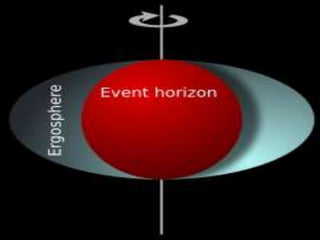
   Event horizon is a spherical surface that
    marks the boundary of the black hole .

    You can pass in through the horizon, but you
    can't get back out of it.
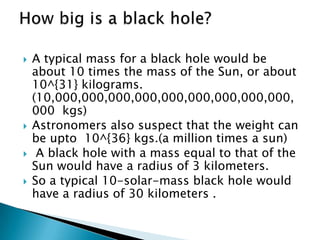
   A typical mass for a black hole would be
    about 10 times the mass of the Sun, or about
    10^{31} kilograms.
    (10,000,000,000,000,000,000,000,000,000,
    000 kgs)
   Astronomers also suspect that the weight can
    be upto 10^{36} kgs.(a million times a sun)
    A black hole with a mass equal to that of the
    Sun would have a radius of 3 kilometers.
   So a typical 10-solar-mass black hole would
    have a radius of 30 kilometers .
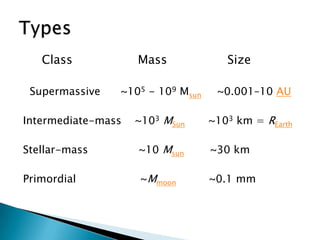
Class            Mass             Size

 Supermassive   ~105 - 109 Msun    ~0.001–10 AU

Intermediate-mass   ~103 MSun     ~103 km = REarth

Stellar-mass        ~10 Msun      ~30 km

Primordial          ~Mmoon        ~0.1 mm
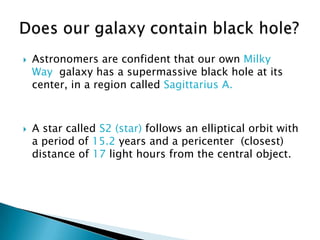
   Astronomers are confident that our own Milky
    Way galaxy has a supermassive black hole at its
    center, in a region called Sagittarius A.


   A star called S2 (star) follows an elliptical orbit with
    a period of 15.2 years and a pericenter (closest)
    distance of 17 light hours from the central object.
The

Black holes

  • 1.
    (The burial ofmassive stars)
  • 3.
    The name 'black hole' was invented by John Archibald Wheeler .  Before Wheeler came along, these objects were often referred to as 'frozen stars.'  The concept of black hole was first proposed by Pierre Simon Laplace in 1795.  Using Newton's Theory of Gravitation ,Laplace calculated that if an object were compressed into a small enough radius, then the escape velocity of that object would be faster than the speed of light.
  • 4.
    The velocity at which the body is thrown in such a way that it does not return again.  This is the concept used for rocket propulsion.  on earth it is 11.2 km/sec  on moon it is 2.4 km/sec
  • 5.
    In black holesthe Escape velocity> 3,00,000 km/sec  even light cann’t escape through it.
  • 6.
    Stars rotate around the centers of galaxy with their own gravitational energy.  When their energy comes to an end , they collapse in their own gravity .  This forms a black hole.
  • 7.
    Event horizon is a spherical surface that marks the boundary of the black hole .  You can pass in through the horizon, but you can't get back out of it.
  • 9.
    A typical mass for a black hole would be about 10 times the mass of the Sun, or about 10^{31} kilograms. (10,000,000,000,000,000,000,000,000,000, 000 kgs)  Astronomers also suspect that the weight can be upto 10^{36} kgs.(a million times a sun)  A black hole with a mass equal to that of the Sun would have a radius of 3 kilometers.  So a typical 10-solar-mass black hole would have a radius of 30 kilometers .
  • 10.
    Class Mass Size Supermassive ~105 - 109 Msun ~0.001–10 AU Intermediate-mass ~103 MSun ~103 km = REarth Stellar-mass ~10 Msun ~30 km Primordial ~Mmoon ~0.1 mm
  • 11.
    Astronomers are confident that our own Milky Way galaxy has a supermassive black hole at its center, in a region called Sagittarius A.  A star called S2 (star) follows an elliptical orbit with a period of 15.2 years and a pericenter (closest) distance of 17 light hours from the central object.
  • 12.