
NEBULAE, QUASARS,
AND BLAZARS
Bryan Nozaleda
What is a nebula?
A nebula, derived from the Latin
meaning “mist,” is any cloud or
collection of interstellar medium
in one location in space. Nebulae
are produced in many different
ways.
How many kinds of nebulae
are there?
Generally, types of nebulae are described
either by their appearance (for example,
dark nebulae, reflection nebulae, and
planetary nebulae) or the physical
processes that create them (such as
protostellar nebulae, protoplanetary
nebulae, or supernova remnants).
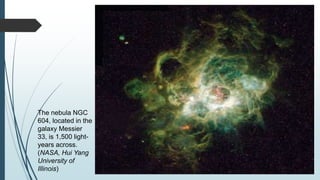
The nebula NGC
604, located in the
galaxy Messier
33, is 1,500 light-
years across.
(NASA, Hui Yang
University of
Illinois)
What are dark nebulae?
Dark nebulae are, well, dark. They look like
black blobs in the sky. They are generally
dark because they contain mainly cold,
high-density, opaque gas, as well as
enough dust to quench the light from stars
behind them. One example of a dark
nebula is the Coal Sack Nebula, located
near the constellation Crux (The Southern
Cross).
What is a reflection nebula?
A reflection nebula is lit by bright, nearby
light sources. The dust grains in them act
like countless microscopic mirrors, which
reflect light from stars or other energetic
objects toward Earth. To the human eye,
reflection nebulae usually look bluish. This
is because blue light is more effectively
reflected in this way than red light.
What is an emission nebula?
An emission nebula is a glowing gas cloud with a
strong source of radiation—usually a bright star—
within or behind it. If the source gives off enough
high-energy ultraviolet radiation, some of the gas is
ionized, which means the electrons and nuclei of the
gas molecules become separated and fly freely
through the cloud. When the free electrons
recombine with the free nuclei to become atoms
again, the gas gives off light of specific colors. Which
colors they emit depends on the temperature,
density, and composition of the gas. The Orion
Nebula, for example, glows mostly green and red.
What is a quasar?
The term “quasar” is short for “quasi-stellar radio
source.” Subsequent studies showed that they
were not stars at all, but rather active galactic
nuclei. Nowadays, the word “quasar” is often
used to mean any quasi-stellar object (QSO),
whether or not it emits radio waves.
When and how were quasars first
found?
 In the 1950s and 1960s, astronomers in Cambridge, England,
began to use the most sensitive radio telescopes of the day to map the
entire sky
 The third Cambridge (3C) catalog contains hundreds of radio sources,
and astronomers took visible-light photographs of these sources to see
what they would look like to our eyes. The 273rd object in the 3C
catalog looked like a star. But when astronomers subsequently studied
more carefully the light it emits, it was discovered that 3C 273 was
actually an active galaxy far away from the Milky Way. In fact, 3C 273
was the first quasar ever discovered and identified as a distant “active
galactic nucleus” (AGN).
An artist’s concept of a quasar in a distant
galaxy. (NASA/JPL-Caltech/T. Pyle (SSC))
What are blazars and BL Lacertae
objects?
BL Lacertae was a radio source that,
originally, was identified as a special kind of
variable star.
Today, objects like BL Lacertae are called
blazars. Their spectral characteristics are very
different from quasars like 3C 273, and they
emit a much higher fraction of their energy at
gamma ray and X-ray wavelengths than
most other QSOs.
How were quasars first identified as
distant, super-bright objects?
In 1962 the Dutch-American astronomer
Maarten Schmidt (1929–), examining the
spectrum of 3C 273, realized that its pattern of
emission lines was very much like that of some
Seyfert galaxies, but more extreme. Using the
redshift, Schmidt showed that 3C 273 was nearly
two billion light-years away from Earth.
How bright can quasars (and QSOs in
general) get?
The brightest quasars (and, in
general, QSOs) are many
thousands of times brighter than
all the stars in our Milky Way
galaxy put together.
What does a quasar really look
like?
 Imagine a supermassive black hole that is millions or
billions of miles across and is at the center of a rapidly
spinning disk of superhot gas. Around the disk and the
black hole is a thick, doughnut-shaped torus of thicker,
cooler gas. Matter falling toward the black hole
accumulates in the torus and slowly swirls into the gas
disk on its way to the black hole. Finally, right near the
black hole, two super-energetic jets of matter shoot
outward, above and below the disk, with matter
traveling at nearly the speed of light. These jets extend
thousands, even millions of light-years out into space.
That is the basic picture of a quasar, or quasi-stellar
object (QSO).

Nebulae, quasars,

  • 1.
  • 2.
    What is anebula? A nebula, derived from the Latin meaning “mist,” is any cloud or collection of interstellar medium in one location in space. Nebulae are produced in many different ways.
  • 3.
    How many kindsof nebulae are there? Generally, types of nebulae are described either by their appearance (for example, dark nebulae, reflection nebulae, and planetary nebulae) or the physical processes that create them (such as protostellar nebulae, protoplanetary nebulae, or supernova remnants).
  • 4.
    The nebula NGC 604,located in the galaxy Messier 33, is 1,500 light- years across. (NASA, Hui Yang University of Illinois)
  • 5.
    What are darknebulae? Dark nebulae are, well, dark. They look like black blobs in the sky. They are generally dark because they contain mainly cold, high-density, opaque gas, as well as enough dust to quench the light from stars behind them. One example of a dark nebula is the Coal Sack Nebula, located near the constellation Crux (The Southern Cross).
  • 6.
    What is areflection nebula? A reflection nebula is lit by bright, nearby light sources. The dust grains in them act like countless microscopic mirrors, which reflect light from stars or other energetic objects toward Earth. To the human eye, reflection nebulae usually look bluish. This is because blue light is more effectively reflected in this way than red light.
  • 7.
    What is anemission nebula? An emission nebula is a glowing gas cloud with a strong source of radiation—usually a bright star— within or behind it. If the source gives off enough high-energy ultraviolet radiation, some of the gas is ionized, which means the electrons and nuclei of the gas molecules become separated and fly freely through the cloud. When the free electrons recombine with the free nuclei to become atoms again, the gas gives off light of specific colors. Which colors they emit depends on the temperature, density, and composition of the gas. The Orion Nebula, for example, glows mostly green and red.
  • 9.
    What is aquasar? The term “quasar” is short for “quasi-stellar radio source.” Subsequent studies showed that they were not stars at all, but rather active galactic nuclei. Nowadays, the word “quasar” is often used to mean any quasi-stellar object (QSO), whether or not it emits radio waves.
  • 10.
    When and howwere quasars first found?  In the 1950s and 1960s, astronomers in Cambridge, England, began to use the most sensitive radio telescopes of the day to map the entire sky  The third Cambridge (3C) catalog contains hundreds of radio sources, and astronomers took visible-light photographs of these sources to see what they would look like to our eyes. The 273rd object in the 3C catalog looked like a star. But when astronomers subsequently studied more carefully the light it emits, it was discovered that 3C 273 was actually an active galaxy far away from the Milky Way. In fact, 3C 273 was the first quasar ever discovered and identified as a distant “active galactic nucleus” (AGN).
  • 11.
    An artist’s conceptof a quasar in a distant galaxy. (NASA/JPL-Caltech/T. Pyle (SSC))
  • 12.
    What are blazarsand BL Lacertae objects? BL Lacertae was a radio source that, originally, was identified as a special kind of variable star. Today, objects like BL Lacertae are called blazars. Their spectral characteristics are very different from quasars like 3C 273, and they emit a much higher fraction of their energy at gamma ray and X-ray wavelengths than most other QSOs.
  • 13.
    How were quasarsfirst identified as distant, super-bright objects? In 1962 the Dutch-American astronomer Maarten Schmidt (1929–), examining the spectrum of 3C 273, realized that its pattern of emission lines was very much like that of some Seyfert galaxies, but more extreme. Using the redshift, Schmidt showed that 3C 273 was nearly two billion light-years away from Earth.
  • 14.
    How bright canquasars (and QSOs in general) get? The brightest quasars (and, in general, QSOs) are many thousands of times brighter than all the stars in our Milky Way galaxy put together.
  • 15.
    What does aquasar really look like?  Imagine a supermassive black hole that is millions or billions of miles across and is at the center of a rapidly spinning disk of superhot gas. Around the disk and the black hole is a thick, doughnut-shaped torus of thicker, cooler gas. Matter falling toward the black hole accumulates in the torus and slowly swirls into the gas disk on its way to the black hole. Finally, right near the black hole, two super-energetic jets of matter shoot outward, above and below the disk, with matter traveling at nearly the speed of light. These jets extend thousands, even millions of light-years out into space. That is the basic picture of a quasar, or quasi-stellar object (QSO).