Unmanned Aerial Vehicles
Exploit Automation with
the Metasploit Framework
James Lee
1
# whoami
● James Lee
● egypt
● Core Developer, Metasploit Project
● Working full time on Metasploit for
2
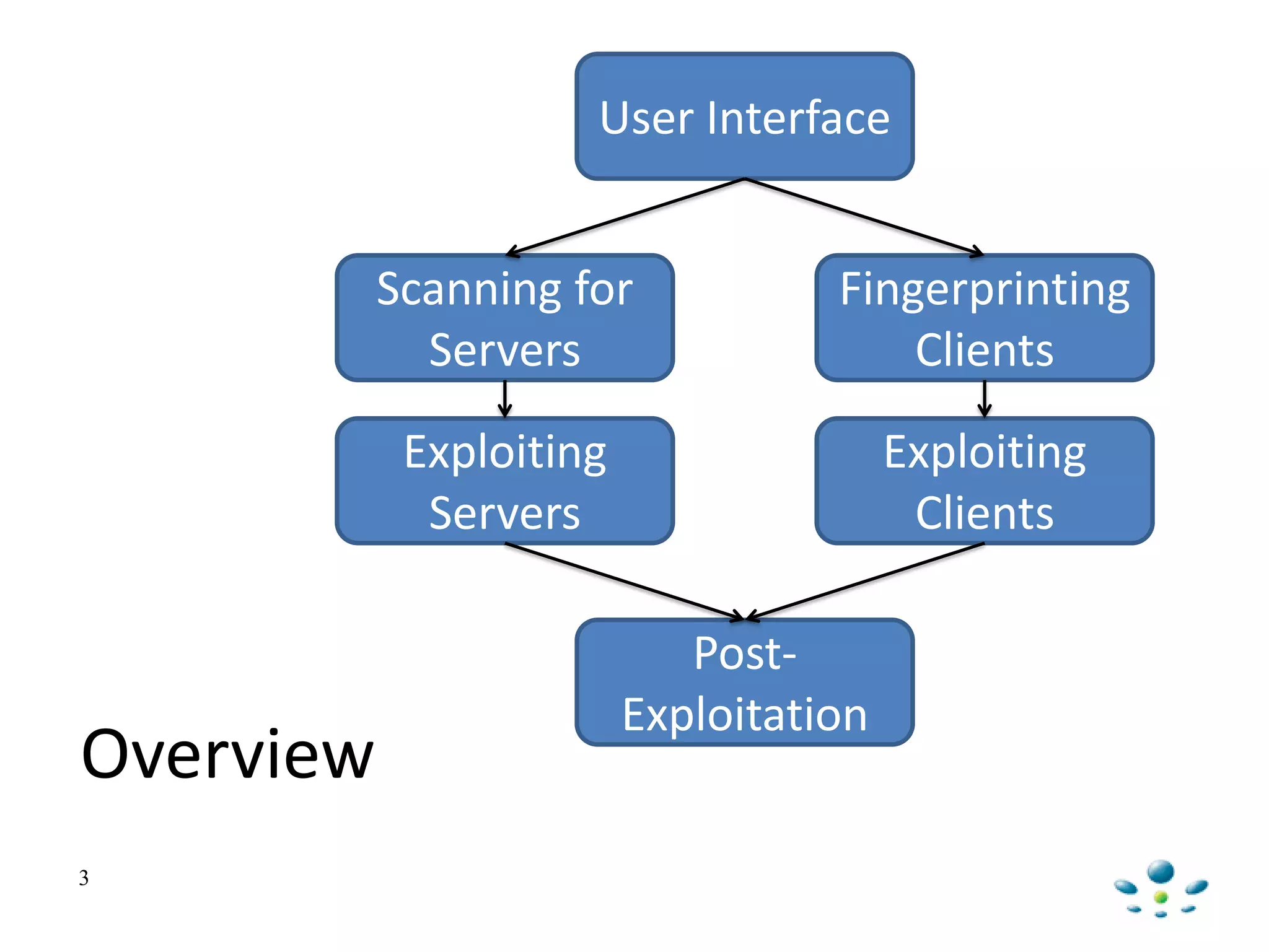
3
Fingerprinting
Clients
Exploiting
Clients
Scanning for
Servers
Exploiting
Servers
User Interface
Post-
Exploitation
Overview
4
Automating msfconsole
● Resource files
● A list of commands to be run in sequence
● Can be anything you would type at the msf> prompt
● setg
● save
5
Resource files
● $ ./msfconsole -r foo.rc
● msf> resource foo.rc
● ~/.msf3/msfconsole.rc
● Loaded on startup
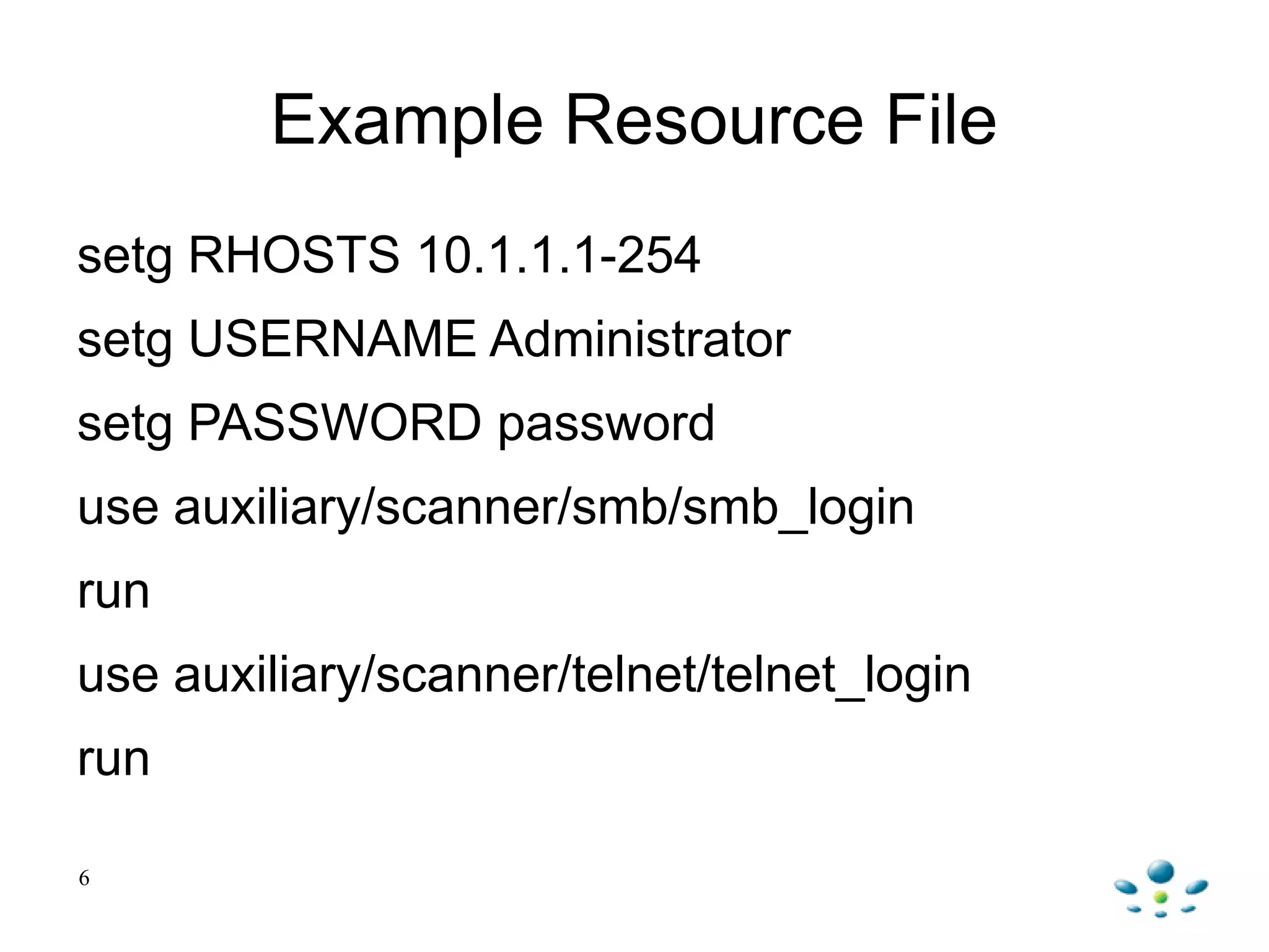
Example Resource File
setg RHOSTS 10.1.1.1-254
setg USERNAME Administrator
setg PASSWORD password
use auxiliary/scanner/smb/smb_login
run
use auxiliary/scanner/telnet/telnet_login
run
6
SERVERS
7
Scanning
● Have to find servers
before you can exploit
them
● Metasploit has several
ways to do this
● Run nmap and nexpose
directly from the console
● Import other tools‟ output
● MSF built-in scanners
(auxiliary/scanner/*)
8
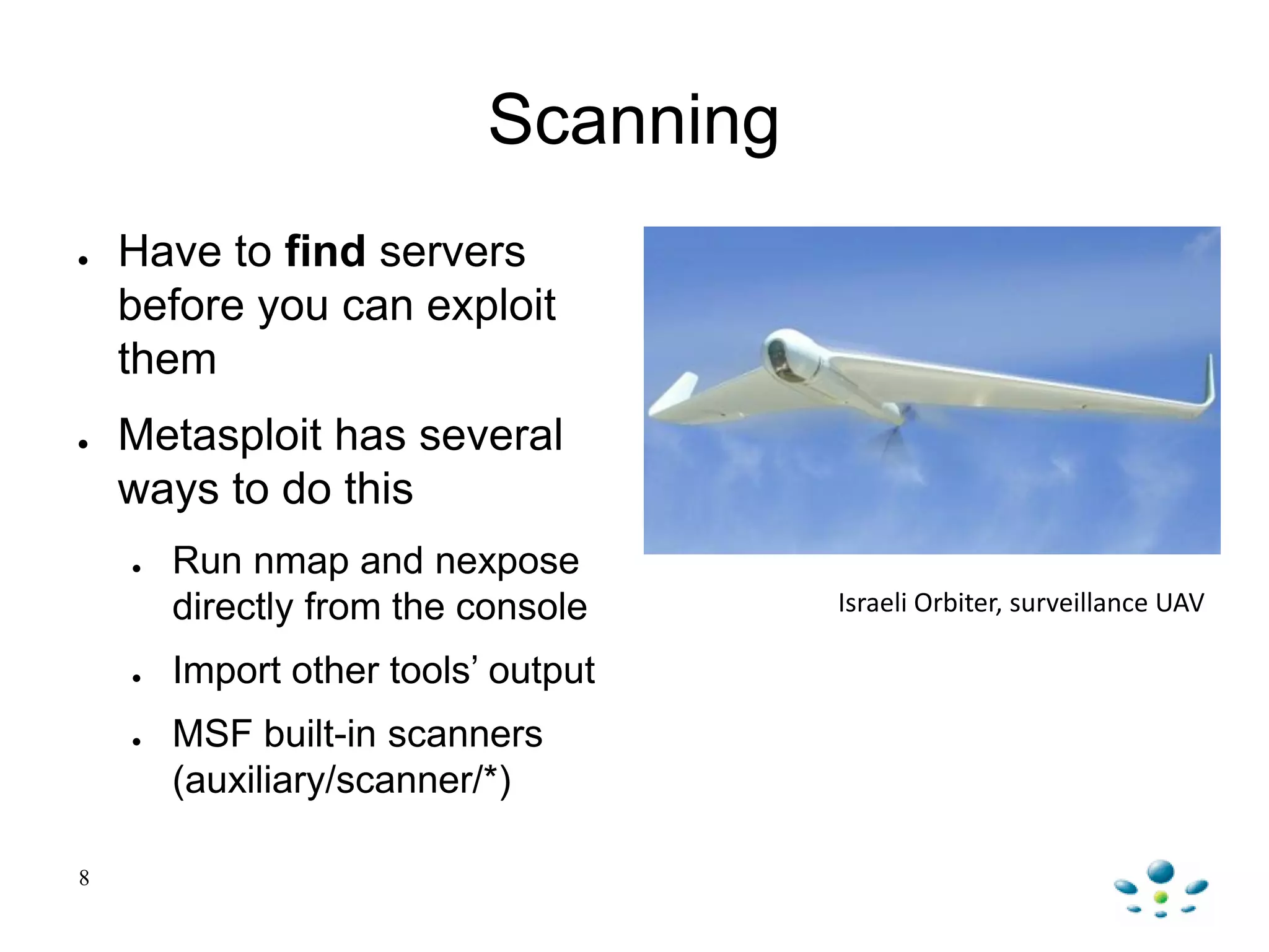
Israeli Orbiter, surveillance UAV
nmap
● Two options:
● Run nmap normally with -oX and use db_import to
store the results
● db_nmap command will run nmap and handle the
import for you
● Either way, results get stored in the database
9
10
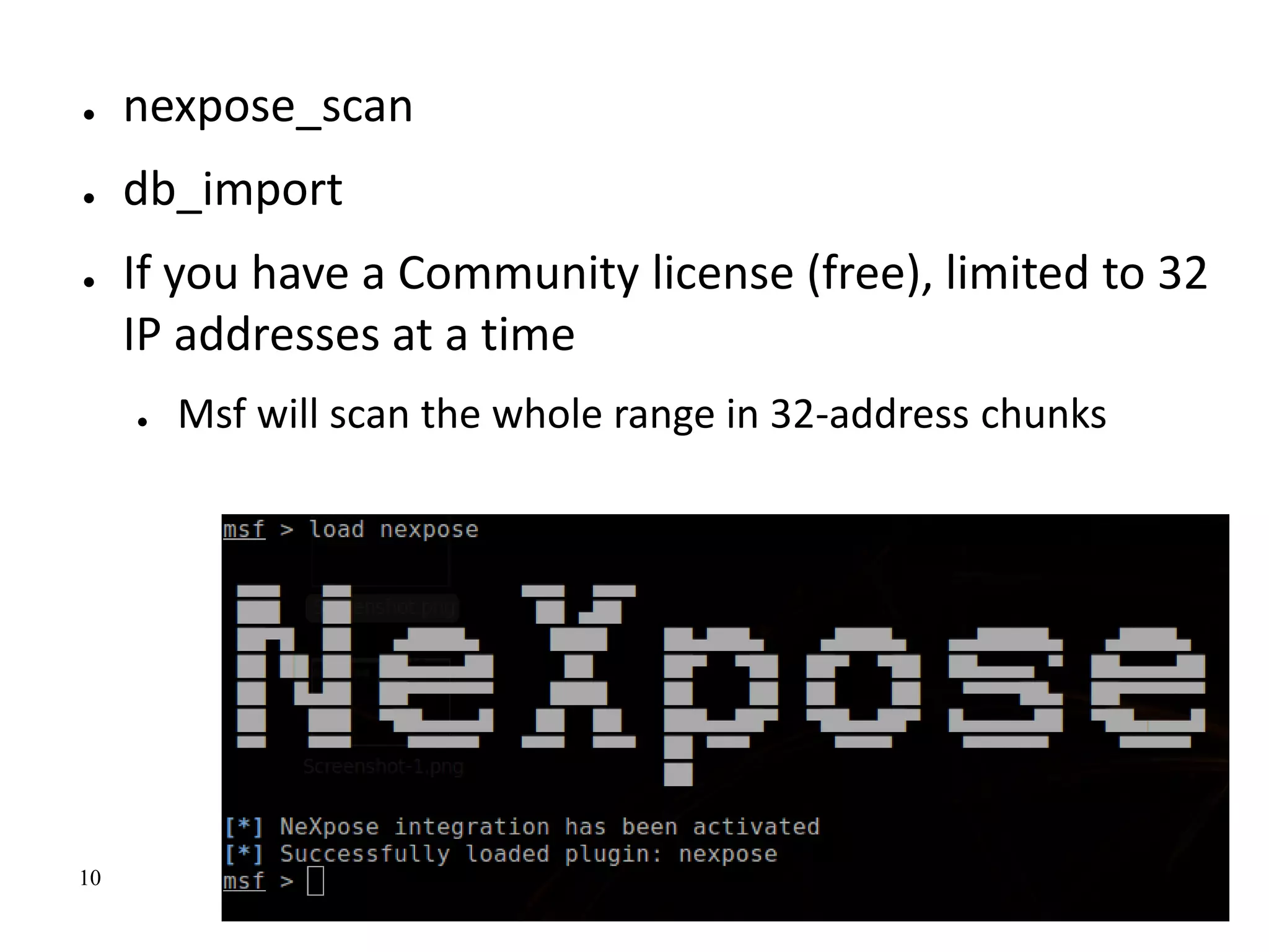
● nexpose_scan
● db_import
● If you have a Community license (free), limited to 32
IP addresses at a time
● Msf will scan the whole range in 32-address chunks
Nexpose
● Also stores vulnerability references
● CVE, BID, …
● Without these, figuring out which exploits to run can
be more difficult
● Can be used to launch exploits as well
11
MSF Built-in Scanning
● Implemented as
auxiliary modules
● Aux is like an exploit
without a payload
● Usage similar to
exploits
● Can go through
meterpreter routes
12
FanWing Surveillance Platform
Faster Setup
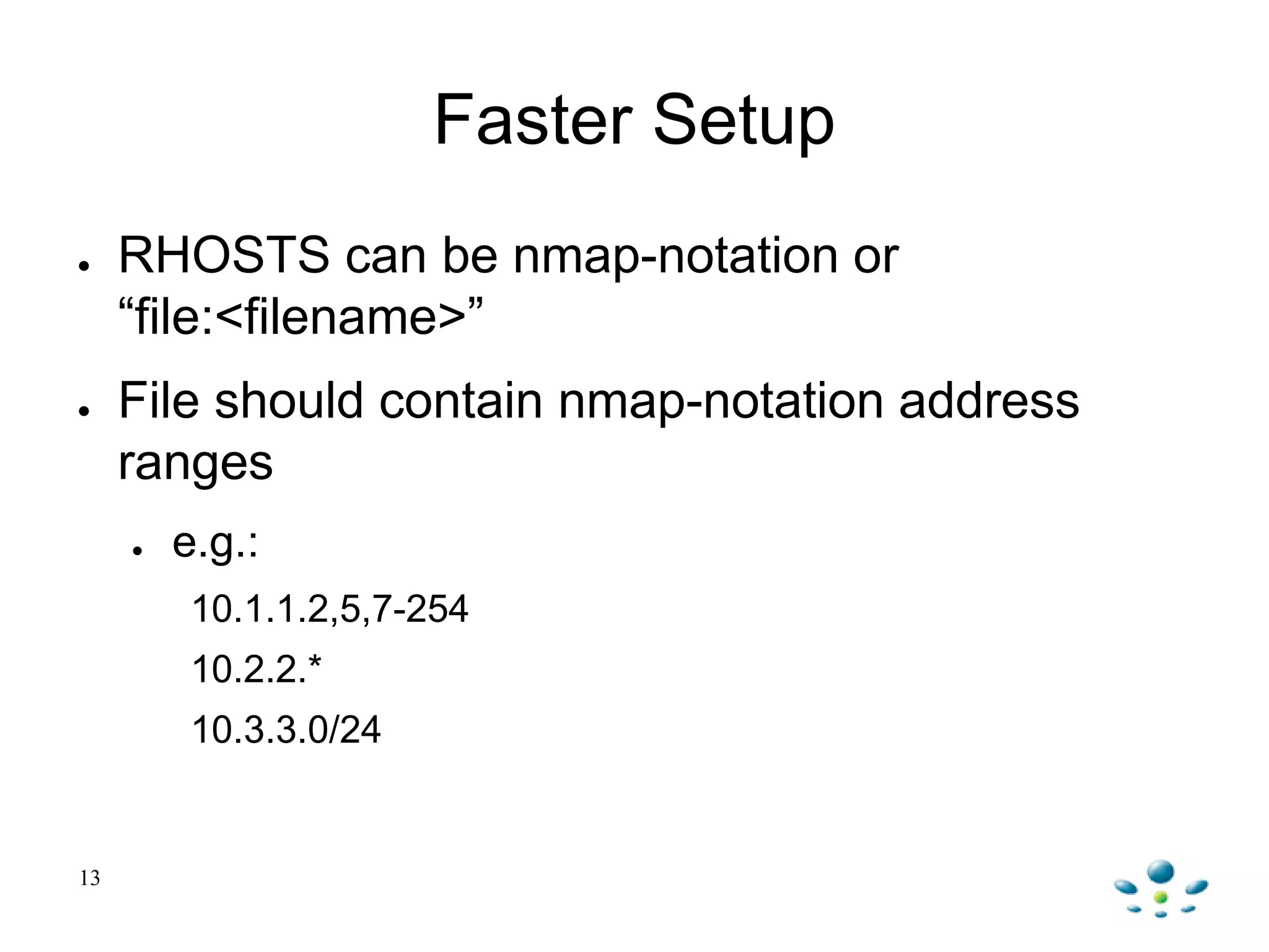
● RHOSTS can be nmap-notation or
“file:<filename>”
● File should contain nmap-notation address
ranges
● e.g.:
10.1.1.2,5,7-254
10.2.2.*
10.3.3.0/24
13
Faster Scanning
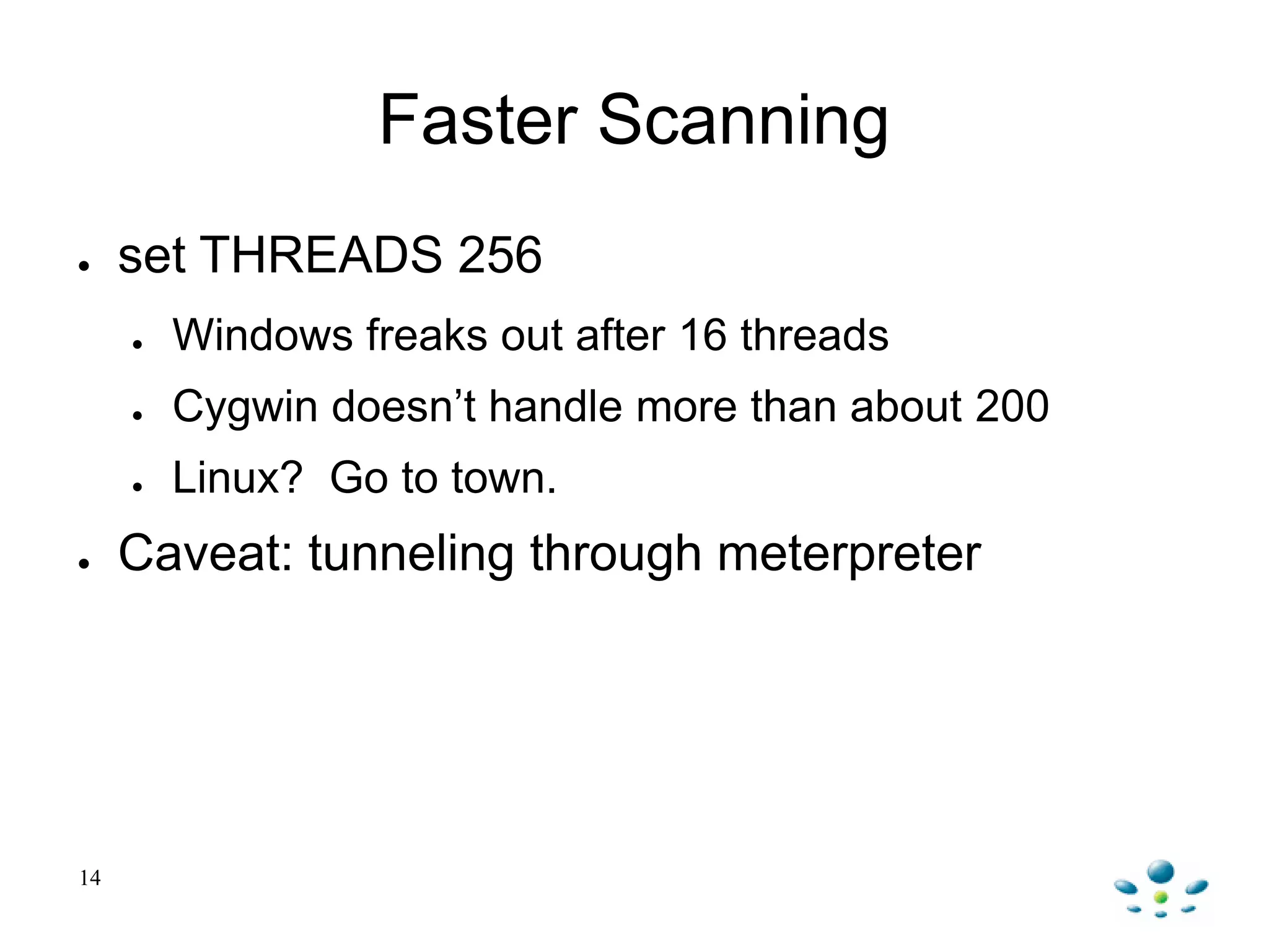
● set THREADS 256
● Windows freaks out after 16 threads
● Cygwin doesn‟t handle more than about 200
● Linux? Go to town.
● Caveat: tunneling through meterpreter
14
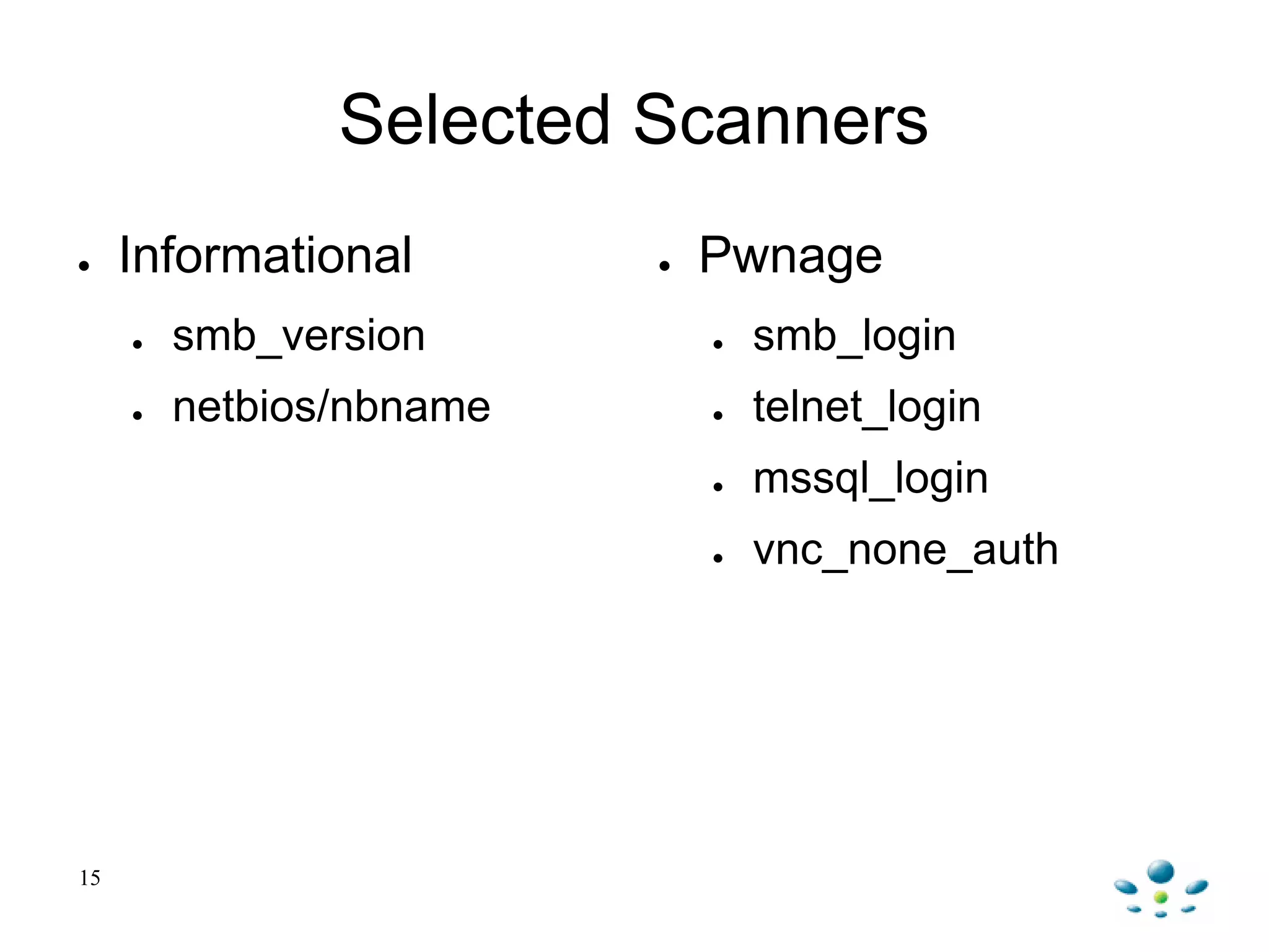
Selected Scanners
● Informational
● smb_version
● netbios/nbname
● Pwnage
● smb_login
● telnet_login
● mssql_login
● vnc_none_auth
15
16
Server Exploits
● The bulk of msf's exploit modules
● 385 as of Jan 9
● Many protocols implemented in an exploit-
friendly way
● smtp, imap, http, smb, dcerpc, sunrpc, ftp, …
● Wide range of protocol-level IDS evasions
Automatically Exploiting Servers
● db_autopwn
● NeXpose plugin
17
db_autopwn
● Need to have targets stored in the db
● If vulnerability references are available, can
cross-reference against specific hosts
● Can just use matching ports if you don't have
refs
● Checks global MinimumRank to limit exploits to
a particular safety level
18
19
NeXpose
● Scan, detect, exploit all in one command
● nexpose_scan -x <host range>
1. Populates the db with hosts, services, vulns
2. Cross-references vulns and exploits
3. Throws exploits at vulnerable servers
● Has the potential to give you tons of shells
● Can take a long time for lots of hosts
● Uses MinimumRank as well
CLIENTS
20
Client Fingerprinting
● User Agent
● Easy to spoof
● Easy to change in a
proxy
● Some third-party
software changes it
● Less often changed in
JavaScript
21
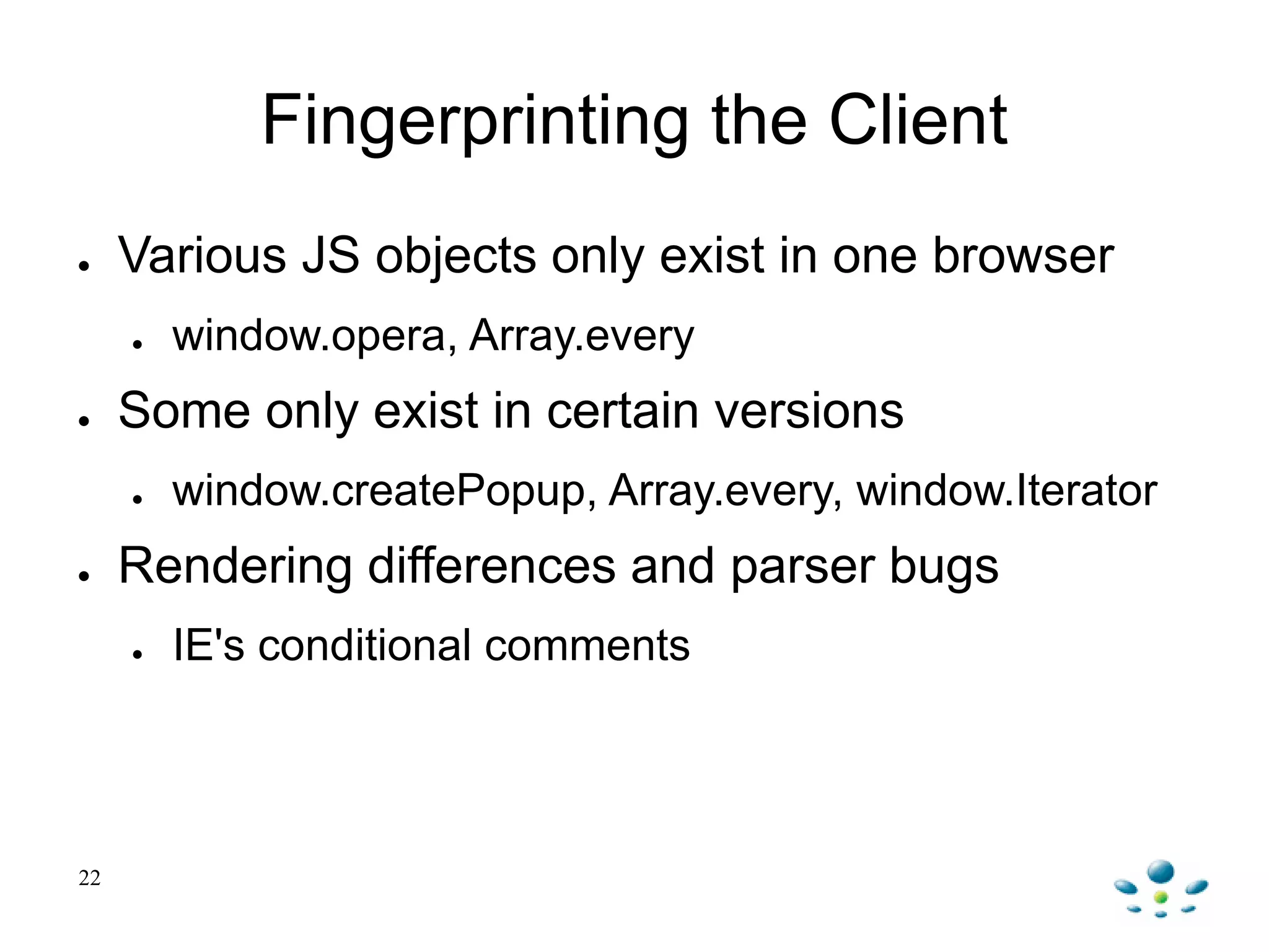
Fingerprinting the Client
● Various JS objects only exist in one browser
● window.opera, Array.every
● Some only exist in certain versions
● window.createPopup, Array.every, window.Iterator
● Rendering differences and parser bugs
● IE's conditional comments
22
Internet Explorer
● Parser bugs, conditional comments
● Reliable, but not precise
● ScriptEngine*Version()
● Almost unique across all combinations of client and
OS, including service pack
● ClientCaps
23
Opera
● window.opera.version()
● Includes minor version, e.g. “9.61”
● window.opera.buildNumber()
● Different on each platform for a given version
● e.g.: “8501” == Windows
● Not precise, only gives platform, no version or
service pack
24
Hybrid Approach for FF
● Existence of
document.getElementsByClassName
means Firefox 3.0
● If UA says IE6, go with FF 3.0
● If UA says FF 3.0.8, it's probably not lying, so
use the more specific value
25
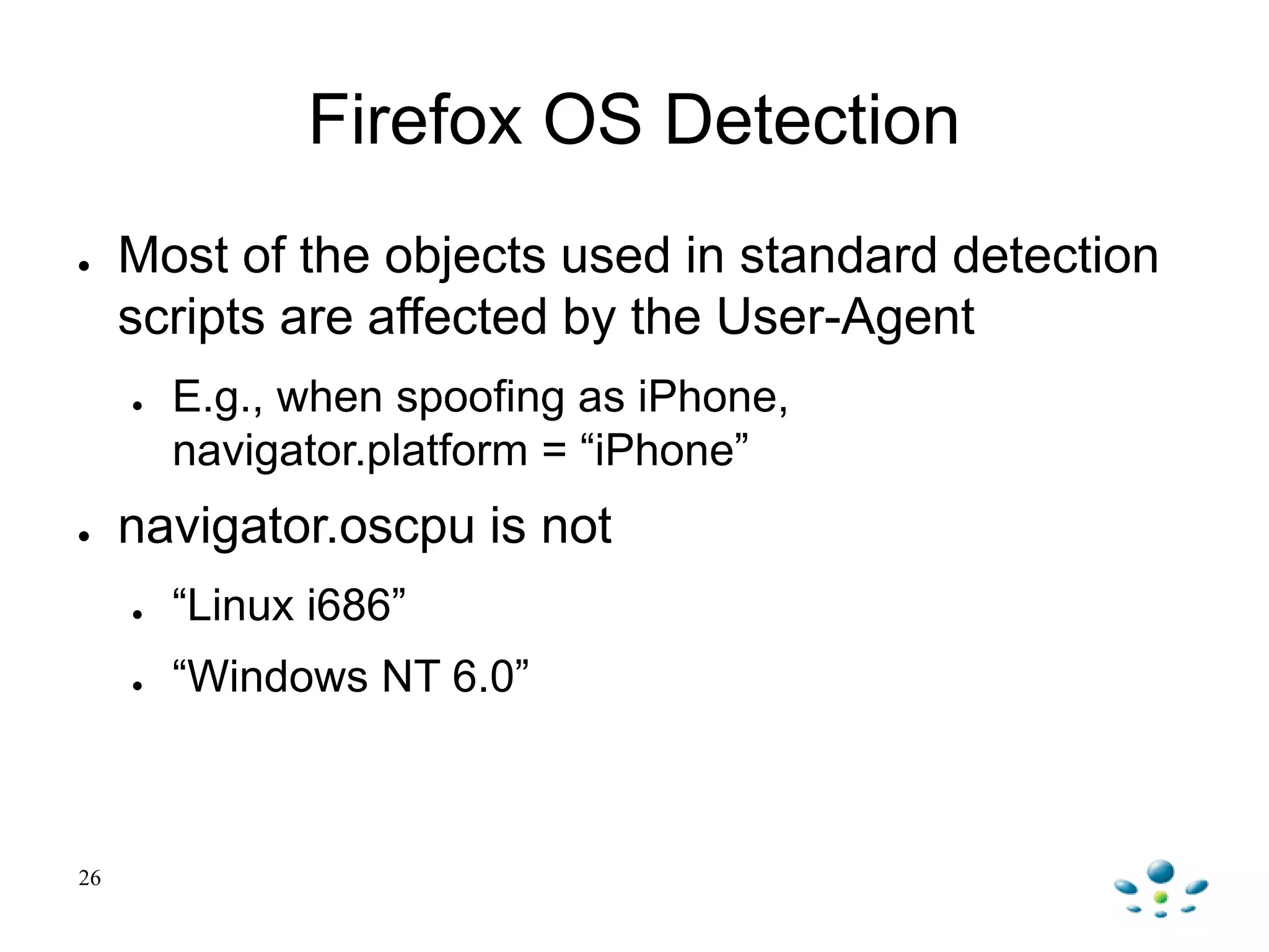
Firefox OS Detection
● Most of the objects used in standard detection
scripts are affected by the User-Agent
● E.g., when spoofing as iPhone,
navigator.platform = “iPhone”
● navigator.oscpu is not
● “Linux i686”
● “Windows NT 6.0”
26
Safari / Webkit
● Infuriatingly standards compliant in JS
● Can detect its existence easily
● window.WebkitPoint, many others
● Most Safari-specific stuff has been around since
1.2, so not useful for version detection
27
Chrome / Webkit
● Same javascript engine as Safari
● So far, no easy way to change UA
● navigator.vendor is always “Google Inc.”
28
29
Client Exploits in MSF
● Extensive HTTP support
● Heapspray in two lines of code
● Sotirov's .NET DLL, heap feng shui
● Wide range of protocol-level IDS evasion
● Simple exploit in ~10 lines of code
30
Automatically Exploiting Clients
● Browser Autopwn Auxiliary module
● I spoke about this at Defcon in 2009
● Fingerprints a client
● Stores detection in the database
● Determines what exploits might work
● Uses MinimumRank, too
● Tries the ones most likely to succeed
31
Advantages of Browser Autopwn
● OS and client detection is client-side, more
reliable in presence of spoofed or broken UA
● Detection results automatically stored in the
database
● Not written in PHP
● PHP sucks
Browser Autopwn Usage
msf> use auxiliary/server/browser_autopwn
msf (browser_autopwn)> set URIPATH /
msf (browser_autopwn)> set EXCLUDE opera
msf (browser_autopwn)> set MATCH .*
msf (browser_autopwn)> run
[*] Starting exploit modules on host 10.1.1.1...
[*] ---
32
Automating Users
● Browser Autopwn automates the exploits but
how do we get users to come to our evil web
server?
33
34
Karmetasploit
● Wireless Access Point of Doom
● Using aircrack-ng, appears to be every access
point that anybody probes for
● “Why, yes, I am Office_WiFi, please connect”
● Lets you control the route, the DNS, everything
● “Yup, I'm your internal web server. And your email
server. And your file server. And...”
More on Karma
● Actually about 5 years old
● It still works amazingly well
● More info about getting it working is on our wiki:
http://www.metasploit.com/redmine/projects/framework/wiki/Karmetasploit
35
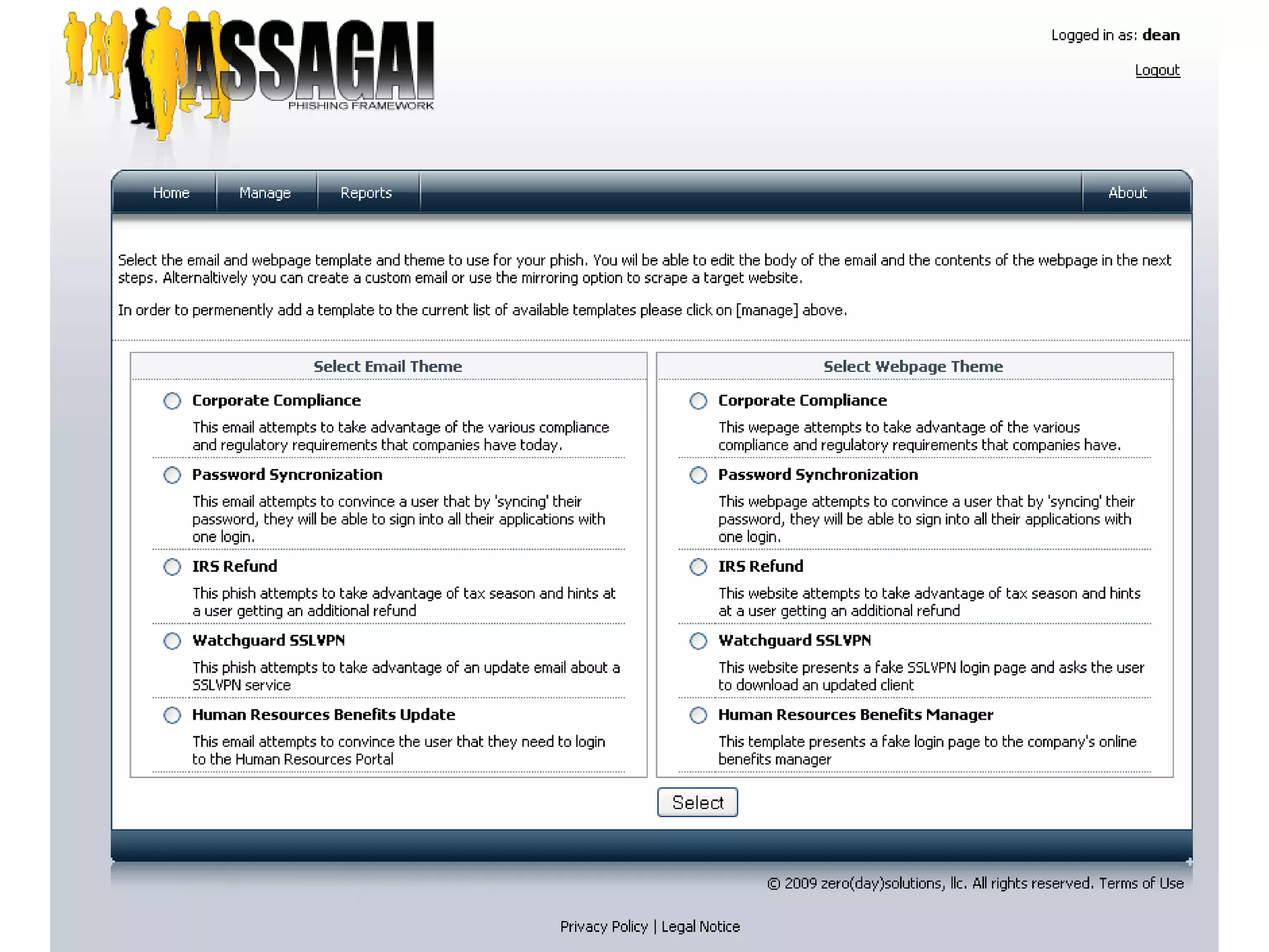
Assagai
● Complete phishing framework
● Uses Metasploit exploits and payloads
● Gathers other statistics
● Has common email templates
36
37
38
39
Metaphish
● Use the target‟s public information against them
● See valsmith, Colin, and dkerb‟s talk from BH
USA 2009
40
41
Automating Post-exploitation
● Meterpreter scripts
● set AutoRunScript <script name>
● Plugins
● Can be auto loaded at startup with resource files
42
Meterpreter scripts
● Just a ruby script
● Easy to write, lots of flexibility
● Access to Meterpreter API
Meterpreter API
● Core + Extensions
● Core is basic, mostly useful for loading extensions
● Current extensions:
● Stdapi
● Priv, Incognito
● Espia
● Sniffer
43
Meterpreter Stdapi: process
● client.sys.process
● Acts like a Hash, where keys are image names and
values are process IDs
● client.sys.process[„explorer.exe‟]
● => 1408
44
Meterpreter Stdapi: memory
p =
client.sys.process.open(pid,PROCESS_ALL_ACCESS)
addr = p.memory.allocate(length)
p.memory.write(addr, “stuff”)
p.thread.create(addr)
45
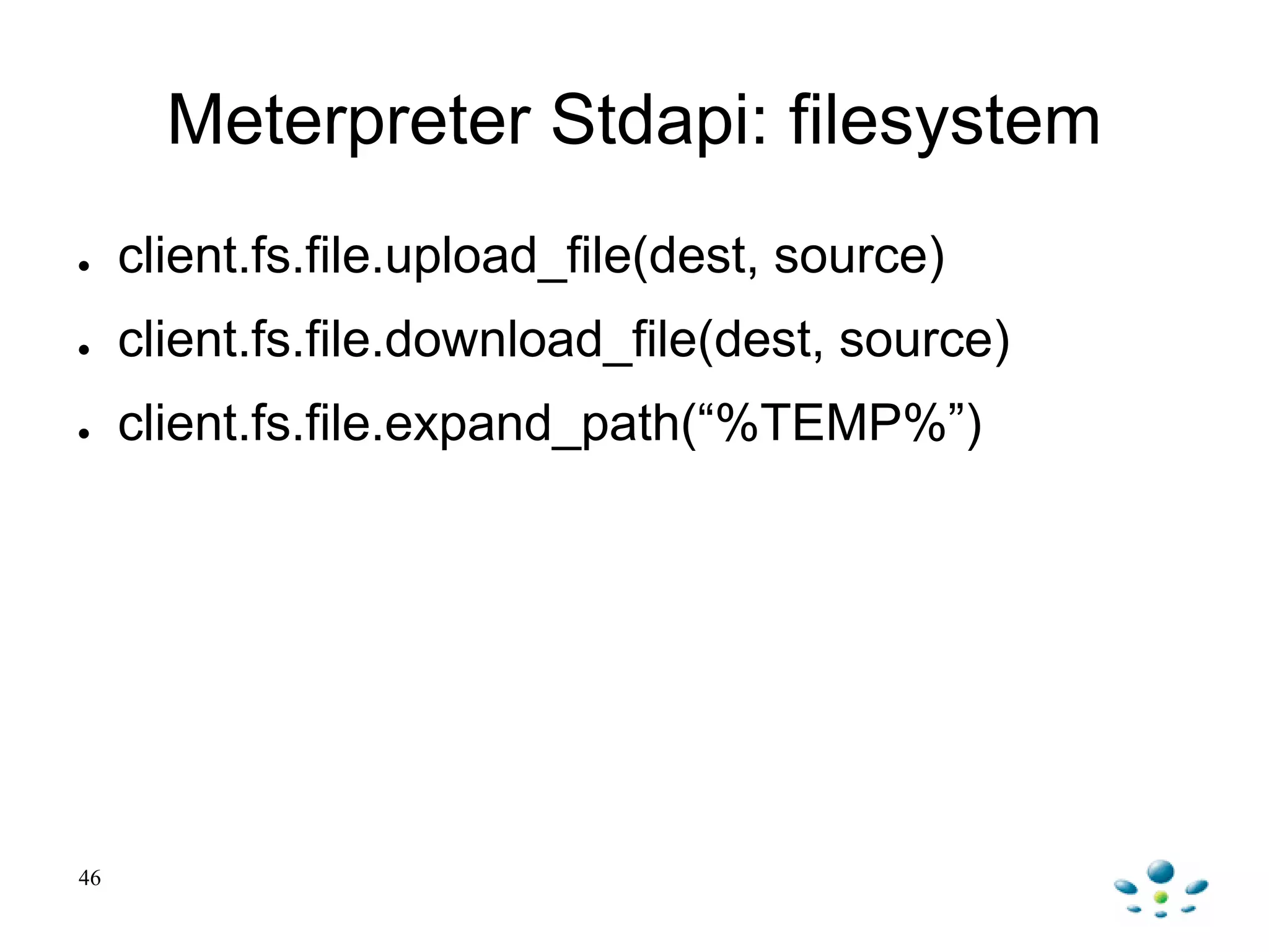
Meterpreter Stdapi: filesystem
● client.fs.file.upload_file(dest, source)
● client.fs.file.download_file(dest, source)
● client.fs.file.expand_path(“%TEMP%”)
46
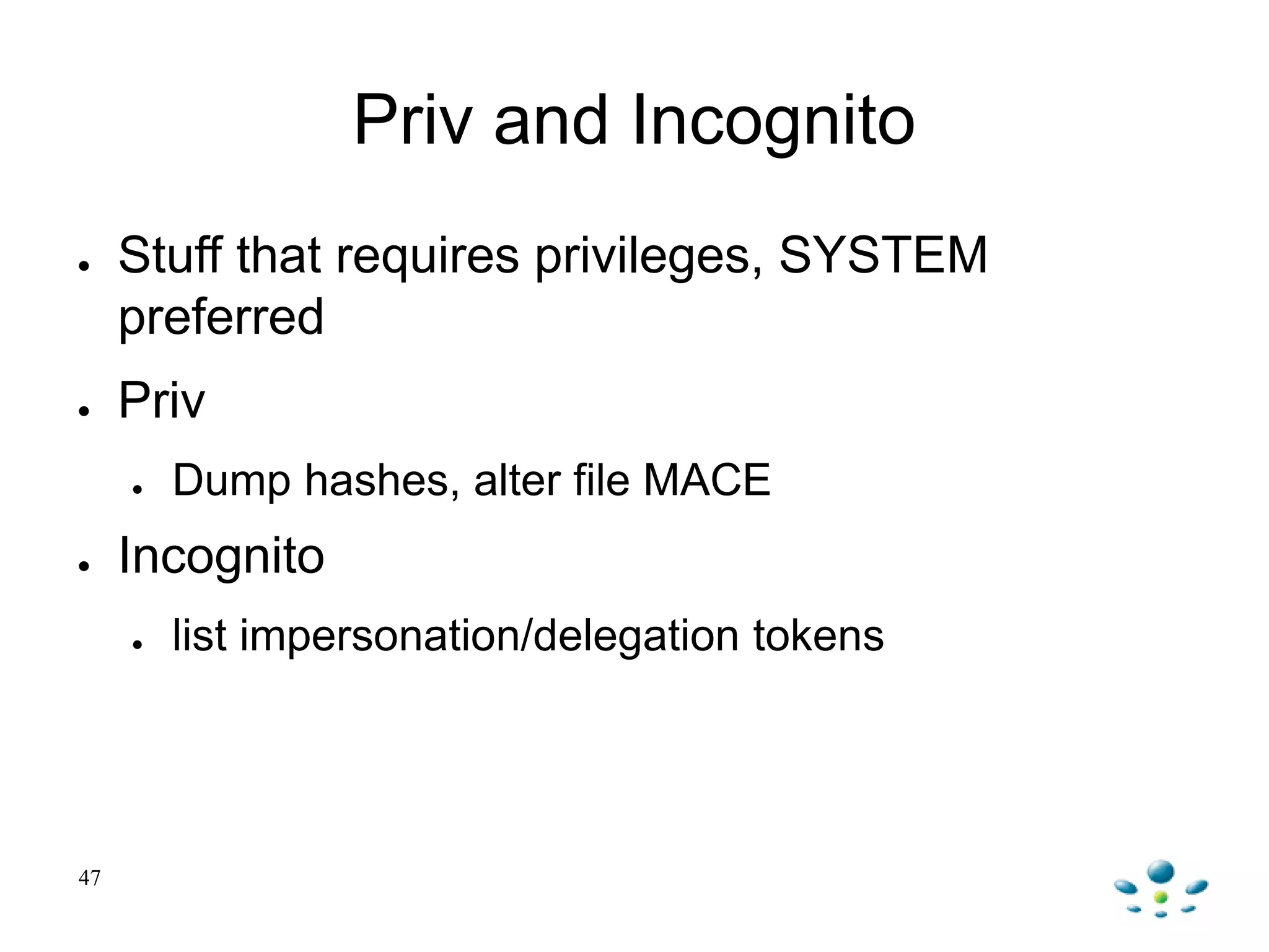
Priv and Incognito
● Stuff that requires privileges, SYSTEM
preferred
● Priv
● Dump hashes, alter file MACE
● Incognito
● list impersonation/delegation tokens
47
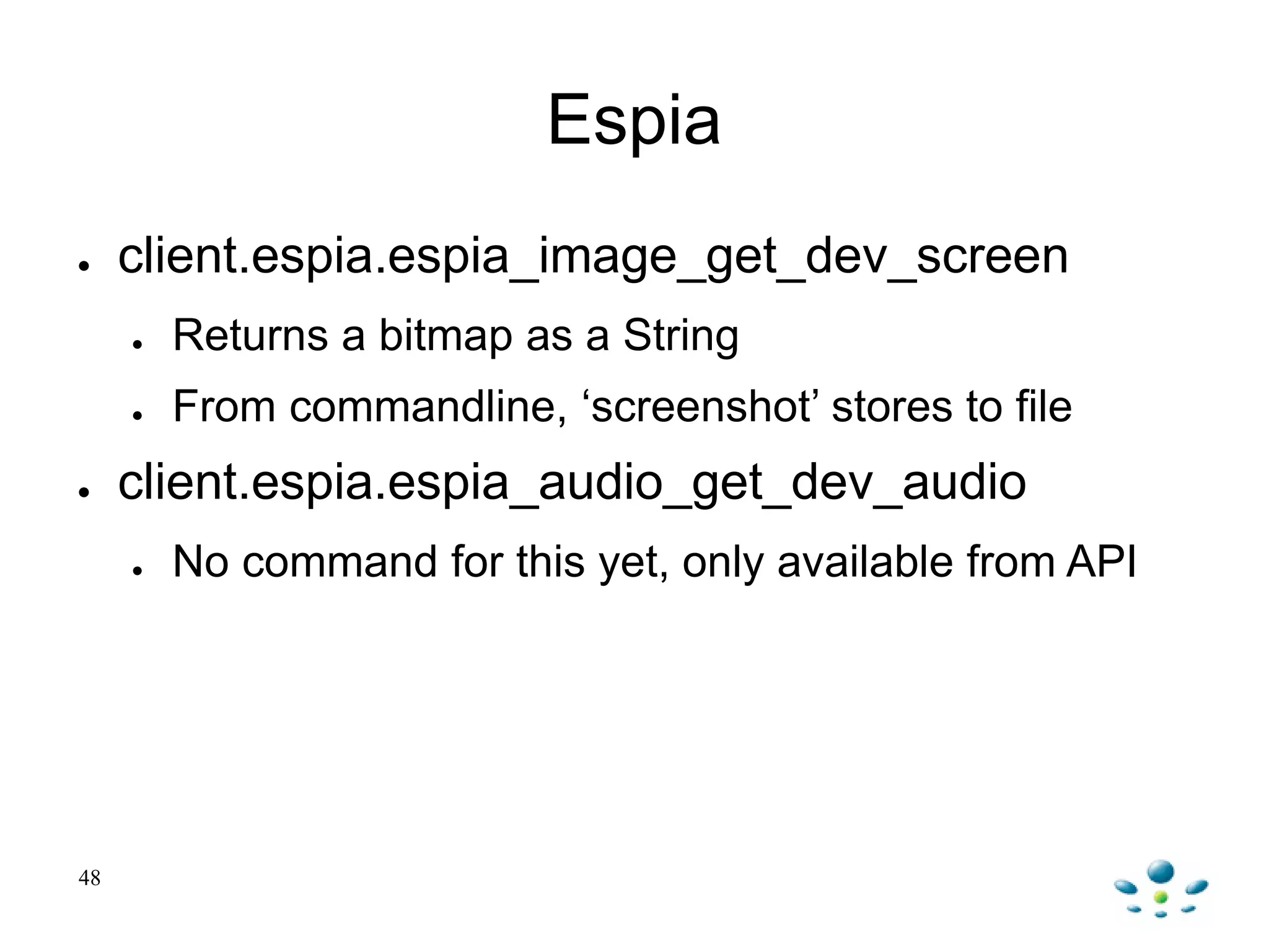
Espia
● client.espia.espia_image_get_dev_screen
● Returns a bitmap as a String
● From commandline, „screenshot‟ stores to file
● client.espia.espia_audio_get_dev_audio
● No command for this yet, only available from API
48
Meterpreter Sniffer
● client.sniffer.capture_start
● Starts capturing
● client.sniffer.capture_dump
● Puts the captured packets into a buffer we can read
● client.sniffer.capture_dump_read
● Reads from the buffer
49
Sniffer caveat
● The packet format isn‟t standard, so we have to
convert it to PCAP to be useful
● Console command does it for you
50
51
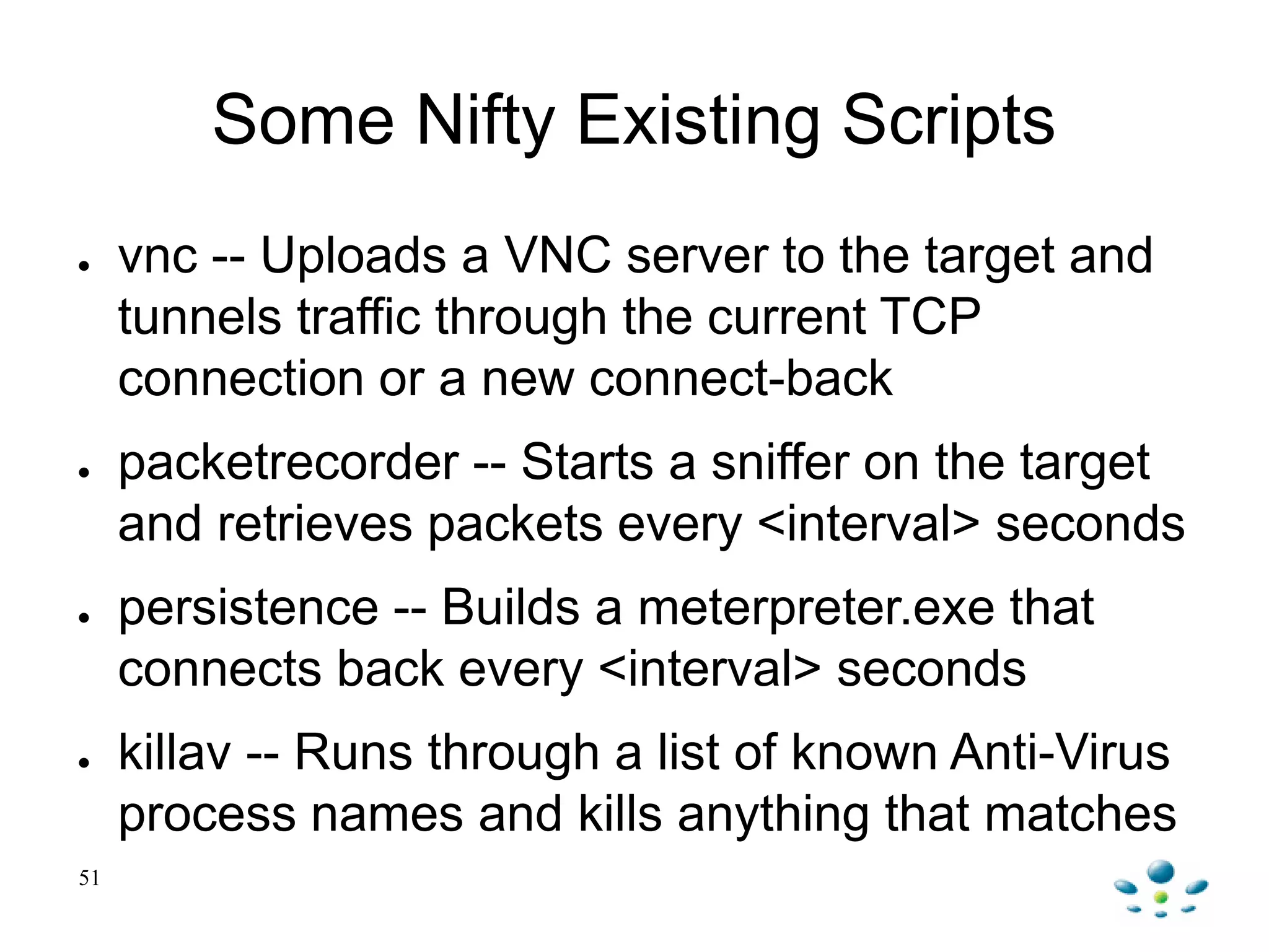
Some Nifty Existing Scripts
● vnc -- Uploads a VNC server to the target and
tunnels traffic through the current TCP
connection or a new connect-back
● packetrecorder -- Starts a sniffer on the target
and retrieves packets every <interval> seconds
● persistence -- Builds a meterpreter.exe that
connects back every <interval> seconds
● killav -- Runs through a list of known Anti-Virus
process names and kills anything that matches
Colin and Dave‟s talk
● Don‟t miss it
● Right after lunch
● About using meterpreter‟s memory API for
doing all kinds of crazy stuff
52
53
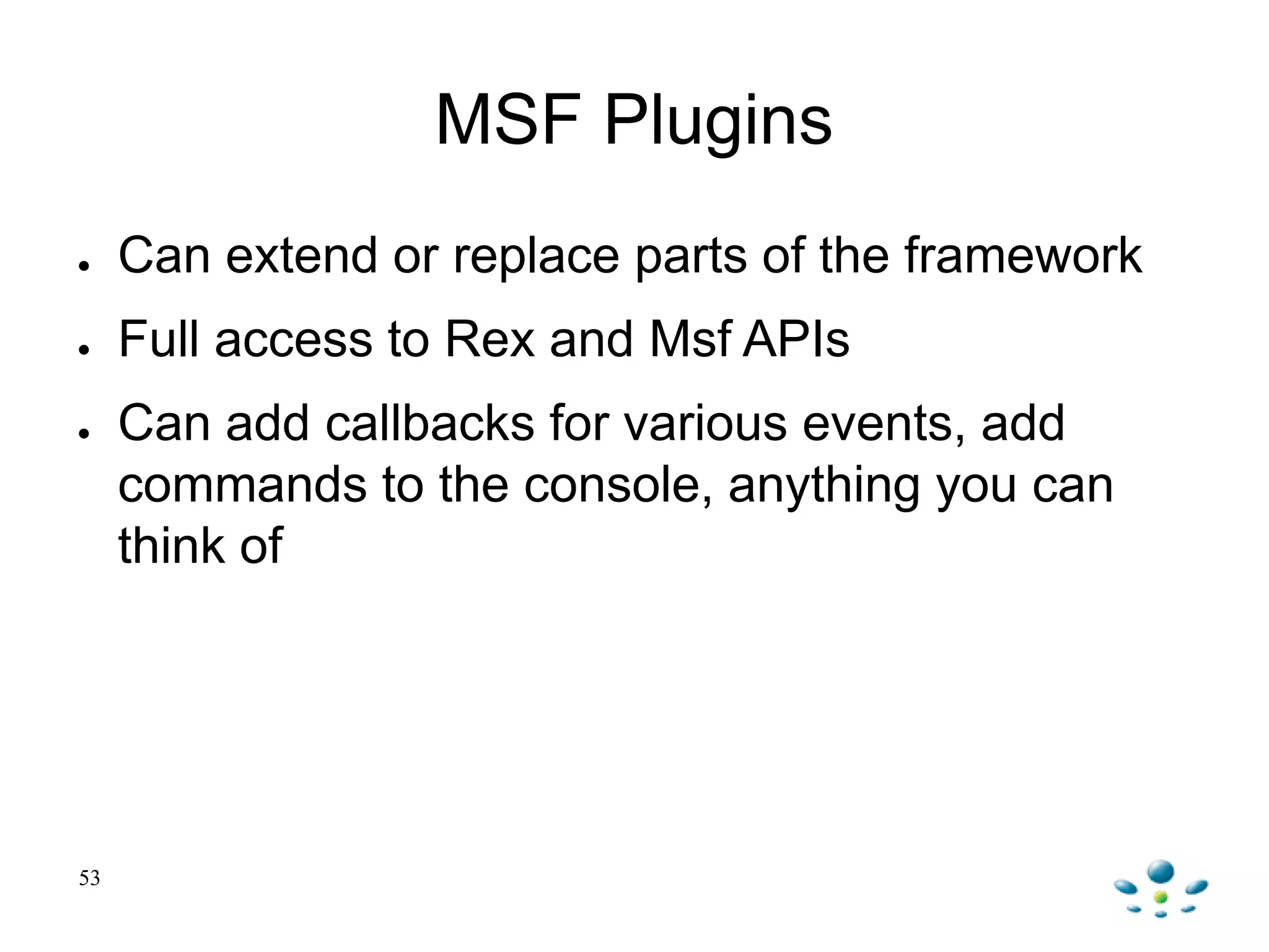
MSF Plugins
● Can extend or replace parts of the framework
● Full access to Rex and Msf APIs
● Can add callbacks for various events, add
commands to the console, anything you can
think of
Hooking sessions from a plugin
include SessionEvent
def on_session_open(session)
# Do something with the session
end
def initialize(framework, opts)
framework.events.add_session_subscriber(self)
end
54
Some notable events
● on_session_open
● on_module_run
● on_exploit_success
55
56
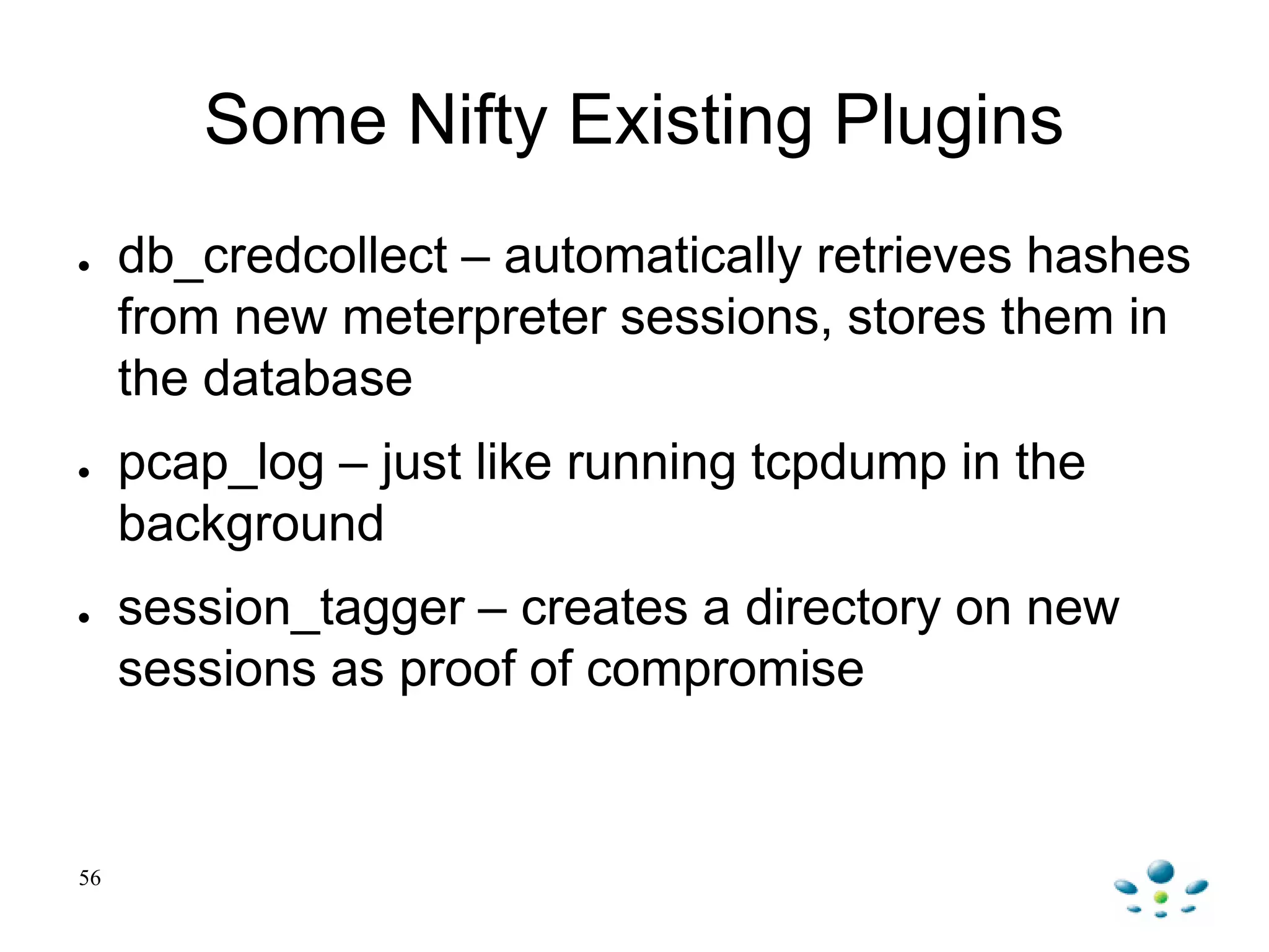
Some Nifty Existing Plugins
● db_credcollect – automatically retrieves hashes
from new meterpreter sessions, stores them in
the database
● pcap_log – just like running tcpdump in the
background
● session_tagger – creates a directory on new
sessions as proof of compromise
57
Demonstrations
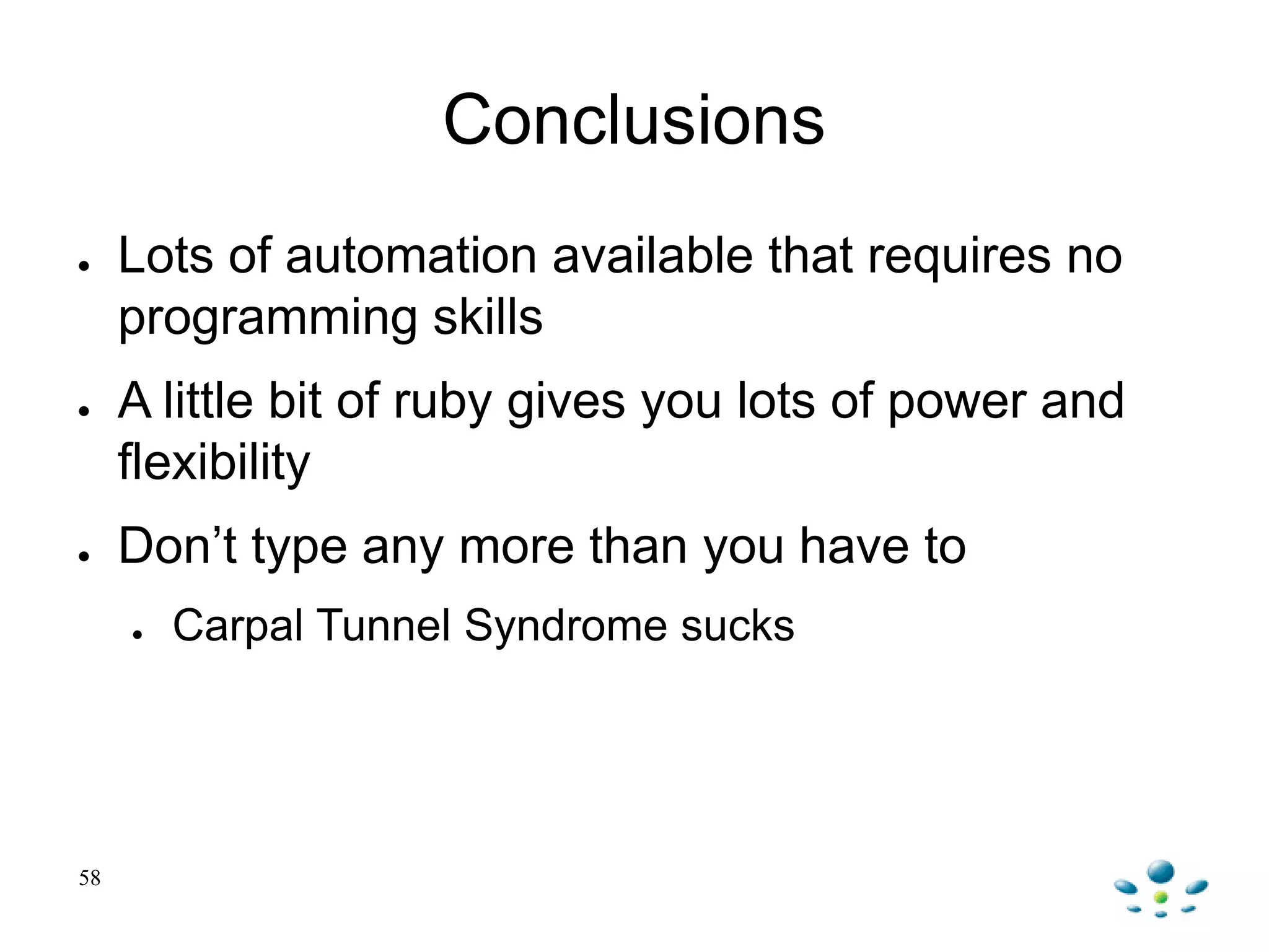
Conclusions
● Lots of automation available that requires no
programming skills
● A little bit of ruby gives you lots of power and
flexibility
● Don‟t type any more than you have to
● Carpal Tunnel Syndrome sucks
58
59
Download it
● svn co http://metasploit.com/svn/framework3/trunk
● Submit patches to msfdev@metasploit.com
Questions?
60

Black hat dc-2010-egypt-uav-slides

  • 1.
    Unmanned Aerial Vehicles ExploitAutomation with the Metasploit Framework James Lee 1
  • 2.
    # whoami ● JamesLee ● egypt ● Core Developer, Metasploit Project ● Working full time on Metasploit for 2
  • 3.
  • 4.
    4 Automating msfconsole ● Resourcefiles ● A list of commands to be run in sequence ● Can be anything you would type at the msf> prompt ● setg ● save
  • 5.
    5 Resource files ● $./msfconsole -r foo.rc ● msf> resource foo.rc ● ~/.msf3/msfconsole.rc ● Loaded on startup
  • 6.
    Example Resource File setgRHOSTS 10.1.1.1-254 setg USERNAME Administrator setg PASSWORD password use auxiliary/scanner/smb/smb_login run use auxiliary/scanner/telnet/telnet_login run 6
  • 7.
  • 8.
    Scanning ● Have tofind servers before you can exploit them ● Metasploit has several ways to do this ● Run nmap and nexpose directly from the console ● Import other tools‟ output ● MSF built-in scanners (auxiliary/scanner/*) 8 Israeli Orbiter, surveillance UAV
  • 9.
    nmap ● Two options: ●Run nmap normally with -oX and use db_import to store the results ● db_nmap command will run nmap and handle the import for you ● Either way, results get stored in the database 9
  • 10.
    10 ● nexpose_scan ● db_import ●If you have a Community license (free), limited to 32 IP addresses at a time ● Msf will scan the whole range in 32-address chunks
  • 11.
    Nexpose ● Also storesvulnerability references ● CVE, BID, … ● Without these, figuring out which exploits to run can be more difficult ● Can be used to launch exploits as well 11
  • 12.
    MSF Built-in Scanning ●Implemented as auxiliary modules ● Aux is like an exploit without a payload ● Usage similar to exploits ● Can go through meterpreter routes 12 FanWing Surveillance Platform
  • 13.
    Faster Setup ● RHOSTScan be nmap-notation or “file:<filename>” ● File should contain nmap-notation address ranges ● e.g.: 10.1.1.2,5,7-254 10.2.2.* 10.3.3.0/24 13
  • 14.
    Faster Scanning ● setTHREADS 256 ● Windows freaks out after 16 threads ● Cygwin doesn‟t handle more than about 200 ● Linux? Go to town. ● Caveat: tunneling through meterpreter 14
  • 15.
    Selected Scanners ● Informational ●smb_version ● netbios/nbname ● Pwnage ● smb_login ● telnet_login ● mssql_login ● vnc_none_auth 15
  • 16.
    16 Server Exploits ● Thebulk of msf's exploit modules ● 385 as of Jan 9 ● Many protocols implemented in an exploit- friendly way ● smtp, imap, http, smb, dcerpc, sunrpc, ftp, … ● Wide range of protocol-level IDS evasions
  • 17.
    Automatically Exploiting Servers ●db_autopwn ● NeXpose plugin 17
  • 18.
    db_autopwn ● Need tohave targets stored in the db ● If vulnerability references are available, can cross-reference against specific hosts ● Can just use matching ports if you don't have refs ● Checks global MinimumRank to limit exploits to a particular safety level 18
  • 19.
    19 NeXpose ● Scan, detect,exploit all in one command ● nexpose_scan -x <host range> 1. Populates the db with hosts, services, vulns 2. Cross-references vulns and exploits 3. Throws exploits at vulnerable servers ● Has the potential to give you tons of shells ● Can take a long time for lots of hosts ● Uses MinimumRank as well
  • 20.
  • 21.
    Client Fingerprinting ● UserAgent ● Easy to spoof ● Easy to change in a proxy ● Some third-party software changes it ● Less often changed in JavaScript 21
  • 22.
    Fingerprinting the Client ●Various JS objects only exist in one browser ● window.opera, Array.every ● Some only exist in certain versions ● window.createPopup, Array.every, window.Iterator ● Rendering differences and parser bugs ● IE's conditional comments 22
  • 23.
    Internet Explorer ● Parserbugs, conditional comments ● Reliable, but not precise ● ScriptEngine*Version() ● Almost unique across all combinations of client and OS, including service pack ● ClientCaps 23
  • 24.
    Opera ● window.opera.version() ● Includesminor version, e.g. “9.61” ● window.opera.buildNumber() ● Different on each platform for a given version ● e.g.: “8501” == Windows ● Not precise, only gives platform, no version or service pack 24
  • 25.
    Hybrid Approach forFF ● Existence of document.getElementsByClassName means Firefox 3.0 ● If UA says IE6, go with FF 3.0 ● If UA says FF 3.0.8, it's probably not lying, so use the more specific value 25
  • 26.
    Firefox OS Detection ●Most of the objects used in standard detection scripts are affected by the User-Agent ● E.g., when spoofing as iPhone, navigator.platform = “iPhone” ● navigator.oscpu is not ● “Linux i686” ● “Windows NT 6.0” 26
  • 27.
    Safari / Webkit ●Infuriatingly standards compliant in JS ● Can detect its existence easily ● window.WebkitPoint, many others ● Most Safari-specific stuff has been around since 1.2, so not useful for version detection 27
  • 28.
    Chrome / Webkit ●Same javascript engine as Safari ● So far, no easy way to change UA ● navigator.vendor is always “Google Inc.” 28
  • 29.
    29 Client Exploits inMSF ● Extensive HTTP support ● Heapspray in two lines of code ● Sotirov's .NET DLL, heap feng shui ● Wide range of protocol-level IDS evasion ● Simple exploit in ~10 lines of code
  • 30.
    30 Automatically Exploiting Clients ●Browser Autopwn Auxiliary module ● I spoke about this at Defcon in 2009 ● Fingerprints a client ● Stores detection in the database ● Determines what exploits might work ● Uses MinimumRank, too ● Tries the ones most likely to succeed
  • 31.
    31 Advantages of BrowserAutopwn ● OS and client detection is client-side, more reliable in presence of spoofed or broken UA ● Detection results automatically stored in the database ● Not written in PHP ● PHP sucks
  • 32.
    Browser Autopwn Usage msf>use auxiliary/server/browser_autopwn msf (browser_autopwn)> set URIPATH / msf (browser_autopwn)> set EXCLUDE opera msf (browser_autopwn)> set MATCH .* msf (browser_autopwn)> run [*] Starting exploit modules on host 10.1.1.1... [*] --- 32
  • 33.
    Automating Users ● BrowserAutopwn automates the exploits but how do we get users to come to our evil web server? 33
  • 34.
    34 Karmetasploit ● Wireless AccessPoint of Doom ● Using aircrack-ng, appears to be every access point that anybody probes for ● “Why, yes, I am Office_WiFi, please connect” ● Lets you control the route, the DNS, everything ● “Yup, I'm your internal web server. And your email server. And your file server. And...”
  • 35.
    More on Karma ●Actually about 5 years old ● It still works amazingly well ● More info about getting it working is on our wiki: http://www.metasploit.com/redmine/projects/framework/wiki/Karmetasploit 35
  • 36.
    Assagai ● Complete phishingframework ● Uses Metasploit exploits and payloads ● Gathers other statistics ● Has common email templates 36
  • 37.
  • 38.
  • 39.
  • 40.
    Metaphish ● Use thetarget‟s public information against them ● See valsmith, Colin, and dkerb‟s talk from BH USA 2009 40
  • 41.
    41 Automating Post-exploitation ● Meterpreterscripts ● set AutoRunScript <script name> ● Plugins ● Can be auto loaded at startup with resource files
  • 42.
    42 Meterpreter scripts ● Justa ruby script ● Easy to write, lots of flexibility ● Access to Meterpreter API
  • 43.
    Meterpreter API ● Core+ Extensions ● Core is basic, mostly useful for loading extensions ● Current extensions: ● Stdapi ● Priv, Incognito ● Espia ● Sniffer 43
  • 44.
    Meterpreter Stdapi: process ●client.sys.process ● Acts like a Hash, where keys are image names and values are process IDs ● client.sys.process[„explorer.exe‟] ● => 1408 44
  • 45.
    Meterpreter Stdapi: memory p= client.sys.process.open(pid,PROCESS_ALL_ACCESS) addr = p.memory.allocate(length) p.memory.write(addr, “stuff”) p.thread.create(addr) 45
  • 46.
    Meterpreter Stdapi: filesystem ●client.fs.file.upload_file(dest, source) ● client.fs.file.download_file(dest, source) ● client.fs.file.expand_path(“%TEMP%”) 46
  • 47.
    Priv and Incognito ●Stuff that requires privileges, SYSTEM preferred ● Priv ● Dump hashes, alter file MACE ● Incognito ● list impersonation/delegation tokens 47
  • 48.
    Espia ● client.espia.espia_image_get_dev_screen ● Returnsa bitmap as a String ● From commandline, „screenshot‟ stores to file ● client.espia.espia_audio_get_dev_audio ● No command for this yet, only available from API 48
  • 49.
    Meterpreter Sniffer ● client.sniffer.capture_start ●Starts capturing ● client.sniffer.capture_dump ● Puts the captured packets into a buffer we can read ● client.sniffer.capture_dump_read ● Reads from the buffer 49
  • 50.
    Sniffer caveat ● Thepacket format isn‟t standard, so we have to convert it to PCAP to be useful ● Console command does it for you 50
  • 51.
    51 Some Nifty ExistingScripts ● vnc -- Uploads a VNC server to the target and tunnels traffic through the current TCP connection or a new connect-back ● packetrecorder -- Starts a sniffer on the target and retrieves packets every <interval> seconds ● persistence -- Builds a meterpreter.exe that connects back every <interval> seconds ● killav -- Runs through a list of known Anti-Virus process names and kills anything that matches
  • 52.
    Colin and Dave‟stalk ● Don‟t miss it ● Right after lunch ● About using meterpreter‟s memory API for doing all kinds of crazy stuff 52
  • 53.
    53 MSF Plugins ● Canextend or replace parts of the framework ● Full access to Rex and Msf APIs ● Can add callbacks for various events, add commands to the console, anything you can think of
  • 54.
    Hooking sessions froma plugin include SessionEvent def on_session_open(session) # Do something with the session end def initialize(framework, opts) framework.events.add_session_subscriber(self) end 54
  • 55.
    Some notable events ●on_session_open ● on_module_run ● on_exploit_success 55
  • 56.
    56 Some Nifty ExistingPlugins ● db_credcollect – automatically retrieves hashes from new meterpreter sessions, stores them in the database ● pcap_log – just like running tcpdump in the background ● session_tagger – creates a directory on new sessions as proof of compromise
  • 57.
  • 58.
    Conclusions ● Lots ofautomation available that requires no programming skills ● A little bit of ruby gives you lots of power and flexibility ● Don‟t type any more than you have to ● Carpal Tunnel Syndrome sucks 58
  • 59.
    59 Download it ● svnco http://metasploit.com/svn/framework3/trunk ● Submit patches to msfdev@metasploit.com
  • 60.