Brainbow
COMBINATORIAL FLUORESCENT PROTEIN TECHNIQUES TO MAP THE
HUMAN CONNECTOME
1
2
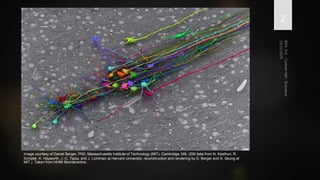
Image courtesy of Daniel Berger, PhD, Massachusetts Institute of Technology (MIT), Cambridge, MA. (EM data from N. Kasthuri, R.
Schalek, K. Hayworth, J.-C. Tapia, and J. Lichtman at Harvard University; reconstruction and rendering by D. Berger and S. Seung at
MIT.) Taken from HHMI Biointeractive.
What is the Connectome?
HOW WE THINK WE THINK
3
Starting at the Synapse
 Neurons connect with one another at
a synapse, or connection, between an
axon and a dendrite of two neurons
 These connections carry electrical
potentials along a neural tract
 All together, neural tracts establish
the reflexes, thinking patterns,
cognition, and personality of an
organism
4
http://www.drugabuse.gov/publications/teaching-packets/brain-
actions-cocaine-opiates-marijuana/section-i-introduction-to-brain/3-
neuronal-structure
Understanding Brain Function 5
https://upload.wikimedia.org/wikipedia/commons/th
umb/e/ec/PhrenologyPix.jpg/220px-
PhrenologyPix.jpg
http://classes.midlandstech.edu/carterp/Courses/bio110/chap08/Sli
de10.JPG
“
”
the size of the connectome would be…
an estimated 1011 neurons, with 1015
connections between them
(SPORNS ET AL. 246)
Mapping the Connectome Is Considerably More Data-Intensive than the Human
Genome Project, Based on the Number of Synapses
6
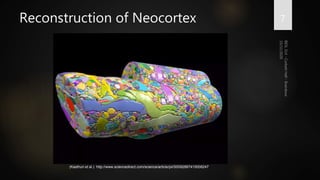
Reconstruction of Neocortex 7
(Kasthuri et al.) http://www.sciencedirect.com/science/article/pii/S0092867415008247
Shedding Light on the Synapse
THE USE OF GREEN FLUORESCENT PROTEIN AND ITS DERIVATIVES
8
“
”
Now it is such a bizarrely improbable coincidence that
anything so mind-bogglingly useful could have evolved
purely by chance that some thinkers have chosen to see it
as the final and clinching proof of the non-existence of
God.
DOUGLAS ADAMS, HITCHHIKERS GUIDE TO THE GALAXY
Cited by Martin Chalfie in both his textbook on GFP and his 2008 Nobel acceptance
speech
9
Green Fluorescent Protein
 Reported in 1955 by Davenport and
Nicol in Aequorea victoria
 In 1962, Shimomura et al. describe an
extract called “aequorin” with
fluorescent properties
 Chalfie et al. began clonal expression
in early 1990s, eventually winning the
2008 Nobel Prize in Chemistry
10
(Kain 305)
Green Fluorescent Protein
 Originally isolated from the
“squeezate” of Aequorea victoria
 Fluoresces upon addition of calcium,
emitting a sharp peak at 509 nm
 Mutations to the internal
chromophore can generate differently
colored fluorescence
11
RCSB ID: 4KW4 (GFP)
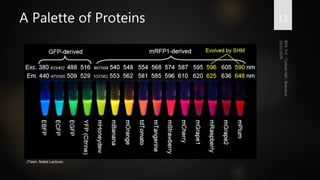
A Palette of Proteins
 Wild-type GFP did not work well in
FRET studies, so alternative sources
were sought
 Another natural source is the
molecule DsRed, found in many corals
of the Discosoma genus
 Genetic mutants of GFP and DsRed
have provided molecular geneticists
with a large palette of easily-inserted
marker proteins
12
(Tsien, Nobel Lecture)
A Palette of Proteins 13
(Tsien, Nobel Lecture)
The Technical Challenge of a
Technicolor Approach
ADAPTING SITE-SPECIFIC RECOMBINASES TO MICE CONNECTOMICS
14
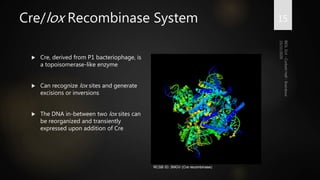
Cre/lox Recombinase System
 Cre, derived from P1 bacteriophage, is
a topoisomerase-like enzyme
 Can recognize lox sites and generate
excisions or inversions
 The DNA in-between two lox sites can
be reorganized and transiently
expressed upon addition of Cre
15
RCSB ID: 3MGV (Cre recombinase)
Cre/lox Recombinase System 16
(Branda and Dymecki 8-10)
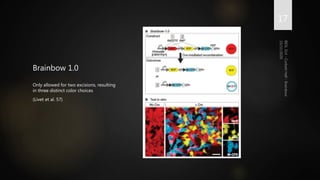
Brainbow 1.0
Only allowed for two excisions, resulting
in three distinct color choices
(Livet et al. 57)
17
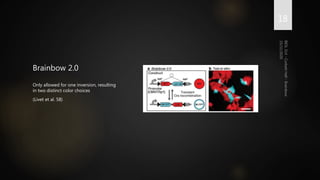
Brainbow 2.0
Only allowed for one inversion, resulting
in two distinct color choices
(Livet et al. 58)
18
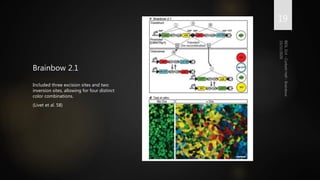
Brainbow 2.1
Included three excision sites and two
inversion sites, allowing for four distinct
color combinations.
(Livet et al. 58)
19
Combinatorial XFP Expression
(Livet et al 59)
20
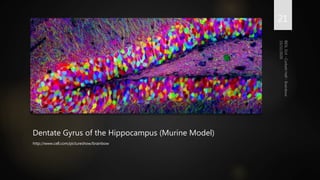
Dentate Gyrus of the Hippocampus (Murine Model)
http://www.cell.com/pictureshow/brainbow
21
Purkinje Neurons
http://www.cell.com/pictureshow/brainbow
22
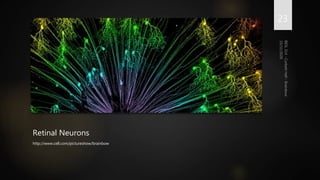
Retinal Neurons
http://www.cell.com/pictureshow/brainbow
23
Applications and Future Directions
 Mapping whole and partial connectomes
 Drosophila brainbow
 Zebrafish brainbow
 Mouse brainbow
 Changing connectomics
 With time
 With disease
 Clonal lineage
 Retinal stem cell populations
 Other tissue types
24
Drosophila Optic Lobe and Wing Epithelium
(Richier 176)
25
Zebrafish Neuron Labeling
(Pan et al. 2840)
26
Zebrafish Neuron Labeling
(Pan et al. 2840)
27
Zebrafish Axon Labeling
(Pan et al. 2841)
28
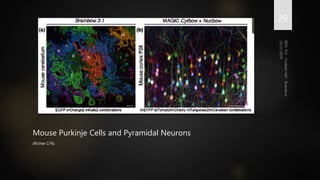
Mouse Purkinje Cells and Pyramidal Neurons
(Richier 176)
29
Dividing Chick NPCs Time-Lapse 30
(Loulier et al.) Movie S1. Time-Lapse Imaging of Dividing Brainbow-Labeled Neural
Progenitors in the Chick Spinal Cord.
Chick Spinal Cord 31
(Loulier et al.) Movie S3. High-Resolution View of Combined
Integrative Cytbow and Nucbow Labels in an E17 Chicken Spinal Cord.

Brainbow - Combinatorial Fluorescent Protein Techniques to Map The Human Connectome

  • 1.
    Brainbow COMBINATORIAL FLUORESCENT PROTEINTECHNIQUES TO MAP THE HUMAN CONNECTOME 1
  • 2.
    2 Image courtesy ofDaniel Berger, PhD, Massachusetts Institute of Technology (MIT), Cambridge, MA. (EM data from N. Kasthuri, R. Schalek, K. Hayworth, J.-C. Tapia, and J. Lichtman at Harvard University; reconstruction and rendering by D. Berger and S. Seung at MIT.) Taken from HHMI Biointeractive.
  • 3.
    What is theConnectome? HOW WE THINK WE THINK 3
  • 4.
    Starting at theSynapse  Neurons connect with one another at a synapse, or connection, between an axon and a dendrite of two neurons  These connections carry electrical potentials along a neural tract  All together, neural tracts establish the reflexes, thinking patterns, cognition, and personality of an organism 4 http://www.drugabuse.gov/publications/teaching-packets/brain- actions-cocaine-opiates-marijuana/section-i-introduction-to-brain/3- neuronal-structure
  • 5.
    Understanding Brain Function5 https://upload.wikimedia.org/wikipedia/commons/th umb/e/ec/PhrenologyPix.jpg/220px- PhrenologyPix.jpg http://classes.midlandstech.edu/carterp/Courses/bio110/chap08/Sli de10.JPG
  • 6.
    “ ” the size ofthe connectome would be… an estimated 1011 neurons, with 1015 connections between them (SPORNS ET AL. 246) Mapping the Connectome Is Considerably More Data-Intensive than the Human Genome Project, Based on the Number of Synapses 6
  • 7.
    Reconstruction of Neocortex7 (Kasthuri et al.) http://www.sciencedirect.com/science/article/pii/S0092867415008247
  • 8.
    Shedding Light onthe Synapse THE USE OF GREEN FLUORESCENT PROTEIN AND ITS DERIVATIVES 8
  • 9.
    “ ” Now it issuch a bizarrely improbable coincidence that anything so mind-bogglingly useful could have evolved purely by chance that some thinkers have chosen to see it as the final and clinching proof of the non-existence of God. DOUGLAS ADAMS, HITCHHIKERS GUIDE TO THE GALAXY Cited by Martin Chalfie in both his textbook on GFP and his 2008 Nobel acceptance speech 9
  • 10.
    Green Fluorescent Protein Reported in 1955 by Davenport and Nicol in Aequorea victoria  In 1962, Shimomura et al. describe an extract called “aequorin” with fluorescent properties  Chalfie et al. began clonal expression in early 1990s, eventually winning the 2008 Nobel Prize in Chemistry 10 (Kain 305)
  • 11.
    Green Fluorescent Protein Originally isolated from the “squeezate” of Aequorea victoria  Fluoresces upon addition of calcium, emitting a sharp peak at 509 nm  Mutations to the internal chromophore can generate differently colored fluorescence 11 RCSB ID: 4KW4 (GFP)
  • 12.
    A Palette ofProteins  Wild-type GFP did not work well in FRET studies, so alternative sources were sought  Another natural source is the molecule DsRed, found in many corals of the Discosoma genus  Genetic mutants of GFP and DsRed have provided molecular geneticists with a large palette of easily-inserted marker proteins 12 (Tsien, Nobel Lecture)
  • 13.
    A Palette ofProteins 13 (Tsien, Nobel Lecture)
  • 14.
    The Technical Challengeof a Technicolor Approach ADAPTING SITE-SPECIFIC RECOMBINASES TO MICE CONNECTOMICS 14
  • 15.
    Cre/lox Recombinase System Cre, derived from P1 bacteriophage, is a topoisomerase-like enzyme  Can recognize lox sites and generate excisions or inversions  The DNA in-between two lox sites can be reorganized and transiently expressed upon addition of Cre 15 RCSB ID: 3MGV (Cre recombinase)
  • 16.
    Cre/lox Recombinase System16 (Branda and Dymecki 8-10)
  • 17.
    Brainbow 1.0 Only allowedfor two excisions, resulting in three distinct color choices (Livet et al. 57) 17
  • 18.
    Brainbow 2.0 Only allowedfor one inversion, resulting in two distinct color choices (Livet et al. 58) 18
  • 19.
    Brainbow 2.1 Included threeexcision sites and two inversion sites, allowing for four distinct color combinations. (Livet et al. 58) 19
  • 20.
  • 21.
    Dentate Gyrus ofthe Hippocampus (Murine Model) http://www.cell.com/pictureshow/brainbow 21
  • 22.
  • 23.
  • 24.
    Applications and FutureDirections  Mapping whole and partial connectomes  Drosophila brainbow  Zebrafish brainbow  Mouse brainbow  Changing connectomics  With time  With disease  Clonal lineage  Retinal stem cell populations  Other tissue types 24
  • 25.
    Drosophila Optic Lobeand Wing Epithelium (Richier 176) 25
  • 26.
  • 27.
  • 28.
  • 29.
    Mouse Purkinje Cellsand Pyramidal Neurons (Richier 176) 29
  • 30.
    Dividing Chick NPCsTime-Lapse 30 (Loulier et al.) Movie S1. Time-Lapse Imaging of Dividing Brainbow-Labeled Neural Progenitors in the Chick Spinal Cord.
  • 31.
    Chick Spinal Cord31 (Loulier et al.) Movie S3. High-Resolution View of Combined Integrative Cytbow and Nucbow Labels in an E17 Chicken Spinal Cord.

Editor's Notes

  • #21 Figure 4 | Combinatorial XFP expression results from tandem copy integration. a, With a Brainbow construct expressing three XFPs, independent recombination of three transgene copies can, in principle, generate ten distinct colour combinations. b, Oculomotor axons of Thy1- Brainbow-1.0 line H (recombination with CreERT2). Boxes show sample regions from different axons. c, Dentate gyrus of Thy1-Brainbow-1.0 line L (recombination with CreERT2). d, A single FRT site inserted in Brainbow constructs allows tandem transgene copy number reduction through Flpmediated recombination. The PCR indicates the disappearance of transgene repeats in Thy1-Brainbow-1.0 line H crossed with Flp-expressing mice (inset). e, A Flp-recombined line derived from line H expresses XFPs in a mutually exclusive manner. Scale bars, 10 mm.
  • #26 FIGURE 5 | Four examples of Brainbow technologies at work. (c) Neurites of lamina and medulla neuron subtypes (ln, mn) in the adult Drosophila optic lobe are visualized by endogenous fluorescent protein signals using a Flybow-2.0B transgene, activated by hs-mFLP5 and NP4151-Gal4—an enhancer trap insertion into the Netrin B locus. The image represents a single optical section. Several neurons (arrowheads) are suitable for tracing in stacks. Photoreceptor axons are visualized by immunolabeling with mAb24B10 (blue). Scale bar, 20 μm. (d) Nuclei of epithelial cell clones in a 3rd instar larval wing disc of Drosophila are labeled by four fluorescent proteins using a Raeppli-NLS transgene, activated by tubulin-Gal4 and UAS-FLP. This approach facilitates the comprehensive analysis of clones in the entire tissue. (Reprinted with permission from Ref 10. Copyright 2014 The Company of Biologists Ltd.) Scale bar, 50 μm.
  • #27 Fig. 3. Gal4 inducible expression with UAS:Zebrabow transgenic fish. (A) Top, diagram of the UAS:Zebrabow constructs; bottom, schematic of UAS:Zebrabow expression. (B-D) Trigeminal sensory neurons labeled with UAS:Zebrabow-V and a somatosensory neuron-specific Gal4 driver, s1102t. In the absence of Cre, only RFP is expressed (B). When Cre is provided, six colors are observed in heterozygotes (C)
  • #28 Fig. 3. Gal4 inducible expression with UAS:Zebrabow transgenic fish. (G,H) Broad labeling can be achieved by co-injecting Gal4 mRNA and Cre protein. Expression is strong from embryonic stage (G, 24 hpf ) to larval stage (H, 3 dpf ). Scale bars: 50 μm.
  • #29 Fig. 4. Axon labeling and tracing. The s1102t;UAS:Zebrabow-V transgenic line labels somatosensory neurons and their axons. (A,B) Central axons in the hindbrain at 5 dpf, viewed dorsally. Axonal varicosities (presynaptic terminals) are visible in individual axons (B, arrowheads). (C-F) Somatosensory neuron cell bodies are located in the trigeminal ganglion (C, arrowhead). Each neuron forms an axonal arbor that branches extensively in the skin. Four neurons (numbered) were traced and are shown in E. The same image in the absence of color information is more difficult to trace (D). Axonal morphology was imaged every 2 hours from 28 to 44 hpf. Two time points are shown
  • #30 FIGURE 5 | Four examples of Brainbow technologies at work. (a) Purkinje cells in the mouse cerebellum are visualized in seven colors (i–vii) using Brainbow-3.1 and L7-Cre transgenes, as well as antibody amplification. (Reprinted with permission from Ref 16. Copyright 2013 Nature Publishing Group) Scale bar, 20 μm. (b) Pyramidal neurons in the P28 cortex of a CAG-CreERTM mouse are labeled by combinations of co-electroporated MAGIC Cytbow and Nucbow markers at E15. The image was acquired by two-photon microscopy. (Reprinted with permission from Ref 17. Copyright 2014 Elsevier Ltd.) Scale bar, 100 μm.
  • #31 An E4 chick embryo neural tube section was observed 48 hr after electroporation withT2Cytbow, se-Cre, and Tol2 transposase expression vectors. A 200 μm thick volume of the section was imaged every 10 min with multichannel two-photon microscopy for a duration of 6.7 hr. The movie encompasses the time points shown in Figure 2. Streams of bipolar neural progenitors contacting the ventricular surface (left) and displaying typical radial interkinetic nuclear migration movements are observed. Progenitors belonging to the same stream share an identical color, indicative of its inheritance from a common ancestor. Several divisions produce cells that maintain their progenitor’s color (arrowheads, see close-ups in Figure 2). Scale bar represents 50 μm.
  • #32 Zoomed view of the E17 spinal cord section shown in Figures 7E and S6, electroporated with T2Cytbow and T2Nucbow plasmids at E2. Several marker combinations are expressed, some of which shared by groups of nearby glial or neural cells.