Mood
   Behaviors and
         Symptom
    Management
In Skilled Nursing
 With Dr. Michael Changaris
   Unipolar Depression: Disrupts life
    through increased irritability, isolation
    and robs people of joy.
   Bipolar Disorder a Disorderly
    Disorder. It leads to extremes in
    behaviors and moods.
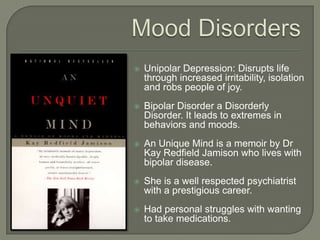
   An Unique Mind is a memoir by Dr
    Kay Redfield Jamison who lives with
    bipolar disease.
   She is a well respected psychiatrist
    with a prestigious career.
   Had personal struggles with wanting
    to take medications.
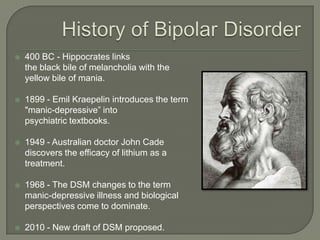
   400 BC - Hippocrates links
    the black bile of melancholia with the
    yellow bile of mania.

   1899 - Emil Kraepelin introduces the term
    "manic-depressive” into
    psychiatric textbooks.

   1949 - Australian doctor John Cade
    discovers the efficacy of lithium as a
    treatment.

   1968 - The DSM changes to the term
    manic-depressive illness and biological
    perspectives come to dominate.

   2010 - New draft of DSM proposed.
   For most the onset for Bipolar occurs in
    late teens and early 20’s.
   Rates in general population for adults is between 1% and
    4% depending on criteria.
   In elders in community rates are between 1% and .5%
   Rates in nursing homes are as high 10%.
   Psychosocial factors increase severity of symptoms and
    predicts health, behavioral problems, and rate of relapse.
   Family relationships, Poverty, Racism, Lack of Social
    Relationships, Life Stress are Key Factors in Prognosis.
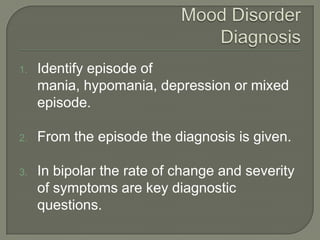
1.   Identify episode of
     mania, hypomania, depression or mixed
     episode.

2.   From the episode the diagnosis is given.

3.   In bipolar the rate of change and severity
     of symptoms are key diagnostic
     questions.
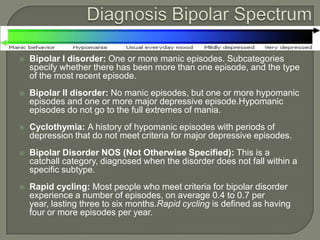
   Bipolar I disorder: One or more manic episodes. Subcategories
    specify whether there has been more than one episode, and the type
    of the most recent episode.
   Bipolar II disorder: No manic episodes, but one or more hypomanic
    episodes and one or more major depressive episode.Hypomanic
    episodes do not go to the full extremes of mania.
   Cyclothymia: A history of hypomanic episodes with periods of
    depression that do not meet criteria for major depressive episodes.
   Bipolar Disorder NOS (Not Otherwise Specified): This is a
    catchall category, diagnosed when the disorder does not fall within a
    specific subtype.
   Rapid cycling: Most people who meet criteria for bipolar disorder
    experience a number of episodes, on average 0.4 to 0.7 per
    year, lasting three to six months.Rapid cycling is defined as having
    four or more episodes per year.
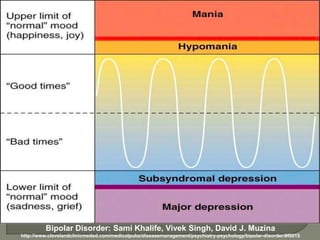
Bipolar Disorder: Sami Khalife, Vivek Singh, David J. Muzina
http://www.clevelandclinicmeded.com/medicalpubs/diseasemanagement/psychiatry-psychology/bipolar-disorder/#f0015
   People can loose jobs, face jokes, feel judged for
    behavior and can feel isolated.
   Bipolar disorder is associated with creativity:
    Painters, Writers, Actors.
   One 2011 Study found, “We propose that
    creativity in BD might be linked to the putative
    hyperdopaminergic state of mania and be
    dependent on intact executive function.”
   Positive social and emotional functioning increase
    executive functioning
   The overall heritability of the bipolar spectrum has
    been put at 0.71.
   Bipolar disorder co-occurs in 67% of
    monozigotic twins and 19% of dizigotic
   Half of adults diagnosed with bipolar disorder
    report traumatic/abusive experiences in
    childhood (independent of trauma due to increased
    health destructive behaviors).
   Childhood abuse relates to severity of
    symptoms, prognosis and symptoms later in life.
   MRI studies in bipolar disorder: Increase in the volume of the
    lateral ventricles, globus pallidus, abnormalities in
    hypothalamic-pituitary-adrenal axis (HPA axis).
   The "kindling" theory: A genetic predisposition is catalyzed by
    stressors that lowers threshold for mood episodes and
    disrupts emotional regulation. After this occurs often enough
    mood symptoms self-perpetuate.
   Disruptions in mitochondria and neuron pump also have been
    identified.
   Individuals with bipolar disorder have alterations in:
    Circadian rhythms, sleep, diurnal cortisol and melatonin.
   Individuals with bipolar disorder can lead very
    productive lives if there is the right social and
    emotional support.
   More then individuals with psychosis individuals with
    bipolar tend to be in higher paying work.
   However there is often a lower reported quality of life
    for individuals with bipolar disorder despite successes.
   If there are significant life stressors, poor social
    support, chaos, etc. there is another life course for the
    illness.
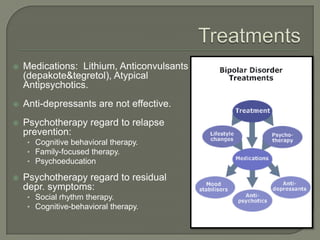
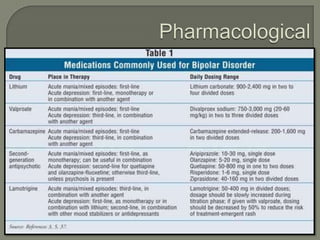
   Medications: Lithium, Anticonvulsants
    (depakote&tegretol), Atypical
    Antipsychotics.
   Anti-depressants are not effective.
   Psychotherapy regard to relapse
    prevention:
    • Cognitive behavioral therapy.
    • Family-focused therapy.
    • Psychoeducation

   Psychotherapy regard to residual
    depr. symptoms:
    • Social rhythm therapy.
    • Cognitive-behavioral therapy.
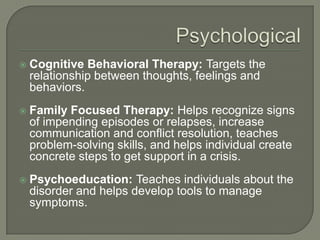
   Cognitive Behavioral Therapy: Targets the
    relationship between thoughts, feelings and
    behaviors.
   Family Focused Therapy: Helps recognize signs
    of impending episodes or relapses, increase
    communication and conflict resolution, teaches
    problem-solving skills, and helps individual create
    concrete steps to get support in a crisis.
   Psychoeducation: Teaches individuals about the
    disorder and helps develop tools to manage
    symptoms.
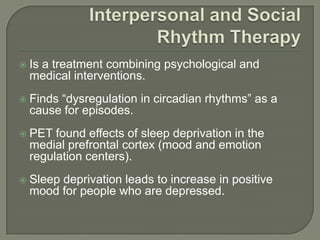
   Is a treatment combining psychological and
    medical interventions.
   Finds “dysregulation in circadian rhythms” as a
    cause for episodes.
   PET found effects of sleep deprivation in the
    medial prefrontal cortex (mood and emotion
    regulation centers).
   Sleep deprivation leads to increase in positive
    mood for people who are depressed.
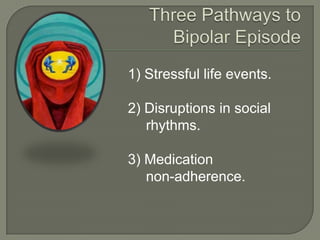
1) Stressful life events.

2) Disruptions in social
   rhythms.

3) Medication
   non-adherence.
1)   The link between mood and life events.
2)   The importance of maintaining regular daily rhythms.
3)   The identification and management of potential
     precipitants of rhythm dysregulation with special
     attention to interpersonal triggers.
4)   The facilitation of mourning the lost healthy self.
5)   The identification and management of affective
     symptoms.
   Instruction on the importance of medication compliance
    (e.g., log and review of medication record and what
    medications were taken, what time, date).
   Management of BD.
     • Improvement of communication.
     • Counseling regarding marital relationship and related issues.
     • Caregiver support and education.

   Observation and assessment of postoperative medical
    conditions including chest pains, pedal edema, and urinary
    incontinence.
   Counseling regarding nutrition-specifically a low fat, low
    salt, and low sugar diet.
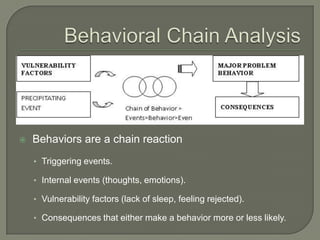
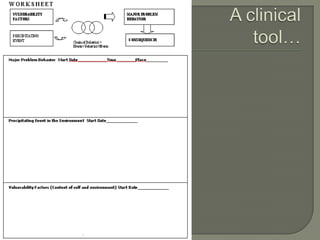
   Behaviors are a chain reaction
    • Triggering events.

    • Internal events (thoughts, emotions).

    • Vulnerability factors (lack of sleep, feeling rejected).

    • Consequences that either make a behavior more or less likely.
   In the skilled nursing context people are isolated from
    social support, have pain, adjustment to illness, anxiety
    about health, and challenges with sleep.
   Regularity in skilled nursing of meals and therapies
    could be very supportive.
   Evening noise, pain, racing thoughts, difficulty falling
    asleep or waking up multiple times per night is
    common.
   There are multiple risk factors that increase bipolar
    behaviors and multiple protective factors against the
    development of a bipolar episode.
   Keep Healthy Boundaries
    • Be careful what you reinforce.
    • What you reinforce will continue.
    • Mice can be reinforced for a behavior with a fight just like it was the best tasting
        food.

   Treat Symptoms
    •   Depression or manic episode
    •   Anxiety
    •   Paranoia
    •   Grief, Pain, Sleep, Social Connection etc.

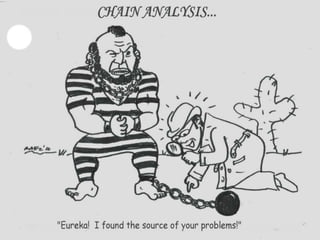
   Behavioral Chain Analysis
    • Consult with behavioral health.
    • Assess triggers, internal factors, precipitating factors.
    • Change triggers, internal factors, precipitating factors.

   Self-regulate: Your emotions are contagious. Individuals who have
    bipolar, traumatic histories or personality problems have a
    heightened sensitivity to the emotions of others.

Bipolar treatment skilled nursing

  • 1.
    Mood Behaviors and Symptom Management In Skilled Nursing With Dr. Michael Changaris
  • 2.
    Unipolar Depression: Disrupts life through increased irritability, isolation and robs people of joy.  Bipolar Disorder a Disorderly Disorder. It leads to extremes in behaviors and moods.  An Unique Mind is a memoir by Dr Kay Redfield Jamison who lives with bipolar disease.  She is a well respected psychiatrist with a prestigious career.  Had personal struggles with wanting to take medications.
  • 3.
    400 BC - Hippocrates links the black bile of melancholia with the yellow bile of mania.  1899 - Emil Kraepelin introduces the term "manic-depressive” into psychiatric textbooks.  1949 - Australian doctor John Cade discovers the efficacy of lithium as a treatment.  1968 - The DSM changes to the term manic-depressive illness and biological perspectives come to dominate.  2010 - New draft of DSM proposed.
  • 4.
    For most the onset for Bipolar occurs in late teens and early 20’s.  Rates in general population for adults is between 1% and 4% depending on criteria.  In elders in community rates are between 1% and .5%  Rates in nursing homes are as high 10%.  Psychosocial factors increase severity of symptoms and predicts health, behavioral problems, and rate of relapse.  Family relationships, Poverty, Racism, Lack of Social Relationships, Life Stress are Key Factors in Prognosis.
  • 5.
    1. Identify episode of mania, hypomania, depression or mixed episode. 2. From the episode the diagnosis is given. 3. In bipolar the rate of change and severity of symptoms are key diagnostic questions.
  • 6.
    Bipolar I disorder: One or more manic episodes. Subcategories specify whether there has been more than one episode, and the type of the most recent episode.  Bipolar II disorder: No manic episodes, but one or more hypomanic episodes and one or more major depressive episode.Hypomanic episodes do not go to the full extremes of mania.  Cyclothymia: A history of hypomanic episodes with periods of depression that do not meet criteria for major depressive episodes.  Bipolar Disorder NOS (Not Otherwise Specified): This is a catchall category, diagnosed when the disorder does not fall within a specific subtype.  Rapid cycling: Most people who meet criteria for bipolar disorder experience a number of episodes, on average 0.4 to 0.7 per year, lasting three to six months.Rapid cycling is defined as having four or more episodes per year.
  • 7.
    Bipolar Disorder: SamiKhalife, Vivek Singh, David J. Muzina http://www.clevelandclinicmeded.com/medicalpubs/diseasemanagement/psychiatry-psychology/bipolar-disorder/#f0015
  • 8.
    People can loose jobs, face jokes, feel judged for behavior and can feel isolated.  Bipolar disorder is associated with creativity: Painters, Writers, Actors.  One 2011 Study found, “We propose that creativity in BD might be linked to the putative hyperdopaminergic state of mania and be dependent on intact executive function.”  Positive social and emotional functioning increase executive functioning
  • 9.
    The overall heritability of the bipolar spectrum has been put at 0.71.  Bipolar disorder co-occurs in 67% of monozigotic twins and 19% of dizigotic  Half of adults diagnosed with bipolar disorder report traumatic/abusive experiences in childhood (independent of trauma due to increased health destructive behaviors).  Childhood abuse relates to severity of symptoms, prognosis and symptoms later in life.
  • 10.
    MRI studies in bipolar disorder: Increase in the volume of the lateral ventricles, globus pallidus, abnormalities in hypothalamic-pituitary-adrenal axis (HPA axis).  The "kindling" theory: A genetic predisposition is catalyzed by stressors that lowers threshold for mood episodes and disrupts emotional regulation. After this occurs often enough mood symptoms self-perpetuate.  Disruptions in mitochondria and neuron pump also have been identified.  Individuals with bipolar disorder have alterations in: Circadian rhythms, sleep, diurnal cortisol and melatonin.
  • 11.
    Individuals with bipolar disorder can lead very productive lives if there is the right social and emotional support.  More then individuals with psychosis individuals with bipolar tend to be in higher paying work.  However there is often a lower reported quality of life for individuals with bipolar disorder despite successes.  If there are significant life stressors, poor social support, chaos, etc. there is another life course for the illness.
  • 12.
    Medications: Lithium, Anticonvulsants (depakote&tegretol), Atypical Antipsychotics.  Anti-depressants are not effective.  Psychotherapy regard to relapse prevention: • Cognitive behavioral therapy. • Family-focused therapy. • Psychoeducation  Psychotherapy regard to residual depr. symptoms: • Social rhythm therapy. • Cognitive-behavioral therapy.
  • 14.
    Cognitive Behavioral Therapy: Targets the relationship between thoughts, feelings and behaviors.  Family Focused Therapy: Helps recognize signs of impending episodes or relapses, increase communication and conflict resolution, teaches problem-solving skills, and helps individual create concrete steps to get support in a crisis.  Psychoeducation: Teaches individuals about the disorder and helps develop tools to manage symptoms.
  • 15.
    Is a treatment combining psychological and medical interventions.  Finds “dysregulation in circadian rhythms” as a cause for episodes.  PET found effects of sleep deprivation in the medial prefrontal cortex (mood and emotion regulation centers).  Sleep deprivation leads to increase in positive mood for people who are depressed.
  • 16.
    1) Stressful lifeevents. 2) Disruptions in social rhythms. 3) Medication non-adherence.
  • 17.
    1) The link between mood and life events. 2) The importance of maintaining regular daily rhythms. 3) The identification and management of potential precipitants of rhythm dysregulation with special attention to interpersonal triggers. 4) The facilitation of mourning the lost healthy self. 5) The identification and management of affective symptoms.
  • 18.
    Instruction on the importance of medication compliance (e.g., log and review of medication record and what medications were taken, what time, date).  Management of BD. • Improvement of communication. • Counseling regarding marital relationship and related issues. • Caregiver support and education.  Observation and assessment of postoperative medical conditions including chest pains, pedal edema, and urinary incontinence.  Counseling regarding nutrition-specifically a low fat, low salt, and low sugar diet.
  • 20.
    Behaviors are a chain reaction • Triggering events. • Internal events (thoughts, emotions). • Vulnerability factors (lack of sleep, feeling rejected). • Consequences that either make a behavior more or less likely.
  • 22.
    In the skilled nursing context people are isolated from social support, have pain, adjustment to illness, anxiety about health, and challenges with sleep.  Regularity in skilled nursing of meals and therapies could be very supportive.  Evening noise, pain, racing thoughts, difficulty falling asleep or waking up multiple times per night is common.  There are multiple risk factors that increase bipolar behaviors and multiple protective factors against the development of a bipolar episode.
  • 23.
    Keep Healthy Boundaries • Be careful what you reinforce. • What you reinforce will continue. • Mice can be reinforced for a behavior with a fight just like it was the best tasting food.  Treat Symptoms • Depression or manic episode • Anxiety • Paranoia • Grief, Pain, Sleep, Social Connection etc.  Behavioral Chain Analysis • Consult with behavioral health. • Assess triggers, internal factors, precipitating factors. • Change triggers, internal factors, precipitating factors.  Self-regulate: Your emotions are contagious. Individuals who have bipolar, traumatic histories or personality problems have a heightened sensitivity to the emotions of others.