Pediatric Bipolar Kelly Subramanian Spring 2009 Psych 493C Is it really a valid disorder?
Outline Key People DSM-IV-TR criteria Symptoms Diagnosis Diagnostic Guidelines ICD vs. DSM Comorbidity Drug-induced Symptoms International Views Research Human Condition
Increased Diagnoses From 1994-2003, the early onset bipolar disorder percent of psychiatric diagnoses increased by 15-fold.  In 2007, estimates of prevalence were as high as 6%.
Demitri Papolos, MD Co-author to  The Bipolar Child  with his wife, Janice Albert Einstein College of Medicine   John Rosemond and Bose Ravenel   Authors to  The Diseasing of America’s Children Say that Papoloses claims are: Arbitrary, ill-defined, and unscientific diagnostic criteria Unproven theories about causation  Treatment recommendations that presume “chemical imbalances” and other unverified brain pathologies Publication   Bipolar Children: Cutting-Edge Controversy, Insights, and Research Key People
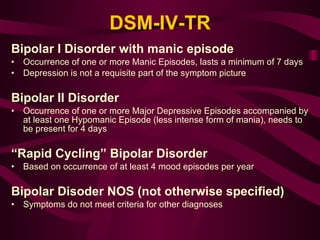
DSM-IV-TR Bipolar I Disorder with manic episode Occurrence of one or more Manic Episodes, lasts a minimum of 7 days Depression is not a requisite part of the symptom picture Bipolar II Disorder Occurrence of one or more Major Depressive Episodes accompanied by at least one Hypomanic Episode (less intense form of mania), needs to be present for 4 days “ Rapid Cycling” Bipolar Disorder Based on occurrence of at least 4 mood episodes per year Bipolar Disoder NOS (not otherwise specified) Symptoms do not meet criteria for other diagnoses
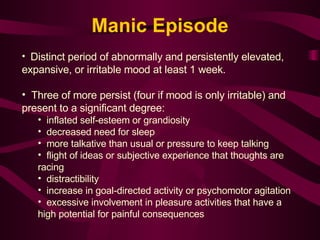
Manic Episode Distinct period of abnormally and persistently elevated, expansive, or irritable mood at least 1 week. Three of more persist (four if mood is only irritable) and present to a significant degree: inflated self-esteem or grandiosity decreased need for sleep more talkative than usual or pressure to keep talking flight of ideas or subjective experience that thoughts are racing distractibility increase in goal-directed activity or psychomotor agitation excessive involvement in pleasure activities that have a high potential for painful consequences
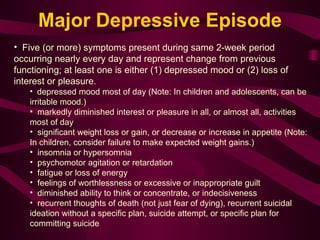
Major Depressive Episode Five (or more) symptoms present during same 2-week period occurring nearly every day and represent change from previous functioning; at least one is either (1) depressed mood or (2) loss of interest or pleasure.  depressed mood most of day (Note: In children and adolescents, can be irritable mood.) markedly diminished interest or pleasure in all, or almost all, activities most of day significant weight loss or gain, or decrease or increase in appetite (Note: In children, consider failure to make expected weight gains.) insomnia or hypersomnia psychomotor agitation or retardation fatigue or loss of energy feelings of worthlessness or excessive or inappropriate guilt  diminished ability to think or concentrate, or indecisiveness recurrent thoughts of death (not just fear of dying), recurrent suicidal ideation without a specific plan, suicide attempt, or specific plan for committing suicide
  In its practice guidelines for pediatricians, states:  “ DSM-IV criteria remain a consensus without clear empirical [research] data supporting the number of items required for the diagnosis. . . Furthermore, the behavioral characteristics specified in DSM-IV, despite efforts to standardize them, remain subjective.”   American Academy of Pediatrics
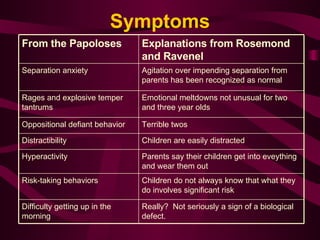
Symptoms Really?  Not seriously a sign of a biological defect. Difficulty getting up in the morning Children do not always know that what they do involves significant risk Risk-taking behaviors Parents say their children get into eveything and wear them out Hyperactivity Children are easily distracted Distractibility Terrible twos Oppositional defiant behavior Emotional meltdowns not unusual for two and three year olds Rages and explosive temper tantrums Agitation over impending separation from parents has been recognized as normal Separation anxiety Explanations from Rosemond and Ravenel  From the Papoloses
Diagnosis Children’s imagination or mania? Other influences Symptoms are subjective Symptoms overlap with different disorders
Comparison of diagnostic guidelines for juvenile bipolar disorder Looked at 3 main sets of guidelines issued The National Institute of Health and Clinical Excellence (UK) The National Institute of Mental Health (USA) Child Psychiatric Workshop (USA) Concluded that there is a need to develop diagnostic guidelines that give the same results. There is widespread uncertainty about which guidelines are best to use.  Diagnostic Guidelines
Developed in 2002 by Demitri Papolos, MD 65 item questionnaire Rate Frequency 1- Never or hardly ever    3- Often 2- Sometimes   4- Very often or almost constantly Symptom/Behaviors: has difficulty arising in the AM has difficulty settling at night has difficulty making transitions interrupts or intrudes on others The Child Bipolar Questionnaire
ICD vs. DSM International Statistical Classification of Diseases and Related Health Problems, in 10 th  edition.  More strict criteria Barbara Geller, Washington University   Criteria used:  euphoria, grandiosity, lack of sleep, herpersexuality, and other mania symptoms. Biederman, Harvard Medial School Criteria generalized: brief stormy episodes of mania lasting only minutes, extremely moody, irritable, aggressive, or emotionally explosive children
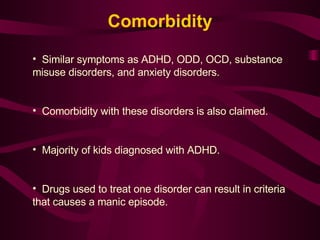
Comorbidity Similar symptoms as ADHD, ODD, OCD, substance misuse disorders, and anxiety disorders. Comorbidity with these disorders is also claimed. Majority of kids diagnosed with ADHD. Drugs used to treat one disorder can result in criteria that causes a manic episode.
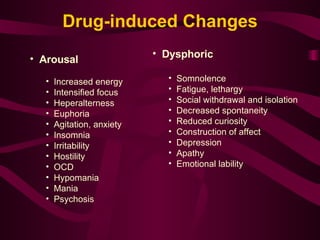
Arousal Increased energy Intensified focus Heperalterness Euphoria Agitation, anxiety Insomnia Irritability Hostility OCD Hypomania Mania Psychosis Dysphoric Somnolence Fatigue, lethargy Social withdrawal and isolation Decreased spontaneity Reduced curiosity Construction of affect Depression  Apathy Emotional lability Drug-induced Changes
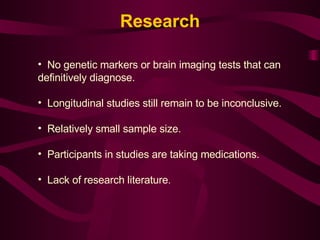
No genetic markers or brain imaging tests that can definitively diagnose. Longitudinal studies still remain to be inconclusive. Relatively small sample size. Participants in studies are taking medications. Lack of research literature .  Research
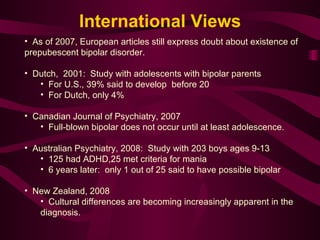
As of 2007, European articles still express doubt about existence of prepubescent bipolar disorder.  Dutch,  2001:  Study with adolescents with bipolar parents For U.S., 39% said to develop  before 20 For Dutch, only 4%  Canadian Journal of Psychiatry, 2007 Full-blown bipolar does not occur until at least adolescence.  Australian Psychiatry, 2008:  Study with 203 boys ages 9-13 125 had ADHD,25 met criteria for mania 6 years later:  only 1 out of 25 said to have possible bipolar New Zealand, 2008 Cultural differences are becoming increasingly apparent in the diagnosis.  International Views
Emotions highs and lows, anger and frustration, humiliation, irritation, giddiness, joy, and enthusiasm  Attribution theory Poor math score is associated with lack of talent in math. More likely to zone out, not do homework, and not study very hard for tests.  Potential to achieve excellent results. Will increase and intensify her efforts in future.   Human Condition
Pediatric Bipolar is not in the DSM-IV, so it does not exist! Symptoms claimed are more broad and general Research does not provide conclusive evidence  Outside of the U.S., bipolar disorder is not believed to occur before puberty Conclusion

Kelly Pediatric Bipolar

  • 1.
    Pediatric Bipolar KellySubramanian Spring 2009 Psych 493C Is it really a valid disorder?
  • 2.
    Outline Key PeopleDSM-IV-TR criteria Symptoms Diagnosis Diagnostic Guidelines ICD vs. DSM Comorbidity Drug-induced Symptoms International Views Research Human Condition
  • 3.
    Increased Diagnoses From1994-2003, the early onset bipolar disorder percent of psychiatric diagnoses increased by 15-fold. In 2007, estimates of prevalence were as high as 6%.
  • 4.
    Demitri Papolos, MDCo-author to The Bipolar Child with his wife, Janice Albert Einstein College of Medicine John Rosemond and Bose Ravenel Authors to The Diseasing of America’s Children Say that Papoloses claims are: Arbitrary, ill-defined, and unscientific diagnostic criteria Unproven theories about causation Treatment recommendations that presume “chemical imbalances” and other unverified brain pathologies Publication Bipolar Children: Cutting-Edge Controversy, Insights, and Research Key People
  • 5.
    DSM-IV-TR Bipolar IDisorder with manic episode Occurrence of one or more Manic Episodes, lasts a minimum of 7 days Depression is not a requisite part of the symptom picture Bipolar II Disorder Occurrence of one or more Major Depressive Episodes accompanied by at least one Hypomanic Episode (less intense form of mania), needs to be present for 4 days “ Rapid Cycling” Bipolar Disorder Based on occurrence of at least 4 mood episodes per year Bipolar Disoder NOS (not otherwise specified) Symptoms do not meet criteria for other diagnoses
  • 6.
    Manic Episode Distinctperiod of abnormally and persistently elevated, expansive, or irritable mood at least 1 week. Three of more persist (four if mood is only irritable) and present to a significant degree: inflated self-esteem or grandiosity decreased need for sleep more talkative than usual or pressure to keep talking flight of ideas or subjective experience that thoughts are racing distractibility increase in goal-directed activity or psychomotor agitation excessive involvement in pleasure activities that have a high potential for painful consequences
  • 7.
    Major Depressive EpisodeFive (or more) symptoms present during same 2-week period occurring nearly every day and represent change from previous functioning; at least one is either (1) depressed mood or (2) loss of interest or pleasure. depressed mood most of day (Note: In children and adolescents, can be irritable mood.) markedly diminished interest or pleasure in all, or almost all, activities most of day significant weight loss or gain, or decrease or increase in appetite (Note: In children, consider failure to make expected weight gains.) insomnia or hypersomnia psychomotor agitation or retardation fatigue or loss of energy feelings of worthlessness or excessive or inappropriate guilt diminished ability to think or concentrate, or indecisiveness recurrent thoughts of death (not just fear of dying), recurrent suicidal ideation without a specific plan, suicide attempt, or specific plan for committing suicide
  • 8.
      In itspractice guidelines for pediatricians, states: “ DSM-IV criteria remain a consensus without clear empirical [research] data supporting the number of items required for the diagnosis. . . Furthermore, the behavioral characteristics specified in DSM-IV, despite efforts to standardize them, remain subjective.” American Academy of Pediatrics
  • 9.
    Symptoms Really? Not seriously a sign of a biological defect. Difficulty getting up in the morning Children do not always know that what they do involves significant risk Risk-taking behaviors Parents say their children get into eveything and wear them out Hyperactivity Children are easily distracted Distractibility Terrible twos Oppositional defiant behavior Emotional meltdowns not unusual for two and three year olds Rages and explosive temper tantrums Agitation over impending separation from parents has been recognized as normal Separation anxiety Explanations from Rosemond and Ravenel From the Papoloses
  • 10.
    Diagnosis Children’s imaginationor mania? Other influences Symptoms are subjective Symptoms overlap with different disorders
  • 11.
    Comparison of diagnosticguidelines for juvenile bipolar disorder Looked at 3 main sets of guidelines issued The National Institute of Health and Clinical Excellence (UK) The National Institute of Mental Health (USA) Child Psychiatric Workshop (USA) Concluded that there is a need to develop diagnostic guidelines that give the same results. There is widespread uncertainty about which guidelines are best to use. Diagnostic Guidelines
  • 12.
    Developed in 2002by Demitri Papolos, MD 65 item questionnaire Rate Frequency 1- Never or hardly ever 3- Often 2- Sometimes 4- Very often or almost constantly Symptom/Behaviors: has difficulty arising in the AM has difficulty settling at night has difficulty making transitions interrupts or intrudes on others The Child Bipolar Questionnaire
  • 13.
    ICD vs. DSMInternational Statistical Classification of Diseases and Related Health Problems, in 10 th edition. More strict criteria Barbara Geller, Washington University   Criteria used: euphoria, grandiosity, lack of sleep, herpersexuality, and other mania symptoms. Biederman, Harvard Medial School Criteria generalized: brief stormy episodes of mania lasting only minutes, extremely moody, irritable, aggressive, or emotionally explosive children
  • 14.
    Comorbidity Similar symptomsas ADHD, ODD, OCD, substance misuse disorders, and anxiety disorders. Comorbidity with these disorders is also claimed. Majority of kids diagnosed with ADHD. Drugs used to treat one disorder can result in criteria that causes a manic episode.
  • 15.
    Arousal Increased energyIntensified focus Heperalterness Euphoria Agitation, anxiety Insomnia Irritability Hostility OCD Hypomania Mania Psychosis Dysphoric Somnolence Fatigue, lethargy Social withdrawal and isolation Decreased spontaneity Reduced curiosity Construction of affect Depression Apathy Emotional lability Drug-induced Changes
  • 16.
    No genetic markersor brain imaging tests that can definitively diagnose. Longitudinal studies still remain to be inconclusive. Relatively small sample size. Participants in studies are taking medications. Lack of research literature . Research
  • 17.
    As of 2007,European articles still express doubt about existence of prepubescent bipolar disorder. Dutch, 2001: Study with adolescents with bipolar parents For U.S., 39% said to develop before 20 For Dutch, only 4% Canadian Journal of Psychiatry, 2007 Full-blown bipolar does not occur until at least adolescence. Australian Psychiatry, 2008: Study with 203 boys ages 9-13 125 had ADHD,25 met criteria for mania 6 years later: only 1 out of 25 said to have possible bipolar New Zealand, 2008 Cultural differences are becoming increasingly apparent in the diagnosis. International Views
  • 18.
    Emotions highs andlows, anger and frustration, humiliation, irritation, giddiness, joy, and enthusiasm Attribution theory Poor math score is associated with lack of talent in math. More likely to zone out, not do homework, and not study very hard for tests. Potential to achieve excellent results. Will increase and intensify her efforts in future.   Human Condition
  • 19.
    Pediatric Bipolar isnot in the DSM-IV, so it does not exist! Symptoms claimed are more broad and general Research does not provide conclusive evidence Outside of the U.S., bipolar disorder is not believed to occur before puberty Conclusion