1
Assessment and Intervention
for Bipolar Disorder:
Best Practices for School Psychologists
2
Acknowledgements
 Adapted from…
Hart, S. R., & Brock, S. E., & Jeltova, I. (2013).
Assessing, identifying, and treating bipolar disorder
at school. New York: Springer.
3
Lecture Outline
 Diagnosis
 Course
 Co-existing Disabilities
 Associated Impairments
 Etiology, Prevalence & Prognosis
 Treatment
 Best Practices for School Psychologists
4
Lecture Goals
You will…
1. gain an overview of bipolar disorder.
2. acquire a sense of what is like to have bipolar
disorder.
3. learn what to look for and what questions to
ask when screening for bipolar disorder.
4. understand important special education issues,
including the psycho-educational evaluation of
a student with a known or suspected bipolar
disorder.
5
It is as if my life were magically run by
two electric currents: joyous positive and
despairing negative - whichever is running
at the moment dominates my life, floods it.
Sylvia Plath (2000)
The Unabridged Journals of Sylvia Plath, 1950-1962
New York: Anchor Books
6
Presentation Outline
 Diagnosis
 Course
 Co-existing Disabilities
 Associated Impairments
 Etiology, Prevalence & Prognosis
 Treatment
 Best Practices for School Psychologists
7
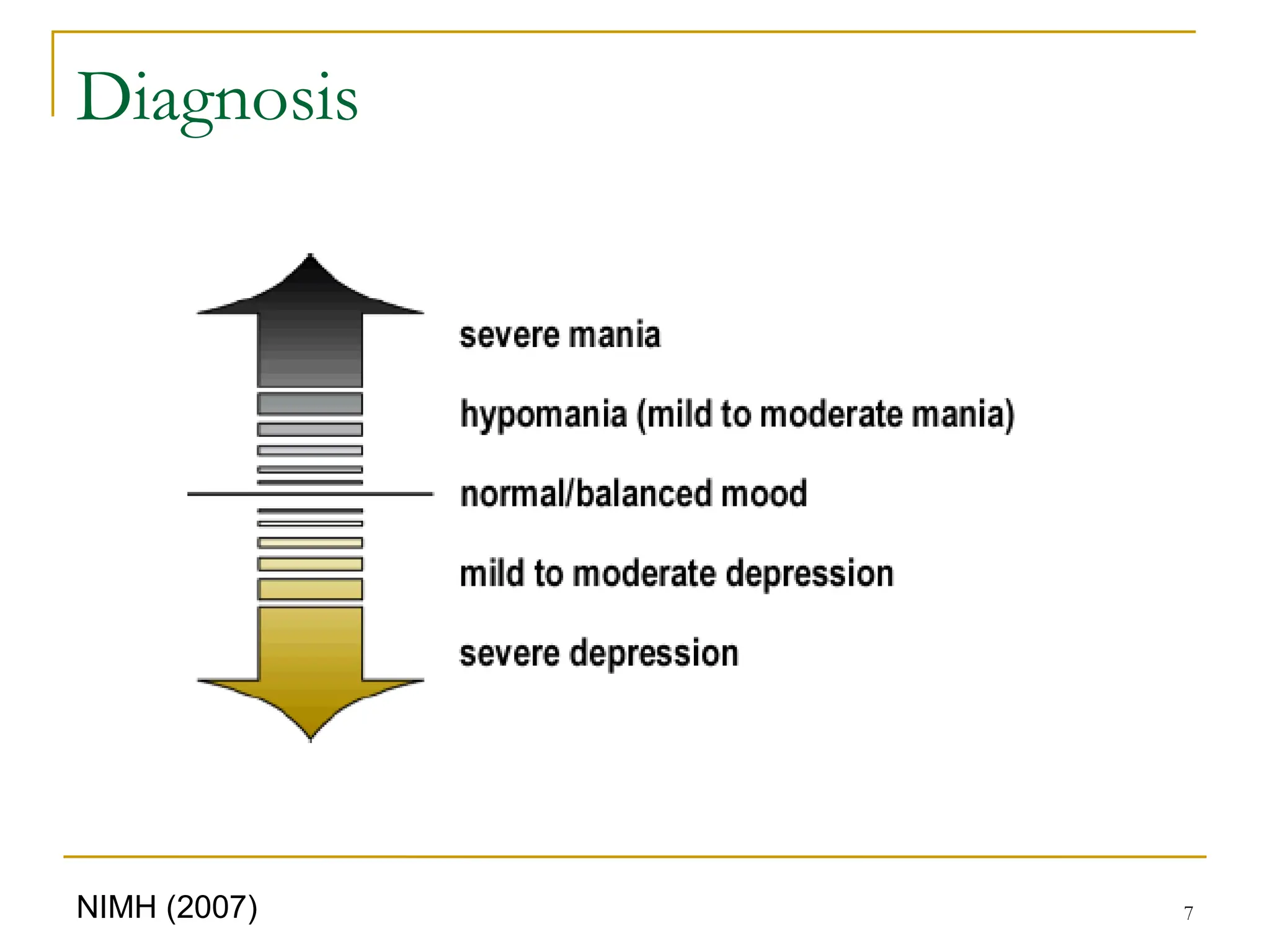
Diagnosis
NIMH (2007)
8
DSM-5 Diagnosis
1. Importance of early diagnosis
2. Pediatric bipolar disorder is especially challenging to identify.
 Characterized by severe affect dysregulation, high levels of
agitation, aggression.
 Relative to adults, children have a mixed presentation, a chronic
course, poor response to mood stabilizers, high co-morbidity
with ADHD
3. Symptoms similar to other disorders.
 For example, ADHD, depression, Oppositional Defiant Disorder,
Obsessive Compulsive Disorder, and Separation Anxiety
Disorder.
4. Treatments differ significantly.
5. The school psychologist may be the first mental health
professional to see bipolar.
Faraon et al. (2003)
9
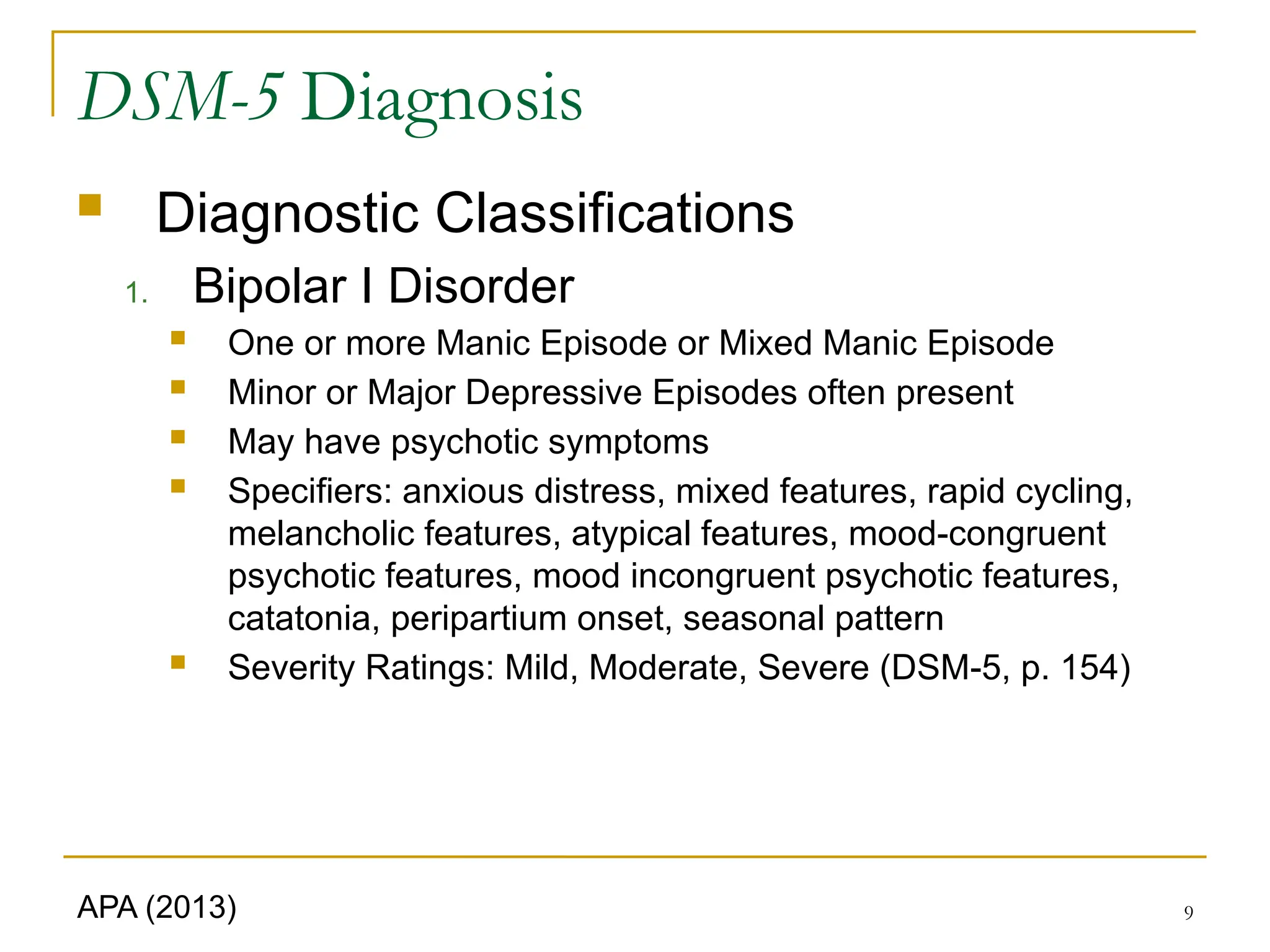
DSM-5 Diagnosis
 Diagnostic Classifications
1. Bipolar I Disorder
 One or more Manic Episode or Mixed Manic Episode
 Minor or Major Depressive Episodes often present
 May have psychotic symptoms
 Specifiers: anxious distress, mixed features, rapid cycling,
melancholic features, atypical features, mood-congruent
psychotic features, mood incongruent psychotic features,
catatonia, peripartium onset, seasonal pattern
 Severity Ratings: Mild, Moderate, Severe (DSM-5, p. 154)
APA (2013)
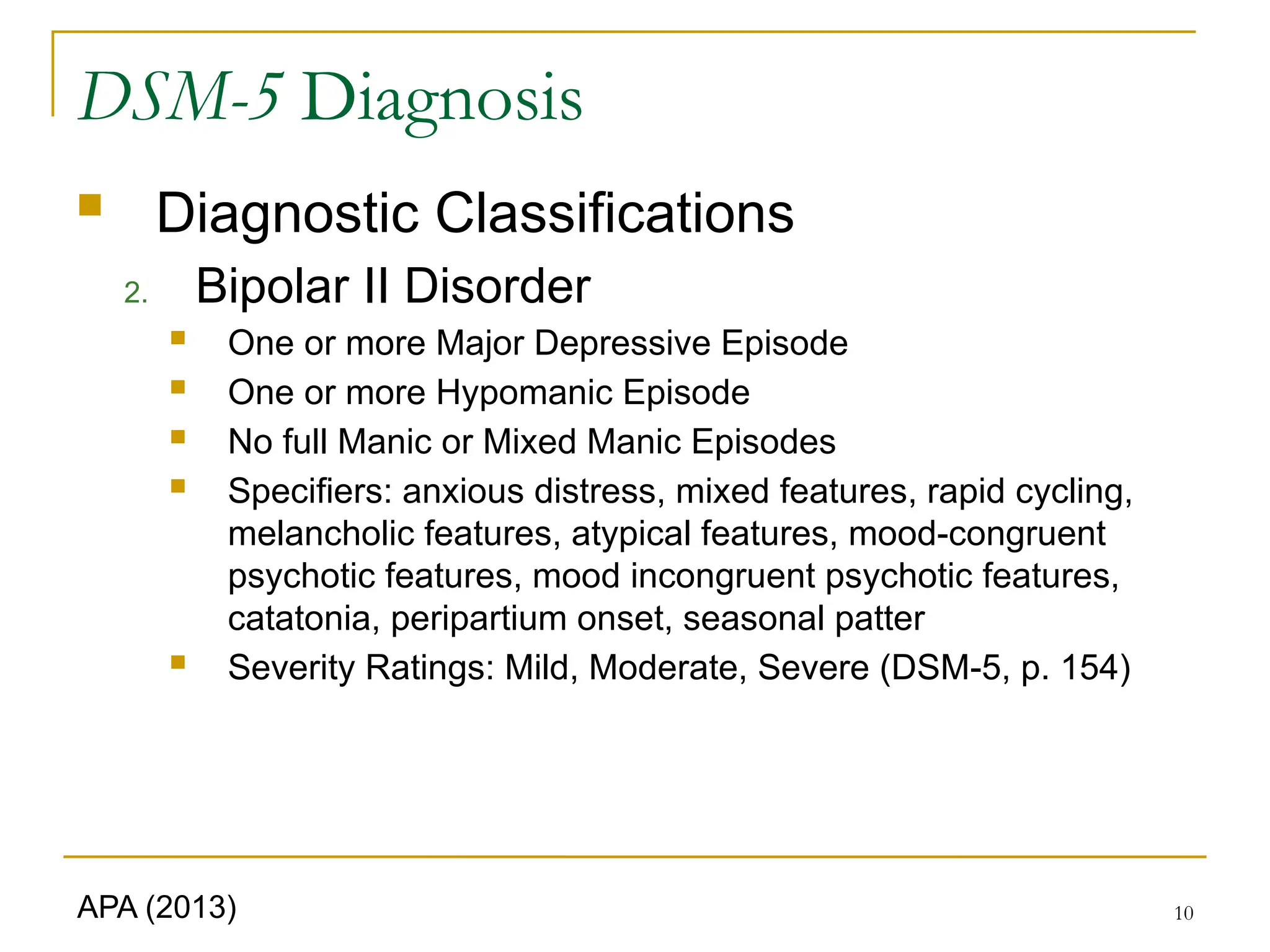
10
DSM-5 Diagnosis
 Diagnostic Classifications
2. Bipolar II Disorder
 One or more Major Depressive Episode
 One or more Hypomanic Episode
 No full Manic or Mixed Manic Episodes
 Specifiers: anxious distress, mixed features, rapid cycling,
melancholic features, atypical features, mood-congruent
psychotic features, mood incongruent psychotic features,
catatonia, peripartium onset, seasonal patter
 Severity Ratings: Mild, Moderate, Severe (DSM-5, p. 154)
APA (2013)
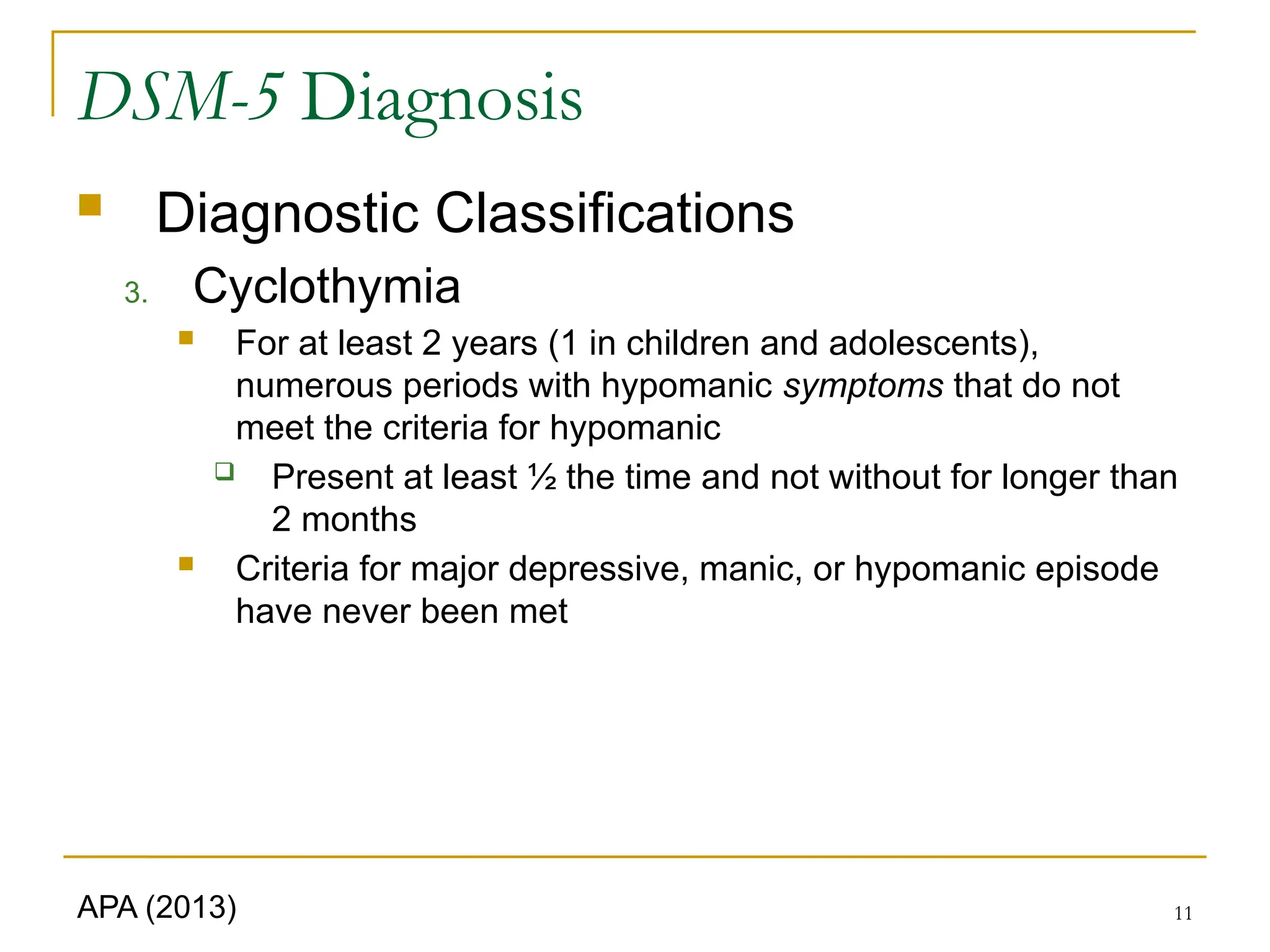
11
DSM-5 Diagnosis
 Diagnostic Classifications
3. Cyclothymia
 For at least 2 years (1 in children and adolescents),
numerous periods with hypomanic symptoms that do not
meet the criteria for hypomanic
 Present at least ½ the time and not without for longer than
2 months
 Criteria for major depressive, manic, or hypomanic episode
have never been met
APA (2013)
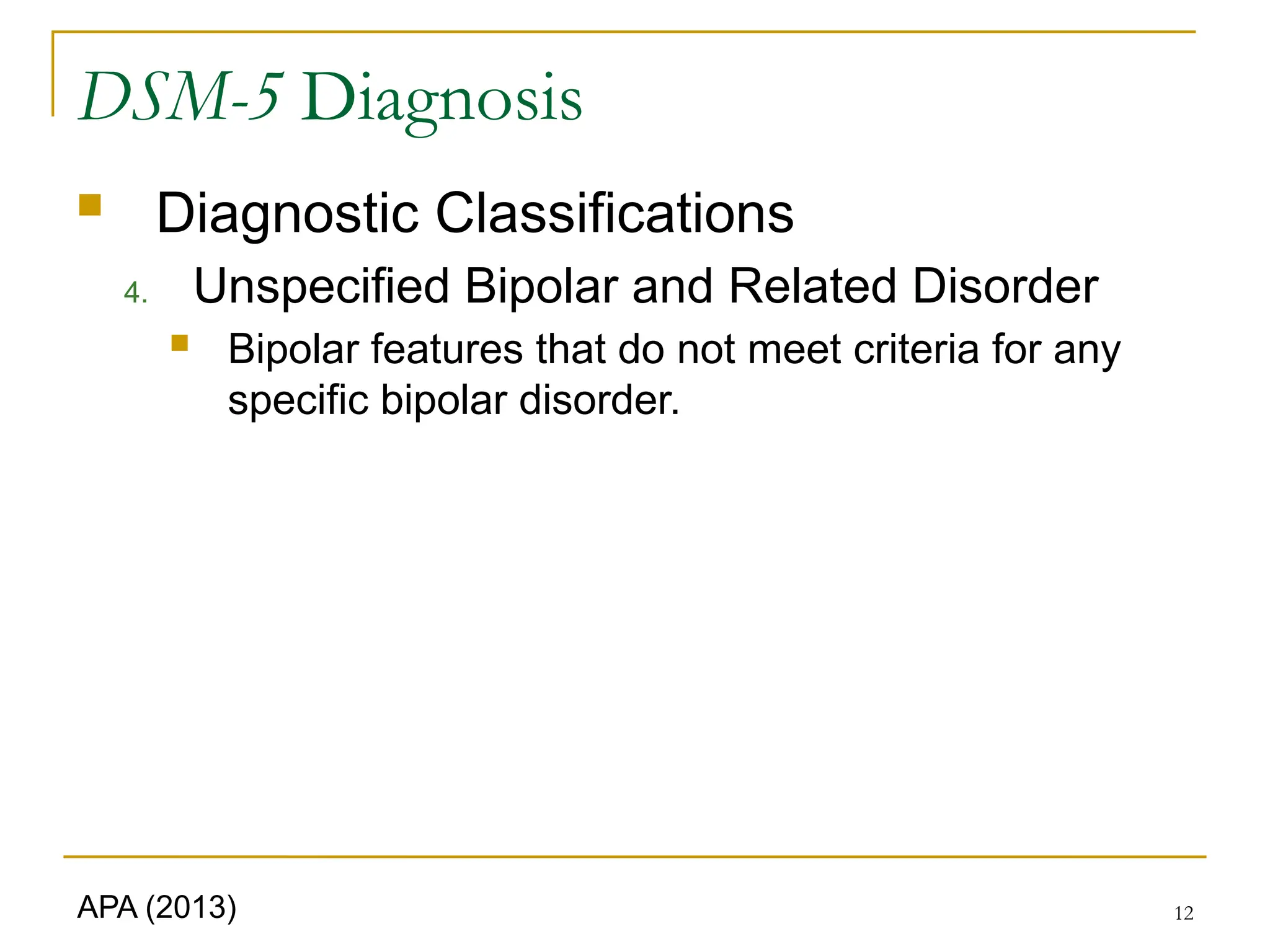
12
DSM-5 Diagnosis
 Diagnostic Classifications
4. Unspecified Bipolar and Related Disorder
 Bipolar features that do not meet criteria for any
specific bipolar disorder.
APA (2013)
13
DSM-5 Diagnosis
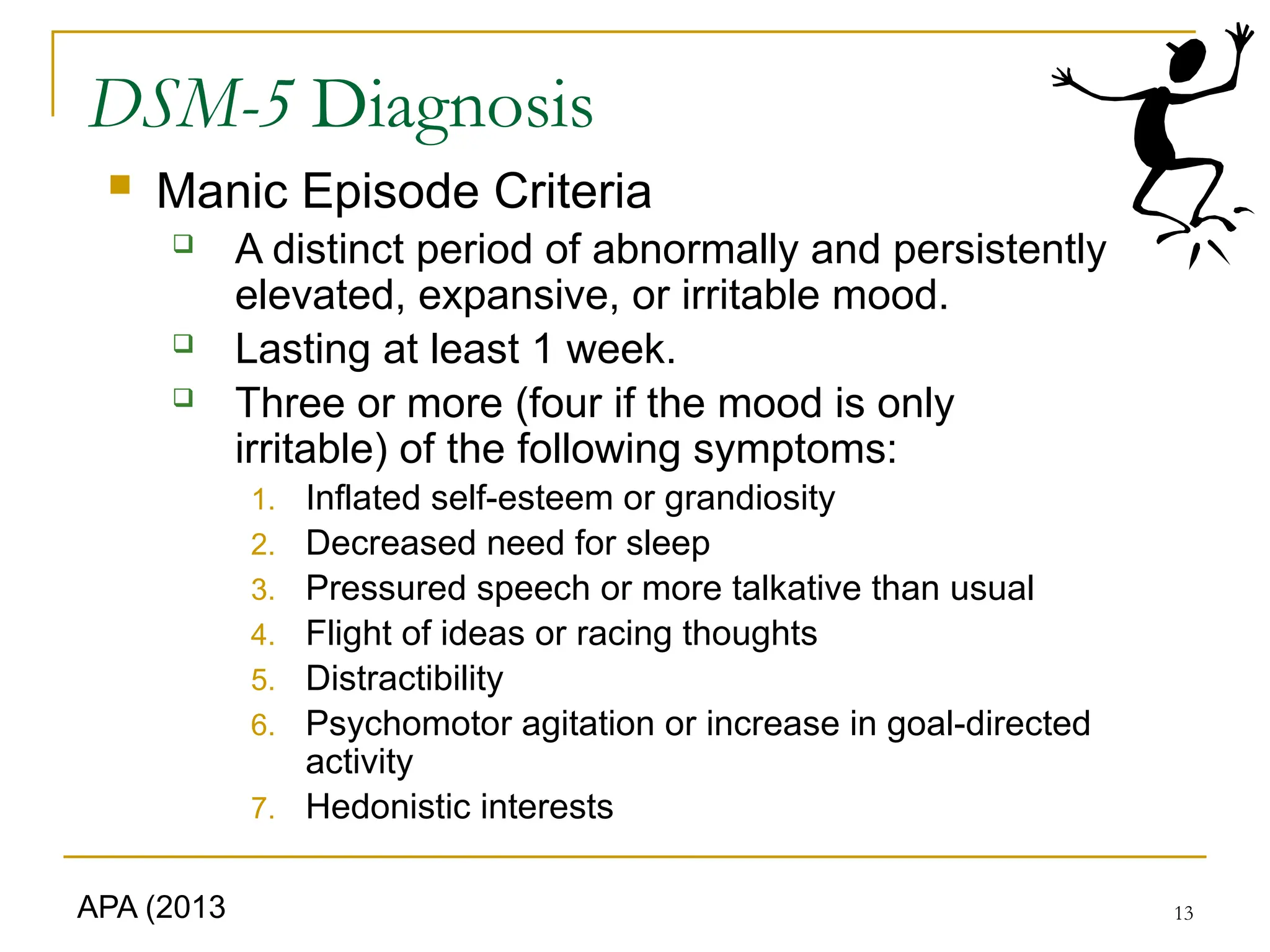
 Manic Episode Criteria
 A distinct period of abnormally and persistently
elevated, expansive, or irritable mood.
 Lasting at least 1 week.
 Three or more (four if the mood is only
irritable) of the following symptoms:
1. Inflated self-esteem or grandiosity
2. Decreased need for sleep
3. Pressured speech or more talkative than usual
4. Flight of ideas or racing thoughts
5. Distractibility
6. Psychomotor agitation or increase in goal-directed
activity
7. Hedonistic interests
APA (2013
14
DSM-5 Diagnosis
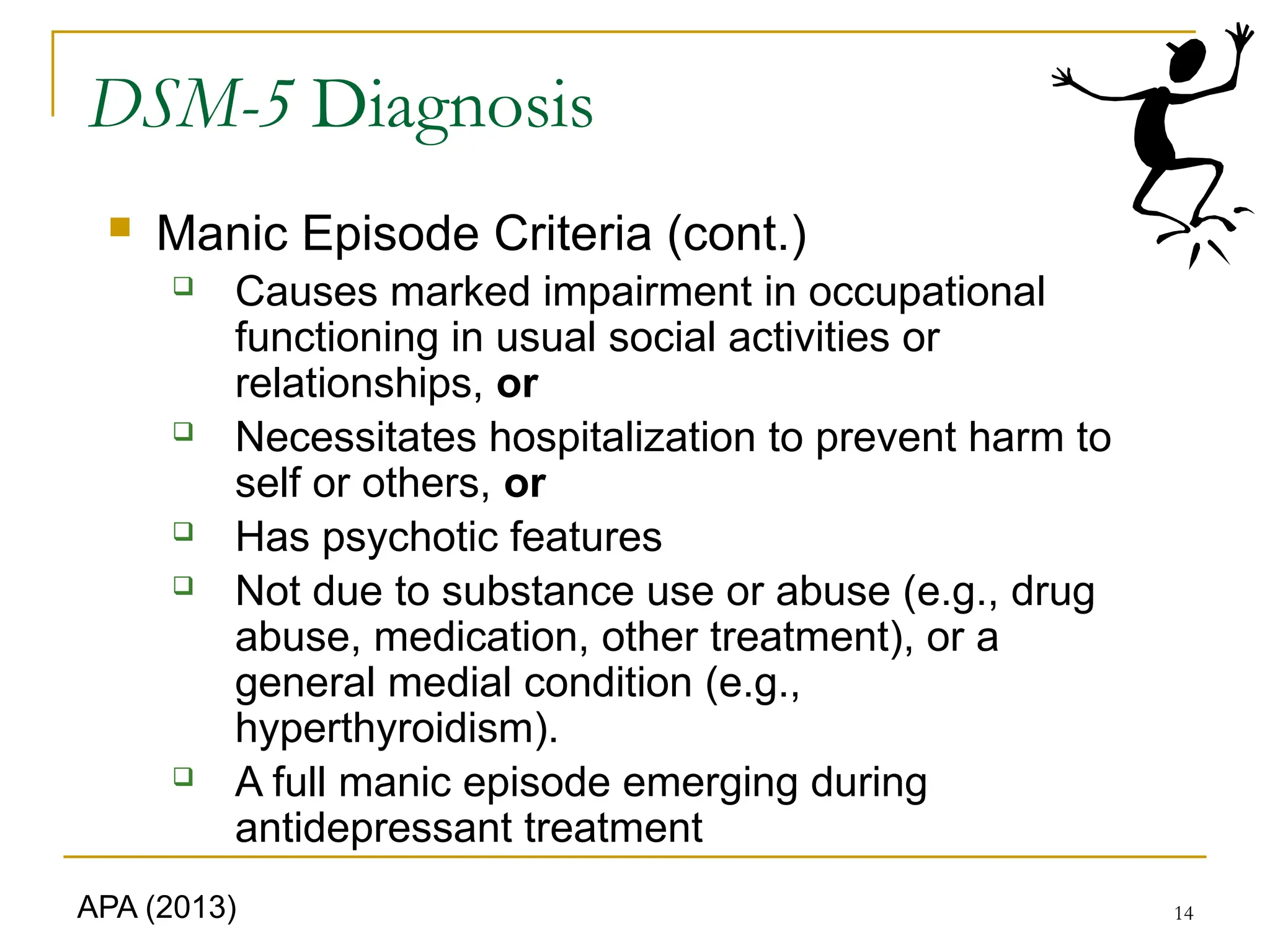
 Manic Episode Criteria (cont.)
 Causes marked impairment in occupational
functioning in usual social activities or
relationships, or
 Necessitates hospitalization to prevent harm to
self or others, or
 Has psychotic features
 Not due to substance use or abuse (e.g., drug
abuse, medication, other treatment), or a
general medial condition (e.g.,
hyperthyroidism).
 A full manic episode emerging during
antidepressant treatment
APA (2013)
15
Diagnosis: Manic Symptoms at School
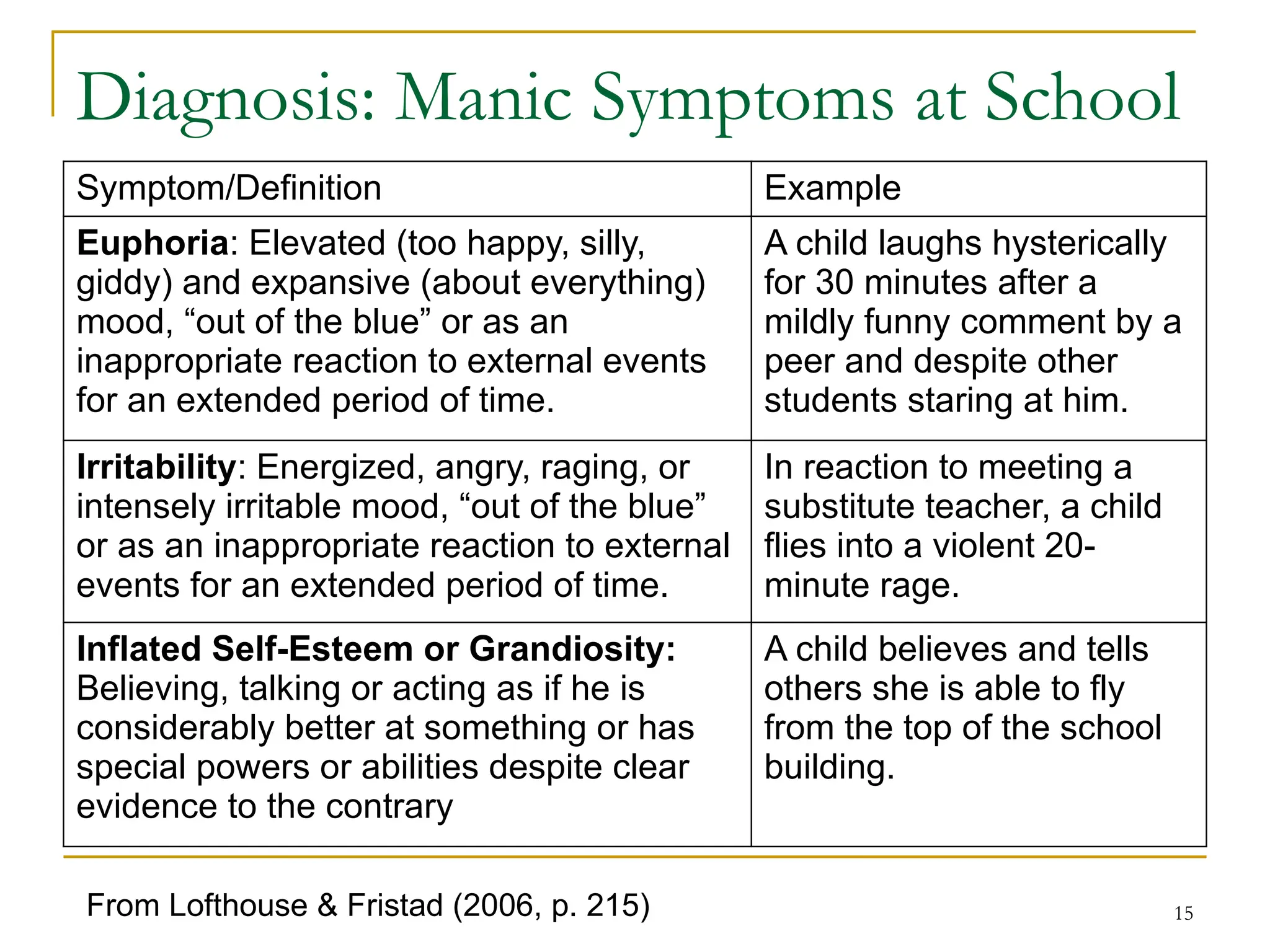
Symptom/Definition Example
Euphoria: Elevated (too happy, silly,
giddy) and expansive (about everything)
mood, “out of the blue” or as an
inappropriate reaction to external events
for an extended period of time.
A child laughs hysterically
for 30 minutes after a
mildly funny comment by a
peer and despite other
students staring at him.
Irritability: Energized, angry, raging, or
intensely irritable mood, “out of the blue”
or as an inappropriate reaction to external
events for an extended period of time.
In reaction to meeting a
substitute teacher, a child
flies into a violent 20-
minute rage.
Inflated Self-Esteem or Grandiosity:
Believing, talking or acting as if he is
considerably better at something or has
special powers or abilities despite clear
evidence to the contrary
A child believes and tells
others she is able to fly
from the top of the school
building.
From Lofthouse & Fristad (2006, p. 215)
16
Diagnosis: Manic Symptoms at School
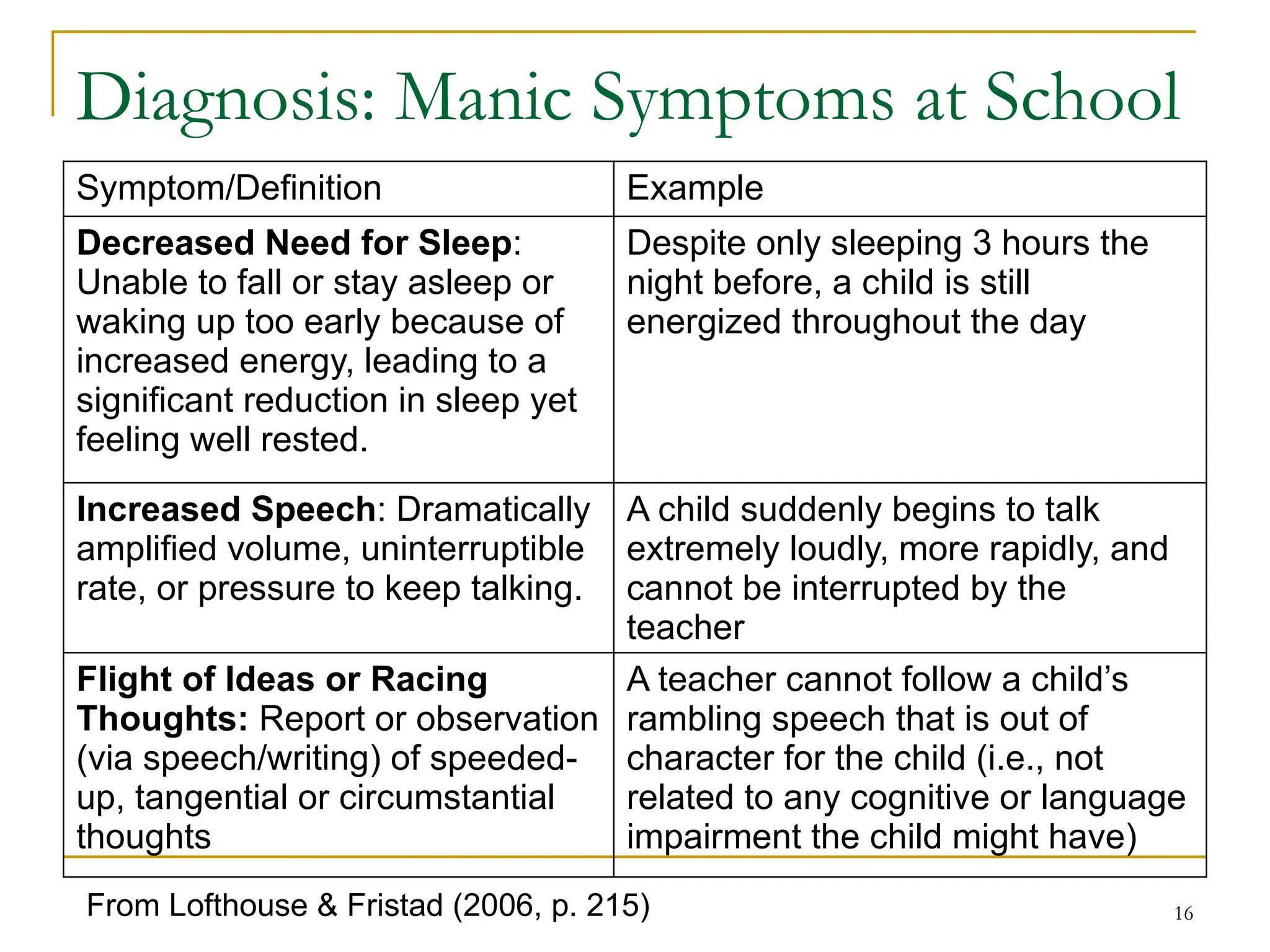
Symptom/Definition Example
Decreased Need for Sleep:
Unable to fall or stay asleep or
waking up too early because of
increased energy, leading to a
significant reduction in sleep yet
feeling well rested.
Despite only sleeping 3 hours the
night before, a child is still
energized throughout the day
Increased Speech: Dramatically
amplified volume, uninterruptible
rate, or pressure to keep talking.
A child suddenly begins to talk
extremely loudly, more rapidly, and
cannot be interrupted by the
teacher
Flight of Ideas or Racing
Thoughts: Report or observation
(via speech/writing) of speeded-
up, tangential or circumstantial
thoughts
A teacher cannot follow a child’s
rambling speech that is out of
character for the child (i.e., not
related to any cognitive or language
impairment the child might have)
From Lofthouse & Fristad (2006, p. 215)
17
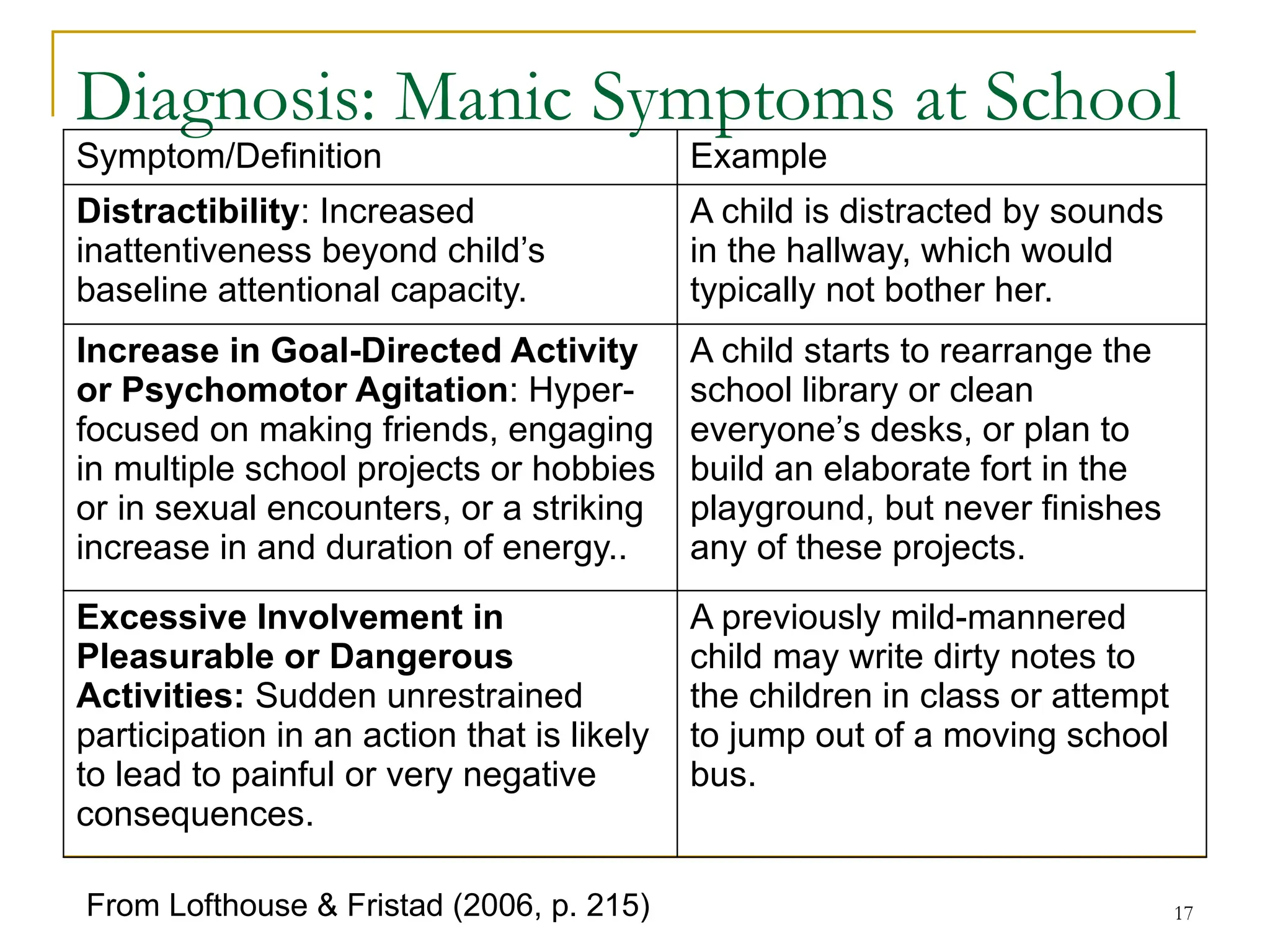
Diagnosis: Manic Symptoms at School
Symptom/Definition Example
Distractibility: Increased
inattentiveness beyond child’s
baseline attentional capacity.
A child is distracted by sounds
in the hallway, which would
typically not bother her.
Increase in Goal-Directed Activity
or Psychomotor Agitation: Hyper-
focused on making friends, engaging
in multiple school projects or hobbies
or in sexual encounters, or a striking
increase in and duration of energy..
A child starts to rearrange the
school library or clean
everyone’s desks, or plan to
build an elaborate fort in the
playground, but never finishes
any of these projects.
Excessive Involvement in
Pleasurable or Dangerous
Activities: Sudden unrestrained
participation in an action that is likely
to lead to painful or very negative
consequences.
A previously mild-mannered
child may write dirty notes to
the children in class or attempt
to jump out of a moving school
bus.
From Lofthouse & Fristad (2006, p. 215)
18
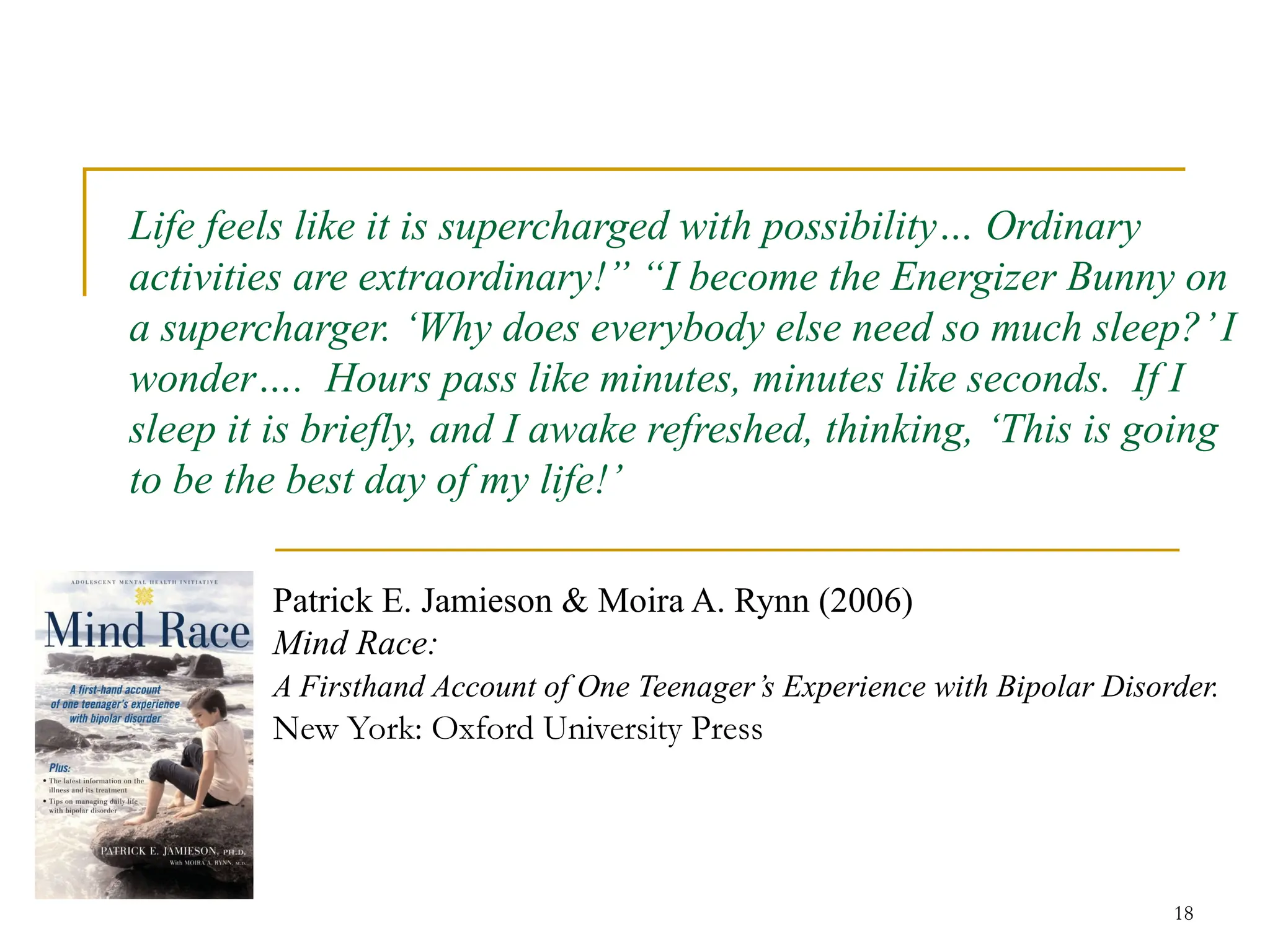
Life feels like it is supercharged with possibility… Ordinary
activities are extraordinary!” “I become the Energizer Bunny on
a supercharger. ‘Why does everybody else need so much sleep?’I
wonder…. Hours pass like minutes, minutes like seconds. If I
sleep it is briefly, and I awake refreshed, thinking, ‘This is going
to be the best day of my life!’
Patrick E. Jamieson & Moira A. Rynn (2006)
Mind Race:
A Firsthand Account of One Teenager’s Experience with Bipolar Disorder.
New York: Oxford University Press
19
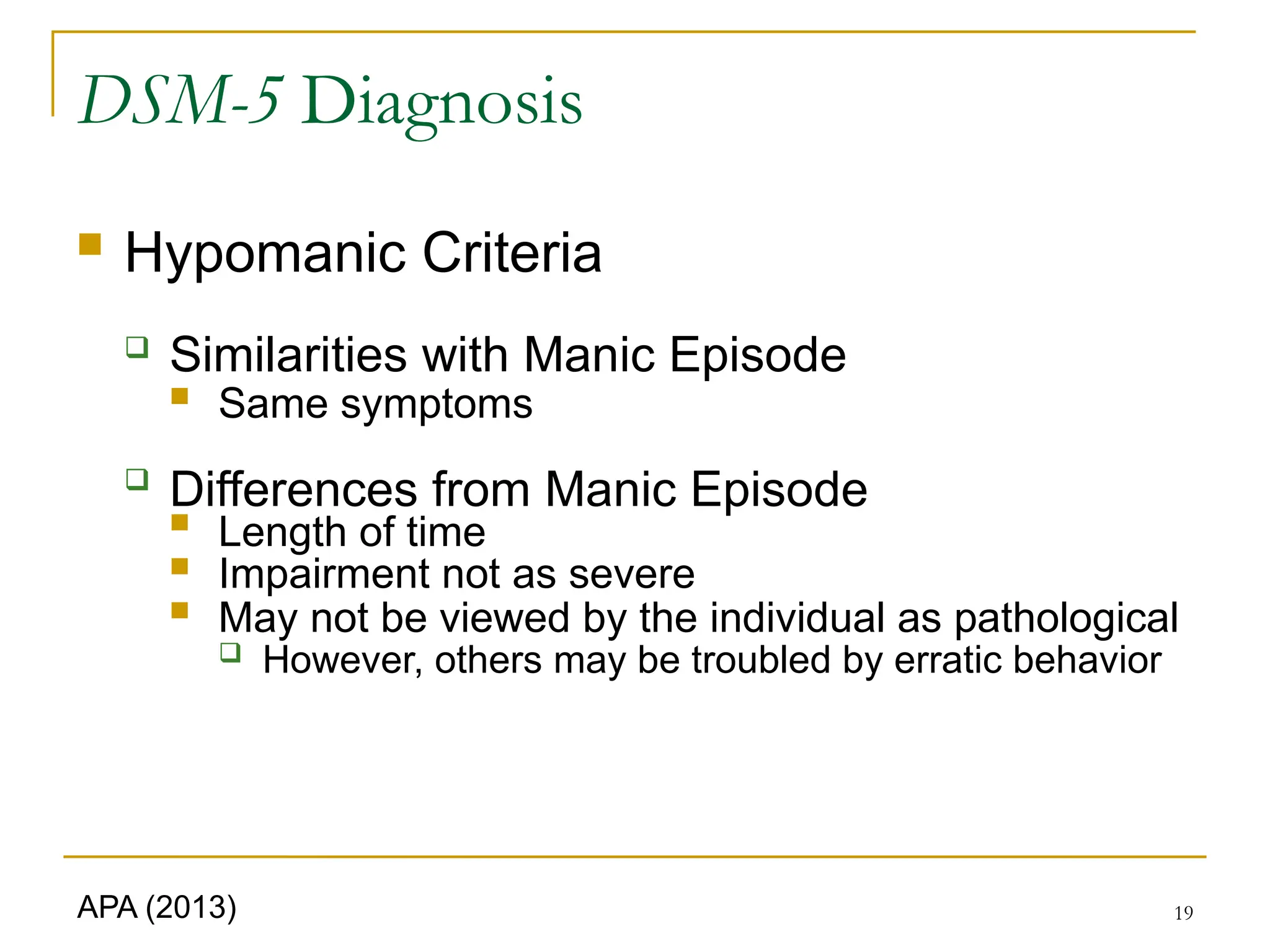
DSM-5 Diagnosis
 Hypomanic Criteria
 Similarities with Manic Episode
 Same symptoms

Differences from Manic Episode

Length of time
 Impairment not as severe
 May not be viewed by the individual as pathological
 However, others may be troubled by erratic behavior
APA (2013)
20
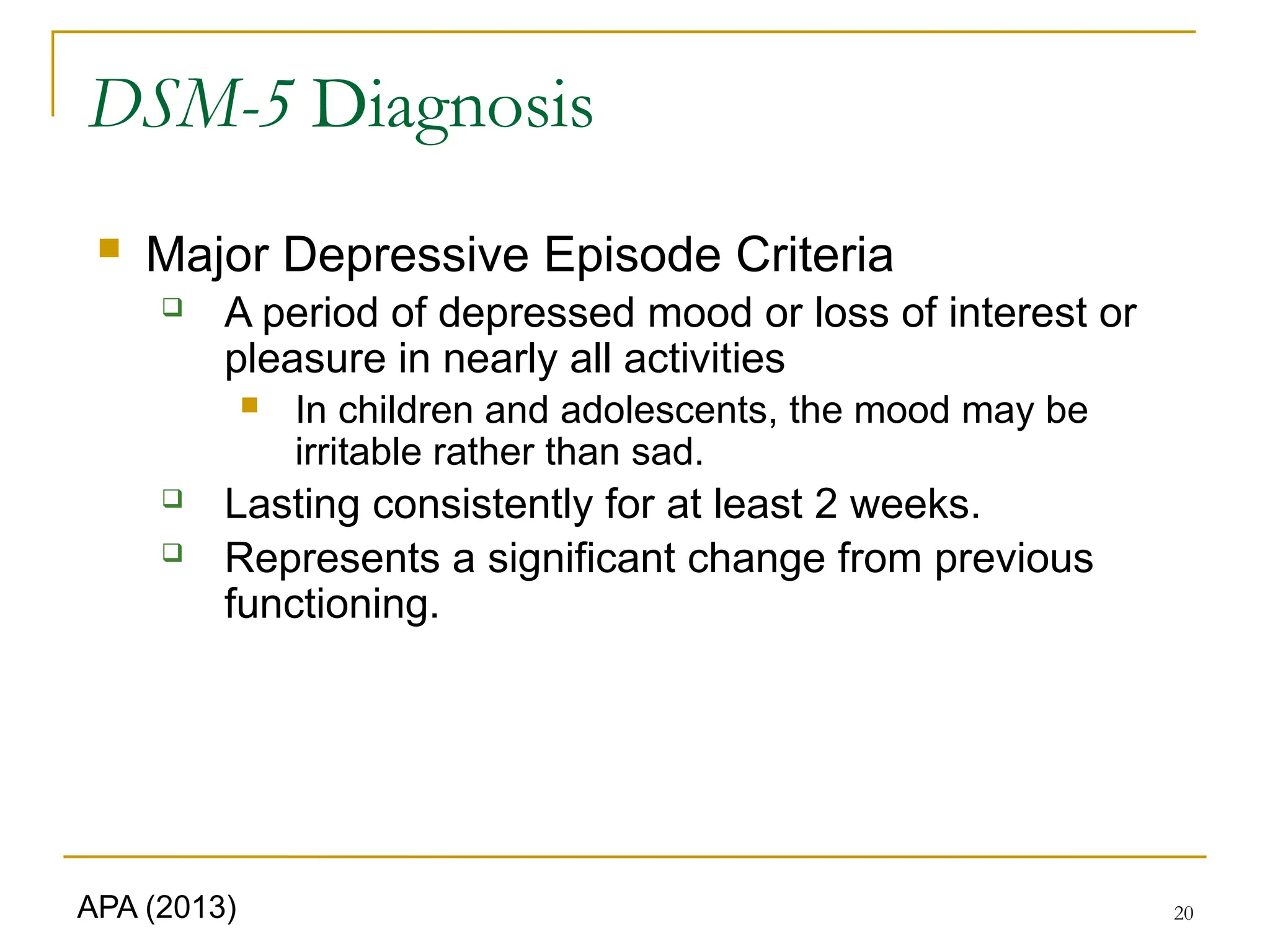
DSM-5 Diagnosis
 Major Depressive Episode Criteria
 A period of depressed mood or loss of interest or
pleasure in nearly all activities
 In children and adolescents, the mood may be
irritable rather than sad.
 Lasting consistently for at least 2 weeks.
 Represents a significant change from previous
functioning.
APA (2013)
21
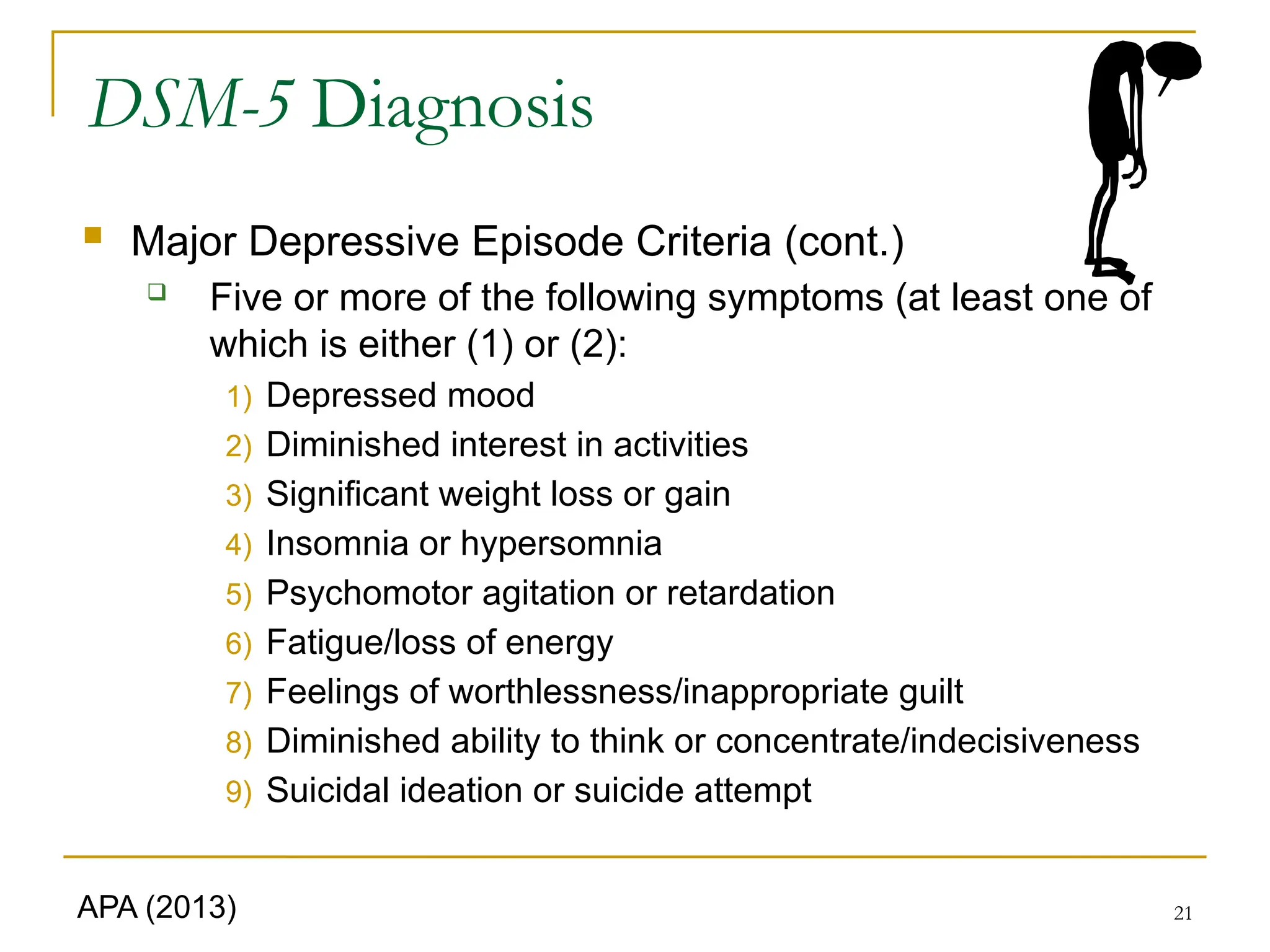
DSM-5 Diagnosis
 Major Depressive Episode Criteria (cont.)
 Five or more of the following symptoms (at least one of
which is either (1) or (2):
1) Depressed mood
2) Diminished interest in activities
3) Significant weight loss or gain
4) Insomnia or hypersomnia
5) Psychomotor agitation or retardation
6) Fatigue/loss of energy
7) Feelings of worthlessness/inappropriate guilt
8) Diminished ability to think or concentrate/indecisiveness
9) Suicidal ideation or suicide attempt
APA (2013)
22
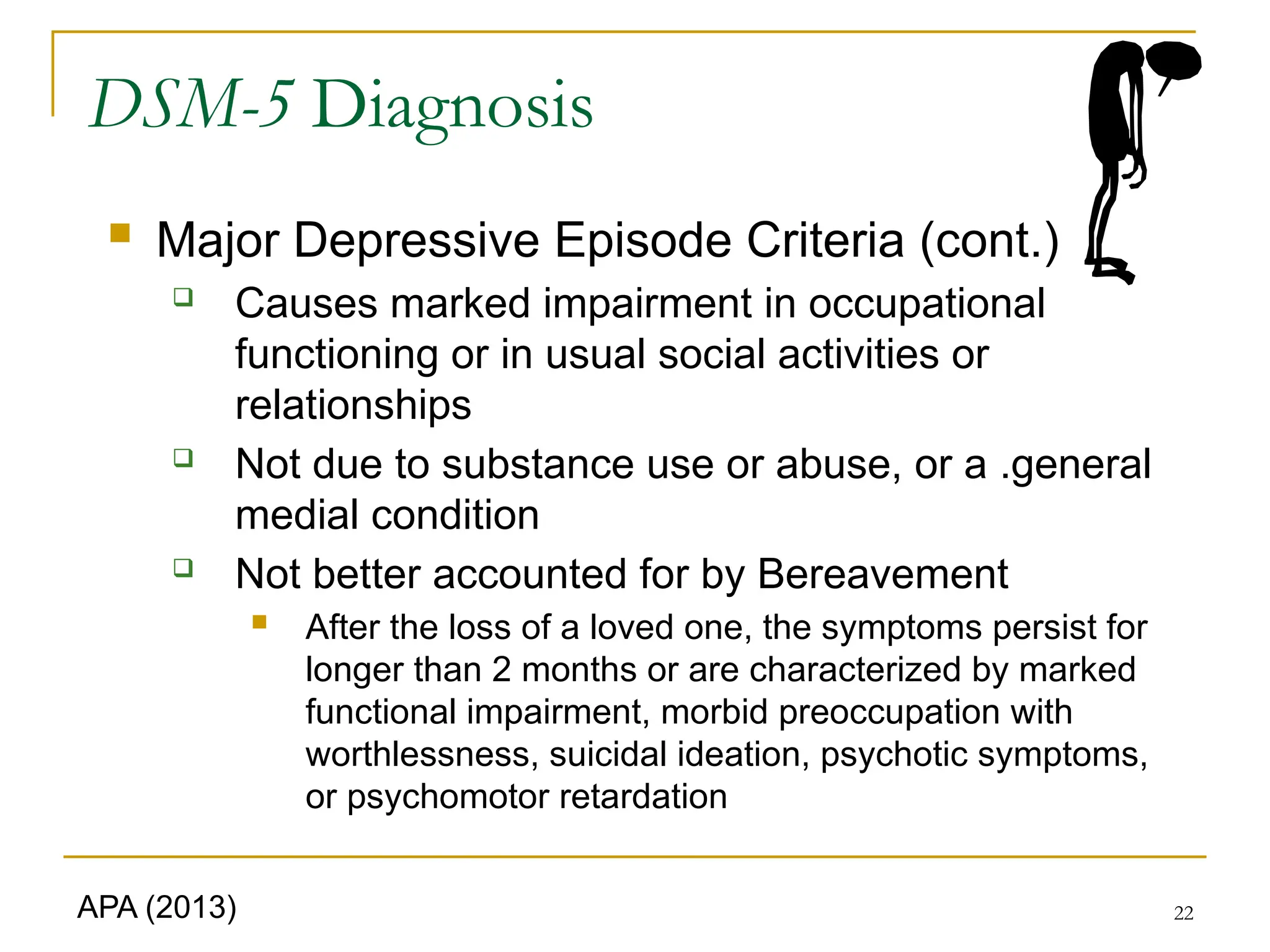
DSM-5 Diagnosis
 Major Depressive Episode Criteria (cont.)
 Causes marked impairment in occupational
functioning or in usual social activities or
relationships
 Not due to substance use or abuse, or a .general
medial condition
 Not better accounted for by Bereavement
 After the loss of a loved one, the symptoms persist for
longer than 2 months or are characterized by marked
functional impairment, morbid preoccupation with
worthlessness, suicidal ideation, psychotic symptoms,
or psychomotor retardation
APA (2013)
23
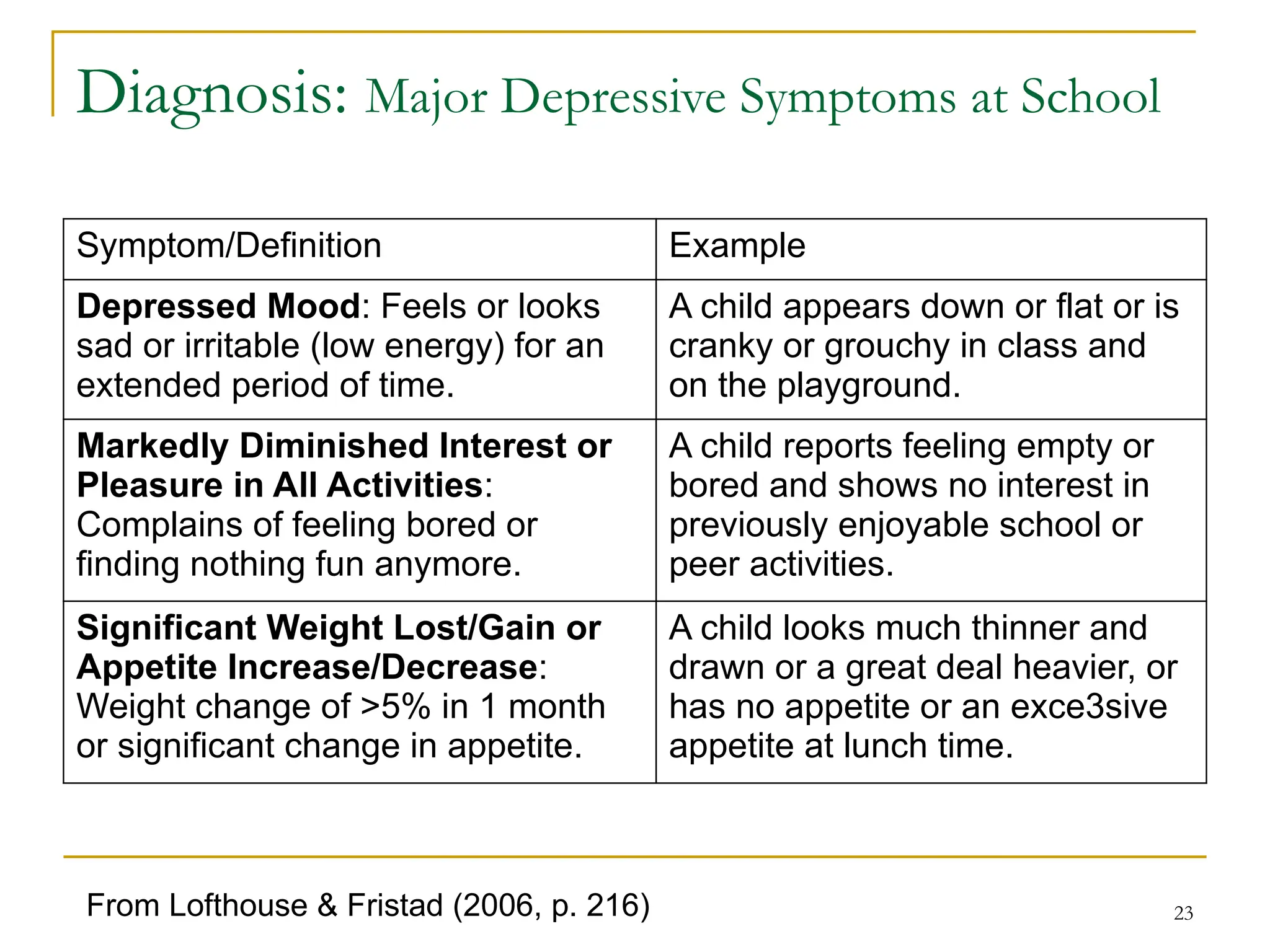
Diagnosis: Major Depressive Symptoms at School
Symptom/Definition Example
Depressed Mood: Feels or looks
sad or irritable (low energy) for an
extended period of time.
A child appears down or flat or is
cranky or grouchy in class and
on the playground.
Markedly Diminished Interest or
Pleasure in All Activities:
Complains of feeling bored or
finding nothing fun anymore.
A child reports feeling empty or
bored and shows no interest in
previously enjoyable school or
peer activities.
Significant Weight Lost/Gain or
Appetite Increase/Decrease:
Weight change of >5% in 1 month
or significant change in appetite.
A child looks much thinner and
drawn or a great deal heavier, or
has no appetite or an exce3sive
appetite at lunch time.
From Lofthouse & Fristad (2006, p. 216)
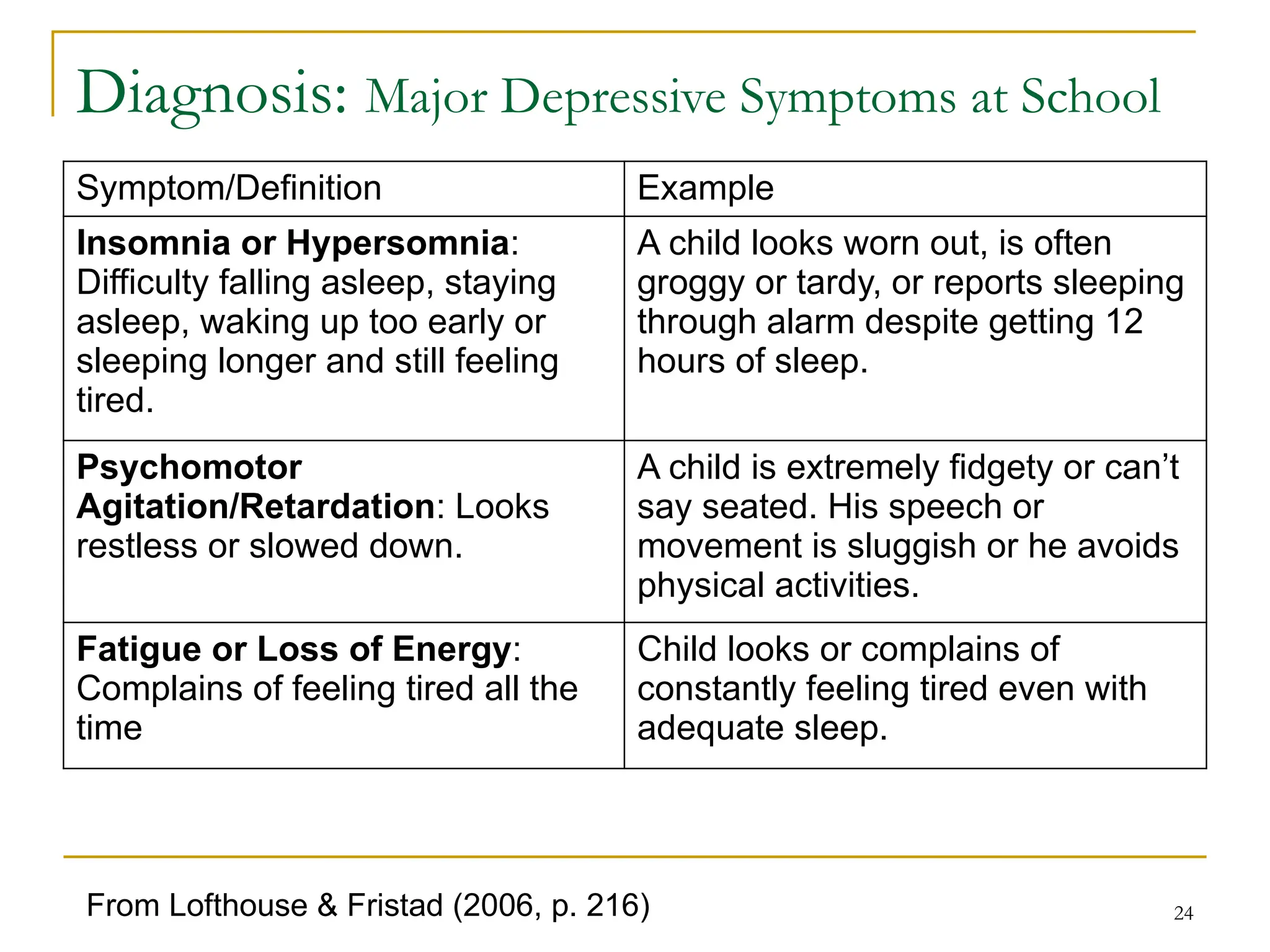
24
Diagnosis: Major Depressive Symptoms at School
Symptom/Definition Example
Insomnia or Hypersomnia:
Difficulty falling asleep, staying
asleep, waking up too early or
sleeping longer and still feeling
tired.
A child looks worn out, is often
groggy or tardy, or reports sleeping
through alarm despite getting 12
hours of sleep.
Psychomotor
Agitation/Retardation: Looks
restless or slowed down.
A child is extremely fidgety or can’t
say seated. His speech or
movement is sluggish or he avoids
physical activities.
Fatigue or Loss of Energy:
Complains of feeling tired all the
time
Child looks or complains of
constantly feeling tired even with
adequate sleep.
From Lofthouse & Fristad (2006, p. 216)
25
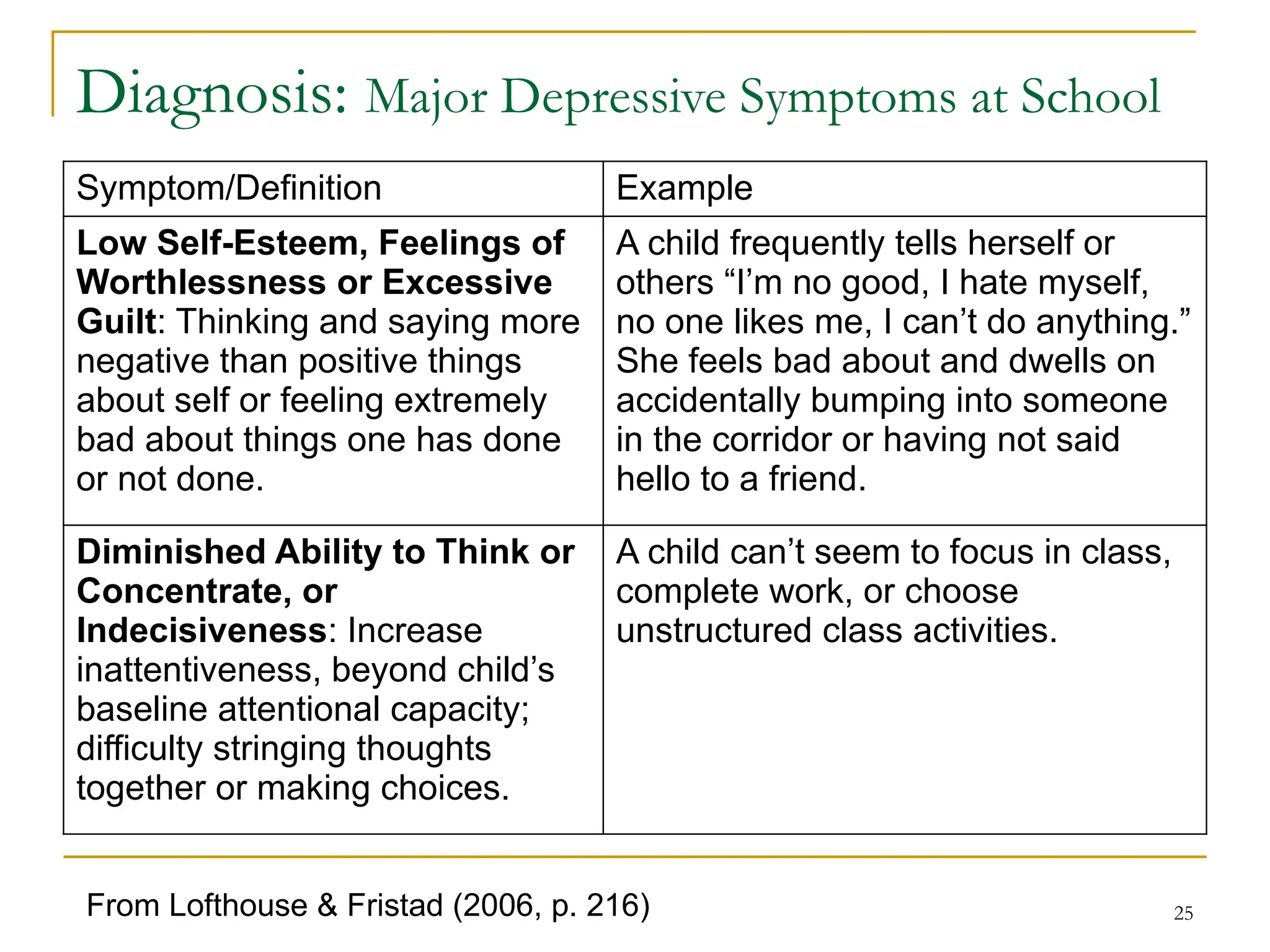
Diagnosis: Major Depressive Symptoms at School
Symptom/Definition Example
Low Self-Esteem, Feelings of
Worthlessness or Excessive
Guilt: Thinking and saying more
negative than positive things
about self or feeling extremely
bad about things one has done
or not done.
A child frequently tells herself or
others “I’m no good, I hate myself,
no one likes me, I can’t do anything.”
She feels bad about and dwells on
accidentally bumping into someone
in the corridor or having not said
hello to a friend.
Diminished Ability to Think or
Concentrate, or
Indecisiveness: Increase
inattentiveness, beyond child’s
baseline attentional capacity;
difficulty stringing thoughts
together or making choices.
A child can’t seem to focus in class,
complete work, or choose
unstructured class activities.
From Lofthouse & Fristad (2006, p. 216)
26
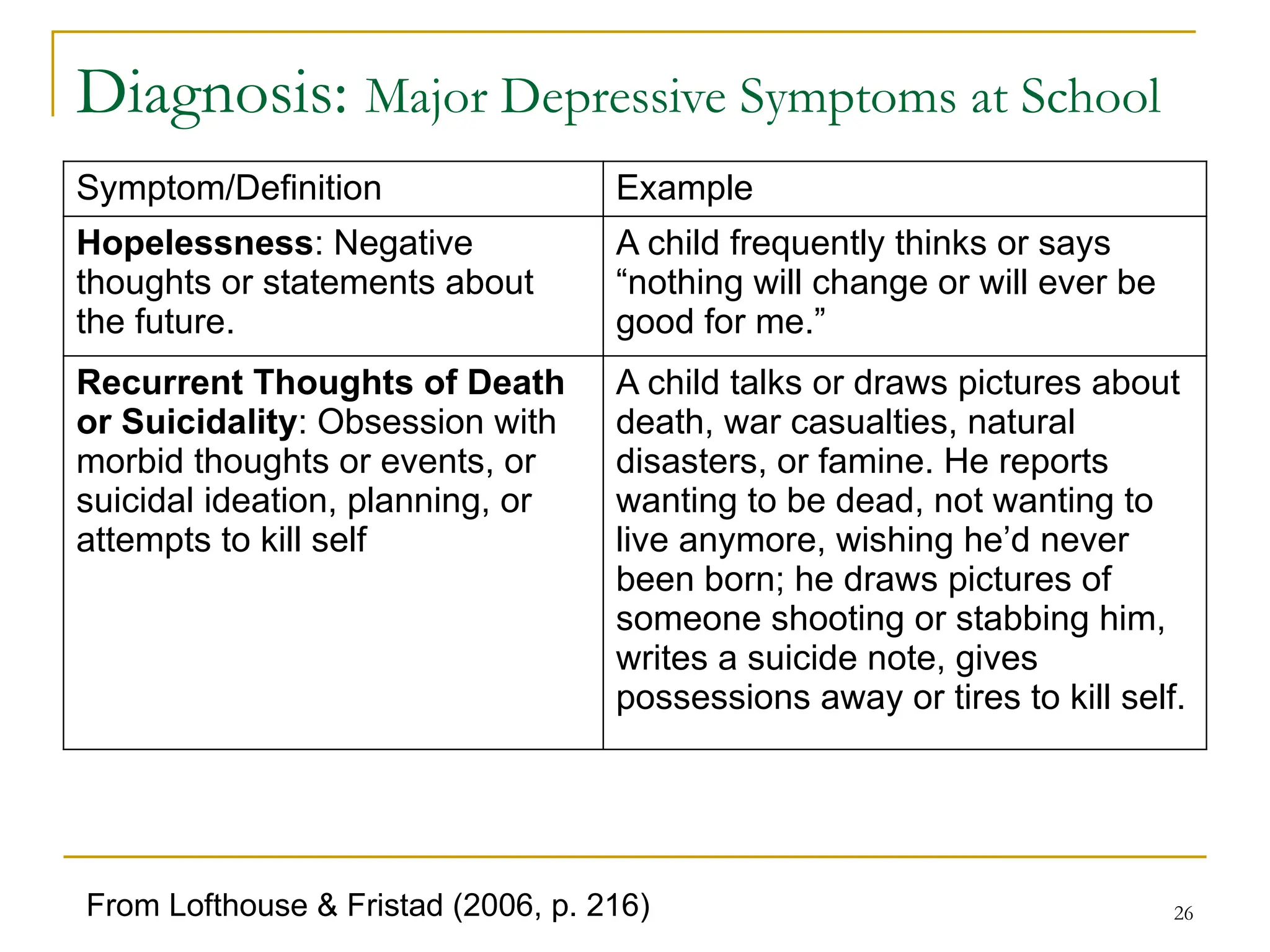
Diagnosis: Major Depressive Symptoms at School
Symptom/Definition Example
Hopelessness: Negative
thoughts or statements about
the future.
A child frequently thinks or says
“nothing will change or will ever be
good for me.”
Recurrent Thoughts of Death
or Suicidality: Obsession with
morbid thoughts or events, or
suicidal ideation, planning, or
attempts to kill self
A child talks or draws pictures about
death, war casualties, natural
disasters, or famine. He reports
wanting to be dead, not wanting to
live anymore, wishing he’d never
been born; he draws pictures of
someone shooting or stabbing him,
writes a suicide note, gives
possessions away or tires to kill self.
From Lofthouse & Fristad (2006, p. 216)
27
DSM-5 Diagnosis
 Rapid-Cycling Specifier
 Can be applied to Bipolar I or II
 Four or more mood episodes (i.e., Major Depressive,
Manic, Mixed, or Hypomanic) per 12 months
 May occur in any order or combination
 Must be demarcated by …
 a period of full remission, or
 a switch to an episode of the opposite polarity
 Manic, Hypomanic, and Mixed are on the same pole
 NOTE: This definition is different from that used in
some literature, where in cycling refers to mood
changes within an episode (Geller et al., 2004).
APA (2013)
Changes From DSM-IV-TR
 No longer classified as a “mood disorder” – has own category
 Placed between the chapters on schizophrenia and depressive
disorders
 Consistent with their place between the two diagnostic classes in
terms of symptomatology, family history, and genetics.
 Bipolar I criteria have not changed
 Bipolar II must have hypomanic as well as history of major
depression and have clinically significant
 can now include episodes with mixed features.
 past editions, a person who had mixed episodes would not be
diagnosed with bipolar II
 diagnosis of hypomania or mania will now require a finding of
increased energy, not just change in mood
Source: APA (2013)
28
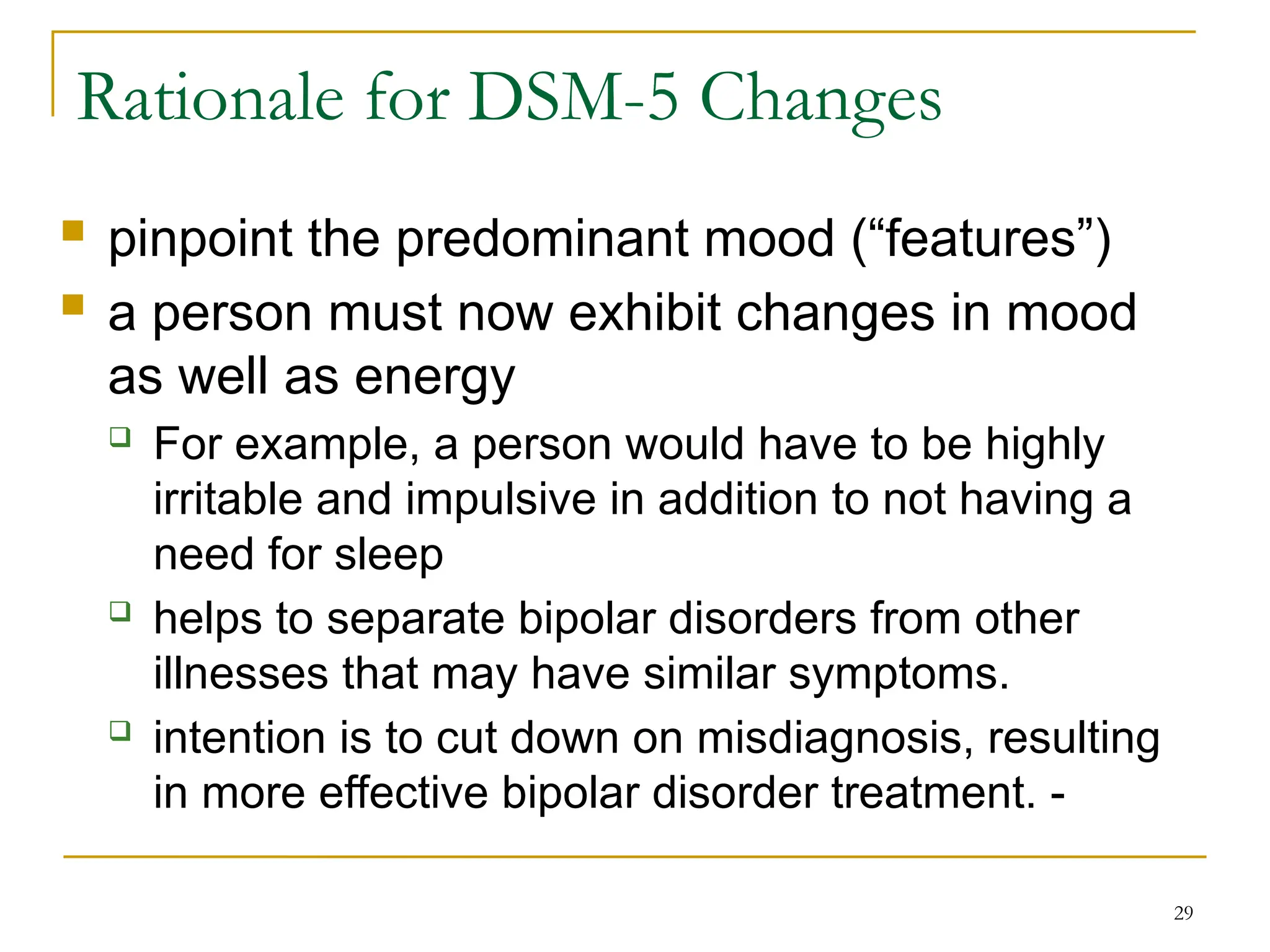
 pinpoint the predominant mood (“features”)
 a person must now exhibit changes in mood
as well as energy
 For example, a person would have to be highly
irritable and impulsive in addition to not having a
need for sleep
 helps to separate bipolar disorders from other
illnesses that may have similar symptoms.
 intention is to cut down on misdiagnosis, resulting
in more effective bipolar disorder treatment. -
29
Rationale for DSM-5 Changes
 Still does not address potential bipolar
children and adolescents
 Could miss bipolar in children and then
prescribe medication that make symptoms
worse
 Hopefully will increased accuracy with
diagnosis
30
Possible Consequences of DSM-5
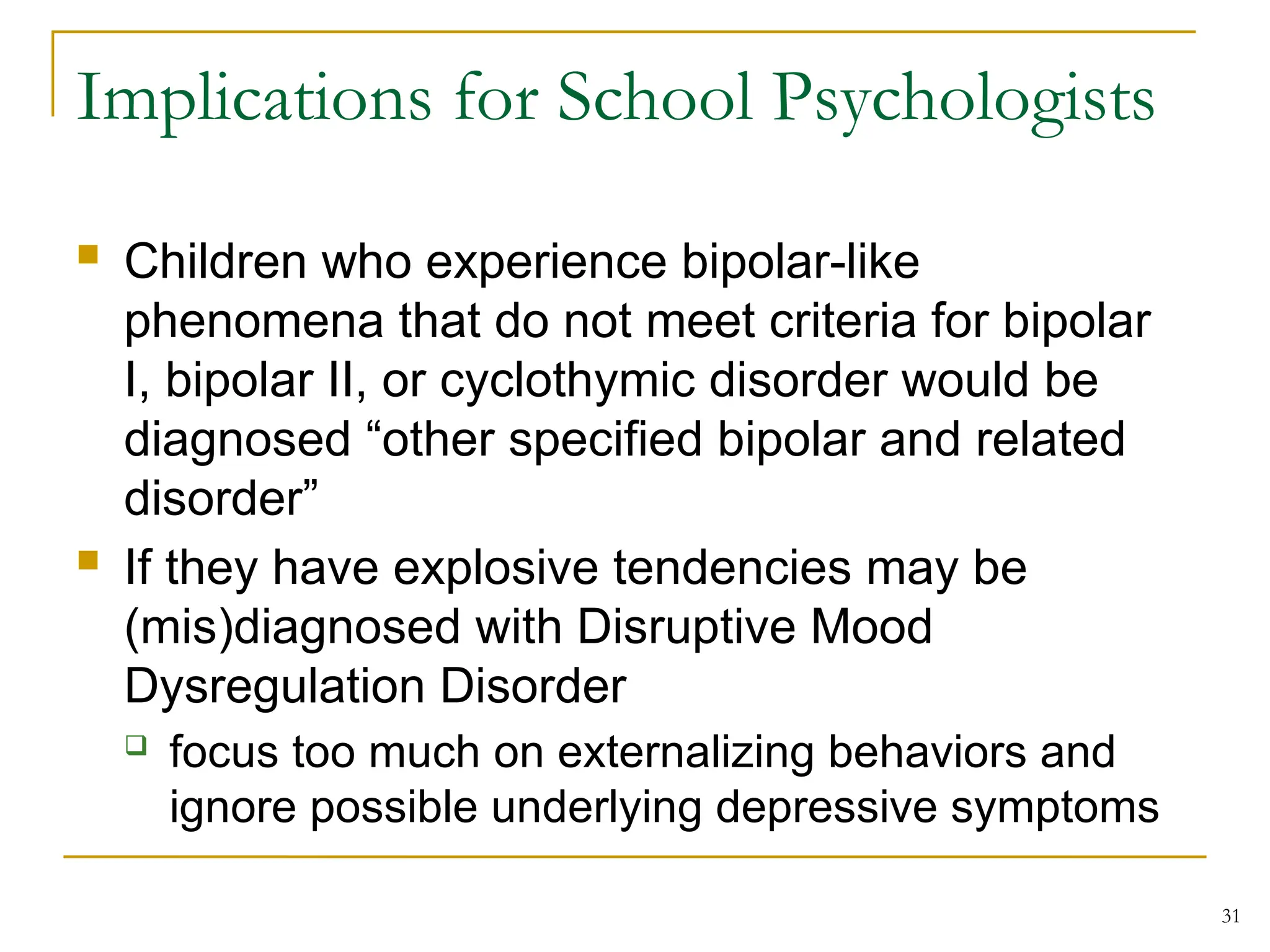
Implications for School Psychologists
 Children who experience bipolar-like
phenomena that do not meet criteria for bipolar
I, bipolar II, or cyclothymic disorder would be
diagnosed “other specified bipolar and related
disorder”
 If they have explosive tendencies may be
(mis)diagnosed with Disruptive Mood
Dysregulation Disorder
 focus too much on externalizing behaviors and
ignore possible underlying depressive symptoms
31
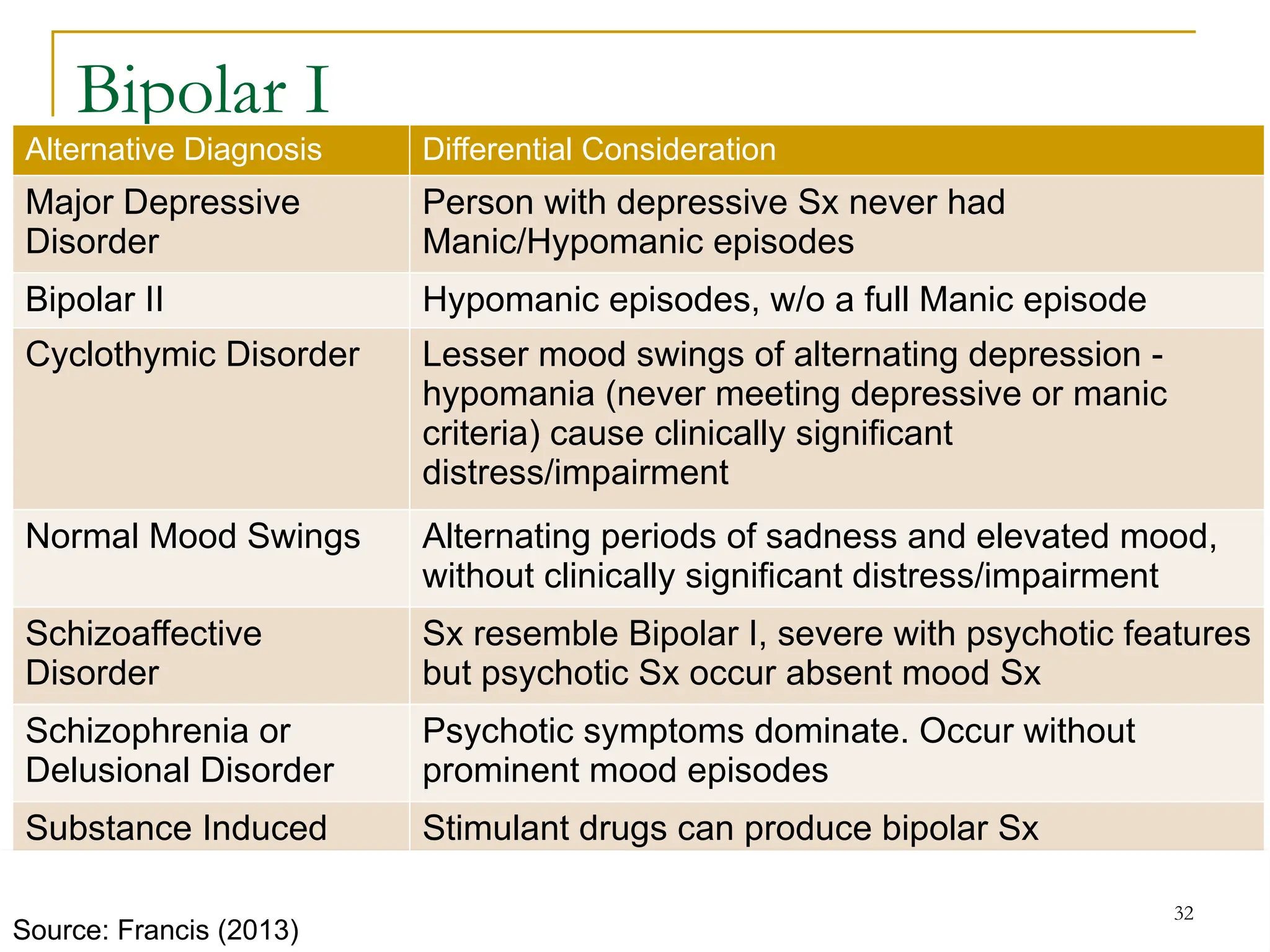
Bipolar I
Alternative Diagnosis Differential Consideration
Major Depressive
Disorder
Person with depressive Sx never had
Manic/Hypomanic episodes
Bipolar II Hypomanic episodes, w/o a full Manic episode
Cyclothymic Disorder Lesser mood swings of alternating depression -
hypomania (never meeting depressive or manic
criteria) cause clinically significant
distress/impairment
Normal Mood Swings Alternating periods of sadness and elevated mood,
without clinically significant distress/impairment
Schizoaffective
Disorder
Sx resemble Bipolar I, severe with psychotic features
but psychotic Sx occur absent mood Sx
Schizophrenia or
Delusional Disorder
Psychotic symptoms dominate. Occur without
prominent mood episodes
Substance Induced
Bipolar Disorder
Stimulant drugs can produce bipolar Sx
32
Source: Francis (2013)
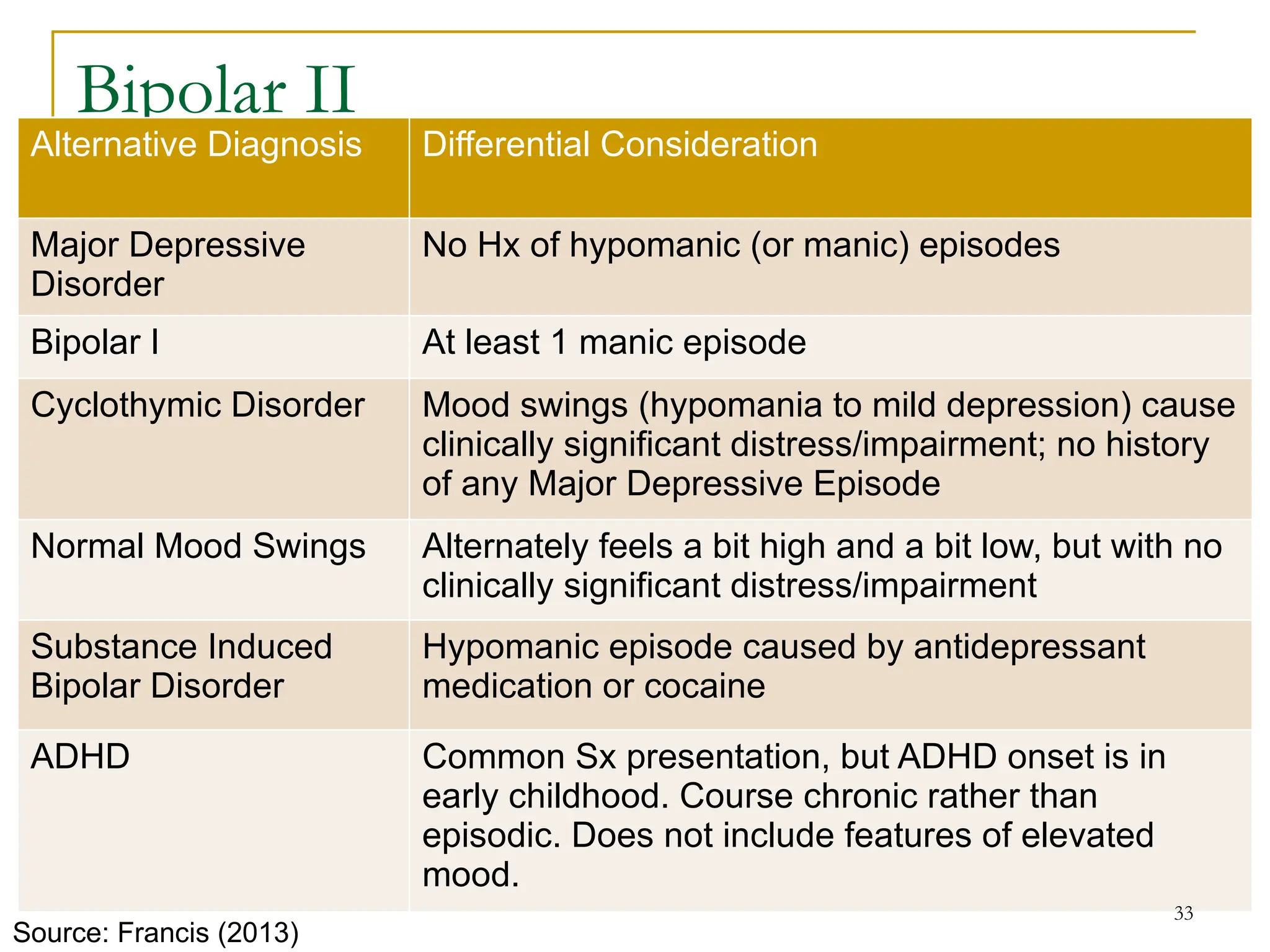
Bipolar II
Alternative Diagnosis Differential Consideration
Major Depressive
Disorder
No Hx of hypomanic (or manic) episodes
Bipolar I At least 1 manic episode
Cyclothymic Disorder Mood swings (hypomania to mild depression) cause
clinically significant distress/impairment; no history
of any Major Depressive Episode
Normal Mood Swings Alternately feels a bit high and a bit low, but with no
clinically significant distress/impairment
Substance Induced
Bipolar Disorder
Hypomanic episode caused by antidepressant
medication or cocaine
ADHD Common Sx presentation, but ADHD onset is in
early childhood. Course chronic rather than
episodic. Does not include features of elevated
mood.
33
Source: Francis (2013)
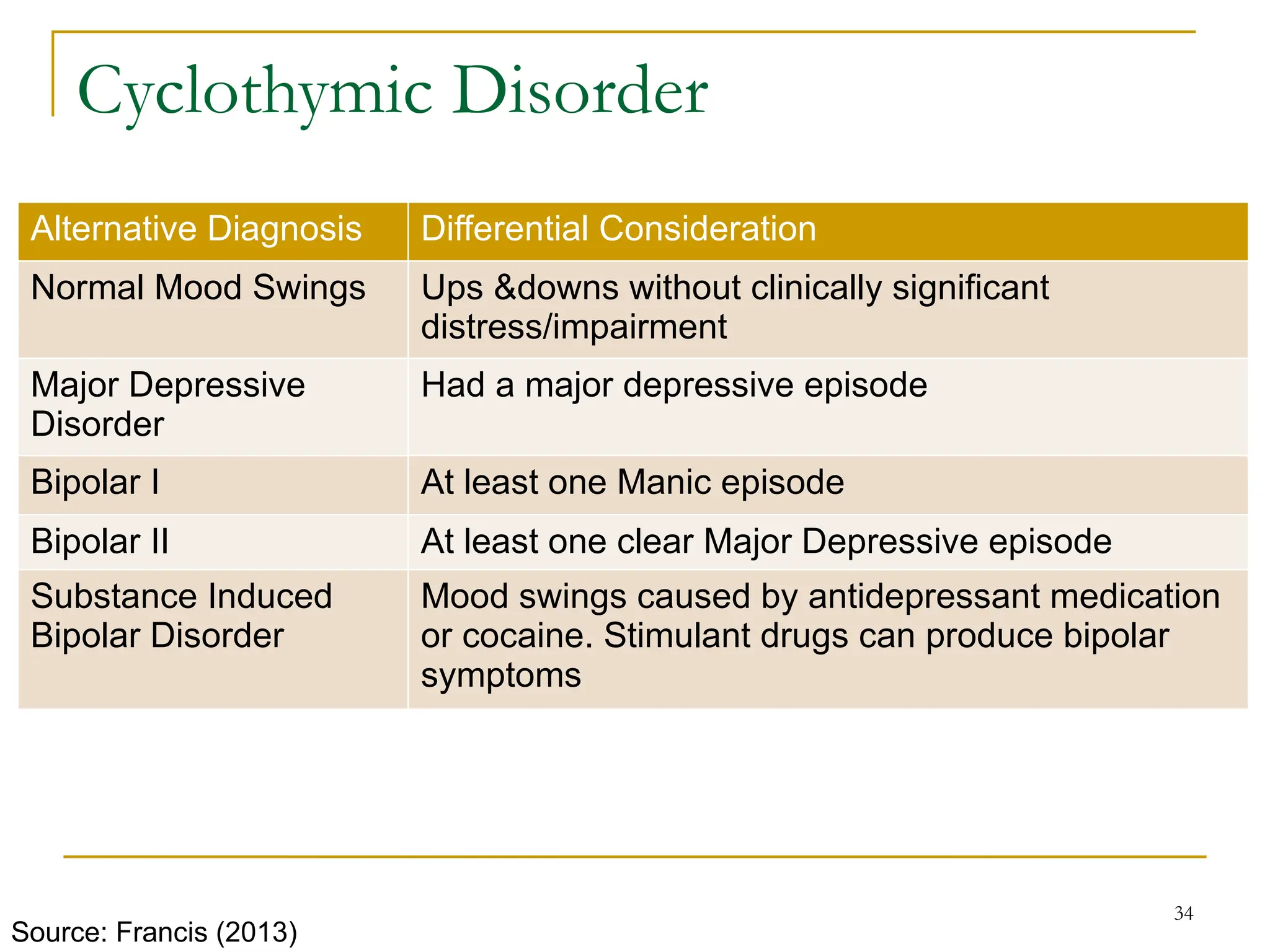
Cyclothymic Disorder
Alternative Diagnosis Differential Consideration
Normal Mood Swings Ups &downs without clinically significant
distress/impairment
Major Depressive
Disorder
Had a major depressive episode
Bipolar I At least one Manic episode
Bipolar II At least one clear Major Depressive episode
Substance Induced
Bipolar Disorder
Mood swings caused by antidepressant medication
or cocaine. Stimulant drugs can produce bipolar
symptoms
34
Source: Francis (2013)
35
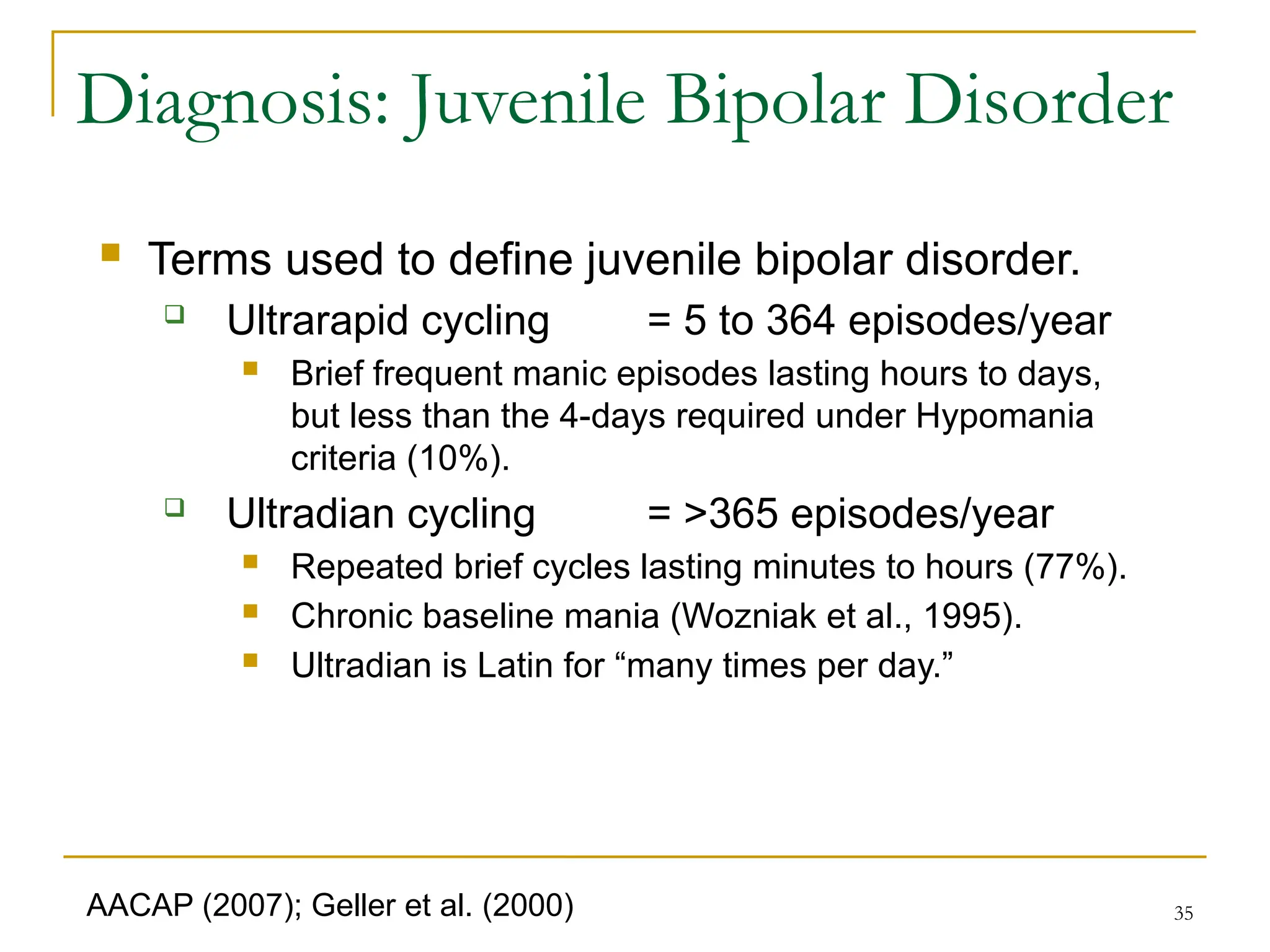
Diagnosis: Juvenile Bipolar Disorder
 Terms used to define juvenile bipolar disorder.
 Ultrarapid cycling = 5 to 364 episodes/year
 Brief frequent manic episodes lasting hours to days,
but less than the 4-days required under Hypomania
criteria (10%).
 Ultradian cycling = >365 episodes/year
 Repeated brief cycles lasting minutes to hours (77%).
 Chronic baseline mania (Wozniak et al., 1995).
 Ultradian is Latin for “many times per day.”
AACAP (2007); Geller et al. (2000)
36
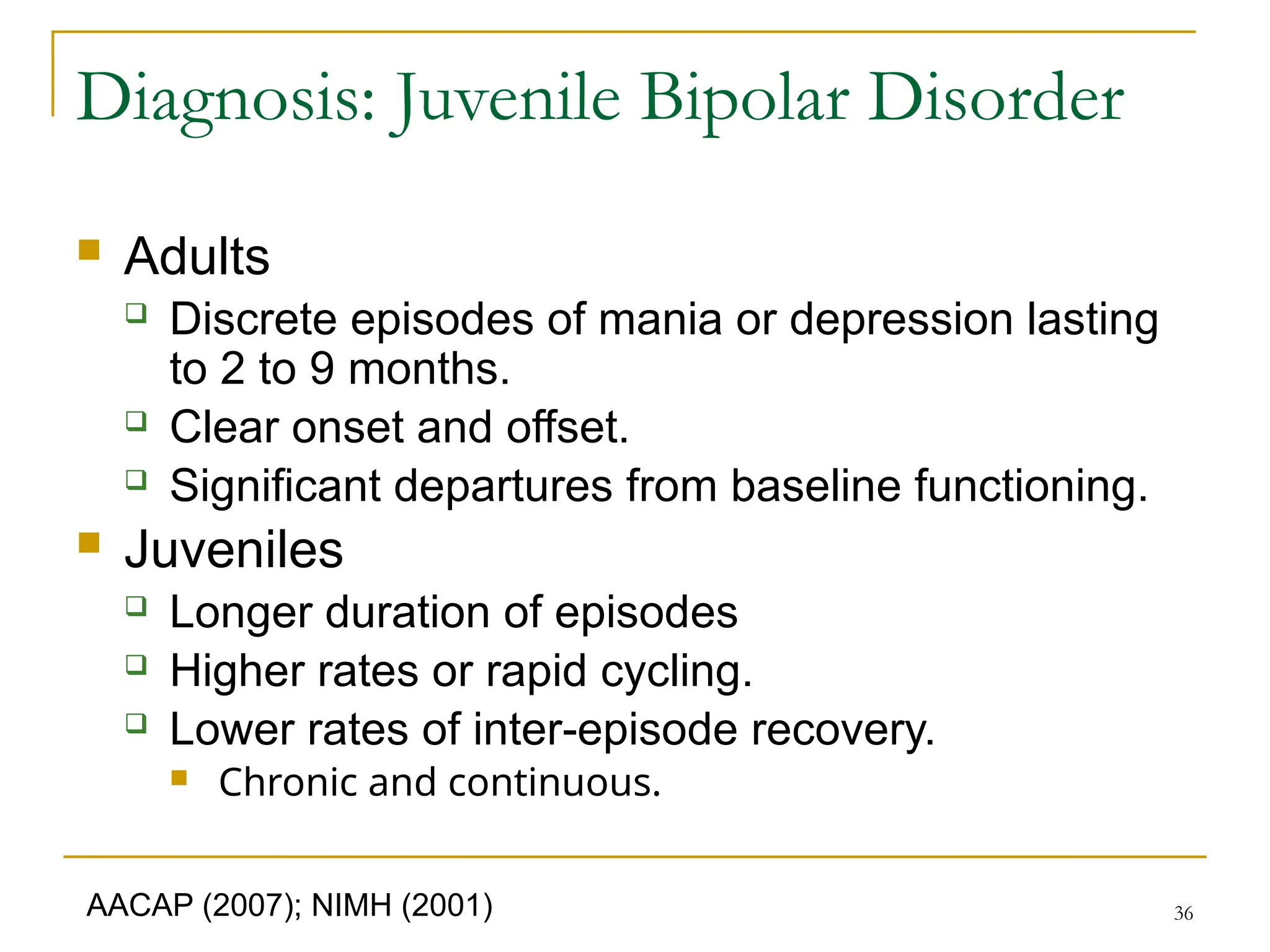
Diagnosis: Juvenile Bipolar Disorder
 Adults
 Discrete episodes of mania or depression lasting
to 2 to 9 months.
 Clear onset and offset.
 Significant departures from baseline functioning.
 Juveniles
 Longer duration of episodes
 Higher rates or rapid cycling.
 Lower rates of inter-episode recovery.
 Chronic and continuous.
AACAP (2007); NIMH (2001)
37
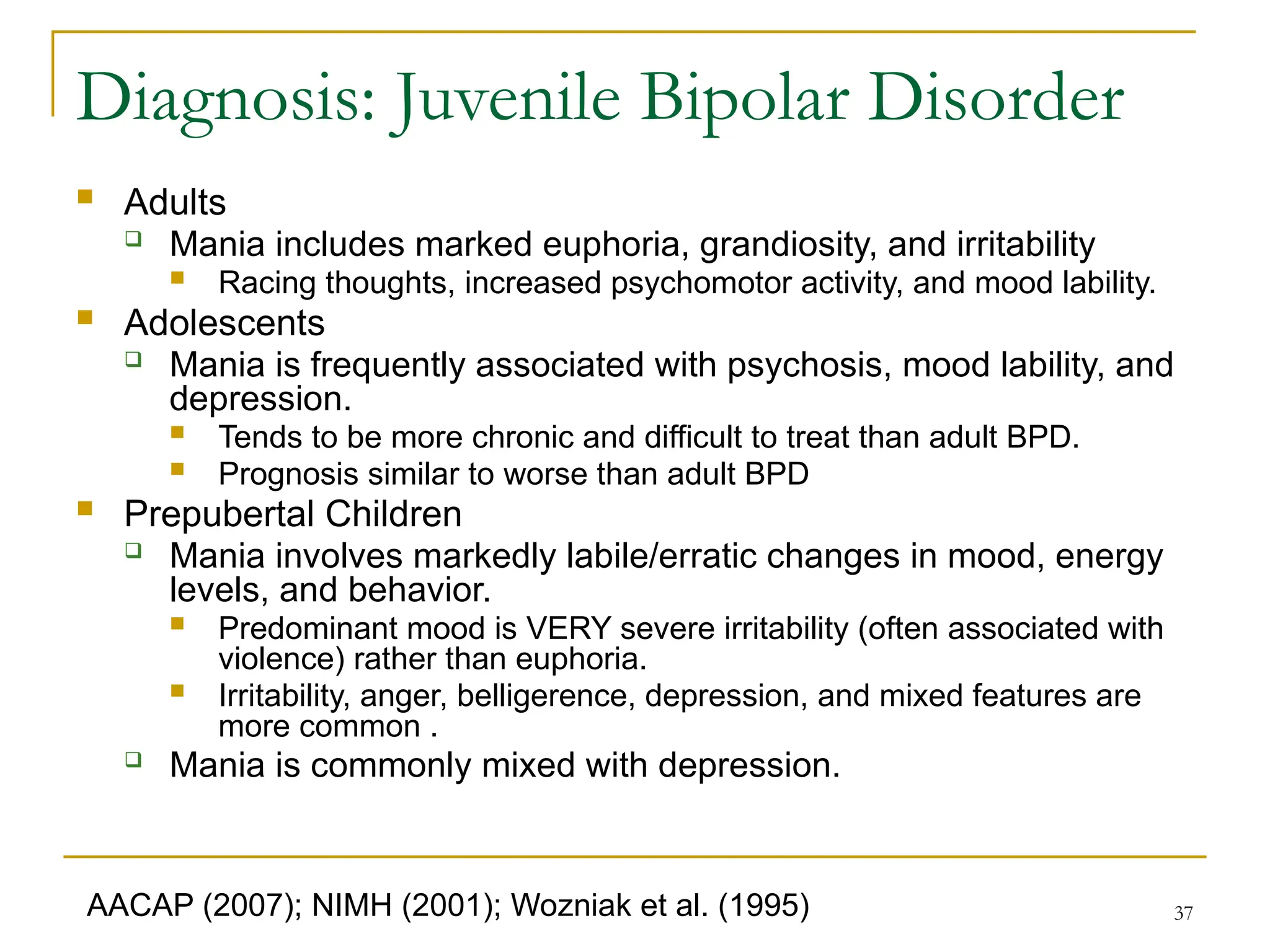
Diagnosis: Juvenile Bipolar Disorder
 Adults
 Mania includes marked euphoria, grandiosity, and irritability
 Racing thoughts, increased psychomotor activity, and mood lability.
 Adolescents
 Mania is frequently associated with psychosis, mood lability, and
depression.
 Tends to be more chronic and difficult to treat than adult BPD.
 Prognosis similar to worse than adult BPD
 Prepubertal Children
 Mania involves markedly labile/erratic changes in mood, energy
levels, and behavior.
 Predominant mood is VERY severe irritability (often associated with
violence) rather than euphoria.
 Irritability, anger, belligerence, depression, and mixed features are
more common .
 Mania is commonly mixed with depression.
AACAP (2007); NIMH (2001); Wozniak et al. (1995)
38
Diagnosis: Juvenile Bipolar Disorder
 Unique Features of Pediatric Bipolar Disorder
 Chronic with long episodes
 Predominantly mixed episodes (20% to 84%) and/or
rapid cycling (46% to 87%)
 Prominent irritability (77% to 98%)
 High rate of comorbid ADHD (75% to 98%) and
anxiety disorders (5% to 50%)
Pavuluri et al. (2005)
39
Diagnosis: Juvenile Bipolar Disorder
 Bipolar Disorder in childhood and adolescence appear to
be the same clinical entity.
 However, there are significant developmental variations
in illness expression.
Masi et al. (2006)
Bipolar Disorder Onset
Childhood Adolescent
Male Gender 67.5% 48.2%
Chronic Course 57.5% 23.3%
Episodic Course 42.5% 76.8%
Attention-deficit/Hyperactivity Disorder 38.7% 8.9%
Oppositional Defiant Disorder 35.9% 10.7%
40
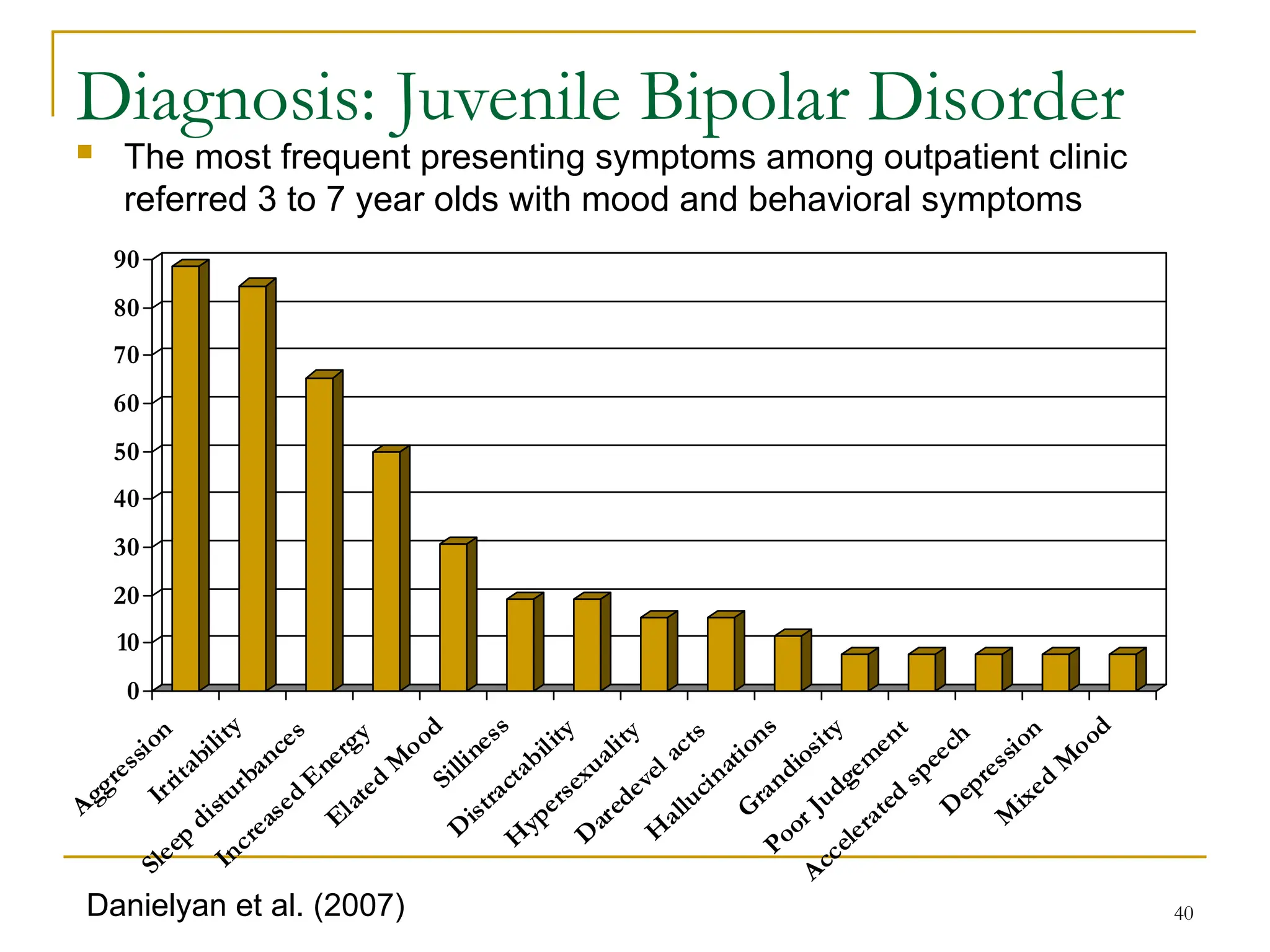
Diagnosis: Juvenile Bipolar Disorder
Danielyan et al. (2007)
0
10
20
30
40
50
60
70
80
90
Aggression
Irritability
Sleep
disturbances
Increased
E
nergy
Elated
M
ood
Silliness
D
istractability
H
ypersexuality
D
aredevel acts
H
allucinations
G
randiosity
Poor Judgem
ent
Accelerated
speech
D
epression
M
ixed
M
ood
 The most frequent presenting symptoms among outpatient clinic
referred 3 to 7 year olds with mood and behavioral symptoms
41
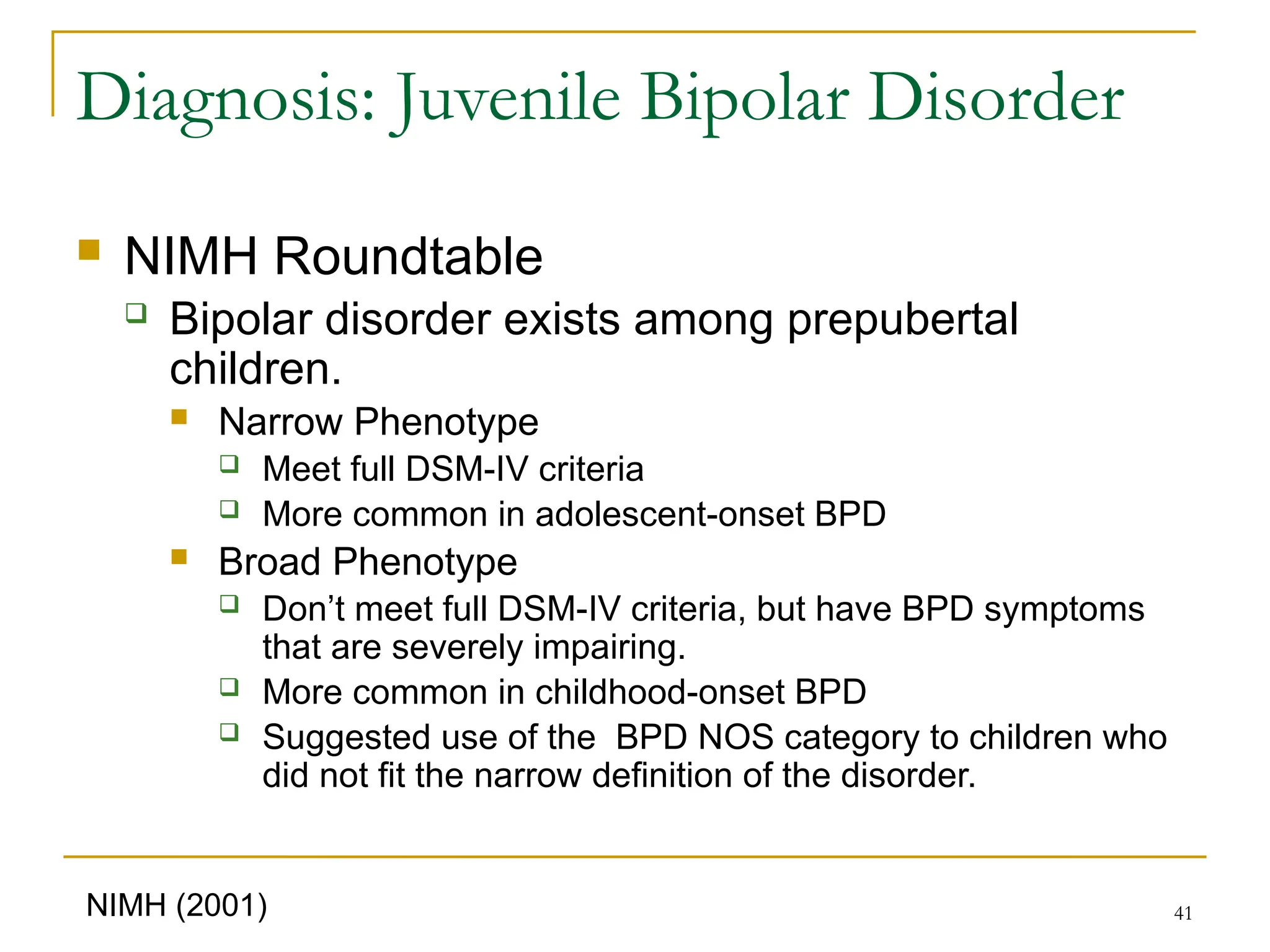
Diagnosis: Juvenile Bipolar Disorder
 NIMH Roundtable
 Bipolar disorder exists among prepubertal
children.
 Narrow Phenotype
 Meet full DSM-IV criteria
 More common in adolescent-onset BPD
 Broad Phenotype
 Don’t meet full DSM-IV criteria, but have BPD symptoms
that are severely impairing.
 More common in childhood-onset BPD
 Suggested use of the BPD NOS category to children who
did not fit the narrow definition of the disorder.
NIMH (2001)
42
Diagnosis: Juvenile Bipolar Disorder
1. Sleep/Wake Cycle Disturbances
2. ADHD-like symptoms
3. Aggression/Poor Frustration Tolerance
4. Intense Affective Rages
5. Bossy and overbearing, extremely oppositional
6. Fear of Harm or social phobia
7. Hypersexuality
8. Laughing hysterically/acting infectiously happy
9. Deep depression
10. Sensory Sensitivities
11. Carbohydrate Cravings
12. Somatic Complaints
 24: A Day in the Life
43
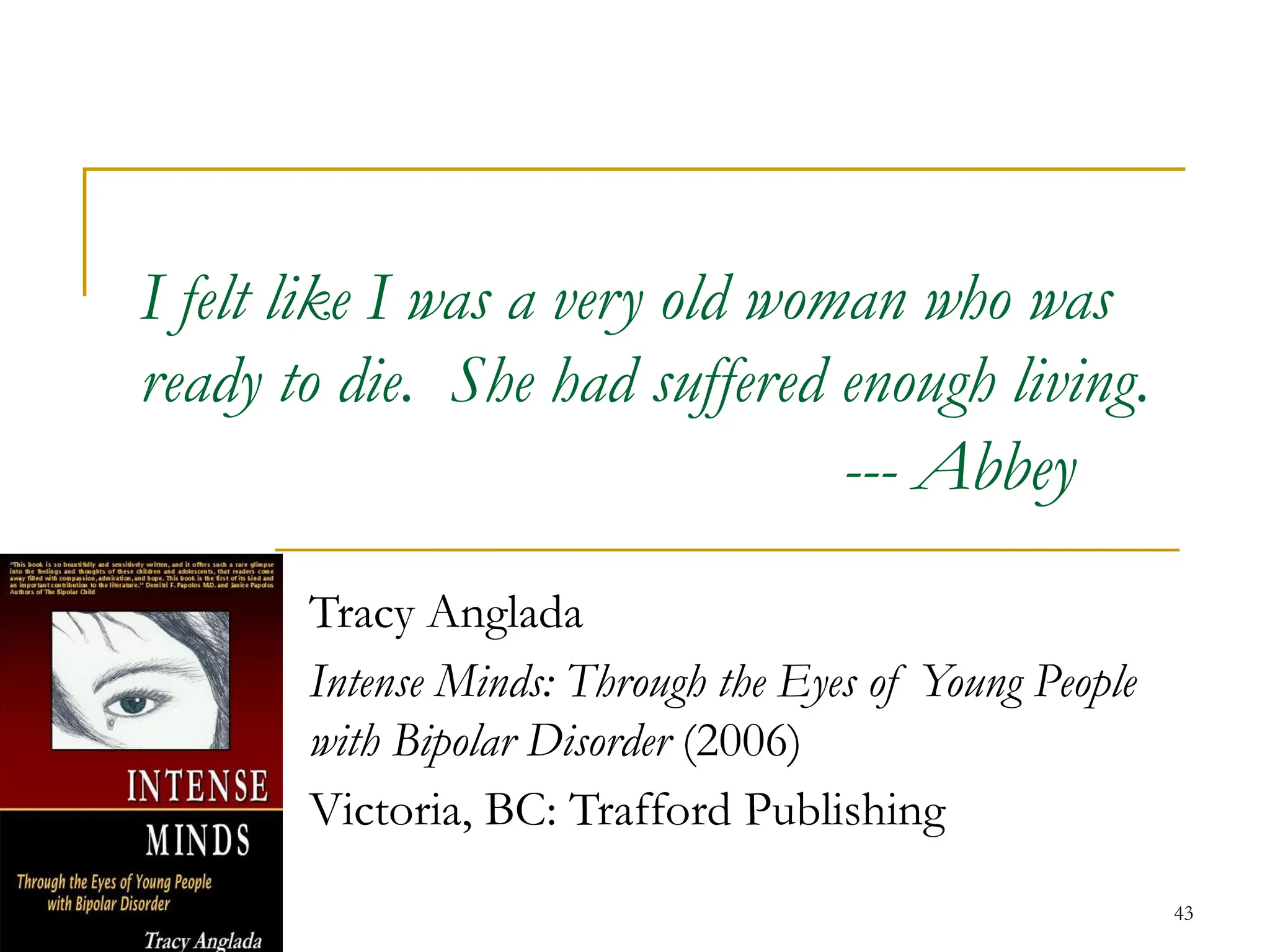
I felt like I was a very old woman who was
ready to die. She had suffered enough living.
--- Abbey
Tracy Anglada
Intense Minds: Through the Eyes of Young People
with Bipolar Disorder (2006)
Victoria, BC: Trafford Publishing
44
Presentation Outline
 Diagnosis
 Course
 Co-existing Disabilities
 Associated Impairments
 Etiology, Prevalence & Prognosis
 Treatment
 Best Practices for School Psychologists
45
Course: Pediatric Bipolar Disorder
 Remission
 2 to 7 weeks without meeting DSM criteria
 Recovery
 8 weeks without meeting DSM criteria
 40% to 100% will recovery in a period of 1 to 2 years
 Relapse
 2 weeks meeting DSM criteria
 60% to 70% of those that recover relapse on average
between 10 to 12 months
 Chronic
 Failure to recover for a period of at least 2 years
Pavuluri et al. (2005)
46
Presentation Outline
 Diagnosis
 Course
 Co-existing Disabilities
 Associated Impairments
 Etiology, Prevalence & Prognosis
 Treatment
 Best Practices for the School Psychologist
 Psycho-Educational Assessment
 Special Education & Programming Issues
 School-Based Interventions
47
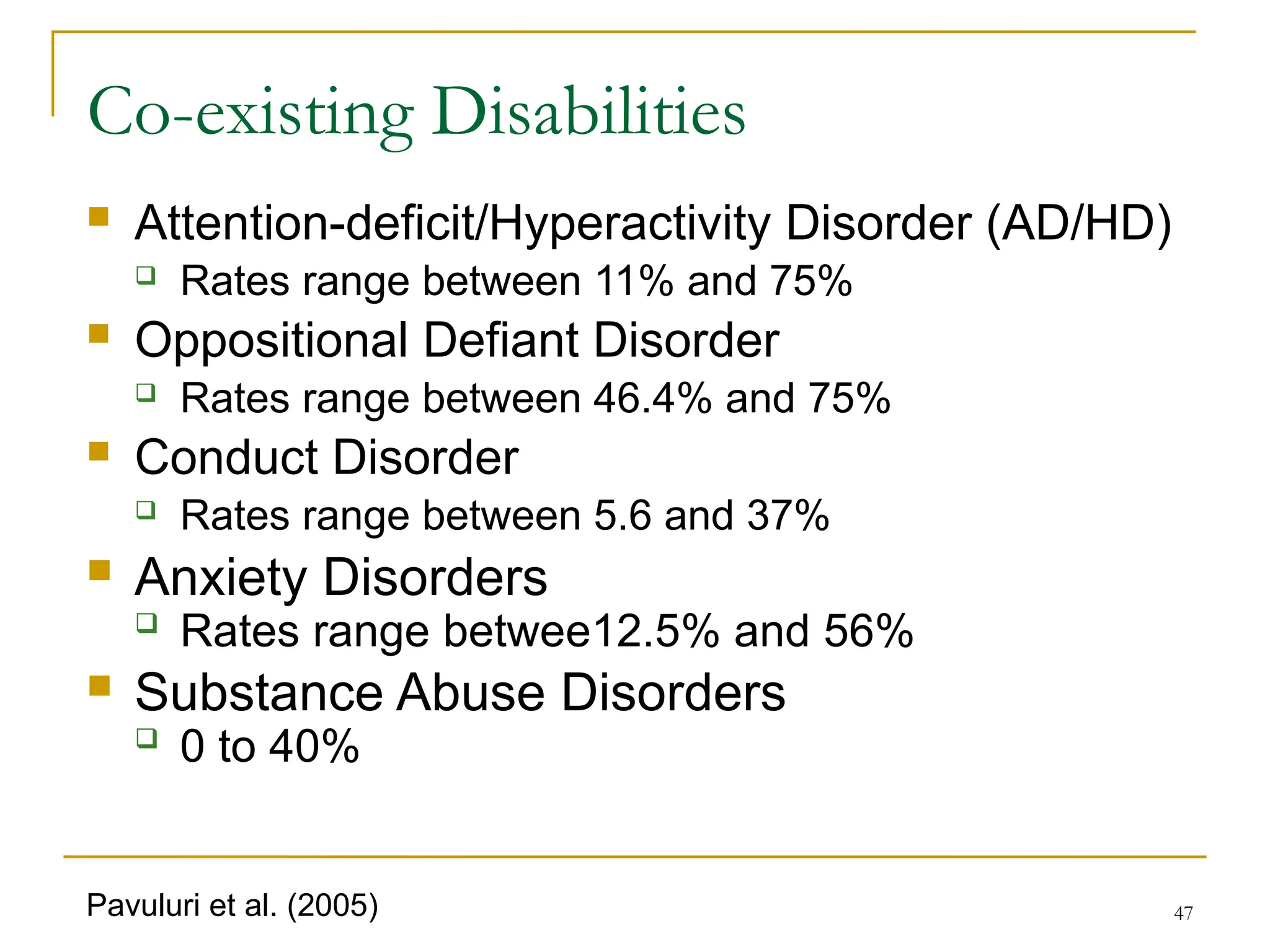
Co-existing Disabilities
 Attention-deficit/Hyperactivity Disorder (AD/HD)
 Rates range between 11% and 75%
 Oppositional Defiant Disorder
 Rates range between 46.4% and 75%
 Conduct Disorder
 Rates range between 5.6 and 37%
 Anxiety Disorders
 Rates range betwee12.5% and 56%
 Substance Abuse Disorders
 0 to 40%
Pavuluri et al. (2005)
48
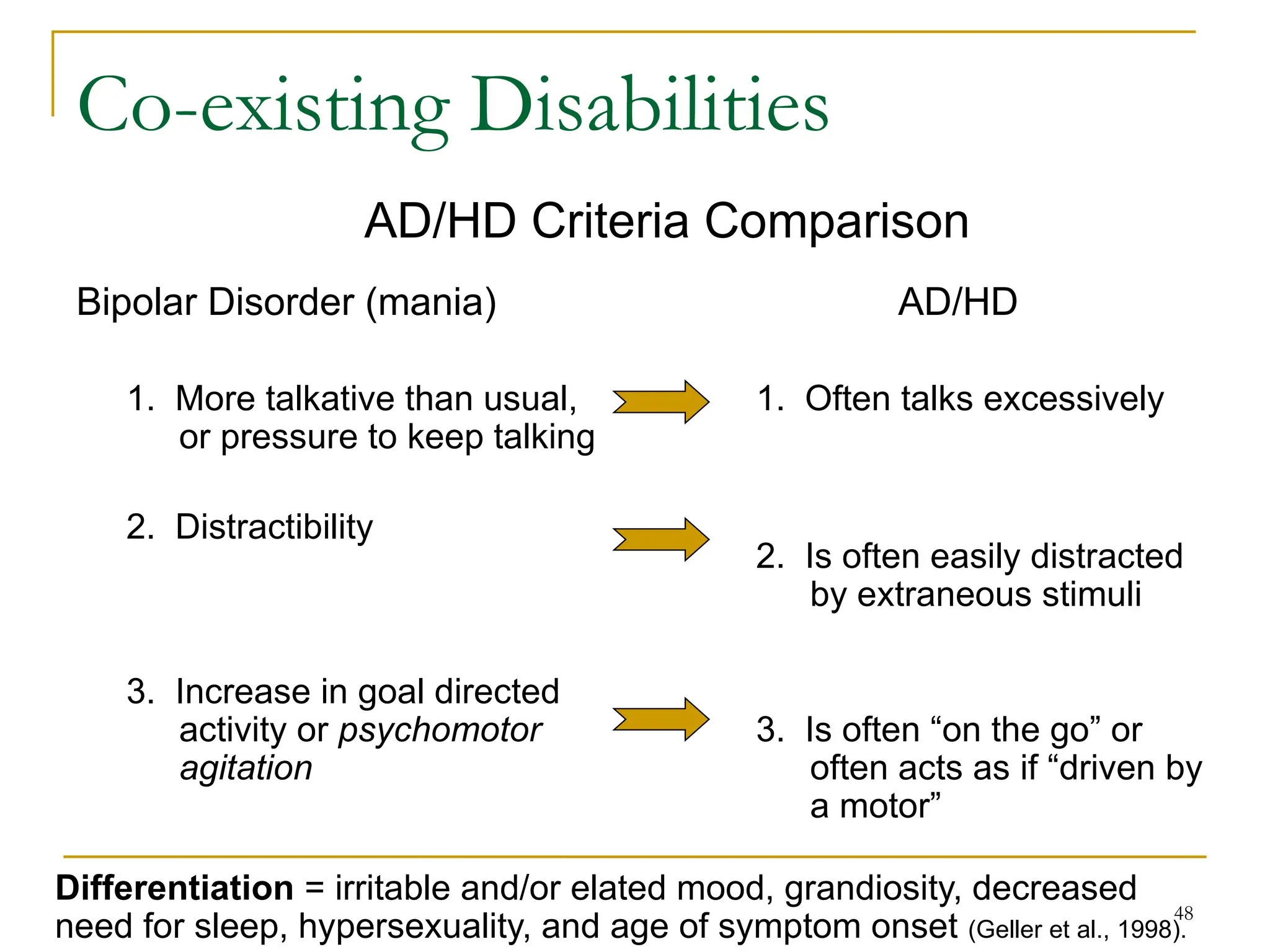
Co-existing Disabilities
Bipolar Disorder (mania)
1. More talkative than usual,
or pressure to keep talking
2. Distractibility
3. Increase in goal directed
activity or psychomotor
agitation
AD/HD
1. Often talks excessively
2. Is often easily distracted
by extraneous stimuli
3. Is often “on the go” or
often acts as if “driven by
a motor”
Differentiation = irritable and/or elated mood, grandiosity, decreased
need for sleep, hypersexuality, and age of symptom onset (Geller et al., 1998).
AD/HD Criteria Comparison
49
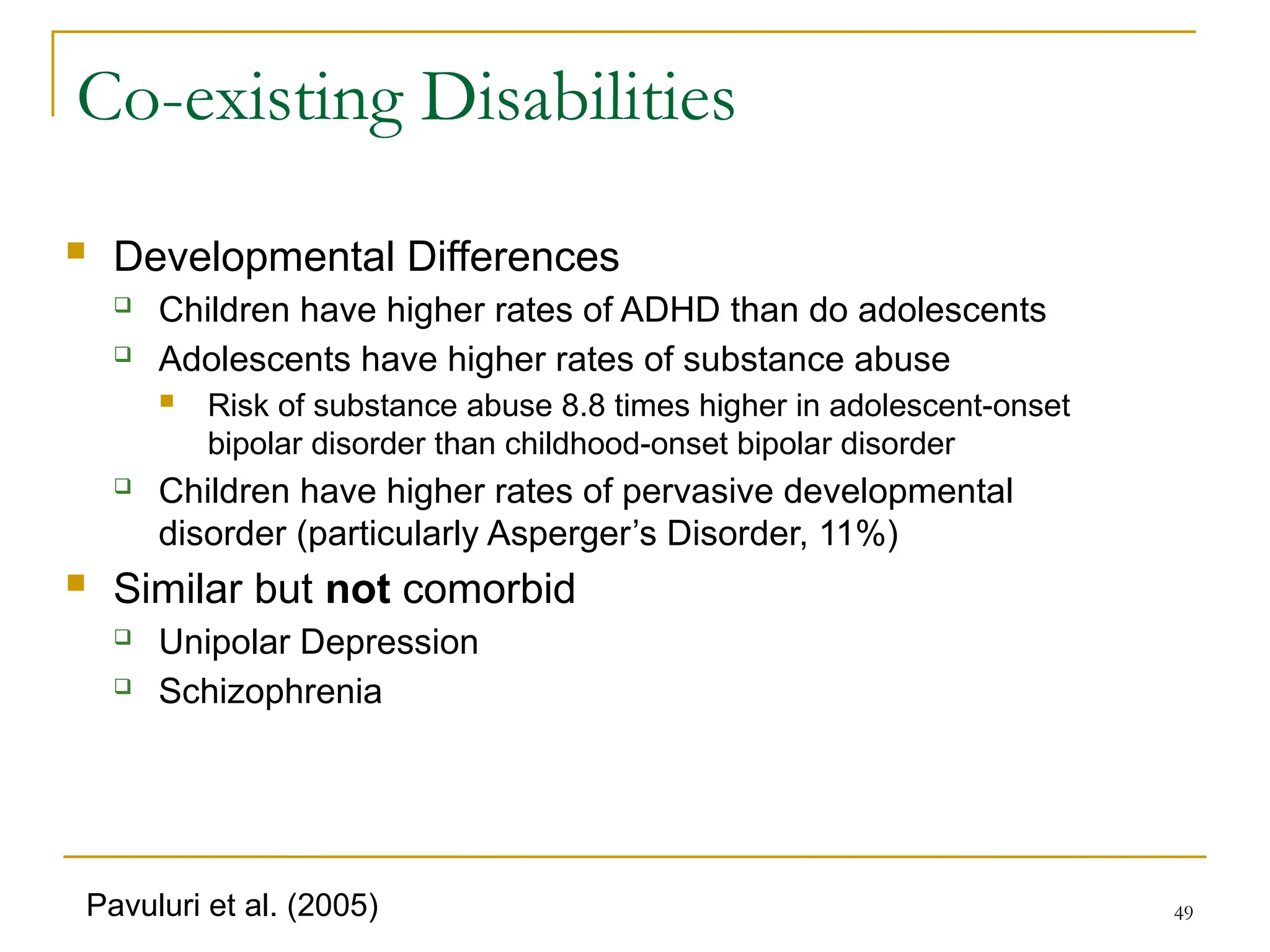
Co-existing Disabilities
 Developmental Differences
 Children have higher rates of ADHD than do adolescents
 Adolescents have higher rates of substance abuse
 Risk of substance abuse 8.8 times higher in adolescent-onset
bipolar disorder than childhood-onset bipolar disorder
 Children have higher rates of pervasive developmental
disorder (particularly Asperger’s Disorder, 11%)
 Similar but not comorbid
 Unipolar Depression
 Schizophrenia
Pavuluri et al. (2005)
50
Presentation Outline
 Diagnosis
 Course
 Co-existing Disabilities
 Associated Impairments
 Etiology, Prevalence & Prognosis
 Treatment
 Best Practices for School Psychologists
51
Associated Impairments
Suicidal Behaviors
 Prevalence of suicide attempts
 40-45%
 Age of first attempt
 Multiple attempts
 Severity of attempts
 Suicidal ideation
52
Associated Impairments
Cognitive Deficits
 Executive Functions
 Attention
 Memory
 Sensory-Motor Integration
 Nonverbal Problem-Solving
 Academic Deficits

Mathematics
53
Associated Impairments
Psychosocial Deficits
 Relationships
 Peers
 Family members
 Recognition and Regulation of Emotion
 Social Problem-Solving
 Self-Esteem
 Impulse Control
54
Presentation Outline
 Diagnosis
 Course
 Co-existing Disabilities
 Associated Impairments
 Etiology, Prevalence & Prognosis
 Treatment
 Best Practices for the School Psychologists
55
 Although the etiology of [early onset bipolar
spectrum disorder] is not known, substantial
evidence in the adult literature and more recent
research with children and adolescents suggest a
biological basis involving genetics, various
neurochemicals, and certain affected brain regions.
 It is distinctly possible that the differing clinical
presentations of pediatric BD are not unitary entities
but diverse in etiology and pathophysiology.
Etiology
Lofthouse & Fristad (2006, p. 212); Pavuluri et al. (2005, p. 853)
56
 Genetics
1. Family Studies
2. Twin Studies
 MZ = .67; DZ = .20 concordance
3. Adoption Studies
4. Genetic Epidemiology
 Early onset BD = confers greater risk to relatives
5. Molecular genetic
 Aggregates among family members
 Appears highly heritable
 Environment = a minority of disease risk
Etiology
Baum et al. (2007); Faraone et al. (2003); Pavuluri et al. (2005)
57
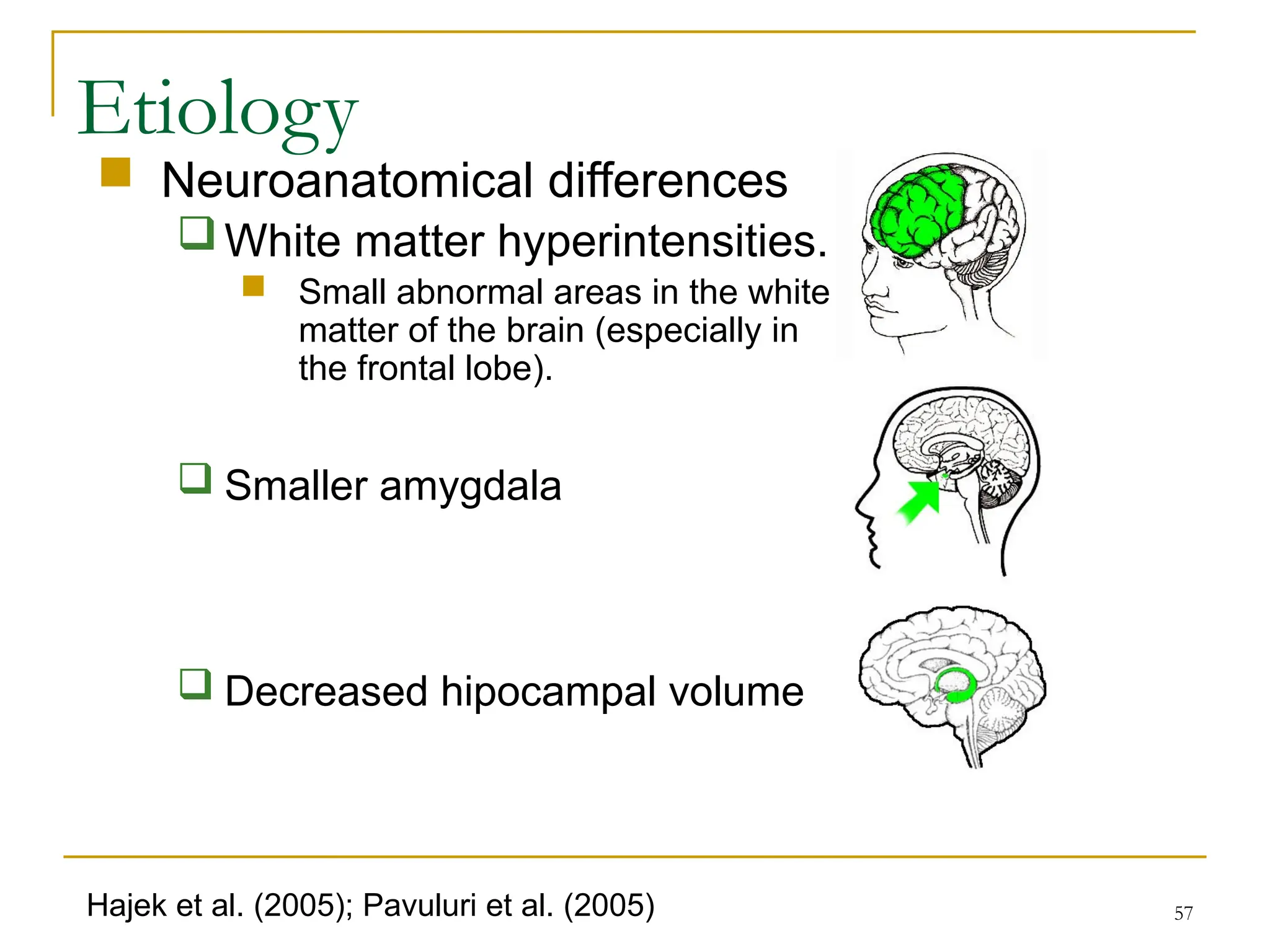
 Neuroanatomical differences
White matter hyperintensities.
 Small abnormal areas in the white
matter of the brain (especially in
the frontal lobe).
 Smaller amygdala
 Decreased hipocampal volume
Etiology
Hajek et al. (2005); Pavuluri et al. (2005)
58
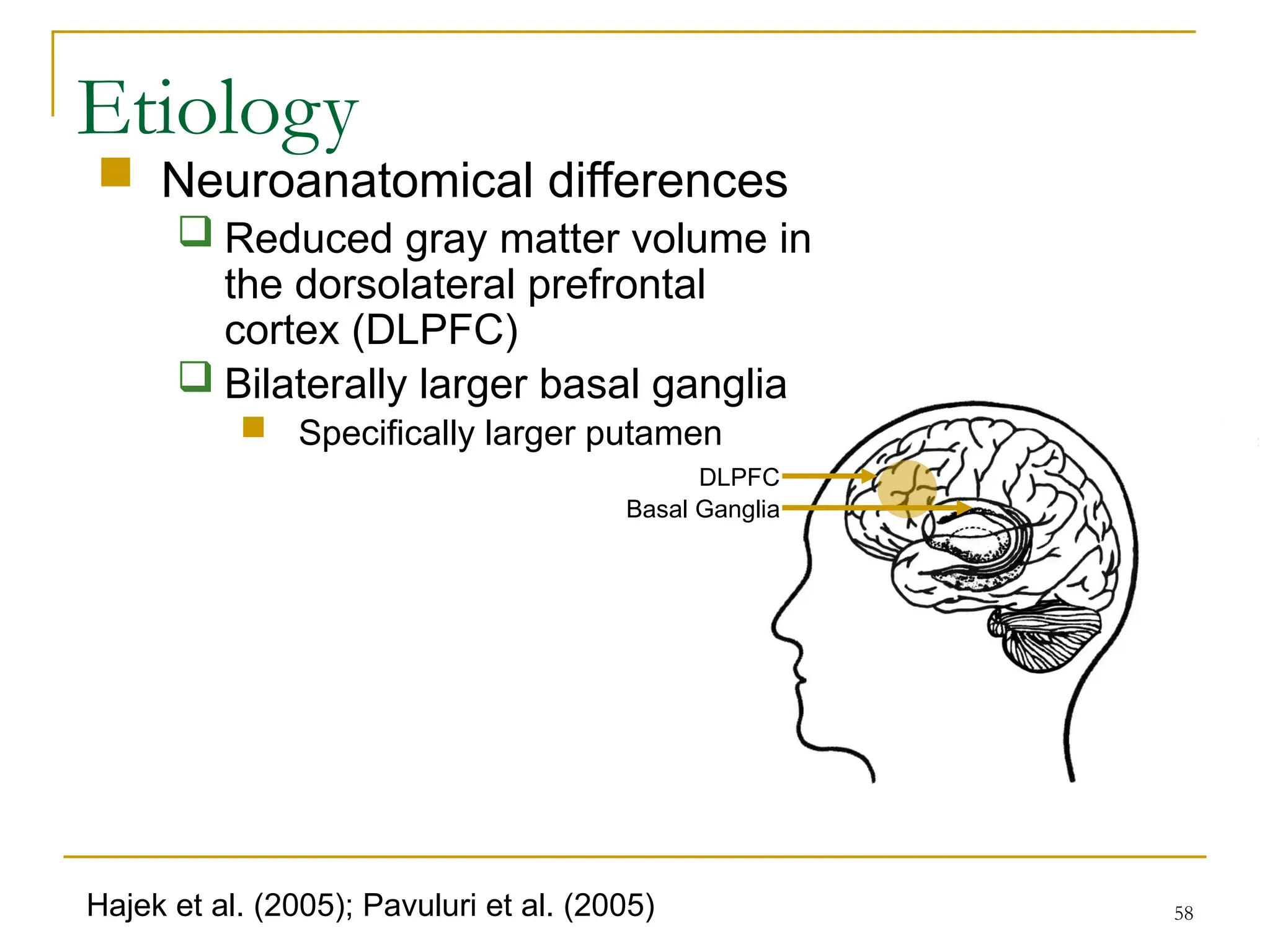
DLPFC
Basal Ganglia
 Neuroanatomical differences
 Reduced gray matter volume in
the dorsolateral prefrontal
cortex (DLPFC)
 Bilaterally larger basal ganglia
 Specifically larger putamen
Etiology
Hajek et al. (2005); Pavuluri et al. (2005)
59
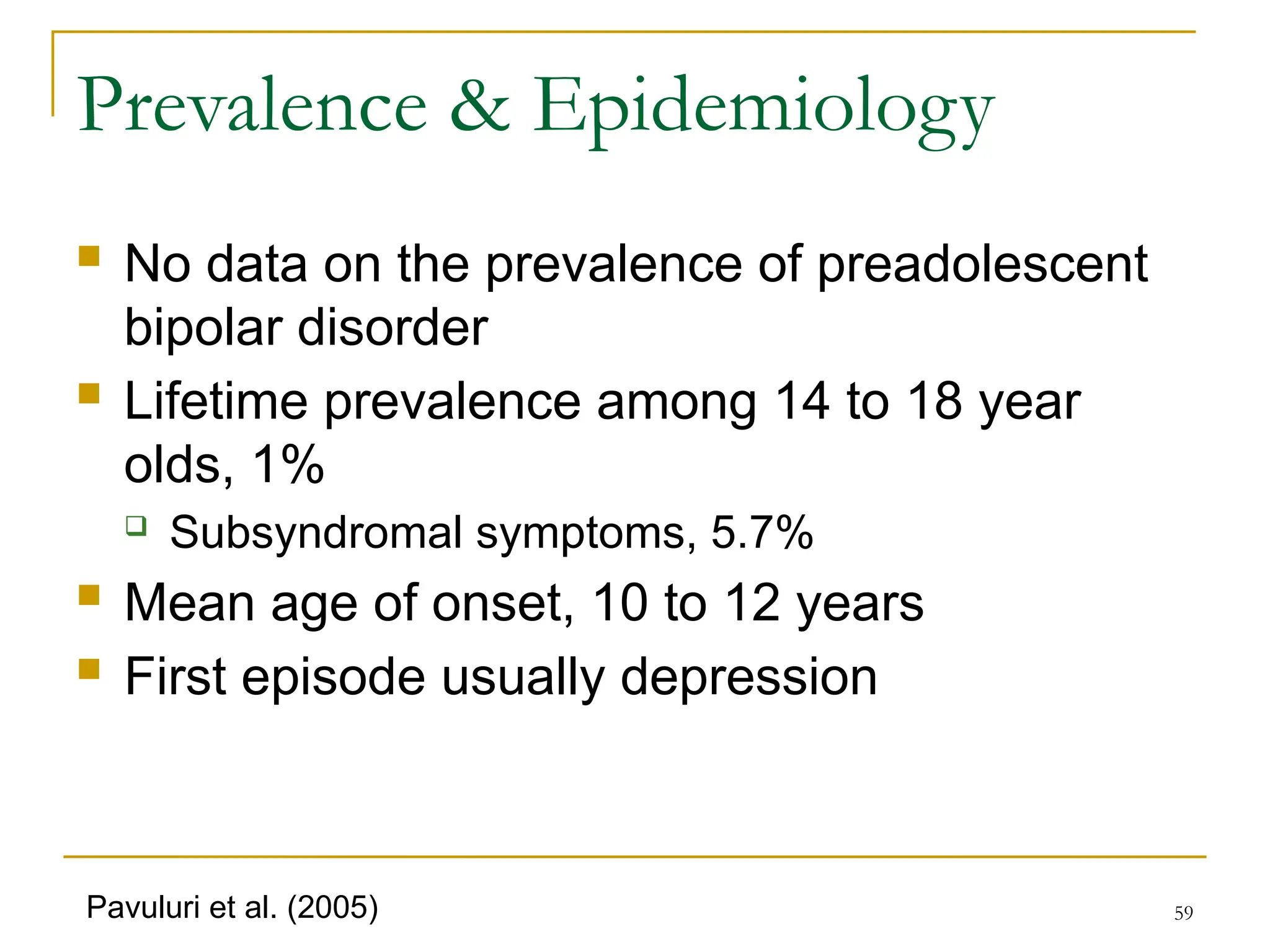
Prevalence & Epidemiology
 No data on the prevalence of preadolescent
bipolar disorder
 Lifetime prevalence among 14 to 18 year
olds, 1%
 Subsyndromal symptoms, 5.7%
 Mean age of onset, 10 to 12 years
 First episode usually depression
Pavuluri et al. (2005)
60
Prognosis
 With respect to prognosis …, [early onset bipolar
spectrum disorder] may include a prolonged and
highly relapsing course; significant impairments
in home, school, and peer functioning; legal
difficulties; multiple hospitalizations and
increased rates of substance abuse and suicide
 In short, children with [early onset bipolar
spectrum disorder] have a chronic brain disorder
that is biopsychosocial in nature and, at this
current time, cannot be cured or grown out of
Lofthouse & Fristad (2006, p. 213-214)
61
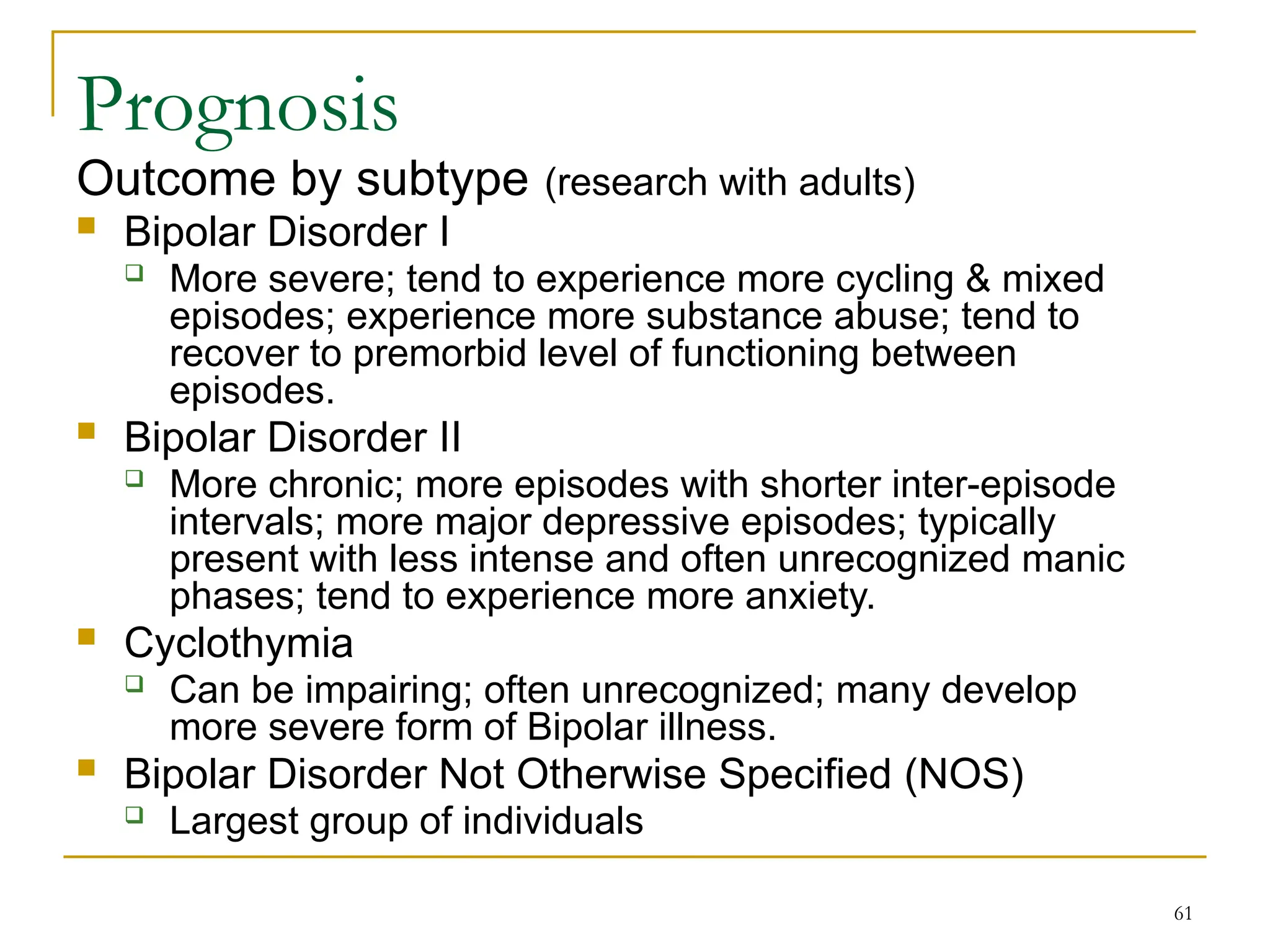
Prognosis
Outcome by subtype (research with adults)
 Bipolar Disorder I
 More severe; tend to experience more cycling & mixed
episodes; experience more substance abuse; tend to
recover to premorbid level of functioning between
episodes.
 Bipolar Disorder II
 More chronic; more episodes with shorter inter-episode
intervals; more major depressive episodes; typically
present with less intense and often unrecognized manic
phases; tend to experience more anxiety.
 Cyclothymia
 Can be impairing; often unrecognized; many develop
more severe form of Bipolar illness.
 Bipolar Disorder Not Otherwise Specified (NOS)
 Largest group of individuals
62
Presentation Outline
 Diagnosis
 Course
 Co-existing Disabilities
 Associated Impairments
 Etiology, Prevalence & Prognosis
 Treatment
 Best Practices for School Psychologists
63
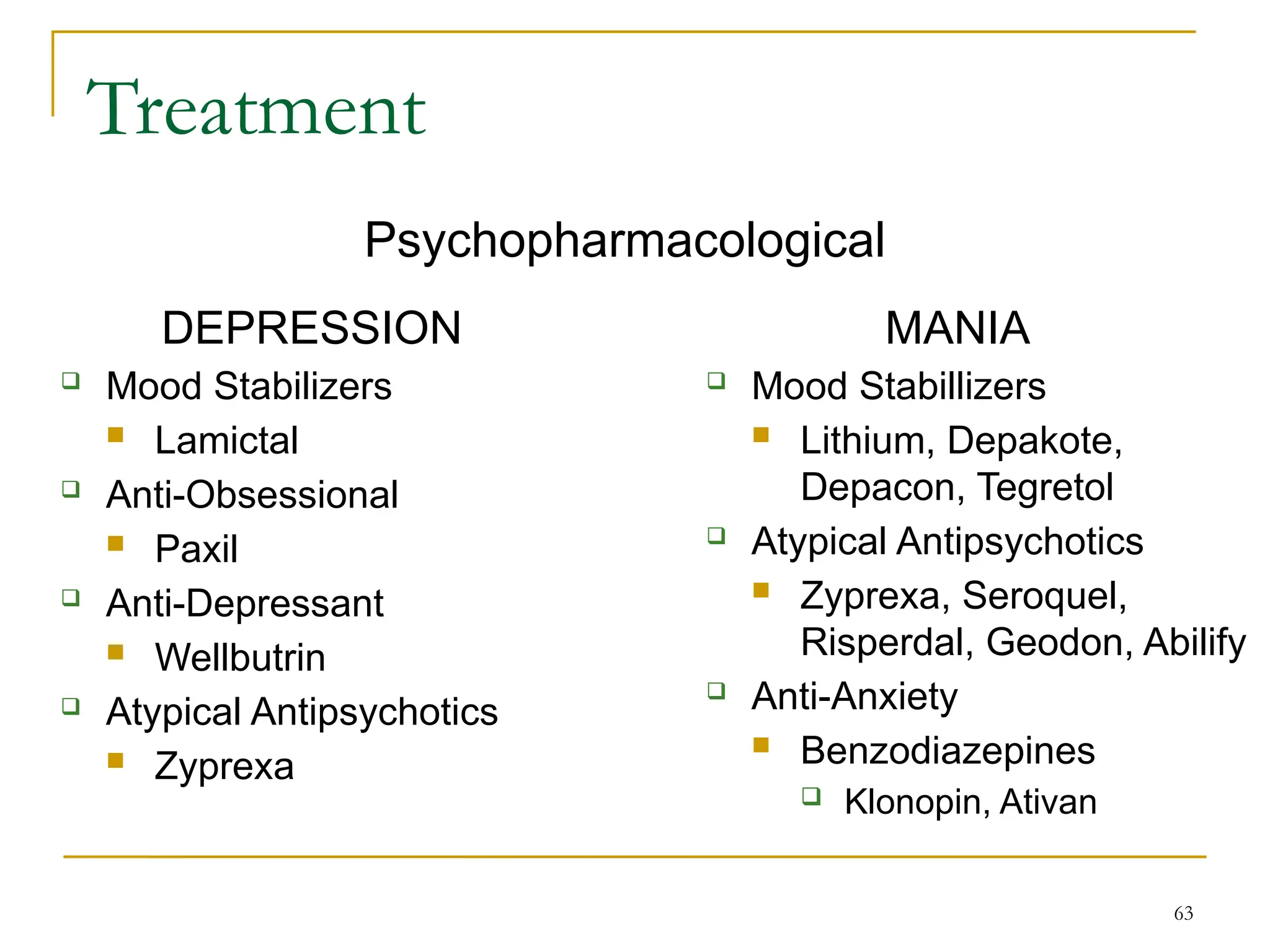
Treatment
DEPRESSION
 Mood Stabilizers
 Lamictal
 Anti-Obsessional
 Paxil
 Anti-Depressant
 Wellbutrin
 Atypical Antipsychotics
 Zyprexa
MANIA
 Mood Stabillizers
 Lithium, Depakote,
Depacon, Tegretol
 Atypical Antipsychotics
 Zyprexa, Seroquel,
Risperdal, Geodon, Abilify
 Anti-Anxiety
 Benzodiazepines
 Klonopin, Ativan
Psychopharmacological
64
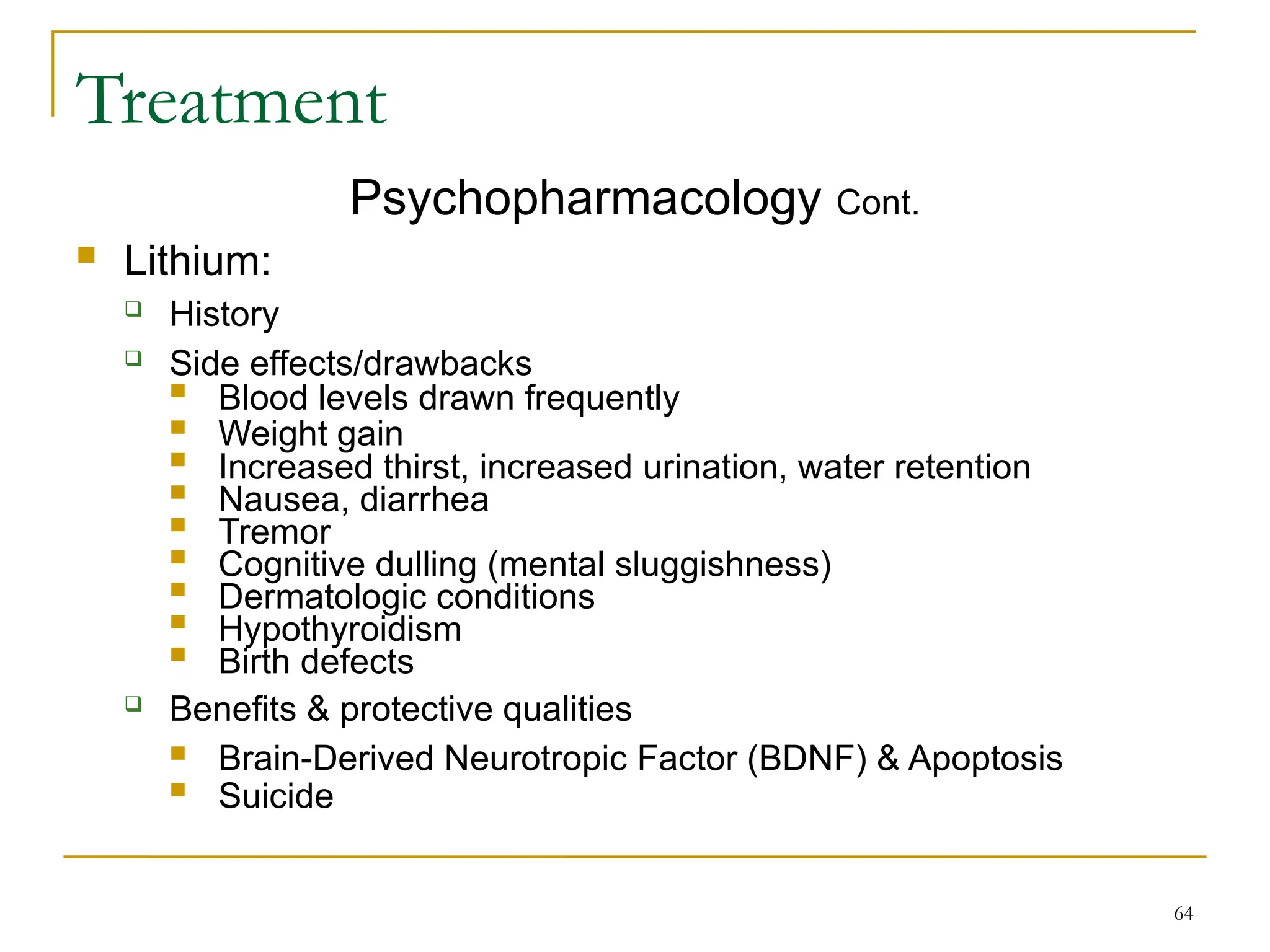
Treatment
Psychopharmacology Cont.
 Lithium:
 History
 Side effects/drawbacks
 Blood levels drawn frequently
 Weight gain
 Increased thirst, increased urination, water retention
 Nausea, diarrhea
 Tremor
 Cognitive dulling (mental sluggishness)
 Dermatologic conditions
 Hypothyroidism
 Birth defects
 Benefits & protective qualities
 Brain-Derived Neurotropic Factor (BDNF) & Apoptosis
 Suicide
65
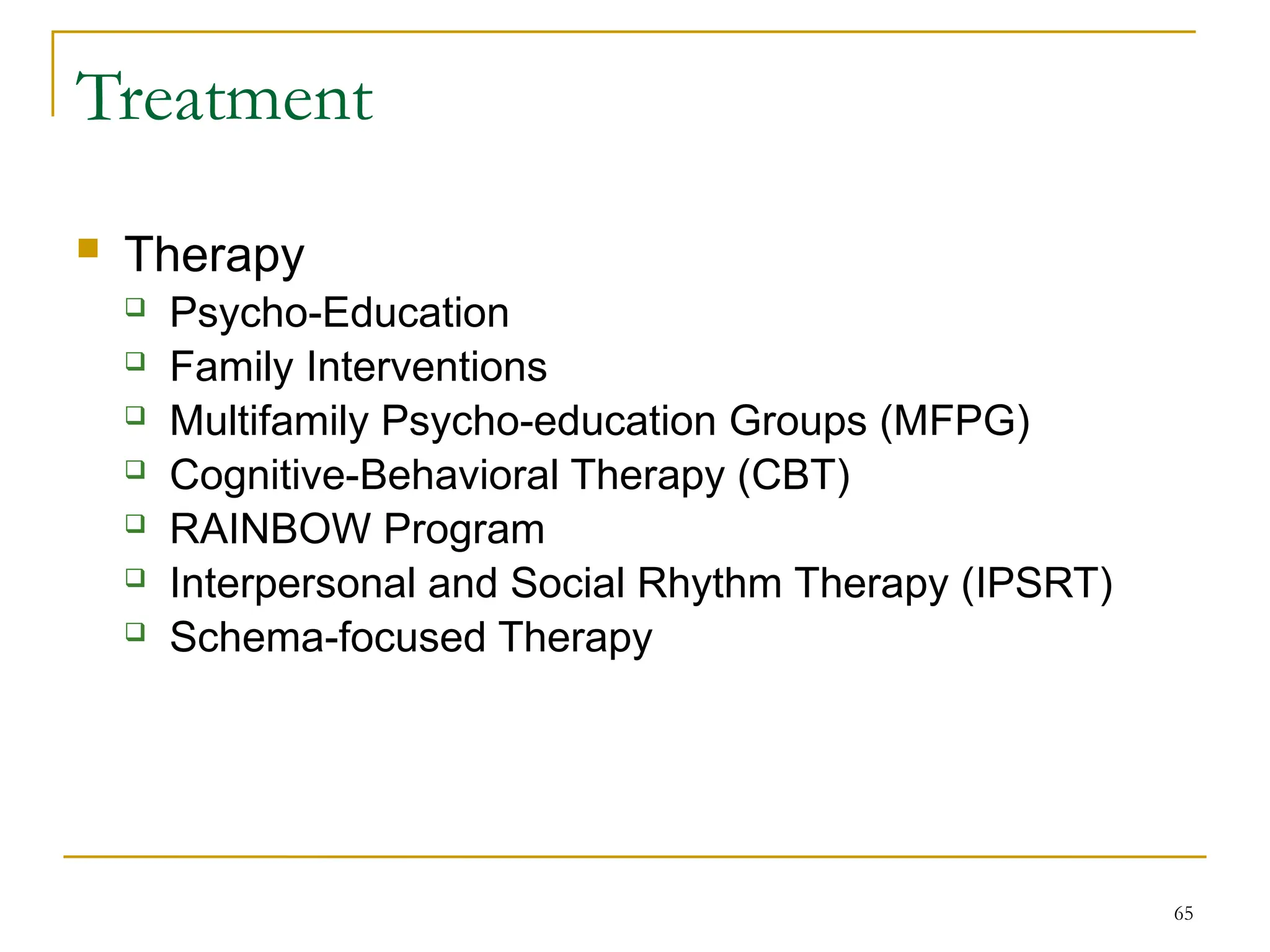
Treatment
 Therapy
 Psycho-Education
 Family Interventions
 Multifamily Psycho-education Groups (MFPG)
 Cognitive-Behavioral Therapy (CBT)
 RAINBOW Program
 Interpersonal and Social Rhythm Therapy (IPSRT)
 Schema-focused Therapy
66
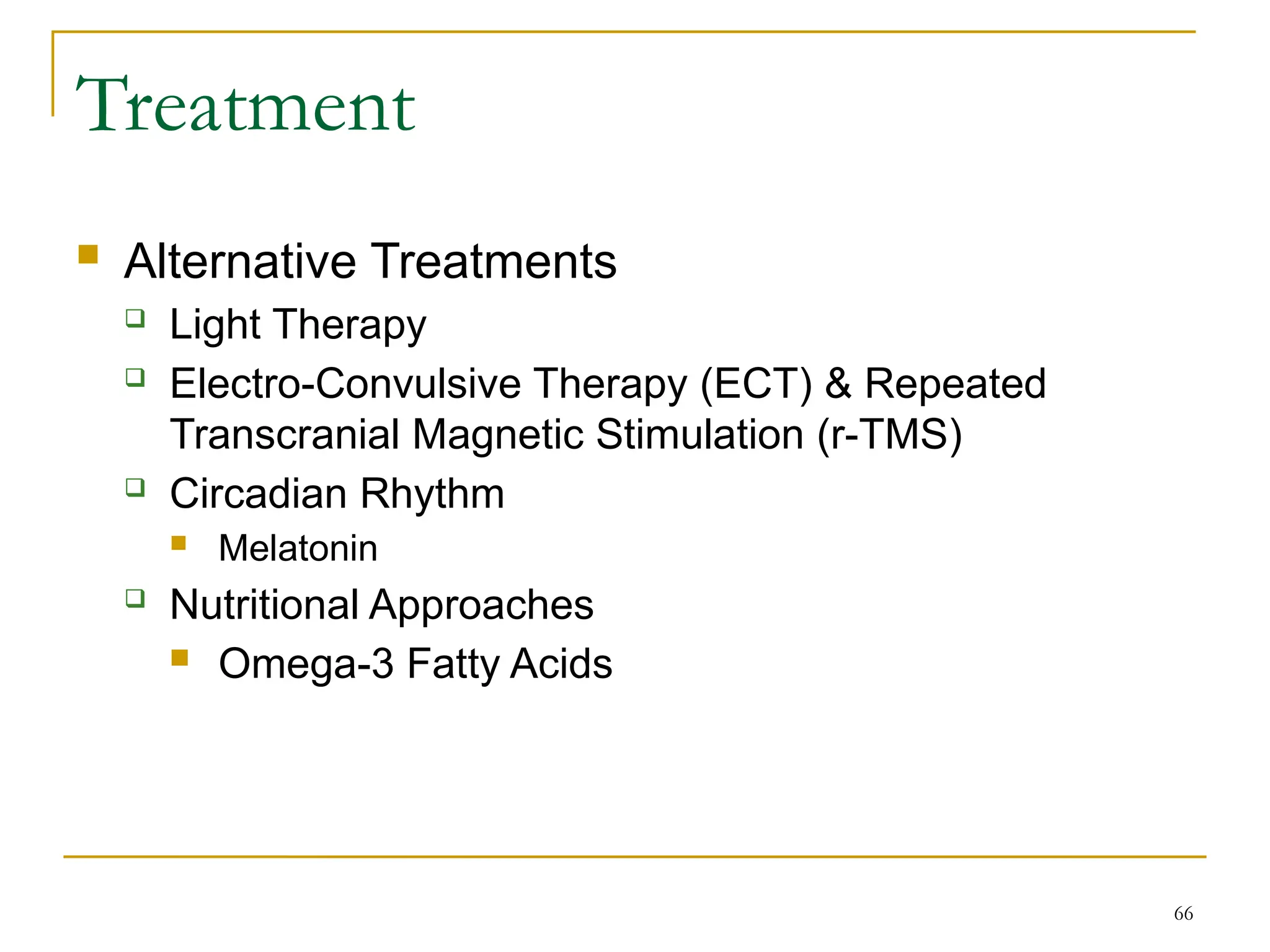
Treatment
 Alternative Treatments
 Light Therapy
 Electro-Convulsive Therapy (ECT) & Repeated
Transcranial Magnetic Stimulation (r-TMS)
 Circadian Rhythm
 Melatonin
 Nutritional Approaches
 Omega-3 Fatty Acids
67
Presentation Outline
 Diagnosis
 Course
 Co-existing Disabilities
 Associated Impairments
 Etiology, Prevalence & Prognosis
 Treatment
 Best Practices for School Psychologists
 Recognize Educational Implications
 Psycho-Educational Assessment
 Special Education & Programming Issues
 School-Based Interventions
68
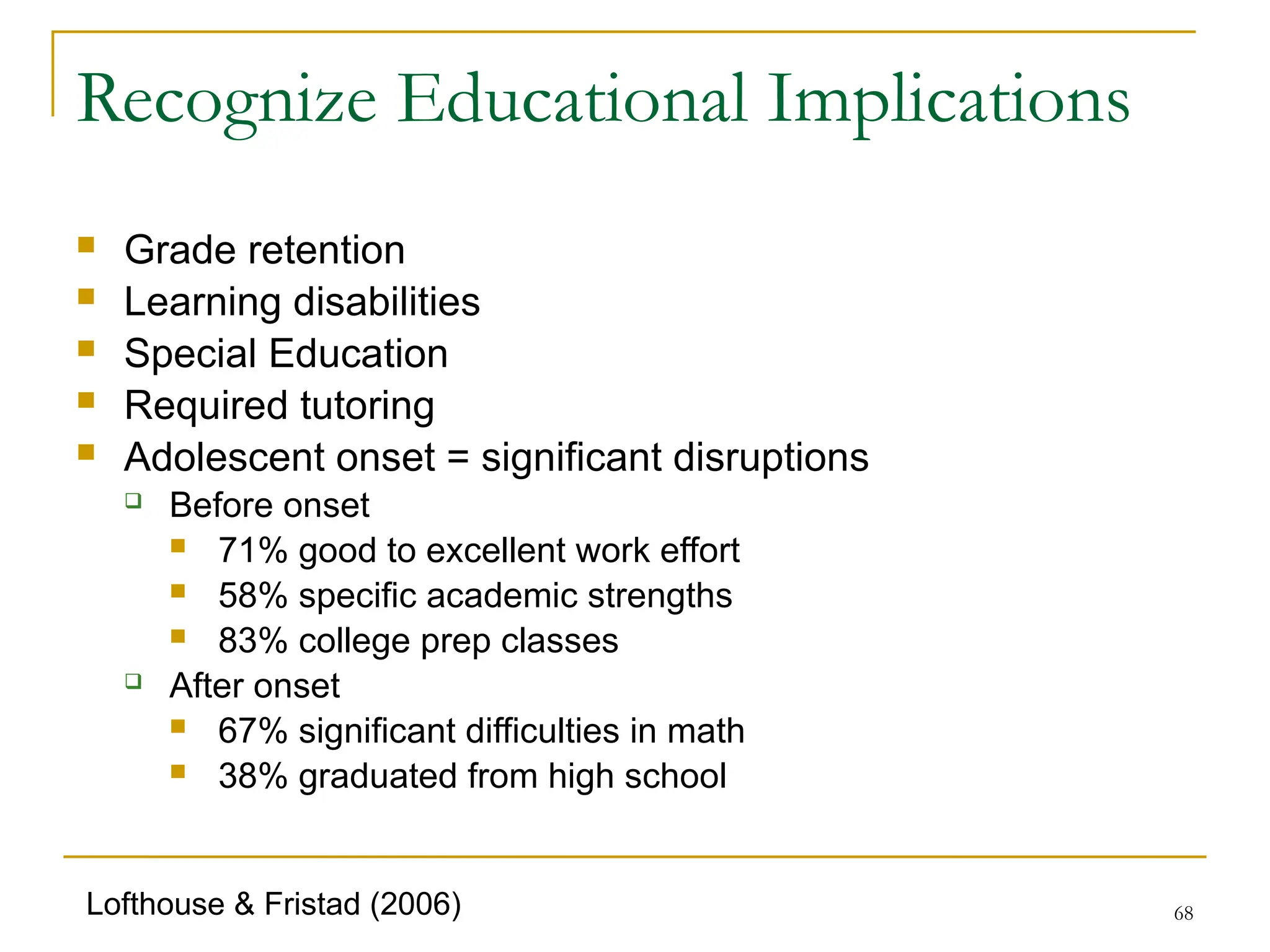
Recognize Educational Implications
 Grade retention
 Learning disabilities
 Special Education
 Required tutoring
 Adolescent onset = significant disruptions
 Before onset
 71% good to excellent work effort
 58% specific academic strengths
 83% college prep classes
 After onset
 67% significant difficulties in math
 38% graduated from high school
Lofthouse & Fristad (2006)
69
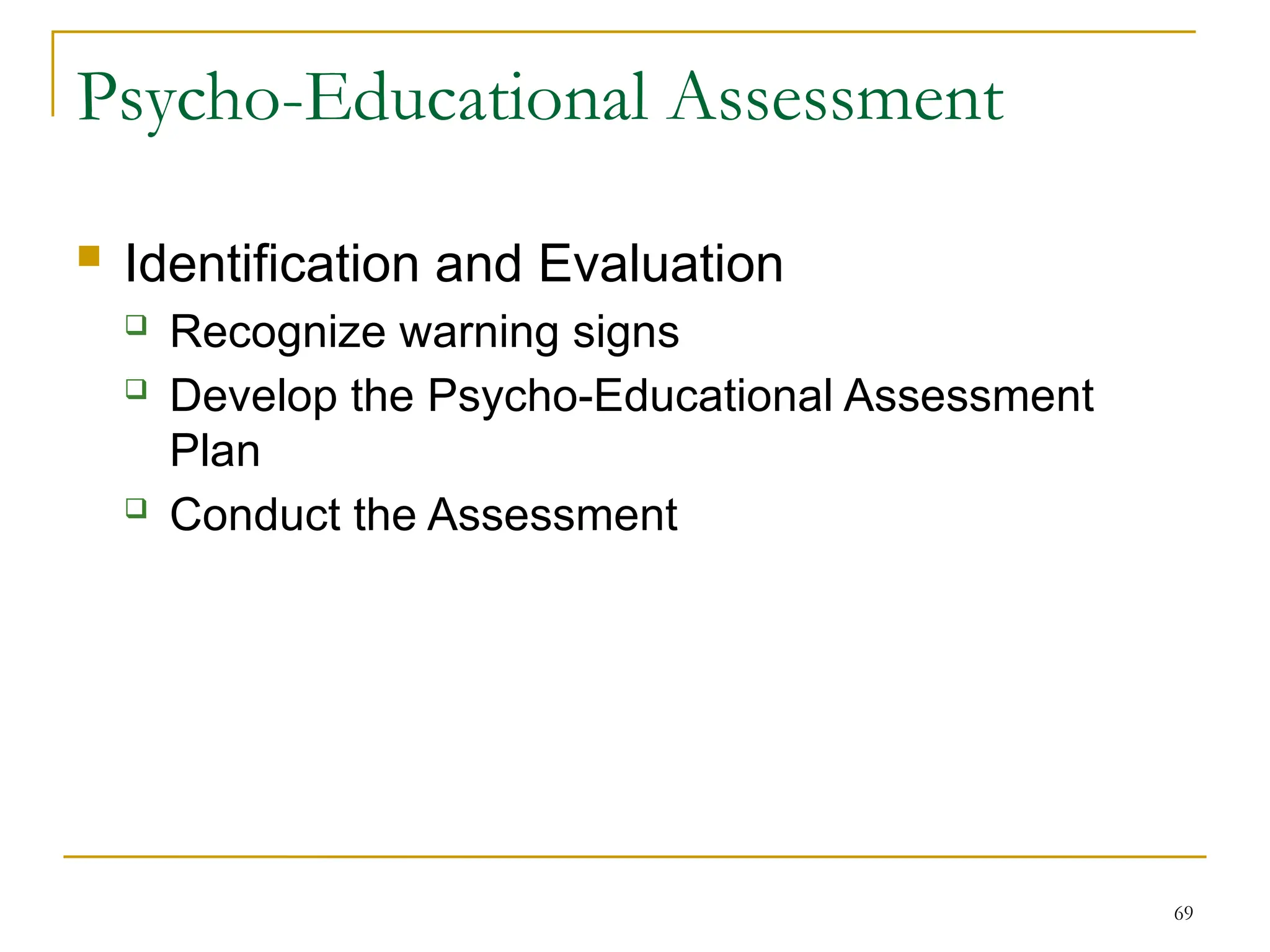
Psycho-Educational Assessment
 Identification and Evaluation
 Recognize warning signs
 Develop the Psycho-Educational Assessment
Plan
 Conduct the Assessment
70
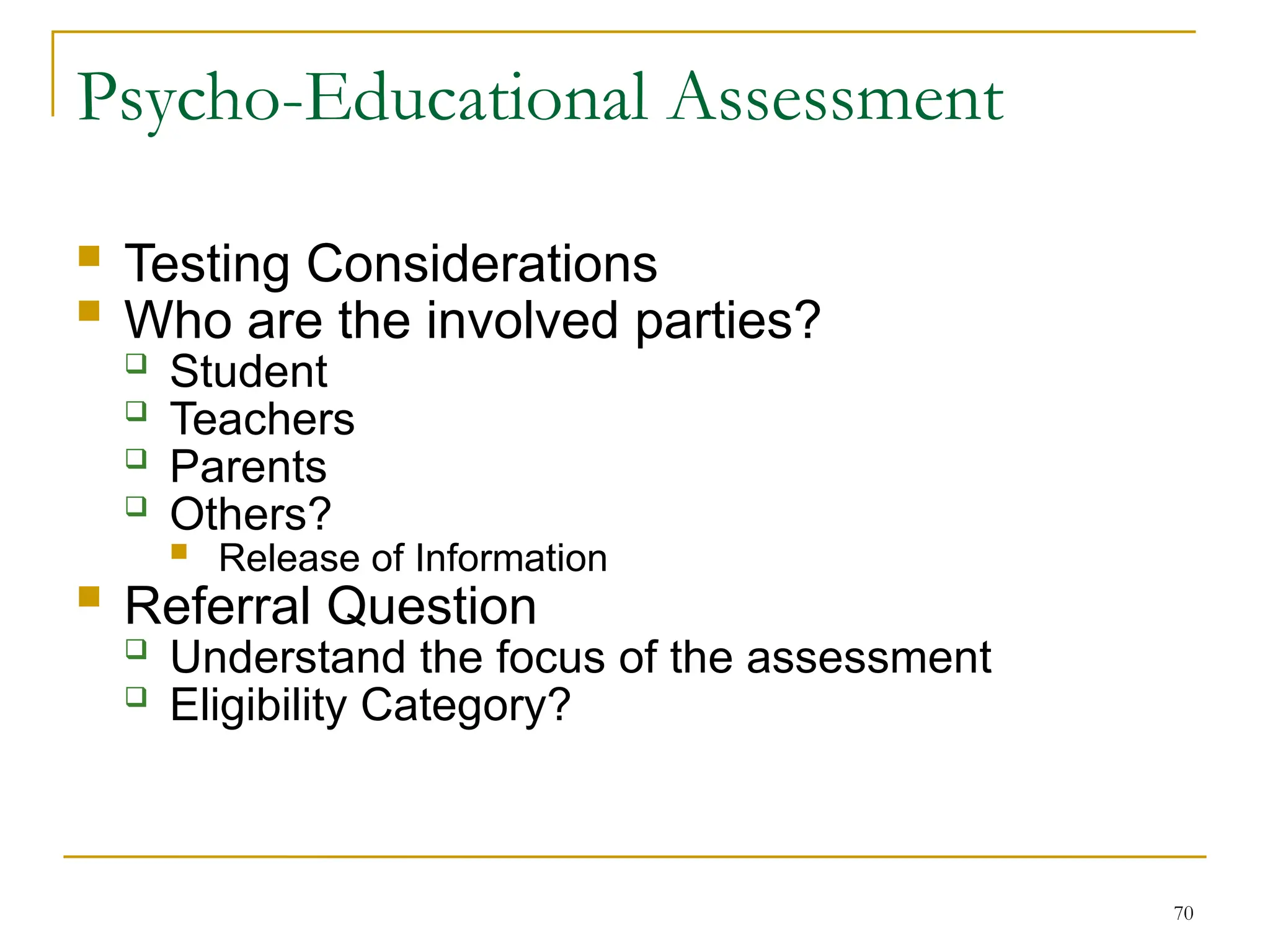
Psycho-Educational Assessment
 Testing Considerations
 Who are the involved parties?
 Student
 Teachers
 Parents
 Others?
 Release of Information
 Referral Question
 Understand the focus of the assessment
 Eligibility Category?
71
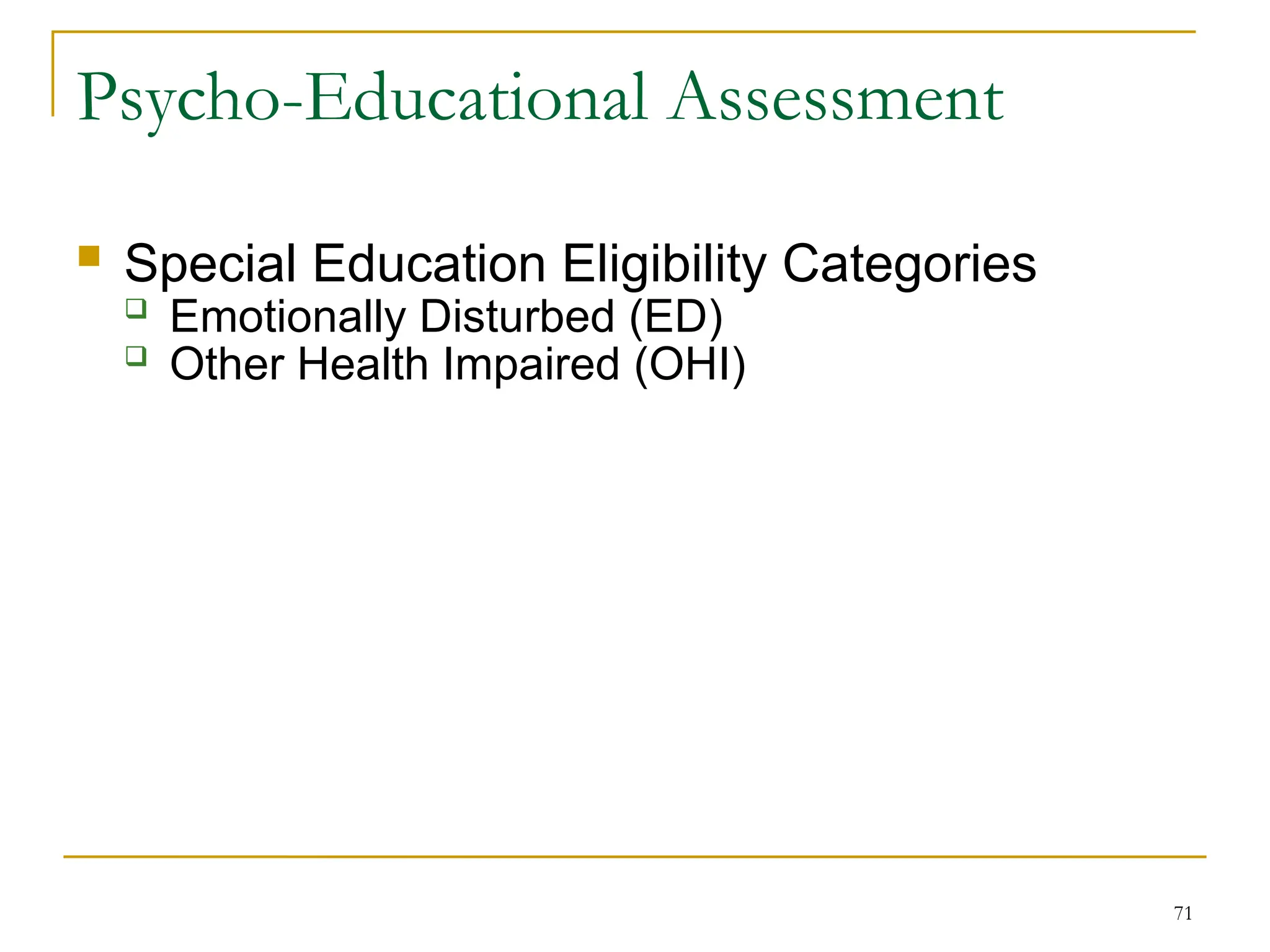
Psycho-Educational Assessment
 Special Education Eligibility Categories
 Emotionally Disturbed (ED)
 Other Health Impaired (OHI)
72
Psycho-Educational Assessment
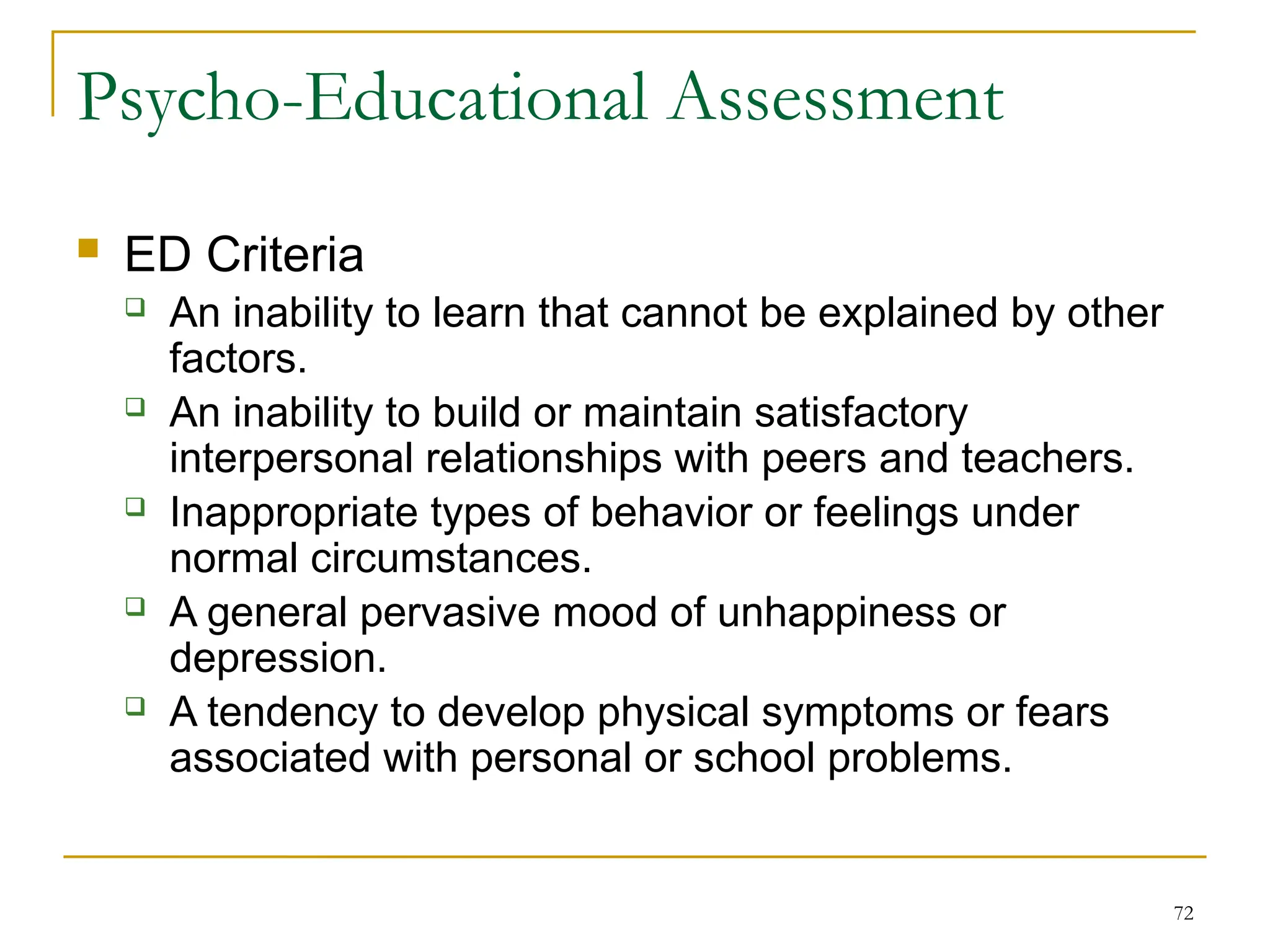
 ED Criteria
 An inability to learn that cannot be explained by other
factors.
 An inability to build or maintain satisfactory
interpersonal relationships with peers and teachers.
 Inappropriate types of behavior or feelings under
normal circumstances.
 A general pervasive mood of unhappiness or
depression.
 A tendency to develop physical symptoms or fears
associated with personal or school problems.
73
Psycho-Educational Assessment
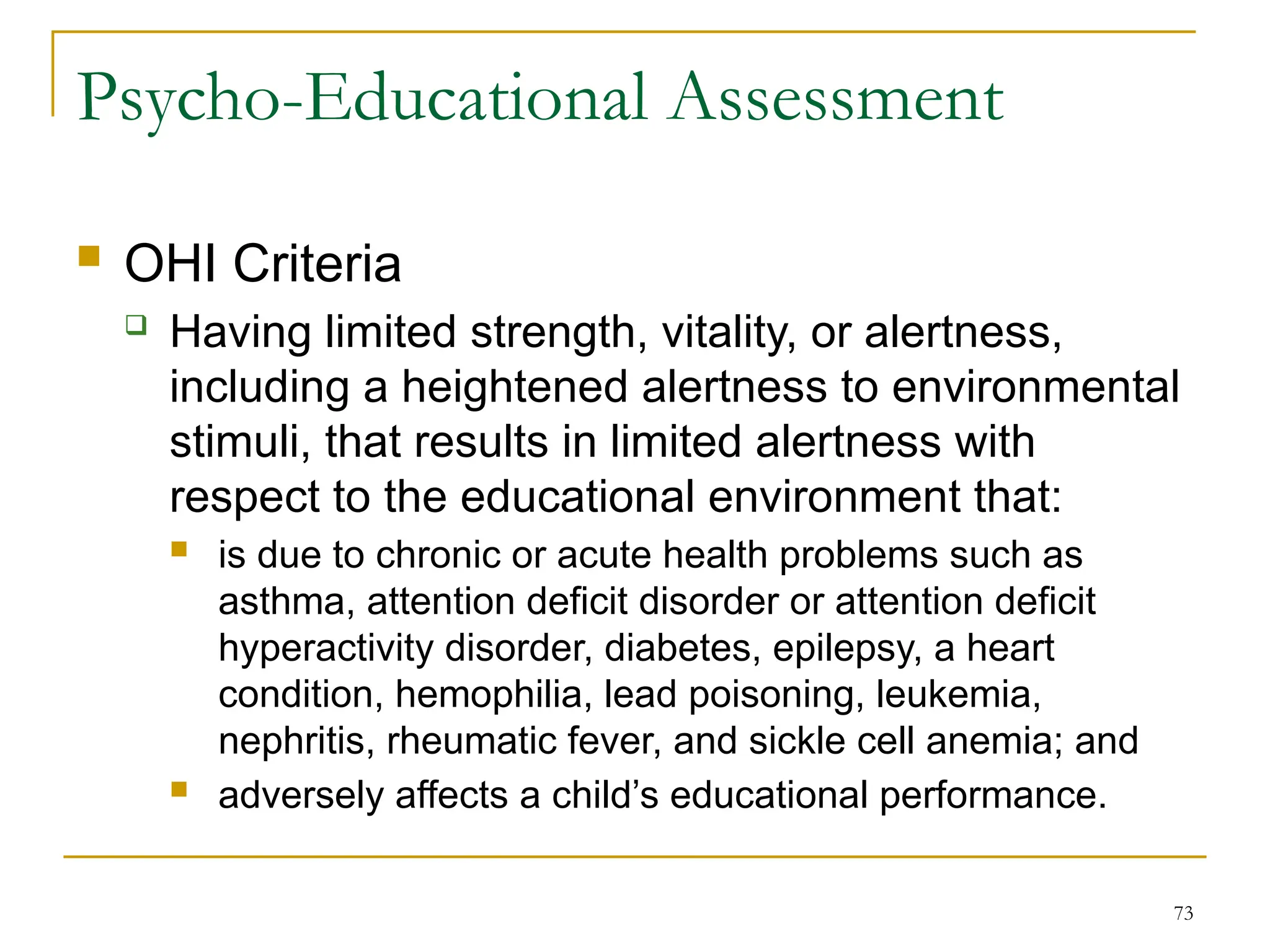
 OHI Criteria
 Having limited strength, vitality, or alertness,
including a heightened alertness to environmental
stimuli, that results in limited alertness with
respect to the educational environment that:
 is due to chronic or acute health problems such as
asthma, attention deficit disorder or attention deficit
hyperactivity disorder, diabetes, epilepsy, a heart
condition, hemophilia, lead poisoning, leukemia,
nephritis, rheumatic fever, and sickle cell anemia; and
 adversely affects a child’s educational performance.
74
Psycho-Educational Assessment
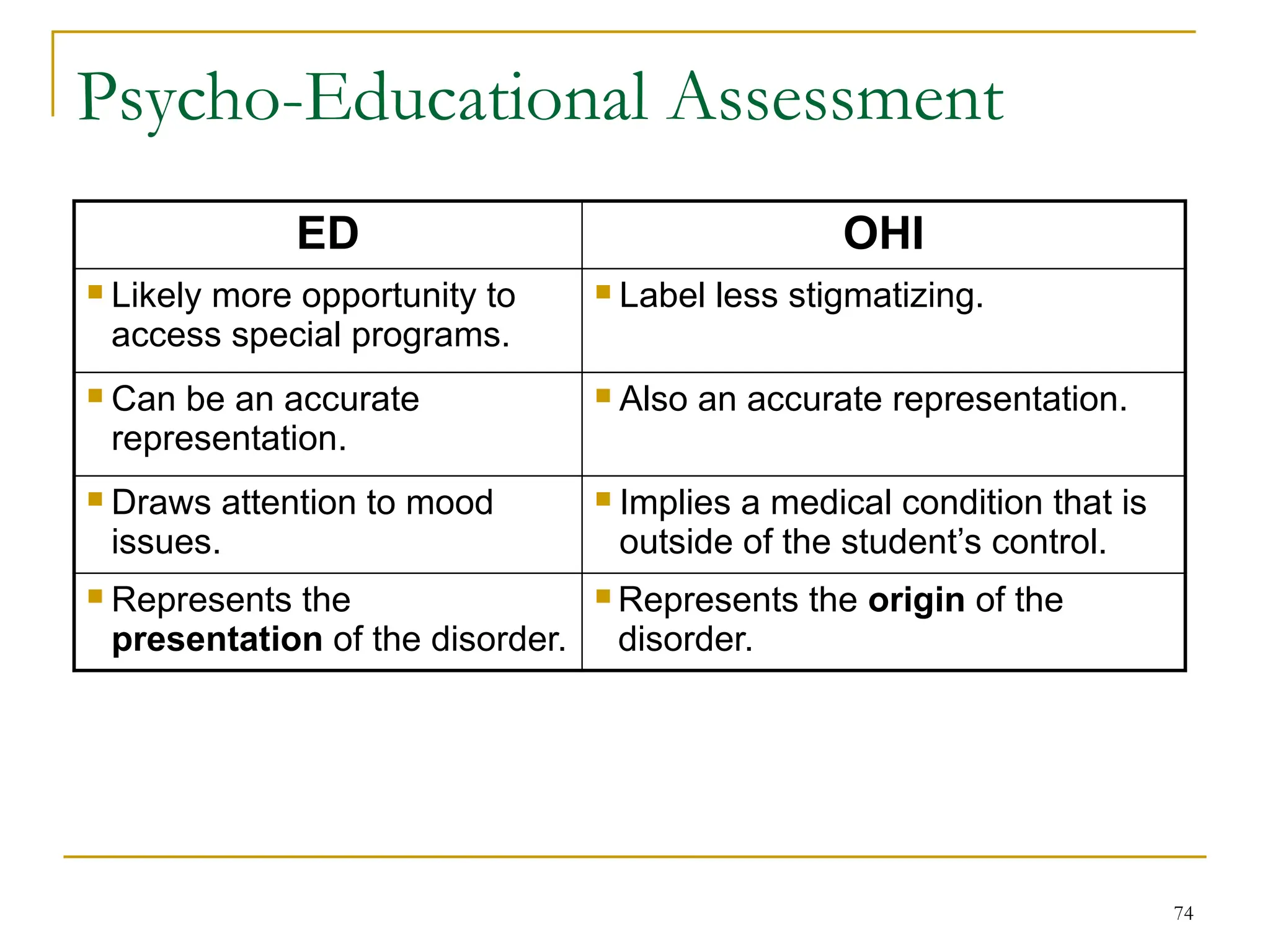
ED OHI
 Likely more opportunity to
access special programs.
 Label less stigmatizing.
 Can be an accurate
representation.
 Also an accurate representation.
 Draws attention to mood
issues.
 Implies a medical condition that is
outside of the student’s control.
 Represents the
presentation of the disorder.
 Represents the origin of the
disorder.
75
Psycho-Educational Assessment
 Health & Developmental
 Family History
 Health History
 Medical History
76
Psycho-Educational Assessment
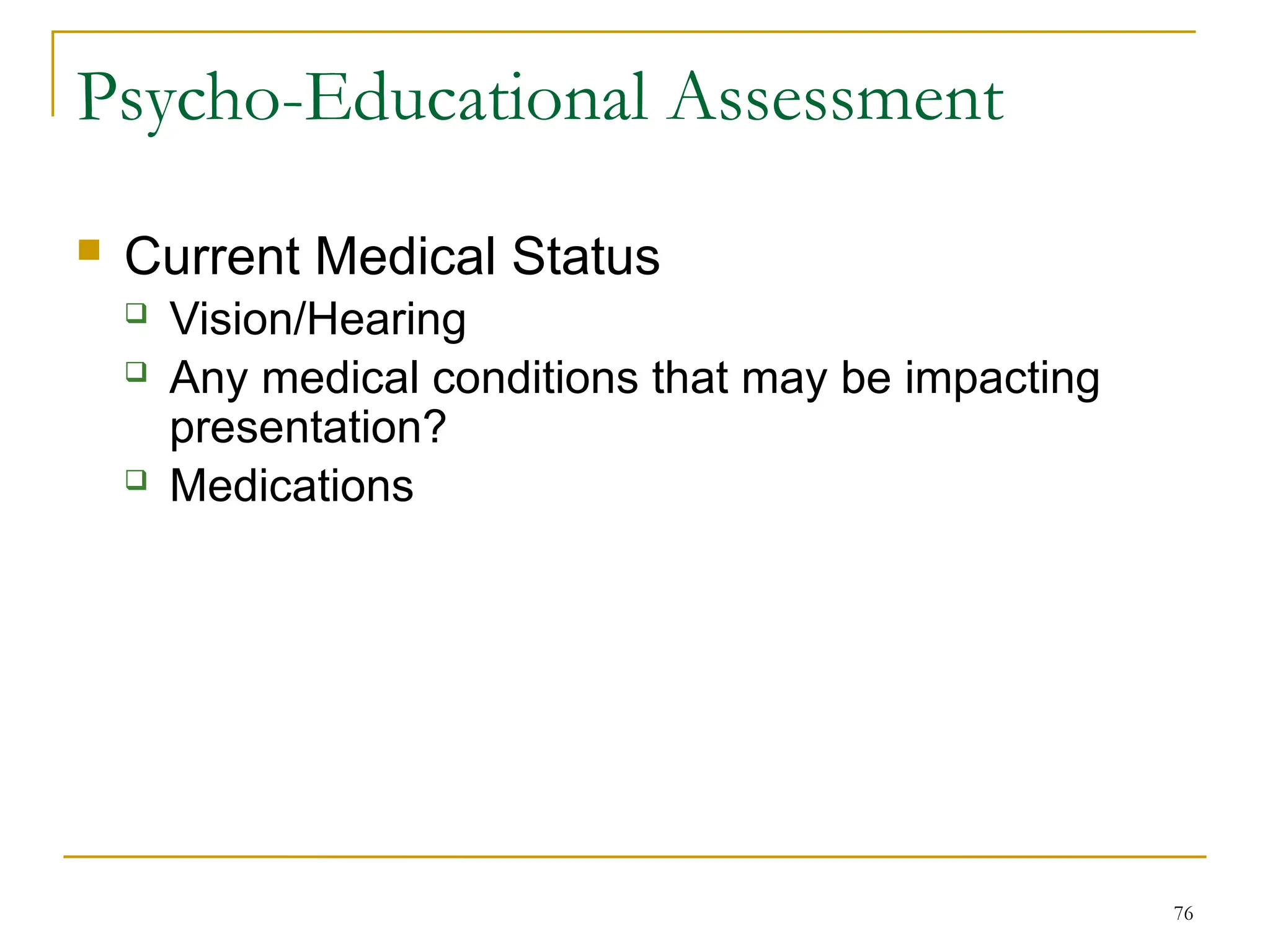
 Current Medical Status
 Vision/Hearing
 Any medical conditions that may be impacting
presentation?
 Medications
77
Psycho-Educational Assessment
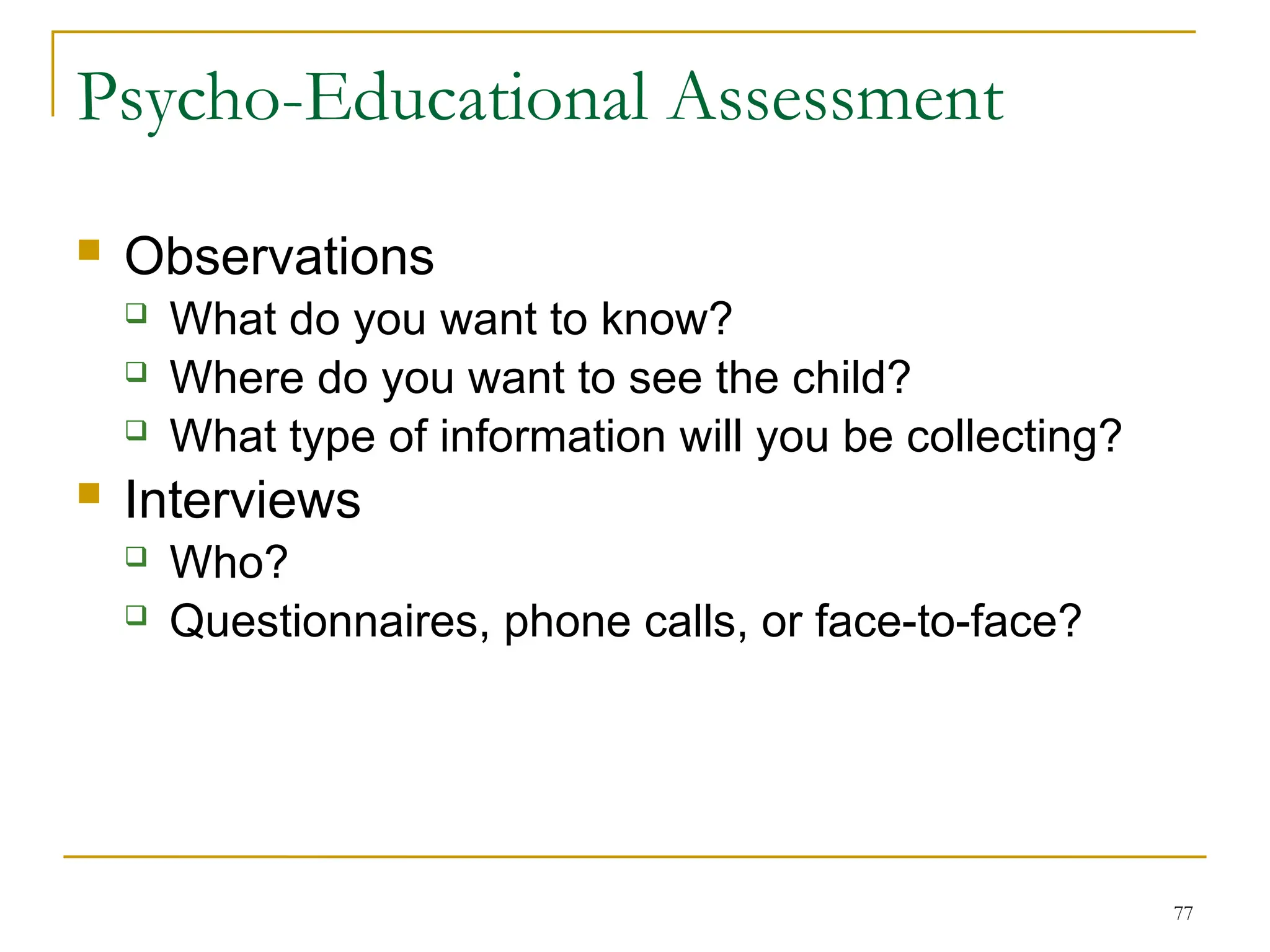
 Observations
 What do you want to know?
 Where do you want to see the child?
 What type of information will you be collecting?
 Interviews
 Who?
 Questionnaires, phone calls, or face-to-face?
78
Psycho-Educational Assessment
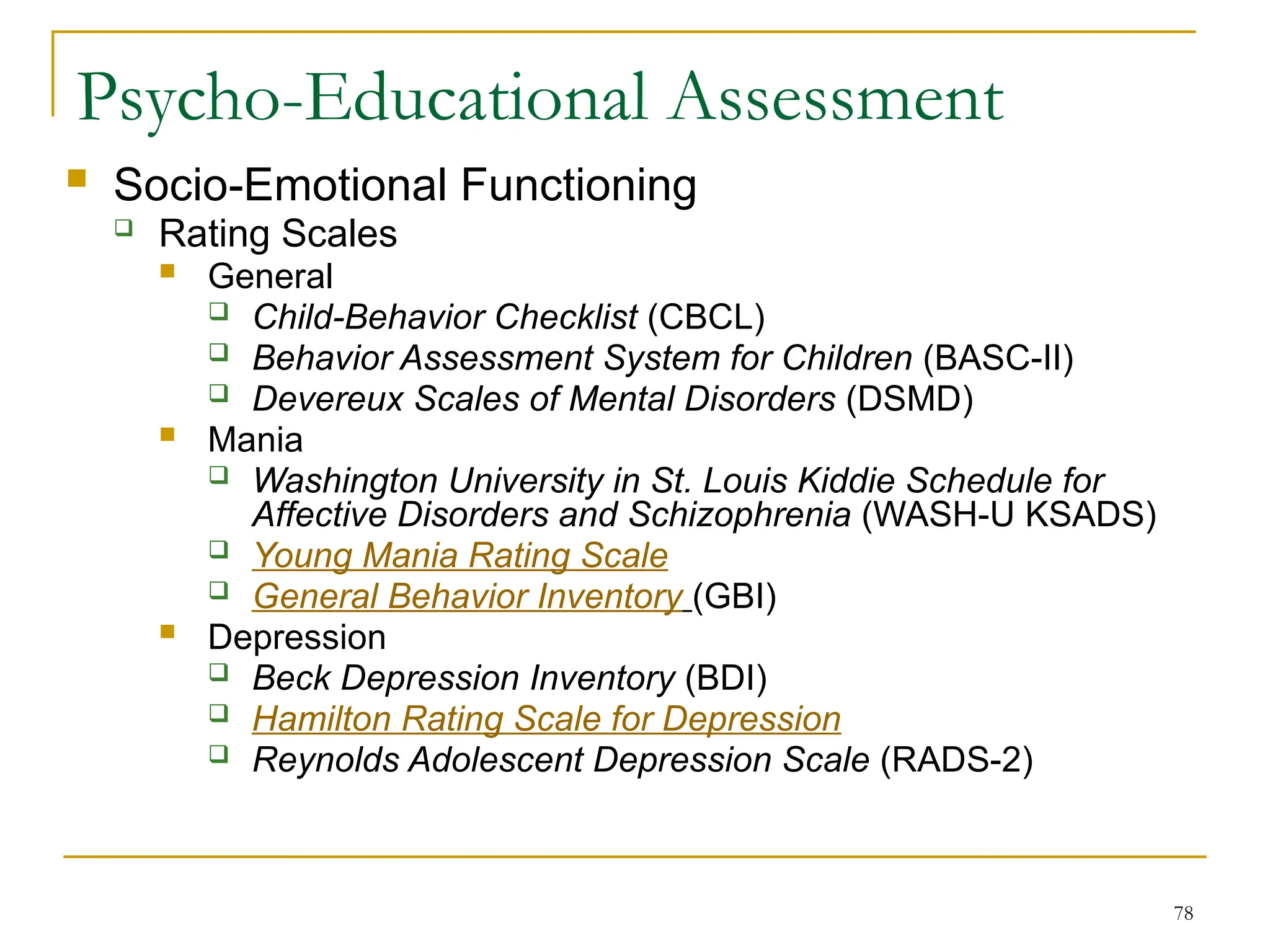
 Socio-Emotional Functioning
 Rating Scales
 General
 Child-Behavior Checklist (CBCL)
 Behavior Assessment System for Children (BASC-II)
 Devereux Scales of Mental Disorders (DSMD)
 Mania
 Washington University in St. Louis Kiddie Schedule for
Affective Disorders and Schizophrenia (WASH-U KSADS)
 Young Mania Rating Scale
 General Behavior Inventory (GBI)
 Depression
 Beck Depression Inventory (BDI)
 Hamilton Rating Scale for Depression
 Reynolds Adolescent Depression Scale (RADS-2)
79
Psycho-Educational Assessment
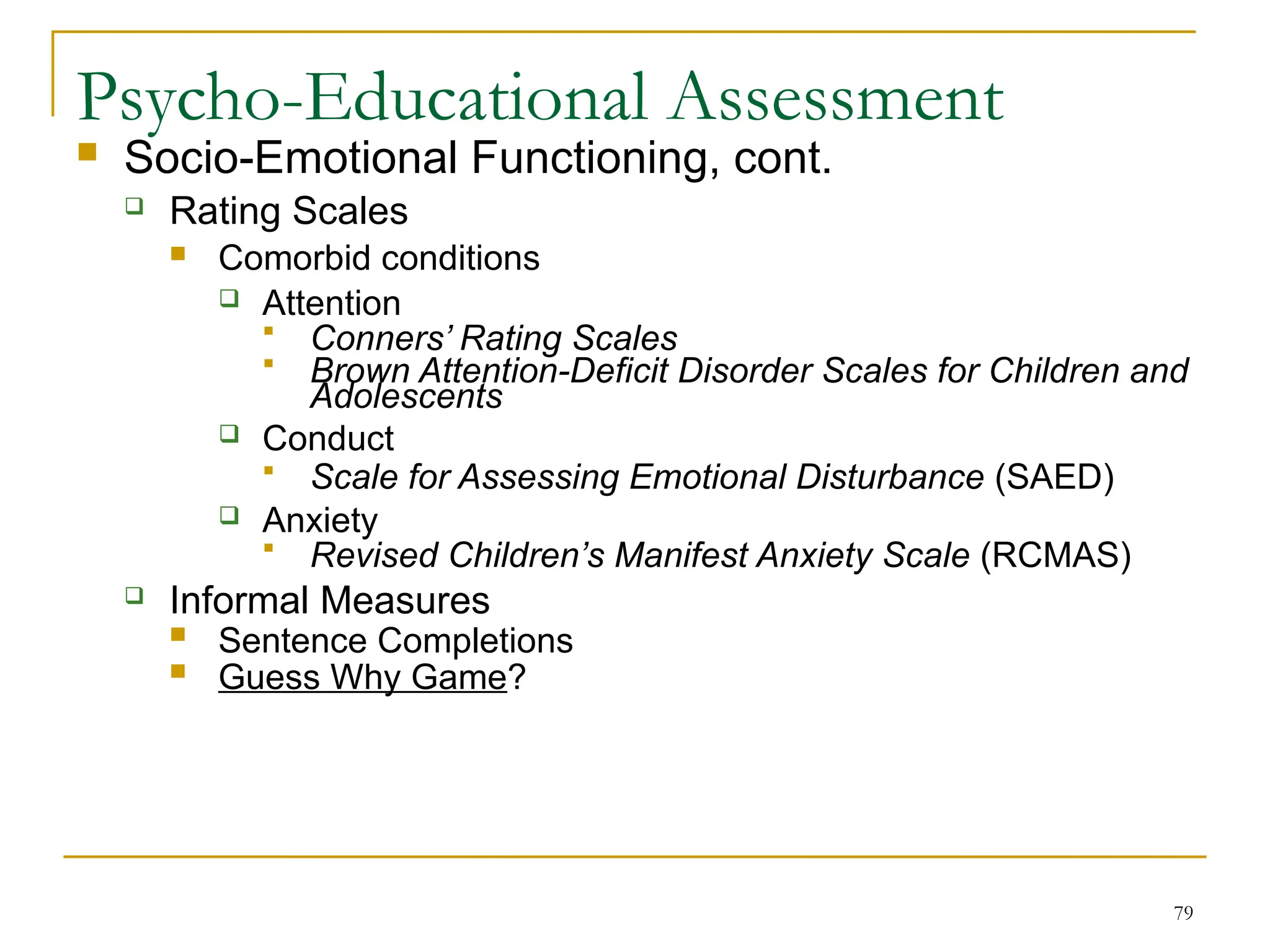
 Socio-Emotional Functioning, cont.
 Rating Scales
 Comorbid conditions
 Attention
 Conners’ Rating Scales
 Brown Attention-Deficit Disorder Scales for Children and
Adolescents
 Conduct
 Scale for Assessing Emotional Disturbance (SAED)
 Anxiety
 Revised Children’s Manifest Anxiety Scale (RCMAS)
 Informal Measures
 Sentence Completions
 Guess Why Game?
80
Psycho-Educational Assessment
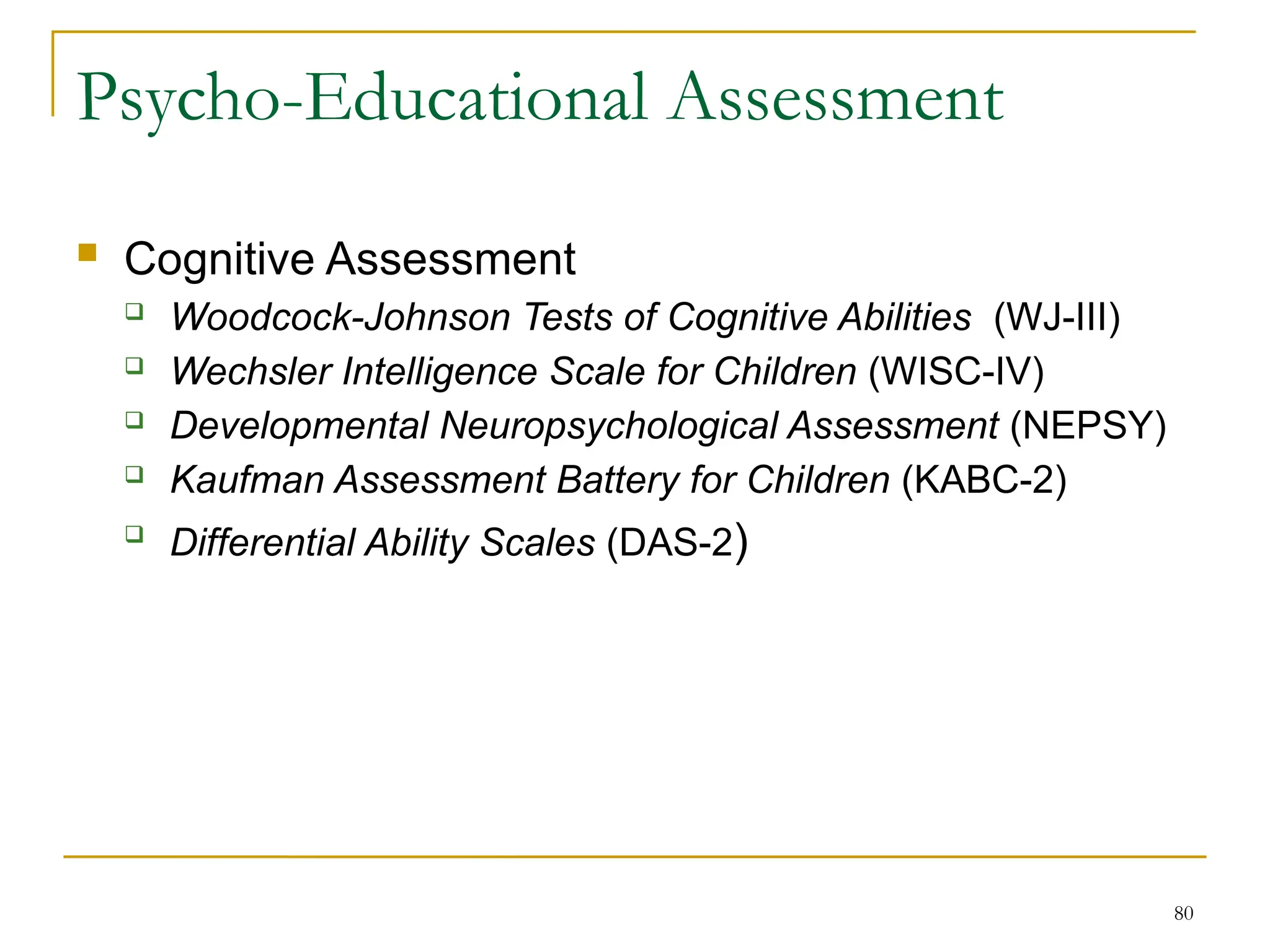
 Cognitive Assessment
 Woodcock-Johnson Tests of Cognitive Abilities (WJ-III)
 Wechsler Intelligence Scale for Children (WISC-IV)
 Developmental Neuropsychological Assessment (NEPSY)
 Kaufman Assessment Battery for Children (KABC-2)

Differential Ability Scales (DAS-2)
81
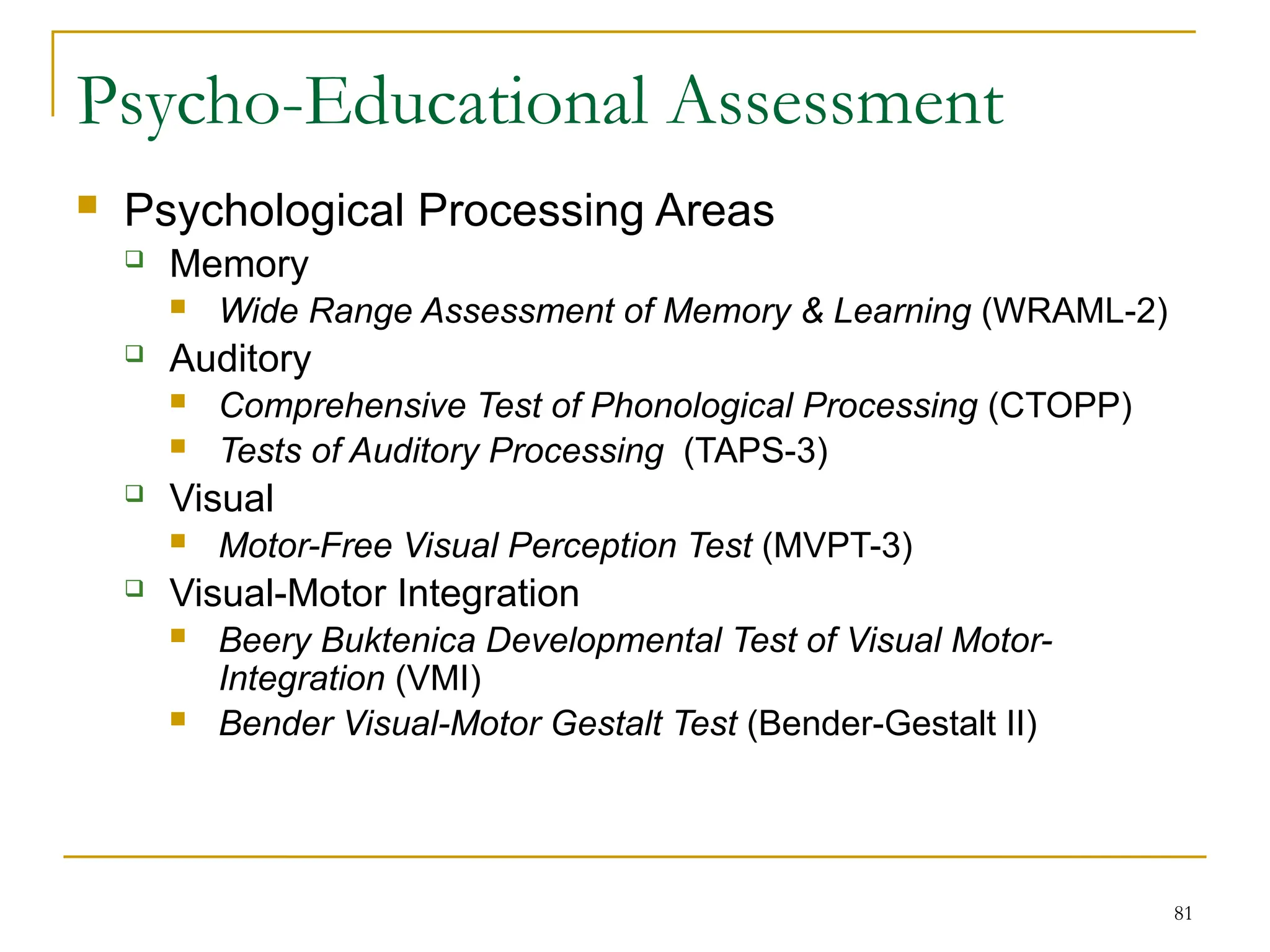
Psycho-Educational Assessment
 Psychological Processing Areas
 Memory
 Wide Range Assessment of Memory & Learning (WRAML-2)
 Auditory
 Comprehensive Test of Phonological Processing (CTOPP)
 Tests of Auditory Processing (TAPS-3)
 Visual
 Motor-Free Visual Perception Test (MVPT-3)
 Visual-Motor Integration
 Beery Buktenica Developmental Test of Visual Motor-
Integration (VMI)
 Bender Visual-Motor Gestalt Test (Bender-Gestalt II)
82
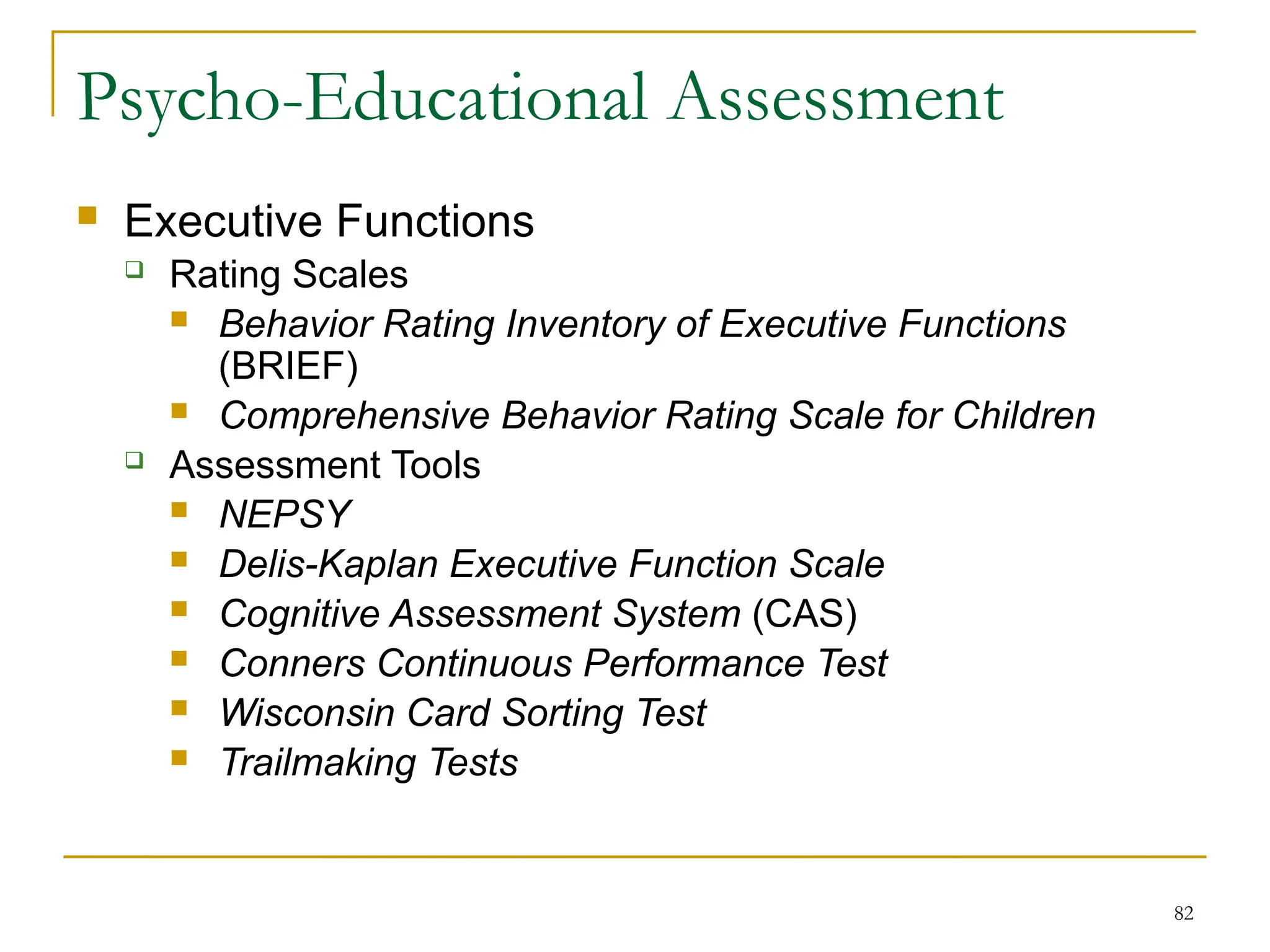
Psycho-Educational Assessment
 Executive Functions
 Rating Scales
 Behavior Rating Inventory of Executive Functions
(BRIEF)
 Comprehensive Behavior Rating Scale for Children
 Assessment Tools
 NEPSY
 Delis-Kaplan Executive Function Scale
 Cognitive Assessment System (CAS)
 Conners Continuous Performance Test
 Wisconsin Card Sorting Test
 Trailmaking Tests
83
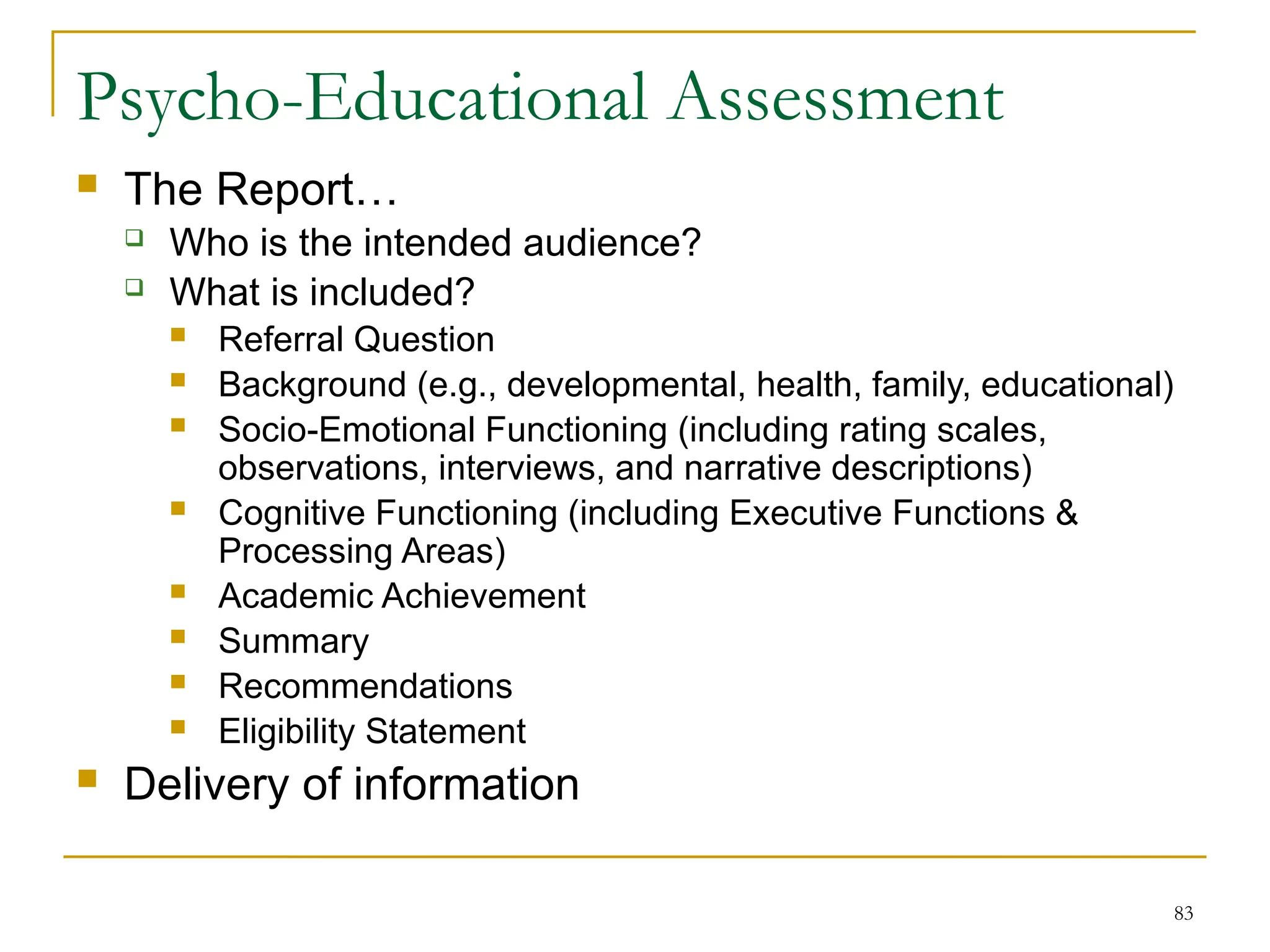
Psycho-Educational Assessment
 The Report…
 Who is the intended audience?
 What is included?
 Referral Question
 Background (e.g., developmental, health, family, educational)
 Socio-Emotional Functioning (including rating scales,
observations, interviews, and narrative descriptions)
 Cognitive Functioning (including Executive Functions &
Processing Areas)
 Academic Achievement
 Summary
 Recommendations
 Eligibility Statement
 Delivery of information
84
Special Education & Programming Issues
 Special Education or 504?
85
Special Education & Programming Issues
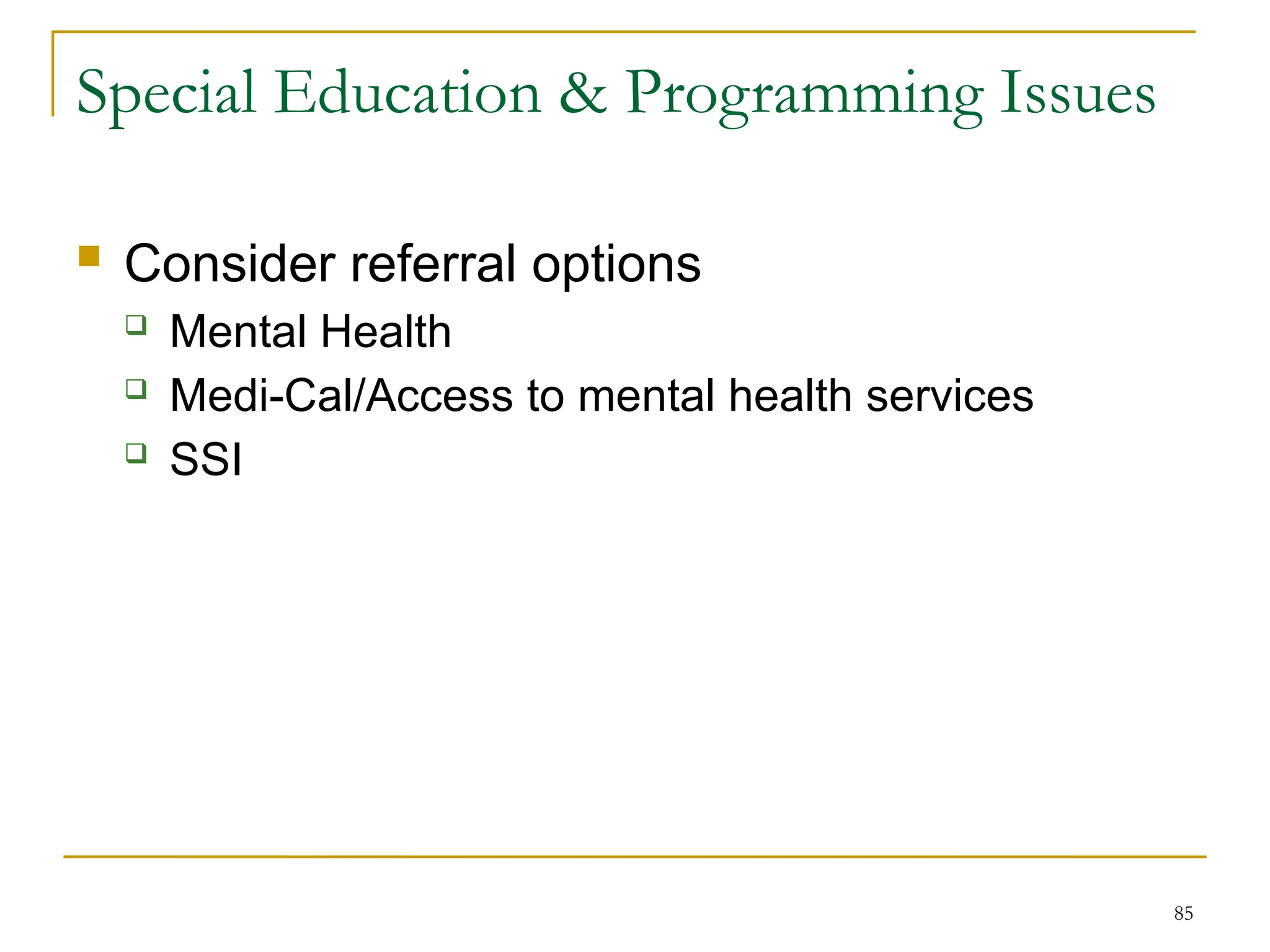
 Consider referral options
 Mental Health
 Medi-Cal/Access to mental health services
 SSI
86
Special Education & Programming Issues
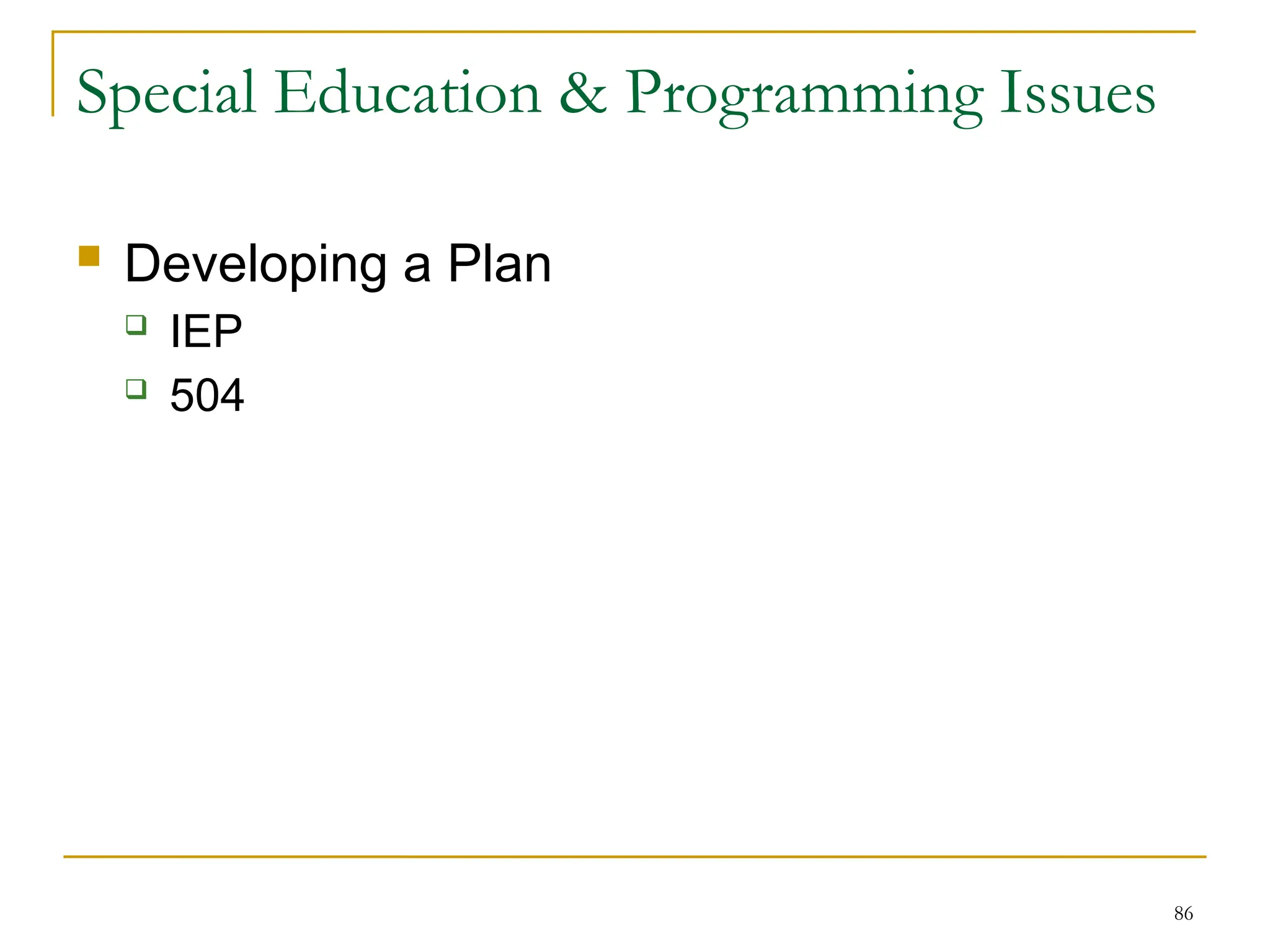
 Developing a Plan
 IEP
 504
87
Special Education & Programming Issues
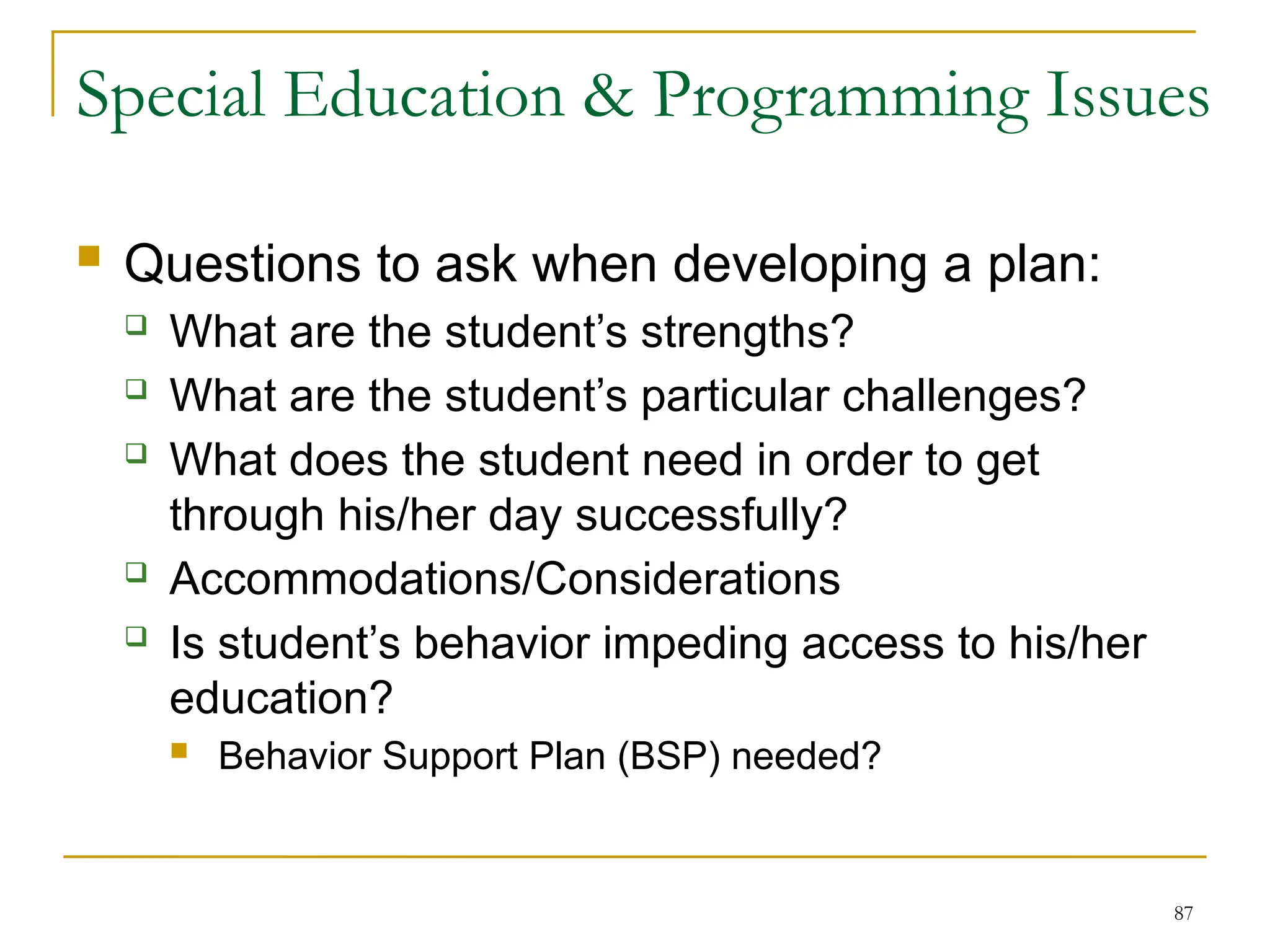
 Questions to ask when developing a plan:
 What are the student’s strengths?
 What are the student’s particular challenges?
 What does the student need in order to get
through his/her day successfully?
 Accommodations/Considerations
 Is student’s behavior impeding access to his/her
education?
 Behavior Support Plan (BSP) needed?
88
School-Based Interventions
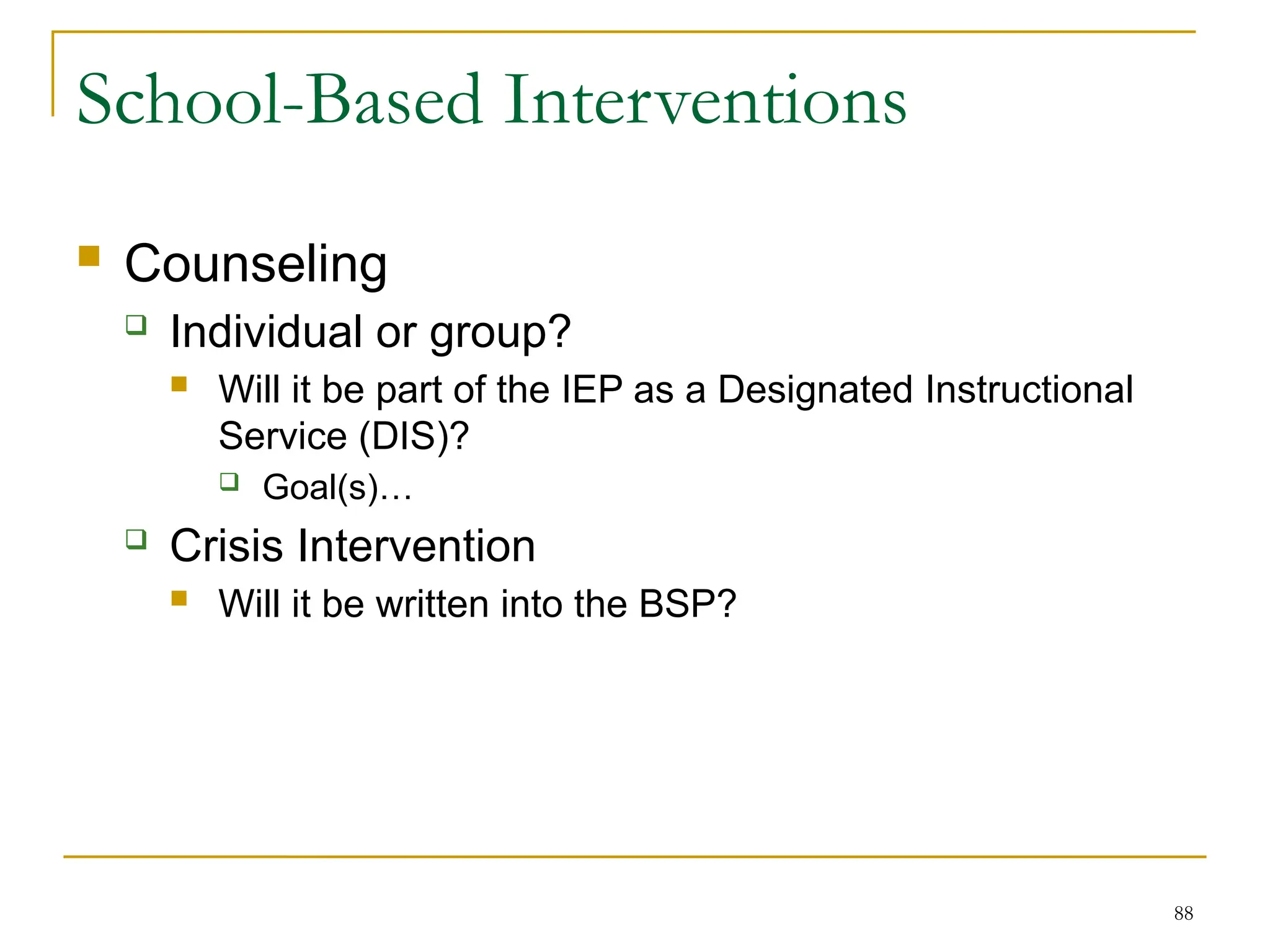
 Counseling
 Individual or group?
 Will it be part of the IEP as a Designated Instructional
Service (DIS)?
 Goal(s)…
 Crisis Intervention
 Will it be written into the BSP?
89
School-Based Interventions
 Possible elements of a counseling program
 Education
 Coping skills
 Social skills
 Suicidal ideation/behaviors
 Substance use
90
School-Based Interventions
 Specific Recommendations
1. Build, maintain, and educate the school-based
team.
2. Prioritize IEP goals.
3. Provide a predictable, positive, and flexible
classroom environment.
4. Be aware of and manage medication side
effects.
5. Develop social skills.
6. Be prepared for episodes of intense emotion.
7. Consider alternatives to regular classroom.
Lofthouse & Fristad (2006, pp. 220-221)
91
References
AACAP. (2007). Practice parameter for the assessment and treatment of children and
adolescents with bipolar disorder. Journal of the American Academy of Child &
Adolescent Psychiatry, 46, 107-125.
American Psychiatric Association. (2013). Diagnostic and statistical manual of mental
disorders (5th
ed.). Washington, DC: Author.
Baum, A. E., Akula, N., Cabanero, M., Cardona, I., Corona, W., Klemens, B., Schulze, T. G.,
Cichon, S., Rietsche, l. M., Nöthen, M. M., Georgi, A., Schumacher, J., Schwarz, M.,
Abou Jamra, R., Höfels, S., Propping, P., Satagopan, J., Detera-Wadleigh, S. D.,
Hardy, J., & McMahon, F. J. (2007). A genome-wide association study implicates
diacylglycerol kinase eta (DGKH) and several other genes in the etiology of bipolar
disorder. Molecular Psychiatry, [E-pub ahead of print].
Danielyan, A., Pathak, S., Kowatch, R. A., Arszman, S. P., & Jones, E. S. (2007). Clinical
characteristics of bipolar disorder in very young children. Journal of Affective
Disorders, 97, 51-59.
Faraone, S. V., Glatt, S. J., & Tsuang, M. T. (2003). The genetics of pediatric-onset bipolar
disorder. Biological Psychiatry, 53, 970-977.
Geller, B., Tillman, R., Craney, J. L., & Bolhofner, K. (2004). Four-year prospective outcome
and natural history of mania in children with a prepubertal and early adolescent bipolar
disorder phenotype. Archives of General Psychiatry, 61, 459-467.
Geller, B., Williams, M., Zimerman, B., Frazier, J., Beringer, L., & Warner, K. L. (1998).
Prepubertal and early adolescent bipolarity differentiate from ADHD by manic
symptoms, grandiose delusions, ultra-rapid or ultradian cycling. Journal of Affective
Disorders, 51, 81-91.
92
References
Hajek, T., Carrey, N., & Alda, M. (2005). Neuroanatomical abnormalities as risk factors for
bipolar disorder. Bipolar Disorders, 7, 393-403.
Leibenluft, E., Charney, D. S., Towbin, K. E., Bhangoo, R. K., & Pine, D. S. (2003). Defining
clinical phenotypes of juvenile mania. American Journal of Psychiatry, 160, 430-437.
Lofthouse, N. L., & Fristad, M. A. (2006). Bipolar disorders. In G. G. Bear & K. M. Minke
(Eds.) Children’s needs III: Development, prevention, and intervention (pp. 211-224).
Bethesda, MD: National Association of School Psychologists.
Masi, G., Perugi, G., Millepiedi, S., Mucci, M., Toni, C., Bertini, N., Pfanner, C., Berloffa, S.,
& Pari, C. (2006). Developmental difference according to age at onset in juvenile
bipolar disorder. Journal of Child and Adolescent Psychopharmacology, 16, 679-685.
NIMH. (2001). National Institute of Mental Health research roundtable on prepubertal
biopolar disorder. Journal of the American Academy of Child & Adolescent Psychiatry,
40, 871-878..
NIMH. (2007). Bipolar disorder. Bethesda, MD: Author. Retrieved May 28, 2007, from
http://www.nimh.nih.gov/publicat/bipolar.cfm
Pavuluri, M. N., Birmaher, B., & Naylor, M. W. (2005). Pediatric bipolar disorder: A review of
the past 10 years. Journal of the American Academy of Child and Adolescent
Psychiatry, 44, 846-871.
Wozniak, J., Biederman, J., Kiely, K., Ablon, J. S., Faraone, S. V., Mundy, E., & Mennin, D.
(1995). Mania-like symptoms suggestive of childhood-onset bipolar disorder in
clinically referred children. Journal of the American Academy of Child & Adolescent
Psychiatry, 34, 867-876.
93
Assessment and Intervention
for Bipolar Disorder:
Best Practices for School Psychologists
Stephen E. Brock, Ph.D., NCSP, LEP
California State University Sacramento
brock@csus.edu
http://www.csus.edu/indiv/b/brocks/

Assessment and intervention for bipolar disorder.

  • 1.
    1 Assessment and Intervention forBipolar Disorder: Best Practices for School Psychologists
  • 2.
    2 Acknowledgements  Adapted from… Hart,S. R., & Brock, S. E., & Jeltova, I. (2013). Assessing, identifying, and treating bipolar disorder at school. New York: Springer.
  • 3.
    3 Lecture Outline  Diagnosis Course  Co-existing Disabilities  Associated Impairments  Etiology, Prevalence & Prognosis  Treatment  Best Practices for School Psychologists
  • 4.
    4 Lecture Goals You will… 1.gain an overview of bipolar disorder. 2. acquire a sense of what is like to have bipolar disorder. 3. learn what to look for and what questions to ask when screening for bipolar disorder. 4. understand important special education issues, including the psycho-educational evaluation of a student with a known or suspected bipolar disorder.
  • 5.
    5 It is asif my life were magically run by two electric currents: joyous positive and despairing negative - whichever is running at the moment dominates my life, floods it. Sylvia Plath (2000) The Unabridged Journals of Sylvia Plath, 1950-1962 New York: Anchor Books
  • 6.
    6 Presentation Outline  Diagnosis Course  Co-existing Disabilities  Associated Impairments  Etiology, Prevalence & Prognosis  Treatment  Best Practices for School Psychologists
  • 7.
  • 8.
    8 DSM-5 Diagnosis 1. Importanceof early diagnosis 2. Pediatric bipolar disorder is especially challenging to identify.  Characterized by severe affect dysregulation, high levels of agitation, aggression.  Relative to adults, children have a mixed presentation, a chronic course, poor response to mood stabilizers, high co-morbidity with ADHD 3. Symptoms similar to other disorders.  For example, ADHD, depression, Oppositional Defiant Disorder, Obsessive Compulsive Disorder, and Separation Anxiety Disorder. 4. Treatments differ significantly. 5. The school psychologist may be the first mental health professional to see bipolar. Faraon et al. (2003)
  • 9.
    9 DSM-5 Diagnosis  DiagnosticClassifications 1. Bipolar I Disorder  One or more Manic Episode or Mixed Manic Episode  Minor or Major Depressive Episodes often present  May have psychotic symptoms  Specifiers: anxious distress, mixed features, rapid cycling, melancholic features, atypical features, mood-congruent psychotic features, mood incongruent psychotic features, catatonia, peripartium onset, seasonal pattern  Severity Ratings: Mild, Moderate, Severe (DSM-5, p. 154) APA (2013)
  • 10.
    10 DSM-5 Diagnosis  DiagnosticClassifications 2. Bipolar II Disorder  One or more Major Depressive Episode  One or more Hypomanic Episode  No full Manic or Mixed Manic Episodes  Specifiers: anxious distress, mixed features, rapid cycling, melancholic features, atypical features, mood-congruent psychotic features, mood incongruent psychotic features, catatonia, peripartium onset, seasonal patter  Severity Ratings: Mild, Moderate, Severe (DSM-5, p. 154) APA (2013)
  • 11.
    11 DSM-5 Diagnosis  DiagnosticClassifications 3. Cyclothymia  For at least 2 years (1 in children and adolescents), numerous periods with hypomanic symptoms that do not meet the criteria for hypomanic  Present at least ½ the time and not without for longer than 2 months  Criteria for major depressive, manic, or hypomanic episode have never been met APA (2013)
  • 12.
    12 DSM-5 Diagnosis  DiagnosticClassifications 4. Unspecified Bipolar and Related Disorder  Bipolar features that do not meet criteria for any specific bipolar disorder. APA (2013)
  • 13.
    13 DSM-5 Diagnosis  ManicEpisode Criteria  A distinct period of abnormally and persistently elevated, expansive, or irritable mood.  Lasting at least 1 week.  Three or more (four if the mood is only irritable) of the following symptoms: 1. Inflated self-esteem or grandiosity 2. Decreased need for sleep 3. Pressured speech or more talkative than usual 4. Flight of ideas or racing thoughts 5. Distractibility 6. Psychomotor agitation or increase in goal-directed activity 7. Hedonistic interests APA (2013
  • 14.
    14 DSM-5 Diagnosis  ManicEpisode Criteria (cont.)  Causes marked impairment in occupational functioning in usual social activities or relationships, or  Necessitates hospitalization to prevent harm to self or others, or  Has psychotic features  Not due to substance use or abuse (e.g., drug abuse, medication, other treatment), or a general medial condition (e.g., hyperthyroidism).  A full manic episode emerging during antidepressant treatment APA (2013)
  • 15.
    15 Diagnosis: Manic Symptomsat School Symptom/Definition Example Euphoria: Elevated (too happy, silly, giddy) and expansive (about everything) mood, “out of the blue” or as an inappropriate reaction to external events for an extended period of time. A child laughs hysterically for 30 minutes after a mildly funny comment by a peer and despite other students staring at him. Irritability: Energized, angry, raging, or intensely irritable mood, “out of the blue” or as an inappropriate reaction to external events for an extended period of time. In reaction to meeting a substitute teacher, a child flies into a violent 20- minute rage. Inflated Self-Esteem or Grandiosity: Believing, talking or acting as if he is considerably better at something or has special powers or abilities despite clear evidence to the contrary A child believes and tells others she is able to fly from the top of the school building. From Lofthouse & Fristad (2006, p. 215)
  • 16.
    16 Diagnosis: Manic Symptomsat School Symptom/Definition Example Decreased Need for Sleep: Unable to fall or stay asleep or waking up too early because of increased energy, leading to a significant reduction in sleep yet feeling well rested. Despite only sleeping 3 hours the night before, a child is still energized throughout the day Increased Speech: Dramatically amplified volume, uninterruptible rate, or pressure to keep talking. A child suddenly begins to talk extremely loudly, more rapidly, and cannot be interrupted by the teacher Flight of Ideas or Racing Thoughts: Report or observation (via speech/writing) of speeded- up, tangential or circumstantial thoughts A teacher cannot follow a child’s rambling speech that is out of character for the child (i.e., not related to any cognitive or language impairment the child might have) From Lofthouse & Fristad (2006, p. 215)
  • 17.
    17 Diagnosis: Manic Symptomsat School Symptom/Definition Example Distractibility: Increased inattentiveness beyond child’s baseline attentional capacity. A child is distracted by sounds in the hallway, which would typically not bother her. Increase in Goal-Directed Activity or Psychomotor Agitation: Hyper- focused on making friends, engaging in multiple school projects or hobbies or in sexual encounters, or a striking increase in and duration of energy.. A child starts to rearrange the school library or clean everyone’s desks, or plan to build an elaborate fort in the playground, but never finishes any of these projects. Excessive Involvement in Pleasurable or Dangerous Activities: Sudden unrestrained participation in an action that is likely to lead to painful or very negative consequences. A previously mild-mannered child may write dirty notes to the children in class or attempt to jump out of a moving school bus. From Lofthouse & Fristad (2006, p. 215)
  • 18.
    18 Life feels likeit is supercharged with possibility… Ordinary activities are extraordinary!” “I become the Energizer Bunny on a supercharger. ‘Why does everybody else need so much sleep?’I wonder…. Hours pass like minutes, minutes like seconds. If I sleep it is briefly, and I awake refreshed, thinking, ‘This is going to be the best day of my life!’ Patrick E. Jamieson & Moira A. Rynn (2006) Mind Race: A Firsthand Account of One Teenager’s Experience with Bipolar Disorder. New York: Oxford University Press
  • 19.
    19 DSM-5 Diagnosis  HypomanicCriteria  Similarities with Manic Episode  Same symptoms  Differences from Manic Episode  Length of time  Impairment not as severe  May not be viewed by the individual as pathological  However, others may be troubled by erratic behavior APA (2013)
  • 20.
    20 DSM-5 Diagnosis  MajorDepressive Episode Criteria  A period of depressed mood or loss of interest or pleasure in nearly all activities  In children and adolescents, the mood may be irritable rather than sad.  Lasting consistently for at least 2 weeks.  Represents a significant change from previous functioning. APA (2013)
  • 21.
    21 DSM-5 Diagnosis  MajorDepressive Episode Criteria (cont.)  Five or more of the following symptoms (at least one of which is either (1) or (2): 1) Depressed mood 2) Diminished interest in activities 3) Significant weight loss or gain 4) Insomnia or hypersomnia 5) Psychomotor agitation or retardation 6) Fatigue/loss of energy 7) Feelings of worthlessness/inappropriate guilt 8) Diminished ability to think or concentrate/indecisiveness 9) Suicidal ideation or suicide attempt APA (2013)
  • 22.
    22 DSM-5 Diagnosis  MajorDepressive Episode Criteria (cont.)  Causes marked impairment in occupational functioning or in usual social activities or relationships  Not due to substance use or abuse, or a .general medial condition  Not better accounted for by Bereavement  After the loss of a loved one, the symptoms persist for longer than 2 months or are characterized by marked functional impairment, morbid preoccupation with worthlessness, suicidal ideation, psychotic symptoms, or psychomotor retardation APA (2013)
  • 23.
    23 Diagnosis: Major DepressiveSymptoms at School Symptom/Definition Example Depressed Mood: Feels or looks sad or irritable (low energy) for an extended period of time. A child appears down or flat or is cranky or grouchy in class and on the playground. Markedly Diminished Interest or Pleasure in All Activities: Complains of feeling bored or finding nothing fun anymore. A child reports feeling empty or bored and shows no interest in previously enjoyable school or peer activities. Significant Weight Lost/Gain or Appetite Increase/Decrease: Weight change of >5% in 1 month or significant change in appetite. A child looks much thinner and drawn or a great deal heavier, or has no appetite or an exce3sive appetite at lunch time. From Lofthouse & Fristad (2006, p. 216)
  • 24.
    24 Diagnosis: Major DepressiveSymptoms at School Symptom/Definition Example Insomnia or Hypersomnia: Difficulty falling asleep, staying asleep, waking up too early or sleeping longer and still feeling tired. A child looks worn out, is often groggy or tardy, or reports sleeping through alarm despite getting 12 hours of sleep. Psychomotor Agitation/Retardation: Looks restless or slowed down. A child is extremely fidgety or can’t say seated. His speech or movement is sluggish or he avoids physical activities. Fatigue or Loss of Energy: Complains of feeling tired all the time Child looks or complains of constantly feeling tired even with adequate sleep. From Lofthouse & Fristad (2006, p. 216)
  • 25.
    25 Diagnosis: Major DepressiveSymptoms at School Symptom/Definition Example Low Self-Esteem, Feelings of Worthlessness or Excessive Guilt: Thinking and saying more negative than positive things about self or feeling extremely bad about things one has done or not done. A child frequently tells herself or others “I’m no good, I hate myself, no one likes me, I can’t do anything.” She feels bad about and dwells on accidentally bumping into someone in the corridor or having not said hello to a friend. Diminished Ability to Think or Concentrate, or Indecisiveness: Increase inattentiveness, beyond child’s baseline attentional capacity; difficulty stringing thoughts together or making choices. A child can’t seem to focus in class, complete work, or choose unstructured class activities. From Lofthouse & Fristad (2006, p. 216)
  • 26.
    26 Diagnosis: Major DepressiveSymptoms at School Symptom/Definition Example Hopelessness: Negative thoughts or statements about the future. A child frequently thinks or says “nothing will change or will ever be good for me.” Recurrent Thoughts of Death or Suicidality: Obsession with morbid thoughts or events, or suicidal ideation, planning, or attempts to kill self A child talks or draws pictures about death, war casualties, natural disasters, or famine. He reports wanting to be dead, not wanting to live anymore, wishing he’d never been born; he draws pictures of someone shooting or stabbing him, writes a suicide note, gives possessions away or tires to kill self. From Lofthouse & Fristad (2006, p. 216)
  • 27.
    27 DSM-5 Diagnosis  Rapid-CyclingSpecifier  Can be applied to Bipolar I or II  Four or more mood episodes (i.e., Major Depressive, Manic, Mixed, or Hypomanic) per 12 months  May occur in any order or combination  Must be demarcated by …  a period of full remission, or  a switch to an episode of the opposite polarity  Manic, Hypomanic, and Mixed are on the same pole  NOTE: This definition is different from that used in some literature, where in cycling refers to mood changes within an episode (Geller et al., 2004). APA (2013)
  • 28.
    Changes From DSM-IV-TR No longer classified as a “mood disorder” – has own category  Placed between the chapters on schizophrenia and depressive disorders  Consistent with their place between the two diagnostic classes in terms of symptomatology, family history, and genetics.  Bipolar I criteria have not changed  Bipolar II must have hypomanic as well as history of major depression and have clinically significant  can now include episodes with mixed features.  past editions, a person who had mixed episodes would not be diagnosed with bipolar II  diagnosis of hypomania or mania will now require a finding of increased energy, not just change in mood Source: APA (2013) 28
  • 29.
     pinpoint thepredominant mood (“features”)  a person must now exhibit changes in mood as well as energy  For example, a person would have to be highly irritable and impulsive in addition to not having a need for sleep  helps to separate bipolar disorders from other illnesses that may have similar symptoms.  intention is to cut down on misdiagnosis, resulting in more effective bipolar disorder treatment. - 29 Rationale for DSM-5 Changes
  • 30.
     Still doesnot address potential bipolar children and adolescents  Could miss bipolar in children and then prescribe medication that make symptoms worse  Hopefully will increased accuracy with diagnosis 30 Possible Consequences of DSM-5
  • 31.
    Implications for SchoolPsychologists  Children who experience bipolar-like phenomena that do not meet criteria for bipolar I, bipolar II, or cyclothymic disorder would be diagnosed “other specified bipolar and related disorder”  If they have explosive tendencies may be (mis)diagnosed with Disruptive Mood Dysregulation Disorder  focus too much on externalizing behaviors and ignore possible underlying depressive symptoms 31
  • 32.
    Bipolar I Alternative DiagnosisDifferential Consideration Major Depressive Disorder Person with depressive Sx never had Manic/Hypomanic episodes Bipolar II Hypomanic episodes, w/o a full Manic episode Cyclothymic Disorder Lesser mood swings of alternating depression - hypomania (never meeting depressive or manic criteria) cause clinically significant distress/impairment Normal Mood Swings Alternating periods of sadness and elevated mood, without clinically significant distress/impairment Schizoaffective Disorder Sx resemble Bipolar I, severe with psychotic features but psychotic Sx occur absent mood Sx Schizophrenia or Delusional Disorder Psychotic symptoms dominate. Occur without prominent mood episodes Substance Induced Bipolar Disorder Stimulant drugs can produce bipolar Sx 32 Source: Francis (2013)
  • 33.
    Bipolar II Alternative DiagnosisDifferential Consideration Major Depressive Disorder No Hx of hypomanic (or manic) episodes Bipolar I At least 1 manic episode Cyclothymic Disorder Mood swings (hypomania to mild depression) cause clinically significant distress/impairment; no history of any Major Depressive Episode Normal Mood Swings Alternately feels a bit high and a bit low, but with no clinically significant distress/impairment Substance Induced Bipolar Disorder Hypomanic episode caused by antidepressant medication or cocaine ADHD Common Sx presentation, but ADHD onset is in early childhood. Course chronic rather than episodic. Does not include features of elevated mood. 33 Source: Francis (2013)
  • 34.
    Cyclothymic Disorder Alternative DiagnosisDifferential Consideration Normal Mood Swings Ups &downs without clinically significant distress/impairment Major Depressive Disorder Had a major depressive episode Bipolar I At least one Manic episode Bipolar II At least one clear Major Depressive episode Substance Induced Bipolar Disorder Mood swings caused by antidepressant medication or cocaine. Stimulant drugs can produce bipolar symptoms 34 Source: Francis (2013)
  • 35.
    35 Diagnosis: Juvenile BipolarDisorder  Terms used to define juvenile bipolar disorder.  Ultrarapid cycling = 5 to 364 episodes/year  Brief frequent manic episodes lasting hours to days, but less than the 4-days required under Hypomania criteria (10%).  Ultradian cycling = >365 episodes/year  Repeated brief cycles lasting minutes to hours (77%).  Chronic baseline mania (Wozniak et al., 1995).  Ultradian is Latin for “many times per day.” AACAP (2007); Geller et al. (2000)
  • 36.
    36 Diagnosis: Juvenile BipolarDisorder  Adults  Discrete episodes of mania or depression lasting to 2 to 9 months.  Clear onset and offset.  Significant departures from baseline functioning.  Juveniles  Longer duration of episodes  Higher rates or rapid cycling.  Lower rates of inter-episode recovery.  Chronic and continuous. AACAP (2007); NIMH (2001)
  • 37.
    37 Diagnosis: Juvenile BipolarDisorder  Adults  Mania includes marked euphoria, grandiosity, and irritability  Racing thoughts, increased psychomotor activity, and mood lability.  Adolescents  Mania is frequently associated with psychosis, mood lability, and depression.  Tends to be more chronic and difficult to treat than adult BPD.  Prognosis similar to worse than adult BPD  Prepubertal Children  Mania involves markedly labile/erratic changes in mood, energy levels, and behavior.  Predominant mood is VERY severe irritability (often associated with violence) rather than euphoria.  Irritability, anger, belligerence, depression, and mixed features are more common .  Mania is commonly mixed with depression. AACAP (2007); NIMH (2001); Wozniak et al. (1995)
  • 38.
    38 Diagnosis: Juvenile BipolarDisorder  Unique Features of Pediatric Bipolar Disorder  Chronic with long episodes  Predominantly mixed episodes (20% to 84%) and/or rapid cycling (46% to 87%)  Prominent irritability (77% to 98%)  High rate of comorbid ADHD (75% to 98%) and anxiety disorders (5% to 50%) Pavuluri et al. (2005)
  • 39.
    39 Diagnosis: Juvenile BipolarDisorder  Bipolar Disorder in childhood and adolescence appear to be the same clinical entity.  However, there are significant developmental variations in illness expression. Masi et al. (2006) Bipolar Disorder Onset Childhood Adolescent Male Gender 67.5% 48.2% Chronic Course 57.5% 23.3% Episodic Course 42.5% 76.8% Attention-deficit/Hyperactivity Disorder 38.7% 8.9% Oppositional Defiant Disorder 35.9% 10.7%
  • 40.
    40 Diagnosis: Juvenile BipolarDisorder Danielyan et al. (2007) 0 10 20 30 40 50 60 70 80 90 Aggression Irritability Sleep disturbances Increased E nergy Elated M ood Silliness D istractability H ypersexuality D aredevel acts H allucinations G randiosity Poor Judgem ent Accelerated speech D epression M ixed M ood  The most frequent presenting symptoms among outpatient clinic referred 3 to 7 year olds with mood and behavioral symptoms
  • 41.
    41 Diagnosis: Juvenile BipolarDisorder  NIMH Roundtable  Bipolar disorder exists among prepubertal children.  Narrow Phenotype  Meet full DSM-IV criteria  More common in adolescent-onset BPD  Broad Phenotype  Don’t meet full DSM-IV criteria, but have BPD symptoms that are severely impairing.  More common in childhood-onset BPD  Suggested use of the BPD NOS category to children who did not fit the narrow definition of the disorder. NIMH (2001)
  • 42.
    42 Diagnosis: Juvenile BipolarDisorder 1. Sleep/Wake Cycle Disturbances 2. ADHD-like symptoms 3. Aggression/Poor Frustration Tolerance 4. Intense Affective Rages 5. Bossy and overbearing, extremely oppositional 6. Fear of Harm or social phobia 7. Hypersexuality 8. Laughing hysterically/acting infectiously happy 9. Deep depression 10. Sensory Sensitivities 11. Carbohydrate Cravings 12. Somatic Complaints  24: A Day in the Life
  • 43.
    43 I felt likeI was a very old woman who was ready to die. She had suffered enough living. --- Abbey Tracy Anglada Intense Minds: Through the Eyes of Young People with Bipolar Disorder (2006) Victoria, BC: Trafford Publishing
  • 44.
    44 Presentation Outline  Diagnosis Course  Co-existing Disabilities  Associated Impairments  Etiology, Prevalence & Prognosis  Treatment  Best Practices for School Psychologists
  • 45.
    45 Course: Pediatric BipolarDisorder  Remission  2 to 7 weeks without meeting DSM criteria  Recovery  8 weeks without meeting DSM criteria  40% to 100% will recovery in a period of 1 to 2 years  Relapse  2 weeks meeting DSM criteria  60% to 70% of those that recover relapse on average between 10 to 12 months  Chronic  Failure to recover for a period of at least 2 years Pavuluri et al. (2005)
  • 46.
    46 Presentation Outline  Diagnosis Course  Co-existing Disabilities  Associated Impairments  Etiology, Prevalence & Prognosis  Treatment  Best Practices for the School Psychologist  Psycho-Educational Assessment  Special Education & Programming Issues  School-Based Interventions
  • 47.
    47 Co-existing Disabilities  Attention-deficit/HyperactivityDisorder (AD/HD)  Rates range between 11% and 75%  Oppositional Defiant Disorder  Rates range between 46.4% and 75%  Conduct Disorder  Rates range between 5.6 and 37%  Anxiety Disorders  Rates range betwee12.5% and 56%  Substance Abuse Disorders  0 to 40% Pavuluri et al. (2005)
  • 48.
    48 Co-existing Disabilities Bipolar Disorder(mania) 1. More talkative than usual, or pressure to keep talking 2. Distractibility 3. Increase in goal directed activity or psychomotor agitation AD/HD 1. Often talks excessively 2. Is often easily distracted by extraneous stimuli 3. Is often “on the go” or often acts as if “driven by a motor” Differentiation = irritable and/or elated mood, grandiosity, decreased need for sleep, hypersexuality, and age of symptom onset (Geller et al., 1998). AD/HD Criteria Comparison
  • 49.
    49 Co-existing Disabilities  DevelopmentalDifferences  Children have higher rates of ADHD than do adolescents  Adolescents have higher rates of substance abuse  Risk of substance abuse 8.8 times higher in adolescent-onset bipolar disorder than childhood-onset bipolar disorder  Children have higher rates of pervasive developmental disorder (particularly Asperger’s Disorder, 11%)  Similar but not comorbid  Unipolar Depression  Schizophrenia Pavuluri et al. (2005)
  • 50.
    50 Presentation Outline  Diagnosis Course  Co-existing Disabilities  Associated Impairments  Etiology, Prevalence & Prognosis  Treatment  Best Practices for School Psychologists
  • 51.
    51 Associated Impairments Suicidal Behaviors Prevalence of suicide attempts  40-45%  Age of first attempt  Multiple attempts  Severity of attempts  Suicidal ideation
  • 52.
    52 Associated Impairments Cognitive Deficits Executive Functions  Attention  Memory  Sensory-Motor Integration  Nonverbal Problem-Solving  Academic Deficits  Mathematics
  • 53.
    53 Associated Impairments Psychosocial Deficits Relationships  Peers  Family members  Recognition and Regulation of Emotion  Social Problem-Solving  Self-Esteem  Impulse Control
  • 54.
    54 Presentation Outline  Diagnosis Course  Co-existing Disabilities  Associated Impairments  Etiology, Prevalence & Prognosis  Treatment  Best Practices for the School Psychologists
  • 55.
    55  Although theetiology of [early onset bipolar spectrum disorder] is not known, substantial evidence in the adult literature and more recent research with children and adolescents suggest a biological basis involving genetics, various neurochemicals, and certain affected brain regions.  It is distinctly possible that the differing clinical presentations of pediatric BD are not unitary entities but diverse in etiology and pathophysiology. Etiology Lofthouse & Fristad (2006, p. 212); Pavuluri et al. (2005, p. 853)
  • 56.
    56  Genetics 1. FamilyStudies 2. Twin Studies  MZ = .67; DZ = .20 concordance 3. Adoption Studies 4. Genetic Epidemiology  Early onset BD = confers greater risk to relatives 5. Molecular genetic  Aggregates among family members  Appears highly heritable  Environment = a minority of disease risk Etiology Baum et al. (2007); Faraone et al. (2003); Pavuluri et al. (2005)
  • 57.
    57  Neuroanatomical differences Whitematter hyperintensities.  Small abnormal areas in the white matter of the brain (especially in the frontal lobe).  Smaller amygdala  Decreased hipocampal volume Etiology Hajek et al. (2005); Pavuluri et al. (2005)
  • 58.
    58 DLPFC Basal Ganglia  Neuroanatomicaldifferences  Reduced gray matter volume in the dorsolateral prefrontal cortex (DLPFC)  Bilaterally larger basal ganglia  Specifically larger putamen Etiology Hajek et al. (2005); Pavuluri et al. (2005)
  • 59.
    59 Prevalence & Epidemiology No data on the prevalence of preadolescent bipolar disorder  Lifetime prevalence among 14 to 18 year olds, 1%  Subsyndromal symptoms, 5.7%  Mean age of onset, 10 to 12 years  First episode usually depression Pavuluri et al. (2005)
  • 60.
    60 Prognosis  With respectto prognosis …, [early onset bipolar spectrum disorder] may include a prolonged and highly relapsing course; significant impairments in home, school, and peer functioning; legal difficulties; multiple hospitalizations and increased rates of substance abuse and suicide  In short, children with [early onset bipolar spectrum disorder] have a chronic brain disorder that is biopsychosocial in nature and, at this current time, cannot be cured or grown out of Lofthouse & Fristad (2006, p. 213-214)
  • 61.
    61 Prognosis Outcome by subtype(research with adults)  Bipolar Disorder I  More severe; tend to experience more cycling & mixed episodes; experience more substance abuse; tend to recover to premorbid level of functioning between episodes.  Bipolar Disorder II  More chronic; more episodes with shorter inter-episode intervals; more major depressive episodes; typically present with less intense and often unrecognized manic phases; tend to experience more anxiety.  Cyclothymia  Can be impairing; often unrecognized; many develop more severe form of Bipolar illness.  Bipolar Disorder Not Otherwise Specified (NOS)  Largest group of individuals
  • 62.
    62 Presentation Outline  Diagnosis Course  Co-existing Disabilities  Associated Impairments  Etiology, Prevalence & Prognosis  Treatment  Best Practices for School Psychologists
  • 63.
    63 Treatment DEPRESSION  Mood Stabilizers Lamictal  Anti-Obsessional  Paxil  Anti-Depressant  Wellbutrin  Atypical Antipsychotics  Zyprexa MANIA  Mood Stabillizers  Lithium, Depakote, Depacon, Tegretol  Atypical Antipsychotics  Zyprexa, Seroquel, Risperdal, Geodon, Abilify  Anti-Anxiety  Benzodiazepines  Klonopin, Ativan Psychopharmacological
  • 64.
    64 Treatment Psychopharmacology Cont.  Lithium: History  Side effects/drawbacks  Blood levels drawn frequently  Weight gain  Increased thirst, increased urination, water retention  Nausea, diarrhea  Tremor  Cognitive dulling (mental sluggishness)  Dermatologic conditions  Hypothyroidism  Birth defects  Benefits & protective qualities  Brain-Derived Neurotropic Factor (BDNF) & Apoptosis  Suicide
  • 65.
    65 Treatment  Therapy  Psycho-Education Family Interventions  Multifamily Psycho-education Groups (MFPG)  Cognitive-Behavioral Therapy (CBT)  RAINBOW Program  Interpersonal and Social Rhythm Therapy (IPSRT)  Schema-focused Therapy
  • 66.
    66 Treatment  Alternative Treatments Light Therapy  Electro-Convulsive Therapy (ECT) & Repeated Transcranial Magnetic Stimulation (r-TMS)  Circadian Rhythm  Melatonin  Nutritional Approaches  Omega-3 Fatty Acids
  • 67.
    67 Presentation Outline  Diagnosis Course  Co-existing Disabilities  Associated Impairments  Etiology, Prevalence & Prognosis  Treatment  Best Practices for School Psychologists  Recognize Educational Implications  Psycho-Educational Assessment  Special Education & Programming Issues  School-Based Interventions
  • 68.
    68 Recognize Educational Implications Grade retention  Learning disabilities  Special Education  Required tutoring  Adolescent onset = significant disruptions  Before onset  71% good to excellent work effort  58% specific academic strengths  83% college prep classes  After onset  67% significant difficulties in math  38% graduated from high school Lofthouse & Fristad (2006)
  • 69.
    69 Psycho-Educational Assessment  Identificationand Evaluation  Recognize warning signs  Develop the Psycho-Educational Assessment Plan  Conduct the Assessment
  • 70.
    70 Psycho-Educational Assessment  TestingConsiderations  Who are the involved parties?  Student  Teachers  Parents  Others?  Release of Information  Referral Question  Understand the focus of the assessment  Eligibility Category?
  • 71.
    71 Psycho-Educational Assessment  SpecialEducation Eligibility Categories  Emotionally Disturbed (ED)  Other Health Impaired (OHI)
  • 72.
    72 Psycho-Educational Assessment  EDCriteria  An inability to learn that cannot be explained by other factors.  An inability to build or maintain satisfactory interpersonal relationships with peers and teachers.  Inappropriate types of behavior or feelings under normal circumstances.  A general pervasive mood of unhappiness or depression.  A tendency to develop physical symptoms or fears associated with personal or school problems.
  • 73.
    73 Psycho-Educational Assessment  OHICriteria  Having limited strength, vitality, or alertness, including a heightened alertness to environmental stimuli, that results in limited alertness with respect to the educational environment that:  is due to chronic or acute health problems such as asthma, attention deficit disorder or attention deficit hyperactivity disorder, diabetes, epilepsy, a heart condition, hemophilia, lead poisoning, leukemia, nephritis, rheumatic fever, and sickle cell anemia; and  adversely affects a child’s educational performance.
  • 74.
    74 Psycho-Educational Assessment ED OHI Likely more opportunity to access special programs.  Label less stigmatizing.  Can be an accurate representation.  Also an accurate representation.  Draws attention to mood issues.  Implies a medical condition that is outside of the student’s control.  Represents the presentation of the disorder.  Represents the origin of the disorder.
  • 75.
    75 Psycho-Educational Assessment  Health& Developmental  Family History  Health History  Medical History
  • 76.
    76 Psycho-Educational Assessment  CurrentMedical Status  Vision/Hearing  Any medical conditions that may be impacting presentation?  Medications
  • 77.
    77 Psycho-Educational Assessment  Observations What do you want to know?  Where do you want to see the child?  What type of information will you be collecting?  Interviews  Who?  Questionnaires, phone calls, or face-to-face?
  • 78.
    78 Psycho-Educational Assessment  Socio-EmotionalFunctioning  Rating Scales  General  Child-Behavior Checklist (CBCL)  Behavior Assessment System for Children (BASC-II)  Devereux Scales of Mental Disorders (DSMD)  Mania  Washington University in St. Louis Kiddie Schedule for Affective Disorders and Schizophrenia (WASH-U KSADS)  Young Mania Rating Scale  General Behavior Inventory (GBI)  Depression  Beck Depression Inventory (BDI)  Hamilton Rating Scale for Depression  Reynolds Adolescent Depression Scale (RADS-2)
  • 79.
    79 Psycho-Educational Assessment  Socio-EmotionalFunctioning, cont.  Rating Scales  Comorbid conditions  Attention  Conners’ Rating Scales  Brown Attention-Deficit Disorder Scales for Children and Adolescents  Conduct  Scale for Assessing Emotional Disturbance (SAED)  Anxiety  Revised Children’s Manifest Anxiety Scale (RCMAS)  Informal Measures  Sentence Completions  Guess Why Game?
  • 80.
    80 Psycho-Educational Assessment  CognitiveAssessment  Woodcock-Johnson Tests of Cognitive Abilities (WJ-III)  Wechsler Intelligence Scale for Children (WISC-IV)  Developmental Neuropsychological Assessment (NEPSY)  Kaufman Assessment Battery for Children (KABC-2)  Differential Ability Scales (DAS-2)
  • 81.
    81 Psycho-Educational Assessment  PsychologicalProcessing Areas  Memory  Wide Range Assessment of Memory & Learning (WRAML-2)  Auditory  Comprehensive Test of Phonological Processing (CTOPP)  Tests of Auditory Processing (TAPS-3)  Visual  Motor-Free Visual Perception Test (MVPT-3)  Visual-Motor Integration  Beery Buktenica Developmental Test of Visual Motor- Integration (VMI)  Bender Visual-Motor Gestalt Test (Bender-Gestalt II)
  • 82.
    82 Psycho-Educational Assessment  ExecutiveFunctions  Rating Scales  Behavior Rating Inventory of Executive Functions (BRIEF)  Comprehensive Behavior Rating Scale for Children  Assessment Tools  NEPSY  Delis-Kaplan Executive Function Scale  Cognitive Assessment System (CAS)  Conners Continuous Performance Test  Wisconsin Card Sorting Test  Trailmaking Tests
  • 83.
    83 Psycho-Educational Assessment  TheReport…  Who is the intended audience?  What is included?  Referral Question  Background (e.g., developmental, health, family, educational)  Socio-Emotional Functioning (including rating scales, observations, interviews, and narrative descriptions)  Cognitive Functioning (including Executive Functions & Processing Areas)  Academic Achievement  Summary  Recommendations  Eligibility Statement  Delivery of information
  • 84.
    84 Special Education &Programming Issues  Special Education or 504?
  • 85.
    85 Special Education &Programming Issues  Consider referral options  Mental Health  Medi-Cal/Access to mental health services  SSI
  • 86.
    86 Special Education &Programming Issues  Developing a Plan  IEP  504
  • 87.
    87 Special Education &Programming Issues  Questions to ask when developing a plan:  What are the student’s strengths?  What are the student’s particular challenges?  What does the student need in order to get through his/her day successfully?  Accommodations/Considerations  Is student’s behavior impeding access to his/her education?  Behavior Support Plan (BSP) needed?
  • 88.
    88 School-Based Interventions  Counseling Individual or group?  Will it be part of the IEP as a Designated Instructional Service (DIS)?  Goal(s)…  Crisis Intervention  Will it be written into the BSP?
  • 89.
    89 School-Based Interventions  Possibleelements of a counseling program  Education  Coping skills  Social skills  Suicidal ideation/behaviors  Substance use
  • 90.
    90 School-Based Interventions  SpecificRecommendations 1. Build, maintain, and educate the school-based team. 2. Prioritize IEP goals. 3. Provide a predictable, positive, and flexible classroom environment. 4. Be aware of and manage medication side effects. 5. Develop social skills. 6. Be prepared for episodes of intense emotion. 7. Consider alternatives to regular classroom. Lofthouse & Fristad (2006, pp. 220-221)
  • 91.
    91 References AACAP. (2007). Practiceparameter for the assessment and treatment of children and adolescents with bipolar disorder. Journal of the American Academy of Child & Adolescent Psychiatry, 46, 107-125. American Psychiatric Association. (2013). Diagnostic and statistical manual of mental disorders (5th ed.). Washington, DC: Author. Baum, A. E., Akula, N., Cabanero, M., Cardona, I., Corona, W., Klemens, B., Schulze, T. G., Cichon, S., Rietsche, l. M., Nöthen, M. M., Georgi, A., Schumacher, J., Schwarz, M., Abou Jamra, R., Höfels, S., Propping, P., Satagopan, J., Detera-Wadleigh, S. D., Hardy, J., & McMahon, F. J. (2007). A genome-wide association study implicates diacylglycerol kinase eta (DGKH) and several other genes in the etiology of bipolar disorder. Molecular Psychiatry, [E-pub ahead of print]. Danielyan, A., Pathak, S., Kowatch, R. A., Arszman, S. P., & Jones, E. S. (2007). Clinical characteristics of bipolar disorder in very young children. Journal of Affective Disorders, 97, 51-59. Faraone, S. V., Glatt, S. J., & Tsuang, M. T. (2003). The genetics of pediatric-onset bipolar disorder. Biological Psychiatry, 53, 970-977. Geller, B., Tillman, R., Craney, J. L., & Bolhofner, K. (2004). Four-year prospective outcome and natural history of mania in children with a prepubertal and early adolescent bipolar disorder phenotype. Archives of General Psychiatry, 61, 459-467. Geller, B., Williams, M., Zimerman, B., Frazier, J., Beringer, L., & Warner, K. L. (1998). Prepubertal and early adolescent bipolarity differentiate from ADHD by manic symptoms, grandiose delusions, ultra-rapid or ultradian cycling. Journal of Affective Disorders, 51, 81-91.
  • 92.
    92 References Hajek, T., Carrey,N., & Alda, M. (2005). Neuroanatomical abnormalities as risk factors for bipolar disorder. Bipolar Disorders, 7, 393-403. Leibenluft, E., Charney, D. S., Towbin, K. E., Bhangoo, R. K., & Pine, D. S. (2003). Defining clinical phenotypes of juvenile mania. American Journal of Psychiatry, 160, 430-437. Lofthouse, N. L., & Fristad, M. A. (2006). Bipolar disorders. In G. G. Bear & K. M. Minke (Eds.) Children’s needs III: Development, prevention, and intervention (pp. 211-224). Bethesda, MD: National Association of School Psychologists. Masi, G., Perugi, G., Millepiedi, S., Mucci, M., Toni, C., Bertini, N., Pfanner, C., Berloffa, S., & Pari, C. (2006). Developmental difference according to age at onset in juvenile bipolar disorder. Journal of Child and Adolescent Psychopharmacology, 16, 679-685. NIMH. (2001). National Institute of Mental Health research roundtable on prepubertal biopolar disorder. Journal of the American Academy of Child & Adolescent Psychiatry, 40, 871-878.. NIMH. (2007). Bipolar disorder. Bethesda, MD: Author. Retrieved May 28, 2007, from http://www.nimh.nih.gov/publicat/bipolar.cfm Pavuluri, M. N., Birmaher, B., & Naylor, M. W. (2005). Pediatric bipolar disorder: A review of the past 10 years. Journal of the American Academy of Child and Adolescent Psychiatry, 44, 846-871. Wozniak, J., Biederman, J., Kiely, K., Ablon, J. S., Faraone, S. V., Mundy, E., & Mennin, D. (1995). Mania-like symptoms suggestive of childhood-onset bipolar disorder in clinically referred children. Journal of the American Academy of Child & Adolescent Psychiatry, 34, 867-876.
  • 93.
    93 Assessment and Intervention forBipolar Disorder: Best Practices for School Psychologists Stephen E. Brock, Ph.D., NCSP, LEP California State University Sacramento brock@csus.edu http://www.csus.edu/indiv/b/brocks/

Editor's Notes

  • #1 New background knowledge offered here and in readings. Very applicable to your practice. Other knowledge will be required, but your prior training and study should have already prepared you for this aspect of the exam. Tonight you get all the “new stuff”
  • #3 Very ambitious agenda for a 170 minute presentation 7:00 to 8:20pm 8:20 to 8:30pm BREAK 8:30 to 9:50pm Only a short breat, but feel free to get up and move around. Feel free to be assertive and ask you questions if you feel I’m missing important topics that you want me to address.
  • #5 The classic understanding of bipolar (or “manic-depressive”) disorder
  • #6 In this section we will look first at diagnostic criteria. However, recognizing the fact that juvenile (AKA pediatric or early onset) bipolar disorder can be different from the adult form (which DSM is based upon) we will also explore how symptoms manifest themselves in the school setting. This is, from my experience, a very important part of what school psychologists need to know… We need to know how to recognize bipolar disorder so as to be able to make appropriate referrals.
  • #7 First, let’s take a look at the big picture and this slide provides such… Consider the various mood states in bipolar disorder as a continuous range. At one end is severe depression, above which is moderate depression and then mild low mood, which many people call "the blues" when it is short-lived but is termed "dysthymia" when it is chronic. Then there is normal or balanced mood, above which comes hypomania (mild to moderate mania), and then severe mania. In some people, however, symptoms of mania and depression may occur together in what is called a mixed bipolar state. Symptoms of a mixed state often include agitation, trouble sleeping, significant change in appetite, psychosis, and suicidal thinking. A person may have a very sad, hopeless mood while at the same time feeling extremely energized. Bipolar disorder may manifest as a problem other than mental illness EG: poor school performance or strained interpersonal relationships. Such problems in fact may be signs of an underlying mood disorder.
  • #8 Next, let’s talk about some general diagnostic issues. 1. First, the importance of early diagnosis. Dr. Joseph Biederman said this about the delay of diagnosis at a National Alliance for the Mentally Ill (NAMI) Conference in 1998: “… Once you have ten years of anything unchecked - from a car to your teeth, to some rampant psychopathology - I would propose this is the equivalent to having metastatic disease ten years later. The problem could be different if the diagnosis were made at the beginning… and effective treatments were deployed… It is possible that the prognosis could be very different than the one we see at the end of the line once these children reach adult psychiatry’s shore…” (taken from Bipolar Child, pg. 57). 2. Second, among the challenges associated with diagnosing pediatric BPD is the fact that DSM criteria BPD were written for adults, and until recently it was not believed to exist among children. When DSM BPD criteria were first published there was very little research regarding its prevalence children. In the past several years we have seen a flurry of research. Unfortunately, the DSM is not scheduled to be revised until 2012; although, hopefully at that time it will include a significant change to the BPD criteria. 3. The symptoms of bipolar are similar to other disorders (and thus, pediatric bipolar is often not recognized until late adolescence). 4. Treatments for these disorders can differ remarkably, and therefore, the first and most important step in treating these children is to accurately recognize BPD. 5. While it is unlikely that school psychologist will make a the initial DSM diagnosis, we may be the first mental health professional to see many of the characteristics and to come into contact with the families. In addition, some psychiatrists still believe that BPD doesn’t exist among children. So, we may be working with psychiatrists that need to be “educated.” Something you might hear from a treating physician or psychiatrist is the idea of “ruling out” ADHD or unipolar depression before looking further for bipolar. This can be a very dangerous situation. If there is a question of mood instability, or you see red flags that indicate further exploration regarding BPD, (such as a family history of BPD), BIPOLAR DISORDER SHOULD BE RULED OUT BEFORE ANY OF THE STIMULANT DRUGS OR ANTIDEPRESSANTS ARE PRESCRIBED!!!!
  • #9 Bipolar disorder is commonly categorized as either Type I, where an individual experiences full-blown mania, or Type II, in which the hypomanic "highs" do not go to the extremes of mania. Type II is more difficult to diagnose (hypomanic episodes may simply appear as a period of successful high productivity and is reported less frequently than a distressing depression). Psychosis can occur in Type I, particularly in manic periods. There are also 'rapid cycling' subtypes. Because there is so much variation in severity/nature, the concept of a bipolar spectrum has been offered. Bipolar Disorder I: In adults, mania is usually episodic with an elevation of mood and increased energy and activity. In children, mania is commonly chronic rather than episodic, and usually presents with irritability, anxiety, and depression (or in mixed states). In adults and children, during depression there is lowering of mood and decreased energy and activity. During a mixed episode both mania and depression can occur on the same day. Many people with bipolar disorder experience severe anxiety and are very irritable (to the point of rage) when in a manic state, while others are euphoric and grandiose. DSM-5 states prevalence rate of 1.8% in US and non US community samples for pediatric population; 2.7% for youths age 12 years or older HOWEVER: Since 1990, 40% increase in dx of childhood bipolar disorder Special Note: Suicide risk much higher in this population: Monitoring is warranted DSM-5 does not distinguish between child/adolescent onset and adult onset and symptoms Bi Polar I : Average age of onset 18 for Bipolar I, ups can be wonderful; eventually euphoria leads to impatient irritability, restless agitation, then utter exhaustion; expressive thoughts may become delusions Many have lifetime episodes one or more manic episodes or mixed episodes with or without major depressive episodes. A depressive episode is not required but are often part of the course of the illness. Full blown mania In children, mania is commonly chronic rather than episodic, and usually presents with irritability, anxiety, and depression (or in mixed states). In adults and children, during depression there is lowering of mood and decreased energy and activity. During a mixed episode both mania and depression can occur on the same day. Many experience severe anxiety and are very irritable (to the point of rage) when in a manic state OR others are euphoric and grandiose DSM 5 focuses on increased activity AND energy levels
  • #10 Bipolar Disorder II: Characterized by one or more Major Depressive Episodes accompanied by at least one Hypomanic Episode. The key difference between bipolar I and bipolar II is that bipolar II has hypomanic but not manic episodes. In addition, while those with bipolar I disorder may experience additional psychotic symptoms such as delusions and hallucinations, bipolar II by does not have psychotic features. Bipolar II: average age onset is mid-20’s Must have major depressive episodes One clear but hypomanic episode (less sever than manic but same symptoms of elevated mood, expansive self-confidence, infectious joking, increased energy, intrusive sociability, less need for sleep and rest Key = usually does not cause clinically significant impairment Never had full-blown manic episode Bipolar II consisting of recurrent intermittent hypomanic and depressive episodes. [Less severe for of mania(hypomania)]. No full mania or psychotic episodes One or more Major Depressive Episodes accompanied by at least one Hypomanic Episode. The key difference between bipolar I and bipolar II is that bipolar II has hypomanic but not manic episodes. more difficult to diagnose (hypomanic episodes may simply appear as a period of successful high productivity and is reported less frequently than a distressing depression). bipolar II by does not have psychotic features.
  • #11 1. Another diagnostic classification is Cyclothymia, which is a chronic, but less extreme/severe, form of bipolar disorder consisting of short periods of depression alternating with short periods of hypomania. The onset of each phase is separated by short periods of normal mood. This diagnosis is excluded if the patient has had either a full blown manic episode or a major depressive episode. A single episode of hypomania is sufficient to diagnose cyclothymic disorder; however, most individuals also have periods of depression. Cyclothymia is a form of bipolar disorder, consisting of recurrent hypomanic symptoms, but no full manic episodes or full major depressive episodes. chronic, but less extreme/severe, form of bipolar disorder consisting of short periods of depression alternating with short periods of hypomania. The onset of each phase is separated by short periods of normal mood. This diagnosis is excluded if the patient has had either a full blown manic episode or a major depressive episode – if this occurs than change to major depressive disorder to Bipolar 1 A single episode of hypomania is sufficient to diagnose cyclothymic disorder; however, most individuals also have periods of depression. Unspecified Bipolar and Related Disorder (comparable to BP-NOS in DSM-IV-TR) Symptoms characteristic of bipolar and related disorder but do not meet full criteria … Most use BPNOS for children adult criteria require well-defined and discrete episodes of abnormal mood and this is often missing in children childhood onset frequently has insidious onset with affective storms Some studies have shown a 40% increase in BPNOS diagnosis with children/adolescents *Berstein, B & Pataki, C. (2011). Pediatric Bipolar Affective Disorder: Background, http://edmedicine.medscape.com/article/913464-overview.]
  • #12 2. If an individual clearly seems to be suffering from some type of bipolar disorder, but does not meet the criteria for one of the conditions laid out above, he or she receives a diagnosis of Bipolar Disorder NOS (Not Otherwise Specified). Many times pediatric bipolar disorder is classified NOS. Unspecified Bipolar and Related Disorder (comparable to BP-NOS in DSM-IV-TR) Symptoms characteristic of bipolar and related disorder but do not meet full criteria … Most use BPNOS for children adult criteria require well-defined and discrete episodes of abnormal mood and this is often missing in children childhood onset frequently has insidious onset with affective storms Some studies have shown a 40% increase in BPNOS diagnosis with children/adolescents
  • #13 Inflated self-esteem or grandiosity Decreased need for sleep (e.g., feels rested after only 3 hours of sleep) More talkative than usual or pressure to keep talking Flight of ideas or subjective experience that thoughts are racing Distractibility (i.e., attention too easily drawn to unimportant or irrelevant external stimuli) Increase in goal-directed activity (either socially, at work or school, or sexually) or psychomotor agitation Excessive involvement in pleasurable activities that have a high potential for painful consequences (e.g., engaging in unrestrained buying sprees, sexual indiscretions, or foolish business investments)
  • #14 NOTE: A full manic episode that emerges during antidepressant treatment (e.g., medication, electroconvulsive therapy) but persists at a fully syndromal level beyond the physiological effect of that treatment is sufficient evidence for a manic episode and therefore a bipolar I diagnosis.
  • #15 What the school psychologist may see that may be pediatric bipolar disorder (from a chapter in the NASP publication Children’s Needs III).
  • #18 Here are some more quotes of individuals with early-onset bipolar disorder from another book titled: “Intense Minds” by Tracy Anglada. “It feels like I don’t know what to do all of the time, because I don’t know which thought to pick in my head. They are all scrambled.” Alisha, age 7 “My thoughts could race so much that I wouldn’t be able to think straight or concentrate on anything because there would be many thoughts going around in my head at once. It’s like everyone who needed me to answer a question or needed me to do something for them and everything that I needed to do was all swirling around in my mind in a big ball. Every once in a while I could catch a thought, but I couldn’t do anything about that thought because of all the swirling.” Joan “I would toss and turn and have the feeling that my skeleton was going to simply burst through my skin unless I got up and did something.” Grace
  • #19 Hypomania literally means mild mania. Decreased need for sleep and lack of daytime fatigue are red flags. The symptoms are the same as for a Manic Episode. To differentiate from manic, consider the length of time and severity of the impairment. Hypomania is characterized by a change in functioning that is uncharacteristic and observable to others, whereas mania causes marked impairment in functioning. Individuals in a hypomanic state don’t usually view it as bad, and may feel more confident, more gregarious or outgoing, or more energetic. Not likely to get treatment, or even to be recognized as pathological. A state likely missed in initial diagnosis (the individual may not even remember hypomania). In addition to looking for a decreased need for sleep and lack of daytime fatigue, also ask about periods where the person feels really good, can conquer the world, is going to have great things happen, etc. And the flip side… inquire about periods of time where they may be irritable, have lots of thoughts going through head, need to get lots of things accomplished, and feel that others are moving too slowly.
  • #21 Depressed mood most of the day, nearly every day as indicated by either subjective report (e.g., feels sad or empty) or observation made by other (e.g., appears tearful). Note: In children and adolescents, can be irritable mood. Markedly diminished interest or pleasure in all, or almost all, activities most of the day, nearly every day (as indicated by either subjective account or observation made by others). Significant weight loss when not dieting or weight gain (e.g., a change of more that 5% of body weight in a month), or decrease or increase in appetite nearly every day. Note: In children, consider failure to make expected weight gains. Insomnia or hypersomnia nearly every day. Psychomotor agitation or retardation nearly every day (observable by others, not merely subjective feelings of restlessness or being slowed down). These children are clumsy and often have difficult with PE. Fatigue or loss of energy nearly every day. Feelings of worthlessness or excessive or inappropriate guilt (which may be delusional) nearly every day (not merely self-reproach or guilt about being sick). Diminished ability to think or concentrate, or indecisiveness, nearly every day (either by subjective account or as observed by others). Recurrent thoughts of death (not jus fear of dying), recurrent suicidal ideation without a specific plan, or a suicide attempt or a specific plan for committing suicide. NOTE: Bipolar Depressive Triad = (a) Over-eating, (b) over-sleeping, and (c) excessive physical fatigue may differential bipolar depression from other mood disorders
  • #28 Specifiers pretty much the same With rapid cycling With mood congruent psychotic features With mood incongruent psychotic features With catatonia With seasonal pattern Has own category in DSM 5 (instead of being under “Mood Disorder); they also moved depression into its own category Bipolar II must have hypomanic as well as history of major depression and have clinically significant can now include episodes with mixed features. Mixed episodes have also been eliminated. Instead of labeling an episode as mixed, the provider will now have the option to specify a manic or depressive episode with a certain specification, “with mixed features” attached to it. The goal is to pinpoint the predominant mood. Can be applied to episodes of mania or hypomania when depressive features are present, and to episodes of depression in the context of major depressive disorder or bipolar disorder when features of mania/hypomania are present In past editions, a person who had mixed episodes would not be diagnosed with bipolar II so this allows for placement in “less severe Bipolar II” (although some debate if BPII is less sever than BP1!) http://www.mentalhealthcenter.org/2013/06/changes-to-bipolar-disorder-treatment-in-the-new-dsm-5/
  • #30 http://shine.yahoo.com/parenting/diagnosing-bipolar-disorder-in-kids--here-s-the-dsm-5-s-controversial-new-update-213957480.html#!jclr5 David Axelson, director of the University of Pittsburgh’s child and adolescent bipolar services outpatient program: if the presence of bipolar is missed, and is instead identified as ADHD, depression or anxiety disorder, which symptoms can mimic, there’s another big risk: “Those medications, when prescribed without mood stabilizing medication, can really worsen, we think, the outcome for kids with bipolar disorder.”  Disruptive Mood Dysregulation Disorder (new disorder is listed under Depressive Disorders) but this is NOT bipolar!
  • #35 Not provided in DSM Most students will tend to experience an ultradian cycling form of the disorder, which means, they are CONSTANTLY cycling! This can also lend some confusion regarding the diagnostic picture, because we don’t tend to see those pronounced mood states. Instead we can see rapid shifts between episodes or a kind of combination of it all. Geller et al., (2000) found “a high rate of ADHD and other disruptive behavior disorders. This sample, with chronic continuous rapid cycling, long durations of episodes, and a high rate of ADHD, may be similar to youths described by Wozniak et al. (1995) as having chronic baseline mania.
  • #36 The nature of the disorder’s cycling and manic symptom presentation are the primary features differentiating Juvenile from Adult Bipolar Disorder. Adults seem to experience abnormally intense moods for weeks or months at a time, but children appear to experience such rapid shifts of mood that they commonly cycle many times within the day. As mentioned on the previous slide, this cycling pattern is called “ultradian” cycling.
  • #37 Severe irritability in children “ several children when irritable used knives to threaten others, to stab the furniture or floor, or to cut off a cat’s tail. Most of the children were described as assaultive when irritable. One child attempted to smother his mother with a pillow. Other children were described in the medical charts as “completely wild,” “explosive,” “extremely aggressive,” or “creating a war zone.” The irritability in these children rapidly became violent, resulting in throwing and breaking things, kicking down doors, and destroying property. This type of sever irritability and ‘affective storms,’ associated with prolonged and non predatory aggressive outbursts, is precisely the one identified in the literature dealing with childhood onset mania.” (Wozniak et al., 1995, p. 872) Among children, mood can veer from morbid and hopeless to silly, giddy and goofy within very short periods of time.
  • #39 In adolescence-onset BPD the episodic adult like course is increasingly more frequent, and the episodic related group is more frequently represented.
  • #40 Primary presenting symptoms of childhood BPD.
  • #41 In 2000, the National Institute of Mental Health convened a roundtable of experts in the field of research to discuss the issue of early-onset bipolar disorder. The Roundtable suggested use of the BD-NOS category for severely impaired children characterized mainly as irritable and aggressive & the NOS category was agreed on to be used as a “working diagnosis” to advance research on this “non-DSM-IV” (or “Broad”) phenotype.
  • #42 Ultradian cycling and it is most often associated with low arousal states in the mornings (these children find it almost impossible to get up in the morning) followed by afternoons and evenings of increased energy. As babies they were often extremely difficult to settle, rarely slept, experienced separation anxiety, and seemed overly responsive to sensory stimulation. In early childhood, the youngster may appear hyperactive, inattentive, fidgety. One of the biggest challenges has been to differentiate children with mania from those with attention deficit hyperactivity disorder. Both groups of children present with irritability, hyperactivity and distractibility. But, elated mood, grandiose behaviors, flight of ideas, decreased need for sleep and hypersexuality occur primarily in mania and are uncommon in ADHD. Easily frustrated and prone to terrible temper tantrums. These explosions can go on for prolonged periods of time. The child can become quite aggressive or even violent (the child may not show this to the outside world). Grandiose behaviors are when children act as if the rules do not pertain to them. For example, they believe they are so smart that they can tell the teacher what to teach, tell other students what to learn and call the school principal to complain about teachers they do not like. Some children are convinced that they can do superhuman deeds (e.g., that they are Superman). Some children experience social phobia, while others are extremely charismatic and risk-taking. Hypersexuality can occur in children with mania without any evidence of physical or sexual abuse. These children act flirtatious beyond their years, may try to touch the private areas of adults (including teachers), and use explicit sexual language. If someone who did not know them saw their behaviors, they would think the child was on his/her way to Disneyland. Parents and teachers often see this as "Jim Carey-like" behaviors. It is most common for children with mania to have multiple cycles during the day from giddy, silly highs to morose, gloomy suicidal depressions. It is very important to recognize these depressed cycles because of the danger of suicide. They had a very difficult time calming their child or getting it to sleep. They also noticed an increased sensitivity to pain or sensory stimulation and higher separation anxiety. Juvenile Bipolar Research Foundation looked at a sample of over a thousand children at risk for, or diagnosed with bipolar disorder, over 65% of the parents endorsed the item "craves sweet-tasting food or carbohydrates" at a frequency rate of "often," or "very often or almost constantly." Bipolar kids may often complain of headaches, stomach or muscle aches, etc.  
  • #43 Here are some more quotes: “Life was a heavy load, and I couldn’t do it right. In fact the load and burden of living was so difficult, and so big, I didn’t think I could accomplish it. I also didn’t know how people could walk down the street looking so happy, because I didn’t know that it wasn’t this way for everyone.” Drew “I felt so heavy. I felt drug down to the point of it being difficult to even sit up in a chair. I was afraid. I was incapable of doing anything but existing. I remember feeling like I was wading through quicksand, just pushing through something so very heavy. Just walking to another room was a challenge. Sitting up was hard. Speaking was too much.” Lee “I felt like life was a burden at times. It is like I never got to the point of being finished or accomplished. Every time I made some progress, then there was another step in front of me, but it usually had a negative feeling, and if something big and unexpected happened, I couldn’t cope.” Todd
  • #47 This is a controversial issue regarding bipolar disorder… Are these really comorbidities? To be honest, we don’t know. 1. Research shows us that BPD is HIGHLY comorbid with ADHD. What are the meds for ADHD? Stimulants. Any concerns about what that might do to a child with bipolar? So, what does research tell us about this medication issue? Some psychiatrists recommend that if there truly needs to be a stimulant added to the med cocktail, the individual is stabilized on a mood stabilizer and then adding a stimulant very slowly & carefully, with lots of observations & checking in to make sure it doesn’t cause a switch to mania. 2. ODD/CD’s = Seems to be an elevated risk for ODD & CD in children with bipolar disorder. Some of the Dxs associated with CD may be due to the behavioral disinhibition, or the irritability & low frustration tolerance associated with BPD. As with ADHD, studies show that these two disorders also exist as a true comorbidity. 3. Anxiety = Adolescents (as opposed to pediatric BPD individuals) tend to develop anxiety disorders more often. 4. Substance = Judd et al. (2003), in a longitudinal study of BPD (average age at onset =20-23 (diffs btwn BP II & I), demonstrated that individuals had an increased risk of substance abuse with between 40 & 50% of the over 200 subjects experiencing this. OTHERS: Used to believe that PDD’s could not have a comorbid mood dx, however, research is showing us that mood d/o’s can occur concurrently with PDD’s, and because no medication for PDD’s specifically, it’s important to address comorbid conditions, because most those conditions can be treated w/medications. In studies of PDD’s (specifically Asperger’s), it’s been shown individuals with PDD’s are 2 to 6 times more likely to develop a comorbid psychiatric condition than their developmentally normal peers, and that over half of individuals with Asperger’s also have mood disorders, and in studies looking at PDD’s and bipolar disorder, there is a significant overrepresentation of children with PDD’s in the overall bipolar disorder group as well as an overrepresentation of children with bipolar disorder in the PDD’s group.
  • #48 We discussed the DSM criteria for a manic phase of bipolar, three of the criteria for ADHD overlap… A study by Geller and colleagues (1998) indicated that there are some fundamental ways to differentiate between the two. They found that bipolar children are significantly more likely to experience elated moods (16 times more likely), grandiosity (11 times more likely), decreased need for sleep (9 times more likely) , hypersexuality (5 times more likely), and irritable moods (1.5 times more likely).
  • #49 When thinking about diagnosis, it’s important to think about some other disorders that bipolar disorder might be masquerading as, or may be confused with, but don’t co-occur with… Unipolar depression. BE VERY CAREFUL if you learn of this diagnosis… May have missed Sx (particularly hypomanic Sx), family history… In a study by Geller & colleagues in 2001 (American Journal of Psychiatry) almost 50% of the subjects originally Dx’d with MDD converted to a BP diagnosis… 2. Schizophrenia--confusion w/psychotic features.
  • #51 With regard to suicide attempts, individuals with BPD have significantly higher rates, even when compared with other psychopathologies such as unipolar depression. Prevalence data indicates that between 40 & 45% of individuals with bpd attempt suicide. Those with a subsyndromal bipolar have been indicated to have a similar rate of suicide attempt as individuals with a unipolar depression, at about 18%. Individuals with BPD tended to be young when attempting suicide for the first time (around 13 years old), a higher percentage of multiple attempts (87% vs 50% major depression), and have more serious attempts. In addition, individuals with BPD report significantly more suicidal ideation (thoughts, feelings) than individuals with subsyndromal BPD or unipolar depression (BPD = 72%; SBDP = 41%; udprn = 52%).
  • #52 It has been suggested that cognitive deficits are a better predictor of outcome than are symptoms. Recent studies have indicated that there are specific deficits evident across phases (including recovery) and subtypes of the disorder. Executive functioning deficits have consistently been indicated for individuals with BPD. The domains that are primarily compromised include: problem-solving, planning, self monitoring, and temporal sequencing of information. Executive functions tend to be more impaired during the manic phase. These individuals exhibit more errors due to difficulties with planning and impulse control (response inhibition). Individuals in the depressive phases tend to take longer to respond, and show increased difficulties with decision-making tasks. Much research has supported BPD individuals difficulty maintaining attention. Specific areas of impairment include: selective, sustained, & set-shifting. Obviously these diff. can be exacerbated by comorbidity with ADHD. Verbal learning and memory has been one of the deficit areas repeatedly indicated. Individuals with BPD typically perform poorer on tasks of new learning as well as recall, even when semantic cues are offered, possibly indicating that there may be problems with the encoding and retrieval of verbal information. Recognition of previously learned verbal information, as well as efficient and fluent retrieval/production of verbal information are also indicated as an area of weakness . Finally, working memory has also been indicated as an area of impairment for individuals with BPD. Sensory-Motor Integration. It has been demonstrated that individuals with bpd have difficulties with the sequencing of motor acts. They may appear clumsy, or have difficulties when required to perform a sequence of physical tasks. Visual processing has been strongly indicated as a trait deficit of bpd individuals. Processing speed and psychomotor speed deficits have also been documented as deficit areas. Particularly rapid visual information processing, fine motor skills, and response latency. Psychomotor speed deficits appear to persist even into recovery… There is some evidence to suggest that individuals with bpd demonstrate difficulties with nonverbal domains as well, particularly concept formation. While these deficits are evident across episodes into recovery, it has been demonstrated that these abilities become more impaired as the severity of the episode increases. (For example, individuals with depression tend to have significantly more impaired ability to sustain attention, as the individual becomes more depressed, he/she performs worse on tasks of attentional set-shifting, problem-solving, decision-making and concept formation). Other research suggests that impairment was correlated with level of psychosocial functioning, chronicity of the disorder, the number of hospitalizations, suicide attempts, and manic episodes. Mathematics deficits have been demonstrated with adolescents in the recovery phase of BPD. Researchers looked at spelling, mathematics and reading (Wide Range Achievement Test-Revised 2 (WRAT-2), Peabody Individual Achievement Test, Bay Area Functional Performance Evaluation Task-Oriented Assessment, Test of Nonverbal Intelligence Test-2nd edition, and self-reports of mathematical performance n=119). Compared with adolescents with unipolar depression and control subjects, BPD adolescents had significantly lower achievement in mathematics. Researchers hypothesized that these mathematics deficits may not simply be due to global deficits in nonverbal intelligence or executive functioning, but may be associated with neuroanatomical abnormalities that result in cognitive deficits, including a slowed response time.
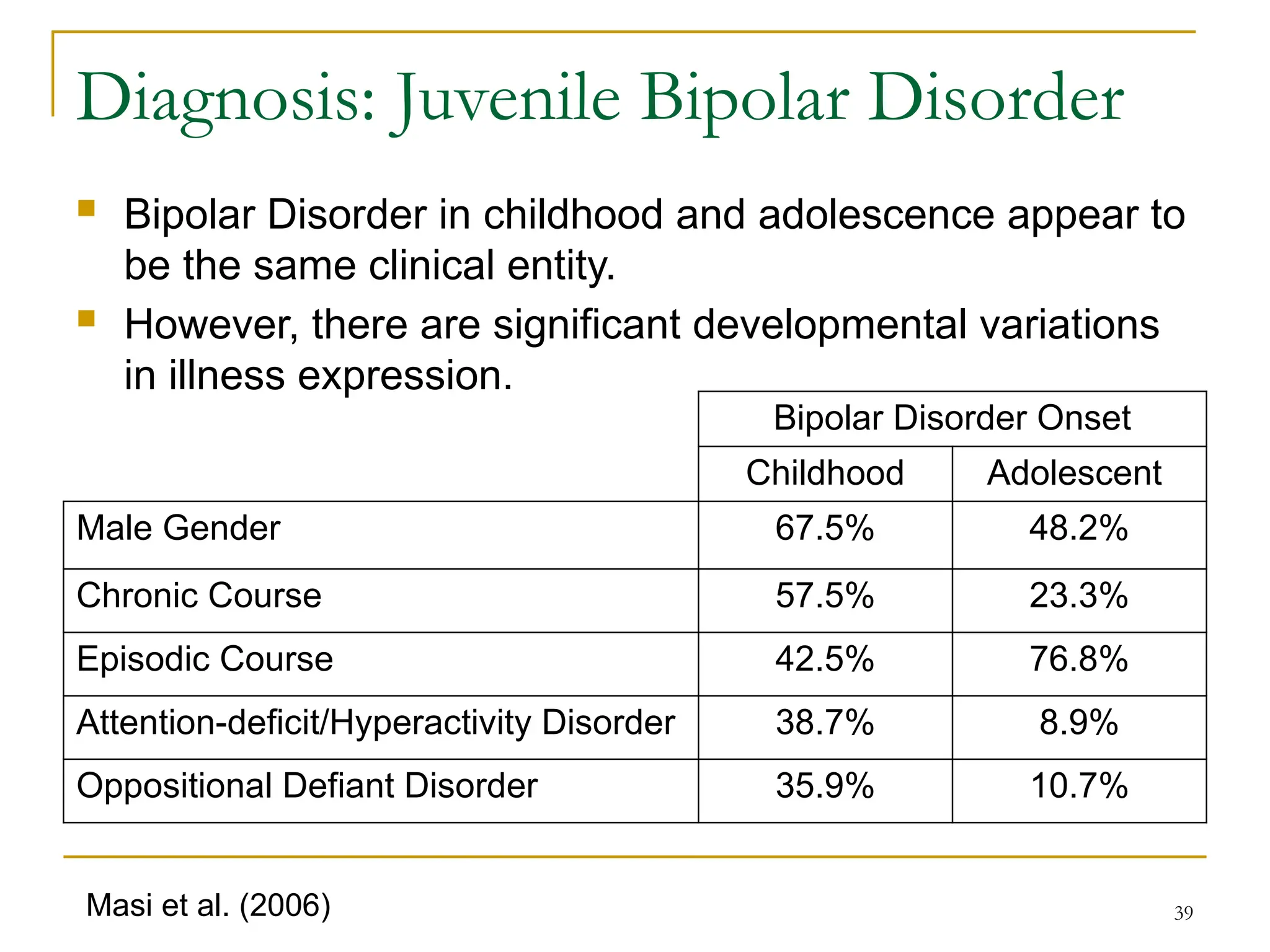
  • #53 In general, impairments in social behaviors and adjustment have been demonstrated, regardless of the state the individual is currently in when compared to control subjects. Over half of early onset BPD had no friends, were teased by other children, and had poor social skills. They also had poor relationships with siblings and high-tension relationships with their parents. Predictors of recovery and relapse are also available from family environment: For example, living in a household with an intact family unit (biologic mother and father) is a significant predictor of recovery for individuals with mania. These individuals were twice as likely to recover as their counterparts. Conversely, individuals with reported low levels of maternal warmth were 4 times more likely to relapse. Studies have suggested that children with BPD have difficulty processing facial affective cues. Not only do individuals have difficulty with recognition, but they also seem to take longer to process this information. Facial cues provide valuable information about another person’s emotions-happiness, irritation, sadness, anger, disgust, etc. Difficulties with this, as well as difficulty with emotion regulation may be some of the reasons why children with BPD have difficulty with relationships, and may not even recognize when interpersonal problems arise. Negative self-esteem has been demonstrated as a strong predictor of relapse for individuals with bpd. Even in symptomatic remission, or recovery, individuals with BPD present with lower self-esteem than their peers. Impulse control is not really a psychosocial deficit, however, it impacts how an individual interacts with his/her environment. Risk-taking behaviors tend to be rather high in individuals in the manic state of BPD. This, obviously, will impact an individuals performance in a classroom or playground setting.
  • #56 There is a 4.5% prevalence of bipolar disorder among relatives of bipolar patients, and a 1.5% prevalence among relatives of depressed patients. Concordance rate of .67 for bipolar in MZ twins, and .20 in DZ twins. From these data it has been suggested that the heritability of bipolar disorder is .59. However, the finding of MZ concordance rates lower that 100% underscores the importance of environmental factors. Compared with a control group, the biological parents of bipolar adoptees had an increase prevalence of bipolar disorder, but the adoptive parents of bipolar adoptees did not. These results showed that genetic – not adoptive – relationships mediated the familial aggregation of bipolar disorder. There is an increased life time rate of bipolar disorder among the first-degree relatives of patients who experienced their first affective symptoms before age 12, compared with relatives of those with onset at 13. Among adults, the development of bipolar disorder appears to depend upon the combined small effects of variations in many different genes, none of which is powerful enough to cause the disease by itself. One of the genes the researchers correlated with this disorder is active in a biochemical pathway through which lithium is thought to exert its therapeutic effects. The gene produces and enzyme (diacylglycerol kinase eta) that functions at a point closer to the root of the lithium-sensitive pathway than does the protein that lithium is thought to target.
  • #57 White matter hyperintensities: small abnormal areas in the white matter of the brain (especially in the frontal lobe) as seen using magnetic resonance imaging. These abnormalities may be caused by the loss of myelin or axons. The evidence for involvement of the amygdala early in the course of the disease is fairly strong. Involvement of the amygdala in BD is consistent with its central role in emotional and social behavior (assigning emotional valence to stimuli and memories, facilitating encoding). The amygdala plays a key role in emotions and forming emotional memories. This almond-shaped structure integrates your senses and links them with your emotions. It also affects basic behaviors such as feeding, sexual arousal, and the “fight-or-flight” reaction to stress. The hippocampus is a horseshoe-shaped brain structure involved in memory, learning, and emotion. It forms new memories and organizes them with related memories and emotions. Images “Partners HealthCare System” Available http://www.wiredtowinthemovie.com/mindtrip_xml.html
  • #58 Reduced gray matter volume in the DLPFC The evidence for involvement of the striatum early in the course of illness is strong. These brain areas have been implicated in the modulation of socially appropriate emotional behavior. Increased striatal volume may be compensatory to a deficit in the fermentation from the frontal lobes or to deficits downstream within the circuitry involving the pallidum and thalamus. Images “Partners HealthCare System” Available http://www.wiredtowinthemovie.com/mindtrip_xml.html
  • #59 Adult prevalence is much higher, most studies indicate 3-6% across nations and cultures.
  • #60 Pediatric bipolar disorder tends to be more debilitating with poorer outcomes. Juvenile BPD is much more chronic & has a very early onset age, with severe impairment, a great deal of emotional lability & impulsivity. They seem to have a more severe and complicated course of their illness. Suicidality (ideation/attempts) is shown to be more frequent in individuals with an onset of the disorder prior to age 18. Adult onset BPD tends to be episodic with shorter, more distinct episodes. Outcomes for individuals with broad phenotype (subsyndromal) also display significant impairment. Negative consequences exist for these individuals in the ability to cope with the demands for their ability to adjustment required during youth.
  • #61 BP I is the more classic form of BD typically with clearly recognizable and distinguished episodes of depression and mania. BP I= is thought to be more severe: experience more cycling or mixed episodes (significant 51 vs 30%); tend to have significantly more severe affective episodes (as evidenced by more hospitalization, lower Global Assessment Scale scores, and a higher prevalence of psychotic features); experience slightly more substance abuse (50 comp to 40%); tend to recover to their premorbid level of psychosocial functioning between episodes. BP II= thought to be more chronic- experience more major depressive episodes (thought to be the depressive pole of the bp spectrum; significant difference with 74 vs.50%); tend to have more episodes with shorter inter-episode intervals; experience more anxiety (38 comp to 23%) especially social phobias (Judd, et al., 2003). Cyclothymia is characterized by chronic fluctuating moods involving periods of hypomania and depression. The periods of both depressive and hypomanic symptoms are shorter, less severe, and do not occur with regularity as experienced with bipolar II or I. However, these mood swings can impair social interactions and work. Many, but not all, people with cyclothymia develop a more severe form of bipolar illness. BP: NOS-remember this is our catch-all for kids. It is the largest group of BP disorders, because of the variety of individuals with this dx, it is difficult to generalize about outcomes at this point.
  • #63 Psychopharmacological treatment of individuals with bpd has two goals: (a) reduction of current symptoms, and (b) prevention of relapse. IOW, medications are prescribed to treat acute episodes as well as for ongoing maintenance. There is no cure. Medications are needed through out life Mood stabilizers are the first line of treatment for any phase of bpd. A mood stabilizer is a drug that will not “destabilize” the disorder, or cause a switch to the opposite pole (e.g., from depression to mania). Switching is the most relevant problem for many of the treatments of bp depression. Bipolar depression is treated somewhat differently for this reason. This points to the importance of a correct diagnosis. The two states of bpd are treated with different medications. Real briefly, these medications may be prescribed when an individual is in a particular cycle of the disorder… Bipolar depression=Again, first line is a mood stabilizer, Lamictal has been shown to be efficacious without promoting switching. Anti-Obsessional meds, such as Paxil have also demonstrated efficacy with the risk of switching. Antidepressants are a more gray area. Atypical antidepressant Wellbutrin is particularly effective. The more classic antidepressants: such as Tricyclic’s (Tri’s) or MAO’s are not effective with bp depression (MAO’. Tri’s have been shown to more than triple the possibility of triggering a manic episode. SSRI’s reportedly do not cause a switch into mania, but are a second choice after Wellbutrin. Atypical Antipsychotics have also been shown to effectively treat bp depression. Many of the same approaches are used with manic episodes, of course, first line is a mood stabilizers: the infamous lithium, which still demonstrates to be the most effective medication in the treatment of mania. Also depakote, depacon, and tegretol have been used successfully. Atypical antipsychotics are effective in the treatment of mania, zyprexa, seroquel, risperdal, geodon and abilify all have research to back their efficacy. Less used are the benzo’s, due primarily, to their side effects and tolerability issues. Obviously, a very complicated issue. However, I think it’s important to be familiar with these names…
  • #64 Lithium is a natural occurring element found in springs, one of the best meds for BPD It’s believed that lithium’s benefits were recognized as far back as the 2nd century, when recommended as a Rx for “manic” patients = “natural H20’s, such as from alkaline springs.” These springs are very rich in lithium. It was “discovered” by accident in the 1940’s by an Australian doctor working in a psychiatric hospital, a Danish doctor furthered its reputation, doing empirical research and establishing not only the improvements related to it’s use, but also the protective or maintenance qualities. Because of the benefits, it was tried for many different things, from gout to kidney stones to heart disease & high blood pressure. Unfortunately, it took some time to figure out all the particulars of the drug and it can be toxic in low concentrations. (Blood levels need to be taken frequently, which is annoying, and a big drawback, especially for kids. ) Side effects… Many of these go away after body adjusts to the meds, but need to be aware of potential side effects & things that will impact the absorption (e.g., sweating a lot) Research has also shown us its benefits related to the suicidal behaviors that are so prevalent among individuals with bipolar disorder
  • #65 Much of the research base for psychotherapy for BPD focuses on relapse and medication compliance. Many of the treatments for bpd are psychoeducational in nature, & tend to include 2-9 sessions that are mainly informative about the disease and its pharmacological treatment. Its goal is to define bp illness as a biological disturbance and to focus treatment on pharmacological measures. Family-focused interventions addresses enhancing communication and coping skills, as well as the role of expressed emotion amongst families. Studies seem to indicate some decreases in relapse rates. MFPG. Empirically supported, not empirically validated. Initial findings indicate increase in parental knowledge regarding disorder, improvement in parent-child relationship. Children showed increase in perceived parental support & increase in perceived social peer support. Increase for families in “consumer skills”- ability to access appropriate services. CBT. A short-term psychotherapeutic individual intervention designed for treating depression. It is based on cognitive restructuring and is aimed at decreasing depressive symptoms and improving self-esteem. It includes self-monitoring and self-regulation, by means of managing and dealing with automatic, dysfunctional thoughts, and usually includes behavioral techniques for decreasing environmental stress & promote social adaptation . There is substantial evidence for the effectiveness of CBT for depression. The application of this theory for bpd derives from this research. There is evidence that improvements in mood and social functioning have been made with individual CBT. There have been no studies on group CBT. RAINBOW program. It’s a combination of CBT & Family Intervention. Focuses on Routine; Affect regulation; positive “I” statements; eliminating Negative thoughts; developing social and problem-solving skills; and learning where and how to get support. A recent study has indicated a decrease in symptom severity. IPSRT addresses the impact of biological and social rhythms on life events. Treatment focuses on eliciting and defining the salient problem area, followed by supported processing of emotion, and problem-solving around practical consequences. With unipolar depression, there is much evidence to support this intervention. There is limited research with bpd, with some evidence to support an impact on subsyndromal symptoms, with impact on the stability of social routine and can lead to longer periods of euthymia . Schema-focused therapy is an integration of cognitive therapy with experiential techniques, and was originally developed for personality disorders. Schemas are core beliefs/pervasive themes regarding oneself and others. They are self-perpetuating, with an individual tending to distort information to maintain its validity. The modified schema-focused cognitive therapy incorporates schemas associated with adaptability to illness and adaptability styles. Few studies.
  • #66 Medication are the primary treatments Psychotherapy are secondary Also may consider alternatives ECT as used today is very safe, and very effective especially with someone who is not medication compliant. Not currently used among children rTMS = smaller electrical current no seizure CR to preserve the sleep cycle “…although dietary interventions such as Omega-3 fatty acids and high intensity vitamin-mineral complexes have been tried in children, their efficacy is still being tested, an only case series data are available. As evidence for efficacy in some of the medicines being used for EOBPSD is currently stronger, families are encouraged to begin treatment with those agents first.” (Lofthouse & Fristad, 2006, p. 218)
  • #69 So, how will a school psychologist be involved with a student know or suspected of having bipolar disorder? As many of these kids are going unrecognized, it will be very important for us to
  • #70 Referral Question: Focus of the assessment… What are the concerns? What behaviors are being seen? What interventions are in place? Are academics the driving force behind the assessment, or behaviors? etc. In that vein… Which eligibility category will you be evaluating?
  • #71 There has been debate over the appropriate category for bpd. Obviously, this discussion really should be dictated by the individual student. Parent groups are really advocating for the use of OHI. As a neurological disorder, an individual with BPD CAN qualify under this category. Before we look at the individual criteria, let’s remember that there may be secondary disabilities (e.g., learning disabilities, speech & language impairments, etc.)
  • #74 Any more?
  • #75 May get complicated, particularly if the student has been hospitalized prior.
  • #76 Many medical issues can mimic characteristics of BPD
  • #77 Observations regarding behaviors that may be interfering with performance; executive functions, comorbid conditions (attention problems), peer relationships… Observations (additional & obs during testing) should include focus on EF’s: Self-regulation of affect. How children respond to challenges presented by progressively more difficult task. Does child give up quickly, push materials away, refuse to continue? = a child who has diff managing emotions in the face of stress). Metacognition. Most apparent with children who talk their way through difficult tasks, provides examiner a “window” to the student’s capacity to use thought to solve problems & respond to challenge; some will engage in self-instruction (“first I do this, then I do this”), others will self-monitor (“no, that’s not right, I have to fix that”), while others will self-evaluate (“you dummy, you did it wrong!”). If students don’t talk, might want to ask how they solved a problem. Goal-Directed Persistence. Students who are determined to solve difficult puzzles will provide some insight into their capacity to persist in the face of obstacles, but it is not wise to generalize too much from this kind of testing situation when assessing a student’s capacity to persist over time to achieve a goal. Flexibility. Some tasks allow you to assess flexibility, e.g., comprehension subtest of the WISC-IV has # of items that require the student to provide more than one answer to a question. Observing the response to that correction or request for additional information, allows you with a sense of the student’s flexibility in the face of corrective feedback. Sustained Attention. By including a variety of tasks, some more interesting than others, you can get a sense of how child sustains attention. (KABC-II does this quite well w/young children, since some of the tasks are more appealing than others & some require close attention to comparatively uninteresting information.) Others. Working Memory, Response Inhibition , Planning/Prioritization , Time Management, Organization ,Task Initiation .
  • #78 CBCL has been shown to be effective in differentiating BPD. The CBCL-PBD profile on the Child Behavior Checklist (CBCL) has been consistently reported showing deviant findings on the Attention Problems, Aggressive Behavior, and Anxious-Depressed subscales. Other rating scales likely available in your districts (e.g., BASC-II ) Not used in validated studies particularly with BPD. Mania. These are primarily research tools, although the K-SADS is available, and has demonstrated reliability & validity in identifying BPD.
  • #80 Obviously, there could be a pretty lengthy list here, right? I’m sure we all have our favorites… Here’s some of the more popular, theoretically sound & reliable & valid. & each, has it’s pros & cons.
  • #82 BRIEF = normed on children 5-18 & includes both teacher & parent versions. Gives global measure of EF’s as well as two indexes, Behavioral Regulation (inhibit, shift, & emotional control) and Metacognition (initiate, working memory, plan/organize, organization of materials, & monitor).
  • #83 Will the parents be bringing this report to a psychiatrist to help with diagnosis? Will this be the first time the parents are hearing some of this information? Perhaps then, a meeting prior to the IEP to talk in more depth about the findings.
  • #85 So, how will a school psychologist be involved with a student know or suspected of having bipolar disorder? You may be the first mental health professional to recognize red flag behaviors. As diagnosis is not in our purview, and medications as we learned earlier, are the best line of treatment currently, we want to get these students connected to outside mental health agencies. Obviously, the first question is parent’s health insurance. I spoke with a mother, whose family had excellent insurance, and it still was costing her over $800/month out of pocket for psychiatrist visits, medications, and counseling appointments.
  • #86 Okay, so we’ve got the student attached to some type of mental health services, and s/he has qualified for special education services through our very comprehensive psycho-educational assessment. Q: How will we be involved next? A: Develop an appropriate and individualized education program plan. However, if as a team you’ve decided this student can be served through the general education program, and are developing a 504 plan, the psych should still be involved, because who better to help develop accommodations & modifications.
  • #87 First, we’re going to ask some questions about our student… Strengths? Challenges? Needs? Behavior impeding access? Do we need a BIP?
  • #88 Recent survey conducted by SAMHSA (School Mental Health Services in the United States November of 2005) in response to the President’s New Commission on Mental Health (report=Achieving the Promise, Transforming Mental Health Care In America) indicated that 70-80% of children who receive mental health services receive services from school-based providers. It’s likely that you will be providing some type of counseling to a student with bipolar disorder.
  • #90 Important that professionals and paraprofessionals involved with the child understand the nature and symptoms of the disorder. Working with these kids can be challenging. Educating ALL staff members (from principals to child’s teacher to other teacher child may come in contact with, to other staff members child may come in contact with, including bus drivers, and yard duties, and substitute teachers). It’s important that individuals at the site understand, have compassion for, know how to work successfully with the child, & know the plan Communication between home and school is important. It’s important for the educators to know what is going on for the child/family in the home as it is for the parents/family to know what is happening in the classroom/school environment. Communication about behavior can be as simple as a daily behavior rating chart or daily emails. It’s also important for communication to occur between ALL relevant individuals involved in the child’s everyday school environment (e.g., lunchroom staff, playground staff, etc.) In addition, you may also be asked or need to communicate with the child’s outside practitioner/mental health provider. You are the best positioned