Bipolar Disorder   Causes and Treatment Jessica Wood Advanced General Psychology
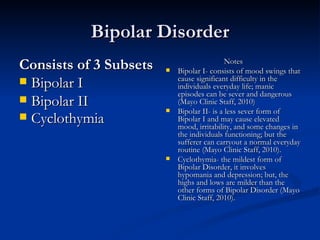
Bipolar Disorder Consists of 3 Subsets   Bipolar I Bipolar II Cyclothymia   Notes Bipolar I- consists of mood swings that cause significant difficulty in the individuals everyday life; manic episodes can be sever and dangerous (Mayo Clinic Staff, 2010)  Bipolar II- is a less sever form of Bipolar I and may cause elevated mood, irritability, and some changes in the individuals functioning; but the sufferer can carryout a normal everyday routine (Mayo Clinic Staff, 2010). Cyclothymia- the mildest form of Bipolar Disorder, it involves hypomania and depression; but, the highs and lows are milder than the other forms of Bipolar Disorder (Mayo Clinic Staff, 2010).
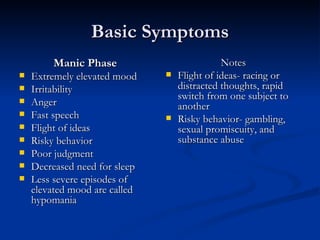
Basic Symptoms Manic Phase  Extremely elevated mood  Irritability  Anger Fast speech  Flight of ideas  Risky behavior  Poor judgment Decreased need for sleep Less severe episodes of elevated mood are called hypomania  Notes Flight of ideas- racing or distracted thoughts, rapid switch from one subject to another Risky behavior- gambling, sexual promiscuity, and substance abuse
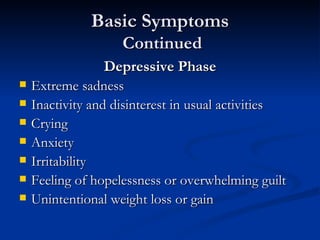
Basic Symptoms  Continued Depressive Phase Extreme sadness Inactivity and disinterest in usual activities Crying Anxiety  Irritability Feeling of hopelessness or overwhelming guilt Unintentional weight loss or gain
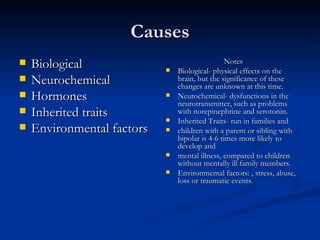
Causes Biological Neurochemical Hormones  Inherited traits Environmental factors  Notes Biological- physical effects on the brain, but the significance of these changes are unknown at this time. Neurochemical- dysfunctions in the neurotransmitter, such as problems with norepinephrine and serotonin. Inherited Traits- run in families and  children with a parent or sibling with bipolar is 4-6 times more likely to develop and  mental illness, compared to children without mentally ill family members. Environmental factors: , stress, abuse, loss or traumatic events.
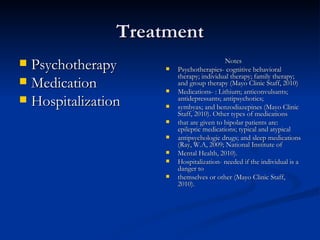
Treatment Psychotherapy Medication  Hospitalization  Notes Psychotherapies- cognitive behavioral therapy; individual therapy; family therapy; and group therapy (Mayo Clinic Staff, 2010)  Medications- : Lithium; anticonvulsants; antidepressants; antipsychotics;  symbyax; and benzodiazepines (Mayo Clinic Staff, 2010). Other types of medications  that are given to bipolar patients are: epileptic medications; typical and atypical  antipsychologic drugs; and sleep medications (Ray, W.A, 2009; National Institute of  Mental Health, 2010). Hospitalization- needed if the individual is a danger to  themselves or other (Mayo Clinic Staff, 2010).
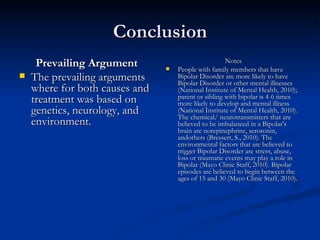
Conclusion Prevailing Argument The prevailing arguments where for both causes and treatment was based on genetics, neurology, and environment. Notes People with family members that have Bipolar Disorder are more likely to have Bipolar Disorder or other mental illnesses (National Institute of Mental Health, 2010); parent or sibling with bipolar is 4-6 times more likely to develop and mental illness (National Institute of Mental Health, 2010). The chemical/ neurotransmitters that are believed to be imbalanced in a Bipolar’s brain are norepinephrine, serotonin, andothers (Bressert, S., 2010). The environmental factors that are believed to trigger Bipolar Disorder are stress, abuse, loss or traumatic events may play a role in Bipolar (Mayo Clinic Staff, 2010). Bipolar episodes are believed to begin between the ages of 15 and 30 (Mayo Clinic Staff, 2010).
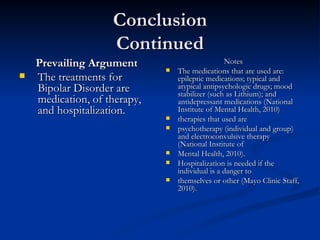
Conclusion Continued Prevailing Argument The treatments for Bipolar Disorder are medication, of therapy, and hospitalization.  Notes The medications that are used are: epileptic medications; typical and atypical antipsychologic drugs; mood stabilizer (such as Lithium); and antidepressant medications (National Institute of Mental Health, 2010)  therapies that used are  psychotherapy (individual and group) and electroconvulsive therapy (National Institute of  Mental Health, 2010).  Hospitalization is needed if the individual is a danger to  themselves or other (Mayo Clinic Staff, 2010).
Strengths and Weaknesses of Articles   Bipolar Disorder: Causes and Treatments Mayo Clinic Staff.  Related Events in Patients Treated with Antiepileptic Drugs. A. Arana, C.E. Wentworth, J.L. Ayuso-Mateos, and F.M. Arellano.  Notes Mayo Clinic- The strengths of this medical website are: it gives valid and up to date information; the information is easy to understand; and is laid out in an easy to access format. The weaknesses are: it gives general information on the causes of the mental disorder; it is general on the effects of the mediation; and it is general on the risk factors of the disorder.  Arana, Wentworth, Mateos, and Arellano- The strength of this article is that it gives conclusive evidence that epileptic medications can cause a higher risk of suicide related events in bipolar and depression patients. Because, of this fact it is important that doctors that prescribe these medications keep a close eye on their patients, to minimize the risks. The weakness of this article is that it did not take into the evaluation the environmental factors that are associated with suicidal events.
Strengths and Weaknesses of Articles Continued Cross-National Epidemiology of Major Depression and Bipolar Disorder. M.M. Weissman and et al.  Bipolar Disorder. J.M. Torpy, C. Lynm, and R.M. Glass.   Notes Cross-National Epidemiology- The strength of this study was that it surveyed a wide spectrum of people. The weaknesses of the study is that it did not take into account all of the cultural differences that can determine what is considered mental illness. Bipolar Disorder. J.M. Torpy, C. Lynm, and R.M. Glass- The strengths of this are article is that that it gives more details on diagnosing bipolar over some of the other articles. The weaknesses of the article are: it seems to diminish the importance of therapy and does not describe the various types that can be helpful; it skims over the medications that can be used to treat the disorder and highlights the negative effects; and it lacks the causes of bipolar disorder.
Strengths and Weaknesses of Articles Continued The Causes of Bipolar Disorder (Manic Depression). S. Bressert   Notes The Causes of Bipolar Disorder (Manic Depression). S. Bressert- The strengths of the website are: it is very detailed and gives more information (in details) than all of the other websites and articles, on causes. The weakness is that it does not give the types of tools that can identify the disorder.
References Arana, A., Wentworth, C.E., Ayuso-Meteos, J.L., and Arellano, F.M. (2010). Suicide-Related Events in Patients Treated with Antiepileptic Drugs.  http://www.nejm.org/doi/full/10.1056/NEJMoa0909801 .  Bressert, S. (2010). The Causes of Bipolar Disorder (Manic Depression).  http://psychcentral.com/lib/2007/the-causes-of-bipolar-disorder-manic-depression/ .  Das, A.K. and et al (2005). Screening for Bipolar Disorder in a Primary Care Practice.  http://jama.ama-assn.org/cgi/content/abstract/293/8/956?maxtoshow=&hits=10&RESULTFORMAT=& fulltext = bipolar&searchid =1&FIRSTINDEX=0&resourcetype=HWCIT .  Mansfield, A. & et al. (2010). Deployment and the Use of Mental Health Services among U.S. Army Wives.  http://www.nejm.org/doi/full/10.1056/NEJMoa0900177 .  Mayo Clinic Staff (2010). Bipolar Disorder.  http://www.mayoclinic.com/health/bipolar-disorder/DS00356
References  Continued National Institute of Mental Health. Bipolar Disorder.  http://www.nimh.nih.gov/health/publications/bipolar-disorder/complete-index.shtml .  Ray, W.A. & et al (2009). Atypical Antipsychotic Drugs and the Risk of Sudden Cardiac Death.  http://www.nejm.org/doi/full/10.1056/NEJMoa0806994 .  Sachs, G.S. & et al. (2007). Effectiveness of Adjunctive Antidepressants Treatment for Bipolar Depression.  http://www.nejm.org/doi/full/10.1056/NEJMoa064135 .  Torpy, J.M., Lynm, C., & Glass (2009). Bipolar Disorder.  http://jama.ama-assn.org/cgi/content/full/301/5/564?maxtoshow=&hits=10&RESULTFORMAT=& fulltext = bipolar&searchid =1&FIRSTINDEX=10&resourcetype=HWCIT .  Weissman, M.M. & et al. Cross-National Epidemiology of Major Depresssion and Bipolar Disorder.  http://jama.ama-assn.org/cgi/reprint/276/4/293?maxtoshow=&hits=10&RESULTFORMAT=& fulltext = bipolar&searchid =1&FIRSTINDEX=0&resourcetype=HWCIT .

Bipolar Disorder Agp

  • 1.
    Bipolar Disorder Causes and Treatment Jessica Wood Advanced General Psychology
  • 2.
    Bipolar Disorder Consistsof 3 Subsets Bipolar I Bipolar II Cyclothymia Notes Bipolar I- consists of mood swings that cause significant difficulty in the individuals everyday life; manic episodes can be sever and dangerous (Mayo Clinic Staff, 2010) Bipolar II- is a less sever form of Bipolar I and may cause elevated mood, irritability, and some changes in the individuals functioning; but the sufferer can carryout a normal everyday routine (Mayo Clinic Staff, 2010). Cyclothymia- the mildest form of Bipolar Disorder, it involves hypomania and depression; but, the highs and lows are milder than the other forms of Bipolar Disorder (Mayo Clinic Staff, 2010).
  • 3.
    Basic Symptoms ManicPhase Extremely elevated mood Irritability Anger Fast speech Flight of ideas Risky behavior Poor judgment Decreased need for sleep Less severe episodes of elevated mood are called hypomania Notes Flight of ideas- racing or distracted thoughts, rapid switch from one subject to another Risky behavior- gambling, sexual promiscuity, and substance abuse
  • 4.
    Basic Symptoms Continued Depressive Phase Extreme sadness Inactivity and disinterest in usual activities Crying Anxiety Irritability Feeling of hopelessness or overwhelming guilt Unintentional weight loss or gain
  • 5.
    Causes Biological NeurochemicalHormones Inherited traits Environmental factors Notes Biological- physical effects on the brain, but the significance of these changes are unknown at this time. Neurochemical- dysfunctions in the neurotransmitter, such as problems with norepinephrine and serotonin. Inherited Traits- run in families and children with a parent or sibling with bipolar is 4-6 times more likely to develop and mental illness, compared to children without mentally ill family members. Environmental factors: , stress, abuse, loss or traumatic events.
  • 6.
    Treatment Psychotherapy Medication Hospitalization Notes Psychotherapies- cognitive behavioral therapy; individual therapy; family therapy; and group therapy (Mayo Clinic Staff, 2010) Medications- : Lithium; anticonvulsants; antidepressants; antipsychotics; symbyax; and benzodiazepines (Mayo Clinic Staff, 2010). Other types of medications that are given to bipolar patients are: epileptic medications; typical and atypical antipsychologic drugs; and sleep medications (Ray, W.A, 2009; National Institute of Mental Health, 2010). Hospitalization- needed if the individual is a danger to themselves or other (Mayo Clinic Staff, 2010).
  • 7.
    Conclusion Prevailing ArgumentThe prevailing arguments where for both causes and treatment was based on genetics, neurology, and environment. Notes People with family members that have Bipolar Disorder are more likely to have Bipolar Disorder or other mental illnesses (National Institute of Mental Health, 2010); parent or sibling with bipolar is 4-6 times more likely to develop and mental illness (National Institute of Mental Health, 2010). The chemical/ neurotransmitters that are believed to be imbalanced in a Bipolar’s brain are norepinephrine, serotonin, andothers (Bressert, S., 2010). The environmental factors that are believed to trigger Bipolar Disorder are stress, abuse, loss or traumatic events may play a role in Bipolar (Mayo Clinic Staff, 2010). Bipolar episodes are believed to begin between the ages of 15 and 30 (Mayo Clinic Staff, 2010).
  • 8.
    Conclusion Continued PrevailingArgument The treatments for Bipolar Disorder are medication, of therapy, and hospitalization. Notes The medications that are used are: epileptic medications; typical and atypical antipsychologic drugs; mood stabilizer (such as Lithium); and antidepressant medications (National Institute of Mental Health, 2010) therapies that used are psychotherapy (individual and group) and electroconvulsive therapy (National Institute of Mental Health, 2010). Hospitalization is needed if the individual is a danger to themselves or other (Mayo Clinic Staff, 2010).
  • 9.
    Strengths and Weaknessesof Articles Bipolar Disorder: Causes and Treatments Mayo Clinic Staff. Related Events in Patients Treated with Antiepileptic Drugs. A. Arana, C.E. Wentworth, J.L. Ayuso-Mateos, and F.M. Arellano. Notes Mayo Clinic- The strengths of this medical website are: it gives valid and up to date information; the information is easy to understand; and is laid out in an easy to access format. The weaknesses are: it gives general information on the causes of the mental disorder; it is general on the effects of the mediation; and it is general on the risk factors of the disorder. Arana, Wentworth, Mateos, and Arellano- The strength of this article is that it gives conclusive evidence that epileptic medications can cause a higher risk of suicide related events in bipolar and depression patients. Because, of this fact it is important that doctors that prescribe these medications keep a close eye on their patients, to minimize the risks. The weakness of this article is that it did not take into the evaluation the environmental factors that are associated with suicidal events.
  • 10.
    Strengths and Weaknessesof Articles Continued Cross-National Epidemiology of Major Depression and Bipolar Disorder. M.M. Weissman and et al. Bipolar Disorder. J.M. Torpy, C. Lynm, and R.M. Glass. Notes Cross-National Epidemiology- The strength of this study was that it surveyed a wide spectrum of people. The weaknesses of the study is that it did not take into account all of the cultural differences that can determine what is considered mental illness. Bipolar Disorder. J.M. Torpy, C. Lynm, and R.M. Glass- The strengths of this are article is that that it gives more details on diagnosing bipolar over some of the other articles. The weaknesses of the article are: it seems to diminish the importance of therapy and does not describe the various types that can be helpful; it skims over the medications that can be used to treat the disorder and highlights the negative effects; and it lacks the causes of bipolar disorder.
  • 11.
    Strengths and Weaknessesof Articles Continued The Causes of Bipolar Disorder (Manic Depression). S. Bressert Notes The Causes of Bipolar Disorder (Manic Depression). S. Bressert- The strengths of the website are: it is very detailed and gives more information (in details) than all of the other websites and articles, on causes. The weakness is that it does not give the types of tools that can identify the disorder.
  • 12.
    References Arana, A.,Wentworth, C.E., Ayuso-Meteos, J.L., and Arellano, F.M. (2010). Suicide-Related Events in Patients Treated with Antiepileptic Drugs. http://www.nejm.org/doi/full/10.1056/NEJMoa0909801 . Bressert, S. (2010). The Causes of Bipolar Disorder (Manic Depression). http://psychcentral.com/lib/2007/the-causes-of-bipolar-disorder-manic-depression/ . Das, A.K. and et al (2005). Screening for Bipolar Disorder in a Primary Care Practice. http://jama.ama-assn.org/cgi/content/abstract/293/8/956?maxtoshow=&hits=10&RESULTFORMAT=& fulltext = bipolar&searchid =1&FIRSTINDEX=0&resourcetype=HWCIT . Mansfield, A. & et al. (2010). Deployment and the Use of Mental Health Services among U.S. Army Wives. http://www.nejm.org/doi/full/10.1056/NEJMoa0900177 . Mayo Clinic Staff (2010). Bipolar Disorder. http://www.mayoclinic.com/health/bipolar-disorder/DS00356
  • 13.
    References ContinuedNational Institute of Mental Health. Bipolar Disorder. http://www.nimh.nih.gov/health/publications/bipolar-disorder/complete-index.shtml . Ray, W.A. & et al (2009). Atypical Antipsychotic Drugs and the Risk of Sudden Cardiac Death. http://www.nejm.org/doi/full/10.1056/NEJMoa0806994 . Sachs, G.S. & et al. (2007). Effectiveness of Adjunctive Antidepressants Treatment for Bipolar Depression. http://www.nejm.org/doi/full/10.1056/NEJMoa064135 . Torpy, J.M., Lynm, C., & Glass (2009). Bipolar Disorder. http://jama.ama-assn.org/cgi/content/full/301/5/564?maxtoshow=&hits=10&RESULTFORMAT=& fulltext = bipolar&searchid =1&FIRSTINDEX=10&resourcetype=HWCIT . Weissman, M.M. & et al. Cross-National Epidemiology of Major Depresssion and Bipolar Disorder. http://jama.ama-assn.org/cgi/reprint/276/4/293?maxtoshow=&hits=10&RESULTFORMAT=& fulltext = bipolar&searchid =1&FIRSTINDEX=0&resourcetype=HWCIT .