1) A randomized controlled trial compared fixed lower energy (150-150-150 J) versus escalating higher energy (200-300-360 J) biphasic defibrillation for out-of-hospital cardiac arrest.
2) Among patients requiring multiple shocks, conversion rates were significantly higher with escalating higher energy (36.6% vs 24.7%). Ventricular fibrillation termination rates were also significantly higher with escalating higher energy.
3) For first shock success, conversion and ventricular fibrillation termination rates were similar between the two groups. There were no differences in survival outcomes or adverse effects.
![BIPHASIC Trial
A Randomized Comparison of Fixed Lower Versus Escalating Higher
Energy Levels for Defibrillation in Out-of-Hospital Cardiac Arrest
Ian G. Stiell, MD, MSc, FRCPC; Robert G. Walker, BA; Lisa P. Nesbitt, MHA;
Fred W. Chapman, PhD; Donna Cousineau, RN, MSN; James Christenson, MD; Paul Bradford, MD;
Sunil Sookram, MD; Ross Berringer, MD; Paula Lank, RN, BSN; George A. Wells, PhD
Background—There is little clear evidence as to the optimal energy levels for initial and subsequent shocks in biphasic
waveform defibrillation. The present study compared fixed lower- and escalating higher-energy regimens for
out-of-hospital cardiac arrest.
Methods and Results—The Randomized Controlled Trial to Compare Fixed Versus Escalating Energy Regimens for
Biphasic Waveform Defibrillation (BIPHASIC Trial) was a multicenter, randomized controlled trial of 221 out-of-
hospital cardiac arrest patients who received Ն1 shock given by biphasic automated external defibrillator devices that
were randomly programmed to provide, blindly, fixed lower-energy (150-150-150 J) or escalating higher-energy
(200-300-360 J) regimens. Patient mean age was 66.0 years; 79.6% were male. The cardiac arrest was witnessed in
63.8%; a bystander performed cardiopulmonary resuscitation in 23.5%; and initial rhythm was ventricular fibrillation/
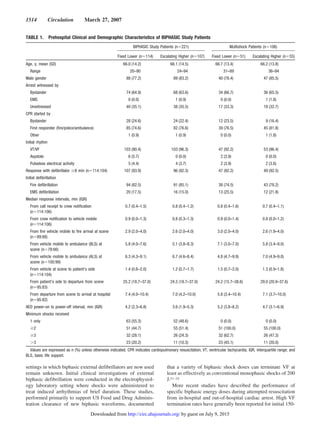
ventricular tachycardia in 92.3%. The fixed lower- and escalating higher-energy regimen cases were similar for the 106
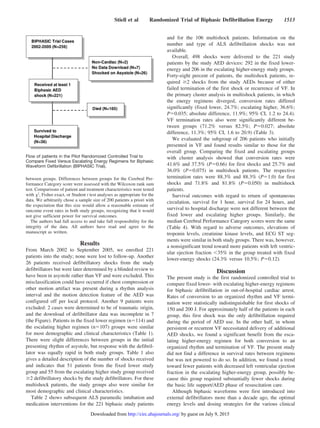
multishock patients and for all 221 patients. In the primary analysis in multishock patients, conversion rates differed
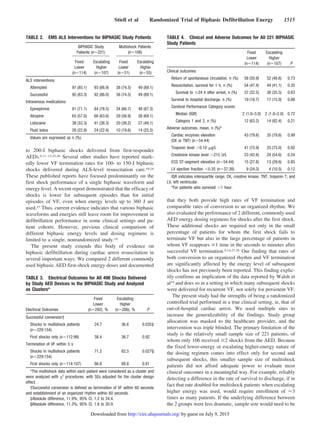
significantly (fixed lower, 24.7%, versus escalating higher, 36.6%; Pϭ0.035; absolute difference, 11.9%; 95% CI, 1.2
to 24.4). Ventricular fibrillation termination rates also were significantly different between groups (71.2% versus 82.5%;
Pϭ0.027; absolute difference, 11.3%; 95% CI, 1.6 to 20.9). For the secondary analysis of first shock success, conversion
rates were similar between the fixed lower and escalating higher study groups (38.4% versus 36.7%; Pϭ0.92), as were
ventricular fibrillation termination rates (86.8% versus 88.8%; Pϭ0.81). There were no distinguishable differences
between regimens for survival outcomes or adverse effects.
Conclusions—This is the first randomized trial to compare fixed lower and escalating higher biphasic energy regimens in
out-of-hospital cardiac arrest, and it demonstrated higher rates of ventricular fibrillation conversion and termination with
an escalating higher-energy regimen for patients requiring multiple shocks. These results suggest that patients in
ventricular fibrillation benefit from higher biphasic energy levels if multiple defibrillation shocks are required.
(Circulation. 2007;115:1511-1517.)
Key Words: defibrillation Ⅲ fibrillation Ⅲ heart arrest Ⅲ resuscitation Ⅲ cardiopulmonary resuscitation
Out-of-hospital sudden cardiac arrest is an important
healthcare problem, with some 300 000 such cases
occurring annually in the United States. The vast majority of
such patients do not survive, with hospital discharge rates
uncommonly exceeding 5%.1,2 The American Heart Associ-
ation’s (AHA’s) 4-link chain of survival concept has been
developed to better explain community response to out-of-
hospital cardiac arrest.3 Much interest and focus have been
directed toward improving interventions for out-of-hospital
cardiac arrest. Recent initiatives have, in particular, addressed
the second (early cardiopulmonary resuscitation [CPR]), third
(early defibrillation), and fourth (early advanced life support
[ALS]) links.4 Although optimal therapy is multifaceted,
most survivors of out-of-hospital cardiac arrest are those
patients who present in ventricular fibrillation (VF) and are
rapidly and effectively defibrillated.5
Clinical Perspective p 1517
Recent AHA-sponsored guidelines for emergency cardio-
vascular care have endorsed newer technology for the defi-
Received June 26, 2006; accepted December 22, 2006.
From the Department of Emergency Medicine (I.G.S.), Department of Epidemiology and Community Medicine (G.A.W.), and Clinical Epidemiology
Program (L.P.N., D.C.), Ottawa Health Research Institute, University of Ottawa, Ottawa, Canada; Medtronic Emergency Response Systems (R.G.W.,
F.W.C., P.L.), Redmond, Wash; University of British Columbia and British Columbia Ambulance Service (J.C.) and Vancouver Fire Department (R.B.),
Vancouver, Canada; Windsor Base Hospital (P.B.), Windsor, Canada; and Emergency Medical Services (S.S.), Edmonton, Canada.
Clinical trial registration information—URL: http://www.clinicaltrials.gov. Unique identifier: NCT00212992.
Correspondence to Dr Ian G. Stiell, Clinical Epidemiology Unit, Office F657, Ottawa Health Research Institute, The Ottawa Hospital, Civic Campus,
1053 Carling Ave, Ottawa, Ontario, Canada, K1Y 4E9. E-mail istiell@ohri.ca
© 2007 American Heart Association, Inc.
Circulation is available at http://www.circulationaha.org DOI: 10.1161/CIRCULATIONAHA.106.648204
1511
Arrhythmia/Electrophysiology
by guest on July 9, 2015http://circ.ahajournals.org/Downloaded from](https://image.slidesharecdn.com/8cddfbe1-0c1b-422a-8161-c63704789447-150710175629-lva1-app6891/85/biphasic-1-320.jpg)