Biophysical Properties – Lecture -2
Learning Objectives:
Students will be able to:
• Define Buffers
• Enlist Classification of Buffers
• Composition of Buffers
• Buffers Action Mechanism & Capacity Professor Dr. Syed Irfan Raza
PhD Biochemistry
B u f f e r s
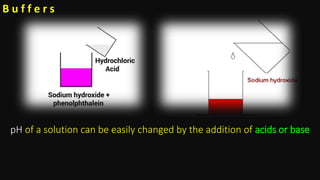
pH of a solution can be easily changed by the addition of acids or base
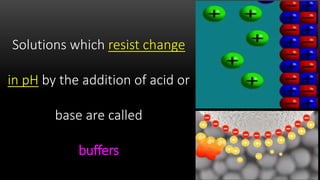
Solutions which resist change
in pH by the addition of acid or
base are called
buffers
Buffer
Buffer
Wk. acid
Conj.
Base
Buffer Composition
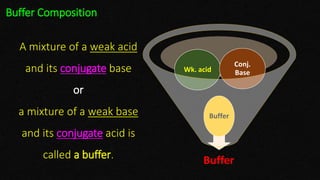
A mixture of a weak acid
and its conjugate base
or
a mixture of a weak base
and its conjugate acid is
called a buffer.
Buffers
Basic
Acidic
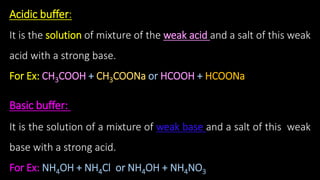
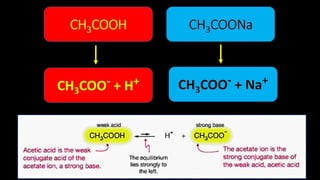
Acidic buffer:
It is the solution of mixture of the weak acid and a salt of this weak
acid with a strong base.
For Ex: CH3COOH + CH3COONa or HCOOH + HCOONa
Basic buffer:
It is the solution of a mixture of weak base and a salt of this weak
base with a strong acid.
For Ex: NH4OH + NH4Cl or NH4OH + NH4NO3
A conjugate acid is formed
when a proton is added to
a base.
A conjugate base is
formed when a proton is
removed from an acid.
Define Conjugate acid & Base
Conjugate
Acid
&
Conjugate
Base
3. In a solution of HCl & Water:
a. HCL will behave as a weak acid
b. Water will behave as Conjugate base
c. H3O+ will work as acid
d. Cl- will behave as conjugate acid
e. H2O will work as base
Mechanism of Buffer Action
• Buffer capacity (β) is defined as a quantitative measure of the
resistance of pH change when ions are added in Buffer solutions.
• It is also known as acid neutralizing or alkalinity capacity.
• Also it is defined as the moles or grams equivalent of an acid or a
base that is required to bring a change in the pH of a solution by 1.
• It depends on the concentration of a solution.
Buffer Capacity (β)

Biophysical Properties - Lecture - 2.pptx

  • 1.
    Biophysical Properties –Lecture -2 Learning Objectives: Students will be able to: • Define Buffers • Enlist Classification of Buffers • Composition of Buffers • Buffers Action Mechanism & Capacity Professor Dr. Syed Irfan Raza PhD Biochemistry
  • 2.
    B u ff e r s pH of a solution can be easily changed by the addition of acids or base
  • 3.
    Solutions which resistchange in pH by the addition of acid or base are called buffers
  • 4.
    Buffer Buffer Wk. acid Conj. Base Buffer Composition Amixture of a weak acid and its conjugate base or a mixture of a weak base and its conjugate acid is called a buffer.
  • 5.
  • 6.
    Acidic buffer: It isthe solution of mixture of the weak acid and a salt of this weak acid with a strong base. For Ex: CH3COOH + CH3COONa or HCOOH + HCOONa Basic buffer: It is the solution of a mixture of weak base and a salt of this weak base with a strong acid. For Ex: NH4OH + NH4Cl or NH4OH + NH4NO3
  • 7.
    A conjugate acidis formed when a proton is added to a base. A conjugate base is formed when a proton is removed from an acid. Define Conjugate acid & Base
  • 8.
  • 9.
    3. In asolution of HCl & Water: a. HCL will behave as a weak acid b. Water will behave as Conjugate base c. H3O+ will work as acid d. Cl- will behave as conjugate acid e. H2O will work as base
  • 12.
  • 13.
    • Buffer capacity(β) is defined as a quantitative measure of the resistance of pH change when ions are added in Buffer solutions. • It is also known as acid neutralizing or alkalinity capacity. • Also it is defined as the moles or grams equivalent of an acid or a base that is required to bring a change in the pH of a solution by 1. • It depends on the concentration of a solution. Buffer Capacity (β)