SUSTAINABLE
ARCHITECTURE :
LESSONS FROM NATURE
XVII Mexican Conference on Structural Engineering and
Sustainable Development
Leon , November 5th and University of Mexico
November 8th 2010
Professor Derek Clements –Croome
School of Construction Management & Engineering
www.derekcroome.comwww.rdg.ac.uk/ib
Lessons from Nature
L’architecte du futur construira en imitant la nature
parce que c’est la plus rationnelle, durable et
économique des méthodes --- Gaudi
Although human ingenuity makes various inventions it
will never discover inventions more beautiful,
appropriate and more direct than in Nature because in
her nothing is lacking and nothing is superfluous.---
Leonardo da Vinci
The engineering skill that goes into a beaver dam rivals
the elegant calculations that built Pyramids and the
Panama Canal -- Gould and Gould ( 2007)
Characteristics of Nature
 runs on sunlight;
 uses only the energy it needs;
 fits form to function;
 recycles;
 rewards cooperation;
 banks on diversity;
 demands local expertise;
 realises the power of limits. Benyus (2002)
Biomimetics
The abstraction of good
design from Nature
Functional Biomimetics
 Capture functional attributes
of living organisms and
 Converts them into to
technological solutions
Julian F.V. Vincent
Construction Methods
 Sculpting
 Piling up
 Moulding
 Rolling and folding
 Sticking together
 Weaving and sewing
 Much of our aesthetic is
derived from an organic and
fluid language that you find in
Nature.
 It involves complex, three
dimensional geometries but
there is always a rigorous
logic behind them.
Science and Nature
Scientists aspire to replace many of
the essential features of
photosynthesis---- the process by
which plants use sunlight to
produce oxygen and organic
molecules.
Royal Society of Chemistry, Harnessing Light: Solar Energy for a Low Carbon Future,
The Artificial Leaf
Research groups are now trying to create
artificial leafs by using ruthenium and
manganese complexes to try and mimic
natural processes.
An Artificial Leaf would split water to
produce oxygen and hydrogen, use
hydrogen either as a fuel or to reduce
carbon dioxide to produce organic fuels.
Royal Society of Chemistry, Harnessing Light: Solar Energy for a Low Carbon Future,2008
The Physical Worlds of
Plants and Animals
 Gravity
 movement, growth
 Fluid flows
 air, water, blood
 Surface tension
 wetting, moving on
water surface
 Friction
 joints, burrowing
 Adhesion
 gecko, flies
 Impact
 fighting, feeding
 Temperature
 heating, cooling
 Gas transfer
 breathing, respiration
Dr Richard Bonser , What is Biomimetics ? 2008
Biomimetics, Design and
Intelligent Buildings
BOTH ORGANISMS AND BUILDINGS HAVE
TO SURVIVE IN THEIR ENVIRONMENTS
 ADAPTATION (Shape, Materials,
Structures,…),MODULATION
 SENSING, ACTUATION (Passive, Active)
 INTELLIGENCE (Choices, Responses)
 ENERGY MANAGEMENT
Jeronimidis, G, 2007, The University of Reading
Biomimetics Design and
Architecture
FINDING HOW BIOLOGY SOLVES THE SAME
KIND OF PROBLEMS
MATERIALS/STRUCTURES → FIBRES/COMPOSITES
SENSING, ACTUATION → INTEGRATION
INTELLIGENCE (Responses) → SENSORY SYSTEM
ENERGY MANAGEMENT → METABOLISM
Based on Jeronimidis, G, 2007, The University of Reading
smart materials and structures (sensing,
actuation)
Functionality level
Molecular
Application field
medicine, biotechnology,
nanotechnology, materials science (self-
assembly), surfaces
Cell / tissue
materials science, textiles, fibrous
composites, engineering structures,
surfaces, architecture
Organ
Organism
composites and engineering
structures, smart materials and
structures, architecture
Influences of Biomimetics
Jeronimidis, G, 2007, The University of Reading
Control internal environment
Adapt to changes in environment
 Adaptive passive solutions – no
computing power involved but no
choice
 Active solutions – needs computing
power but can provide choice
Sensing and Actuation to
Signalling
Regulation
Transduction
Response
Smart / Adaptive (no choice)
Intelligent (choice)
The sensing function proper is carried out by
living cells but often the hierarchical
organisation of the materials and structures
can amplify signals (vibration, temperature,
deformation, etc.)
Jeronimidis, G, 2007, The University of Reading
Energy input
Highly Integrated
Hardware-Software
Systems
Most biological sensors can
achieve sensitivities
comparable to thermal noise
(~ 10-21W/s) and detect
energies typical of single
quanta
 Chemical (most animals and some plants)
 Vibration (spiders, scorpions, insects, crocodiles)
 Infrared (beetles, snakes)
 Fluid-flow (various insects, crustaceans)
 Strain (insects, arthropods)
 Pressure (fish)
 Touch (most animals and some plants)
 Electrical (fish)
 Magnetic (fish, birds)
 Electromagnetic (vision, most animals)
Jeronimidis, G, 2007, The University of Reading
Biomimetics Offers Many
Types of Sensors
Insects, Spiders and
Crustaceans - sensory
information from
• strains in the exoskeleton (campaniform
sensors)
• infrared detectors (modified campaniform)
• air flow and pressure detectors (hair
sensors)
• vibration detectors (slits & lyriform
sensors) Jeronimidis, G, 2007, The University of Reading
Some Applications
 Hearing prosthetic devices
 Low-mass, small dimensions vibration
sensors
 accelerometers, damage detectors (AE),
seismographs
 Low mass, small dimensions fluid-flow
sensors
 aero-elastic tailoring, smart wings,….
Jeronimidis, G, 2007, The University of Reading
Intelligent Buildings for
People
 A multi sensory experience
 Must be healthy and sustainable
 Interact with environment (external,
internal)
 Light
 Heat
 Air
 Humidity
 Occupants control
What Do We Expect from
an Intelligent Building?
 Carry structural loads (external, internal)
 Provide shelter
 Interact with environment (external, internal)
 Control internal environment (sensing, actuation)
 Adapt to changes in environment (sensing,
actuation)
 Integration of functions
Jeronimidis, G, 2007, The University of Reading
Structural Loads and Shelter
Are the materials we use the best ones for the job ?
Can you build a 2km high building with existing materials?
What would be the challenges ? And the advantages?
Existing construction materials are probably not suitable
not enough strength and stiffness
too high a density
not particularly good for implementing functional
integration
Animals and Plants have evolved various
strategies for dealing with these problems
(thermal insulation, cooling – radiating
surfaces, blood flow), light interception
(plants)
In addition, plants are unique in being
able to convert solar power into integrated
functionality
Except for colonies (ants, bees, termites,
…) the individual organism is the sole
occupant of his “building”
Jeronimidis, G, 2007, The University of Reading
We would like the
intelligent buildings of the
future generation to open
its windows like eyelids to
the dawn
Aldersey-Williams
Back to the Nature in the Urban Jungle, The Times, 26.8.2010 p.16
Nature has always been
architecture’s chief muse. The
earliest Greek temples, made at
first, from tree trunks, gradually
honed into the ancient
architectural orders, were an early
attempt at reconciling Nature and
man in architectural form.
Back to the Nature in the Urban Jungle, The Times, 26.8.2010 p.16
Form/shape biomimetics
Capture the aesthetic attributes of
biological structures and
introduce them into man-made
artifacts
Jeronimidis, G, 2007, The University of Reading
The Fish (Peix) at Via Olimpica
Barcelona 1989-1992 by Ghery
H. Alderney-William , Zoomorphic 2004, (Lawrence King)
Frank Gehry’s fish
represent s “freedom”
and structural fluidity
H. Alderney-William , Zoomorphic 2004, (Lawrence King)
Milwaukee Art Museum,
Wisconsin, USA, 1994-2001 by
Santiago Calatrava is like a Bird
Auditorium Parco della Musica
Rome Italy
1994-2002 by
Renzo Piano
like a Beetle
Scottish Exhibition and Conference
Centre by Norman Foster like an
Armadillo
Organic Architecture
Organic architecture
promotes harmony
between human
habitation and the natural
world through design.
Sympathetic and
integrated into its site so
that buildings,
furnishings, and
surroundings become
part of a unified,
interrelated composition.
Fallingwater by Frank Lloyd Wright
Green Roofs
Dandelion House by Terunobu Fujimori 1995
Patterns in Nature
The Fibonacci numbers 1, 2, 3, 5, 8,
13, 21, 34, 55, 89, 144………frequently
occur in Nature. The seeds of
sunflowers and daisies have spiral
patterns. Daisies have 21 clockwise
and 34 anticlockwise spirals. Similar
patterns occur in pine cones and
pineapples. Petals number 3 for lilies,
buttercups 5, delphiniums 8,
marigolds 13, asters 21, daisies 34, 55
or 89 and sunflowers 55, 89 or 144
The head of a
daisy shows
the spiral
arrangement
whose
numerical
relations are
Fibonacci
numbers
 21 clockwise
 34 anticlockwise
Powers, A., 1999, Nature in Design, (Conran Octopus), p.34
Florets of
Romanesco
broccoli are
“self-similar” at
all scales: an
example of
fractal geometry.
Powers, A., 1999, Nature in Design, Conran Octopus, p.39
Patterns in Nature
If you take Fibonacci numbers as
successive ratios
8/5, 13/8, 21/13, …….then the ratio
values approach the golden
number φ=1.618. The golden ratio
is φ : 1 which is associated with
aesthetics in art and architecture.
Powers, A., 1999,
Nature in Design,
(Conran Octopus),
Nature’s
Spirals
Nautilus
Shell
Powers, A., 1999, Nature in Design, (Conran Octopus), p.30
A storm in the
Bering Sea
from Nimbus 5
satellite. The
largest and
smallest
forms in
Nature reveal
the process
growth and
change.
Nature’s Spirals
The coiled leaf of
the thread-leaf
sundew and the
chameleon's
coiled tail show
the practical
application of
good design
principles in
nature Powers, A., 1999, Nature in Design, (Conran Octopus), p.31
Nature’s
Spirals
An x-ray photograph
of the inner
chambers of a
marine snail shell
reveals a
“logarithmic”
helical spiral. This
has been described
as a “pyramid coiled
round a vertical
axis” Powers, A., 1999, Nature in Design, (Conran Octopus), p.35
Nature’s Spirals
The crystals of cholesteryl acetate seen
through high magnification display the
extraordinary beauty found in the
structure of matter
Powers, A., 1999, Nature in Design, (Conran Octopus), p.25
Geometry of Nature
Examples seen in Gaudi’s work
 Columns of Teresina School
 Columns of Sagrada Familia
 Church Crypt in Guell Estate
(see book on Gaudi by Nonell)
Animal and Human
Technologies
Spider’s webs, devices
for catching food;
Spider’s web in detail
hardened forms of viscous
thready masses.
Otto –Rasch 2001
Bubble and net formation in a
living cell (radiolaria)
http://oceanica.cofc.edu/
We mimic Nature, but have yet
to come up with anything to
match its technical and
aesthetic ingenuity, its ability
to adapt to its environment
and change over time .Nothing
beats a spider's web or for
example the human skin.
Back to the Nature in the Urban Jungle, The Times, 26.8.2010 p.16
Examples of Spiders Webs
Foelix 1996
Water
Spider
constructs
underwater
oxygen tent
used as a
hunting lair.
Hancocks, D, 1971, Animals and
Architecture, (Hugh Evelyn), p14
Spider lives
in ‘diving
bell’
Amoeba Sand Grain House
A single-celled
amoeba an
organism with no
nervous system
builds this intricate
portable sand grain
house
Hansell M, 2007,Built By Animals, Oxford University Press,p59
Birds’ nests: houses for
vertebrates, built from local
materials
Inside a termite city –
three dimensional light
construction
Oryx weaverbirds nests, South Africa
Otto –Rasch 2001
Bower birds collect and arrange
by size brightly coloured objects
with which to lure the females
and stimulate a sexual
response.
Reed Hut Weather Shetler
More highly developed building
technology for woven reed hut.Primeval House
Dual Purpose Nests
The false flap above the
apparent entrance is
always closed but has
here been opened to
reveal the true way into
the nest. Such nests are
sometimes used after
breeding by adult birds
for shelter at night.
Hancocks, D, 1971, Animals and Architecture, Hugh Evelyn, p15
The egg storage nest built
by penduline tit is one
example of protection
against predators. The
apparent entrance (shown
dotted) leads only into an
empty pouch.
Hexagonal Bee Cells
Give compact and lightweight
construction,for storage ;the
developing larvae are fed by worker
bees up to 3000 times a day and
after six days, having mounted five
times, the pupae are sealed into their
cells for a further twelve days
Wasps have developed similar
structural principles to the bees. With its
covering removed a nest shows the
layered combs hanging on a fragile
network of pillars.
Hancocks, D, 1971, Animals and Architecture, Hugh Evelyn, p15
Bees
optimise use
of material
by use of
hexagon
cells.
Bees also optimise their
routes too to save energy.
Can we learn from this for
improving traffic
management?
Dr N Raine University of London ( Royal
Holloway), The Times, October 25th 2010, page
18
Wasps’ Nest: Miniature
City Built of Self-made
Paper
The beginning of
sociality. Female
Mischocyttarus
Wasps build their
cells together so
ensuring that the
eggs within are
never unguarded.
Attenborough, D, 2005,Life in the
Undergrowth, BBC Books p.235
American
Potter Wasp
finishes off
her neat mud
pot by adding
an elegant
out-turned
rim, the mud
of which, is
still dark and
wet
Attenborough, D, 2005,Life in the Undergrowth, BBC Books p.234
Survival of Animal and Plants
Depends on Sensing to Capture
Information from their Physical
and Chemical Environments
 Defence Against Predators
 Capture of Prey
 Adaptation
 Navigation
 Communication
Biological Sensing extracts“ meaning” from noisy
environments
Jeronimidis, G, 2007, The University of Reading
Sense Organs
Crab eyes either
enlarge or be
reduced.
Having eyes
mounted on stalks
helps to increase
field of view and
range.
Light is limited or
absent in the deep
sea.
Reduction or loss of
eyes is common in
some deep sea
Giant Red Hermit Crab with large eye
stalks
. Jeronimidis, G, 2007, The University of ReadingPhoto by Project Oceanica
Insects, Spiders and
Crustacean-sensory
information from
 strains in the exoskeleton
(campaniform sensors)
 infrared detectors (modified
campaniform)
 air flow and pressure detectors (hairs)
 vibration detectors (slits & lyriform
sensors)
Jeronimidis, G, 2007, The University of Reading
Adult Male Gryllodes Sigillatus Cricket
Example: Sensory filiform hairs of
crickets: detection of predators
(air flow)
The filiform sensing
hairs are located on the
cerci (from a few tens in
young, up to 1000+ in
adults)
cerci
Filiform hair
length varies
between 100 and
1500 μm
Diameter
typically 4-10 μmJeronimidis, G, 2007, The University of Reading
MEMS fabricated hair
array, produced by MESA
at the University of
Twente
Fig. 1a Mechanosensor
hair array on cercus
Adult male cricket
Acheta domesticus
Jeronimidis et at, Customised Intelligent Life-inspired Arrays, The University of Reading
Microelectromechanical
(MEMS) System
Longhair sensors for
airflow and acoustic
measurements also
photonics e.g. crickets,
gecko
Jeronimidis, G, 2007, The University of Reading
Biomimetic Hair Sensor
Arrays - MEMS
(MESA, University of Twente2004)
Sensors connected in parallel
Single layer SU-8 Hairs
(470 mm)
Capacitive MEMS Systems
 High sensitivity
 Generator or modulator type
 (Low power consumption)
 •Measures displacement
 •Relative complex read out electronics
 •Ability for 2 dimensional sensing (directionality)
Jeronimidis, G, 2007, The University of Reading
Cerci organs (about 2mm long)
carry about 2000 hair-type sense
organs each act as:
air-flow sensors
chemical sensors
acceleration sensors
deformation sensors
contact sensors
WOOD CRICKET (15 mm
long)
Integrated Sensing
Jeronimidis, G, 2007, The University of Reading
Seidel 2004
Dangles et al., 2004
Jeronimidis, G, 2007, The University of Reading
Sensory Filiform Hairs of
Crickets
SEM of cricket cerci at 257x mag
Prey Localisation in Desert
Scorpions – Vibration-
based Triangulation
Jeronimidis, G, 2007, The University of Reading
Velcro: George de Mestral, 1948
Seed pods
Galiumaparine
(Stickywilly)
Jeronimidis, G, 2007, The University of Reading
Hooks on a piece of Velcro
brand fastener
Loops on a piece of Velcro brand
fastener
Tiny hooks on a Burdock (Arctium lappa)
hooks (left) and loops (right).
http://en.wikipedia.org/wiki/Velcro
Shark-Skin Effect: Drag
Reduction
Jeronimidis, G, 2007, The University of Reading
Frogs Inspire New Super
Sticky Tape
The sticky toe pads of tree frogs ,
lizards and crickets have inspired
Indian researchers to create a super
glue and an adhesive tape that is both
strong and reusable over 25 times.
Dr Animangsu Ghatak, at the Indian
Institute of Technology, Kanpur, and
colleagues have made an adhesive
tape by running air or oil filled micro
channels through a soft, elastic
material, making it stickier than
conventional glues.
Reuter, Frogs inspire new super sticky tape, 17.10.2007
Synthetic Gecko is
Composed of Millions of
Mushroom-shaped Hairs
one metre square of a new super-sticky
material inspired by gecko feet could
suspend the weight of an average family
car
Geckos, Glue and Sticky
tape
Scanning electron
microscope image of a
1cm2 section of the
Gecko-sticky tape.
Spiderman toy hanging
from a glass plate,
attached using the tape
with a contact area
of approximately
0.5cm2.
Bunching of the hairs
is a problem that
reduces the adhesive
properties of the tape.
Pooley, B. Biomimetics: Borrowing from Biology Thenakedscientists.com
Leaf folding in Mimosa
pudica
(1-3 secondes)
Shape Change
Stimulus:
mechanical contact
vibration
light
temperature
humidity
Jeronimidis, G, 2007, The University of Reading
Digital-Botanic Architecture
Dollens explores the use of software such
as Xfrog to grow building elements using
the software’s botanic algorithms. He
designs hypothetical structures and
building-skins that are realized in digital
models, physical stereolithographic models,
graphics and animations. For example his
2004 Spiral Bridge (influenced by a
seedpod’s spiraling flight and by the
biological lattice of the sponge, Euplectella).
Digital Botanic Architecture
The idea is not to make buildings look
like botanic organisms. It is to interlace
Nature and architecture enabling the
design of hybridized, biological
structures. The overall aim is to create
new architectural typologies
incorporating natural attributes ordered
in performance, materials, mechanics,
communications, and form.
Dollens 2009
Dollens, 2005,Design Biomimetics: An Inquiry and Proposal for Architecture and Industrial Design
Spiral Bridge
based on the
sponge
Euplectella and
the leaves of
Tipiana tipu.
2004 by Dennis
Dollens and
Ignasi Pérez
Arnal.
The Podhotel
copies leaves and
pods from a
flower stalk, the
leaves being
transformed into
solar and shading
panels and the
pods being
prefabricated
rooms.
Dennis Dollens Grows Architecture: Podhotels and Spiral Bridges,06.05.07 www.treehugger.com
Arizona Pod Hotel
Nettle leaf and (right) graphic
extrapolations manipulated into tiling
blocks; note veining, circulation texture,
and patterns.
Dollens, 2005,Design Biomimetics: An Inquiry and Proposal for Architecture and Industrial Design
Bio-inspired Shape
Roof-supporting “trees” – Stuttgart Airport
Jeronimidis, G, 2007, The University of Reading
The key to functional integration in
biology is the use of fibre architectures for
designing structures, incorporating
sensors and providing actuation
Almond shell studied as a monocoque
paneling system with experimentally layered
and structurally linked panels allowing air
movement.
Dollens, 2005,Design Biomimetics: An Inquiry and Proposal for Architecture and Industrial Design
Rhino/3D Studio MAX drawings: D. Dollens.
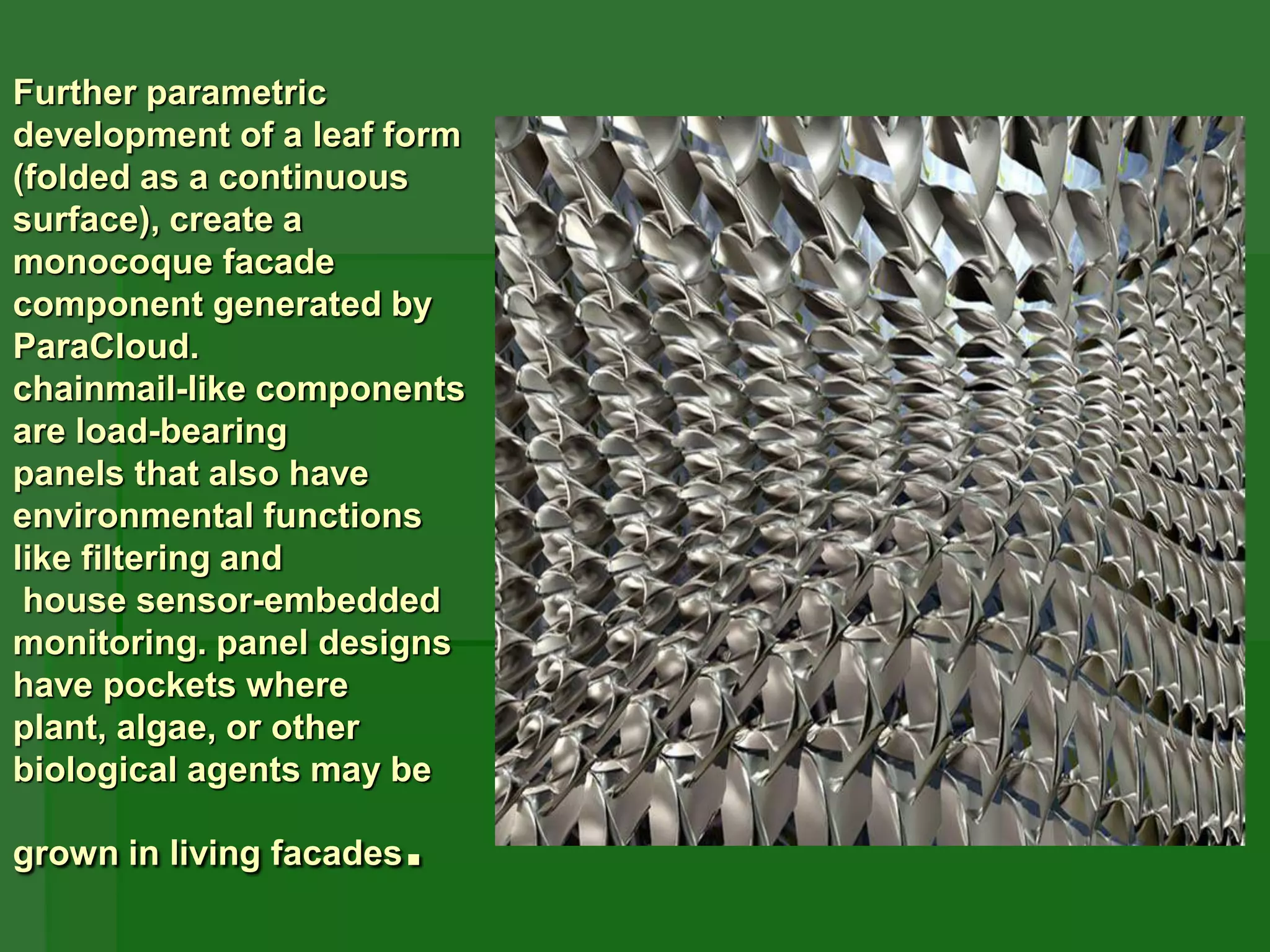
Further parametric
development of a leaf form
(folded as a continuous
surface), create a
monocoque facade
component generated by
ParaCloud.
chainmail-like components
are load-bearing
panels that also have
environmental functions
like filtering and
house sensor-embedded
monitoring. panel designs
have pockets where
plant, algae, or other
biological agents may be
grown in living facades.
Bio Tower by Dollens
Seabed Plumbing Scheme
Global warming can be halted by
plumbing a gigantic array of
pipes into the depths of the
oceans
The plankton growth would take
carbon dioxide out of the
atmosphere and encourage
cloud formation so, cool the
world and save it from global
warming.
Smith L., Scientists propose 'plumbing' method to solve crisis of global warming, The Times Online, 26.09.07
Seabed
Plumbing
Scheme
Plankton Absorb
Carbon
Smith L., Scientists propose 'plumbing' method to solve
crisis of global warming, The Times Online, 26.09.07
Excavation of the
chambers and
highways made by
the leafcutter ant
(Atta laevigata) in
Argentina after the
nest had been
flooded with 6.7
metric tonnes of
cement mixed in
9,000 litres of
water.
Hansell M, 2007,Built By Animals,
(Oxford University Press),
Leafcutter Ants’ Nest
Cross section of an American termite nest. The nest
is ventilated by air cooled by the ground water. Melet 1999
Termites
TERMITES
The dramatic forms of
giant white ant hills
are a familiar sight
over large areas of
Northern Australia,
occasionally reaching
mammoth proportions
they lend a surrealistic
quality to the
landscape.
Hancocks, D, 1971, Animals and Architecture, (Hugh Evelyn), p12
Attenborough, D, 2005,Life in the undergrowth, BBC Books p.222
A queen termite
lies in the royal
chamber with her
consort, the only
fertile male in the
colony, lying
alongside. She is
surrounded by
workers who
collect her eggs
and ingest
secretions from
her body.
Hancocks, D, 1971, Animals and Architecture, Hugh Evelyn, p13
Termite nests
display a
wide variety
of shapes
and sizes.
These
structures
belong to two
different
species, and
have been
built side by
side in the
African
jungle
Blind worker termite adds
its little mud pellet to the
colony's great
construction
Attenborough, D, 2005,Life in the Undergrowth, BBC Books p.231
Magnetic or Compass termitaries near Darwin ,
Australia..
Attenborough, D, 2005,Life in the undergrowth, BBC Books p.228
Compass termites in
Australia Evolved orientation
of termitary for
preferred maximum
temperature level
of about 320C
Von Frisch 1975
Termitary of
Macro-termes
subhyalinus at
Lake Manyara,
National Park
Tanzania
Von Frisch 1975
Nest of a termite
species (Apicotermes
gurgulifex) that uses
its own excrement to
fashion a harmonious
structure. The nest,
about 20cm high, lives
below ground and is
surrounded by an air
space. The surface is
pierced by ventilation
slits, each slit being
surrounded by a
raised ring.
Von Frisch 1975
Various termitaries with
temperature conditions
Longitudinal section through
the nest of Macroternes
bellicosus from Ivory Coast.
Air is circulated by buoyancy
Bio-inspired Function
Architecture inspired by termite nests
Jeronimidis, G, 2007, The University of Reading
The Ultima Tower - a
Human Termite Nest by
Eugene Tsui
Eastgate Centre, Harare, Zimbabwe
Designed to be ventilated and cooled by entirely
natural means in 1996
Architect Mick Pearce. Arups
Eastgate Office Building in Harare
Zimbabwe inspired by termites nest
TERMES
RESEARCH
PROJECT at
Loughborough
University led by
Rupert Soar.
MRI scans taken
inside mounds.
Also see BBC DVD
2005 on Life in the
Undergrowth by
David
Attenborough
Benyus in Kellert et al 2008
Biomimetics: Early Examples
Giant Water lilies – Kew
Gardens-inspires the rib vaults
at Crystal Palace Crystal Palace 1851
Jeronimidis, G, 2007, The University of Reading
The Lotus Effect is the
self-cleaning property
found with lotus plants'
leaves.
Nanotechnologists are
developing methods to
make paints, roof tiles,
fabrics and other surfaces
that can stay dry and clean
themselves in the same
way as the lotus leaf.
Usually achieved by
treating the surface with a
fluorochemical or silicone
treatment
http://en.wikipedia.org/wiki/Lotus_effect
The Lotus Effect
Self-Cleaning Surfaces
)
Microscopic structure and
surface chemistry mean
surfaces never get wet.
Surface roughness and
surface tension are basis
of system
Coloured water on the
Lotusleaf (Nelumbo
Nucifera)
Jeronimidis, G, 2007, The University of Reading
Fractal topology
of extruded leaf
wax
Physical principle = Surface
tension affected by wax
Droplet collects particles
and clean leaf
Jeronimidis, G, 2007, The University of Reading
The Lotus Effect
Water forms droplets on the tips of the epidermal
protrusions and collects pollutants, dirt and small
insects as it rolls off the leaf.
Pooley, B. Biomimetics: Borrowing from Biology Thenakedscientists.com
Scientists at Bonn University
have invented a self-cleaning
paint based on the leaves of
the lotus plant, which seem
clean the minute after a rain
shower, their waxy hairs hold
the raindrops, absorb dirt,
then roll off when they reach
critical mass.
Back to the Nature in the Urban Jungle, The Times, 26.8.2010 p.16
Bioluminescence
Bioluminescence is the production
and emission of light by a living
organism. Its name is a hybrid word,
originating from the Greek bios for
"living" and the Latin lumen "light".
Bioluminescence is a naturally
occurring form of chemiluminescence
where energy is released by a
chemical reaction in the form of light
emission
Bioluminescent Trees
BIOLUMINESCENT TREES
 Fireflies, anglerfish, other
creatures and some mushrooms
glow due to bioluminescense
Alberto Estévez’s
Bioluminescent Tree
Experiments in bio-illumination with
implications for architecture, industrial
and environmental design.
Dollens, 2005,Design Biomimetics: An Inquiry and Proposal for Architecture and Industrial Design
Gilder .J, Clements-Croome .D .J, 2010, Bio inspired
Intelligent Design for the Future of Buildings
Gilder’s proposed photovoltaic cell over the
membrane absorbing sunrays from all
directions inprired by Moths Eye
Microscopic view of a schematic membrane with
impregnations on its outer surface created for increasing
its exposed surface area.
A virtual analysis of the model for this
project showing the encapsulated
routings of the heating and cooling
network within the base material of the
structure.
Gilder .J, Clements-Croome .D .J, 2010, Bio inspired Intelligent Design for the Future of Buildings
Lessons from Nature?
• Lateral Thinking and Creativity
• Inspiration not imitation
• Simple Physics – Smart
Engineering Implementation
• Functional Integration – Adaptive
Design
Nature can Influence Design
Facet of Nature Architectural Feature
Human femur bone Base of Eiffel Tower
Amazon water lily Vaulting of Crystal Palace
Skeletons of radiolarians Geodesic domes
Byssus threads of mussels Adhesive filaments
Box fish Daimler –Chrysler car
Logarithmic spiral in seashells;
cochlea; skin pores Ventilation fans by PAX Scientific
continued
Nature can Influence Design
Facet of Nature Architectural feature
Peacocks; humming birds;
butterflies Structural colour (Vukusic 2004)
Maple samara winged seed
Sea sponge filaments (Venus’s
flower basket)
Pillar like structures of Moths eye
Cuttlefish
Photosynthesis
Shark skin
Samara House by Frank Lloyd
Wright
Light guide
Anti-reflective surface( MARAG
film for and solar cells and
displays)
Skin cells change colour
Dye sensitised solar cells
Low drag swimming suits
Various Useful Crossovers
from Nature
BIOLOGICAL
INSPRIATION
BUILDING
NEEDS
REQUIRED
CHARACTERISTICS
RELATED SMART MATERIALS AND
TECHNOLOGIES
INHERENT SMARTY
MATERIALS
ACTIVE ENGINEERING
SYSTEMS
SKIN
Control of Solar
radiation through
enveloping
material
Spectral absorptivity /
transmissivity of the
skin
Photochromics Amalgramation of two or
more of these technologies for
a multilateral energy
exchange system. Eg
photovoltaic cells mounted
over Photocromic film
HAIR ON THE
HEAD
The relative position
of the screens with
respect to the skin
Use on green follage
exterior facades and
roofs integrated with
facade material E.g.
creepers grow on
mebranes
Louvres and panelling
systems with embedded
sensors and actuator
mechanisms
SWEATING
Control of Interior
heat generation
Evaporative cooling Earthen and vernacular
architecture materials
like moist clay and
dung
Invitation of sweating
mechanism through walls
with capillary mechanism by
the use of:
 Phase change materials
 Thermoelectrics
BODY FAT
Control of heat
loss from core
areas (human
operational area)
Thermal
Conductivity of
enveloping
material
Phase-change materials
used as energy
reservoirs.
 Thermotropics,
Plezoelectrics as
sensors for closing
mechanism
BLOOD
VESSELS
Energy Delivery
 HVAC
 Electrical
 Plumbing etc
Minimum waste of
energy in
conversation and
also in delivery
Embedded branching
analogies delivered
from nature such as the
branching of a tree and
other such tubular
systems embedded with
in the structural
framework E.g. Fibre
optics
Engineering piping and
ducting within the
structural framework of a
building by deriving the
principles of branching in
nature
BLOOMIN
G OF
FLOWERS
Optimisation of
Lighting
Occupancy and
lighting
requirement
sensing
Engineering of smart
material technologies for
responsive active system,:
 Photovoltaics
 Photoelectrics
 Pyroelectrics
MOTHS
EYE
Absorption of
Solar radiation
through
enveloping
material
Highly absorptive
material in order to
maximum incident
radiation from the
sun to generate
electricity
 Photovoltaics
 Photochromics
 Electrochromics
Amalagramation of two or
more of these technologies
for a multilateral energy
exchange system. E.g.
Photovoltaic cells
mounted over a
Photochromic film
SPIDERS
WEB
The ability to
absorb/drain/direct,
moisture from the air
(indoor/outdoor) and
harvest water
Silky tail-shaped
protein fibres which
change structure in
response to water
Nano-fibres provide a
roughly knobby texture
Replicate the architecture of the
web to channelize water
TERMITES
Natural ventilation Evaporative cooling
though porous
membranes
Earthen vernacular
architecture material
like most clay and dung
Limitation of sweating mechanism
through walls with capillary
mechanism by the use of:
 Phase-change materials
 Thermoelectrics
 Nano tubes with closing
mechanism
SHARK
SKIN
Low resistance to
Winds thus increasing
the life of the building
and reducing structural
stresses
Low Friction Drag Nano technology paints
with “dermal denticals”
similar to that found on
the skin of a shark
INSECTS Optimisation of lighting Size, location,
colour and efficacy
 Light-emitting
diodes (LEDs)
 Electroluminescent
 Chemoluminescent
paints
Product engineering with
Photovoltaic materials generating
electric energy for
electroluminescent materials
would theoretically make zero
energy street lighting and ambient
lighting possible.
GROWTH
MECHANIS
MS WITHIN
PLANTS
Optimisation of
Temperature and Air
Quality
Temperature,
Humidity and Air
Quality sensing.
Also occupancy
sensing
Systems devised from the
engineering of
 Thermoelectrics
 Pyroelectrics
 Biosensor
 Chemical sensors
 Optical MEMS.
SPIDER AND
SCORPIONS
Monitoring of
Structural
Systems
Stress and deformation
monitoring
Crack monitoring
Vibration monitoring
and control
 Fibre-optics
 Piezoelectrics
Systems devised from the
applications of:
 Electrorheologicals
(ERs)
 MAgneto rheologicals
 Shape memory alloys
SELF HEALING
/REPAIR
Health
monitoring of
facades
Structural and surface
integration check and
healing
 Fibre-optics
 Piezoelectrics
 Self healing materials
(Self healing in
polymers and fibre-rein
forced polymer
composites)
Systems devised from the
engineering of Shape
memory alloys
LOTUS LEAF Surface finishes  Self cleaning
 Heat and
Radiation
reflection
 Durability
The lotus leaf inspired
Nanotechnology in:
 Self cleaning paints &
finishes
 Self-cleaning films &
membranes
 Conductive paints
 Luminescent paints
PATTERNS IN
NATURE
From following
function
Growth-inspired
adaptive design
algorithm
Shape Memory Alloys Geometric studies of
criterion based on
minimisation and
equalisation of surface
stresses
Conclusions
Bio-architectural engineering
shows:
 Economy of energy and materials
as in Nature
 Aesthetics
 Sensor Systems
 Integrated SolutionsJeronimidis, G, 2007, The University of Reading
Conclusions: Biological
Sensors
 High sensitivity
 Small dimensions, small mass (arrays)
 Highly integrated hardware-software
 Vast pool of paradigms for inspiration
 SIMPLE PHYSICS
 SMART IMPLEMENTATION
Jeronimidis, G, 2007, The University of Reading
Design biomimetics is a bridge that
can connect building design
professions on a route to linking
designed, environmental, and,
eventually, non-toxic materials.
Design biomimetics can lead to
technological means for
visualization, digital fabrication,
and, eventually, bioengineering
and intelligent systems.
Dennis Dollens Grows Architecture: Podhotels and Spiral Bridges,06.05.07www.treehugger.co
More importantly, design
biomimetics can emphasize
ways of thinking and designing
that bring architecture and
industrial design into a process
of environmental and biological
focus on more responsive,
safer buildings
Dennis Dollens Grows Architecture: Podhotels and Spiral Bridges,06.05.07 www.treehugger.com
Lessons from Bees
 Form a decision making group of
individuals with shared interests
 Minimise the leader’s influence
 Seek diverse solutions
 Update knowledge through debate
 Use quorums to gain cohesion,
accuracy and speed
Seeley in Honeybee Democracy 2010 Princeton UP
Lessons from Nature
Although human ingenuity makes
various inventions it will never
discover inventions more
beautiful, appropriate and more
direct than in Nature because in
her nothing is lacking and nothing
is superfluous.
Leonardo Da Vinci
WHAT WE CALL THE BEGINNING
IS OFTEN THE END
AND TO MAKE AN END IS TO
MAKE A BEGINNING
THE END IS WHERE WE START
FROM
T.S.ELIOT-- FOUR QUARTETS-- LITTLE GIDDING

Prof Derek Clements-Croome - Sustainable architecture

  • 1.
    SUSTAINABLE ARCHITECTURE : LESSONS FROMNATURE XVII Mexican Conference on Structural Engineering and Sustainable Development Leon , November 5th and University of Mexico November 8th 2010 Professor Derek Clements –Croome School of Construction Management & Engineering www.derekcroome.comwww.rdg.ac.uk/ib
  • 2.
    Lessons from Nature L’architectedu futur construira en imitant la nature parce que c’est la plus rationnelle, durable et économique des méthodes --- Gaudi Although human ingenuity makes various inventions it will never discover inventions more beautiful, appropriate and more direct than in Nature because in her nothing is lacking and nothing is superfluous.--- Leonardo da Vinci The engineering skill that goes into a beaver dam rivals the elegant calculations that built Pyramids and the Panama Canal -- Gould and Gould ( 2007)
  • 3.
    Characteristics of Nature runs on sunlight;  uses only the energy it needs;  fits form to function;  recycles;  rewards cooperation;  banks on diversity;  demands local expertise;  realises the power of limits. Benyus (2002)
  • 4.
    Biomimetics The abstraction ofgood design from Nature
  • 5.
    Functional Biomimetics  Capturefunctional attributes of living organisms and  Converts them into to technological solutions Julian F.V. Vincent
  • 6.
    Construction Methods  Sculpting Piling up  Moulding  Rolling and folding  Sticking together  Weaving and sewing
  • 7.
     Much ofour aesthetic is derived from an organic and fluid language that you find in Nature.  It involves complex, three dimensional geometries but there is always a rigorous logic behind them.
  • 8.
    Science and Nature Scientistsaspire to replace many of the essential features of photosynthesis---- the process by which plants use sunlight to produce oxygen and organic molecules. Royal Society of Chemistry, Harnessing Light: Solar Energy for a Low Carbon Future,
  • 9.
    The Artificial Leaf Researchgroups are now trying to create artificial leafs by using ruthenium and manganese complexes to try and mimic natural processes. An Artificial Leaf would split water to produce oxygen and hydrogen, use hydrogen either as a fuel or to reduce carbon dioxide to produce organic fuels. Royal Society of Chemistry, Harnessing Light: Solar Energy for a Low Carbon Future,2008
  • 10.
    The Physical Worldsof Plants and Animals  Gravity  movement, growth  Fluid flows  air, water, blood  Surface tension  wetting, moving on water surface  Friction  joints, burrowing  Adhesion  gecko, flies  Impact  fighting, feeding  Temperature  heating, cooling  Gas transfer  breathing, respiration Dr Richard Bonser , What is Biomimetics ? 2008
  • 11.
    Biomimetics, Design and IntelligentBuildings BOTH ORGANISMS AND BUILDINGS HAVE TO SURVIVE IN THEIR ENVIRONMENTS  ADAPTATION (Shape, Materials, Structures,…),MODULATION  SENSING, ACTUATION (Passive, Active)  INTELLIGENCE (Choices, Responses)  ENERGY MANAGEMENT Jeronimidis, G, 2007, The University of Reading
  • 12.
    Biomimetics Design and Architecture FINDINGHOW BIOLOGY SOLVES THE SAME KIND OF PROBLEMS MATERIALS/STRUCTURES → FIBRES/COMPOSITES SENSING, ACTUATION → INTEGRATION INTELLIGENCE (Responses) → SENSORY SYSTEM ENERGY MANAGEMENT → METABOLISM Based on Jeronimidis, G, 2007, The University of Reading
  • 13.
    smart materials andstructures (sensing, actuation) Functionality level Molecular Application field medicine, biotechnology, nanotechnology, materials science (self- assembly), surfaces Cell / tissue materials science, textiles, fibrous composites, engineering structures, surfaces, architecture Organ Organism composites and engineering structures, smart materials and structures, architecture Influences of Biomimetics Jeronimidis, G, 2007, The University of Reading
  • 14.
    Control internal environment Adaptto changes in environment  Adaptive passive solutions – no computing power involved but no choice  Active solutions – needs computing power but can provide choice Sensing and Actuation to
  • 15.
    Signalling Regulation Transduction Response Smart / Adaptive(no choice) Intelligent (choice) The sensing function proper is carried out by living cells but often the hierarchical organisation of the materials and structures can amplify signals (vibration, temperature, deformation, etc.) Jeronimidis, G, 2007, The University of Reading Energy input
  • 16.
    Highly Integrated Hardware-Software Systems Most biologicalsensors can achieve sensitivities comparable to thermal noise (~ 10-21W/s) and detect energies typical of single quanta
  • 17.
     Chemical (mostanimals and some plants)  Vibration (spiders, scorpions, insects, crocodiles)  Infrared (beetles, snakes)  Fluid-flow (various insects, crustaceans)  Strain (insects, arthropods)  Pressure (fish)  Touch (most animals and some plants)  Electrical (fish)  Magnetic (fish, birds)  Electromagnetic (vision, most animals) Jeronimidis, G, 2007, The University of Reading Biomimetics Offers Many Types of Sensors
  • 18.
    Insects, Spiders and Crustaceans- sensory information from • strains in the exoskeleton (campaniform sensors) • infrared detectors (modified campaniform) • air flow and pressure detectors (hair sensors) • vibration detectors (slits & lyriform sensors) Jeronimidis, G, 2007, The University of Reading
  • 19.
    Some Applications  Hearingprosthetic devices  Low-mass, small dimensions vibration sensors  accelerometers, damage detectors (AE), seismographs  Low mass, small dimensions fluid-flow sensors  aero-elastic tailoring, smart wings,…. Jeronimidis, G, 2007, The University of Reading
  • 20.
    Intelligent Buildings for People A multi sensory experience  Must be healthy and sustainable  Interact with environment (external, internal)  Light  Heat  Air  Humidity  Occupants control
  • 21.
    What Do WeExpect from an Intelligent Building?  Carry structural loads (external, internal)  Provide shelter  Interact with environment (external, internal)  Control internal environment (sensing, actuation)  Adapt to changes in environment (sensing, actuation)  Integration of functions Jeronimidis, G, 2007, The University of Reading
  • 22.
    Structural Loads andShelter Are the materials we use the best ones for the job ? Can you build a 2km high building with existing materials? What would be the challenges ? And the advantages? Existing construction materials are probably not suitable not enough strength and stiffness too high a density not particularly good for implementing functional integration
  • 23.
    Animals and Plantshave evolved various strategies for dealing with these problems (thermal insulation, cooling – radiating surfaces, blood flow), light interception (plants) In addition, plants are unique in being able to convert solar power into integrated functionality Except for colonies (ants, bees, termites, …) the individual organism is the sole occupant of his “building” Jeronimidis, G, 2007, The University of Reading
  • 24.
    We would likethe intelligent buildings of the future generation to open its windows like eyelids to the dawn Aldersey-Williams Back to the Nature in the Urban Jungle, The Times, 26.8.2010 p.16
  • 25.
    Nature has alwaysbeen architecture’s chief muse. The earliest Greek temples, made at first, from tree trunks, gradually honed into the ancient architectural orders, were an early attempt at reconciling Nature and man in architectural form. Back to the Nature in the Urban Jungle, The Times, 26.8.2010 p.16
  • 26.
    Form/shape biomimetics Capture theaesthetic attributes of biological structures and introduce them into man-made artifacts Jeronimidis, G, 2007, The University of Reading
  • 27.
    The Fish (Peix)at Via Olimpica Barcelona 1989-1992 by Ghery H. Alderney-William , Zoomorphic 2004, (Lawrence King)
  • 28.
    Frank Gehry’s fish represents “freedom” and structural fluidity H. Alderney-William , Zoomorphic 2004, (Lawrence King)
  • 29.
    Milwaukee Art Museum, Wisconsin,USA, 1994-2001 by Santiago Calatrava is like a Bird
  • 31.
    Auditorium Parco dellaMusica Rome Italy 1994-2002 by Renzo Piano like a Beetle
  • 33.
    Scottish Exhibition andConference Centre by Norman Foster like an Armadillo
  • 34.
    Organic Architecture Organic architecture promotesharmony between human habitation and the natural world through design. Sympathetic and integrated into its site so that buildings, furnishings, and surroundings become part of a unified, interrelated composition. Fallingwater by Frank Lloyd Wright
  • 35.
    Green Roofs Dandelion Houseby Terunobu Fujimori 1995
  • 36.
    Patterns in Nature TheFibonacci numbers 1, 2, 3, 5, 8, 13, 21, 34, 55, 89, 144………frequently occur in Nature. The seeds of sunflowers and daisies have spiral patterns. Daisies have 21 clockwise and 34 anticlockwise spirals. Similar patterns occur in pine cones and pineapples. Petals number 3 for lilies, buttercups 5, delphiniums 8, marigolds 13, asters 21, daisies 34, 55 or 89 and sunflowers 55, 89 or 144
  • 37.
    The head ofa daisy shows the spiral arrangement whose numerical relations are Fibonacci numbers  21 clockwise  34 anticlockwise Powers, A., 1999, Nature in Design, (Conran Octopus), p.34
  • 38.
    Florets of Romanesco broccoli are “self-similar”at all scales: an example of fractal geometry. Powers, A., 1999, Nature in Design, Conran Octopus, p.39
  • 39.
    Patterns in Nature Ifyou take Fibonacci numbers as successive ratios 8/5, 13/8, 21/13, …….then the ratio values approach the golden number φ=1.618. The golden ratio is φ : 1 which is associated with aesthetics in art and architecture.
  • 40.
    Powers, A., 1999, Naturein Design, (Conran Octopus), Nature’s Spirals Nautilus Shell
  • 41.
    Powers, A., 1999,Nature in Design, (Conran Octopus), p.30 A storm in the Bering Sea from Nimbus 5 satellite. The largest and smallest forms in Nature reveal the process growth and change. Nature’s Spirals
  • 42.
    The coiled leafof the thread-leaf sundew and the chameleon's coiled tail show the practical application of good design principles in nature Powers, A., 1999, Nature in Design, (Conran Octopus), p.31 Nature’s Spirals
  • 43.
    An x-ray photograph ofthe inner chambers of a marine snail shell reveals a “logarithmic” helical spiral. This has been described as a “pyramid coiled round a vertical axis” Powers, A., 1999, Nature in Design, (Conran Octopus), p.35 Nature’s Spirals
  • 44.
    The crystals ofcholesteryl acetate seen through high magnification display the extraordinary beauty found in the structure of matter Powers, A., 1999, Nature in Design, (Conran Octopus), p.25
  • 45.
    Geometry of Nature Examplesseen in Gaudi’s work  Columns of Teresina School  Columns of Sagrada Familia  Church Crypt in Guell Estate (see book on Gaudi by Nonell)
  • 46.
    Animal and Human Technologies Spider’swebs, devices for catching food; Spider’s web in detail hardened forms of viscous thready masses. Otto –Rasch 2001
  • 47.
    Bubble and netformation in a living cell (radiolaria) http://oceanica.cofc.edu/
  • 48.
    We mimic Nature,but have yet to come up with anything to match its technical and aesthetic ingenuity, its ability to adapt to its environment and change over time .Nothing beats a spider's web or for example the human skin. Back to the Nature in the Urban Jungle, The Times, 26.8.2010 p.16
  • 49.
    Examples of SpidersWebs Foelix 1996
  • 50.
    Water Spider constructs underwater oxygen tent used asa hunting lair. Hancocks, D, 1971, Animals and Architecture, (Hugh Evelyn), p14
  • 51.
  • 52.
    Amoeba Sand GrainHouse A single-celled amoeba an organism with no nervous system builds this intricate portable sand grain house Hansell M, 2007,Built By Animals, Oxford University Press,p59
  • 53.
    Birds’ nests: housesfor vertebrates, built from local materials Inside a termite city – three dimensional light construction Oryx weaverbirds nests, South Africa Otto –Rasch 2001
  • 54.
    Bower birds collectand arrange by size brightly coloured objects with which to lure the females and stimulate a sexual response.
  • 55.
    Reed Hut WeatherShetler More highly developed building technology for woven reed hut.Primeval House
  • 56.
    Dual Purpose Nests Thefalse flap above the apparent entrance is always closed but has here been opened to reveal the true way into the nest. Such nests are sometimes used after breeding by adult birds for shelter at night. Hancocks, D, 1971, Animals and Architecture, Hugh Evelyn, p15 The egg storage nest built by penduline tit is one example of protection against predators. The apparent entrance (shown dotted) leads only into an empty pouch.
  • 57.
    Hexagonal Bee Cells Givecompact and lightweight construction,for storage ;the developing larvae are fed by worker bees up to 3000 times a day and after six days, having mounted five times, the pupae are sealed into their cells for a further twelve days Wasps have developed similar structural principles to the bees. With its covering removed a nest shows the layered combs hanging on a fragile network of pillars. Hancocks, D, 1971, Animals and Architecture, Hugh Evelyn, p15
  • 59.
    Bees optimise use of material byuse of hexagon cells.
  • 60.
    Bees also optimisetheir routes too to save energy. Can we learn from this for improving traffic management? Dr N Raine University of London ( Royal Holloway), The Times, October 25th 2010, page 18
  • 61.
    Wasps’ Nest: Miniature CityBuilt of Self-made Paper
  • 62.
    The beginning of sociality.Female Mischocyttarus Wasps build their cells together so ensuring that the eggs within are never unguarded. Attenborough, D, 2005,Life in the Undergrowth, BBC Books p.235
  • 63.
    American Potter Wasp finishes off herneat mud pot by adding an elegant out-turned rim, the mud of which, is still dark and wet Attenborough, D, 2005,Life in the Undergrowth, BBC Books p.234
  • 64.
    Survival of Animaland Plants Depends on Sensing to Capture Information from their Physical and Chemical Environments  Defence Against Predators  Capture of Prey  Adaptation  Navigation  Communication Biological Sensing extracts“ meaning” from noisy environments Jeronimidis, G, 2007, The University of Reading
  • 65.
    Sense Organs Crab eyeseither enlarge or be reduced. Having eyes mounted on stalks helps to increase field of view and range. Light is limited or absent in the deep sea. Reduction or loss of eyes is common in some deep sea Giant Red Hermit Crab with large eye stalks . Jeronimidis, G, 2007, The University of ReadingPhoto by Project Oceanica
  • 66.
    Insects, Spiders and Crustacean-sensory informationfrom  strains in the exoskeleton (campaniform sensors)  infrared detectors (modified campaniform)  air flow and pressure detectors (hairs)  vibration detectors (slits & lyriform sensors) Jeronimidis, G, 2007, The University of Reading
  • 67.
    Adult Male GryllodesSigillatus Cricket
  • 68.
    Example: Sensory filiformhairs of crickets: detection of predators (air flow) The filiform sensing hairs are located on the cerci (from a few tens in young, up to 1000+ in adults) cerci Filiform hair length varies between 100 and 1500 μm Diameter typically 4-10 μmJeronimidis, G, 2007, The University of Reading
  • 69.
    MEMS fabricated hair array,produced by MESA at the University of Twente Fig. 1a Mechanosensor hair array on cercus Adult male cricket Acheta domesticus Jeronimidis et at, Customised Intelligent Life-inspired Arrays, The University of Reading
  • 70.
    Microelectromechanical (MEMS) System Longhair sensorsfor airflow and acoustic measurements also photonics e.g. crickets, gecko Jeronimidis, G, 2007, The University of Reading
  • 71.
    Biomimetic Hair Sensor Arrays- MEMS (MESA, University of Twente2004) Sensors connected in parallel Single layer SU-8 Hairs (470 mm)
  • 72.
    Capacitive MEMS Systems High sensitivity  Generator or modulator type  (Low power consumption)  •Measures displacement  •Relative complex read out electronics  •Ability for 2 dimensional sensing (directionality) Jeronimidis, G, 2007, The University of Reading
  • 73.
    Cerci organs (about2mm long) carry about 2000 hair-type sense organs each act as: air-flow sensors chemical sensors acceleration sensors deformation sensors contact sensors WOOD CRICKET (15 mm long) Integrated Sensing Jeronimidis, G, 2007, The University of Reading
  • 74.
    Seidel 2004 Dangles etal., 2004 Jeronimidis, G, 2007, The University of Reading Sensory Filiform Hairs of Crickets
  • 75.
    SEM of cricketcerci at 257x mag
  • 76.
    Prey Localisation inDesert Scorpions – Vibration- based Triangulation Jeronimidis, G, 2007, The University of Reading
  • 77.
    Velcro: George deMestral, 1948 Seed pods Galiumaparine (Stickywilly) Jeronimidis, G, 2007, The University of Reading
  • 78.
    Hooks on apiece of Velcro brand fastener Loops on a piece of Velcro brand fastener Tiny hooks on a Burdock (Arctium lappa) hooks (left) and loops (right). http://en.wikipedia.org/wiki/Velcro
  • 79.
    Shark-Skin Effect: Drag Reduction Jeronimidis,G, 2007, The University of Reading
  • 80.
    Jeronimidis, G, 2007,The University of Reading
  • 81.
    Frogs Inspire NewSuper Sticky Tape The sticky toe pads of tree frogs , lizards and crickets have inspired Indian researchers to create a super glue and an adhesive tape that is both strong and reusable over 25 times. Dr Animangsu Ghatak, at the Indian Institute of Technology, Kanpur, and colleagues have made an adhesive tape by running air or oil filled micro channels through a soft, elastic material, making it stickier than conventional glues. Reuter, Frogs inspire new super sticky tape, 17.10.2007
  • 83.
    Synthetic Gecko is Composedof Millions of Mushroom-shaped Hairs one metre square of a new super-sticky material inspired by gecko feet could suspend the weight of an average family car
  • 84.
    Geckos, Glue andSticky tape Scanning electron microscope image of a 1cm2 section of the Gecko-sticky tape. Spiderman toy hanging from a glass plate, attached using the tape with a contact area of approximately 0.5cm2. Bunching of the hairs is a problem that reduces the adhesive properties of the tape. Pooley, B. Biomimetics: Borrowing from Biology Thenakedscientists.com
  • 85.
    Leaf folding inMimosa pudica (1-3 secondes) Shape Change Stimulus: mechanical contact vibration light temperature humidity Jeronimidis, G, 2007, The University of Reading
  • 86.
    Digital-Botanic Architecture Dollens exploresthe use of software such as Xfrog to grow building elements using the software’s botanic algorithms. He designs hypothetical structures and building-skins that are realized in digital models, physical stereolithographic models, graphics and animations. For example his 2004 Spiral Bridge (influenced by a seedpod’s spiraling flight and by the biological lattice of the sponge, Euplectella).
  • 87.
    Digital Botanic Architecture Theidea is not to make buildings look like botanic organisms. It is to interlace Nature and architecture enabling the design of hybridized, biological structures. The overall aim is to create new architectural typologies incorporating natural attributes ordered in performance, materials, mechanics, communications, and form. Dollens 2009
  • 88.
    Dollens, 2005,Design Biomimetics:An Inquiry and Proposal for Architecture and Industrial Design Spiral Bridge based on the sponge Euplectella and the leaves of Tipiana tipu. 2004 by Dennis Dollens and Ignasi Pérez Arnal.
  • 89.
    The Podhotel copies leavesand pods from a flower stalk, the leaves being transformed into solar and shading panels and the pods being prefabricated rooms. Dennis Dollens Grows Architecture: Podhotels and Spiral Bridges,06.05.07 www.treehugger.com
  • 90.
  • 91.
    Nettle leaf and(right) graphic extrapolations manipulated into tiling blocks; note veining, circulation texture, and patterns. Dollens, 2005,Design Biomimetics: An Inquiry and Proposal for Architecture and Industrial Design
  • 92.
    Bio-inspired Shape Roof-supporting “trees”– Stuttgart Airport Jeronimidis, G, 2007, The University of Reading
  • 93.
    The key tofunctional integration in biology is the use of fibre architectures for designing structures, incorporating sensors and providing actuation
  • 94.
    Almond shell studiedas a monocoque paneling system with experimentally layered and structurally linked panels allowing air movement. Dollens, 2005,Design Biomimetics: An Inquiry and Proposal for Architecture and Industrial Design Rhino/3D Studio MAX drawings: D. Dollens.
  • 95.
    Further parametric development ofa leaf form (folded as a continuous surface), create a monocoque facade component generated by ParaCloud. chainmail-like components are load-bearing panels that also have environmental functions like filtering and house sensor-embedded monitoring. panel designs have pockets where plant, algae, or other biological agents may be grown in living facades.
  • 96.
    Bio Tower byDollens
  • 97.
    Seabed Plumbing Scheme Globalwarming can be halted by plumbing a gigantic array of pipes into the depths of the oceans The plankton growth would take carbon dioxide out of the atmosphere and encourage cloud formation so, cool the world and save it from global warming. Smith L., Scientists propose 'plumbing' method to solve crisis of global warming, The Times Online, 26.09.07
  • 98.
    Seabed Plumbing Scheme Plankton Absorb Carbon Smith L.,Scientists propose 'plumbing' method to solve crisis of global warming, The Times Online, 26.09.07
  • 99.
    Excavation of the chambersand highways made by the leafcutter ant (Atta laevigata) in Argentina after the nest had been flooded with 6.7 metric tonnes of cement mixed in 9,000 litres of water. Hansell M, 2007,Built By Animals, (Oxford University Press), Leafcutter Ants’ Nest
  • 100.
    Cross section ofan American termite nest. The nest is ventilated by air cooled by the ground water. Melet 1999 Termites
  • 101.
    TERMITES The dramatic formsof giant white ant hills are a familiar sight over large areas of Northern Australia, occasionally reaching mammoth proportions they lend a surrealistic quality to the landscape. Hancocks, D, 1971, Animals and Architecture, (Hugh Evelyn), p12
  • 102.
    Attenborough, D, 2005,Lifein the undergrowth, BBC Books p.222 A queen termite lies in the royal chamber with her consort, the only fertile male in the colony, lying alongside. She is surrounded by workers who collect her eggs and ingest secretions from her body.
  • 103.
    Hancocks, D, 1971,Animals and Architecture, Hugh Evelyn, p13 Termite nests display a wide variety of shapes and sizes. These structures belong to two different species, and have been built side by side in the African jungle
  • 104.
    Blind worker termiteadds its little mud pellet to the colony's great construction Attenborough, D, 2005,Life in the Undergrowth, BBC Books p.231
  • 106.
    Magnetic or Compasstermitaries near Darwin , Australia.. Attenborough, D, 2005,Life in the undergrowth, BBC Books p.228
  • 108.
    Compass termites in AustraliaEvolved orientation of termitary for preferred maximum temperature level of about 320C Von Frisch 1975
  • 109.
    Termitary of Macro-termes subhyalinus at LakeManyara, National Park Tanzania Von Frisch 1975
  • 110.
    Nest of atermite species (Apicotermes gurgulifex) that uses its own excrement to fashion a harmonious structure. The nest, about 20cm high, lives below ground and is surrounded by an air space. The surface is pierced by ventilation slits, each slit being surrounded by a raised ring. Von Frisch 1975
  • 111.
    Various termitaries with temperatureconditions Longitudinal section through the nest of Macroternes bellicosus from Ivory Coast. Air is circulated by buoyancy
  • 112.
    Bio-inspired Function Architecture inspiredby termite nests Jeronimidis, G, 2007, The University of Reading
  • 113.
    The Ultima Tower- a Human Termite Nest by Eugene Tsui
  • 114.
    Eastgate Centre, Harare,Zimbabwe Designed to be ventilated and cooled by entirely natural means in 1996 Architect Mick Pearce. Arups
  • 115.
    Eastgate Office Buildingin Harare Zimbabwe inspired by termites nest
  • 116.
    TERMES RESEARCH PROJECT at Loughborough University ledby Rupert Soar. MRI scans taken inside mounds. Also see BBC DVD 2005 on Life in the Undergrowth by David Attenborough Benyus in Kellert et al 2008
  • 117.
    Biomimetics: Early Examples GiantWater lilies – Kew Gardens-inspires the rib vaults at Crystal Palace Crystal Palace 1851 Jeronimidis, G, 2007, The University of Reading
  • 118.
    The Lotus Effectis the self-cleaning property found with lotus plants' leaves. Nanotechnologists are developing methods to make paints, roof tiles, fabrics and other surfaces that can stay dry and clean themselves in the same way as the lotus leaf. Usually achieved by treating the surface with a fluorochemical or silicone treatment http://en.wikipedia.org/wiki/Lotus_effect
  • 119.
    The Lotus Effect Self-CleaningSurfaces ) Microscopic structure and surface chemistry mean surfaces never get wet. Surface roughness and surface tension are basis of system Coloured water on the Lotusleaf (Nelumbo Nucifera) Jeronimidis, G, 2007, The University of Reading
  • 120.
    Fractal topology of extrudedleaf wax Physical principle = Surface tension affected by wax Droplet collects particles and clean leaf Jeronimidis, G, 2007, The University of Reading
  • 121.
    The Lotus Effect Waterforms droplets on the tips of the epidermal protrusions and collects pollutants, dirt and small insects as it rolls off the leaf. Pooley, B. Biomimetics: Borrowing from Biology Thenakedscientists.com
  • 122.
    Scientists at BonnUniversity have invented a self-cleaning paint based on the leaves of the lotus plant, which seem clean the minute after a rain shower, their waxy hairs hold the raindrops, absorb dirt, then roll off when they reach critical mass. Back to the Nature in the Urban Jungle, The Times, 26.8.2010 p.16
  • 123.
    Bioluminescence Bioluminescence is theproduction and emission of light by a living organism. Its name is a hybrid word, originating from the Greek bios for "living" and the Latin lumen "light". Bioluminescence is a naturally occurring form of chemiluminescence where energy is released by a chemical reaction in the form of light emission
  • 124.
    Bioluminescent Trees BIOLUMINESCENT TREES Fireflies, anglerfish, other creatures and some mushrooms glow due to bioluminescense
  • 125.
    Alberto Estévez’s Bioluminescent Tree Experimentsin bio-illumination with implications for architecture, industrial and environmental design. Dollens, 2005,Design Biomimetics: An Inquiry and Proposal for Architecture and Industrial Design
  • 126.
    Gilder .J, Clements-Croome.D .J, 2010, Bio inspired Intelligent Design for the Future of Buildings
  • 127.
    Gilder’s proposed photovoltaiccell over the membrane absorbing sunrays from all directions inprired by Moths Eye Microscopic view of a schematic membrane with impregnations on its outer surface created for increasing its exposed surface area.
  • 128.
    A virtual analysisof the model for this project showing the encapsulated routings of the heating and cooling network within the base material of the structure. Gilder .J, Clements-Croome .D .J, 2010, Bio inspired Intelligent Design for the Future of Buildings
  • 129.
    Lessons from Nature? •Lateral Thinking and Creativity • Inspiration not imitation • Simple Physics – Smart Engineering Implementation • Functional Integration – Adaptive Design
  • 130.
    Nature can InfluenceDesign Facet of Nature Architectural Feature Human femur bone Base of Eiffel Tower Amazon water lily Vaulting of Crystal Palace Skeletons of radiolarians Geodesic domes Byssus threads of mussels Adhesive filaments Box fish Daimler –Chrysler car Logarithmic spiral in seashells; cochlea; skin pores Ventilation fans by PAX Scientific continued
  • 131.
    Nature can InfluenceDesign Facet of Nature Architectural feature Peacocks; humming birds; butterflies Structural colour (Vukusic 2004) Maple samara winged seed Sea sponge filaments (Venus’s flower basket) Pillar like structures of Moths eye Cuttlefish Photosynthesis Shark skin Samara House by Frank Lloyd Wright Light guide Anti-reflective surface( MARAG film for and solar cells and displays) Skin cells change colour Dye sensitised solar cells Low drag swimming suits
  • 132.
    Various Useful Crossovers fromNature BIOLOGICAL INSPRIATION BUILDING NEEDS REQUIRED CHARACTERISTICS RELATED SMART MATERIALS AND TECHNOLOGIES INHERENT SMARTY MATERIALS ACTIVE ENGINEERING SYSTEMS SKIN Control of Solar radiation through enveloping material Spectral absorptivity / transmissivity of the skin Photochromics Amalgramation of two or more of these technologies for a multilateral energy exchange system. Eg photovoltaic cells mounted over Photocromic film HAIR ON THE HEAD The relative position of the screens with respect to the skin Use on green follage exterior facades and roofs integrated with facade material E.g. creepers grow on mebranes Louvres and panelling systems with embedded sensors and actuator mechanisms SWEATING Control of Interior heat generation Evaporative cooling Earthen and vernacular architecture materials like moist clay and dung Invitation of sweating mechanism through walls with capillary mechanism by the use of:  Phase change materials  Thermoelectrics
  • 133.
    BODY FAT Control ofheat loss from core areas (human operational area) Thermal Conductivity of enveloping material Phase-change materials used as energy reservoirs.  Thermotropics, Plezoelectrics as sensors for closing mechanism BLOOD VESSELS Energy Delivery  HVAC  Electrical  Plumbing etc Minimum waste of energy in conversation and also in delivery Embedded branching analogies delivered from nature such as the branching of a tree and other such tubular systems embedded with in the structural framework E.g. Fibre optics Engineering piping and ducting within the structural framework of a building by deriving the principles of branching in nature BLOOMIN G OF FLOWERS Optimisation of Lighting Occupancy and lighting requirement sensing Engineering of smart material technologies for responsive active system,:  Photovoltaics  Photoelectrics  Pyroelectrics MOTHS EYE Absorption of Solar radiation through enveloping material Highly absorptive material in order to maximum incident radiation from the sun to generate electricity  Photovoltaics  Photochromics  Electrochromics Amalagramation of two or more of these technologies for a multilateral energy exchange system. E.g. Photovoltaic cells mounted over a Photochromic film
  • 134.
    SPIDERS WEB The ability to absorb/drain/direct, moisturefrom the air (indoor/outdoor) and harvest water Silky tail-shaped protein fibres which change structure in response to water Nano-fibres provide a roughly knobby texture Replicate the architecture of the web to channelize water TERMITES Natural ventilation Evaporative cooling though porous membranes Earthen vernacular architecture material like most clay and dung Limitation of sweating mechanism through walls with capillary mechanism by the use of:  Phase-change materials  Thermoelectrics  Nano tubes with closing mechanism SHARK SKIN Low resistance to Winds thus increasing the life of the building and reducing structural stresses Low Friction Drag Nano technology paints with “dermal denticals” similar to that found on the skin of a shark INSECTS Optimisation of lighting Size, location, colour and efficacy  Light-emitting diodes (LEDs)  Electroluminescent  Chemoluminescent paints Product engineering with Photovoltaic materials generating electric energy for electroluminescent materials would theoretically make zero energy street lighting and ambient lighting possible. GROWTH MECHANIS MS WITHIN PLANTS Optimisation of Temperature and Air Quality Temperature, Humidity and Air Quality sensing. Also occupancy sensing Systems devised from the engineering of  Thermoelectrics  Pyroelectrics  Biosensor  Chemical sensors  Optical MEMS.
  • 135.
    SPIDER AND SCORPIONS Monitoring of Structural Systems Stressand deformation monitoring Crack monitoring Vibration monitoring and control  Fibre-optics  Piezoelectrics Systems devised from the applications of:  Electrorheologicals (ERs)  MAgneto rheologicals  Shape memory alloys SELF HEALING /REPAIR Health monitoring of facades Structural and surface integration check and healing  Fibre-optics  Piezoelectrics  Self healing materials (Self healing in polymers and fibre-rein forced polymer composites) Systems devised from the engineering of Shape memory alloys LOTUS LEAF Surface finishes  Self cleaning  Heat and Radiation reflection  Durability The lotus leaf inspired Nanotechnology in:  Self cleaning paints & finishes  Self-cleaning films & membranes  Conductive paints  Luminescent paints PATTERNS IN NATURE From following function Growth-inspired adaptive design algorithm Shape Memory Alloys Geometric studies of criterion based on minimisation and equalisation of surface stresses
  • 136.
    Conclusions Bio-architectural engineering shows:  Economyof energy and materials as in Nature  Aesthetics  Sensor Systems  Integrated SolutionsJeronimidis, G, 2007, The University of Reading
  • 137.
    Conclusions: Biological Sensors  Highsensitivity  Small dimensions, small mass (arrays)  Highly integrated hardware-software  Vast pool of paradigms for inspiration  SIMPLE PHYSICS  SMART IMPLEMENTATION Jeronimidis, G, 2007, The University of Reading
  • 138.
    Design biomimetics isa bridge that can connect building design professions on a route to linking designed, environmental, and, eventually, non-toxic materials. Design biomimetics can lead to technological means for visualization, digital fabrication, and, eventually, bioengineering and intelligent systems. Dennis Dollens Grows Architecture: Podhotels and Spiral Bridges,06.05.07www.treehugger.co
  • 139.
    More importantly, design biomimeticscan emphasize ways of thinking and designing that bring architecture and industrial design into a process of environmental and biological focus on more responsive, safer buildings Dennis Dollens Grows Architecture: Podhotels and Spiral Bridges,06.05.07 www.treehugger.com
  • 140.
    Lessons from Bees Form a decision making group of individuals with shared interests  Minimise the leader’s influence  Seek diverse solutions  Update knowledge through debate  Use quorums to gain cohesion, accuracy and speed Seeley in Honeybee Democracy 2010 Princeton UP
  • 141.
    Lessons from Nature Althoughhuman ingenuity makes various inventions it will never discover inventions more beautiful, appropriate and more direct than in Nature because in her nothing is lacking and nothing is superfluous. Leonardo Da Vinci
  • 142.
    WHAT WE CALLTHE BEGINNING IS OFTEN THE END AND TO MAKE AN END IS TO MAKE A BEGINNING THE END IS WHERE WE START FROM T.S.ELIOT-- FOUR QUARTETS-- LITTLE GIDDING