Biology 205
Ecology and Adaptation
Lecture 4
Life in Water
Dr. Erik D. Davenport
Lecture outline
 Hydrologic cycle.
 Aquatic environmental factors: what, why and
how are they distributed in different aquatic
systems.
 The responses of living organisms to these
factors in different aquatic systems.
Water on Earth
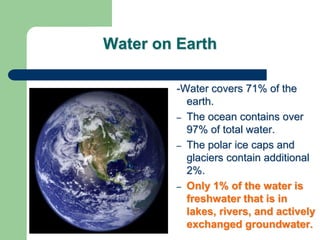
-Water covers 71% of the
earth.
– The ocean contains over
97% of total water.
– The polar ice caps and
glaciers contain additional
2%.
– Only 1% of the water is
freshwater that is in
lakes, rivers, and actively
exchanged groundwater.
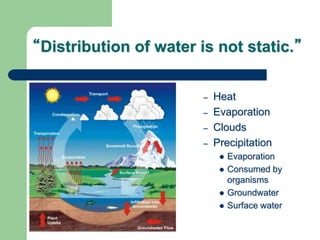
“Distribution of water is not static.”
– Heat
– Evaporation
– Clouds
– Precipitation
 Evaporation
 Consumed by
organisms
 Groundwater
 Surface water
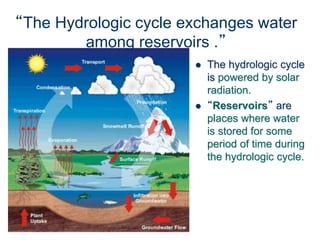
“The Hydrologic cycle exchanges water
among reservoirs .”
 The hydrologic cycle
is powered by solar
radiation.
 “Reservoirs” are
places where water
is stored for some
period of time during
the hydrologic cycle.
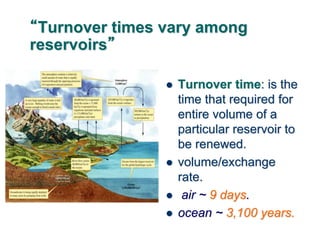
“Turnover times vary among
reservoirs”
 Turnover time: is the
time that required for
entire volume of a
particular reservoir to
be renewed.
 volume/exchange
rate.
 air ~ 9 days.
 ocean ~ 3,100 years.
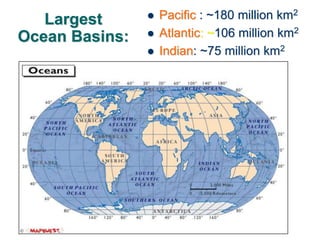
Largest
Ocean Basins:
 Pacific : ~180 million km2
 Atlantic: ~106 million km2
 Indian: ~75 million km2
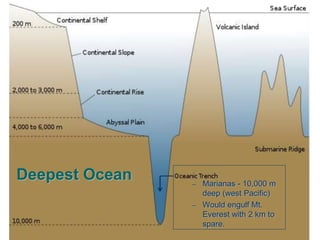
Deepest Ocean – Marianas - 10,000 m
deep (west Pacific)
– Would engulf Mt.
Everest with 2 km to
spare.
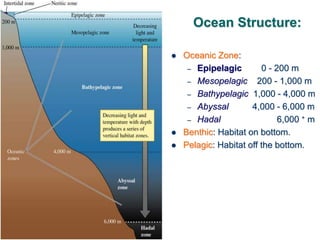
Ocean Structure:
 Oceanic Zone:
– Epipelagic 0 - 200 m
– Mesopelagic 200 - 1,000 m
– Bathypelagic 1,000 - 4,000 m
– Abyssal 4,000 - 6,000 m
– Hadal 6,000 + m
 Benthic: Habitat on bottom.
 Pelagic: Habitat off the bottom.
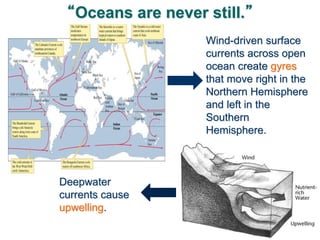
“Oceans are never still.”
Wind-driven surface
currents across open
ocean create gyres
that move right in the
Northern Hemisphere
and left in the
Southern
Hemisphere.
Deepwater
currents cause
upwelling.
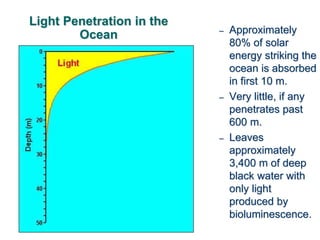
Light Penetration in the
Ocean – Approximately
80% of solar
energy striking the
ocean is absorbed
in first 10 m.
– Very little, if any
penetrates past
600 m.
– Leaves
approximately
3,400 m of deep
black water with
only light
produced by
bioluminescence.
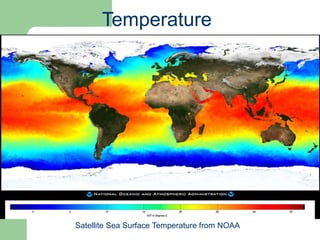
Temperature
Satellite Sea Surface Temperature from NOAA
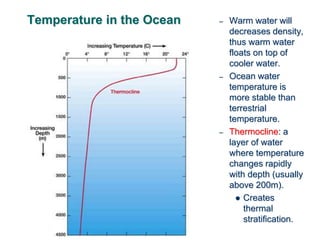
Temperature in the Ocean – Warm water will
decreases density,
thus warm water
floats on top of
cooler water.
– Ocean water
temperature is
more stable than
terrestrial
temperature.
– Thermocline: a
layer of water
where temperature
changes rapidly
with depth (usually
above 200m).
 Creates
thermal
stratification.
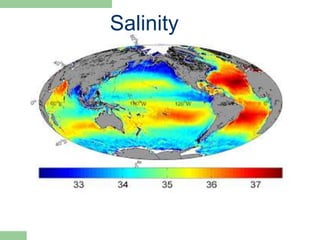
Salinity
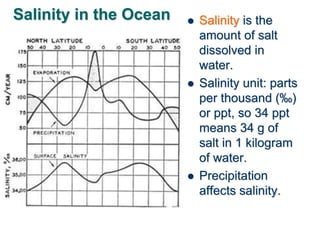
Salinity in the Ocean  Salinity is the
amount of salt
dissolved in
water.
 Salinity unit: parts
per thousand (‰)
or ppt, so 34 ppt
means 34 g of
salt in 1 kilogram
of water.
 Precipitation
affects salinity.
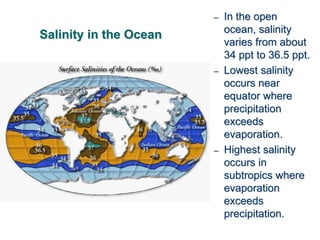
Salinity in the Ocean
– In the open
ocean, salinity
varies from about
34 ppt to 36.5 ppt.
– Lowest salinity
occurs near
equator where
precipitation
exceeds
evaporation.
– Highest salinity
occurs in
subtropics where
evaporation
exceeds
precipitation.
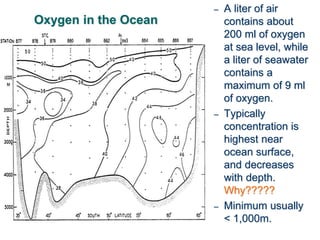
Oxygen in the Ocean
– A liter of air
contains about
200 ml of oxygen
at sea level, while
a liter of seawater
contains a
maximum of 9 ml
of oxygen.
– Typically
concentration is
highest near
ocean surface,
and decreases
with depth.
Why?????
– Minimum usually
< 1,000m.
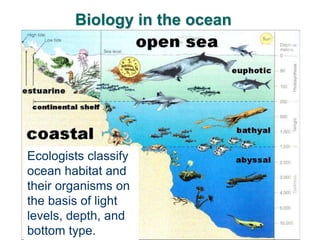
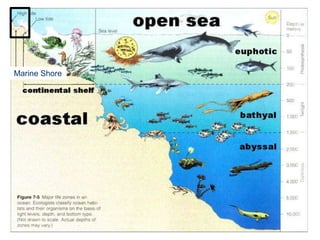
Biology in the ocean
Ecologists classify
ocean habitat and
their organisms on
the basis of light
levels, depth, and
bottom type.
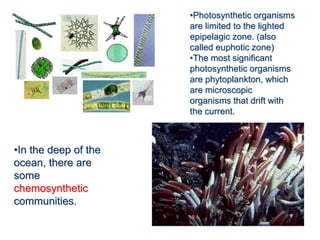
•In the deep of the
ocean, there are
some
chemosynthetic
communities.
•Photosynthetic organisms
are limited to the lighted
epipelagic zone. (also
called euphotic zone)
•The most significant
photosynthetic organisms
are phytoplankton, which
are microscopic
organisms that drift with
the current.
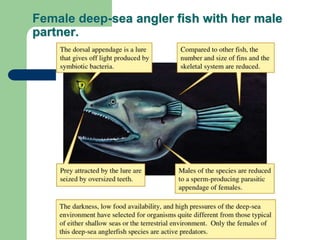
Female deep-sea angler fish with her male
partner.
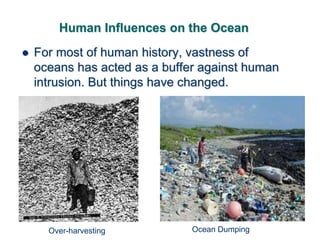
Human Influences on the Ocean
 For most of human history, vastness of
oceans has acted as a buffer against human
intrusion. But things have changed.
Over-harvesting Ocean Dumping
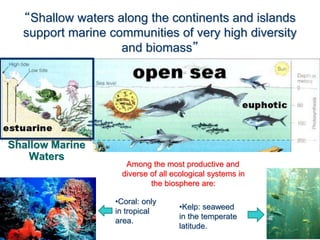
Shallow Marine
Waters
Among the most productive and
diverse of all ecological systems in
the biosphere are:
“Shallow waters along the continents and islands
support marine communities of very high diversity
and biomass”
•Kelp: seaweed
in the temperate
latitude.
•Coral: only
in tropical
area.
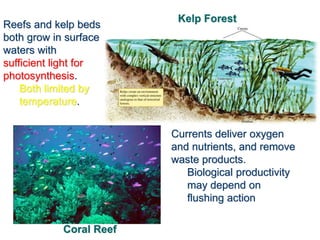
Coral Reef
Reefs and kelp beds
both grow in surface
waters with
sufficient light for
photosynthesis.
Both limited by
temperature.
Currents deliver oxygen
and nutrients, and remove
waste products.
Biological productivity
may depend on
flushing action
Kelp Forest
Marine Shore
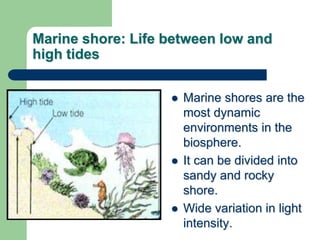
Marine shore: Life between low and
high tides
 Marine shores are the
most dynamic
environments in the
biosphere.
 It can be divided into
sandy and rocky
shore.
 Wide variation in light
intensity.
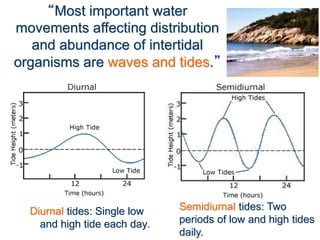
Diurnal tides: Single low
and high tide each day.
“Most important water
movements affecting distribution
and abundance of intertidal
organisms are waves and tides.”
Semidiurnal tides: Two
periods of low and high tides
daily.
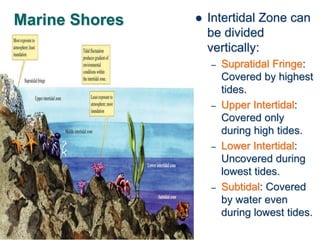
Marine Shores  Intertidal Zone can
be divided
vertically:
– Supratidal Fringe:
Covered by highest
tides.
– Upper Intertidal:
Covered only
during high tides.
– Lower Intertidal:
Uncovered during
lowest tides.
– Subtidal: Covered
by water even
during lowest tides.
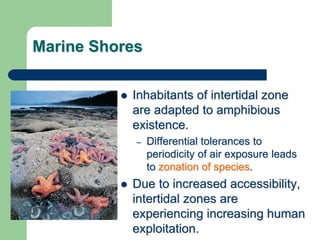
Marine Shores
 Inhabitants of intertidal zone
are adapted to amphibious
existence.
– Differential tolerances to
periodicity of air exposure leads
to zonation of species.
 Due to increased accessibility,
intertidal zones are
experiencing increasing human
exploitation.
Estuaries, Salt
marshes and
mangrove forests
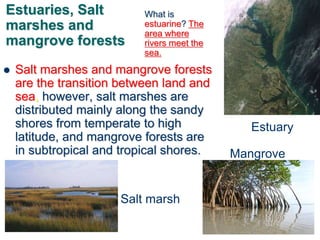
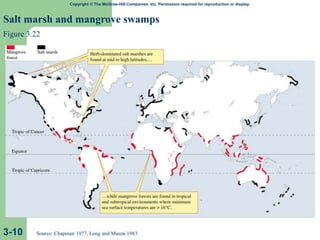
 Salt marshes and mangrove forests
are the transition between land and
sea, however, salt marshes are
distributed mainly along the sandy
shores from temperate to high
latitude, and mangrove forests are
in subtropical and tropical shores.
What is
estuarine? The
area where
rivers meet the
sea.
Salt marsh
Mangrove
Estuary
Copyright © The McGraw-Hill Companies, Inc. Permission required for reproduction or display.
Salt marsh and mangrove swamps
Figure 3.22
3-10 Source: Chapman 1977, Long and Mason 1983
Physical conditions
 Experience the significant variations in tidal
level.
 Exposed to highly light variations.
 Ocean tide and river flow drive the complex
water movements in the estuaries. And
further influence the nutrients delivery,
oxygen distributions, etc….
 Extremely vulnerable to human intrusion.
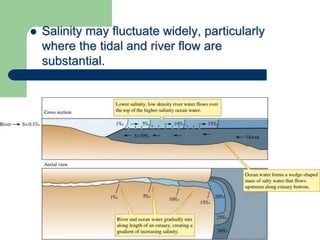
 Salinity may fluctuate widely, particularly
where the tidal and river flow are
substantial.
Rivers and Streams
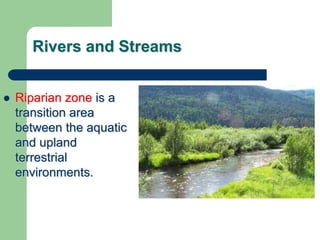
 Riparian zone is a
transition area
between the aquatic
and upland
terrestrial
environments.
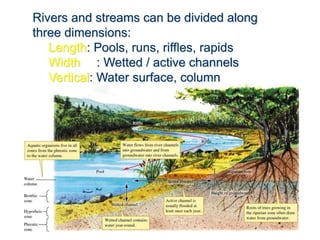
Rivers and streams can be divided along
three dimensions:
Length: Pools, runs, riffles, rapids
Width : Wetted / active channels
Vertical: Water surface, column
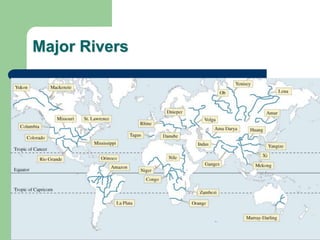
Major Rivers
Rivers and Streams
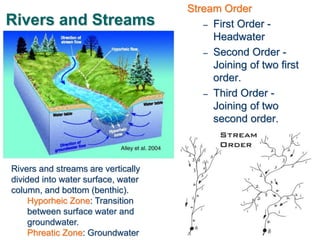
Stream Order
– First Order -
Headwater
– Second Order -
Joining of two first
order.
– Third Order -
Joining of two
second order.
Rivers and streams are vertically
divided into water surface, water
column, and bottom (benthic).
Hyporheic Zone: Transition
between surface water and
groundwater.
Phreatic Zone: Groundwater
Rivers and Streams - Physical
Conditions
 Light
– How much light shines on the surface.
– How far light penetrates the water column.
 Water Movements
– Erosion from land.
– Suspended bottom sediments.
 Temperature
– Closely tracks air temperature.
Rivers and Streams
 Chemical Conditions
– Salinity
 Reflects history of leaching in the basin.
– Oxygen
 Inversely correlated with temperature.
 Human Influence
– Long, intense history of human use.
 Transportation, Irrigation, Waste Disposal.
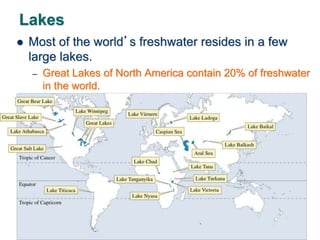
Lakes
 Most of the world’s freshwater resides in a few
large lakes.
– Great Lakes of North America contain 20% of freshwater
in the world.
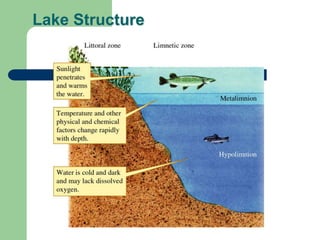
Lake Structure
Lakes - Physical Conditions
 Light
– Lake color depends on light absorption and biological
activity.
 Temperature
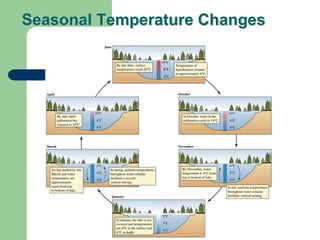
– Lakes become thermally stratified as they warm.
 Water Movement
– Wind-driven mixing of the water column is ecologically
important.
Seasonal Temperature Changes
Copyright © The McGraw-Hill Companies, Inc. Permission required for reproduction or display.
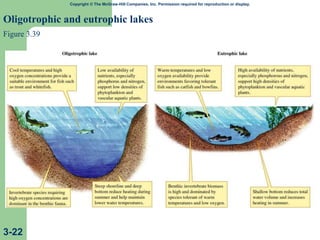
Oligotrophic and eutrophic lakes
Figure 3.39
3-22
 Oligotrophic lake: well-mixed lakes of low
biological productive, and have high oxygen
concentration.
 Eutrophic lakes: lakes with high biological
productivity, and also associated with low or
depleted oxygen concentration.
Lakes - Chemical Conditions
 Oxygen
– Oligotrophic: Low biological production, although
often well oxygenated.
– Eutrophic: High biological production, but may be
depleted of oxygen.
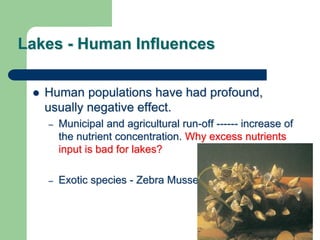
Lakes - Human Influences
 Human populations have had profound,
usually negative effect.
– Municipal and agricultural run-off ------ increase of
the nutrient concentration. Why excess nutrients
input is bad for lakes?
– Exotic species - Zebra Mussels
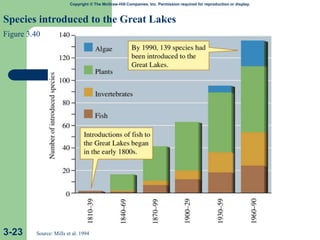
Copyright © The McGraw-Hill Companies, Inc. Permission required for reproduction or display.
Species introduced to the Great Lakes
Figure 3.40
3-23 Source: Mills et al. 1994
Review
 Hydrologic Cycle
 Deep Blue Sea
 Shallow Marine Waters
 Marine Shores
 Estuaries, Salt Marshes, and Mangrove
Forests
 Rivers and Streams
 Lakes

Biology 205 4

  • 1.
    Biology 205 Ecology andAdaptation Lecture 4 Life in Water Dr. Erik D. Davenport
  • 2.
    Lecture outline  Hydrologiccycle.  Aquatic environmental factors: what, why and how are they distributed in different aquatic systems.  The responses of living organisms to these factors in different aquatic systems.
  • 3.
    Water on Earth -Watercovers 71% of the earth. – The ocean contains over 97% of total water. – The polar ice caps and glaciers contain additional 2%. – Only 1% of the water is freshwater that is in lakes, rivers, and actively exchanged groundwater.
  • 4.
    “Distribution of wateris not static.” – Heat – Evaporation – Clouds – Precipitation  Evaporation  Consumed by organisms  Groundwater  Surface water
  • 5.
    “The Hydrologic cycleexchanges water among reservoirs .”  The hydrologic cycle is powered by solar radiation.  “Reservoirs” are places where water is stored for some period of time during the hydrologic cycle.
  • 6.
    “Turnover times varyamong reservoirs”  Turnover time: is the time that required for entire volume of a particular reservoir to be renewed.  volume/exchange rate.  air ~ 9 days.  ocean ~ 3,100 years.
  • 7.
    Largest Ocean Basins:  Pacific: ~180 million km2  Atlantic: ~106 million km2  Indian: ~75 million km2
  • 8.
    Deepest Ocean –Marianas - 10,000 m deep (west Pacific) – Would engulf Mt. Everest with 2 km to spare.
  • 9.
    Ocean Structure:  OceanicZone: – Epipelagic 0 - 200 m – Mesopelagic 200 - 1,000 m – Bathypelagic 1,000 - 4,000 m – Abyssal 4,000 - 6,000 m – Hadal 6,000 + m  Benthic: Habitat on bottom.  Pelagic: Habitat off the bottom.
  • 10.
    “Oceans are neverstill.” Wind-driven surface currents across open ocean create gyres that move right in the Northern Hemisphere and left in the Southern Hemisphere. Deepwater currents cause upwelling.
  • 11.
    Light Penetration inthe Ocean – Approximately 80% of solar energy striking the ocean is absorbed in first 10 m. – Very little, if any penetrates past 600 m. – Leaves approximately 3,400 m of deep black water with only light produced by bioluminescence.
  • 12.
    Temperature Satellite Sea SurfaceTemperature from NOAA
  • 13.
    Temperature in theOcean – Warm water will decreases density, thus warm water floats on top of cooler water. – Ocean water temperature is more stable than terrestrial temperature. – Thermocline: a layer of water where temperature changes rapidly with depth (usually above 200m).  Creates thermal stratification.
  • 14.
  • 15.
    Salinity in theOcean  Salinity is the amount of salt dissolved in water.  Salinity unit: parts per thousand (‰) or ppt, so 34 ppt means 34 g of salt in 1 kilogram of water.  Precipitation affects salinity.
  • 16.
    Salinity in theOcean – In the open ocean, salinity varies from about 34 ppt to 36.5 ppt. – Lowest salinity occurs near equator where precipitation exceeds evaporation. – Highest salinity occurs in subtropics where evaporation exceeds precipitation.
  • 17.
    Oxygen in theOcean – A liter of air contains about 200 ml of oxygen at sea level, while a liter of seawater contains a maximum of 9 ml of oxygen. – Typically concentration is highest near ocean surface, and decreases with depth. Why????? – Minimum usually < 1,000m.
  • 18.
    Biology in theocean Ecologists classify ocean habitat and their organisms on the basis of light levels, depth, and bottom type.
  • 19.
    •In the deepof the ocean, there are some chemosynthetic communities. •Photosynthetic organisms are limited to the lighted epipelagic zone. (also called euphotic zone) •The most significant photosynthetic organisms are phytoplankton, which are microscopic organisms that drift with the current.
  • 20.
    Female deep-sea anglerfish with her male partner.
  • 21.
    Human Influences onthe Ocean  For most of human history, vastness of oceans has acted as a buffer against human intrusion. But things have changed. Over-harvesting Ocean Dumping
  • 22.
    Shallow Marine Waters Among themost productive and diverse of all ecological systems in the biosphere are: “Shallow waters along the continents and islands support marine communities of very high diversity and biomass” •Kelp: seaweed in the temperate latitude. •Coral: only in tropical area.
  • 23.
    Coral Reef Reefs andkelp beds both grow in surface waters with sufficient light for photosynthesis. Both limited by temperature. Currents deliver oxygen and nutrients, and remove waste products. Biological productivity may depend on flushing action Kelp Forest
  • 24.
  • 25.
    Marine shore: Lifebetween low and high tides  Marine shores are the most dynamic environments in the biosphere.  It can be divided into sandy and rocky shore.  Wide variation in light intensity.
  • 26.
    Diurnal tides: Singlelow and high tide each day. “Most important water movements affecting distribution and abundance of intertidal organisms are waves and tides.” Semidiurnal tides: Two periods of low and high tides daily.
  • 27.
    Marine Shores Intertidal Zone can be divided vertically: – Supratidal Fringe: Covered by highest tides. – Upper Intertidal: Covered only during high tides. – Lower Intertidal: Uncovered during lowest tides. – Subtidal: Covered by water even during lowest tides.
  • 28.
    Marine Shores  Inhabitantsof intertidal zone are adapted to amphibious existence. – Differential tolerances to periodicity of air exposure leads to zonation of species.  Due to increased accessibility, intertidal zones are experiencing increasing human exploitation.
  • 29.
    Estuaries, Salt marshes and mangroveforests  Salt marshes and mangrove forests are the transition between land and sea, however, salt marshes are distributed mainly along the sandy shores from temperate to high latitude, and mangrove forests are in subtropical and tropical shores. What is estuarine? The area where rivers meet the sea. Salt marsh Mangrove Estuary
  • 30.
    Copyright © TheMcGraw-Hill Companies, Inc. Permission required for reproduction or display. Salt marsh and mangrove swamps Figure 3.22 3-10 Source: Chapman 1977, Long and Mason 1983
  • 31.
    Physical conditions  Experiencethe significant variations in tidal level.  Exposed to highly light variations.  Ocean tide and river flow drive the complex water movements in the estuaries. And further influence the nutrients delivery, oxygen distributions, etc….  Extremely vulnerable to human intrusion.
  • 32.
     Salinity mayfluctuate widely, particularly where the tidal and river flow are substantial.
  • 33.
    Rivers and Streams Riparian zone is a transition area between the aquatic and upland terrestrial environments.
  • 34.
    Rivers and streamscan be divided along three dimensions: Length: Pools, runs, riffles, rapids Width : Wetted / active channels Vertical: Water surface, column
  • 35.
  • 36.
    Rivers and Streams StreamOrder – First Order - Headwater – Second Order - Joining of two first order. – Third Order - Joining of two second order. Rivers and streams are vertically divided into water surface, water column, and bottom (benthic). Hyporheic Zone: Transition between surface water and groundwater. Phreatic Zone: Groundwater
  • 37.
    Rivers and Streams- Physical Conditions  Light – How much light shines on the surface. – How far light penetrates the water column.  Water Movements – Erosion from land. – Suspended bottom sediments.  Temperature – Closely tracks air temperature.
  • 38.
    Rivers and Streams Chemical Conditions – Salinity  Reflects history of leaching in the basin. – Oxygen  Inversely correlated with temperature.  Human Influence – Long, intense history of human use.  Transportation, Irrigation, Waste Disposal.
  • 39.
    Lakes  Most ofthe world’s freshwater resides in a few large lakes. – Great Lakes of North America contain 20% of freshwater in the world.
  • 40.
  • 41.
    Lakes - PhysicalConditions  Light – Lake color depends on light absorption and biological activity.  Temperature – Lakes become thermally stratified as they warm.  Water Movement – Wind-driven mixing of the water column is ecologically important.
  • 42.
  • 43.
    Copyright © TheMcGraw-Hill Companies, Inc. Permission required for reproduction or display. Oligotrophic and eutrophic lakes Figure 3.39 3-22
  • 44.
     Oligotrophic lake:well-mixed lakes of low biological productive, and have high oxygen concentration.  Eutrophic lakes: lakes with high biological productivity, and also associated with low or depleted oxygen concentration.
  • 45.
    Lakes - ChemicalConditions  Oxygen – Oligotrophic: Low biological production, although often well oxygenated. – Eutrophic: High biological production, but may be depleted of oxygen.
  • 46.
    Lakes - HumanInfluences  Human populations have had profound, usually negative effect. – Municipal and agricultural run-off ------ increase of the nutrient concentration. Why excess nutrients input is bad for lakes? – Exotic species - Zebra Mussels
  • 47.
    Copyright © TheMcGraw-Hill Companies, Inc. Permission required for reproduction or display. Species introduced to the Great Lakes Figure 3.40 3-23 Source: Mills et al. 1994
  • 48.
    Review  Hydrologic Cycle Deep Blue Sea  Shallow Marine Waters  Marine Shores  Estuaries, Salt Marshes, and Mangrove Forests  Rivers and Streams  Lakes