
Presented by: DR. RHEA LOWELLA SANTILLAN FISER, RPsy, Rpm, CSIOP
BIOLOGICAL
FOUNDATION
OF BEHAVIOR
Learning Objectives
1. Identify the parts and functions of the main
divisions of the nervous system.
2. Explain how hormonal imbalance affects
one’s behavioral responses.
3. Describe the anatomy and functions of the
major parts of the brain.
4. Trace the pathway of the nerve impulse
from the receptor cells to the effectors.
5. Appreciate the significance of the nervous
system in integrating the different bodily
activities.
Presented by:
DR. RHEA LOWELLA SANTILLAN FISER, RPsy, Rpm, CSIOP
WHAT IS NERVOUS SYSTEM?
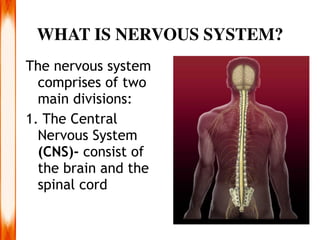
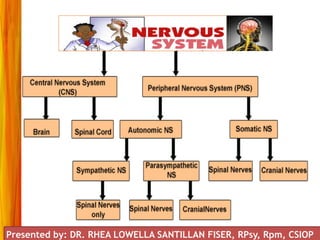
The nervous system
comprises of two
main divisions:
1. The Central
Nervous System
(CNS)- consist of
the brain and the
spinal cord
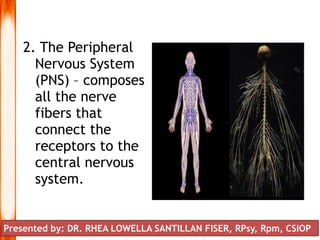
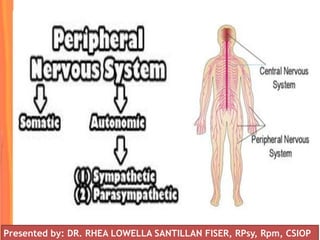
2. The Peripheral
Nervous System
(PNS) – composes
all the nerve
fibers that
connect the
receptors to the
central nervous
system.
Presented by: DR. RHEA LOWELLA SANTILLAN FISER, RPsy, Rpm, CSIOP
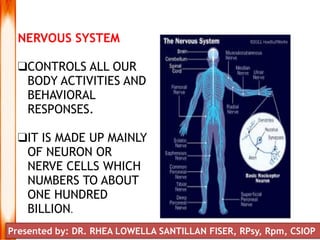
NERVOUS SYSTEM
❑CONTROLS ALL OUR
BODY ACTIVITIES AND
BEHAVIORAL
RESPONSES.
❑IT IS MADE UP MAINLY
OF NEURON OR
NERVE CELLS WHICH
NUMBERS TO ABOUT
ONE HUNDRED
BILLION.
Presented by: DR. RHEA LOWELLA SANTILLAN FISER, RPsy, Rpm, CSIOP
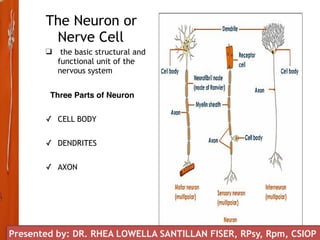
The Neuron or
Nerve Cell
❑ the basic structural and
functional unit of the
nervous system
Three Parts of Neuron
✓ CELL BODY
✓ DENDRITES
✓ AXON
Presented by: DR. RHEA LOWELLA SANTILLAN FISER, RPsy, Rpm, CSIOP
The Neuron
Presented by: DR. RHEA LOWELLA SANTILLAN FISER, RPsy, Rpm, CSIOP
Presented by: DR. RHEA LOWELLA G.
SANTILLAN, CSIOP, Rpm
The Neuron
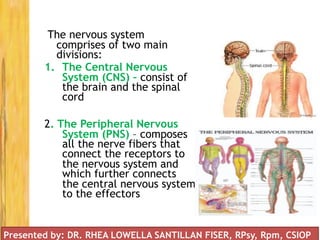
The nervous system
comprises of two main
divisions:
1. The Central Nervous
System (CNS) – consist of
the brain and the spinal
cord
2. The Peripheral Nervous
System (PNS) – composes
all the nerve fibers that
connect the receptors to
the nervous system and
which further connects
the central nervous system
to the effectors
Presented by: DR. RHEA LOWELLA SANTILLAN FISER, RPsy, Rpm, CSIOP
The Neuron
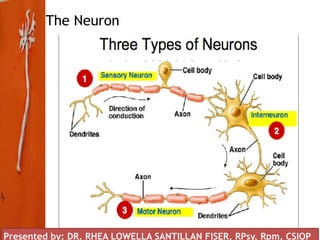
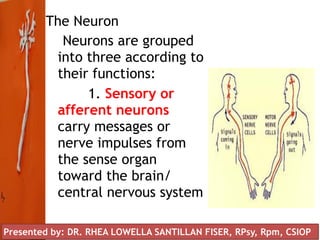
Neurons are grouped
into three according to
their functions:
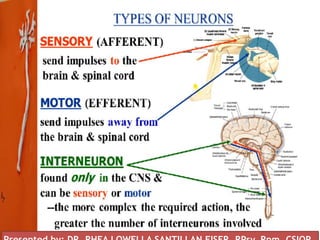
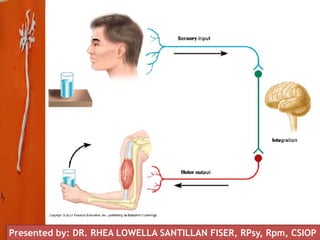
1. Sensory or
afferent neurons
carry messages or
nerve impulses from
the sense organ
toward the brain/
central nervous system
Presented by: DR. RHEA LOWELLA SANTILLAN FISER, RPsy, Rpm, CSIOP
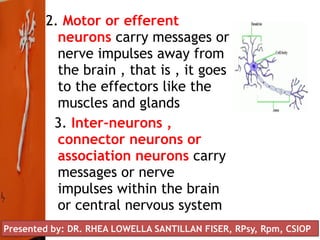
2. Motor or efferent
neurons carry messages or
nerve impulses away from
the brain , that is , it goes
to the effectors like the
muscles and glands
3. Inter-neurons ,
connector neurons or
association neurons carry
messages or nerve
impulses within the brain
or central nervous system
Presented by: DR. RHEA LOWELLA SANTILLAN FISER, RPsy, Rpm, CSIOP
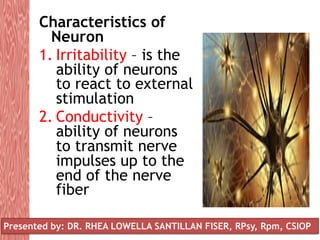
Characteristics of
Neuron
1. Irritability – is the
ability of neurons
to react to external
stimulation
2. Conductivity –
ability of neurons
to transmit nerve
impulses up to the
end of the nerve
fiber
Presented by: DR. RHEA LOWELLA SANTILLAN FISER, RPsy, Rpm, CSIOP
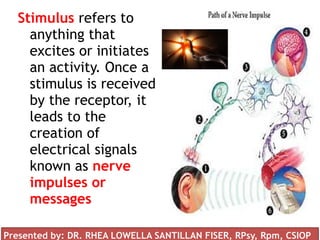
Stimulus refers to
anything that
excites or initiates
an activity. Once a
stimulus is received
by the receptor, it
leads to the
creation of
electrical signals
known as nerve
impulses or
messages
Presented by: DR. RHEA LOWELLA SANTILLAN FISER, RPsy, Rpm, CSIOP
Presented by: DR. RHEA LOWELLA G.
SANTILLAN, CSIOP, Rpm
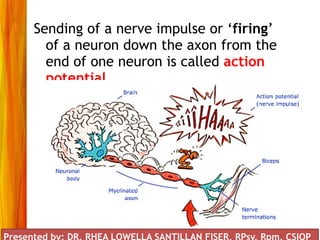
Sending of a nerve impulse or ‘firing’
of a neuron down the axon from the
end of one neuron is called action
potential.
Presented by: DR. RHEA LOWELLA SANTILLAN FISER, RPsy, Rpm, CSIOP
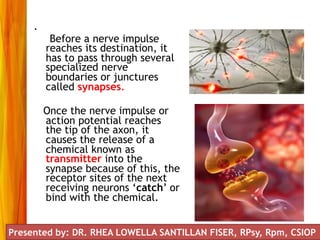
.
Before a nerve impulse
reaches its destination, it
has to pass through several
specialized nerve
boundaries or junctures
called synapses.
Once the nerve impulse or
action potential reaches
the tip of the axon, it
causes the release of a
chemical known as
transmitter into the
synapse because of this, the
receptor sites of the next
receiving neurons ‘catch’ or
bind with the chemical.
Presented by: DR. RHEA LOWELLA SANTILLAN FISER, RPsy, Rpm, CSIOP
Laws governing the Neuron
1. All or Nothing Law- states that
it is either that neuron reacts
or not at all, but if it does, it
reacts with fullest strength
1. Law of Dynamic Polarity-
states that nerve impulses
travel only in one direction
from neuron to neuron
Presented by: DR. RHEA LOWELLA SANTILLAN FISER, RPsy, Rpm, CSIOP
NERVOUS SYSTEM
Presented by: DR. RHEA LOWELLA SANTILLAN FISER, RPsy, Rpm, CSIOP
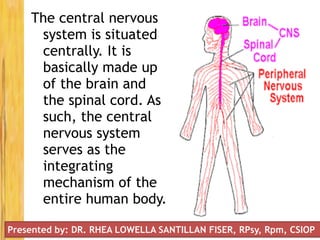
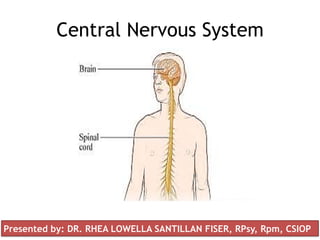
The central nervous
system is situated
centrally. It is
basically made up
of the brain and
the spinal cord. As
such, the central
nervous system
serves as the
integrating
mechanism of the
entire human body.
Presented by: DR. RHEA LOWELLA SANTILLAN FISER, RPsy, Rpm, CSIOP
Central Nervous System
Presented by: DR. RHEA LOWELLA SANTILLAN FISER, RPsy, Rpm, CSIOP
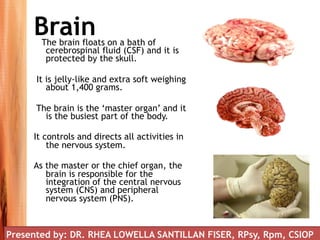
BrainThe brain floats on a bath of
cerebrospinal fluid (CSF) and it is
protected by the skull.
It is jelly-like and extra soft weighing
about 1,400 grams.
The brain is the ‘master organ’ and it
is the busiest part of the body.
It controls and directs all activities in
the nervous system.
As the master or the chief organ, the
brain is responsible for the
integration of the central nervous
system (CNS) and peripheral
nervous system (PNS).
Presented by: DR. RHEA LOWELLA SANTILLAN FISER, RPsy, Rpm, CSIOP
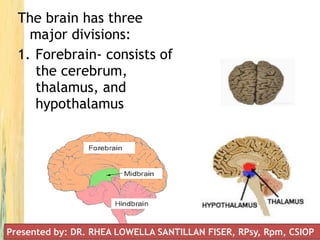
The brain has three
major divisions:
1. Forebrain- consists of
the cerebrum,
thalamus, and
hypothalamus
Presented by: DR. RHEA LOWELLA SANTILLAN FISER, RPsy, Rpm, CSIOP
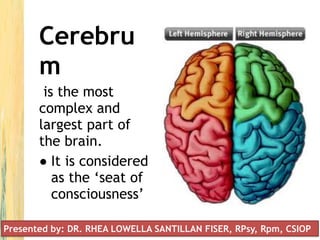
Cerebru
m
is the most
complex and
largest part of
the brain.
● It is considered
as the ‘seat of
consciousness’
Presented by: DR. RHEA LOWELLA SANTILLAN FISER, RPsy, Rpm, CSIOP
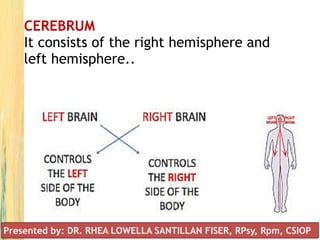
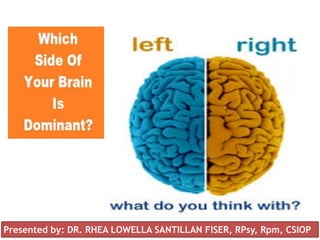
CEREBRUM
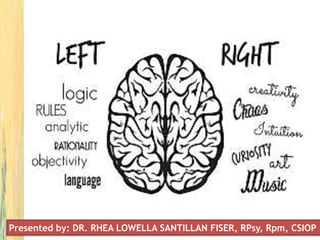
It consists of the right hemisphere and
left hemisphere..
Presented by: DR. RHEA LOWELLA SANTILLAN FISER, RPsy, Rpm, CSIOP
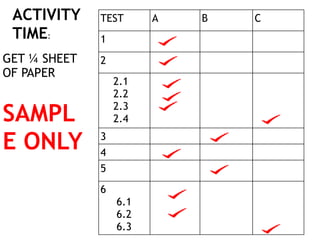
ACTIVITY
TIME:
GET ¼ SHEET
OF PAPER
TEST A B C
1
2
2.1
2.2
2.3
2.4
3
4
5
6
6.1
6.2
6.3
SAMPL
E ONLY
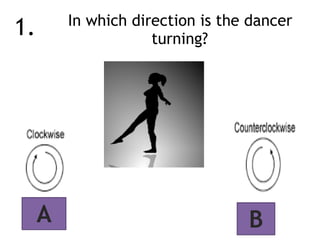
TEST I
In which direction is the dancer
turning?
A B
1.
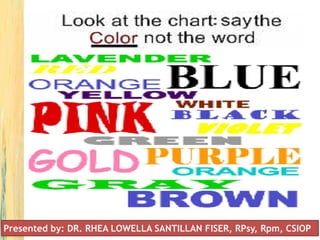
TEST 2
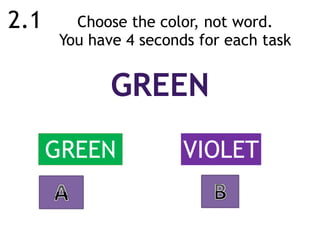
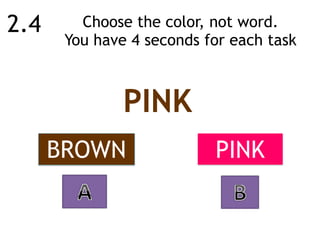
Choose the color, not word. 

You have 4 seconds for each task
GREEN
VIOLETGREEN
2.1
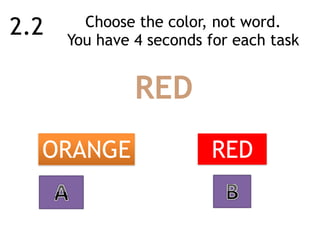
Choose the color, not word. 

You have 4 seconds for each task
REDORANGE
RED
2.2
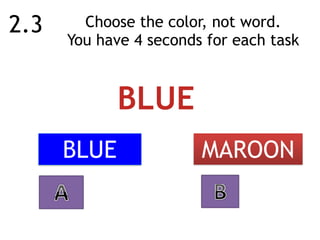
Choose the color, not word. 

You have 4 seconds for each task
MAROONBLUE
2.3
BLUE
Choose the color, not word. 

You have 4 seconds for each task
PINKBROWN
PINK
2.4
TEST 3
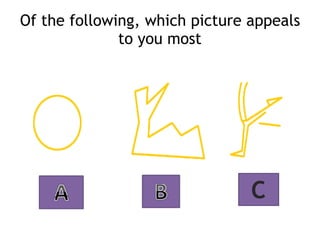
Of the following, which picture appeals
to you most
C
TEST 4
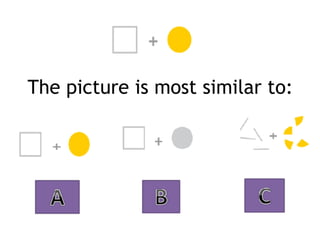
The picture is most similar to:
TEST 5
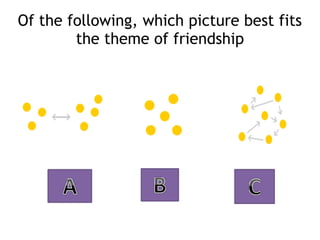
Of the following, which picture best fits
the theme of friendship
Presented by: DR. RHEA LOWELLA G.
SANTILLAN, CSIOP, Rpm
TEST 6
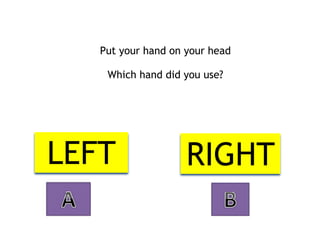
Put your hand on your head


Which hand did you use?
LEFT RIGHT
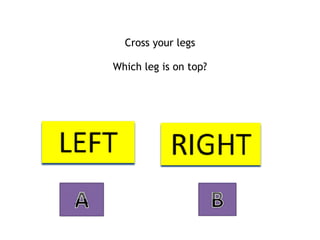
Cross your legs


Which leg is on top?
Presented by: DR. RHEA LOWELLA G.
SANTILLAN, CSIOP, Rpm
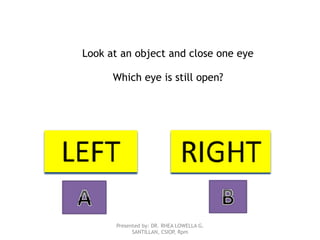
Look at an object and close one eye


Which eye is still open?
INTERPRETATION
Presented by: DR. RHEA LOWELLA SANTILLAN FISER, RPsy, Rpm, CSIOP
ANSWER
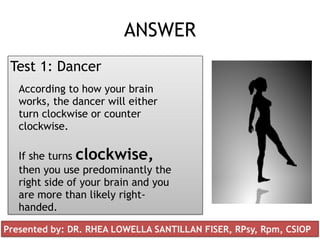
Test 1: Dancer
According to how your brain
works, the dancer will either
turn clockwise or counter
clockwise.
If she turns clockwise,
then you use predominantly the
right side of your brain and you
are more than likely right-
handed.
Presented by: DR. RHEA LOWELLA SANTILLAN FISER, RPsy, Rpm, CSIOP
ANSWER
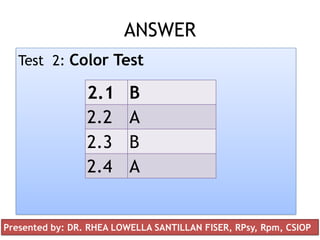
Test 2: Color Test
2.1 B
2.2 A
2.3 B
2.4 A
Presented by: DR. RHEA LOWELLA SANTILLAN FISER, RPsy, Rpm, CSIOP
Presented by: DR. RHEA LOWELLA G.
SANTILLAN, CSIOP, Rpm
ANSWER
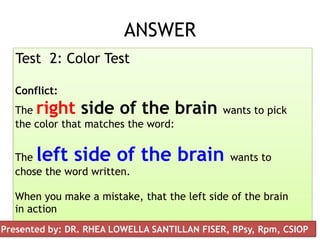
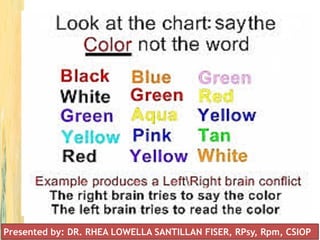
Test 2: Color Test
Conflict:
The right side of the brain wants to pick
the color that matches the word:
The left side of the brain wants to
chose the word written.
When you make a mistake, that the left side of the brain
in action
Presented by: DR. RHEA LOWELLA SANTILLAN FISER, RPsy, Rpm, CSIOP
ANSWER
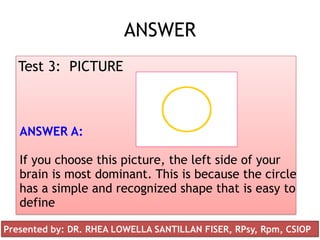
Test 3: PICTURE
ANSWER A:
If you choose this picture, the left side of your
brain is most dominant. This is because the circle
has a simple and recognized shape that is easy to
define
Presented by: DR. RHEA LOWELLA SANTILLAN FISER, RPsy, Rpm, CSIOP
ANSWER
Test 3: PICTURE
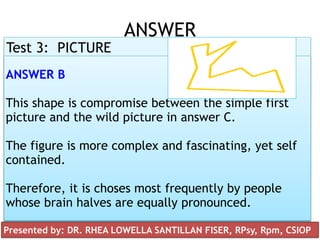
ANSWER B
This shape is compromise between the simple first
picture and the wild picture in answer C.
The figure is more complex and fascinating, yet self
contained.
Therefore, it is choses most frequently by people
whose brain halves are equally pronounced.
Presented by: DR. RHEA LOWELLA SANTILLAN FISER, RPsy, Rpm, CSIOP
ANSWER
Test 3: PICTURE
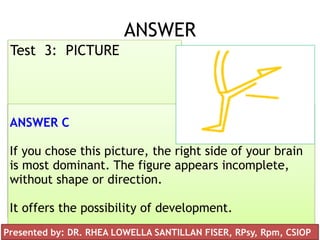
ANSWER C
If you chose this picture, the right side of your brain
is most dominant. The figure appears incomplete,
without shape or direction.
It offers the possibility of development.
Presented by: DR. RHEA LOWELLA SANTILLAN FISER, RPsy, Rpm, CSIOP
Presented by: DR. RHEA LOWELLA G.
SANTILLAN, CSIOP, Rpm
ANSWER

Test 4: SIMILAR TO
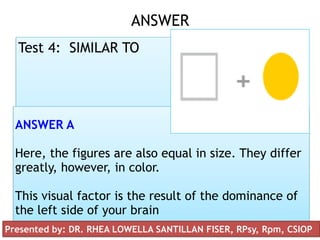
ANSWER A
Here, the figures are also equal in size. They differ
greatly, however, in color.
This visual factor is the result of the dominance of
the left side of your brain
Presented by: DR. RHEA LOWELLA SANTILLAN FISER, RPsy, Rpm, CSIOP
Presented by: DR. RHEA LOWELLA G.
SANTILLAN, CSIOP, Rpm
ANSWER

Test 4: SIMILAR TO
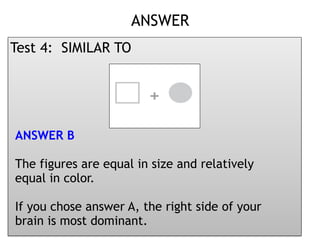
ANSWER B
The figures are equal in size and relatively
equal in color.
If you chose answer A, the right side of your
brain is most dominant.
ANSWER

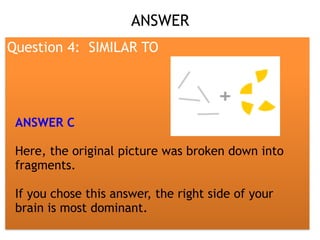
Question 4: SIMILAR TO
ANSWER C
Here, the original picture was broken down into
fragments.
If you chose this answer, the right side of your
brain is most dominant.
Presented by: DR. RHEA LOWELLA G.
SANTILLAN, CSIOP, Rpm
ANSWER

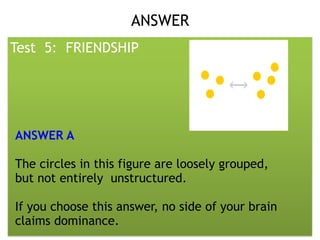
Test 5: FRIENDSHIP
ANSWER A
The circles in this figure are loosely grouped,
but not entirely unstructured.
If you choose this answer, no side of your brain
claims dominance.
Presented by: DR. RHEA LOWELLA G.
SANTILLAN, CSIOP, Rpm
ANSWER

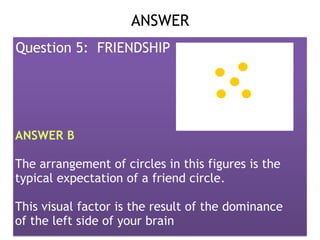
Question 5: FRIENDSHIP
ANSWER B
The arrangement of circles in this figures is the
typical expectation of a friend circle.
This visual factor is the result of the dominance
of the left side of your brain
Presented by: DR. RHEA LOWELLA G.
SANTILLAN, CSIOP, Rpm
ANSWER

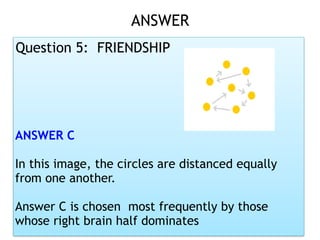
Question 5: FRIENDSHIP
ANSWER C
In this image, the circles are distanced equally
from one another.
Answer C is chosen most frequently by those
whose right brain half dominates
ANSWER

Test 6, 7, and 8
If your in right –brain mode,
You will use your left hand, left leg or left eye.
If your in left-brain mode, you will use your right hand,
right leg
or right eye.
In these cases, the right side of the body is controlled by the
left side of the brain and vice versa.
Presented by: DR. RHEA LOWELLA SANTILLAN FISER, RPsy, Rpm, CSIOP
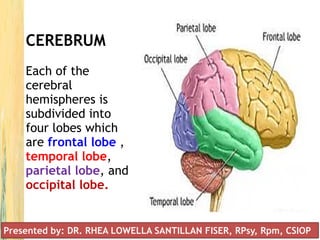
CEREBRUM
Each of the
cerebral
hemispheres is
subdivided into
four lobes which
are frontal lobe ,
temporal lobe,
parietal lobe, and
occipital lobe.
Presented by: DR. RHEA LOWELLA SANTILLAN FISER, RPsy, Rpm, CSIOP
Presented by: DR. RHEA LOWELLA G.
SANTILLAN, CSIOP, Rpm
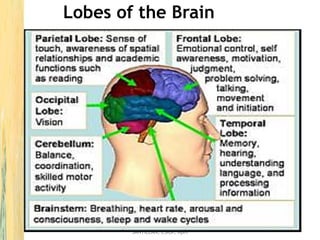
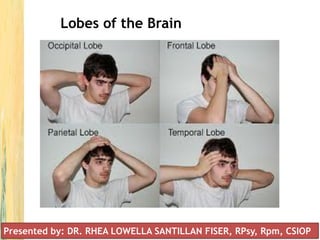
Lobes of the Brain
Lobes of the Brain
Presented by: DR. RHEA LOWELLA SANTILLAN FISER, RPsy, Rpm, CSIOP
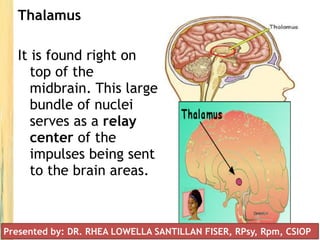
Thalamus
It is found right on
top of the
midbrain. This large
bundle of nuclei
serves as a relay
center of the
impulses being sent
to the brain areas.
Presented by: DR. RHEA LOWELLA SANTILLAN FISER, RPsy, Rpm, CSIOP
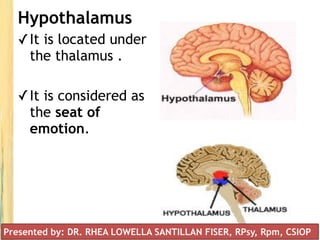
Hypothalamus
✓It is located under
the thalamus .
✓It is considered as
the seat of
emotion.
Presented by: DR. RHEA LOWELLA SANTILLAN FISER, RPsy, Rpm, CSIOP
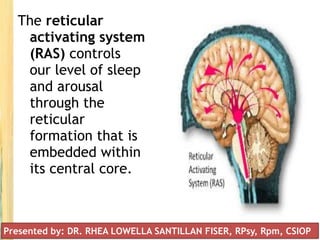
The reticular
activating system
(RAS) controls
our level of sleep
and arousal
through the
reticular
formation that is
embedded within
its central core.
Presented by: DR. RHEA LOWELLA SANTILLAN FISER, RPsy, Rpm, CSIOP
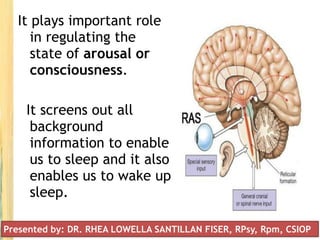
It plays important role
in regulating the
state of arousal or
consciousness.
It screens out all
background
information to enable
us to sleep and it also
enables us to wake up
sleep.
Presented by: DR. RHEA LOWELLA SANTILLAN FISER, RPsy, Rpm, CSIOP
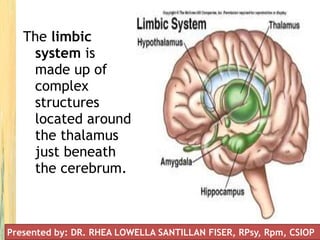
The limbic
system is
made up of
complex
structures
located around
the thalamus
just beneath
the cerebrum.
Presented by: DR. RHEA LOWELLA SANTILLAN FISER, RPsy, Rpm, CSIOP
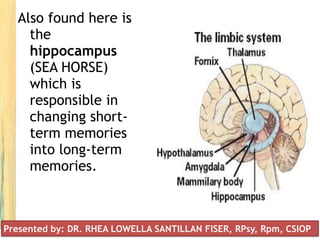
Also found here is
the
hippocampus
(SEA HORSE)
which is
responsible in
changing short-
term memories
into long-term
memories.
Presented by: DR. RHEA LOWELLA SANTILLAN FISER, RPsy, Rpm, CSIOP
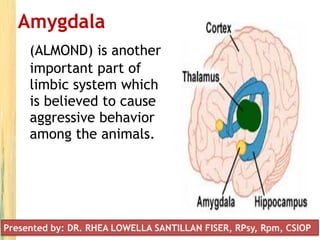
Amygdala
(ALMOND) is another
important part of
limbic system which
is believed to cause
aggressive behavior
among the animals.
Presented by: DR. RHEA LOWELLA SANTILLAN FISER, RPsy, Rpm, CSIOP
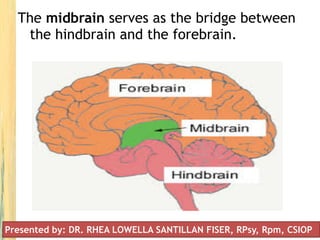
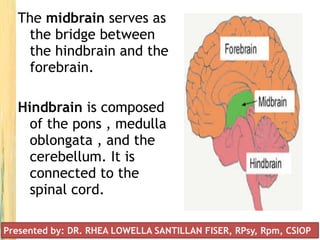
The midbrain serves as the bridge between
the hindbrain and the forebrain.
Presented by: DR. RHEA LOWELLA SANTILLAN FISER, RPsy, Rpm, CSIOP
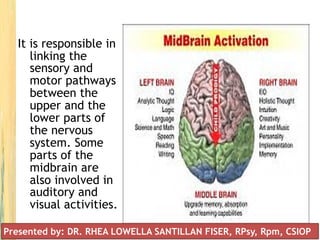
It is responsible in
linking the
sensory and
motor pathways
between the
upper and the
lower parts of
the nervous
system. Some
parts of the
midbrain are
also involved in
auditory and
visual activities.
Presented by: DR. RHEA LOWELLA SANTILLAN FISER, RPsy, Rpm, CSIOP
The midbrain serves as
the bridge between
the hindbrain and the
forebrain.
Hindbrain is composed
of the pons , medulla
oblongata , and the
cerebellum. It is
connected to the
spinal cord.
Presented by: DR. RHEA LOWELLA SANTILLAN FISER, RPsy, Rpm, CSIOP
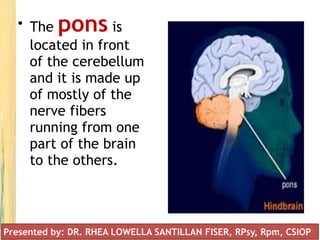
• The pons is
located in front
of the cerebellum
and it is made up
of mostly of the
nerve fibers
running from one
part of the brain
to the others.
Presented by: DR. RHEA LOWELLA SANTILLAN FISER, RPsy, Rpm, CSIOP
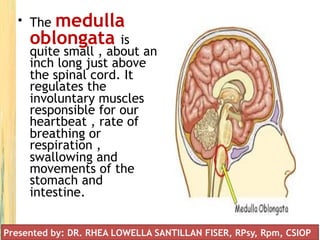
• The medulla
oblongata is
quite small , about an
inch long just above
the spinal cord. It
regulates the
involuntary muscles
responsible for our
heartbeat , rate of
breathing or
respiration ,
swallowing and
movements of the
stomach and
intestine.
Presented by: DR. RHEA LOWELLA SANTILLAN FISER, RPsy, Rpm, CSIOP
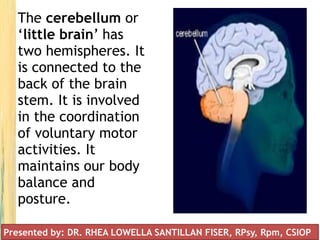
The cerebellum or
‘little brain’ has
two hemispheres. It
is connected to the
back of the brain
stem. It is involved
in the coordination
of voluntary motor
activities. It
maintains our body
balance and
posture.
Presented by: DR. RHEA LOWELLA SANTILLAN FISER, RPsy, Rpm, CSIOP
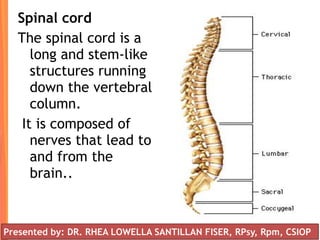
Spinal cord
The spinal cord is a
long and stem-like
structures running
down the vertebral
column.
It is composed of
nerves that lead to
and from the
brain..
Presented by: DR. RHEA LOWELLA SANTILLAN FISER, RPsy, Rpm, CSIOP
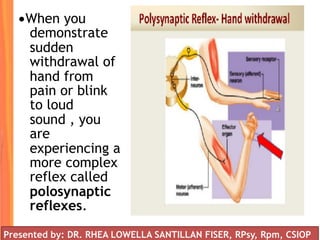
•When you
demonstrate
sudden
withdrawal of
hand from
pain or blink
to loud
sound , you
are
experiencing a
more complex
reflex called
polosynaptic
reflexes.
Presented by: DR. RHEA LOWELLA SANTILLAN FISER, RPsy, Rpm, CSIOP
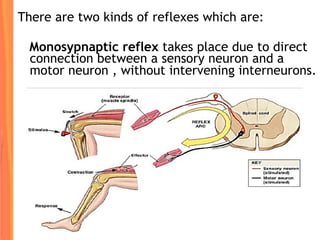
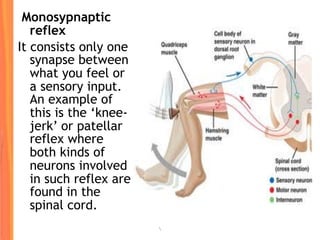
There are two kinds of reflexes which are:
Monosypnaptic reflex takes place due to direct
connection between a sensory neuron and a
motor neuron , without intervening interneurons.
Monosypnaptic
reflex
It consists only one
synapse between
what you feel or
a sensory input.
An example of
this is the ‘knee-
jerk’ or patellar
reflex where
both kinds of
neurons involved
in such reflex are
found in the
spinal cord.
Presented by: DR. RHEA LOWELLA SANTILLAN FISER, RPsy, Rpm, CSIOP
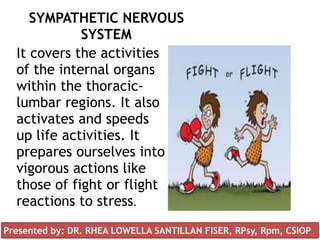
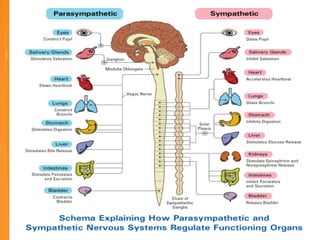
SYMPATHETIC NERVOUS
SYSTEM
It covers the activities
of the internal organs
within the thoracic-
lumbar regions. It also
activates and speeds
up life activities. It
prepares ourselves into
vigorous actions like
those of fight or flight
reactions to stress.
Presented by: DR. RHEA LOWELLA SANTILLAN FISER, RPsy, Rpm, CSIOP
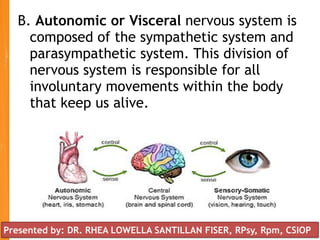
B. Autonomic or Visceral nervous system is
composed of the sympathetic system and
parasympathetic system. This division of
nervous system is responsible for all
involuntary movements within the body
that keep us alive.
Presented by: DR. RHEA LOWELLA SANTILLAN FISER, RPsy, Rpm, CSIOP
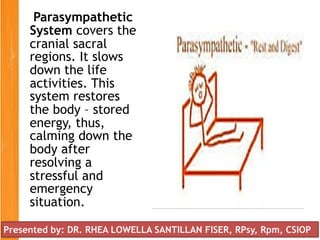
Parasympathetic
System covers the
cranial sacral
regions. It slows
down the life
activities. This
system restores
the body – stored
energy, thus,
calming down the
body after
resolving a
stressful and
emergency
situation.
Presented by: DR. RHEA LOWELLA SANTILLAN FISER, RPsy, Rpm, CSIOP
Presented by: DR. RHEA LOWELLA G.
SANTILLAN, CSIOP, Rpm
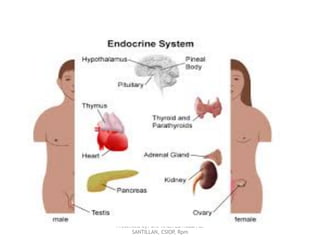
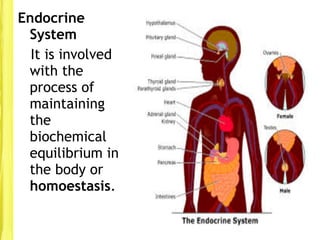
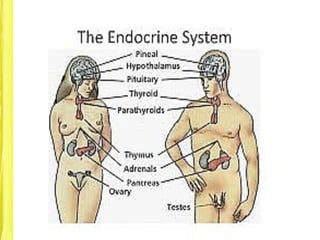
Endocrine
System
It is involved
with the
process of
maintaining
the
biochemical
equilibrium in
the body or
homoestasis.
Presented by: DR. RHEA LOWELLA G.
SANTILLAN, CSIOP, Rpm
Endocrine
System
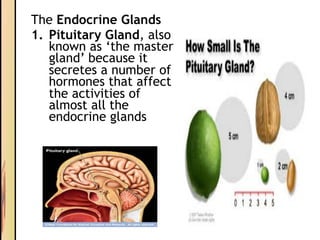
The Endocrine Glands
1. Pituitary Gland, also
known as ‘the master
gland’ because it
secretes a number of
hormones that affect
the activities of
almost all the
endocrine glands
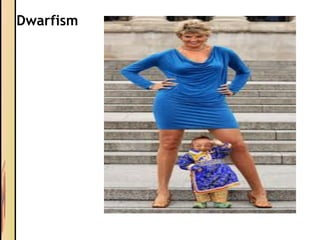
Dwarfism
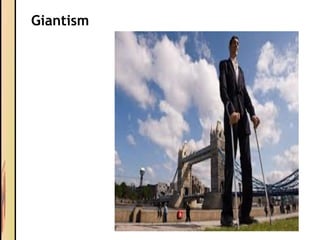
Giantism
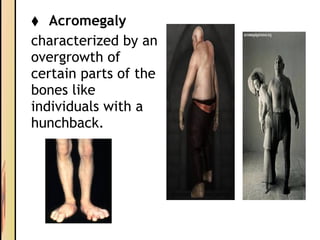
⬧ Acromegaly
characterized by an
overgrowth of
certain parts of the
bones like
individuals with a
hunchback.
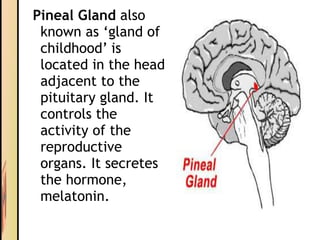
Pineal Gland also
known as ‘gland of
childhood’ is
located in the head
adjacent to the
pituitary gland. It
controls the
activity of the
reproductive
organs. It secretes
the hormone,
melatonin.
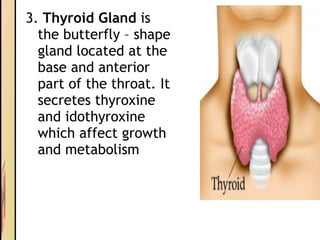
3. Thyroid Gland is
the butterfly – shape
gland located at the
base and anterior
part of the throat. It
secretes thyroxine
and idothyroxine
which affect growth
and metabolism
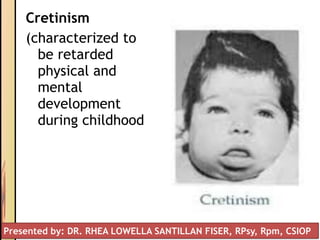
Cretinism
(characterized to
be retarded
physical and
mental
development
during childhood
Presented by: DR. RHEA LOWELLA SANTILLAN FISER, RPsy, Rpm, CSIOP
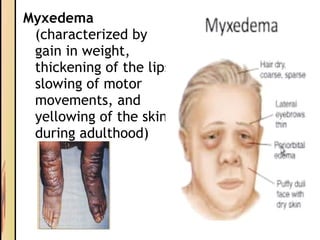
Myxedema
(characterized by
gain in weight,
thickening of the lips
slowing of motor
movements, and
yellowing of the skin
during adulthood)
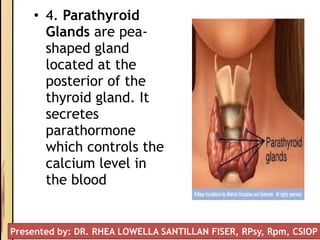
• 4. Parathyroid
Glands are pea-
shaped gland
located at the
posterior of the
thyroid gland. It
secretes
parathormone
which controls the
calcium level in
the blood
Presented by: DR. RHEA LOWELLA SANTILLAN FISER, RPsy, Rpm, CSIOP
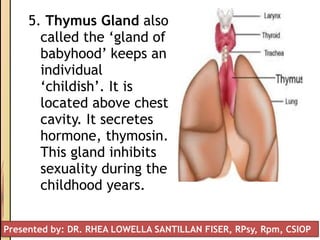
5. Thymus Gland also
called the ‘gland of
babyhood’ keeps an
individual
‘childish’. It is
located above chest
cavity. It secretes
hormone, thymosin.
This gland inhibits
sexuality during the
childhood years.
Presented by: DR. RHEA LOWELLA SANTILLAN FISER, RPsy, Rpm, CSIOP
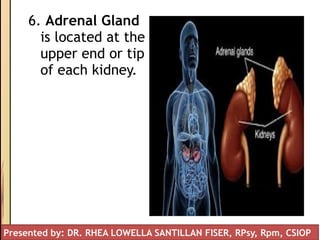
6. Adrenal Gland
is located at the
upper end or tip
of each kidney.
Presented by: DR. RHEA LOWELLA SANTILLAN FISER, RPsy, Rpm, CSIOP
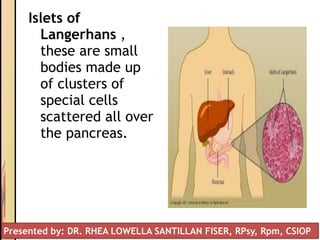
Islets of
Langerhans ,
these are small
bodies made up
of clusters of
special cells
scattered all over
the pancreas.
Presented by: DR. RHEA LOWELLA SANTILLAN FISER, RPsy, Rpm, CSIOP
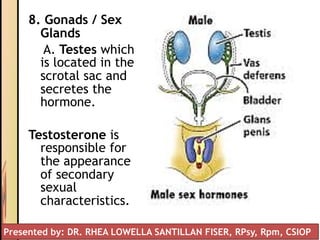
8. Gonads / Sex
Glands
A. Testes which
is located in the
scrotal sac and
secretes the
hormone.
Testosterone is
responsible for
the appearance
of secondary
sexual
characteristics.
Presented by: DR. RHEA LOWELLA SANTILLAN FISER, RPsy, Rpm, CSIOP
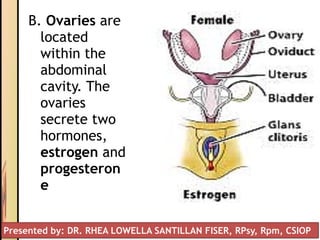
B. Ovaries are
located
within the
abdominal
cavity. The
ovaries
secrete two
hormones,
estrogen and
progesteron
e
Presented by: DR. RHEA LOWELLA SANTILLAN FISER, RPsy, Rpm, CSIOP
Dr. Rhea Lowella Santillan-Fiser, RPsy, Rpm, CSIOP
Professor
For more questions you can email me through
rheasantillan@live.com
Youtube Channel
DR. Rhea Lowella Santillan Fiser
https://www.youtube.com/channel/UChWhr-Lk0o5mo6mXQR-
SGOA

Biological Foundation of Behavior

  • 1.
    Presented by: DR.RHEA LOWELLA SANTILLAN FISER, RPsy, Rpm, CSIOP BIOLOGICAL FOUNDATION OF BEHAVIOR
  • 2.
    Learning Objectives 1. Identifythe parts and functions of the main divisions of the nervous system. 2. Explain how hormonal imbalance affects one’s behavioral responses. 3. Describe the anatomy and functions of the major parts of the brain. 4. Trace the pathway of the nerve impulse from the receptor cells to the effectors. 5. Appreciate the significance of the nervous system in integrating the different bodily activities. Presented by: DR. RHEA LOWELLA SANTILLAN FISER, RPsy, Rpm, CSIOP
  • 3.
    WHAT IS NERVOUSSYSTEM? The nervous system comprises of two main divisions: 1. The Central Nervous System (CNS)- consist of the brain and the spinal cord
  • 4.
    2. The Peripheral NervousSystem (PNS) – composes all the nerve fibers that connect the receptors to the central nervous system. Presented by: DR. RHEA LOWELLA SANTILLAN FISER, RPsy, Rpm, CSIOP
  • 5.
    NERVOUS SYSTEM ❑CONTROLS ALLOUR BODY ACTIVITIES AND BEHAVIORAL RESPONSES. ❑IT IS MADE UP MAINLY OF NEURON OR NERVE CELLS WHICH NUMBERS TO ABOUT ONE HUNDRED BILLION. Presented by: DR. RHEA LOWELLA SANTILLAN FISER, RPsy, Rpm, CSIOP
  • 6.
    The Neuron or NerveCell ❑ the basic structural and functional unit of the nervous system Three Parts of Neuron ✓ CELL BODY ✓ DENDRITES ✓ AXON Presented by: DR. RHEA LOWELLA SANTILLAN FISER, RPsy, Rpm, CSIOP
  • 7.
    The Neuron Presented by:DR. RHEA LOWELLA SANTILLAN FISER, RPsy, Rpm, CSIOP
  • 8.
    Presented by: DR.RHEA LOWELLA G. SANTILLAN, CSIOP, Rpm The Neuron
  • 9.
    The nervous system comprisesof two main divisions: 1. The Central Nervous System (CNS) – consist of the brain and the spinal cord 2. The Peripheral Nervous System (PNS) – composes all the nerve fibers that connect the receptors to the nervous system and which further connects the central nervous system to the effectors Presented by: DR. RHEA LOWELLA SANTILLAN FISER, RPsy, Rpm, CSIOP
  • 10.
    The Neuron Neurons aregrouped into three according to their functions: 1. Sensory or afferent neurons carry messages or nerve impulses from the sense organ toward the brain/ central nervous system Presented by: DR. RHEA LOWELLA SANTILLAN FISER, RPsy, Rpm, CSIOP
  • 11.
    Presented by: DR.RHEA LOWELLA SANTILLAN FISER, RPsy, Rpm, CSIOP
  • 12.
    2. Motor orefferent neurons carry messages or nerve impulses away from the brain , that is , it goes to the effectors like the muscles and glands 3. Inter-neurons , connector neurons or association neurons carry messages or nerve impulses within the brain or central nervous system Presented by: DR. RHEA LOWELLA SANTILLAN FISER, RPsy, Rpm, CSIOP
  • 13.
    Characteristics of Neuron 1. Irritability– is the ability of neurons to react to external stimulation 2. Conductivity – ability of neurons to transmit nerve impulses up to the end of the nerve fiber Presented by: DR. RHEA LOWELLA SANTILLAN FISER, RPsy, Rpm, CSIOP
  • 14.
    Stimulus refers to anythingthat excites or initiates an activity. Once a stimulus is received by the receptor, it leads to the creation of electrical signals known as nerve impulses or messages Presented by: DR. RHEA LOWELLA SANTILLAN FISER, RPsy, Rpm, CSIOP
  • 15.
    Presented by: DR.RHEA LOWELLA G. SANTILLAN, CSIOP, Rpm Sending of a nerve impulse or ‘firing’ of a neuron down the axon from the end of one neuron is called action potential. Presented by: DR. RHEA LOWELLA SANTILLAN FISER, RPsy, Rpm, CSIOP
  • 16.
    . Before a nerveimpulse reaches its destination, it has to pass through several specialized nerve boundaries or junctures called synapses. Once the nerve impulse or action potential reaches the tip of the axon, it causes the release of a chemical known as transmitter into the synapse because of this, the receptor sites of the next receiving neurons ‘catch’ or bind with the chemical. Presented by: DR. RHEA LOWELLA SANTILLAN FISER, RPsy, Rpm, CSIOP
  • 17.
    Laws governing theNeuron 1. All or Nothing Law- states that it is either that neuron reacts or not at all, but if it does, it reacts with fullest strength 1. Law of Dynamic Polarity- states that nerve impulses travel only in one direction from neuron to neuron Presented by: DR. RHEA LOWELLA SANTILLAN FISER, RPsy, Rpm, CSIOP
  • 18.
    NERVOUS SYSTEM Presented by:DR. RHEA LOWELLA SANTILLAN FISER, RPsy, Rpm, CSIOP
  • 19.
    The central nervous systemis situated centrally. It is basically made up of the brain and the spinal cord. As such, the central nervous system serves as the integrating mechanism of the entire human body. Presented by: DR. RHEA LOWELLA SANTILLAN FISER, RPsy, Rpm, CSIOP
  • 20.
    Central Nervous System Presentedby: DR. RHEA LOWELLA SANTILLAN FISER, RPsy, Rpm, CSIOP
  • 21.
    BrainThe brain floatson a bath of cerebrospinal fluid (CSF) and it is protected by the skull. It is jelly-like and extra soft weighing about 1,400 grams. The brain is the ‘master organ’ and it is the busiest part of the body. It controls and directs all activities in the nervous system. As the master or the chief organ, the brain is responsible for the integration of the central nervous system (CNS) and peripheral nervous system (PNS). Presented by: DR. RHEA LOWELLA SANTILLAN FISER, RPsy, Rpm, CSIOP
  • 22.
    The brain hasthree major divisions: 1. Forebrain- consists of the cerebrum, thalamus, and hypothalamus Presented by: DR. RHEA LOWELLA SANTILLAN FISER, RPsy, Rpm, CSIOP
  • 23.
    Cerebru m is the most complexand largest part of the brain. ● It is considered as the ‘seat of consciousness’ Presented by: DR. RHEA LOWELLA SANTILLAN FISER, RPsy, Rpm, CSIOP
  • 24.
    CEREBRUM It consists ofthe right hemisphere and left hemisphere.. Presented by: DR. RHEA LOWELLA SANTILLAN FISER, RPsy, Rpm, CSIOP
  • 25.
    Presented by: DR.RHEA LOWELLA SANTILLAN FISER, RPsy, Rpm, CSIOP
  • 26.
    ACTIVITY TIME: GET ¼ SHEET OFPAPER TEST A B C 1 2 2.1 2.2 2.3 2.4 3 4 5 6 6.1 6.2 6.3 SAMPL E ONLY
  • 27.
  • 28.
    In which directionis the dancer turning? A B 1.
  • 29.
  • 30.
    Choose the color,not word. 
 You have 4 seconds for each task GREEN VIOLETGREEN 2.1
  • 31.
    Choose the color,not word. 
 You have 4 seconds for each task REDORANGE RED 2.2
  • 32.
    Choose the color,not word. 
 You have 4 seconds for each task MAROONBLUE 2.3 BLUE
  • 33.
    Choose the color,not word. 
 You have 4 seconds for each task PINKBROWN PINK 2.4
  • 34.
  • 35.
    Of the following,which picture appeals to you most C
  • 36.
  • 37.
    The picture ismost similar to:
  • 38.
  • 39.
    Of the following,which picture best fits the theme of friendship
  • 40.
    Presented by: DR.RHEA LOWELLA G. SANTILLAN, CSIOP, Rpm TEST 6
  • 41.
    Put your handon your head
 
 Which hand did you use? LEFT RIGHT
  • 42.
  • 43.
    Presented by: DR.RHEA LOWELLA G. SANTILLAN, CSIOP, Rpm Look at an object and close one eye
 
 Which eye is still open?
  • 44.
    INTERPRETATION Presented by: DR.RHEA LOWELLA SANTILLAN FISER, RPsy, Rpm, CSIOP
  • 45.
    ANSWER Test 1: Dancer Accordingto how your brain works, the dancer will either turn clockwise or counter clockwise. If she turns clockwise, then you use predominantly the right side of your brain and you are more than likely right- handed. Presented by: DR. RHEA LOWELLA SANTILLAN FISER, RPsy, Rpm, CSIOP
  • 46.
    ANSWER Test 2: ColorTest 2.1 B 2.2 A 2.3 B 2.4 A Presented by: DR. RHEA LOWELLA SANTILLAN FISER, RPsy, Rpm, CSIOP
  • 47.
    Presented by: DR.RHEA LOWELLA G. SANTILLAN, CSIOP, Rpm ANSWER Test 2: Color Test Conflict: The right side of the brain wants to pick the color that matches the word: The left side of the brain wants to chose the word written. When you make a mistake, that the left side of the brain in action Presented by: DR. RHEA LOWELLA SANTILLAN FISER, RPsy, Rpm, CSIOP
  • 48.
    ANSWER Test 3: PICTURE ANSWERA: If you choose this picture, the left side of your brain is most dominant. This is because the circle has a simple and recognized shape that is easy to define Presented by: DR. RHEA LOWELLA SANTILLAN FISER, RPsy, Rpm, CSIOP
  • 49.
    ANSWER Test 3: PICTURE ANSWERB This shape is compromise between the simple first picture and the wild picture in answer C. The figure is more complex and fascinating, yet self contained. Therefore, it is choses most frequently by people whose brain halves are equally pronounced. Presented by: DR. RHEA LOWELLA SANTILLAN FISER, RPsy, Rpm, CSIOP
  • 50.
    ANSWER Test 3: PICTURE ANSWERC If you chose this picture, the right side of your brain is most dominant. The figure appears incomplete, without shape or direction. It offers the possibility of development. Presented by: DR. RHEA LOWELLA SANTILLAN FISER, RPsy, Rpm, CSIOP
  • 51.
    Presented by: DR.RHEA LOWELLA G. SANTILLAN, CSIOP, Rpm ANSWER
 Test 4: SIMILAR TO ANSWER A Here, the figures are also equal in size. They differ greatly, however, in color. This visual factor is the result of the dominance of the left side of your brain Presented by: DR. RHEA LOWELLA SANTILLAN FISER, RPsy, Rpm, CSIOP
  • 52.
    Presented by: DR.RHEA LOWELLA G. SANTILLAN, CSIOP, Rpm ANSWER
 Test 4: SIMILAR TO ANSWER B The figures are equal in size and relatively equal in color. If you chose answer A, the right side of your brain is most dominant.
  • 53.
    ANSWER
 Question 4: SIMILARTO ANSWER C Here, the original picture was broken down into fragments. If you chose this answer, the right side of your brain is most dominant.
  • 54.
    Presented by: DR.RHEA LOWELLA G. SANTILLAN, CSIOP, Rpm ANSWER
 Test 5: FRIENDSHIP ANSWER A The circles in this figure are loosely grouped, but not entirely unstructured. If you choose this answer, no side of your brain claims dominance.
  • 55.
    Presented by: DR.RHEA LOWELLA G. SANTILLAN, CSIOP, Rpm ANSWER
 Question 5: FRIENDSHIP ANSWER B The arrangement of circles in this figures is the typical expectation of a friend circle. This visual factor is the result of the dominance of the left side of your brain
  • 56.
    Presented by: DR.RHEA LOWELLA G. SANTILLAN, CSIOP, Rpm ANSWER
 Question 5: FRIENDSHIP ANSWER C In this image, the circles are distanced equally from one another. Answer C is chosen most frequently by those whose right brain half dominates
  • 57.
    ANSWER
 Test 6, 7,and 8 If your in right –brain mode, You will use your left hand, left leg or left eye. If your in left-brain mode, you will use your right hand, right leg or right eye. In these cases, the right side of the body is controlled by the left side of the brain and vice versa.
  • 58.
    Presented by: DR.RHEA LOWELLA SANTILLAN FISER, RPsy, Rpm, CSIOP
  • 59.
    Presented by: DR.RHEA LOWELLA SANTILLAN FISER, RPsy, Rpm, CSIOP
  • 60.
    Presented by: DR.RHEA LOWELLA SANTILLAN FISER, RPsy, Rpm, CSIOP
  • 61.
    Presented by: DR.RHEA LOWELLA SANTILLAN FISER, RPsy, Rpm, CSIOP
  • 62.
    CEREBRUM Each of the cerebral hemispheresis subdivided into four lobes which are frontal lobe , temporal lobe, parietal lobe, and occipital lobe. Presented by: DR. RHEA LOWELLA SANTILLAN FISER, RPsy, Rpm, CSIOP
  • 63.
    Presented by: DR.RHEA LOWELLA G. SANTILLAN, CSIOP, Rpm Lobes of the Brain
  • 64.
    Lobes of theBrain Presented by: DR. RHEA LOWELLA SANTILLAN FISER, RPsy, Rpm, CSIOP
  • 65.
    Thalamus It is foundright on top of the midbrain. This large bundle of nuclei serves as a relay center of the impulses being sent to the brain areas. Presented by: DR. RHEA LOWELLA SANTILLAN FISER, RPsy, Rpm, CSIOP
  • 66.
    Hypothalamus ✓It is locatedunder the thalamus . ✓It is considered as the seat of emotion. Presented by: DR. RHEA LOWELLA SANTILLAN FISER, RPsy, Rpm, CSIOP
  • 67.
    The reticular activating system (RAS)controls our level of sleep and arousal through the reticular formation that is embedded within its central core. Presented by: DR. RHEA LOWELLA SANTILLAN FISER, RPsy, Rpm, CSIOP
  • 68.
    It plays importantrole in regulating the state of arousal or consciousness. It screens out all background information to enable us to sleep and it also enables us to wake up sleep. Presented by: DR. RHEA LOWELLA SANTILLAN FISER, RPsy, Rpm, CSIOP
  • 69.
    The limbic system is madeup of complex structures located around the thalamus just beneath the cerebrum. Presented by: DR. RHEA LOWELLA SANTILLAN FISER, RPsy, Rpm, CSIOP
  • 70.
    Also found hereis the hippocampus (SEA HORSE) which is responsible in changing short- term memories into long-term memories. Presented by: DR. RHEA LOWELLA SANTILLAN FISER, RPsy, Rpm, CSIOP
  • 71.
    Amygdala (ALMOND) is another importantpart of limbic system which is believed to cause aggressive behavior among the animals. Presented by: DR. RHEA LOWELLA SANTILLAN FISER, RPsy, Rpm, CSIOP
  • 72.
    The midbrain servesas the bridge between the hindbrain and the forebrain. Presented by: DR. RHEA LOWELLA SANTILLAN FISER, RPsy, Rpm, CSIOP
  • 73.
    It is responsiblein linking the sensory and motor pathways between the upper and the lower parts of the nervous system. Some parts of the midbrain are also involved in auditory and visual activities. Presented by: DR. RHEA LOWELLA SANTILLAN FISER, RPsy, Rpm, CSIOP
  • 74.
    The midbrain servesas the bridge between the hindbrain and the forebrain. Hindbrain is composed of the pons , medulla oblongata , and the cerebellum. It is connected to the spinal cord. Presented by: DR. RHEA LOWELLA SANTILLAN FISER, RPsy, Rpm, CSIOP
  • 75.
    • The ponsis located in front of the cerebellum and it is made up of mostly of the nerve fibers running from one part of the brain to the others. Presented by: DR. RHEA LOWELLA SANTILLAN FISER, RPsy, Rpm, CSIOP
  • 76.
    • The medulla oblongatais quite small , about an inch long just above the spinal cord. It regulates the involuntary muscles responsible for our heartbeat , rate of breathing or respiration , swallowing and movements of the stomach and intestine. Presented by: DR. RHEA LOWELLA SANTILLAN FISER, RPsy, Rpm, CSIOP
  • 77.
    The cerebellum or ‘littlebrain’ has two hemispheres. It is connected to the back of the brain stem. It is involved in the coordination of voluntary motor activities. It maintains our body balance and posture. Presented by: DR. RHEA LOWELLA SANTILLAN FISER, RPsy, Rpm, CSIOP
  • 78.
    Spinal cord The spinalcord is a long and stem-like structures running down the vertebral column. It is composed of nerves that lead to and from the brain.. Presented by: DR. RHEA LOWELLA SANTILLAN FISER, RPsy, Rpm, CSIOP
  • 79.
    •When you demonstrate sudden withdrawal of handfrom pain or blink to loud sound , you are experiencing a more complex reflex called polosynaptic reflexes. Presented by: DR. RHEA LOWELLA SANTILLAN FISER, RPsy, Rpm, CSIOP
  • 80.
    There are twokinds of reflexes which are: Monosypnaptic reflex takes place due to direct connection between a sensory neuron and a motor neuron , without intervening interneurons.
  • 81.
    Monosypnaptic reflex It consists onlyone synapse between what you feel or a sensory input. An example of this is the ‘knee- jerk’ or patellar reflex where both kinds of neurons involved in such reflex are found in the spinal cord.
  • 82.
    Presented by: DR.RHEA LOWELLA SANTILLAN FISER, RPsy, Rpm, CSIOP
  • 83.
    SYMPATHETIC NERVOUS SYSTEM It coversthe activities of the internal organs within the thoracic- lumbar regions. It also activates and speeds up life activities. It prepares ourselves into vigorous actions like those of fight or flight reactions to stress. Presented by: DR. RHEA LOWELLA SANTILLAN FISER, RPsy, Rpm, CSIOP
  • 84.
    B. Autonomic orVisceral nervous system is composed of the sympathetic system and parasympathetic system. This division of nervous system is responsible for all involuntary movements within the body that keep us alive. Presented by: DR. RHEA LOWELLA SANTILLAN FISER, RPsy, Rpm, CSIOP
  • 86.
    Parasympathetic System covers the cranialsacral regions. It slows down the life activities. This system restores the body – stored energy, thus, calming down the body after resolving a stressful and emergency situation. Presented by: DR. RHEA LOWELLA SANTILLAN FISER, RPsy, Rpm, CSIOP
  • 87.
    Presented by: DR.RHEA LOWELLA G. SANTILLAN, CSIOP, Rpm
  • 88.
    Endocrine System It is involved withthe process of maintaining the biochemical equilibrium in the body or homoestasis.
  • 89.
    Presented by: DR.RHEA LOWELLA G. SANTILLAN, CSIOP, Rpm Endocrine System
  • 90.
    The Endocrine Glands 1.Pituitary Gland, also known as ‘the master gland’ because it secretes a number of hormones that affect the activities of almost all the endocrine glands
  • 91.
  • 92.
  • 93.
    ⬧ Acromegaly characterized byan overgrowth of certain parts of the bones like individuals with a hunchback.
  • 94.
    Pineal Gland also knownas ‘gland of childhood’ is located in the head adjacent to the pituitary gland. It controls the activity of the reproductive organs. It secretes the hormone, melatonin.
  • 95.
    3. Thyroid Glandis the butterfly – shape gland located at the base and anterior part of the throat. It secretes thyroxine and idothyroxine which affect growth and metabolism
  • 96.
    Cretinism (characterized to be retarded physicaland mental development during childhood Presented by: DR. RHEA LOWELLA SANTILLAN FISER, RPsy, Rpm, CSIOP
  • 97.
    Myxedema (characterized by gain inweight, thickening of the lips slowing of motor movements, and yellowing of the skin during adulthood)
  • 98.
    • 4. Parathyroid Glandsare pea- shaped gland located at the posterior of the thyroid gland. It secretes parathormone which controls the calcium level in the blood Presented by: DR. RHEA LOWELLA SANTILLAN FISER, RPsy, Rpm, CSIOP
  • 99.
    5. Thymus Glandalso called the ‘gland of babyhood’ keeps an individual ‘childish’. It is located above chest cavity. It secretes hormone, thymosin. This gland inhibits sexuality during the childhood years. Presented by: DR. RHEA LOWELLA SANTILLAN FISER, RPsy, Rpm, CSIOP
  • 100.
    6. Adrenal Gland islocated at the upper end or tip of each kidney. Presented by: DR. RHEA LOWELLA SANTILLAN FISER, RPsy, Rpm, CSIOP
  • 101.
    Islets of Langerhans , theseare small bodies made up of clusters of special cells scattered all over the pancreas. Presented by: DR. RHEA LOWELLA SANTILLAN FISER, RPsy, Rpm, CSIOP
  • 102.
    8. Gonads /Sex Glands A. Testes which is located in the scrotal sac and secretes the hormone. Testosterone is responsible for the appearance of secondary sexual characteristics. Presented by: DR. RHEA LOWELLA SANTILLAN FISER, RPsy, Rpm, CSIOP
  • 103.
    B. Ovaries are located withinthe abdominal cavity. The ovaries secrete two hormones, estrogen and progesteron e Presented by: DR. RHEA LOWELLA SANTILLAN FISER, RPsy, Rpm, CSIOP
  • 105.
    Dr. Rhea LowellaSantillan-Fiser, RPsy, Rpm, CSIOP Professor For more questions you can email me through rheasantillan@live.com Youtube Channel DR. Rhea Lowella Santillan Fiser https://www.youtube.com/channel/UChWhr-Lk0o5mo6mXQR- SGOA