BIOLOGICAL EFFECTS OF RADIATION
USHA YADAV
Scientific Officer
RP&AD B.A.R.C.
Ph. 022-25593968 (OFFICE)
e-mail- yusha@barc.gov.in
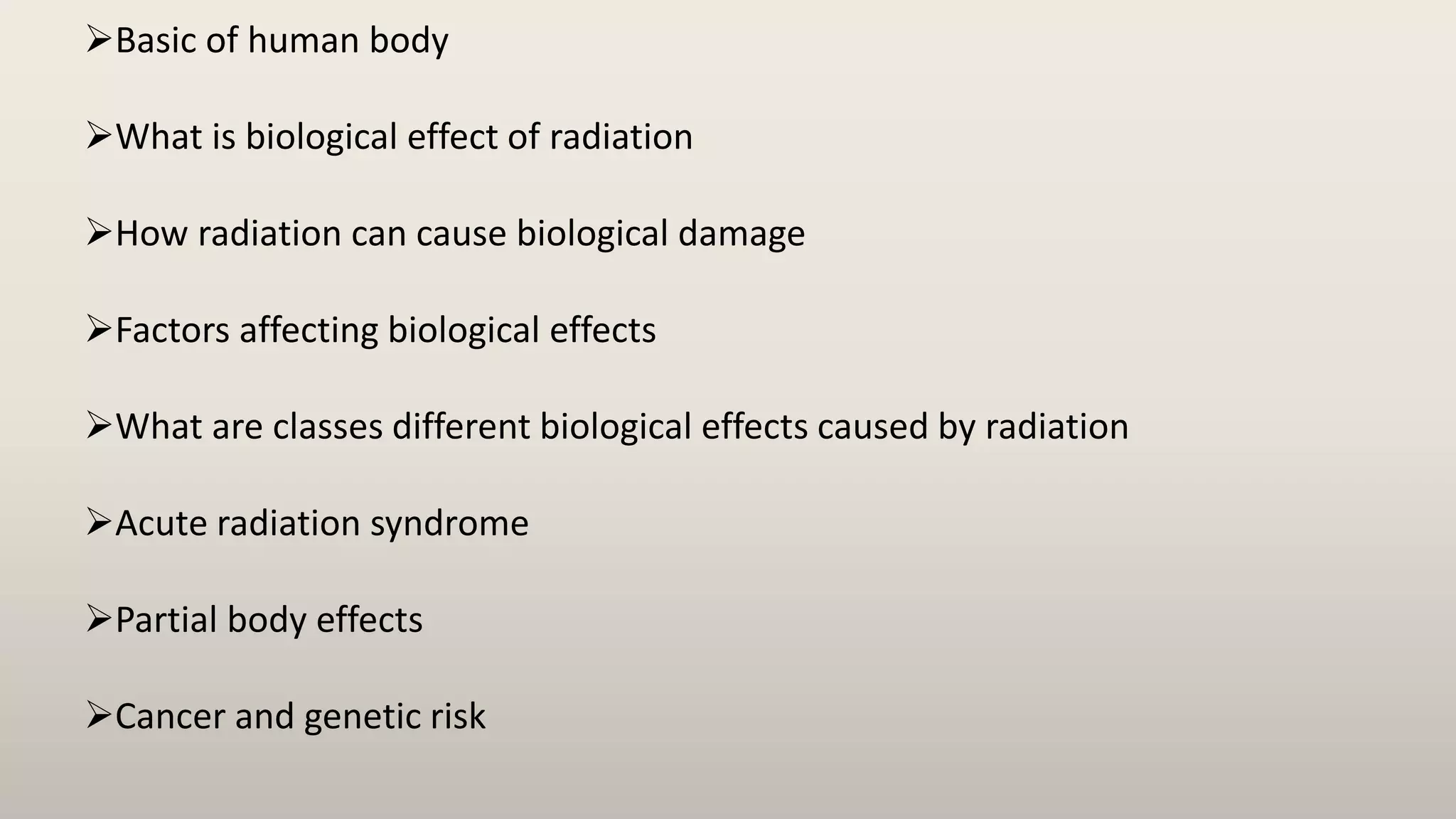
Basic of human body
What is biological effect of radiation
How radiation can cause biological damage
Factors affecting biological effects
What are classes different biological effects caused by radiation
Acute radiation syndrome
Partial body effects
Cancer and genetic risk
Levels of organization of human body
Bio-molecues –> Cells ->Tissues –> oragns –> Systems –> Organism
Levels of organization of human body
Cells are basic unit of life
• Structural and functional unit
• Can have 1000s of shapes
• 1000s of functions depending upon the tissue they reside
Cell division
Cell division is divided in three broad phases : 1. Interphase and 2. Mitotic phase
Interphase is further divided into 3 more
phases:
1. Gap 1 or G1 phase
2. Synthetic or S-phase
3. Gap2 or G2 Phase
Mitotic Phase is further divided into 2 more
phases:
1.Mitosis
2.Cytokinesis
Mitosis is again divided into 4 major parts:
1.Prophase
2.Metaphase
3.Anaphase
4.Telophase
Complete Cell cycle Mitosis and cytokinesis
Purpose Of cell division
1. Growth:
2. Maintenance
3. Reproduction
Radiation deposits energy in localized manner
Cellular level effects of DNA damage
• CELL KILLING
• Mitotic death / apoptosis
• CELL MODIFICATION OR MUTATION
• CHROMOSOMAL ABERRATIONS
• DIVISION DELAY
• FUNCTIONAL DAMAGE
What are the conditions in which we can get exposed
1. Continuous exposure to Natural background.
2. Occupational exposure to plant workers,
radiographers , researchers etc.
3. Medical Exposure to patients.
4. Accidental exposure.
ANNUAL DOSE PER PERSON FROM NATURAL SOURDES OF RADIATION
Source Annual Effective Dose (Mean) mSv
External
Cosmic 0.36
Terrestrial Sources 0.41
Internal
potassium-40 0.18
Radon-220,222 & daughters 1.26
Uranium, thorium etc, 0.16
Total 2.37
TYPES OF RADIATION EXPOSURE.
Acute Exposure: heavy doses within short duration (few Grays within few hours)
May be life threatening
Examples:
• Accidental exposure to radiation in nuclear or medical facilities.
• Intended nuclear detonation.
Chronic Exposure:
Small doses received over a long duration of time.
Not severe only late effects may happen
Example:
• High background radiation areas,
• occupational workers.
Partial body exposure: only part of body gets exposure
• Radioactive source spillage to contained particular part of body.
• Exposure to a particular internal organ
Whole body exposure: whole body receives radiation uniformly
• Suppose one of us enter a room which has radioactive source radiation is
coming out of source spread in the room.
External exposure: No contamination only exposure from outside
Internal exposure : Internalization of radioactivity inside body
PATHWAYS OF RADIOACTIVITY
• Inhalation
• Ingestion
• Absorption
• Puncture or through wound
EFFECTIVE HALF LIFE OF RADIO NUCLIDES
HOW REDUCE INTERNAL EXPOSURE
• Reduce the effective half life by increasing the rate of
excretion
• Admission of diuretic
• Prevention of uptake
• Prevention of absorption in the intestine
• Washing of wounds and body surface
• Prompting vomiting when ingested
• Prevention
• Mask
• Hand gloves, lab coat
• Clean working condition
• Cold traps for volatile radioactive solutions
• Use fume hood
IMPORTANT DEFINITIONS
Linear Energy Transfer (LET): energy transferred by radiation per unit length. Measured in
keV/µm.
Alpha and other charged particles are high LET radiation while neutron,
beta and gamma are considered low LET radiation.
Absorbed dose (DT): Energy of radiation absorbed per unit of body weight. It is measured in:
Gray(Gy), 1Gy = 1 joules/kg
Ingestion
Digestion
Absorption to extracellular fluid
Inhalation
Incorporation Excretion(feces and urine)
Decay
via respiratory system via digestive tract system
PATHWAYS OF RADIOACTIVITY
Equivalent Dose (HT) and Radiation Weighting Factor (WR )
Equivalent Dose is a measure of the biological
damage:
HT = WR DT
Unit is the Sievert (Sv)
Each type of radiation has been given a
‘Radiation Weighting Factor’ (WR) :
Alpha Particles 20
Beta Particles 1
Photons 1
Neutrons 2.5 – 20
WR is continuous function of energy for
neutrons
Effective Dose for any particular organ is given by:
E = WT HT
And if more than one organ is involved:
E =  WT HT
Effective Dose (E) and Tissue Weighting Factor (WT )
Depending on sensitivity
organs have been given a
tissue weighting factor(WT)
Tissue weighting factors
ICRP2007
Tissue WT  WT
Bone marrow (red), Colon, Lung,
Stomach, Breast
0.12 0.60
Gonads 0.08 0.08
Bladder, Oesophagus, Liver,
Thyroid
0.04 0.16
Bone surface, Brain, Salivary
glands, Skin.
0.01 0.04
Remainder Tissues*
(Nominal WT applied to the
average dose to 13 tissues)
0.12 0.12
* Adrenals, extrathoracic region, gall bladder,
heart, kidneys, lymphatic nodes, muscle, oral
mucosa, pancreas, prostate (males), small
intestine, spleen, thymus and uterus/cervix
(females)
BIOLOGICAL EFFECT OF RADIATION
The potential biological effects and damages is
determined by many factors
Received dose of radiation : same quantity of radiation may give different doses to different organ,
higher the dose severe the damage.
Quality of radiation : high energy radiation is more harmful than the lower one,
high LET radiation is more damaging than low LET however high LET radiations
generally have lower penetration thus possessing lesser external hazard only internal
exposure will cause damage but that will be very severe in comparison to low LET
radiations like gamma for similar doses.
Exposure conditions (spatial distribution) : whole body exposure is more dangerous than partial body.
Internal exposer is more damaging than external
(for same spatial distribution).
Quantity of radiation : higher the quantity higher the dose thus damage.
INTERACTION OF RADIATION WITH BIOLOGICAL
SYSTEM
DNA as the most important target for Radiation
DNA is genetic material and stores information for all the functions of
cell.
Damage to DNA is highly detrimental to cell which may lead to
Inhibition or delay of cell division.
cell death.
modification of cell.
Hence, cells possess extensive DNA damage repair mechanism which
take care of minor DNA damages efficiently.
However, major damage to DNA like chromosomal aberrations may
lead to misrepair or no repair and is of major concern.
Dividing cells have higher amount of DNA and more chances of DNA
damages hence they are most sensitive to radiation.
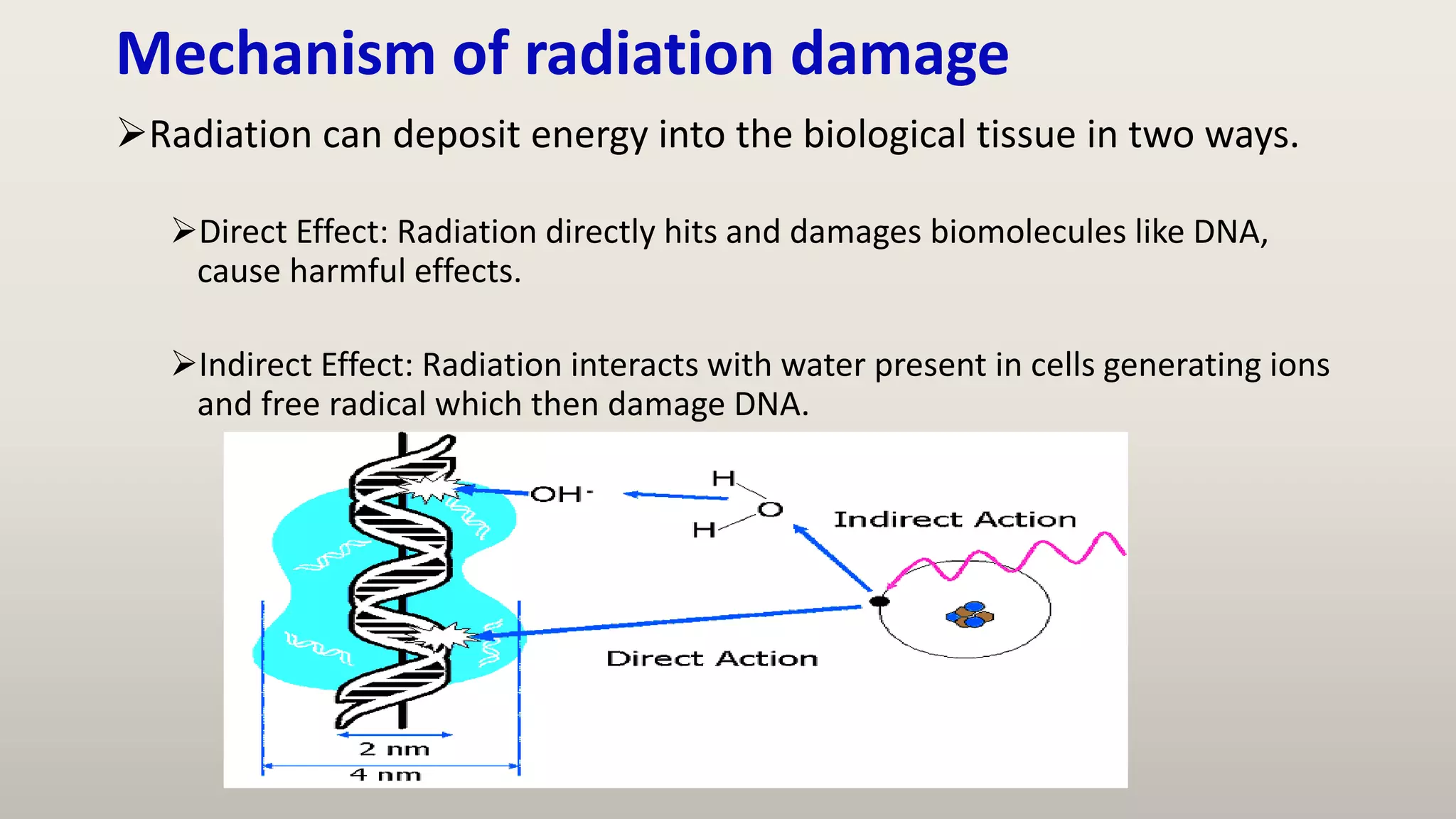
Mechanism of radiation damage
Radiation can deposit energy into the biological tissue in two ways.
Direct Effect: Radiation directly hits and damages biomolecules like DNA,
cause harmful effects.
Indirect Effect: Radiation interacts with water present in cells generating ions
and free radical which then damage DNA.
BIOLOGICAL EFFECTS OF RADIATION
IN TIME PERSPECTIVE
Time scale
Fractions of seconds
Seconds
Minutes
Hours
Days
Weeks
Months
Years
Decades
Generations
Effects
Energy absorption
Changes in biomolecules
(DNA, membranes)
Biological repair
Change of information in cell
Cell death
(Deterministic effect)
Organ Clinical
death changes
Mutations in
Germ cell Somatic cell
(Stochastic effect)
Cancer
Hereditary
effects
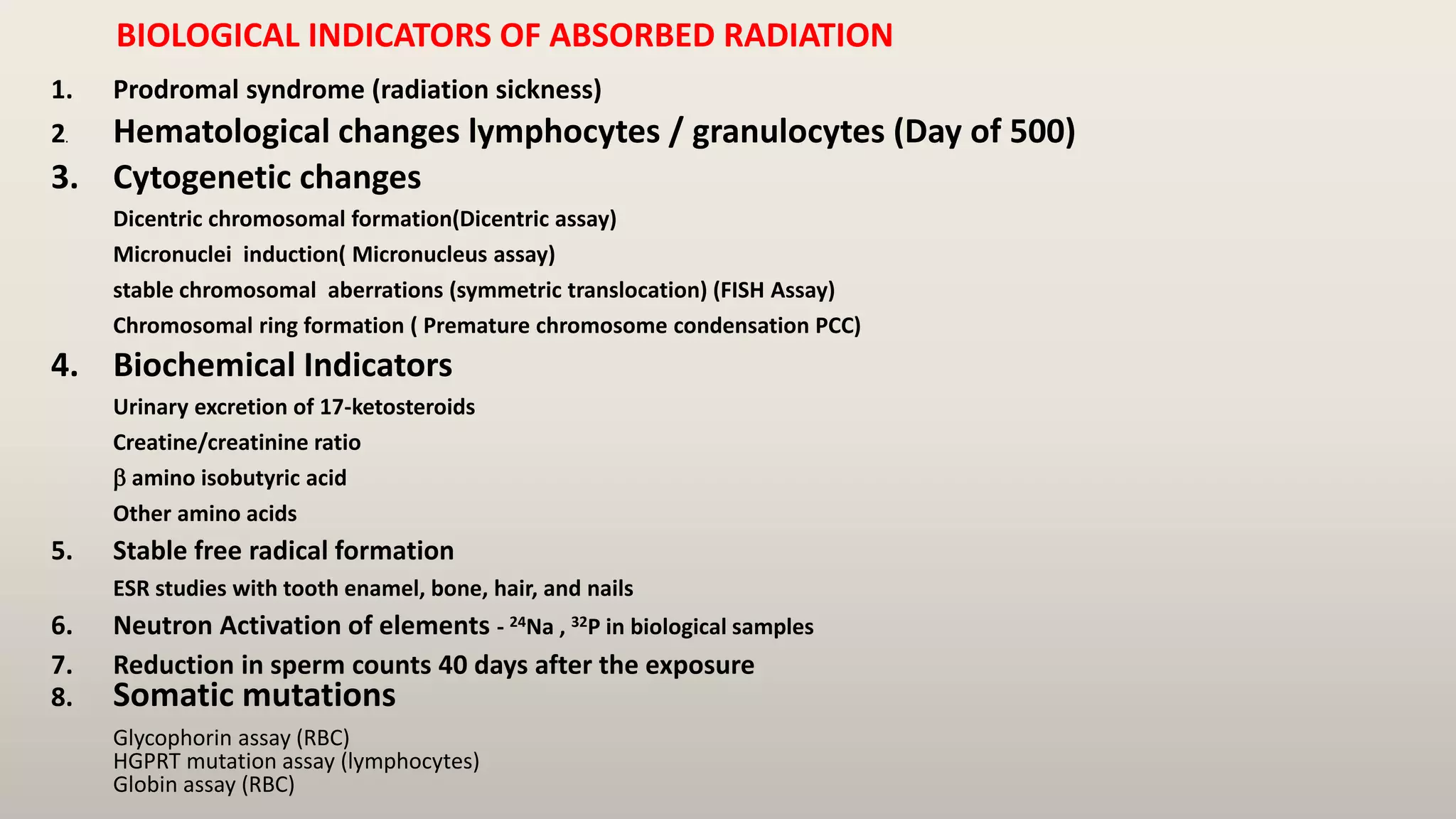
BIOLOGICAL INDICATORS OF ABSORBED RADIATION
1. Prodromal syndrome (radiation sickness)
2. Hematological changes lymphocytes / granulocytes (Day of 500)
3. Cytogenetic changes
Dicentric chromosomal formation(Dicentric assay)
Micronuclei induction( Micronucleus assay)
stable chromosomal aberrations (symmetric translocation) (FISH Assay)
Chromosomal ring formation ( Premature chromosome condensation PCC)
4. Biochemical Indicators
Urinary excretion of 17-ketosteroids
Creatine/creatinine ratio
 amino isobutyric acid
Other amino acids
5. Stable free radical formation
ESR studies with tooth enamel, bone, hair, and nails
6. Neutron Activation of elements - 24Na , 32P in biological samples
7. Reduction in sperm counts 40 days after the exposure
8. Somatic mutations
Glycophorin assay (RBC)
HGPRT mutation assay (lymphocytes)
Globin assay (RBC)
CHROMOSOMAL ABERRATION
TRANSLOCATION
INVERSION
MICRONUCLEUS INDUCTION
• Micronuclei
• Normal cell
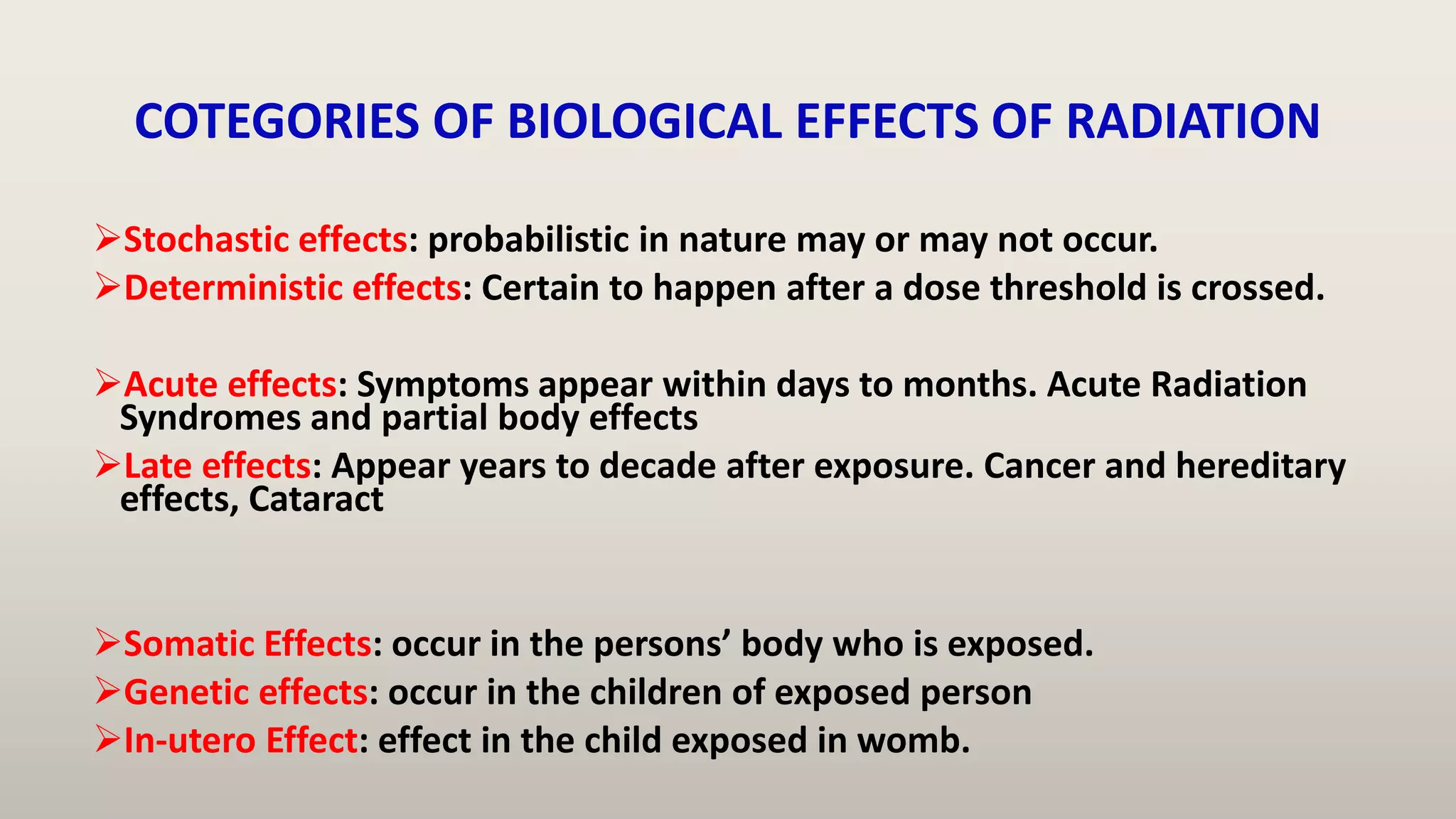
COTEGORIES OF BIOLOGICAL EFFECTS OF RADIATION
Stochastic effects: probabilistic in nature may or may not occur.
Deterministic effects: Certain to happen after a dose threshold is crossed.
Acute effects: Symptoms appear within days to months. Acute Radiation
Syndromes and partial body effects
Late effects: Appear years to decade after exposure. Cancer and hereditary
effects, Cataract
Somatic Effects: occur in the persons’ body who is exposed.
Genetic effects: occur in the children of exposed person
In-utero Effect: effect in the child exposed in womb.
Acute radiation syndrome(ARS)
• Combination of clinical syndromes occuring in stages hours to weeks
after exposure as injury to various tissues and organs is expressed
• Initial or prodromal phase
• Latent phase
• Manifest illness phase
• Recovery phase
ARS threat
• Accidental situations
in any facility using radiation sources like pwerplants
or medical sectors
• Nuclear detonation
Phases of ARS
ACUTE RADIATION SYNDROMES (whole
body exposure)
• Syndrome Organs Affected
Sensitivity
• Hematopoietic Blood forming organs Most
• Gastrointestinal Gastrointestinal system Very
• Central Nervous Brain and muscles Least
System
1. NVD Syndrome
• Occurs when whole body exposure is more than 1 Gray.
• Symptoms:
• Nausea
• Vomiting
• Diarrhea
• Fatigue
• Headache
• Lack of appetite
• Symptoms start to occur with 24 hours of exposure.
2. Hematopoietic syndrome
• Occurs when whole body is exposed to 3-5 gray.
• Involves loss of bone marrow stem cells which are progenitors for
different cells of blood.
• Symptoms:
• Anemia ( Low RBC synthesis)
• Frequent Infections (Low WBC synthesis)
• Fever
• Hemorrhage (Low platelets synthesis)
• Symptoms start appearing after 1-2 months.
• Fatality occurs in 30-60 days of exposure.
 3-5 Gy is also known as LD50/60 which means 50 % mortality within 60 days
after 3-5 Gy of whole body radiation exposure.
3.GASTROINTESTINAL TRACT SYNDROME
• Occurs when whole body is exposed to 5-15 Gray.
• It involves damage to actively dividing cells of the gastrointestinal
tract (crypt of epithelial cells present in small intestine)
• Symptoms:
• Poor absorption of nutrients.
• Bloody Diarrhea leading to fluid loss and electrolyte imbalance in cells
• Ulceration
• Low blood pressure
• Circulatory collapse
• Symptoms manifest 3-6 days after exposure
• Fatality occurs within 1-2 weeks.
4. CENTRAL NERVOUS SYSTEM SYNDROME
• Occurs when whole body exposure is higher than 15 Gray
• Involves damage to central nervous system.
• Symptoms:
• Coma
• Tremors
• Ataxia (In-voluntary movement)
• Convulsions
• Delirium (talking without senses)
• Symptom onset within few hours of exposure.
• Fatality occurs within 5 days.
Whole Body Irradiation (low LET
radiation)
Dose Range Effect
Less than 0.1 Gy No detectable effect
Above 0.1 Gy Chromosome aberrations detectable
(for biodosimetry)- No symptoms
Above 0.5 Gy Above effect plus transient reduction in White
Blood Cell (lymphocytes & granulocyte) count –No
symptoms
ACUTE WHOLE BODY EXPOSURES
Dose Effect
1 Gy Radiation Sickness
3-5 Gy Bone-marrow Syndrome
5-15 Gy Damage to Intestinal tract
>15 Gy Central Nervous System
Syndrome
1.Skin
• Threshold 3 Gray:
• Transient erythema within 1-2 days.
• Temporary epilation
• Threshold 6 Gray:
• Permanent epilation
• Fixed erythema within 3-4 days
• Thrshold 10-20 Gray:
• Burns, skin peeling off, blisters, wounds necrosis.
PARTIAL BODY EXPOSURE
Occupational radiation burn following approximately three weeks of exposure
to radiation emitted from nested voltage electron beam accelerator being
tested to kill bacteria.
ACUTE PARTIAL BODY EXPOSURES
2.REPRODUCTIVE SYSTEM
MALES THRESHOLD SYMPTOMS
(TESTES) DOSE
0.15 Gy Temporary sterility
(after 2 months)
3.5-6 Gy Permanent sterility
FEMALES
(OVARIES) Sterility age dependent
1.5-2 Gy Temporary sterility
2.5-6 Gy Permanent sterility
• Eye lens is highly Radiation Senstive.
• Coagulation of proteins occur with
doses greater than 0.150 Gy.
From “Atlas de Histologia...”. J. Boya
Histologic view of eye:
Eye lens is highly RS, moreover, it is
surrounded by highly RS cuboid
cells.
THRESHOLD DOSE CONSEQUENCE
0.5 Gy Cataract
Time of appearance several years
(LATE EFFECT)
ACUTE PARTIAL BODY EXPOSURES
3. Effects in EYE
DETERMINISTIC AND STOCHASTIC EFFECTS
Deterministic Effects Stochastic Effects
By cell killing By modifying cells in its function
All ARSs and Partial body exposure more than threshold
value
Cancer and hereditary effects
Threshold dose exist No threshold
The effects are definite to appear if the exposure is
more than the threshold value
Appearance of effect is a probability
Severity of symptoms increases with doses Probability of appearance of effects increases with
increase in dose.
Radiation And Cancer Risk
• For low doses and low dose rate it is 5% and 4% per Sv. for general
public and occupational workers respectively
• For general public total risk is higher because that includes pregnant
woman and children also.
• Spontaneous frequency of Cancer is 10-20%.
CANCER RISK
• Depend on many factors :
• Site sensitivity : Bone marrow ,breast and lungs are the most sensitive
and brain is least
• Latent period: solid cancers appear late 10-60 years while leukemia
may appear within 3years after exposure.
• Age: Children and embryo are more sensitive that adults
• Gender: females are more sensitive than males
• For In utero : time of conception
In-Utero Effects of Radiation
Heritable (Genetic) effect of radiation
• Genetic effects are effects seen in in the children of the exposed
parents & occurs due to modification (mutation/chromosomal
aberration) in germ cells (sperm or ovum).
• No human data confirms about relation of radiation with genetic
effects but yes it is observed in animal studies done in mice and flies
and risk calculated for human also with some corrections.
• Risk is 1% Sv-1 for general population
0.6% Sv-1 for occupational workers (18 – 65y)
• For genetic effects spontaneous frequency is 2.4 %.
OPERATIONAL LIMITS
OPERATIONAL LIMITS
Guidelines are set up by International Commission of Radiological
Protection (ICRP)
AIMS OF RADIOLOGICAL PROTECTION
• To prevent deterministic effects
• To limit the occurrence of stochastic effects to acceptable limits
OPERATIONAL LIMITS
Guidelines are set up by International Commission of Radiological
Protection (ICRP)
AIMS OF RADIOLOGICAL PROTECTION
• To prevent deterministic effects
• To limit the occurrence of stochastic effects to acceptable limits
SYSTEM OF DOSE LIMITATION
1) No practice shall be adopted unless its
introduction produced a net positive benefit
2) All exposures shall be kept As Low As Reasonably
Achievable (ALARA), economic & social factors
being taken into account
3) Dose to individuals shall not exceed recommended
limits.
Exposure due to natural background radiation & medical
exposure excluded in arriving at the dose limits.
DOSE LIMITS
Application Occupational Public
Effective Dose 20mSv per year.
averaged over defined
period of 5 years, with
no more than 30 mSv
in a single year
1 mSv per year.
Averaged over 5
years.
Annual Equivalent dose
to individual organs
Eye lens
Skin
Hands & feet
150 mSv
500 mSv*
500 mSv**
15 mSv
50mSv
-
DOSE LIMIT FOR PREGNANT WOMAN
• Effective dose of 1 mSv to the embryo/fetus
• And by limiting the intake of radionuclides to 0.05 of Annual Limit
on Intake (ALI)
Acceptable Risk for Radiation Workers
For safe industries, internationally acceptable risk is
• 1 death /1000 occupational workers in a year
Acceptable Risk for General Public
• 1 death /10,000 persons/year
• Under permitted operational limits working with radiation is as safe
as any other industries.
• Below 20 mSv . Per year is a very safe dose which can not cause any
immediate damage to the body and minimum late effects (risk of only
1 death /1000 per year as in any internationally accepted safe
industry)
• Accidental exposures are very fatal so please assure taking all the
precautions guided for work wear TLD, lead apron etc.
Conclusion

BIOLOGICAL EFFECTS OF RADIATION USHA YADAV.pptx

  • 1.
    BIOLOGICAL EFFECTS OFRADIATION USHA YADAV Scientific Officer RP&AD B.A.R.C. Ph. 022-25593968 (OFFICE) e-mail- yusha@barc.gov.in
  • 2.
    Basic of humanbody What is biological effect of radiation How radiation can cause biological damage Factors affecting biological effects What are classes different biological effects caused by radiation Acute radiation syndrome Partial body effects Cancer and genetic risk
  • 3.
  • 4.
    Bio-molecues –> Cells->Tissues –> oragns –> Systems –> Organism Levels of organization of human body
  • 5.
    Cells are basicunit of life • Structural and functional unit • Can have 1000s of shapes • 1000s of functions depending upon the tissue they reside
  • 6.
    Cell division Cell divisionis divided in three broad phases : 1. Interphase and 2. Mitotic phase Interphase is further divided into 3 more phases: 1. Gap 1 or G1 phase 2. Synthetic or S-phase 3. Gap2 or G2 Phase Mitotic Phase is further divided into 2 more phases: 1.Mitosis 2.Cytokinesis Mitosis is again divided into 4 major parts: 1.Prophase 2.Metaphase 3.Anaphase 4.Telophase
  • 7.
    Complete Cell cycleMitosis and cytokinesis
  • 8.
    Purpose Of celldivision 1. Growth: 2. Maintenance 3. Reproduction
  • 9.
    Radiation deposits energyin localized manner
  • 10.
    Cellular level effectsof DNA damage • CELL KILLING • Mitotic death / apoptosis • CELL MODIFICATION OR MUTATION • CHROMOSOMAL ABERRATIONS • DIVISION DELAY • FUNCTIONAL DAMAGE
  • 11.
    What are theconditions in which we can get exposed 1. Continuous exposure to Natural background. 2. Occupational exposure to plant workers, radiographers , researchers etc. 3. Medical Exposure to patients. 4. Accidental exposure.
  • 12.
    ANNUAL DOSE PERPERSON FROM NATURAL SOURDES OF RADIATION Source Annual Effective Dose (Mean) mSv External Cosmic 0.36 Terrestrial Sources 0.41 Internal potassium-40 0.18 Radon-220,222 & daughters 1.26 Uranium, thorium etc, 0.16 Total 2.37
  • 13.
    TYPES OF RADIATIONEXPOSURE. Acute Exposure: heavy doses within short duration (few Grays within few hours) May be life threatening Examples: • Accidental exposure to radiation in nuclear or medical facilities. • Intended nuclear detonation. Chronic Exposure: Small doses received over a long duration of time. Not severe only late effects may happen Example: • High background radiation areas, • occupational workers.
  • 14.
    Partial body exposure:only part of body gets exposure • Radioactive source spillage to contained particular part of body. • Exposure to a particular internal organ Whole body exposure: whole body receives radiation uniformly • Suppose one of us enter a room which has radioactive source radiation is coming out of source spread in the room. External exposure: No contamination only exposure from outside Internal exposure : Internalization of radioactivity inside body
  • 15.
    PATHWAYS OF RADIOACTIVITY •Inhalation • Ingestion • Absorption • Puncture or through wound
  • 16.
    EFFECTIVE HALF LIFEOF RADIO NUCLIDES
  • 17.
    HOW REDUCE INTERNALEXPOSURE • Reduce the effective half life by increasing the rate of excretion • Admission of diuretic • Prevention of uptake • Prevention of absorption in the intestine • Washing of wounds and body surface • Prompting vomiting when ingested • Prevention • Mask • Hand gloves, lab coat • Clean working condition • Cold traps for volatile radioactive solutions • Use fume hood
  • 18.
    IMPORTANT DEFINITIONS Linear EnergyTransfer (LET): energy transferred by radiation per unit length. Measured in keV/µm. Alpha and other charged particles are high LET radiation while neutron, beta and gamma are considered low LET radiation. Absorbed dose (DT): Energy of radiation absorbed per unit of body weight. It is measured in: Gray(Gy), 1Gy = 1 joules/kg
  • 19.
    Ingestion Digestion Absorption to extracellularfluid Inhalation Incorporation Excretion(feces and urine) Decay via respiratory system via digestive tract system PATHWAYS OF RADIOACTIVITY
  • 20.
    Equivalent Dose (HT)and Radiation Weighting Factor (WR ) Equivalent Dose is a measure of the biological damage: HT = WR DT Unit is the Sievert (Sv) Each type of radiation has been given a ‘Radiation Weighting Factor’ (WR) : Alpha Particles 20 Beta Particles 1 Photons 1 Neutrons 2.5 – 20 WR is continuous function of energy for neutrons
  • 21.
    Effective Dose forany particular organ is given by: E = WT HT And if more than one organ is involved: E =  WT HT Effective Dose (E) and Tissue Weighting Factor (WT ) Depending on sensitivity organs have been given a tissue weighting factor(WT) Tissue weighting factors ICRP2007 Tissue WT  WT Bone marrow (red), Colon, Lung, Stomach, Breast 0.12 0.60 Gonads 0.08 0.08 Bladder, Oesophagus, Liver, Thyroid 0.04 0.16 Bone surface, Brain, Salivary glands, Skin. 0.01 0.04 Remainder Tissues* (Nominal WT applied to the average dose to 13 tissues) 0.12 0.12 * Adrenals, extrathoracic region, gall bladder, heart, kidneys, lymphatic nodes, muscle, oral mucosa, pancreas, prostate (males), small intestine, spleen, thymus and uterus/cervix (females)
  • 22.
  • 23.
    The potential biologicaleffects and damages is determined by many factors Received dose of radiation : same quantity of radiation may give different doses to different organ, higher the dose severe the damage. Quality of radiation : high energy radiation is more harmful than the lower one, high LET radiation is more damaging than low LET however high LET radiations generally have lower penetration thus possessing lesser external hazard only internal exposure will cause damage but that will be very severe in comparison to low LET radiations like gamma for similar doses. Exposure conditions (spatial distribution) : whole body exposure is more dangerous than partial body. Internal exposer is more damaging than external (for same spatial distribution). Quantity of radiation : higher the quantity higher the dose thus damage.
  • 24.
    INTERACTION OF RADIATIONWITH BIOLOGICAL SYSTEM
  • 25.
    DNA as themost important target for Radiation DNA is genetic material and stores information for all the functions of cell. Damage to DNA is highly detrimental to cell which may lead to Inhibition or delay of cell division. cell death. modification of cell. Hence, cells possess extensive DNA damage repair mechanism which take care of minor DNA damages efficiently. However, major damage to DNA like chromosomal aberrations may lead to misrepair or no repair and is of major concern. Dividing cells have higher amount of DNA and more chances of DNA damages hence they are most sensitive to radiation.
  • 26.
    Mechanism of radiationdamage Radiation can deposit energy into the biological tissue in two ways. Direct Effect: Radiation directly hits and damages biomolecules like DNA, cause harmful effects. Indirect Effect: Radiation interacts with water present in cells generating ions and free radical which then damage DNA.
  • 27.
    BIOLOGICAL EFFECTS OFRADIATION IN TIME PERSPECTIVE Time scale Fractions of seconds Seconds Minutes Hours Days Weeks Months Years Decades Generations Effects Energy absorption Changes in biomolecules (DNA, membranes) Biological repair Change of information in cell Cell death (Deterministic effect) Organ Clinical death changes Mutations in Germ cell Somatic cell (Stochastic effect) Cancer Hereditary effects
  • 28.
    BIOLOGICAL INDICATORS OFABSORBED RADIATION 1. Prodromal syndrome (radiation sickness) 2. Hematological changes lymphocytes / granulocytes (Day of 500) 3. Cytogenetic changes Dicentric chromosomal formation(Dicentric assay) Micronuclei induction( Micronucleus assay) stable chromosomal aberrations (symmetric translocation) (FISH Assay) Chromosomal ring formation ( Premature chromosome condensation PCC) 4. Biochemical Indicators Urinary excretion of 17-ketosteroids Creatine/creatinine ratio  amino isobutyric acid Other amino acids 5. Stable free radical formation ESR studies with tooth enamel, bone, hair, and nails 6. Neutron Activation of elements - 24Na , 32P in biological samples 7. Reduction in sperm counts 40 days after the exposure 8. Somatic mutations Glycophorin assay (RBC) HGPRT mutation assay (lymphocytes) Globin assay (RBC)
  • 29.
  • 30.
  • 31.
  • 32.
  • 33.
    COTEGORIES OF BIOLOGICALEFFECTS OF RADIATION Stochastic effects: probabilistic in nature may or may not occur. Deterministic effects: Certain to happen after a dose threshold is crossed. Acute effects: Symptoms appear within days to months. Acute Radiation Syndromes and partial body effects Late effects: Appear years to decade after exposure. Cancer and hereditary effects, Cataract Somatic Effects: occur in the persons’ body who is exposed. Genetic effects: occur in the children of exposed person In-utero Effect: effect in the child exposed in womb.
  • 34.
    Acute radiation syndrome(ARS) •Combination of clinical syndromes occuring in stages hours to weeks after exposure as injury to various tissues and organs is expressed • Initial or prodromal phase • Latent phase • Manifest illness phase • Recovery phase ARS threat • Accidental situations in any facility using radiation sources like pwerplants or medical sectors • Nuclear detonation Phases of ARS
  • 35.
    ACUTE RADIATION SYNDROMES(whole body exposure) • Syndrome Organs Affected Sensitivity • Hematopoietic Blood forming organs Most • Gastrointestinal Gastrointestinal system Very • Central Nervous Brain and muscles Least System
  • 36.
    1. NVD Syndrome •Occurs when whole body exposure is more than 1 Gray. • Symptoms: • Nausea • Vomiting • Diarrhea • Fatigue • Headache • Lack of appetite • Symptoms start to occur with 24 hours of exposure.
  • 37.
    2. Hematopoietic syndrome •Occurs when whole body is exposed to 3-5 gray. • Involves loss of bone marrow stem cells which are progenitors for different cells of blood. • Symptoms: • Anemia ( Low RBC synthesis) • Frequent Infections (Low WBC synthesis) • Fever • Hemorrhage (Low platelets synthesis) • Symptoms start appearing after 1-2 months. • Fatality occurs in 30-60 days of exposure.  3-5 Gy is also known as LD50/60 which means 50 % mortality within 60 days after 3-5 Gy of whole body radiation exposure.
  • 38.
    3.GASTROINTESTINAL TRACT SYNDROME •Occurs when whole body is exposed to 5-15 Gray. • It involves damage to actively dividing cells of the gastrointestinal tract (crypt of epithelial cells present in small intestine) • Symptoms: • Poor absorption of nutrients. • Bloody Diarrhea leading to fluid loss and electrolyte imbalance in cells • Ulceration • Low blood pressure • Circulatory collapse • Symptoms manifest 3-6 days after exposure • Fatality occurs within 1-2 weeks.
  • 39.
    4. CENTRAL NERVOUSSYSTEM SYNDROME • Occurs when whole body exposure is higher than 15 Gray • Involves damage to central nervous system. • Symptoms: • Coma • Tremors • Ataxia (In-voluntary movement) • Convulsions • Delirium (talking without senses) • Symptom onset within few hours of exposure. • Fatality occurs within 5 days.
  • 41.
    Whole Body Irradiation(low LET radiation) Dose Range Effect Less than 0.1 Gy No detectable effect Above 0.1 Gy Chromosome aberrations detectable (for biodosimetry)- No symptoms Above 0.5 Gy Above effect plus transient reduction in White Blood Cell (lymphocytes & granulocyte) count –No symptoms
  • 42.
    ACUTE WHOLE BODYEXPOSURES Dose Effect 1 Gy Radiation Sickness 3-5 Gy Bone-marrow Syndrome 5-15 Gy Damage to Intestinal tract >15 Gy Central Nervous System Syndrome
  • 43.
    1.Skin • Threshold 3Gray: • Transient erythema within 1-2 days. • Temporary epilation • Threshold 6 Gray: • Permanent epilation • Fixed erythema within 3-4 days • Thrshold 10-20 Gray: • Burns, skin peeling off, blisters, wounds necrosis. PARTIAL BODY EXPOSURE
  • 44.
    Occupational radiation burnfollowing approximately three weeks of exposure to radiation emitted from nested voltage electron beam accelerator being tested to kill bacteria.
  • 48.
    ACUTE PARTIAL BODYEXPOSURES 2.REPRODUCTIVE SYSTEM MALES THRESHOLD SYMPTOMS (TESTES) DOSE 0.15 Gy Temporary sterility (after 2 months) 3.5-6 Gy Permanent sterility FEMALES (OVARIES) Sterility age dependent 1.5-2 Gy Temporary sterility 2.5-6 Gy Permanent sterility
  • 49.
    • Eye lensis highly Radiation Senstive. • Coagulation of proteins occur with doses greater than 0.150 Gy. From “Atlas de Histologia...”. J. Boya Histologic view of eye: Eye lens is highly RS, moreover, it is surrounded by highly RS cuboid cells. THRESHOLD DOSE CONSEQUENCE 0.5 Gy Cataract Time of appearance several years (LATE EFFECT) ACUTE PARTIAL BODY EXPOSURES 3. Effects in EYE
  • 50.
    DETERMINISTIC AND STOCHASTICEFFECTS Deterministic Effects Stochastic Effects By cell killing By modifying cells in its function All ARSs and Partial body exposure more than threshold value Cancer and hereditary effects Threshold dose exist No threshold The effects are definite to appear if the exposure is more than the threshold value Appearance of effect is a probability Severity of symptoms increases with doses Probability of appearance of effects increases with increase in dose.
  • 51.
    Radiation And CancerRisk • For low doses and low dose rate it is 5% and 4% per Sv. for general public and occupational workers respectively • For general public total risk is higher because that includes pregnant woman and children also. • Spontaneous frequency of Cancer is 10-20%.
  • 52.
    CANCER RISK • Dependon many factors : • Site sensitivity : Bone marrow ,breast and lungs are the most sensitive and brain is least • Latent period: solid cancers appear late 10-60 years while leukemia may appear within 3years after exposure. • Age: Children and embryo are more sensitive that adults • Gender: females are more sensitive than males • For In utero : time of conception
  • 53.
  • 54.
    Heritable (Genetic) effectof radiation • Genetic effects are effects seen in in the children of the exposed parents & occurs due to modification (mutation/chromosomal aberration) in germ cells (sperm or ovum). • No human data confirms about relation of radiation with genetic effects but yes it is observed in animal studies done in mice and flies and risk calculated for human also with some corrections. • Risk is 1% Sv-1 for general population 0.6% Sv-1 for occupational workers (18 – 65y) • For genetic effects spontaneous frequency is 2.4 %.
  • 56.
  • 57.
    OPERATIONAL LIMITS Guidelines areset up by International Commission of Radiological Protection (ICRP) AIMS OF RADIOLOGICAL PROTECTION • To prevent deterministic effects • To limit the occurrence of stochastic effects to acceptable limits
  • 58.
    OPERATIONAL LIMITS Guidelines areset up by International Commission of Radiological Protection (ICRP) AIMS OF RADIOLOGICAL PROTECTION • To prevent deterministic effects • To limit the occurrence of stochastic effects to acceptable limits
  • 59.
    SYSTEM OF DOSELIMITATION 1) No practice shall be adopted unless its introduction produced a net positive benefit 2) All exposures shall be kept As Low As Reasonably Achievable (ALARA), economic & social factors being taken into account 3) Dose to individuals shall not exceed recommended limits. Exposure due to natural background radiation & medical exposure excluded in arriving at the dose limits.
  • 60.
    DOSE LIMITS Application OccupationalPublic Effective Dose 20mSv per year. averaged over defined period of 5 years, with no more than 30 mSv in a single year 1 mSv per year. Averaged over 5 years. Annual Equivalent dose to individual organs Eye lens Skin Hands & feet 150 mSv 500 mSv* 500 mSv** 15 mSv 50mSv -
  • 61.
    DOSE LIMIT FORPREGNANT WOMAN • Effective dose of 1 mSv to the embryo/fetus • And by limiting the intake of radionuclides to 0.05 of Annual Limit on Intake (ALI)
  • 62.
    Acceptable Risk forRadiation Workers For safe industries, internationally acceptable risk is • 1 death /1000 occupational workers in a year
  • 63.
    Acceptable Risk forGeneral Public • 1 death /10,000 persons/year
  • 64.
    • Under permittedoperational limits working with radiation is as safe as any other industries. • Below 20 mSv . Per year is a very safe dose which can not cause any immediate damage to the body and minimum late effects (risk of only 1 death /1000 per year as in any internationally accepted safe industry) • Accidental exposures are very fatal so please assure taking all the precautions guided for work wear TLD, lead apron etc. Conclusion